Published
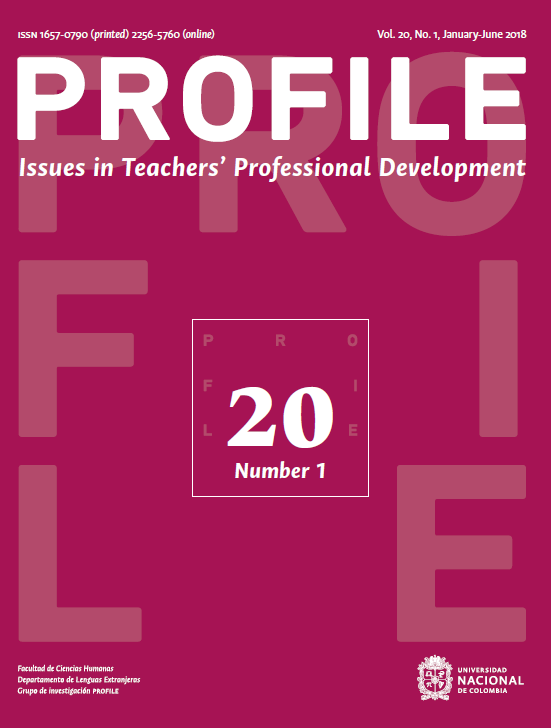
Queer English Language Teacher Identity: A Narrative Exploration in Colombia
Identidad queer de profesores de inglés: una exploración narrativa en Colombia
DOI:
https://doi.org/10.15446/profile.v20n1.63658Keywords:
Identity, language teacher identity, queer identity (en)identidad, identidad del profesor de lenguas, identidad queer (es)
This article presents partial results of research exploring links between language teacher identity and queer identity in English language teachers working in Colombia. Three gay male teachers participated in a narrative research project framed within a poststructural perspective on identity. I conducted and recorded semi-structured interviews with the participants and then carried out a thematic analysis of these interviews which led to the emergence of three main themes. Here, I present the most prevalent theme, that of being a gay language teacher in the Colombian context which reveals that the participants all live their queer identity alongside their language teacher identity with ease although they do recount instances of homophobia which have impacted their day-to-day lives and their careers.
References
Aneja, G. A. (2016). (Non)native speakered: Rethinking (non)nativeness and teacher identity in TESOL teacher education. TESOL Quarterly, 50(3), 572-596. https://doi.org/10.1002/tesq.315.
Barkhuizen, G. (2014). Narrative research in language teaching and learning. Language Teaching, 47(4), 450-466. https://doi.org/10.1017/S0261444814000172.
Block, D. (2007). The rise of identity in SLA research, post Firth and Wagner (1997). The Modern Language Journal, 91(s1), 863-876. https://doi.org/10.1111/j.1540-4781.2007.00674.x.
Block, D. (2013). Issues in language and identity research in applied linguistics. ELIA: Estudios de Lingüística Inglesa Aplicada, 13, 11-46. Retrieved from http://institucional.us.es/revistas/elia/13/art_1.pdf.
Castañeda-Peña., H. A. (2008). ‘I said it!’ ‘I’m first!’: Gender and language-learner identities. Colombian Applied Linguistics Journal, 10, 112-125.
Clarke, M. (2009). The ethico-politics of teacher identity. Educational Philosophy and Theory, 41(2), 185-200. https://doi.org/10.1111/j.1469-5812.2008.00420.x.
Creswell, J. W. (2007). Qualitative inquiry and research design: Choosing among five approaches (2nd ed.). Thousand Oaks, US: Sage Publications.
Donahue, D. M. (2007). Rethinking silence as support: Normalizing lesbian and gay teacher identities through models and conversations in student teaching. Journal of Gay and Lesbian Issues in Education, 4(4), 73-95. https://doi.org/10.1300/J367v04n04_06.
Dörnyei, Z. (2007). Research methods in applied linguistics: Qualitative, quantitative, and mixed methods research. Oxford, UK: Oxford University Press.
Editor’s Note. (2007). Teacher research: Retrospect and prospect. Journal of Gay & Lesbian Issues in Education, 4(4), 1-5. https://doi.org/10.1300/J367v04n04_01.
Equaldex. (2016). LGBT Rights in Colombia. Retrieved from http://www.equaldex.com/region/colombia.
Gray, J. (2010). The construction of English: Culture, consumerism and promotion in the ELT global coursebook. Basingstoke, UK: Palgrave Macmillan. https://doi.org/10.1057/9780230283084.
Gray, J. (2016). Language and non-normative sexual identities. In S. Preece (Ed.), The Routledge handbook of language and identity (pp. 225-240). London, UK: Routledge.
Gray, J. (in press). Introduction. In J. Gray & T. Morton (Eds.), Social interaction and ELT teacher identity. Edinburgh, UK: Edinburgh University Press.
Kanno, Y., & Stuart, C. (2011). Learning to become a second language teacher: Identities-in-practice. The Modern Language Journal, 95(2), 236-252. https://doi.org/10.1111/j.1540-4781.2011.01178.x.
Kupfer, R. (2000). Retracing my journey toward self-acceptance and effectiveness as a lesbian teacher. In J. S. Ritchie & D. S. Wilson (Eds.), Teacher narrative as critical inquiry: Rewriting the script (pp. 150-170). New York, US: Teacher’s College Press.
Lantolf, J. P., & Thorne, S. L. (2006). Sociocultural theory and second language learning. In B. VanPatten & J. Williams (Eds.), Theories in second language acquisition: An introduction (pp. 201-224). New York, US: Routledge.
Mann, S. (2011). A critical review of qualitative interviews in applied linguistics. Applied Linguistics, 32(1), 6-24. https://doi.org/10.1093/applin/amq043.
Menard-Warwick, J. (2011). A methodological reflection on the process of narrative analysis: Alienation and identity in the life histories of English language teachers. TESOL Quarterly, 45(3), 564-574.
Moore, A., Edwards, G., Halpin, D., & George, R. (2002). Compliance, resistance and pragmatism: The (re)construction of schoolteacher identities in a period of intensive educational reform. British Educational Research Journal, 28(4), 551-565. https://doi.org/10.1080/0141192022000005823.
Nelson, C. (1999). Sexual identities in ESL: Queer theory and classroom enquiry. TESOL Quarterly, 33(3), 371-391. https://doi.org/10.2307/3587670.
Nelson, C. (2004). A queer chaos of meanings: Coming out conundrums in globalised classrooms. Journal of Gay and Lesbian issues in Education, 2(1), 27-46. https://doi.org/10.1300/J367v02n01_05.
Nelson, C. (2009). Sexual identities in English language education: Classroom conversations. New York, US: Routledge.
Norton, B. (1995). Social identity, investment and language learning. TESOL Quarterly, 29(1), 9-31. https://doi.org/10.2307/3587803.
Norton, B. (2010). Language and identity. In N. Hornberger & S. McKay (Eds.) Sociolinguistics and language education (pp. 349-369). Clevedon, UK: Multilingual Matters.
Norton, B., & Toohey, K. (2011). Identity, language learning and social change. Language Teaching, 44(4), 412-446. https://doi.org/10.1017/S0261444811000309.
Polkinghorne, D. E. (2005). Language and meaning: Data collection in qualitative research. Journal of Counseling Psychology, 52(2), 137-145. https://doi.org/10.1037/0022-0167.52.2.137.
Rampton, M. B. H. (1990). Displacing the ‘native speaker’: Expertise, affiliation, and inheritance. ELT Journal, 44(2), 97-101. https://doi.org/10.1093/eltj/44.2.97.
Rondón, F. (2012). LGBT students’ short range narratives and gender performance in the EFL classroom. Colombian Applied Linguistics Journal, 14(1), 77-91. https://doi.org/10.14483/22487085.3814.
Seidman, I. (1991). Interviewing as qualitative research. New York, US: Teacher’s College Press.
Trent, J. (2016). The identity construction experiences of early career English language teachers in Hong Kong: Great expectations and practical realities. Research Papers in Education, 31(3), 316-336. https://doi.org/10.1080/02671522.2015.1037336.
Tsui, A. B. M. (2007). Complexities of identity formation: A narrative enquiry of an EFL teacher. TESOL Quarterly, 41(4), 657-680. https://doi.org/10.1002/j.1545-7249.2007.tb00098.x.
Varghese, M., Morgan, B., Johnston, B., & Johnson, K. A. (2005). Theorizing language teacher identity: Three perspectives and beyond. Journal of Language, Identity and Education, 4(1), 21-44. https://doi.org/10.1207/s15327701jlie0401_2.
Varghese, M., Motha, S., Park, G., Reeves, J., & Trent, J. (2016). In this issue. TESOL Quarterly, 50(3). 545-571. https://doi.org/10.1002/tesq.333.
Dimensions
PlumX
Article abstract page views
Downloads
How to Cite
License
Copyright (c) 2018 Author

This work is licensed under a Creative Commons Attribution-NonCommercial-NoDerivatives 4.0 International License.
You are authorized to copy and redistribute the material in any medium or format as long as you give appropriate credit to the authors of the articles and to Profile: Issues in Teachers' Professional Development as original source of publication. The use of the material for commercial purposes is not allowed. If you remix, transform, or build upon the material, you may not distribute the modified material.
Authors retain the intellectual property of their manuscripts with the following restriction: first publication is granted to Profile: Issues in Teachers' Professional Development.