Published
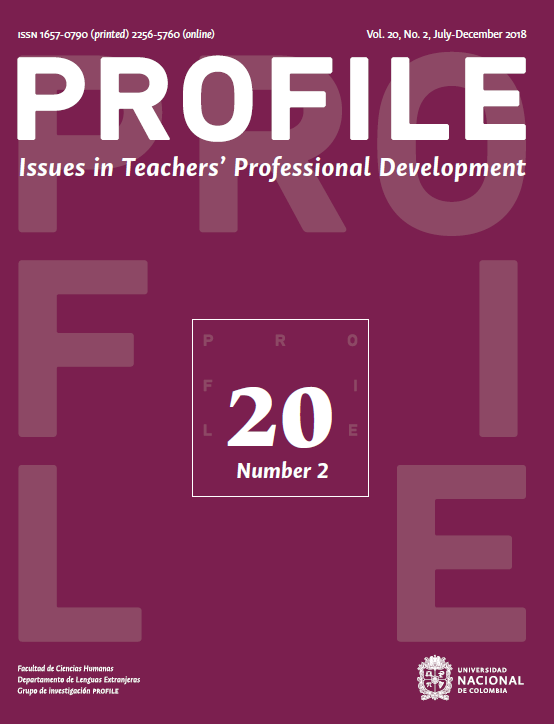
Foreign Language Faculty Research-Related Beliefs, Perceptions, and Research Motivation at Three Mexican Universities
Motivación, creencias y percepciones hacia la investigación de profesores de lenguas extranjeras en tres universidades mexicanas
DOI:
https://doi.org/10.15446/profile.v20n2.66008Keywords:
Foreign language faculty, research conditions, research motivation, research self-efficacy (en)condiciones para la investigación, creencias de autoeficacia para la investigación, motivación para investigar, profesores de lenguas extranjeras (es)
This paper examines the research self-efficacy beliefs, research motivation, and perceptions of research importance and research obstacles of 100 professors and lecturers of foreign languages at three Mexican universities. Survey results show that faculty hold moderate to high research self-efficacy beliefs, are highly motivated to conduct research, think research in the area is very important, and perceive that lack of time is the main obstacle to conducting research. The lack of fit between most participants’ relatively high self-efficacy and limited research engagement suggests the possibility that faculty overestimate their research abilities. The implications of these findings are also discussed.
References
Allison, D., & Carey, J. (2007). What do university language teachers say about language teaching research? TESL Canada Journal, 24(2), 61-81. https://doi.org/10.18806/tesl.v24i2.139.
Atay, D. (2008). Teacher research for professional development. ELT Journal, 62(2), 139-147. https://doi.org/10.1093/elt/ccl053.
Bai, L., & Hudson, P. (2011). Understanding Chinese TEFL academics’ capacity for research. Journal of Further and Higher Education, 35(3), 391-407. https://doi.org/10.1080/0309877X.2011.569014.
Bandura, A. (1986). Social foundations of thought and action: A social cognitive theory. Englewood Cliffs, US: Prentice- Hall.
Bandura, A. (Ed). (1995). Self-efficacy in changing societies. Cambridge, UK: Cambridge University Press. https://doi.org/10.1017/CBO9780511527692.
Bandura, A. (1997). Self-efficacy: The exercise of control. New York, US: Worth Publishers.
Borg, S. (2009). English language teachers’ conceptions of research. Applied Linguistics, 30(3), 358-388. https://doi.org/10.1093/applin/amp007.
Borg, S. (2013). Teacher research in language teaching: A critical analysis. Cambridge, UK: Cambridge University Press.
Borg, S., & Alshumaimeri, Y. (2012). University teacher educators’ research engagement: Perspectives from Saudi Arabia. Teaching and Teacher Education, 28(3), 347-356. https://doi.org/10.1016/j.tate.2011.10.011.
Borg, S., & Liu, Y. (2013). Chinese college English teachers’ research engagement. TESOL Quarterly, 47(2), 270-299. https://doi.org/10.1002/tesq.56.
Brown, P., & Levinson, S. C. (1987). Politeness: Some universals in language usage. Cambridge, UK: Cambridge University Press.
Burns, A. (2010). Doing action research in English language teaching: A guide for practitioners. New York, US: Routledge.
Busseniers, P., Nuñez, P., & Rodríguez, V. (2010). Teachers and research at the school of languages, Universidad Veracruzana. In P. Busseniers, M. M. Hernández, & B. C. Murrieta (Eds.), Variaciones sobre un mismo tema: la investigación sobre lenguas extranjeras (pp.100-112). Xalapa, MX: Universidad Veracruzana.
Chwalisz, K., Altmaier, E., & Russell, D. (1992). Causal attributions, self-efficacy cognitions and coping with stress. Journal of Social and Clinical Psychology, 11(4), 377-400. https://doi.org/10.1521/jscp.1992.11.4.377.
Dörnyei, Z. (2003). Questionnaires in second language research: Construction, administration and processing. New York, US: Lawrence Erlbaum Associates.
Elmore, R. F. (2004). School reform from the inside out: Policy, practice, and performance. Cambridge, US: Harvard Education Press.
Gao, X., Barkhuizen, G., & Chow, A. (2011). Research engagement and educational decentralisation: Problematising primary school English teachers’ research experiences in China. Educational Studies, 37(2), 207-219. https://doi.org/10.1080/03055698.2010.506338.
Gurney, M. (1989). Implementer or innovator: A teacher’s challenge to the restrictive paradigm of traditional research. In P. Lomax (Ed.), The management of change (pp. 13-28). London, UK: Multilingual Matters.
Hackett, G. (1995). Self-efficacy in career choice and development. In A. Bandura (Ed.) Self-efficacy in adaptation of youth to changing societies (pp. 232-258). Cambridge, UK: Cambridge University Press. https://doi.org/10.1017/CBO9780511527692.010.
Hardré, P. L., Miller, R. B., Beasley, A., Pace, T., Maxwell, M. S., & Xie, K. (2007). What motivates university faculty members to do research? Tenure-track faculty in research-extensive universities. Journal of the Professoriate, 2(1), 75-99.
Hargreaves, A. (2001). Aprender a cambiar: la enseñanza más allá de las materias y los niveles [Learning to change: Teaching beyond courses and levels]. Barcelona, ES: Octaedro.
Hemmings, B., & Kay, R. (2010). Research self-efficacy, publication output, and early career development. International Journal of Educational Management, 24(7), 562-574. https://doi.org/10.1108/09513541011079978.
Hernández, E., Gómez, L., & Murrieta, G. (2011). La investigación en el área de lenguas en la Universidad de Quintana Roo: logros, retos y expectativas [Research on languages at the University of Quintana Roo: Achievements, challenges, and expectations]. In M. R. Reyes. (Ed.), 20 años de lenguas extranjeras en la Universidad de Quintana Roo (pp. 19-42). Chetumal, MX: UQRoo-Planea.
Kim, H., & Cho, Y. (2014). Pre service teachers’ motivation, teacher efficacy, and expectation of reality shock. Asia-Pacific Journal of Teacher Education, 42(1), 67-81. https://doi.org/10.1080/1359866X.2013.855999.
Kirkwood, M., & Christie, D. (2006). The role of teacher research in continuing professional development. British Journal of Educational Studies, 54(4), 429-448. https://doi.org/10.1111/j.1467-8527.2006.00355.x.
Landino, R. A., & Owen, S. V. (1988). Self-efficacy in university faculty. Journal of Vocational Behavior, 33(1), 1-14. https://doi.org/10.1016/0001-8791(88)90030-9.
Lengeling, M. (2010). Becoming an English teacher: Participants’ voices and identities in an in-service training course in Central Mexico, Guanajuato. Guanajuato, MX: Universidad de Guanajuato.
Levi, J. P., & Varela, J. (Coord.). (2005). Análisis multivariable para las ciencias sociales [Multivariate analysis for social science]. Spain: Pearson.
Mehrani, M. B. (2015). English teachers’ research engagement: Level of engagement and motivation. Iranian Journal of Language Teaching Research, 3(1), 83-97. Retrieved from http://www.urmia.ac.ir/sites/www.urmia.ac.ir/files/Article5.pdf.
Pajares, F. (1996). Self-efficacy beliefs in academic settings. Review of Educational Research, 66, 543-578. https://doi.org/10.3102/00346543066004543.
Ramírez, J., Gilbón, D., & Moreno, E. (2010). Las investigaciones sobre la enseñanza de lenguas extranjeras en México: ¿dónde estamos y qué nos falta por recorrer? [Research on teaching foreign languages in Mexico: Where are we and what are we missing?] Imaginales, Revista de Investigación Social, (8), 33-39.
Reyes-Cruz, M. R., & Hernández-Méndez, E. (2014). Productividad y condiciones para la investigación: el caso de los profesores de lenguas extranjeras. Sinéctica, 42, 1-17.
Reyes-Cruz, M. R., & Higuera-Bonfil, A. (2015). Cómo se materializa la política pública sobre la investigación en tres universidades mexicanas. Revista Congreso Universidad, 4(3), 175-188.
Reyes-Cruz, M. R., & Perales-Escudero, M. D. (2016). Research self-efficacy and its sources in foreign language university faculty in Mexico: Implications for educational policy. Higher Education Research and Development, 35(4), 800-814. https://doi.org/10.1080/07294360.2015.1137884.
Secretaría de Educación Pública. (2006). Programa de mejoramiento del profesorado: un primer análisis de su operación e impactos en el proceso de fortalecimiento académico de las universidades públicas [Program for the improvement of the teaching staff: A first analysis of its operation and impacts in the process of academic strengthening of the public universities]. México D.F.: Author.
Schunk, D. H. (1982). Progress self-monitoring: Effects on children’s self-efficacy and achievement. Journal of Experimental Education, 51(2), 89-93. https://doi.org/10.1080/00220973.1982.11011845.
Vasil, L. (1992). Self-efficacy expectations and causal attributions for achievement among male and female university faculty. Journal of Vocational Behavior, 41(3), 259-69. https://doi.org/10.1016/0001-8791(92)90028-X.
Wheatley, K. F. (2002). The potential benefit of teacher self-efficacy doubts for educational reform. Teaching and Teacher Education, 18(1), 5-22. https://doi.org/10.1016/S0742-051X(01)00047-6.
Wyatt, M. (2015). Using qualitative research methods to assess the degree of fit between teachers’ reported self-efficacy beliefs and their practical knowledge during teacher education. Australian Journal of Teacher Education, 40(1), 117-145. https://doi.org/10.14221/ajte.2015v40n1.7.
Wyatt, M., & Dikilitaş, K. (2016). English language teachers becoming more efficacious through research engagement at their Turkish university. Educational Action Research, 24(4), 550-570. https://doi.org/10.1080/09650792.2015.1076731.
Xu, Y. (2013). Becoming researchers: A narrative study of Chinese university EFL teachers’ research practice and their professional identity construction.Language Teaching Research, 18(2), 1-18. https://doi.org/10.1177/1362168813505943.
Yuan, R., Sun, P., & Teng, L. (2016). Understanding language teachers’ motivations towards research. TESOL Quarterly, 50(1), 220-234. https://doi.org/10.1002/tesq.279.
Zimmerman, B. J. (1995). Self-efficacy and educational development. In A. Bandura (Ed.), Self-efficacy in changing societies (pp. 202-231). Cambridge, UK: Cambridge University Press. https://doi.org/10.1017/CBO9780511527692.009.
Dimensions
PlumX
Article abstract page views
Downloads
How to Cite
License
Copyright (c) 2018 PROFILE Issues in Teachers' Professional Development

This work is licensed under a Creative Commons Attribution-NonCommercial-NoDerivatives 4.0 International License.
You are authorized to copy and redistribute the material in any medium or format as long as you give appropriate credit to the authors of the articles and to Profile: Issues in Teachers' Professional Development as original source of publication. The use of the material for commercial purposes is not allowed. If you remix, transform, or build upon the material, you may not distribute the modified material.
Authors retain the intellectual property of their manuscripts with the following restriction: first publication is granted to Profile: Issues in Teachers' Professional Development.