Publicado

2024-01-02

Wing Phenotypic Diversity in Stingless Bees Genera (Apidae: Meliponini) from Ecuador Amazonia

Diversidad fenotípica alar en géneros de abejas sin aguijón (Apidae: Meliponini) de la Amazonía Ecuatoriana

DOI:

https://doi.org/10.15446/abc.v29n1.106788

Palabras clave:

Meliponiculture, Plebeia, Procrustes, Scaura, wing vein (en)
Meliponicultura, Plebeia, Procrustes, Scaura, venación alar (es)

Autores/as

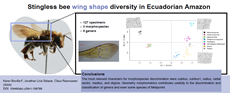
Native stingless bees, Meliponini, are the only social bees that produce honey in addition to honeybees. These bees have been managed in meliponiculture and for crop pollination. In Ecuador, meliponiculture studies are scarce and limited by the lack of species recognition. Traditionally the taxonomic recognition of the species is based on morphological characteristics. In Hymenoptera, the wing shape has proven to be a valuable tool in combination with traditional characters. Due to this, the wing shape was evaluated for discriminating morphospecies in Ecuador’s Amazonian meliponaries. A total of 127 specimens grouped into six genera were analyzed: Melipona (Melikerria) sp., Melipona (Michmelia) sp1., Melipona (Michmelia) sp2., Tetragonisca sp., Paratrigona sp., Nannotrigona sp., Scaura sp., and Plebeia sp. The most significant differences are located at the vein intersection: cubital and cubital 1 (Cu + Cu1), posterior margin of the marginal cell (r and Rs), and basal and posterior marginal cell (M and Rs).

Las abejas nativas sin aguijón, Meliponini, junto con las melíferas son las únicas abejas sociales que producen miel. Las especies de esta Tribu han sido manejadas en meliponicultura y para la polinización de cultivos. En Ecuador, los estudios de meliponicultura son escasos y limitados por la falta de reconocimiento de especies. Tradicionalmente el reconocimiento taxonómico se basa en características morfológicas; en Hymenoptera, la forma del ala ha demostrado ser una herramienta valiosa en combinación con los caracteres tradicionales. Debido a esto, se evaluó la forma del ala para morfoespecies en meliponarios amazónicos de Ecuador. Se analizaron 127 ejemplares agrupados en seis géneros: Melipona (Melikerria) sp., Melipona (Michmelia) sp1., Melipona (Michmelia) sp2., Tetragonisca sp., Paratrigona sp., Nannotrigona sp., Scaura sp., y Plebeia sp. Los cambios más significativos se localizan en la intersección de las venas: cubital y cubital 1 (Cu + Cu1), margen posterior de la celda marginal (r y Rs), y celda marginal basal y posterior (M y Rs).

Recibido: 13 de febrero de 2023; Revisión recibida: 13 de marzo de 2023; Aceptado: 16 de junio de 2023

Abstract

Native stingless bees, Meliponini, are the only social bees that produce honey in addition to honeybees. These bees have been managed in meliponiculture and for crop pollination. In Ecuador, meliponiculture studies are scarce and limited by the lack of species recognition. Traditionally the taxonomic recognition of the species is based on morphological characteristics. In Hymenoptera, the wing shape has proven to be a valuable tool in combination with traditional characters. Due to this, the wing shape was evaluated for discriminating morphospecies in Ecuador’s Amazonian meliponaries. A total of 127 specimens grouped into six genera were analyzed: Melipona (Melikerria) sp., Melipona (Michmelia) sp1., Melipona (Michmelia) sp2., Tetragonisca sp., Paratrigona sp., Nannotrigona sp., Scaura sp., and Plebeia sp. The most significant differences are located at the vein intersection: cubital and cubital 1 (Cu + Cu1), posterior margin of the marginal cell (r and Rs), and basal and posterior marginal cell (M and Rs).

Keywords

Meliponiculture, Plebeia, Procrustes, Scaura, wing vein.

Resumen

Las abejas nativas sin aguijón, Meliponini, junto con las melíferas son las únicas abejas sociales que producen miel. Las especies de esta Tribu han sido manejadas en meliponicultura y para la polinización de cultivos. En Ecuador, los estudios de meliponicultura son escasos y limitados por la falta de reconocimiento de especies. Tradicionalmente el reconocimiento taxonómico se basa en características morfológicas; en Hymenoptera, la forma del ala ha demostrado ser una herramienta valiosa en combinación con los caracteres tradicionales. Debido a esto, se evaluó la forma del ala para morfoespecies en meliponarios amazónicos de Ecuador. Se analizaron 127 ejemplares agrupados en seis géneros: Melipona (Melikerria) sp., Melipona (Michmelia) sp1., Melipona (Michmelia) sp2., Tetragonisca sp., Paratrigona sp., Nannotrigona sp., Scaura sp., y Plebeia sp. Los cambios más significativos se localizan en la intersección de las venas: cubital y cubital 1 (Cu + Cu1), margen posterior de la celda marginal (r y Rs), y celda marginal basal y posterior (M y Rs).

Palabras clave

Plebeia, Procrustes, Scaura, venación alar.

INTRODUCTION

The native stingless bees, Meliponini, are part of the group of bees named corbiculate bees (Apidae: Apinae) (Ayala, 1999; Arnold et al., 2018). Within these, a modified, reduced, and non- functional stinger characterizes the workers (Nates- Parra and Rosso, 2013). The global diversity estimate is 526 native stingless bee species grouped in 61 genera (Rasmussen and Gonzales, 2013). However, the actual richness appears to be greater than 800 spp (Rasmussen and Delgado, 2019; Burgett et al., 2020). In Central and South America are reported about 400 species (75 % of the total species described worldwide) within 32 genera, distributed from northern Mexico to Argentina (Barquero- Elizondo et al., 2019; Assefa et al., 2021).

Modern native stingless bee management in Ecuador dates since the 1980s (Jacome and Guarderas, 2016). Studies published between 2006 and 2009 are related to meliponilure and management of Melipona indescisa Cockerell 1920 and M. mimetica Cockerell 1914 (Mejia and Jimenez, 2006; Rivas, 2009). Later, between 2014 and 2017 were reported the use for honey production of the following species: Cephalotrigina capitata Smith, 1854, Geotrigona fumipennis Camargo and Moure 1996, Melipona eburnean Friese 1900, M. indecisa, M. mimetica, M. rufiventris Friese 1900, Nannotrigona sp., Oxytrigona mellicolor Packard, 1869, Paratrigona aff. eutaeinata, Paratrigona eutaeinata Camargo y Moure 1994, Scaptotrigona ederi Engel, 2022, Scaptotrigona postica Latreille 1807, Scaptotrigona sp. cf. postica, Scaptotrigona sp., Tetragonisca sp., Trigona fulviventris, and Trigona "matera" nom. nud, recorded for the Eastern and Southern part of Ecuador (Ramirez et al., 2014; Vit et al., 2015). In the Amazonian Ecuador, Oriental region, Geotrigona leucogastra Cockerell, 1914, Melipona grandis Guerin- Meneville 1844 and Scaptotrigona ederi, have been reported used by Kichwa communities (Vit et al., 2017). Despite these fragmentary reports, in Ecuador, knowledge and management of Native stingless bees are still incipient (Jacome and Guarderas, 2016). There is a lack of basic faunistic knowledge on meliponilure, as well as collection, processing, and analysis of managed species (Ramirez et al., 2014; Assefa et al., 2021).

Traditional taxonomic identification methods include the use of dichotomous keys and morphological knowledge of the group to be identified, where phenotypic characteristics of bees are used (Combey et al., 2013; Francoy et al., 2009). Nevertheless, in megadiverse insect taxa such as Hymenoptera, particularly in Meliponini, it is difficult, first establish the actual number of species and then to identify them due to as there appear new species every so often and the presence of cryptic species (Nates, 2001a; Michener, 2007). However, several studies suggested that phenotypic quantification by characterizing Hymenoptera wings could be a helpful tool for recognizing different taxonomic levels as a complement to traditional taxonomy, where morphology is mainly used (Francoy et al., 2008; dos Santos et al., 2009a; dos Santos et al., 2019b). Specifically, stingless bee wings can be used as part of species identification even though the forewing venation is reduced (Ayala, 1999; Álvarez, 2015). In this context, geometric morphometry can be defined as a quantitative study of shape after removing the effects of scale, translation, and rotation; could be used for this purpose (Benitez and Puschel, 2014). Geometric morphometry uses multivariable statistical techniques to analyze the coordinates of landmarks based on anatomical homologous points that provide a quantifiable result of the differences in shape (Owen, 2012; Benitez and Puschel, 2014). With this tool, it is possible to discriminate and separate taxonomic groups through the shape, describing the differences using landmark displacements. Several studies have already shown the application of geometric morphometry as an efficient method of differentiation between closely related bee taxa (Combey et al., 2013; Vijayakumar and Jayaraj, 2013; Rattanawannee et al., 2015; Nogueira et al., 2019; dos Santos et al., 2009a; dos Santos et al., 2019b).

Based on these reports, wing shape characterization using geometric morphometry is here tested as an additional tool for describing the taxonomic diversity of native stingless bees from meliponaries in the Napo province of Ecuador.

MATERIALS AND METHODS

Native stingless bee sampling. Bee collections were made from three localities in the Napo province, two in the Tena canton: the community of Aguapungo close to the city of Tena (site 1: 0°58'10.3"S and 77°48'16.2"W site 2: 0°58'14.6"S and 77°48'27.8"W) and one in Archidona canton: city of Archidona (site 3: 0°54'11.1"S and 77°48'09.7"W). Ministerio del Ambiente, Agua y Transicion Ecologica del Ecuador, an environmental regulation entity, approved the scientific collection according to authorization #1340/2021. At least 15 individuals of each morphospcies were taken directly from a single nest of meliponaries per group, for Tetragonisca sp. 15 individuals were taken, due to the due to availability and accessibility, and 16 for the rest morphospcies. Specimens were placed in vials with 70% alcohol (Marquez, 2005). and later pin- mounted for identification using dichotomous keys (Ayala, 1999; Michener, 2007; Álvarez, 2015; Rasmussen and Delgado, 2019). From each specimen, the right fore wing was removed, and from the bottom, the microscope slide was mounted with Euparal medium, and photographed (Fig. 1), at the same scale (dos Santos et al., 2009; Nogueira et al., 2019). From each slide 11 anatomical landmarks (Lm), were digitized (Fig. 2) with TpsDig2 v2.11 (following Rohlf, 2018). The 11 anatomical landmarks were located on intersection points of venation, Lm type I (following Prado- Silva et al., 2016).

Geometric morphometrics analysis. The Geomorph package (Adams and Otarola- Castillo, 2013) in the R v4.1.0 program was used to perform Principal Component Analysis (PCA), and the centroid size (CS) analysis, differences between them were evaluated statistically using the Kruskal- Wallis. Morphoj 2.0 (Klingenberg, 2011) was used for a Canonical Variable Analysis (CVA) in order to statistically evaluate a posteriori re- classification of the previously identified stingless bees genera and morphospecies (García- Olivares et al., 2015; Nogueira et al., 2019); all Lm wing shape differences were represented through deformation grids.

Right fore wing of eight morphospecies collected in Napo meliponaries: 1, Melipona grandis. 2, Melipona eburnea. 3, Melipona illota. Smaller morphospecies 4, Tetragonisca angustula. 5, Paratrigona sp. 6, Nannotrigona melanocera. 7, Scaura sp. 8, Plebeia sp.

Figure 1: Right fore wing of eight morphospecies collected in Napo meliponaries: 1, Melipona grandis. 2, Melipona eburnea. 3, Melipona illota. Smaller morphospecies 4, Tetragonisca angustula. 5, Paratrigona sp. 6, Nannotrigona melanocera. 7, Scaura sp. 8, Plebeia sp.

RESULTS

The final native stingless bees wing dataset comprises 127 specimens grouped into eight morphospecies in six genera: Melipona (3 morphospecies), Tetragonisca (1 msp), Paratrigona (1 msp), Nannotrigona (1 msp), Scaura (1 msp), and Plebeia (1 msp). The CS showed significant differences (Kruskal- Wallis test, ×2 = 113.15; p < 0.001), between the large morphospecies (Fig. 3): Melipona grandis (5.014±0.005 mm), Melipona eburnea (4.150±0.011 mm) and Melipona illota Cockerell, 1919 (3.816±0.020 mm), and the smaller morphospecies: Nannotrigona melanocera (Schwarz, 1938) (2.002±0.023 mm), Plebeia sp (1.967±0.042 mm), Tetragonisca angustula Latreille, 1811 (1.950±0.127 mm), Scaura sp. (1.840±0.113 mm) and Paratrigona sp. (1.770±0.026 mm) (Table1).

Right fore wing of Melliponini showing the landmarks (1-11) configuration analyzed

Figure 2: Right fore wing of Melliponini showing the landmarks (1-11) configuration analyzed

Figure 4, shows the PCA shape for the main variation axes, with six differentiated groups and two partially overlapping morphospecies (both in the M. (Michmelia) subgenus). The CVA (Fig. 5) showed significant differences between morphospecies; a priori group morphospecies assignments based on traditional morphology was correctly (100%) assigned to a posteriori group based on MANOVA average Mahalanobis distances (Wilk's λ = 0.000; p < 0.0001).

At generic level, all taxa represented in the PCA showed shape variation concentrated between wing cells: Marginal, 1st submarginal, and 2nd submarginal, in contrast with Lm 1 and 2 that do not show differences among genera. Particularly, the three Melipona morphospecies were characterized by a diagonal displacement of Lm 9 and variation between Lm 3, 4, and 5; where Lm 3 and 4 are displaced diagonally, while Lm 5 is displaced to the left. In Tetragonisca sp., there are variations of Lm 3, 6, and 11; Lm 3 and 6 have a left displacement, while Lm 11 has a left displacement. Then, Paratrigona sp. showed a marked variation in Lm 3, 4, and 5 indicating a diagonal displacement to the right, while Nannotrigona sp., Plebeia sp., and Scaura sp. present displacements of Lm 9 diagonally to the right. Finally, Scaura sp. showed a diagonal displacement to the left in Lm 3 and 4.

Table 1.: Stingless bees morphospecies collected in each site; the a priori identification was based on traditional characters, and used as groups for a posteriori reclassification based on wing geometric morphometrics.

Centroid size boxplot of eight morphospecies collected in Napo meliponaries. Large morphospecies: 1, Melipona grandis. 2, Melipona eburnea. 3, Melipona illota. Smaller morphospecies 4, Tetragonisca angustula. 5, Paratrigona sp. 6, Nannotrigona melanocera. 7, Scaura sp. 8, Plebeia sp.

Figure 3: Centroid size boxplot of eight morphospecies collected in Napo meliponaries. Large morphospecies: 1, Melipona grandis. 2, Melipona eburnea. 3, Melipona illota. Smaller morphospecies 4, Tetragonisca angustula. 5, Paratrigona sp. 6, Nannotrigona melanocera. 7, Scaura sp. 8, Plebeia sp.

DISCUSSION

The central size differences could be associated with the capacity of each phenotype under different genetic and environmental characteristics, which respond to micro and macroevolutionary causes (Benitez and Puschel, 2014; Jaramillo- Ocampo, 2014). Wing variation may be closely related to flight distance, with the largest bees able to fly distances between 1,500 and 2,500 meters from their nests, while the smallest restricted between 600 to 950 m (Roubik and Aluja, 1983; Nogueira et al., 2019).

Nunes et al. (2013), state that wing shape is more affected by evolutionary factors than size; the shape is not related to altitude and geographic variations. Additionally, Benitez and Puschel (2014), reported a close relationship between size and shape, pointing out that the first PCA axes can be associated with shape variation due to size. Our results showed that the first PCA axes explain more than 70% of the variance, suggesting a possible allometric effect in some of the morphospecies studied. Allometry in Hymenoptera was verified by Belyaev and Farisenkov (2019), showing that body size increased according to the contraction in the forewing contour. Danforth (1989), stated that the wings of small hymenoptera tend to be broad and spatulate, while the hymenopteran's wings tend to be apically tapered.

Particularly, the partial overlapping between the wing shape of the two morphospecies of Melipona (Michmelia), could be explained due to the evolutionary closeness - and the inadequateness of geometric morphometrics analysis to separate closely related species; Phylogenetic studies suggest Michmelia is a clearly monophyletic group (Rasmussen and Cameron, 2010). On the other hand, the shape similarities of Plebeia and Scaura could be related to the fact that these taxa are hypothesized as a monophyletic clade (Rasmussen and Cameron, 2010). However, this result could be a kind of flawed, due to the geometric morphometry in this work having been used to separate single representatives from each genus, therefore - for a good comparison of the partial overlapping species - care should be taken when applying this method between closely related species.

Principal Component Analysis diagram of two principal components (within percentage explained variance contribution) for 127 specimens and eight native stingless bees morphospecies recollected in meliponaries of Napo. The deformation grid represents the extreme variation axes.

Figure 4: Principal Component Analysis diagram of two principal components (within percentage explained variance contribution) for 127 specimens and eight native stingless bees morphospecies recollected in meliponaries of Napo. The deformation grid represents the extreme variation axes.

The deformation grids allowed us to visualize the differences in the wing conformation according to a consensus configuration (Fig. 4). The most relevant characters for morphospecies discrimination were Lm9 (veins Cu - cubitus and Cu1- cubitus1 intersection), Lm3 (veins R- radius and Rs- radial sector intersection), Lm4 (veins M- medius and Rs - radial sector intersection), and Lm5 (stigma and Rs- radial sector intersection). The function of most veins in Hymenoptera is unknown, the only veins with known functionality are those anchored to the base, which are important for the wing stability during flight (Francoy et al., 2009). Some authors have hypothesized that the reduction in Meliponini wing venation could be related to an increase in wing flexibility, while others suggested the relationship with the distribution of sensory receptors. We believe that the reduction is because the ancestral stingless bees were tiny, and therefore lost most of the venation during this dwarfism, until the group again gained size, but did not regain the lost venation. As part of these results, six landmarks are necessary for differentiation of genus level, in this case, they are Lm3, Lm4, Lm9, and Lm5 which were mentioned already, Lm6, and, Lm1, in order of relevance (Fig. 2). All of them present an important shape variation in the wing coordinates.

Several authors have demonstrated a commercial interest in the stingless bee genera reported in this work: Melipona sp. (Ramirez et al., 2014; Vit et al., 2015, 2017), Tetragonisca sp. (Ramirez et al., 2014; Vit et al., 2016), Paratrigona sp. (Ramirez et al., 2014; Vit et al., 2015), and Nannotrigona sp. (Ramirez et al., 2014). However, the genera Scaura and Plebeia have not been previously reported for meliponiculture in Ecuador. According to Nates (2001a, 2001b) and Francoy (2011), the commonly used Meliponini genera are Melipona and Tetragonisca, due to the quantity and quality of honey produced and the wide distribution range of these (Francoy et al., 2011; Nates- Parra and Rosso, 2013). While the use of species like Nannotrigona and Scaura is limited, due to the low honey production. Additionally, nests of one species of Scaura are always associated with termites. Those genera producing low quantities of honey could be managed for conservation, recreation activity, or pollination (Nates- Parra and Rosso, 2013).

Canonical Variates Analysis diagram for 127 specimens and eight stingless bee morphospecies recollected in meliponaries of Napo.

Figure 5: Canonical Variates Analysis diagram for 127 specimens and eight stingless bee morphospecies recollected in meliponaries of Napo.

Our results showed that geometry morphometrics allows for the discrimination of morphospecies in Napo meliponaries. In particular, we found that by only six measurements, it is possible to classify the colonies according to genus and sometimes species. The use of wing descriptors in Meliponini reveals the importance of this structure for taxonomic proposes (Rattanawannee et al., 2015; Nogueira et al., 2019). This method is a quantitative technique that allows for obtaining reliable and comparative results traditionally obtained by morphology (Vijayakumar and Jayaraj, 2013; Jaramillo- Ocampo, 2014). Several authors concluded that geometry morphometrics applied to the Hymenoptera wing contributes usefully to the discrimination and classification of genera and even some species of Meliponini (Francoy et al., 2009; García- Olivares et al., 2015). Finally, we suggest that quantitative phenotypic description of additional anatomical partitions (e.g., wings, thorax, legs) could be combined with molecular techniques to identify an easily recognizable classification in Meliponini.

ACKNOWLEDGEMENTS

We thank to the meliponicultures: Uli Zebisch, Brian Ruano and Jaime Marti of Napo for allowed the bee collection.

REFERENCIAS

Adams, D. C. y Otárola-Castillo, E. (2013). Geomorph: An r package for the collection and analysis of geometric morphometric shape data. Methods in Ecology and Evolution, 4(4), 393-399. https://doi.org/10.1111/2041-210X.12035[CrossRef]

Álvarez, L. J. (2015). Diversidad de las abejas nativas de la tribu Meliponini (Hymenoptera, Apidae) en Argentina. [Tesis de doctorado]. Universidad Nacional de la Plata. https://doi.org/10.35537/10915/52025[CrossRef]

Arnold, N., Ayala, R., Mérida, J., Sagot, P., Aldasoro, M. y Vandame, R. (2018). New records of stingless bees (Apidae: Meliponini) for the Mexican states of Chiapas and Oaxaca. Revista Mexicana de Biodiversidad, 89(3), 651-665. https://doi.org/10.22201/b.20078706e.2018.3.2429[CrossRef]

Assefa, A., Tegegne, M. y Tack, M. (2021). Indigenous knowledge of ground-nesting stingless bees in southwestern Ethiopia. International Journal of Tropical Insect Science, 41, 2617-2626. https://doi.org/10.1007/s42690-021-00442-6[CrossRef]

Ayala, R. (1999). Revision de las abejas sin aguijon de Mexico (Hymenoptera: Apidae: Meliponini). Folia Entomológica Mexicana, 123(106), 1-123.

Barquero-Elizondo, A. I., Aguilar-Monge, I., Méndez-Cartín, A. L., Hernández-Sánchez, G., Sánchez-Toruño, H., Montero-Flores, W., Herrera-González, E., Sánchez-Chaves, L. A., Barrantes-Vásquez, A., Gutiérrez-Leitón, M., Mesén-Montano, I. y Bullé-Bueno, F. (2019). Asociación entre abejas sin aguijón (Apidae, Meliponini) y la flora del bosque seco en la región norte de Guanacaste, Costa Rica Association Between Stingless Bees (Apidae, Meliponini) and the Dry Forest Flora in the Northern Region of Guanacaste, Costa R. Trop J Environ Sci, 53(1), 70-91. https://doi.org/10.15359/rca.53-1.4[CrossRef]

Belyaev, O. A. y Farisenkov, S. E. (2019). A Study on Allometry of Wing Shape and Venation in Insects. Part 1. Hymenoptera. Moscow University Biological Sciences Bulletin, 73(4), 229-235. https://doi.org/10.3103/S0096392518040028[CrossRef]

Benítez, H. A. y Püschel, T. A. (2014). Modelando la varianza de la forma: Morfometría geométrica aplicaciones en biología evolutiva. International Journal of Morphology, 32(3), 998-1008. https://doi.org/10.4067/S0717-95022014000300041[CrossRef]

dos Santos, S., Roselino, A., Hrncir, M. y Bego, L. (2009). Pollination of tomatoes by the stingless bee Melipona quadrifasciata and the honey bee Apis mellifera (Hymenoptera, Apidae). Genetics and Molecular Research, 8(2), 751-757. https://doi.org/10.4238/vol8-2kerr015[CrossRef]

Burgett, M., Sangjaroen, P., Yavilat, J. y Chuttong, B. (2020). First report of hovering guard bees of the Paleotropical stingless bee Tetrigona apicalis (Hymenoptera: Apidae: Meliponini). Apidologie, 51(1), 88-93. https://doi.org/10.1007/s13592-019-00717-5[CrossRef]

Combey, R., Stephanie, J., Teixeira, G., Bonatti, V., Kwapong, P. y Francoy, T. M. (2013). Geometric morphometrics reveals morphological differentiation within four African stingless bee species. Scholars Research Library Annals of Biological Research, 4, 93-103.

Danforth, B. N. (1989). The evolution of hymenoptera wings: the importance of size. Journal of Zoology, 218(2), 247-276. https://doi.org/10.1111/J.1469-7998.1989.TB02536.X[CrossRef]

dos Santos, C. F., Halinski, R., de Souza dos Santos, P. D., Almeida, E. A. B. y Blocthein, B. (2019a). Looking beyond the flowers: associations of stingless bees with sap-sucking insects. Science of Nature, 106(3-4). https://doi.org/10.1007/s00114-019-1608-y[CrossRef]

dos Santos, C. F., Souza dos Santos, P. D., Marques, D. M., da-Costa, T. y Blocthein, B. (2019b). Geometric morphometrics of the forewing shape and size discriminate Plebeia species (Hymenoptera: Apidae) nesting in different substrates. Systematic Entomology, 44(4), 787-796. https://doi.org/10.1111/syen.12354[CrossRef]

Francoy, T. M., Grassi, M. L., Imperatriz-Fonseca, V. L., de Jesús May-Itzá, W. y Quezada-Euán, J. J. G. (2011). Geometric morphometrics of the wing as a tool for assigning genetic lineages and geographic origin to Melipona beecheii (Hymenoptera: Meliponini). Apidologie, 42(4), 499-507. https://doi.org/10.1007/s13592-011-0013-0[CrossRef]

Francoy, T. M., Wittmann, D., Drauschke, M., Müller, S., Steinhage, V., Bezerra-Laure, M. A. F., Jong, D. J. y Gonçalves, L. S. (2008). Identification of Africanized honey bees through wing morphometrics: Two fast and efficient procedures. Apidologie, 39(5), 488-494. https://doi.org/10.1051/apido:2008028[CrossRef]

Francoy, T. M., Silva, R. A. O., Nunes-Silva, P., Menezes, C. y Imperatriz-Fonseca, V. L. (2009). Gender identification of five genera of stingless bees (Apidae, Meliponini) based on wing morphology. Genetics and Molecular Research, 8(1), 207-214. https://doi.org/10.4238/vol8-1gmr557[CrossRef]

García-Olivares, V., Zaragoza-trello, C., Ramirez, J., Guerrero-Peñaranda, A. y Ruiz, C. (2015). Caracterización rápida de la biodiversidad usando morfometría geométrica: Caso de estudio con abejas sin aguijón (Apidae: Meliponini) del sur de Ecuador. Ciencias Biológicas y Ambientales, 7(1). https://doi.org/10.18272/aci.v7i1.226[CrossRef]

Jácome, I. y Guarderas, L. (2016). Transparencia de nidos de Melipona Favosa Orbignyi Guerin, 1844 (Hymenoptera: Apidae: Meliponini) a cajas-colmenas y susos de su miel, desde el conocimiento del Pueblo Kichwa de la amazonía de Ecuador. Boletín de La SEA, 59(59), 311-317.

Jaramillo-Ocampo, N. (2014). Morfometría geométrica: principios teóricos y métodos de empleo. Fronteras de investigación en enfermedades infecciosas. Modelo enfermedad de Chagas (1st ed., Issue May). Universidad de Antioquia.

Klingenberg, C. P. (2011). Morphoj: an integrated software package for geometric morphometrics. Molecular Ecology Resources.

Márquez, J. (2005). Técnicas de colecta y preservación de insectos. Boletín Sociedad Entomológica Aragonesa, 37, 385-408.

Mejia, O. A. y Jiménez, M. (2006). Guia para la cria y manejo de la abeja Nativa real o wimal, Melipona indecisa. In Fundación Altotropico, Quito. https://docplayer.es/22997651-Guia-abeja-nativa-real-o-wimal.html[Link]

Michener, C. (2007). The bees of the world. In American Scientist, 2nd ed., 78(2).

Nates, P. (2001a). Guía para la cría y manejo de la abeja angelita o virginita. Tetragonisca angustula.

Nates, P. (2001b). Las Abejas sin Aguijón ( Hymenoptera : Apidae). Biota Colombiana, 2(3), 233-248.

Nates-Parra, G., y Rosso, J. (2013). Diversity of Stingless Bees (Hymenoptera: Meliponini) Used in Meliponiculture in Colombia. Acta Biológica Colombiana, 18(3), 415-426.

Nogueira, D. S., Mahlmann, T., Teixeira, J. S. G., Oliveira, M. L. y Roubik, D. W. (2019). Geometric morphometrics of wing venation to differentiates new species of Scaura Schwarz populations (Hymenoptera: Apidae: Meliponini). Scientia Plena, 15(1). https://doi.org/10.14808/sci.plena.2019.018001[CrossRef]

Nunes, L. A., Passos, G. B., Carvalho, C. A. L. y Araújo, E. D. (2013). Tamanho e Forma em Melipona quadrifasciata anthidioides Lepeletier, 1836 (Hymenoptera; Meliponini). Brazilian Journal of Biology, 73(4), 887-893. https://doi.org/10.1590/S1519-69842013000400027[CrossRef]

Owen, R. E. (2012). Applications of Morphometrics to the Hymenoptera, Particularly Bumble Bees (Bombus, Apidae). Morphometrics. https://doi.org/10.5772/34745[CrossRef]

Prado-Silva, A., Nunes, L. A., de Oliveira Alves, R. M., Carneiro, P. L. S. y Waldschmidt, A. M. (2016). Variation of fore wing shape in Melipona mandacaia Smith, 1863 (Hymenoptera, Meliponini) along its geographic range. Journal of Hymenoptera Research, 48, 85–94. https://doi.org/10.3897/JHR.48.6619[CrossRef]

Ramirez, J. A., Urena, J. v, y Camacho, A. (2014). Las abejas sin aguijón (Apidae:Meliponini) de la región sur del Ecuador. Estudios Universitarios Universidad de Loja, 2002010010, 103-111.

Rasmussen, C. y Cameron, S. A. (2010). Global stingless bee phylogeny supports ancient divergence, vicariance, and long distance dispersal. Biological Journal of the Linnean Society, 99(1), 206-232. https://doi.org/10.1111/j.1095-8312.2009.01341.x[CrossRef]

Rasmussen, C., y Delgado, C. (2019). Abejas sin aguijón. In Instituto de Investigaciones de la Amazonia Peruana (Issue August).

Rasmussen, C. y Gonzalez, V. (2013). Prologue. Stingless bees now and in the future. In: Vit P, Roubik D, (Eds). Stingless Bees Process Honey and Pollen in Cerumen Pots. Facultad de Farmacia y Bioanálisis, Universidad de los Andes, Mérida, Venezuela. p. vi-ix.

Rattanawannee, A., Duangpakdee, O., Rod-Im, P. y Hepburn, R. (2015). Discrimination of two Tetragonula (Apidae: Meliponini) species in Thailand using geometric morphometric analysis of wing venation. Kasetsart Journal - Natural Science, 49(5), 700-710.

Rivas, J. A. (2009). Evaluación económica, productiva del Bermejo (Melipona mimética), en la comunidad la manga parroquia Garza Real Cantón Zapotillo (Vol. 2). [Tesis de pregrado]. Universidad Nacional de Loja. https://dspace.unl.edu.ec//handle/123456789/5434[Link]

Rohlf, F. J. (2018). tpsDig, Digitize Landmarks and Outlines. (Version 2.31). Department of Ecology and Evolution, State University of New York.

Roubik, D. W. y Aluja, M. (1983). Flight Ranges of Melipona and Trigona in Tropical Forest. Journal of the Kansas entomological society, 56(2), 217-222. https://www.jstor.org/stable/25084398[Link]

Vijayakumar, K. y Jayaraj, R. (2013). Geometric morphometry analysis of three species of stingless bees in India. International Journal for Life Sciences and Educational Research, 1(2), 91-95.

Vit, P., Gonzalez, I., Sorroza, L. y Pedro, S. R. (2016). Caracterizacion fisicoquimica de miel de angelita Tetragonisca angustula (Latreille, 1811) producida en Esmeraldas, Ecuador / Physicochemical characterization of "angelita" Tetragonisca angustula (Latreille, 1811) honey produced in Esmeraldas, Ecuador. Ciencia UNEMI, 9(20), 77-84. https://doi.org/10.29076/issn.2528-7737vol9iss20.2016pp77-84p[CrossRef]

Vit, P., Pedro, S. R. M., Vergara, C. y Deliza, R. (2017). Ecuadorian honey types described by kichwa community in rio chico, Pastaza province, Ecuador using free-choice profiling. Revista Brasileira de Farmacognosia, 27(3), 384-387. https://doi.org/10.1016/j.bjp.2017.01.005[CrossRef]

Vit, P., Vargas, O., Lopez, T. y Valle, F. (2015). Meliponini biodiversity and medicinal uses of pot-honey from El Oro province in Ecuador. Emirates Journal of Food and Agriculture, 27(6), 502. https://doi.org/10.9755/ejfa.2015.04.079[CrossRef]

The authors affirm that there are no conflicts of interest associated with the publication of this manuscript. They have no financial, personal, or professional interests that might impact the research or this content
The first author was responsible for the written content and performing statistical analyses. The second author provided written assistance, additional support, and contributed to editorial improvements. Meanwhile, the third author oversaw identifying the bee species and made some revisions to the text.
Bonilla-F, K., Liria Salazar, J., Rasmussen C. (2024). Wing Phenotypic Diversity in Stingless Bees Genera (Apidae: Meliponini) from Ecuador Amazonia. Acta Biol Colomb, 29(1), 112-118 https://doi.org/10.15446/abc.v29n1.106788

Referencias

Adams, D. C. and Otárola-Castillo, E. (2013). Geomorph: An r package for the collection and analysis of geometric morphometric shape data. Methods in Ecology and Evolution, 4(4), 393–399. https://doi.org/10.1111/2041-210X.12035

Álvarez, L. J. (2015). Diversidad de las abejas nativas de la tribu Meliponini (Hymenoptera, Apidae) en Argentina. [Tesis de doctorado]. Universidad Nacional de la Plata. https://doi.org/https://doi.org/10.35537/10915/52025

Arnold, N., Ayala, R., Mérida, J., Sagot, P., Aldasoro, M. and Vandame, R. (2018). New records of stingless bees (Apidae: Meliponini) for the Mexican states of Chiapas and Oaxaca. Revista Mexicana de Biodiversidad, 89(3), 651–665. https://doi.org/10.22201/ib.20078706e.2018.3.2429

Assefa, A., Tegegne, M. and Tack, M. (2021). Indigenous knowledge of ground-nesting stingless bees in southwestern Ethiopia. International Journal of Tropical Insect Science, 41, 2617-2626. https://doi.org/10.1007/s42690-021-00442-6

Ayala, R. (1999). Revision de las abejas sin aguijon de Mexico (Hymenoptera: Apidae: Meliponini). Folia Entomológica Mexicana, 123(106), 1–123.

Barquero-Elizondo, A. I., Aguilar-Monge, I., Méndez-Cartín, A. L., Hernández-Sánchez, G., Sánchez-Toruño, H., Montero-Flores, W., Herrera-González, E., Sánchez-Chaves, L. A., Barrantes-Vásquez, A., Gutiérrez-Leitón, M., Mesén-Montano, I. and Bullé-Bueno, F. (2019). Asociación entre abejas sin aguijón (Apidae, Meliponini) y la flora del bosque seco en la región norte de Guanacaste, Costa Rica Association Between Stingless Bees (Apidae, Meliponini) and the Dry Forest Flora in the Northern Region of Guanacaste, Costa R. Trop J Environ Sci, 53(1), 70–91. http://dx.doi.org/10.15359/rca.53-1.4

Belyaev, O. A. and Farisenkov, S. E. (2019). A Study on Allometry of Wing Shape and Venation in Insects. Part 1. Hymenoptera. Moscow University Biological Sciences Bulletin, 73(4), 229–235. https://doi.org/10.3103/S0096392518040028

Benítez, H. A. and Püschel, T. A. (2014). Modelando la varianza de la forma: Morfometría geométrica aplicaciones en biología evolutiva. International Journal of Morphology, 32(3), 998–1008. https://doi.org/10.4067/S0717-95022014000300041

dos Santos, S., Roselino, A., Hrncir, M. and Bego, L. (2009). Pollination of tomatoes by the stingless bee Melipona quadrifasciata and the honey bee Apis mellifera (Hymenoptera, Apidae). Genetics and Molecular Research, 8(2), 751–757. https://doi.org/10.4238/vol8-2kerr015

Burgett, M., Sangjaroen, P., Yavilat, J. and Chuttong, B. (2020). First report of hovering guard bees of the Paleotropical stingless bee Tetrigona apicalis (Hymenoptera: Apidae: Meliponini). Apidologie, 51(1), 88–93. https://doi.org/10.1007/s13592-019-00717-5

Combey, R., Stephanie, J., Teixeira, G., Bonatti, V., Kwapong, P. and Francoy, T. M. (2013). Geometric morphometrics reveals morphological differentiation within four African stingless bee species. Scholars Research Library Annals of Biological Research, 4, 93–103.

Danforth, B. N. (1989). The evolution of hymenopteran wings: the importance of size. Journal of Zoology, 218(2), 247–276. https://doi.org/10.1111/J.1469-7998.1989.TB02536.X

dos Santos, C. F., Halinski, R., de Souza dos Santos, P. D., Almeida, E. A. B. and Blochtein, B. (2019a). Looking beyond the flowers: associations of stingless bees with sap-sucking insects. Science of Nature, 106(3–4). https://doi.org/10.1007/s00114-019-1608-y

dos Santos, C. F., Souza dos Santos, P. D., Marques, D. M., da-Costa, T. and Blochtein, B. (2019b). Geometric morphometrics of the forewing shape and size discriminate Plebeia species (Hymenoptera: Apidae) nesting in different substrates. Systematic Entomology, 44(4), 787–796. https://doi.org/10.1111/syen.12354

Francoy, T. M., Grassi, M. L., Imperatriz-Fonseca, V. L., de Jesús May-Itzá, W. and Quezada-Euán, J. J. G. (2011). Geometric morphometrics of the wing as a tool for assigning genetic lineages and geographic origin to Melipona beecheii (Hymenoptera: Meliponini). Apidologie, 42(4), 499–507. https://doi.org/10.1007/s13592-011-0013-0

Francoy, T. M., Wittmann, D., Drauschke, M., Müller, S., Steinhage, V., Bezerra-Laure, M. A. F., Jong, D. J. and Gonçalves, L. S. (2008). Identification of Africanized honey bees through wing morphometrics: Two fast and efficient procedures. Apidologie, 39(5), 488–494. https://doi.org/10.1051/apido:2008028

Francoy, T. M., Silva, R. A. O., Nunes-Silva, P., Menezes, C. and Imperatriz-Fonseca, V. L. (2009). Gender identification of five genera of stingless bees (Apidae, Meliponini) based on wing morphology. Genetics and Molecular Research, 8(1), 207–214. https://doi.org/10.4238/vol8-1gmr557

García-Olivares, V., Zaragoza-trello, C., Ramirez, J., Guerrero-Peñaranda, A. and Ruiz, C. (2015). Caracterización rápida de la biodiversidad usando morfometría geométrica: Caso de estudio con abejas sin aguijón (Apidae: Meliponini) del sur de Ecuador. 1. Ciencias Biológicas y Ambientales, 7(1). https://doi.org/https://doi.org/10.18272/aci.v7i1.226

Jácome, I. and Guarderas, L. (2016). Transparencia de nidos de Melipona Favosa Orbignyi Guerin, 1844 (Hymenoptera: Apidae: Meliponini) a cajas-colmenas y susos de su miel, desde el conocimiento del Pueblo Kichwa de la amazonía de Ecuador. Boletín de La SEA, 59(59), 311–317.

Jaramillo-Ocampo, N. (2014). Morfometría geométrica: principios teóricos y métodos de empleo. Fronteras de investigación en enfermedades infecciosas. Modelo enfermedad de Chagas (1st ed., Issue May). Universidad de Antioquia.

Klingenberg, C. P. (2011). MorphoJ: an integrated software package for geometric morphometrics. Molecular Ecology Resources. DOI: https://doi.org/10.1111/j.1755-0998.2010.02924.x

Márquez, J. (2005). Técnicas de colecta y preservación de insectos. Boletín Sociedad Entomológica Aragonesa, 37, 385–408.

Mejia, O. A. and Jiménez, M. (2006). Guia para la cria y manejo de la abeja Nativa real o wimal, Melipona indecisa. In Fundación Altotropico, Quito. https://docplayer.es/22997651-Guia-abeja-nativa-real-o-wimal.html

Michener, C. (2007). The bees of the world. In American Scientist, 2nd ed., 78(2). DOI: https://doi.org/10.56021/9780801885730

Nates, P. (2001a). Guía para la cría y manejo de la abeja angelita o virginita. Tetragonisca angustula.

Nates, P. (2001b). Las Abejas sin Aguijón ( Hymenoptera : Apidae). Biota Colombiana, 2(3), 233–248.

Nates-Parra, G., and Rosso, J. (2013). Diversity of Stingless Bees (Hymenoptera: Meliponini) Used in Meliponiculture in Colombia. Acta Biológica Colombiana, 18(3), 415–426.

Nogueira, D. S., Mahlmann, T., Teixeira, J. S. G., Oliveira, M. L. and Roubik, D. W. (2019). Geometric morphometrics of wing venation to differentiates new species of Scaura Schwarz populations (Hymenoptera: Apidae: Meliponini). Scientia Plena, 15(1). https://doi.org/10.14808/sci.plena.2019.018001

Nunes, L. A., Passos, G. B., Carvalho, C. A. L. and Araújo, E. D. (2013). Tamanho e Forma em Melipona quadrifasciata anthidioides Lepeletier, 1836 (Hymenoptera; Meliponini). Brazilian Journal of Biology, 73(4), 887–893. https://doi.org/10.1590/S1519-69842013000400027

Owen, R. E. (2012). Applications of Morphometrics to the Hymenoptera, Particularly Bumble Bees (Bombus, Apidae). Morphometrics. https://doi.org/10.5772/34745

Prado-Silva, A., Nunes, L. A., de Oliveira Alves, R. M., Carneiro, P. L. S. and Waldschmidt, A. M. (2016). Variation of fore wing shape in Melipona mandacaia Smith, 1863 (Hymenoptera, Meliponini) along its geographic range. Journal of Hymenoptera Research, 48, 85–94. https://doi.org/10.3897/JHR.48.6619

Ramírez, J. A., Ureña, J. v, and Camacho, A. (2014). Las abejas sin aguijón (Apidae:Meliponini) de la región sur del Ecuador. Estudios Universitarios Universidad de Loja, 2002010010, 103–111.

Rasmussen, C. and Cameron, S. A. (2010). Global stingless bee phylogeny supports ancient divergence, vicariance, and long distance dispersal. Biological Journal of the Linnean Society, 99(1), 206–232. https://doi.org/10.1111/j.1095-8312.2009.01341.x

Rasmussen, C., and Delgado, C. (2019). Abejas sin aguijón. In Instituto de Investigaciones de la Amazonia Peruana (Issue August).

Rasmussen, C. and Gonzalez, V. (2013). Prologue. Stingless bees now and in the future. In: Vit P, Roubik D, (Eds). Stingless Bees Process Honey and Pollen in Cerumen Pots. Facultad de Farmacia y Bioanálisis, Universidad de los Andes, Mérida, Venezuela. p. vi-ix.

Rattanawannee, A., Duangpakdee, O., Rod-Im, P. and Hepburn, R. (2015). Discrimination of two Tetragonula (Apidae: Meliponini) species in Thailand using geometric morphometric analysis of wing venation. Kasetsart Journal - Natural Science, 49(5), 700–710.

Rivas, J. A. (2009). Evaluación económica, productiva del Bermejo (Melipona mimética), en la comunidad la manga parroquia Garza Real Cantón Zapotillo (Vol. 2). [Tesis de pregrado]. Universidad Nacional de Loja. https://dspace.unl.edu.ec//handle/123456789/5434

Rohlf, F. J. (2018). tpsDig, Digitize Landmarks and Outlines. (Version 2.31). Department of Ecology and Evolution, State University of New York.

Roubik, D. W. and Aluja, M. (1983). Flight Ranges of Melipona and Trigona in Tropical Forest. Journal of the Kansas entomological society, 56(2), 217-222. https://www.jstor.org/stable/25084398

Vijayakumar, K. and Jayaraj, R. (2013). Geometric morphometry analysis of three species of stingless bees in India. International Journal for Life Sciences and Educational Research, 1(2), 91–95.

Vit, P., Gonzalez, I., Sorroza, L. and Pedro, S. R. (2016). Caracterización físicoquímica de miel de angelita Tetragonisca angustula (Latreille, 1811) producida en Esmeraldas, Ecuador / Physicochemical characterization of “angelita” Tetragonisca angustula (Latreille, 1811) honey produced in Esmeraldas, Ecuador. Ciencia UNEMI, 9(20), 77–84. https://doi.org/10.29076/issn.2528-7737vol9iss20.2016pp77-84p

Vit, P., Pedro, S. R. M., Vergara, C. and Deliza, R. (2017). Ecuadorian honey types described by kichwa community in rio chico, Pastaza province, Ecuador using free-choice profiling. Revista Brasileira de Farmacognosia, 27(3), 384–387. https://doi.org/10.1016/j.bjp.2017.01.005

Vit, P., Vargas, O., López, T. and Valle, F. (2015). Meliponini biodiversity and medicinal uses of pot-honey from El Oro province in Ecuador. Emirates Journal of Food and Agriculture, 27(6), 502. https://doi.org/10.9755/ejfa.2015.04.079

Cómo citar

APA

Bonilla Farinango, K. V., Liria Salazar, J. & Rasmussen, C. (2024). Wing Phenotypic Diversity in Stingless Bees Genera (Apidae: Meliponini) from Ecuador Amazonia. Acta Biológica Colombiana, 29(1), 112–118. https://doi.org/10.15446/abc.v29n1.106788

ACM

[1]
Bonilla Farinango, K.V., Liria Salazar, J. y Rasmussen, C. 2024. Wing Phenotypic Diversity in Stingless Bees Genera (Apidae: Meliponini) from Ecuador Amazonia. Acta Biológica Colombiana. 29, 1 (ene. 2024), 112–118. DOI:https://doi.org/10.15446/abc.v29n1.106788.

ACS

(1)
Bonilla Farinango, K. V.; Liria Salazar, J.; Rasmussen, C. Wing Phenotypic Diversity in Stingless Bees Genera (Apidae: Meliponini) from Ecuador Amazonia. Acta biol. Colomb. 2024, 29, 112-118.

ABNT

BONILLA FARINANGO, K. V.; LIRIA SALAZAR, J.; RASMUSSEN, C. Wing Phenotypic Diversity in Stingless Bees Genera (Apidae: Meliponini) from Ecuador Amazonia. Acta Biológica Colombiana, [S. l.], v. 29, n. 1, p. 112–118, 2024. DOI: 10.15446/abc.v29n1.106788. Disponível em: https://revistas.unal.edu.co/index.php/actabiol/article/view/106788. Acesso em: 16 jul. 2026.

Chicago

Bonilla Farinango, Karen Vanessa, Jonathan Liria Salazar, y Claus Rasmussen. 2024. «Wing Phenotypic Diversity in Stingless Bees Genera (Apidae: Meliponini) from Ecuador Amazonia». Acta Biológica Colombiana 29 (1):112-18. https://doi.org/10.15446/abc.v29n1.106788.

Harvard

Bonilla Farinango, K. V., Liria Salazar, J. y Rasmussen, C. (2024) «Wing Phenotypic Diversity in Stingless Bees Genera (Apidae: Meliponini) from Ecuador Amazonia», Acta Biológica Colombiana, 29(1), pp. 112–118. doi: 10.15446/abc.v29n1.106788.

IEEE

[1]
K. V. Bonilla Farinango, J. Liria Salazar, y C. Rasmussen, «Wing Phenotypic Diversity in Stingless Bees Genera (Apidae: Meliponini) from Ecuador Amazonia», Acta biol. Colomb., vol. 29, n.º 1, pp. 112–118, ene. 2024.

MLA

Bonilla Farinango, K. V., J. Liria Salazar, y C. Rasmussen. «Wing Phenotypic Diversity in Stingless Bees Genera (Apidae: Meliponini) from Ecuador Amazonia». Acta Biológica Colombiana, vol. 29, n.º 1, enero de 2024, pp. 112-8, doi:10.15446/abc.v29n1.106788.

Turabian

Bonilla Farinango, Karen Vanessa, Jonathan Liria Salazar, y Claus Rasmussen. «Wing Phenotypic Diversity in Stingless Bees Genera (Apidae: Meliponini) from Ecuador Amazonia». Acta Biológica Colombiana 29, no. 1 (enero 2, 2024): 112–118. Accedido julio 16, 2026. https://revistas.unal.edu.co/index.php/actabiol/article/view/106788.

Vancouver

1.
Bonilla Farinango KV, Liria Salazar J, Rasmussen C. Wing Phenotypic Diversity in Stingless Bees Genera (Apidae: Meliponini) from Ecuador Amazonia. Acta biol. Colomb. [Internet]. 2 de enero de 2024 [citado 16 de julio de 2026];29(1):112-8. Disponible en: https://revistas.unal.edu.co/index.php/actabiol/article/view/106788

Descargar cita

CrossRef Cited-by

CrossRef citations1

1. Joseline Sofía Ocaña-Cabrera, Jorge Ron-Román, Sarah Martin-Solano, Claude Saegerman. (2025). Chemical Contaminants in Cerumen Samples from Ecuadorian Stingless Bees: Reporting Glyphosate, Aminomethylphosphonic Acid, and the Presence of Metals and Metalloids. Insects, 16(11), p.1079. https://doi.org/10.3390/insects16111079.

Dimensions

PlumX

Visitas a la página del resumen del artículo

611

Descargas

Los datos de descargas todavía no están disponibles.
