
Publicado
Spatial distribution of zooplanktonic acoustic biomass and its relationship with oceanographic variables under different upwelling regimes in La Guajira, Colombian Caribbean
Distribución espacial de la biomasa acústica zooplanctónica y su relación con variables oceanográficas bajo distintos regímenes de surgencia en La Guajira, Caribe Colombiano
DOI:
https://doi.org/10.15446/abc.v30n2.113598Palabras clave:
Chlorophyll-a , Echosounder, Plankton, Productivity, Temperature (en)Clorofila-a, Ecosonda, Plancton, Productividad, Temperatura (es)
Descargas
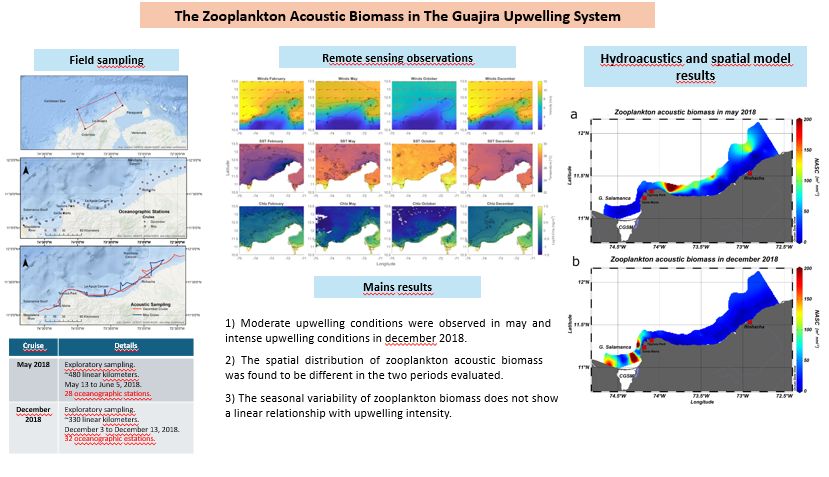
We evaluated the distribution of zooplankton biomass in the Guajira Upwelling System (Caribbean Sea) using more than 800 km of acoustic transects collected during two field campaigns in 2018: one in May (weak upwelling) and another in December (intense upwelling). Spatial variability of zooplankton acoustic biomass was modeled with geostatistical methods, and its relationships with environmental variables were assessed using generalized additive models. The results revealed marked seasonal differences in zooplankton distribution. In May, biomass was concentrated along the continental shelf edge, whereas in December it was associated with upwelling centers influenced by fluvial inputs from the Magdalena River (Gulf of Salamanca). During weak upwelling, zooplankton biomass was higher and linked to elevated dissolved oxygen concentrations and low chlorophyll-a levels. Overall, seasonal variability in zooplankton biomass did not show a linear relationship with upwelling intensity, likely reflecting complex air–ocean–river interactions in the region.
La distribución de la biomasa de zooplancton en el sistema de surgencia de La Guajira (Mar Caribe) se evaluó utilizando más de 800 km lineales de datos acústicos obtenidos de dos muestreos realizados en 2018 durante un período de surgencia débil (mayo) e intensa (diciembre). La modelación de la variabilidad espacial e interpolación de la biomasa acústica del zooplancton se realizó con un método geoestadístico, y se analizó su relación con variables ambientales a través de modelos aditivos generalizados. Se encontró que la distribución espacial de la biomasa acústica del zooplancton fue diferente en los dos períodos evaluados. Para mayo se concentró en el borde de la plataforma continental, y en diciembre se asoció con focos de surgencias o zonas con altos aportes fluviales del río Magdalena (Golfo de Salamanca). En el período de afloramiento débil, la biomasa de zooplancton fue mayor y se asoció con altas concentraciones de oxígeno disuelto y niveles bajos de clorofila-a. La variabilidad estacional de la biomasa de zooplancton no mostró una relación lineal con la intensidad de los afloramientos, probablemente como consecuencia de procesos de interacción aire-océano-río que afectan la región.
Referencias
Andrade, C. and Barton, E. (2005). The Guajira upwelling system. Cont. Shelf Res, 25(9), 1003-1022. https://doi.org/10.1016/j.csr.2004.12.012
Arones, K., Grados, D., Ayon, P. and Bertrand, A. (2019). Spatio-temporal trends in zooplankton biomass in the northern Humboldt current system off Peru from 1961-2012. Deep-Sea Res. II, 169-170, 104656. https://doi.org/10.1016/j.dsr2.2019.104656
Ballon, M., Bertrand, A., Lebourges-Dhaussy, A., Gutierrez, M., Ayon, P., Grados, D. and Gerlotto, F. (2011). Is there enough zooplankton to feed forage fish populations off Peru? An acoustic (positive) answer. Prog. Oceanogr, 91(4), 360-381. https://doi.org/10.1016/j.pocean.2011.03.001
Barua, D. K. (2019). Coastal Upwelling and Downwelling. In Finkl C.W., Makowski C. (eds). Encyclopedia of Coastal Science. Encyclopedia of Earth Sciences Series (Springer). https://doi.org/10.1007/978-3-319-93806-6_88
Behrenfeld, M. J., O’Malley, R. T., Siegel, D. A., McClain, C. R., Sarmiento, J. L., Feldman, G. C., Milligan, A. J., Falkowski, P. G., Letelier, R. M. and Boss, E. S. (2006). Climate-driven trends in contemporary ocean productivity. Nature, 444(7120), 752-755. https://doi.org/10.1038/nature05317
Beier, E., Bernal, G., Ruiz-Ochoa, M. and Barton, E. D. (2017). Freshwater exchanges and surface salinity in the Colombian basin, Caribbean Sea. PLOS ONE, 12(8), e0182116. https://doi.org/10.1371/journal.pone.0182116
Bernal, A., Werding, B. y Zea, S. (2004). Variación espacial y temporal de biomasa zooplanctónica en el sector nerítico del Mar Caribe colombiano. REMAR. 187-196. Bernal, A. y Zea, S. (2000). Estructura de la comunidad del zooplancton en condiciones de descarga continental y de afloramiento costero en Santa Marta, Caribe colombiano. Bol. Investig. Mar. Costeras, 29, 3-26.
Burd, B. J. and Thomson, R. E. (2012). Estimating Zooplankton Biomass Distribution in the Water Column Near the Endeavour Segment of Juan de Fuca Ridge Using Acoustic Backscatter and Concurrently Towed Nets. Oceanography, 25(1), 269-276. https://doi.org/10.5670/oceanog.2012.25
Burnham, K. P. and Anderson, D. R. (2002). Model Selection and Multimodel Inference: A Practical Information Theoretic Approach (2.a ed.). Springer-Verlag. https://doi.org/10.1007/b97636
Chavez, F. P. and Messie, M. (2009). A comparison of Eastern Boundary Upwelling Ecosystems. Prog. Oceanogr, 83(1), 80-96. https://doi.org/10.1016/j.pocean.2009.07.032
Checkley, D. M. and Barth, J. A. (2009). Patterns and processes in the California Current System. Prog. Oceanogr, 83(1), 49-64. https://doi.org/10.1016/j.pocean.2009.07.028
Correa-Ramirez, M., Rodriguez-Santana, A., Ricaurte-Villota, C. and Paramo, J. (2020). The Southern Caribbean upwelling system off Colombia: Water massesand mixing processes. Deep-Sea Res. I, 155, 103145. https://doi.org/10.1016/j.dsr.2019.103145
Cressie, N. (2015). Statistics for Spatial Data, Revised Edition. Wiley. Criales, M., Garcia, C. y Wolff, M. (2006). Flujos de biomasa y estructura de un ecosistema de surgencia tropical en La Guajira, Caribe colombiano. Rev Biol Trop, 54(4), 1257-1282. https://doi.org/10.15517/rbt.v54i4.3103
Cury, P. and Roy, C. (1989). Optimal Environmental Window and Pelagic Fish Recruitment Success in Upwelling Areas. Can. J. Fish. Aquat. Sci., 46(4), 670-680. https://doi.org/10.1139/f89-086
Doney, S. C. (2006). Plankton in a warmer world. Nature, 444(7120). https://doi.org/10.1038/444695a
Fleminger, A. and Clutter, R. I. (1965). Avoidance of Towed Nets by Zooplankton. Limnol. Oceanogr, 10(1), 96-104. https://doi.org/10.4319/lo.1965.10.1.0096
Foote, K. and Stanton, T. K. (2000). Acoustical methods. In Zooplankton Methodology Manual (pp. 223-258). Academic Press. https://doi.org/10.1016/B978-012327645-2/50007-4
Garcia-Hoyos, L. (2008). Dinámica en el acoplamiento océanoatmósfera y su influencia en la biomasa fitoplanctónica durante un evento de surgencia y no surgencia en la zona costera del departamento del Magdalena. [Tesis de pregrado]. Universidad Jorge Tadeo Lozano. Bogota, Colombia.
Hersbach, H., Bell, B., Berrisford, P., Hirahara, S., Horanyi, A., Munoz‐Sabater, J., Nicolas, J., Peubey, C., Radu, R., Schepers, D., Simmons, A., Soci, C., Abdalla, S., Abellan, X., Balsamo, G., Bechtold, P., Biavati, G., Bidlot, J., Bonavita, M., … Thepaut, J. (2020). The ERA5 global reanalysis. Q. J. Roy. Meteorol. Soc, 146(730), 1999-2049. https://doi.org/10.1002/qj.3803
Hickey, B., McGabe, R., Geier, S., Dever, E. P. and Kachel, N. (2009). Three interacting freshwater plumes in the northern California Current System. J. Geophys. Res., 114(2), C00B03. https://doi.org/10.1029/2008JC004907
ICES. (2003). Report of the planning group on the HAC Data Exchange Format (p. 27 pp).
IFREMER. (2021). Hydroacoustics Efficient Recording Module for EchoSounders -Hermes [Software]. https://www.flotteoceanographique.fr/en/Facilities/Shipboardsoftware/Gestion-de-missions-etdesdonnees/HERMES-and-MOVIES3D
IOC, SCOR, & IAPSO. (2010). The international thermodynamic equation of seawater – 2010: Calculation and use of thermodynamic properties. Intergovernmental Oceanographic Commission, Manuals and Guides No. 56, UNESCO.
IRD. (2018). Matecho User Manual. Institut de Recherche pour le Developpement (IRD).
Jech, J. M., Lawson, G. L. and Lowe, M. R. (2018). Comparing acoustic classification methods to estimate krill biomass in the Georges Bank region from 1999 to 2012. Limnol. Oceanogr. Methods, 16(10), 680-695. https://doi.org/10.1002/lom3.10275
Lezama-Ochoa, A., Ballon, M., Woillez, M., Grados, D., Irigoien, X. and Bertrand, A. (2011). Spatial patterns and scale-dependent relationships between macrozoplankton and fish in the Bay of Biscay: An acoustic study. Mar. Ecol. Prog. Ser., 439, 151-168. https://doi.org/10.3354/meps09318
Medellin-Mora, D. (2016). Factores y mecanismos que modulan la estructura comunitaria del mesozooplancton marino: Efecto de la estratificación vertical de la columna de agua. Concepción—Chile: [Tesis Doctoral]. Universidad de Concepcion. Concepcion, Chile.
Miller, C. and Wheeler, P. (2012). Biological Oceanography (Vol. 2). Wiley-Blackwell.
Paramo, J., Correa, M. y Nunez, S. (2011). Evidencias de desacople fisico-biologico en el sistema de surgencia en La Guajira, Caribe colombiano. Rev. Biol. Mar. Oceanogr, 46(3), 421-430. https://doi.org/10.4067/S071819572011000300011
Paramo, J., Quinones, R. A., Ramirez, A. and Wiff, R. (2003). Relationship between abundance of small pelagic fishes and environmental factors in the Colombian Caribbean Sea: An analysis based on hydroacoustic information. Aquat. Living Resour., 16(3), 239-245. https://doi.org/10.1016/S0990-7440(03)00043-3
Pebesma, E., Bivand, R., Rowlingson, B., Gomez-Rubio, V., Hijmans, R., Sumner, M., MacQueen, D., Lemon, J., Lindgren, F., O’Brien, J. and O’Rourke, J. (2021). sp: Classes and Methods for Spatial Data (Version 1.4) [R].
Perrot, Y., Brehmer, P., Habasque, J., Roudaut, G., Behagle, N., Sarre, A. and Lebourges-Dhaussy, A. (2018). Matecho: An Open-Source Tool for Processing Fisheries Acoustics Data. Acoustics Australia, 46(2), 241-248. https://doi.org/10.1007/s40857-018-0135-x
Pinheiro, J., Bates, D., DebRoy, S., Sarkar, D., Heisterkamp, S., Van Willigen, B. and Ranke, J. (2021). nlme: Linear and Nonlinear Mixed Effects Models (Version 3.1) [Software].
R Core Team. (2020). R: A language and environment for statistical computing [Software]. R Foundation for Statistical Computing. https://www.R-project.org/
Rangel-Buitrago, N. and Idarraga-Garcia, J. (2010). Geologia general, morfologia submarina y facies sedimentarias en el margen continental y los fondos oceanicos del Mar Caribe colombiano. En Biodiversidad del margen continental del Caribe colombiano (pp. 29-52). INVEMAR Serie de Publicaciones Especiales.
Restrepo, J. D. and Kjerfve, B. (2000). Magdalena river: Interannual variability (1975–1995) and revised water discharge and sediment load estimates. J. Hydrol., 235(1-2), 137-149. https://doi.org/10.1016/S0022-1694(00)00269-9
Ribero, P., Diggle, P., Christensen, O., Schlather, M., Bivand, R. and Ripley, B. (2020). geoR: Analysis of Geostatistical Data (Version 1.8) [R]. https://cran.r-project.org/web/packages/geoR/index.html
Rueda-Roa, D. T. and Muller-Karger, F. E. (2013). The southern Caribbean upwelling system: Sea surface temperature, wind forcing and chlorophyll concentration patterns. Deep-Sea Res. I, 78, 102-114. https://doi.org/10.1016/j.dsr.2013.04.008
Silva-Trujillo, L., Criales, M., Paramo, J., Gutierrez-Salcedo, J. and Linero-Cueto, J. (2017). Hydroacoustics evaluation of zooplankton in the Department of Magdalena, Colombian Caribbean. 2017 IEEE/OES Acoustics in Underwater Geosciences Symposium (RIO Acoustics), 1-20. https://doi.org/10.1109/RIOAcoustics.2017.8349761
Simmonds, F. and MacLennan, D. (2005). Target Strength of Fish. In Fisheries Acoustics: Theory and Practice (Second Edition, pp. 217-261). Wiley-Blackwell. https://doi.org/10.1002/9780470995303.ch6
Stanton, T. K., Wiebe, P. H., Chu, D. and Goodman, L. (1994). Acoustic characterization and discrimination of marine zooplankton and turbulence. ICES J. Mar. Sci., 51(4), 469-479. https://doi.org/10.1006/jmsc.1994.1048
Sverdrup, K. and Kudela, R. (2020). Investigating Oceanography (Third edition). McGraw-Hill.
Timonin, A. G., Arashkevich, E. G., Drits, A. V. and Semenova, T. N. (1992). Zooplankton dynamics in the northern Benguela ecosystem, with special reference to the copepod Calanoides carinatus. Afr. J. Mar. Sci., 12(1), 545-560. https://doi.org/10.2989/02577619209504724
Torregroza-Espinosa, A. C., Restrepo, J. C., Escobar, J., Pierini, J. and Newton, A. (2021). Spatial and temporal variability of temperature, salinity and chlorophyll-a in the Magdalena River mouth, Caribbean Sea. J. South Am. Earth Sci., 105, 102978. https://doi.org/10.1016/j.jsames.2020.102978
Torres Parra, R. R., Latandret Solana, S., Salon Barros, J. and Dagua Paz, C. J. (2023). Water masses in the Caribbean Sea and sub-annual variability in the Guajira upwelling region. Ocean Dyn., 73(2), 39-57. https://doi.org/10.1007/s10236-022-01529-5
Torres, R. and Tsimplis, M. (2012). Seasonal sea level cycle in the Caribbean Sea. J. Geophys. Res. (Oceans), 117, 3304. https://doi.org/10.1029/2012JC008159
Vasquez-Carrillo, C. and Sullivan Sealey, K. (2021). Biodiversity of Upwelling Coastal Systems of the Southern Caribbean Sea Adjacent to Guajira Peninsula. J. Mar. Sci. Eng, 9(8), 846. https://doi.org/10.3390/jmse9080846
Wang, Y. and Liu, Q. (2006). Comparison of Akaike information criterion (AIC) and Bayesian information criterion (BIC) in selection of stock–recruitment relationships. Fisheries Res., 77(2), 220-225. https://doi.org/10.1016/j.fishres.2005.08.011
Wilkerson, F. P., Lassiter, A. M., Dugdale, R. C., Marchi, A., & Hogue, V. E. (2006). The phytoplankton bloom response to wind events and upwelled nutrients during the CoOP WEST study. Deep-Sea Res. II, 53(25), 3023-3048. https://doi.org/10.1016/j.dsr2.2006.07.007
Wood, S. (2021). mgcv: Mixed GAM Computation Vehicle with Automatic Smoothness Estimation (Version 1.8) [R].
Zamora, A. (2012). La poblacion costera y sus actividades. En Atlas marino costero de La Guajira (pp. 116-131). Serie de Publicaciones Especiales de Invemar No. 27.
Dimensions
PlumX
Visitas a la página del resumen del artículo
Descargas
Cómo citar
Licencia

Esta obra está bajo una licencia internacional Creative Commons Atribución-NoComercial-CompartirIgual 4.0.
1. La aceptación de manuscritos por parte de la revista implicará, además de su edición electrónica de acceso abierto bajo licencia Attribution-NonCommercial-ShareAlike 4.0 (CC BY NC SA), la inclusión y difusión del texto completo a través del repositorio institucional de la Universidad Nacional de Colombia y en todas aquellas bases de datos especializadas que el editor considere adecuadas para su indización con miras a incrementar la visibilidad de la revista.
2. Acta Biológica Colombiana permite a los autores archivar, descargar y compartir, la versión final publicada, así como las versiones pre-print y post-print incluyendo un encabezado con la referencia bibliográfica del articulo publicado.
3. Los autores/as podrán adoptar otros acuerdos de licencia no exclusiva de distribución de la versión de la obra publicada (p. ej.: depositarla en un archivo telemático institucional o publicarla en un volumen monográfico) siempre que se indique la publicación inicial en esta revista.
4. Se permite y recomienda a los autores/as difundir su obra a través de Internet (p. ej.: en archivos institucionales, en su página web o en redes sociales cientificas como Academia, Researchgate; Mendelay) lo cual puede producir intercambios interesantes y aumentar las citas de la obra publicada. (Véase El efecto del acceso abierto).




