 Correo Electrónico
 DNINFOA - SIA
 Bibliotecas
 Convocatorias
 Identidad U.N.


Publicado
Aislamiento de microorganismos electrogénicos con potencial para reducir cromo hexavalente
Isolation of Electrogenic Microorganisms with Potential to Reduce Hexavalent Chromium
DOI:
https://doi.org/10.15446/abc.v22n1.57189Palabras clave:
ARNr 16S, biorremediación, celda de combustible microbiana, reducción de cromo. (es)16S rRNA, bioremediation, microbial fuel cell, chromium reduction. (en)
Descargas
Se realizó el aislamiento de microorganismos cultivables a partir de la biopelícula formada sobre el ánodo de una celda de combustible microbiana puesta en operación durante 30 días; los microorganismos aislados fueron evaluados en su capacidad de producir energía en celdas de combustible microbianas y de reducir el cromo hexavalente, Cr (VI). Se aislaron cinco microorganismos, los cuales fueron caracterizados mediante análisis del gen del ARNr 16S, el cual ubicó a los microorganismos en cuatro géneros bacterianos: Exiguobacterium (CrMFC1), Acinetobacter (CrMFC2), Aeromonas (CrMFC3 y CrMFC5), y Serratia (CrMFC4). Todas las cepas aisladas mostraron actividad electrogénica y capacidad para reducir cromo hexavalente; la cepa de Acinetobacter CrMFC2 mostró el mejor desempeño electroquímico al registrar una densidad de potencia máxima de 18,61 mW/m2; las demás cepas mostraron valores de densidad de potencia máxima entre 4,6 mW/m2 y 7.1 mW/m2. Las cepas de Aeromonas CrMFC5 y Exiguobacterium CrMFC1 mostraron las mejores tasas de reducción de cromo al ser capaces de reducir el 100% del Cr (VI) en menos de 24 horas, destacándose la cepa de Aeromonas CrMFC5 la cual redujo el 100 % de Cr (VI) en 10 horas; las demás cepas redujeron el 100 % del contaminante al cabo de 28 a 30 horas. Los microorganismos aislados en este estudio son escasamente conocidos por su capacidad electrogénica y de reducir el Cr (VI); no obstante, se muestran promisorios para su utilización en sistemas mixtos que involucren la producción de energía acoplada a sistema de biorremediación de aguas contaminadas con cromo.
Isolation of cultivable microorganisms was made from the biofilm formed on the anode of a microbial fuel cell put into operation for 30 days; isolated microorganisms were evaluated for their ability to produce energy and reduce the hexavalent chromium Cr (VI). Five microorganisms were isolated, which were characterized by analysis of 16S rRNA gene, placing them in four bacterial genera: Exiguobacterium (CrMFC1), Acinetobacter (CrMFC2), Aeromonas (CrMFC3 and CrMFC5) and Serratia (CrMFC4). All isolates showed electrogenic activity and ability to reduce hexavalent chromium; the Acinetobacter CrMFC1 strain showed the best electrochemical performance registering a maximum power density of 18.61 mW/m2; the other strains showed values of maximum power density between 4.6 mW/m2and 7.1 mW/m2. Strains Aeromonas CrMFC5 and Exiguobacterium CrMFC1 showed the best rates of chromium reduction being able to reduce 100 % of the Cr (VI) in less than 24 hours, the Aeromonas CrMFC5 strain was the most efficient, reducing 100 % of Cr (VI) in 10 hours; the other strains reduced 100% of the contaminant after 28 to 30 hours. The microorganisms isolated in this study are hardly known for their electrogenic capacity and for reducing Cr (VI); however, show promise for their use in combined systems involving energy production system coupled to bioremediation of chromium contaminated water.
DOI: https://doi.org/10.15446/abc.v22n1.57189
AISLAMIENTO DE MICROORGANISMOS ELECTROGÉNICOS CON POTENCIAL PARA REDUCIR CROMO HEXAVALENTE
Isolation of Electrogenic Microorganisms with Potential to Reduce Hexavalent Chromium
Alexander MORA COLLAZOS1, Enrique BRAVO MONTAÑO1.
1 Grupo de investigación en Biología de Plantas y Microorganismos, Departamento de Biología, Universidad del Valle. Ciudad Universitaria Meléndez, Calle 13 nº. 100-00. Cali, Colombia.
For correspondence. alexander.mora.collazos@gmail.com
Received: 28th April 2016, Returned for revision: 9th August 2016, Accepted: 16th September 2016.
Associate Editor: Juan F. González.
Citation/Citar este artículo como: Mora Collazos A, Bravo Montaño E. Aislamiento de microorganismos electrogénicos con potencial para reducir cromo hexavalente. Acta biol. Colomb. 2017;22(1):27-36. DOI: https://doi.org/10.15446/abc.v22n1.57189
RESUMEN
Se realizó el aislamiento de microorganismos cultivables a partir de la biopelícula formada sobre el ánodo de una celda de combustible microbiana puesta en operación durante 30 días; los microorganismos aislados fueron evaluados en su capacidad de producir energía en celdas de combustible microbianas y de reducir el cromo hexavalente, Cr (VI). Se aislaron cinco microorganismos, los cuales fueron caracterizados mediante análisis del gen del ARNr 16S, el cual ubicó a los microorganismos en cuatro géneros bacterianos: Exiguobacterium (CrMFC1), Acinetobacter (CrMFC2), Aeromonas (CrMFC3 y CrMFC5), y Serratia (CrMFC4). Todas las cepas aisladas mostraron actividad electrogénica y capacidad para reducir cromo hexavalente; la cepa de Acinetobacter CrMFC2 mostró el mejor desempeño electroquímico al registrar una densidad de potencia máxima de 18,61 mW/m2; las demás cepas mostraron valores de densidad de potencia máxima entre 4,6 mW/m2 y 7.1 mW/m2. Las cepas de Aeromonas CrMFC5 y Exiguobacterium CrMFC1 mostraron las mejores tasas de reducción de cromo al ser capaces de reducir el 100% del Cr (VI) en menos de 24 horas, destacándose la cepa de Aeromonas CrMFC5 la cual redujo el 100 % de Cr (VI) en 10 horas; las demás cepas redujeron el 100 % del contaminante al cabo de 28 a 30 horas. Los microorganismos aislados en este estudio son escasamente conocidos por su capacidad electrogénica y de reducir el Cr (VI); no obstante, se muestran promisorios para su utilización en sistemas mixtos que involucren la producción de energía acoplada a sistema de biorremediación de aguas contaminadas con cromo.
Palabras clave: ARNr 16S, biorremediación, celda de combustible microbiana, reducción de cromo.
ABSTRACT
Isolation of cultivable microorganisms was made from the biofilm formed on the anode of a microbial fuel cell put into operation for 30 days; isolated microorganisms were evaluated for their ability to produce energy and reduce the hexavalent chromium Cr (VI). Five microorganisms were isolated, which were characterized by analysis of 16S rRNA gene, placing them in four bacterial genera: Exiguobacterium (CrMFC1), Acinetobacter (CrMFC2), Aeromonas (CrMFC3 and CrMFC5) and Serratia (CrMFC4). All isolates showed electrogenic activity and ability to reduce hexavalent chromium; the Acinetobacter CrMFC1 strain showed the best electrochemical performance registering a maximum power density of 18.61 mW/m2; the other strains showed values of maximum power density between 4.6 mW/m2 and 7.1 mW/m2. Strains Aeromonas CrMFC5 and Exiguobacterium CrMFC1 showed the best rates of chromium reduction being able to reduce 100 % of the Cr (VI) in less than 24 hours, the Aeromonas CrMFC5 strain was the most efficient, reducing 100 % of Cr (VI) in 10 hours; the other strains reduced 100% of the contaminant after 28 to 30 hours. The microorganisms isolated in this study are hardly known for their electrogenic capacity and for reducing Cr (VI); however, show promise for their use in combined systems involving energy production system coupled to bioremediation of chromium contaminated water.
Keywords: 16S rRNA, bioremediation, microbial fuel cell, chromium reduction.
INTRODUCCIÓN
En las últimas décadas ha venido creciendo el interés por las llamadas celdas de combustible microbianas (MFC, por sus siglas en inglés: microbial fuel cell) debido a sus múltiples aplicaciones potenciales, que no solo incluyen la producción sostenible de energía eléctrica a partir de compuestos biodegradables, sino también la generación de otros beneficios como la biosíntesis de compuestos de interés industrial a bajo costo (Logan y Rabaey, 2012) y la descontaminación de aguas residuales y de otros sustratos complejos en procesos de biorremediación (Du et al., 2007; Ahn y Logan, 2010; Zhou et al., 2013; Chabert et al., 2015). Las MFC son sistemas bioelectroquímicos que convierten la energía química disponible en sustratos orgánicos o inorgánicos directamente en electricidad a través de la actividad metabólica de los microorganismos (Pant et al., 2010).
Una MFC típica consta de dos tipos de electrodos (ánodo y cátodo), en los cuales, dependiendo del diseño y de las condiciones operativas, se forman biopelículas microbianas, en uno u otro o en ambos electrodos. Por ejemplo, los microorganismos presentes en la biopelícula anódica oxidan catalíticamente los sustratos presentes, que en el caso de que sean compuestos orgánicos, generan protones, CO2, y electrones, que son transferidos directa o indirectamente al ánodo; éstos son llevados hasta el cátodo a través de un circuito externo donde participan en la reducción del oxígeno junto a los protones que fueron liberados en el ánodo, formando agua (Du et al., 2007; ElMekawy et al., 2014).
Los estudios sobre esta biotecnología, indican que la densidad de potencia generada por una MFC no podría llegar a ser igual o mejor que la de una pila de combustible químico (Zhou et al., 2013). Sin embargo, la posibilidad de descontaminar cuerpos de agua o degradar compuestos de desecho a bajo costo con la posibilidad de producir energía eléctrica en el proceso sin la generación de nuevos contaminantes representa un costo-beneficio importante (Zhou et al., 2013).
El desarrollo de MFC eficientes requiere de la contribución de diferentes disciplinas científicas y técnicas como la microbiología, la electroquímica y la ingeniería. Desde el enfoque microbiológico, no solo se requiere la identificación y caracterización de microorganismos con características electrogénicas, que sean capaces de transferir electrones al sistema mientras metabolizan sustratos presentes en él, sino también el estudio de la ecología de las comunidades microbianas en el entorno de la MFC (Ahn y Logan, 2010), la estratificación de la biopelícula (Wang et al., 2015) y los organismos asociados.
El cromo tiene multitud de aplicaciones industriales y ha sido objeto de estudio en los últimos años por la problemática ambiental y de salud ocupacional que genera. El metal puede presentarse en diversos compuestos con estados de oxidación de II a VI. Los estados de valencia de interés industrial son el cromo hexavalente y en menor grado el cromo trivalente (Vullo, 2003; Loayza, 2006; Mancera-Rodríguez y Álvarez-León, 2006). El Cr (VI), aunque es poco estable es muy soluble, con una alta movilidad entre sustratos, siendo un contaminante ambiental tóxico y cancerígeno (Cervantes et al., 2001; Cuberos et al., 2009; Gutiérrez et al., 2010), de allí el interés por encontrar tecnologías adecuadas orientadas a la biorremediación del cromo hexavalente. Las MFC podrían constituir una opción biotecnológica promisoria en esta dirección.
El presente trabajo tuvo como objetivo contribuir a la identificación y caracterización de microorganismos electrogénicos con la capacidad de reducir Cr (VI), presentes en la biopelícula anódica de una MFC alimentada con sustratos ambientales provenientes de agua lénticas.
MATERIALES Y MÉTODOS
Obtención de las biopelículas
Se construyó una celda de combustible microbiana sedimentaria utilizando un recipiente de 500 mL y barras de grafito como electrodos; la MFC fue alimentada e inoculada con sustratos ambientales (lodos y agua) provenientes del lago de la estación experimental del Departamento de Biología de la Universidad del Valle. El lago se encuentra ubicado en las coordenadas: 3°22' N 76°32' W; se registraron valores promedio de 2,5 mg/L de oxígeno disuelto, 7,8 de pH y 104 µS de conductividad eléctrica durante el montaje experimental. Las MFC se mantuvieron en funcionamiento durante 30 días, tiempo en el cual se garantizó la formación de biopelícula. Pasado este tiempo los ánodos fueron retirados y se tomaron muestras que fueron destinadas para el cultivo de los microorganismos.
Aislamiento de los microorganismos cultivables
Se realizó el cultivo y aislamiento de bacterias provenientes de la biopelícula formada sobre el ánodo de las MFC. Los ánodos se lavaron con agua destilada estéril y se raspó la superficie de éstos con un escarpelo estéril, el raspado se utilizó para inocular medio líquido, basándose en la composición de agua residual artificial (ARA) (Lee et al., 2003) agregando un suplemento de glucosa (20 mM). Los cultivos fueron incubados durante 24 horas, posteriormente se realizaron siembras en superficie en placas de ARA solidificadas con agar-agar, donde se seleccionaron colonias bacterianas con características morfológicas distintivas.
Caracterización morfológica y bioquímica de los microorganismos aislados
Se realizó la caracterización morfológica de los microorganismos aislados mediante observaciones macroscópicas (Microscopio estereoscópico Leica EZ4 HD) y mediante microscopía óptica (Microscopio óptico Leica DM1000); la caracterización bioquímica se realizó utilizando el kit comercial BBL™ Crystal™ Enteric/Nonfermenter ID Kit.
Caracterización molecular
Se realizó la extracción de ADN genómico a los microorganismos aislados, utilizando el kit comercial Ultra Clean Microbial DNA Isolation kit (MOBIO LAB) para obtener un producto libre de inhibidores y de buena calidad para la PCR. El ADN extraído se amplificó enzimáticamente utilizado los cebadores universales: 27F 5'AGAGTTTGATCMTGGCTCAG3' y 1492R 5' TACGGYTACCTTGTTACGACTT3'; el coctel de la PCR se preparó con base en las siguientes concentraciones finales: buffer (1X), MgCl2 (1,75 µM), dNTP's (5 µM cada uno), cebadores (4 µM cada uno), Taq polimerasa (1 unidad). El programa utilizado para la amplificación consistió en un ciclo de desnaturalización a 94 ºC durante cinco minutos, una fase de amplificación de 35 ciclos, con una desnaturalización a 94 ºC durante un minuto, hibridación a 54 ºC durante 45 segundos y extensión a 72 ºC durante 40 segundos; seguido de una última fase de un ciclo con una extensión final a 72 ºC durante diez minutos. Se determinaron las secuencias mediante procedimientos estándares del servicio suministrado por la compañía Macrogen (USA).
Las secuencias obtenidas fueron comparadas directamente con las bases de datos del GenBank y del Ribosomal Database Project; se utilizaron las herramientas de búsqueda de alineación local básica (Blast-N) y la herramienta naïve Bayesian classifier (Wang et al., 2007) para la clasificación y asignación de taxones jerárquicos. Se recolectaron secuencias de las bases de datos de las diferentes especies de los géneros que mostraron relación con las secuencias obtenidas; las secuencias fueron alineadas con el programa Bioedit Sequence Alignment Editor (Hall, 1999) y se utilizaron para la construcción de un árbol de máxima verosimilitud utilizando el software PAUP versión 4.0b10; el modelo de substitución nucleotídica fue seleccionado por el criterio de Akaike en ModelTest versión 2.1.3 (Darriba et al., 2012); el soporte estadístico fue evaluado mediante el bootstrap de máxima verosimilitud (ML) con 1000 repeticiones.
Caracterización electroquímica de los microorganismos aislados
Los microorganismos aislados fueron ensayados de forma individual en su capacidad de generar energía. Se construyeron MFC de una cámara utilizando recipientes de 100 mL. Los electrodos se construyeron utilizando piezas cilíndricas de grafito con un área superficial de 11,3 cm2; para el caso del cátodo, el electrodo fue recubierto con catalizador de platino-carbono (0,1 mg/cm2) preparada en una solución de Nafion al 5 %. El sustrato energético utilizado, consistió en caldo nutritivo (peptona 0,5 %; extracto de carne 0,3 %; NaCl 0.5 %), suplementado con glucosa al 20 mM; cada MFC se inoculó con un cultivo (10 % v/v) de cada uno de los aislados microbianos seleccionados. Las MFC se mantuvieron en funcionamiento durante 16 días, tiempo en el cual se monitoreó el desempeño electroquímico de cada microorganismo mediante colecta de curvas de densidad de potencia.
Bioensayo exploratorio de remoción de cromo hexavalente
Se evaluó el potencial de los microorganismos aislados en su capacidad para reducir Cr (VI). En los experimentos se usaron inóculos de los aislados a una concentración de 10 % v/v partiendo de un cultivo microbiano concentrado; los ensayos de reducción se llevaron a cabo a una concentración de 10 mg/L de Cr (VI) en medio LB; estos fueron incubados a 30 ºC durante 30 horas, tiempo en el cual se evaluó la remoción biológica de Cr (VI) estimada mediante la determinación del cromo hexavalente residual; para esto, se tomó una alícuota de 500 µL a la cual se le agregó 40 µL de H2SO4 al 5 M y 200 µL de una solución concentrada de difenilcarbazida; la mezcla se aforó a 10 mL con agua destilada y se dejó reaccionar durante cinco minutos. La determinación de Cr (VI) residual se estimó en medio ácido por la formación de un complejo violeta con difenilcarbazida, por espectrofotometría a una longitud de onda de 540 nm (Greenberg et al., 1992).
RESULTADOS
Aislamiento y caracterización de microorganismos
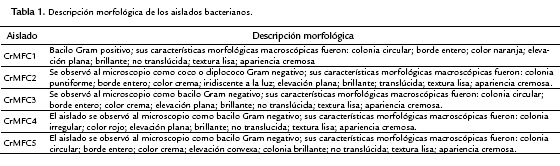
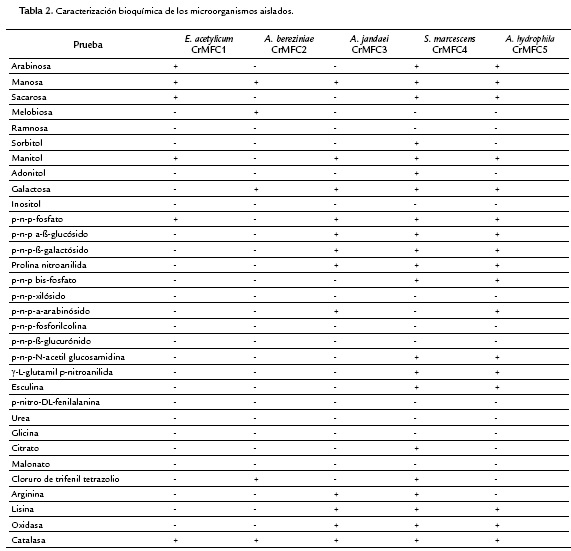
Se logró el aislamiento de cinco microorganismos con características morfológicas distintivas (tabla 1), provenientes de la biopelícula anódica de la MFC; en la tabla 2 se registran los resultados de las pruebas bioquímicas realizadas a los microorganismos aislados.
Las secuencias obtenidas a partir de los aislados bacterianos fueron depositadas en la base de datos del Genbank, con números de accesión: KU724074-KU724078. La herramienta naïve Bayesian classifier fue utilizada para comparar las secuencias obtenidas con las depositadas en la bases de datos del Ribosomal Database Project, indicando que los cinco microorganismos aislados pertenecen a cuatro géneros diferentes: Exiguobacterium, Acinetobacter, Aeromonas y Serratia. Utilizando como base los resultados de la herramienta naïve Bayesian classifier , se realizó la inferencia de la historia filogenética de las secuencias obtenidas con secuencias de las diferentes especies de los géneros Exiguobacterium, Acinetobacter, Aeromonas y Serratia; se generó un árbol por el método de máxima verosimilitud (Fig. 1); el modelo de sustitución nucleotídica utilizado fue GTR+I+G con 0,3350 como parámetro alfa de la distribución gamma, 0,44 como la proporción de sitios invariantes, las frecuencias nucleotídicas fueron T=0,2053, C=0,2327, A=0,2420 y G=0.3.

La reconstrucción filogenética, identificó al aislado CrMFC1 como Exiguobacterium acetylicum; al aislado CrMFC2 como Acinetobacter bereziniae; a los aislados CrMFC3 y CrMFC5 como Aeromonas jandaei y Aeromonas hydrophila respetivamente; el aislado CrMFC4 aparece relacionado con secuencias de Serratia marcescens (Fig. 1).
Caracterización electroquímica
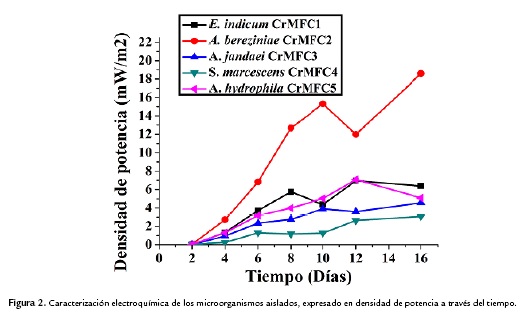
La actividad electrogénica de cada aislado fue evaluada en MFC durante 16 días (Fig. 2); todos los aislados mostraron actividad electrogénica. El mayor valor de densidad de potencia fue de 18,61 mW/m2, registrado por la cepa de A. bereziniae CrMFC2; seguido en eficiencia por las cepas de E. acetylicum CrMFC1 y A. hydrophila CrMFC5, las cuales mostraron valores de densidad de potencia máximos de 6,9 mW/m2 y 7,1 mW/m2 respectivamente; los valores de densidad de potencia más bajos se observaron en las cepas de A. jandaei CrMFC3 y S. marcescens CrMFC4 mostrando valores de densidad de potencia máxima en el día 16 de 4,6 mW/m2 y 3,07 mW/m2 respectivamente.
Bioensayos de reducción de cromo
Los resultados de remoción de Cr (VI) para cada uno de los microorganismos evaluados se muestran en la figura 3. De los cinco microorganismos evaluados, la cepa de A. hydrophila CrMFC5 y E. acetylicum CrMFC1 mostraron las mejores tasas de reducción al ser capaces de reducir el 100 % del Cr (VI) en menos de 24 horas, destacándose la cepa de A. hydrophila CrMFC5 la cual redujo el 100 % de Cr (VI) en diez horas; seguido en eficiencia por las cepas de S. marcescens CrMFC4, A. jandaei CrMFC3 y A. bereziniae CrMFC2 que redujeron el 100 % de Cr (VI) al cabo de 28 a 30 horas. Todas las cepas evaluadas se mostraron promisorias en la reducción de cromo hexavalente.
DISCUSIÓN
En este trabajo se describen cinco aislados microbianos electrogénicos con la capacidad de reducir Cr (VI), promisorios para la implementación en sistemas electrogénicos mixtos que acoplen la biorremediación de aguas contaminadas con Cr (VI).
El género Exiguobacterium morfológicamente se caracteriza por presentar colonias pigmentadas con tonalidades naranja a amarillo; todos los representantes del género son catalasa negativos, producen ácido a partir de la sacarosa y son incapaces de utilizar como fuente de carbono el adanitol, inositol y sorbitol (Vos et al., 2009); características morfológicas y bioquímicas (Tabla 1 y 2) que concuerdan con lo observado en el aislado CrMFC1, datos que respaldan el resultado obtenido mediante la inferencia filogenética (Fig. 1).
El aislado CrMFC1 se encuentra agrupado en el mismo clado que E. acetylicumy E. indicum; no obstante, el aislado CrMFC1 se muestra más relacionado con organismos de la especie de E. acetylicum. Los resultados de la prueba bioquímica (Tabla 2) contrastados con referentes bibliográficos, indican que para las pruebas de galactosa, malonato, manitol, manosa, melobiosa, sorbitol, ramnosa, glicina, lisina y arginina concuerdan con los resultados reportados para E. acetylicum; a la vez que difieren de los resultados que se reportan para E. indicum (Chaturvedi y Shivaji, 2006; Vos et al., 2009; Zhu et al., 2013).
El género Aeromonas se caracteriza por ser cocobacilos a bacilos Gram negativos, son anaerobios facultativos, generalmente oxidasa y catalasa positivos; los resultados de la pruebas bioquímicas reportados para este género (adonitol, galactosa, inositol, malonato, manitol, manosa, melobiosa, sacarosa, sorbitol, ramnosa, esculina, urea, lisina y arginina) concuerdan con los resultados reportados tanto para el aislado CrMFC 3 identificado como A. jandaei y el aislado CrMFC5 identificado como A.hydrophila (Brenner et al., 2005). Datos que confirman la clasificación obtenida mediante la inferencia filogenética (Fig. 1).
En el caso del aislado CrMFC3 se reporta una incoherencia según lo reportado por Brenner et al. (2005) en la prueba de citrato; no obstante, Abbott et al. (2003) indican que las características bioquímicas del género Aeromonas pueden presentar variaciones entre individuos de la misma especie, siendo el citrato uno de los parámetro variables.
Los organismos del género Acinetobacter son Gram negativos; las células comúnmente se organizan en pares; son oxidasa negativos y catalasa positivos (Brenner et al., 2005); los resultados de la prueba para la hidrólisis de esculina; utilización de urea, malonato, arginina y lisina concuerdan con los resultados reportados para el aislado CrMFC2 identificado como A. bereziniae (Nemec et al., 2010). Los resultados de las pruebas bioquímicas para el aislado de CrMFC4 concuerdan con lo reportado para la especie de S. marcescens (Brenner et al., 2005).
El análisis de inferencia filogenética a partir del gen del ARNr 16S, la cual esta soportada por valores de bootstrap que superan el 90 % en todos los casos (Fig. 1), las características morfológicas de los aislados y los datos bioquímicos permitieron clasificar con alto grado de confiabilidad al aislado CrMFC1 como Exiguobacterium acetylicum; al aislado CrMFC2 como Acinetobacter bereziniae; a los aislados CrMFC3 y CrMFC5 como Aeromonas jandaei y Aeromonas hydrophila respetivamente y al aislado CrMFC4 como Serratia marcescens.
Los valores de densidad de potencia registrados en la figura 2 se muestran bajos en comparación con otros autores (Liu et al., 2004; Kiely et al., 2011; Logan y Rabaey, 2012; Chabert et al., 2015); no obstante, los bajos valores registrados son producto de los materiales utilizados en la construcción de los electrodos y la poca área superficial disponible para la formación de biopelícula; los resultados obtenidos permiten inferir que las cinco cepas aisladas son microorganismos electrogénicos con un potencial más elevado del mostrado en el presente trabajo.
En la figura 2 se observa el comportamiento electrogénico de los aislados microbianos; todos los microorganismos mostraron actividad electrogénica, destacándose la cepa de A. bereziniae CrMFC2 al generar una densidad de potencia máxima de 18,61 mW/m2, valor que corresponde entre 2,6 a seis veces más que los de los demás aislados bacterianos. El género Acinetobacter es raramente conocido por su capacidad electrogénica; individuos de este género han sido detectados en electrodos de MFC mediante técnicas moleculares (Guo et al., 2016; Miran et al., 2016). Se reporta la capacidad electrogénica de un individuo del género Acinetobacter, considerando a la cepa de A. bereziniae CrMFC2 como un microorganismo con alta capacidad electrogénica y promisoria para ser usada en MFC con un potencial aun por explorar.
La actividad electrogénica del género Exiguobacterium es poco conocida; se tienen reportes de la presencia de estos microorganismos en biopelículas anódicas de MFC detectados por medio de DGGE (Rezaei et al., 2009; Ozkaya et al., 2012). La densidad de potencia generada en la MFC (Fig. 2) por la cepa E.acetylicum CrMFC1, indicaría que existen representantes del género Exiguobacterium con capacidades electrogénicas. La actividad electrogénica de los géneros de Aeromonas y Serratia han sido reportados por otros autores, quienes los consideran microorganismos eficientes en la producción de energía (Pham et al., 2003; Saranya et al., 2014).
Representantes del género Exiguobacterium se han encontrado en reactores anaerobios contaminados con metales pesados (Sahinkaya et al. 2013); Durai et al. (2011) y Sarangi y Krishnan (2008) reportan a representantes del género Exiguobacterium, con la capacidad de tolerar altas concentraciones de Cr (VI) al aislar microorganismos en tanques de agua residual de curtiembres y en suelos altamente contaminados; por otro lado, se ha demostrado que representantes del género Exiguobacterium pueden reducir altas concentraciones de Cr (VI) de manera eficiente (Okeke, 2008; Sarangi y Krishnan, 2008), datos que apoyarían la capacidad de reducir Cr (VI) mostrada por la cepa E.acetylicum CrMFC1 (Fig. 3).
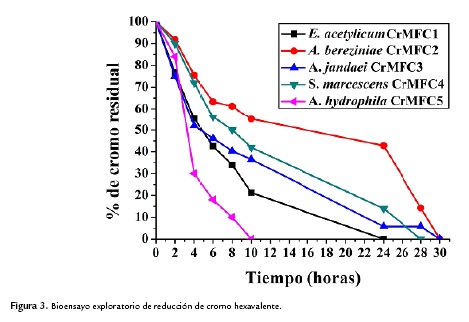
Srivastava y Thakur (2007) y Pei et al. (2009) reportaron microorganismos del género Acinetobacter con la capacidad de tolerar 100 mg/L de Cr (VI). Srivastava y Thakur (2007) consideran al género Acinetobacter promisorio para la reducción de cromo en efluentes industriales (curtiembres) al reportar un 75 % de remoción del contaminante en tres días; por otro lado, Tripathi y Garg (2013) reportan una capacidad de reducir cromo en agua residual industrial del 89 % en siete días partiendo de un bioensayo a 500 mg/L. La cepa A. bereziniae CrMFC2 no mostró las mejores tasas de remoción de cromo (Fig. 3), aun así no se descarta su potencial en tratamientos de aguas residual contaminada con Cr (VI); esta cepa sería promisoria al utilizarse en dispositivos mixtos, que puedan verse favorecidos por la elevada densidad de potencia generada por este microorganismo con el doble beneficio de reducción de cromo.
Se ha demostrado la capacidad de reducir Cr (VI) de manera eficiente en representantes del género Serratia (Mondaca et al., 2002); además de mostrase promisorios al poseer mecanismos de tolerancia a cromo; Zhang y Li (2011) reportan que su aislado bacteriano, perteneciente al género Serratia tiene la capacidad de tolerar 1.500 mg/L Cr (VI).
El potencial de reducción de Cr (VI) en organismos del género Aeromonas es poco conocido. Existen pocos reportes en donde se asocia a individuos de este género con la capacidad de tolerar metales (Ni, Cu, Zn, Cd y Cr) así como su capacidad para reducir Cr (VI) de forma eficiente (Alam y Ahmad, 2011). Se reporta la capacidad de reducir cromo en las cepas de A. jandaei CrMFC3 y A. hydrophila CrMFC5 al ser capases de reducir el 100 % de una solución de Cr (VI) a 10 mg/L al cabo de 30 y diez horas respetivamente (Fig. 2).
La Resolución 0631 de mayo 17 de 2015 del Ministerio de Ambiente Colombiano, reglamenta los valores límites máximos permisibles en vertimientos en cuerpos de agua; la norma indica que para el caso puntual de cromo se permite un vertimiento máximo de 0,5 mg/L tanto para aguas domésticas como industriales; los microorganismos presentados en este estudio demostraron tener la capacidad de reducir valores superiores a los permitidos por la norma, con el potencial de reducir el Cr (VI) en su totalidad.
Microorganismos electrogénicos con la capacidad de reducir Cr (VI) permiten la construcción de MFC con la capacidad de recuperar parte de la energía en forma de electricidad además de reducir Cr (VI) (Tandukar et al., 2009, Xafenias et al., 2014). Biopelículas asociadas a los electrodos de las MFC actúan como catalizadores en la producción de energía y en la biodegradación de compuestos (Huang et al., 2011). La búsqueda de microorganismos eficientes, la capacidad de diseñar y manipular consorcios microbianos son aspectos clave, que permite mejoras en los procesos de biorremediación como sería el caso del Cr (VI) (Pinon-Castillo et al., 2010) y la obtención de agrupaciones microbianas las cuales sean más resistentes y eficientes al trabajar en ambientes contaminados (Brune y Bayer, 2012).
CONCLUSIONES
En la actualidad, la microbiología juega un papel clave en la búsqueda de soluciones y alternativas amigables con el medio ambiente. La búsqueda y estudio de microorganismos particulares con capacidades excepcionales, brinda la posibilidad de pensar en la construcción de sistemas de tratamiento integrales con múltiples beneficios. Los microorganismos aislados en el presente trabajo, son escasamente conocidos por su capacidad electrogénica y capacidad para reducir Cr (VI); no obstante, se presentan como microorganismos promisorios, abriendo la posibilidad de construir e implementar dispositivos electrogénicos que aprovechen la capacidad de reducción de Cr (VI), haciendo rentable y eficiente la tecnología de las MFC, no solo en la producción limpia de energía sino además en la biorremediación de fuentes de agua contaminadas con Cr (VI).
AGRADECIMIENTOS
Al grupo de Investigación de Biología de Plantas y Microorganismos y al Laboratorio de Investigaciones Microbiológicas del Departamento de Biología de la Universidad del Valle. Equipos requeridos para la medición de parámetros electroquímicos fueron donados por la organización Idea Wild (USA).
CONFLICT OF INTEREST
The authors declare that they have no conflict of interest.
REFERENCIAS
Abbott SL, Cheung WKW, Janda JM. The genus Aeromonas: biochemical characteristics, atypical reactions, and phenotypic identification schemes. J Clin Microbiol. 2003;41(6):2348-2357. Doi: 10.1128/JCM.41.6.2348-2357.2003.
Ahn Y, Logan B E. Effectiveness of domestic wastewater treatment using microbial fuel cells at ambient and mesophilic temperatures. Bioresour Technol. 2010;101(2):469-475. Doi: https://doi.org/10.1016/j.biortech.2009.07.039
Alam M Z, Ahmad S. Toxic chromate reduction by resistant and sensitive bacteria isolated from tannery effluent contaminated soil. Ann Microbiol. 2011;62(1):113-121. Doi: 10.1007/s13213-011-0235-4.
Brenner DJ, Krieg N, Staley J, editors. Bergey's Manual® of Systematic Bacteriology: Volume 2 The Proteobacteria, Part B: The Gammaproteobacteria. New Delhi, India: Springer US; 2005. p. 425; 556-561; 799; 808-809.
Brune KD, Bayer TS. Engineering microbial consortia to enhance biomining and bioremediation. Front Microbiol. 2012;3(1):203. Doi: 10.3389/fmicb.2012.00203.
Cervantes C, Campos-García J, Devars S, Gutiérrez-Corona F, Loza-Tavera H, Torres-Guzmán JC, Moreno-Sánchez R. Interactions of chromium with microorganisms and plants. FEMS Microbiol Rev. 2001;25(3):335-347. Doi: https://doi.org/10.1016/S0168-6445(01)00057-2.
Chabert N, Amin Ali O, Achouak W. All ecosystems potentially host electrogenic bacteria. Bioelectrochemistry. 2015;106:88-96. Doi: https://doi.org/10.1016/j.bioelechem.2015.07.004.
Chaturvedi P, Shivaji S. Exiguobacterium indicum sp. nov., a psychrophilic bacterium from the Hamta glacier of the Himalayan mountain ranges of India. Int J Syst Evol Microbiol. 2006;56(12):2765-2770. Doi: 10.1099/ijs.0.64508-0.
Cuberos E, Rodríguez A, Prieto E. Niveles de cromo y alteraciones de salud en una población expuesta a las actividades de curtiembres en Bogotá, Colombia. Rev Salud Pública. 2009;2(11):278-289.
Darriba D, Taboada G L, Doallo R, Posada D. jModelTest 2: more models, new heuristics and parallel computing. Nat Methods. 2012;9(8):772. Doi: 10.1038/nmeth.2109.
Du Z, Li H, Gu T. A state of the art review on microbial fuel cells: a promising technology for wastewater treatment and bioenergy. Biotechnol Adv. 2007;25(5):464-482. Doi: https://doi.org/10.1016/j.biotechadv.2007.05.004.
Durai G, Rajasimman M, Rajamohan N. Aerobic digestion of tannery wastewater in a sequential batch reactor by salt-tolerant bacterial strains. Appl Water Sci. 2011;1(1):35-40. Doi: 10.1007/s13201-011-0006-1.
ElMekawy A, Hegab HM, Vanbroekhoven K, Pant D. Techno-productive potential of photosynthetic microbial fuel cells through different configurations. Renew Sust Energ Rev. 2014;39:617-627. Doi: https://doi.org/10.1016/j.rser.2014.07.116.
Greenberg AE, Clesceri LS, Eaton AD. Standard methods for the examination of water and wastewater, 18th ed. Washington. D.C: American Public Health Association; 1992. p58-60.
Guo X, Zhan Y, Chen C, Cai B, Wang Y, Guo S. Influence of packing material characteristics on the performance of microbial fuel cells using petroleum refinery wastewater as fuel. Renew Energy. 2016;87:437-444. Doi: https://doi.org/10.1016/j.renene.2015.10.041.
Gutiérrez JF, Espino AE, Coreño A, Acevedo FJ, Reyna G, Fernández FJ, et al. Mecanismos de interacción con cromo y aplicaciones biotecnológicas en hongos. Rev Latinoam Biotecnol Amb Algal. 2010;1(1):47-63.
Hall T. BioEdit: a user-friendly biological sequence alignment editor and analysis program for Windows 95/98/NT. Nucleic Acids Symp Ser. 1999;41:95-98.
Huang L, Chai X, Chen G, Logan BE. Effect of set potential on hexavalent chromium reduction and electricity generation from biocathode microbial fuel cells. Environ Sci Technol. 2011;45(11):5025-5031. Doi: 10.1021/es103875d.
Kiely PD, Cusick R, Call DF, Selembo PA, Regan JM, Logan BE. Anode microbial communities produced by changing from microbial fuel cell to microbial electrolysis cell operation using two different wastewaters. Bioresour Technol. 2011;102(1):388-394. Doi: https://doi.org/10.1016/j.biortech.2010.05.019.
Lee J, Phung NT, Chang IS, Kim BH, Sung HC. Use of acetate for enrichment of electrochemically active microorganisms and their 16S rDNA analyses. FEMS Microbiol Lett. 2003;223(2):185-191. Doi: https://doi.org/10.1016/S0378-1097(03)00356-2.
Liu H, Cheng S, Logan BE. Production of electricity from acetate or butyrate using a single-chamber microbial fuel cell. Environ Sci Technol. 2004;39(2):658-662. Doi: 10.1021/es048927c.
Loayza JE. Estudio de Investigación: Gestión integral de residuos peligrosos. Boletín electrónico informativo sobre productos y residuos químicos. 2006;2(13):1-4.
Logan BE, Rabaey K. Conversion of wastes into bioelectricity and chemicals by using microbial electrochemical technologies. Science. 2012;337(6095):686-690. Doi: 10.1126/science.1217412.
Mancera-Rodriguez N J, Álvarez-León R. Estado del conocimiento de las concentraciones de mercurio y otros metals pesados en peces dulceacuícolas de Colombia. Acta biol Colomb. 2006;11:3-23.
Miran W, Nawaz M, Jang J, Lee DS. Conversion of orange peel waste biomass to bioelectricity using a mediator-less microbial fuel cell. Sci Total Environ. 2016;547:197-205. Doi: https://doi.org/10.1016/j.scitotenv.2016.01.004.
Mondaca M, Campos V, Moraga R, Zaror CA. Chromate reduction in Serratia marcescens isolated from tannery effluent and potential application for bioremediation of chromate pollution. Scientific World Journal. 2002;2:972-977. Doi: 10.1100/tsw.2002.154.
Nemec A, Musilek M, Sedo O, De Baere T, Maixnerova M, van der Reijden T, et al.Acinetobacter bereziniae sp. nov. and Acinetobacter guillouiae sp. nov., to accommodate Acinetobacter genomic species 10 and 11, respectively. Int J Syst Evol Microbiol. 2010;60(4):896-903. Doi: 10.1099/ijs.0.013656-0.
Okeke BC. Bioremoval of hexavalent chromium from water by a salt tolerant bacterium, Exiguobacterium sp. GS1. J Ind Microbiol Biotechnol. 2008;35(12):1571-1579. Doi: 10.1007/s10295-008-0399-5.
Ozkaya B, Akoglu B, Karadag D, Aci G, Taskan E, Hasar H. Bioelectricity production using a new electrode in a microbial fuel cell. Bioprocess Biosyst Eng. 2012;35(7):1219-1227. Doi: 10.1007/s00449-012-0709-1.
Pant D, Van-Bogaert G, Diels L, Vanbroekhoven K. A review of the substrates used in microbial fuel cells (MFCs) for sustainable energy production. Bioresour Technol. 2010;101(6):1533-1543. Doi: https://doi.org/10.1016/j.biortech.2009.10.017.
Pei QH, Shahir S, Santhana-Raj AS, Zakaria ZA, Ahmad WA. Chromium(VI) resistance and removal by Acinetobacter haemolyticus. World J Microbiol Biotechnol. 2009;25(6):1085-1093. Doi: 10.1007/s11274-009-9989-2.
Pinon-Castillo H, Brito E, Goni-Urriza M, Guyoneaud R, Duran R, Nevarez-Moorillon GV, et al. Hexavalent chromium reduction by bacterial consortia and pure strains from an alkaline industrial effluent. J Appl Microbiol.2010;109(6):2173-2182. Doi: 10.1111/j.1365-2672.2010.04849.x.
Pham CA, Jung SJ, Phung NT, Lee J, Chang IS, Kim BH, et al. A novel electrochemically active and Fe(III)-reducing bacterium phylogenetically related to Aeromonas hydrophila, isolated from a microbial fuel cell. FEMS Microbiol Lett. 2003;223(1):129-134. Doi: https://doi.org/10.1016/S0378-1097(03)00354-9.
Rezaei F, Xing D, Wagner R, Regan JM, Richard TL, Logan BE. Simultaneous cellulose degradation and electricity production by Enterobacter cloacae in a microbial fuel cell. Appl Environ Microbiol. 2009;75(11):3673-3678. Doi: 10.1128/aem.02600-08.
Sahinkaya E, Kilic A, Calimlioglu B, Toker Y. Simultaneous bioreduction of nitrate and chromate using sulfur-based mixotrophic denitrification process. J Hazard Mater. 2013;262:234-239. Doi: https://doi.org/10.1016/j.jhazmat.2013.08.050.
Sarangi A, Krishnan C. Comparison of in vitro Cr(VI) reduction by CFEs of chromate resistant bacteria isolated from chromate contaminated soil. Bioresour Technol. 2008;99(10):4130-4137. Doi: https://doi.org/10.1016/j.biortech.2007.08.059.
Saranya S, Lavanya V, Jasmine M, Priya R. Bioelectricity production from microbial fuel cell using Serratia marcescens. Int J Adv Interdiscip Res. 2014;1(6):27-30.
Srivastava S, Thakur IS. Evaluation of biosorption potency of Acinetobacter sp. for removal of hexavalent chromium from tannery effluent. Biodegradation. 2007;18(5):637-646. Doi: 10.1007/s10532-006-9096-0.
Tandukar M, Huber SJ, Onodera T, Pavlostathis SG. Biological chromium(VI) reduction in the cathode of a microbial fuel cell. Environ Sci Technol. 2009;43(21):8159-8165. Doi: 10.1021/es9014184.
Tripathi M, Garg SK. Co-remediation of pentachlorophenol and Cr6+ by free and immobilized cells of native Bacillus cereus isolate: spectrometric characterization of PCP dechlorination products, bioreactor trial and chromate reductase activity. Process Biochem. 2013;48(3):496-509. Doi: https://doi.org/10.1016/j.procbio.2013.02.009.
Vos P, Garrity G, Jones D; Krieg N, Ludwig W, Rainey F, Schleifer KH, Whitman W, editors. Bergey's Manual of Systematic Bacteriology: Volume 3: The Firmicutes. New Delhi: Springer-Verlag New York; 2009. p. 460-463.
Vullo DL. Microorganismos y metales pesados: una interacción en beneficio del medio ambiente. Revista Química Viva. 2003;2(3):93-104.
Wang Q, Garrity GM, Tiedje JM, Cole JR. Naive bayesian classifier for rapid assignment of rRNA sequences into the new bacterial taxonomy. Appl Environ Microbiol. 2007;73(16):5261-5267. Doi: 10.1128/AEM.00062-07.
Wang N, Chen Z, Li HB, Su JQ, Zhao F, Zhu YG. Bacterial community composition at anodes of microbial fuel cells for paddy soils: the effects of soil properties. J Soils Sediments. 2015;15(4):926-936. Doi: 10.1007/s11368-014-1056-4.
Xafenias N, Zhang Y, Banks CJ. Evaluating hexavalent chromium reduction and electricity production in microbial fuel cells with alkaline cathodes. Int J Environ Sci Technol. 2014;12(8): 2435-2446. Doi: 10.1007/s13762-014-0651-7.
Zhang K. Li F. Isolation and characterization of a chromium-resistant bacterium Serratia sp. Cr-10 from a chromate-contaminated site. Appl Microbiol Biotechnol. 2011;90(3):1163-1169. Doi: 10.1007/s00253-011-3120-y.
Zhou M, Wang H, Hassett DJ, Gu T. Recent advances in microbial fuel cells (MFCs) and microbial electrolysis cells (MECs) for wastewater treatment, bioenergy and bioproducts. J Chem Technol Biotechnol. 2013;88(4):508-518. Doi: 10.1002/jctb.4004.
Zhu W, Lan Y, Lou X, Han N, Ran T, Xu L, et al. Isolation of proteorhodopsin-bearing bacterium JL-3 from fresh water and characterization of the proteorhodopsin. FEMS Microbiol Lett. 2013;344(1):10-17. Doi: https://doi.org/10.1111/1574-6968.12144.
Referencias
Abbott SL, Cheung WKW, Janda JM. The genus Aeromonas: biochemical characteristics, atypical reactions, and phenotypic identification schemes. J Clin Microbiol. 2003;41(6):2348-2357. Doi:10.1128/JCM.41.6.2348-2357.2003
Ahn Y, Logan B E. Effectiveness of domestic wastewater treatment using microbial fuel cells at ambient and mesophilic temperatures. Bioresour Technol. 2010;101(2):469-475. Doi:http://dx.doi.org/10.1016/j.biortech.2009.07.039
Alam M Z, Ahmad S. Toxic chromate reduction by resistant and sensitive bacteria isolated from tannery effluent contaminated soil. Ann Microbiol. 2011;62(1):113-121. Doi:10.1007/s13213-011-0235-4
Brenner DJ, Krieg N, Staley J, editors. Bergey's Manual® of Systematic Bacteriology: Volume 2 The Proteobacteria, Part B: The Gammaproteobacteria. New Delhi, India: Springer US; 2005. p. 425; 556-561; 799; 808-809.
Brune KD, Bayer TS. Engineering microbial consortia to enhance biomining and bioremediation. Front Microbiol. 2012;3(1):203. Doi:10.3389/fmicb.2012.00203
Cervantes C, Campos-García J, Devars S, Gutiérrez-Corona F, Loza-Tavera H, Torres-Guzmán JC, Moreno-Sánchez R. Interactions of chromium with microorganisms and plants. FEMS Microbiol Rev. 2001;25(3):335-347. Doi:http://dx.doi.org/10.1016/S0168-6445(01)00057-2
Chabert N, Amin Ali O, Achouak W. All ecosystems potentially host electrogenic bacteria. Bioelectrochemistry. 2015;106:88-96. Doi:http://dx.doi.org/10.1016/j.bioelechem.2015.07.004
Chaturvedi P, Shivaji S. Exiguobacterium indicum sp. nov., a psychrophilic bacterium from the Hamta glacier of the Himalayan mountain ranges of India. Int J Syst Evol Microbiol. 2006;56(12):2765-2770. Doi:10.1099/ijs.0.64508-0
Cuberos E, Rodríguez A, Prieto E. Niveles de cromo y alteraciones de salud en una población expuesta a las actividades de curtiembres en Bogotá, Colombia. Rev Salud Pública. 2009;2(11):278-289.
Darriba D, Taboada G L, Doallo R, Posada D. jModelTest 2: more models, new heuristics and parallel computing. Nat Methods. 2012;9(8):772. Doi:10.1038/nmeth.2109
Du Z, Li H, Gu T. A state of the art review on microbial fuel cells: a promising technology for wastewater treatment and bioenergy. Biotechnol Adv. 2007;25(5):464-482. Doi: http://dx.doi.org/10.1016/j.biotechadv.2007.05.004
Durai G, Rajasimman M, Rajamohan N. Aerobic digestion of tannery wastewater in a sequential batch reactor by salt-tolerant bacterial strains. Appl Water Sci. 2011;1(1):35-40. Doi:10.1007/s13201-011-0006-1
ElMekawy A, Hegab HM, Vanbroekhoven K, Pant D. Techno-productive potential of photosynthetic microbial fuel cells through different configurations. Renew Sust Energ Rev. 2014;39:617-627. Doi: http://dx.doi.org/10.1016/j.rser.2014.07.116
Greenberg AE, Clesceri LS, Eaton AD. Standard methods for the examination of water and wastewater, 18th ed. Washington. D.C: American Public Health Association; 1992. p58-60.
Guo X, Zhan Y, Chen C, Cai B, Wang Y, Guo S. Influence of packing material characteristics on the performance of microbial fuel cells using petroleum refinery wastewater as fuel. Renew Energy. 2016;87:437-444. Doi: http://dx.doi.org/10.1016/j.renene.2015.10.041
Gutiérrez JF, Espino AE, Coreño A, Acevedo FJ, Reyna G, Fernández FJ, et al. Mecanismos de interacción con cromo y aplicaciones biotecnológicas en hongos. Rev Latinoam Biotecnol Amb Algal. 2010;1(1):47-63.
Hall T. BioEdit: a user-friendly biological sequence alignment editor and analysis program for Windows 95/98/NT. Nucleic Acids Symp Ser. 1999;41:95-98.
Huang L, Chai X, Chen G, Logan BE. Effect of set potential on hexavalent chromium reduction and electricity generation from biocathode microbial fuel cells. Environ Sci Technol. 2011;45(11):5025-5031. Doi:10.1021/es103875d
Kiely PD, Cusick R, Call DF, Selembo PA, Regan JM, Logan BE. Anode microbial communities produced by changing from microbial fuel cell to microbial electrolysis cell operation using two different wastewaters. Bioresour Technol. 2011;102(1):388-394. Doi: http://dx.doi.org/10.1016/j.biortech.2010.05.019
Lee J, Phung NT, Chang IS, Kim BH, Sung HC. Use of acetate for enrichment of electrochemically active microorganisms and their 16S rDNA analyses. FEMS Microbiol Lett. 2003;223(2):185-191. Doi:http://dx.doi.org/10.1016/S0378-1097(03)00356-2
Liu H, Cheng S, Logan BE. Production of electricity from acetate or butyrate using a single-chamber microbial fuel cell. Environ Sci Technol. 2004;39(2):658-662. Doi: 10.1021/es048927c
Loayza JE. Estudio de Investigación: Gestión integral de residuos peligrosos. Boletín electrónico informativo sobre productos y residuos químicos. 2006;2(13):1-4.
Logan BE, Rabaey K. Conversion of wastes into bioelectricity and chemicals by using microbial electrochemical technologies. Science. 2012;337(6095):686-690. Doi: 10.1126/science.1217412
Mancera-Rodriguez N J, Álvarez-León R. Estado del conocimiento de las concentraciones de mercurio y otros metals pesados en peces dulceacuícolas de Colombia. Acta biol Colomb. 2006;11:3-23.
Miran W, Nawaz M, Jang J, Lee DS. Conversion of orange peel waste biomass to bioelectricity using a mediator-less microbial fuel cell. Sci Total Environ. 2016;547:197-205. Doi:http://dx.doi.org/10.1016/j.scitotenv.2016.01.004
Mondaca M, Campos V, Moraga R, Zaror CA. Chromate reduction in Serratia marcescens isolated from tannery effluent and potential application for bioremediation of chromate pollution. Scientific World Journal. 2002;2:972-977. Doi:10.1100/tsw.2002.154
Nemec A, Musilek M, Sedo O, De Baere T, Maixnerova M, van der Reijden T, et al. Acinetobacter bereziniae sp. nov. and Acinetobacter guillouiae sp. nov., to accommodate Acinetobacter genomic species 10 and 11, respectively. Int J Syst Evol Microbiol. 2010;60(4):896-903. Doi: 10.1099/ijs.0.013656-0
Okeke BC. Bioremoval of hexavalent chromium from water by a salt tolerant bacterium, Exiguobacterium sp. GS1. J Ind Microbiol Biotechnol. 2008;35(12):1571-1579. Doi: 10.1007/s10295-008-0399-5
Ozkaya B, Akoglu B, Karadag D, Aci G, Taskan E, Hasar H. Bioelectricity production using a new electrode in a microbial fuel cell. Bioprocess Biosyst Eng. 2012;35(7):1219-1227. Doi:10.1007/s00449-012-0709-1
Pant D, Van-Bogaert G, Diels L, Vanbroekhoven K. A review of the substrates used in microbial fuel cells (MFCs) for sustainable energy production. Bioresour Technol. 2010;101(6):1533-1543. Doi:http://dx.doi.org/10.1016/j.biortech.2009.10.017
Pei QH, Shahir S, Santhana-Raj AS, Zakaria ZA, Ahmad WA. Chromium(VI) resistance and removal by Acinetobacter haemolyticus. World J Microbiol Biotechnol. 2009;25(6):1085-1093. Doi:10.1007/s11274-009-9989-2
Pinon-Castillo H, Brito E, Goni-Urriza M, Guyoneaud R, Duran R, Nevarez-Moorillon GV, et al. Hexavalent chromium reduction by bacterial consortia and pure strains from an alkaline industrial effluent. J Appl Microbiol.2010;109(6):2173-2182. Doi:10.1111/j.1365-2672.2010.04849.x
Pham CA, Jung SJ, Phung NT, Lee J, Chang IS, Kim BH, et al. A novel electrochemically active and Fe(III)-reducing bacterium phylogenetically related to Aeromonas hydrophila, isolated from a microbial fuel cell. FEMS Microbiol Lett. 2003;223(1):129-134. Doi:http://dx.doi.org/10.1016/S0378-1097(03)00354-9
Rezaei F, Xing D, Wagner R, Regan JM, Richard TL, Logan BE. Simultaneous cellulose degradation and electricity production by Enterobacter cloacae in a microbial fuel cell. Appl Environ Microbiol. 2009;75(11):3673-3678. Doi:10.1128/aem.02600-08
Sahinkaya E, Kilic A, Calimlioglu B, Toker Y. Simultaneous bioreduction of nitrate and chromate using sulfur-based mixotrophic denitrification process. J Hazard Mater. 2013;262:234-239. Doi:http://dx.doi.org/10.1016/j.jhazmat.2013.08.050
Sarangi A, Krishnan C. Comparison of in vitro Cr(VI) reduction by CFEs of chromate resistant bacteria isolated from chromate contaminated soil. Bioresour Technol. 2008;99(10):4130-4137. Doi:http://dx.doi.org/10.1016/j.biortech.2007.08.059
Saranya S, Lavanya V, Jasmine M, Priya R. Bioelectricity production from microbial fuel cell using Serratia marcescens. Int J Adv Interdiscip Res. 2014;1(6):27-30.
Srivastava S, Thakur IS. Evaluation of biosorption potency of Acinetobacter sp. for removal of hexavalent chromium from tannery effluent. Biodegradation. 2007;18(5):637-646. Doi:10.1007/s10532-006-9096-0
Tandukar M, Huber SJ, Onodera T, Pavlostathis SG. Biological chromium(VI) reduction in the cathode of a microbial fuel cell. Environ Sci Technol. 2009;43(21):8159-8165. Doi: 10.1021/es9014184
Tripathi M, Garg SK. Co-remediation of pentachlorophenol and Cr6+ by free and immobilized cells of native Bacillus cereus isolate: spectrometric characterization of PCP dechlorination products, bioreactor trial and chromate reductase activity. Process Biochem. 2013;48(3):496-509. Doi:http://dx.doi.org/10.1016/j.procbio.2013.02.009
Vos P, Garrity G, Jones D; Krieg N, Ludwig W, Rainey F, Schleifer KH, Whitman W, editors. Bergey's Manual of Systematic Bacteriology: Volume 3: The Firmicutes. New Delhi: Springer-Verlag New York; 2009. p. 460-463.
Vullo DL. Microorganismos y metales pesados: una interacción en beneficio del medio ambiente. Revista Química Viva. 2003;2(3):93-104.
Wang Q, Garrity GM, Tiedje JM, Cole JR. Naive bayesian classifier for rapid assignment of rRNA sequences into the new bacterial taxonomy. Appl Environ Microbiol. 2007;73(16):5261-5267. Doi:10.1128/AEM.00062-07
Wang N, Chen Z, Li HB, Su JQ, Zhao F, Zhu YG. Bacterial community composition at anodes of microbial fuel cells for paddy soils: the effects of soil properties. J Soils Sediments. 2015;15(4):926-936. Doi:10.1007/s11368-014-1056-4
Xafenias N, Zhang Y, Banks CJ. Evaluating hexavalent chromium reduction and electricity production in microbial fuel cells with alkaline cathodes. Int J Environ Sci Technol. 2014;12(8): 2435-2446. Doi:10.1007/s13762-014-0651-7
Zhang K. Li F. Isolation and characterization of a chromium-resistant bacterium Serratia sp. Cr-10 from a chromate-contaminated site. Appl Microbiol Biotechnol. 2011;90(3):1163-1169. Doi:10.1007/s00253-011-3120-y
Zhou M, Wang H, Hassett DJ, Gu T. Recent advances in microbial fuel cells (MFCs) and microbial electrolysis cells (MECs) for wastewater treatment, bioenergy and bioproducts. J Chem Technol Biotechnol. 2013;88(4):508-518. Doi:10.1002/jctb.4004
Zhu W, Lan Y, Lou X, Han N, Ran T, Xu L, et al. Isolation of proteorhodopsin-bearing bacterium JL-3 from fresh water and characterization of the proteorhodopsin. FEMS Microbiol Lett. 2013;344(1):10-17. Doi:http://dx.doi.org/10.1111/1574-6968.12144
Cómo citar
APA
ACM
ACS
ABNT
Chicago
Harvard
IEEE
MLA
Turabian
Vancouver
Descargar cita
CrossRef Cited-by
1. Yisong Hu, Lulu Zha, Luhe Tang, Jingyu Zhang, Weihang Deng, Yuan Yang, Zhenzhen Yu, Rong Chen. (2024). Enhanced antifouling behavior and phosphorus removal in a gravity-driven electrochemical dynamic membrane bioreactor (EDMBR) process: Performance and mechanisms. Chemical Engineering Journal, 498, p.155327. https://doi.org/10.1016/j.cej.2024.155327.
2. S. Rojas-Flores, M. De La Cruz Noriega, Santiago M. Benites, G. Aguirre Gonzales, A. Salvador Salinas, F. Silva Palacios. (2020). Generation of bioelectricity from fruit waste. Energy Reports, 6, p.37. https://doi.org/10.1016/j.egyr.2020.10.025.
3. Songhua Li, Yisong Hu, Jinzhuo Shi, Wenqian Xiao, Yuan Yang, Rong Chen. (2025). Electro-conductive nylon mesh assisted electro-chemical membrane bioreactor process (EMBR) for municipal wastewater treatment. Journal of Water Process Engineering, 76, p.108303. https://doi.org/10.1016/j.jwpe.2025.108303.
4. Laura Andrea Acero Páez, Duverney Gaviria Arias. (2025). Análisis In Silico de la molécula OmcZ presente en los Nanocables Proteicos Conductores de Electricidad en Geobacter sulfurreducens. Revista Colombiana de Biotecnología, 27(1), p.37. https://doi.org/10.15446/rev.colomb.biote.v27n1.112409.
Dimensions
PlumX
Visitas a la página del resumen del artículo
Descargas
Licencia
Derechos de autor 2017 Acta Biológica Colombiana

Esta obra está bajo una licencia internacional Creative Commons Atribución 4.0.
1. La aceptación de manuscritos por parte de la revista implicará, además de su edición electrónica de acceso abierto bajo licencia Attribution-NonCommercial-ShareAlike 4.0 (CC BY NC SA), la inclusión y difusión del texto completo a través del repositorio institucional de la Universidad Nacional de Colombia y en todas aquellas bases de datos especializadas que el editor considere adecuadas para su indización con miras a incrementar la visibilidad de la revista.
2. Acta Biológica Colombiana permite a los autores archivar, descargar y compartir, la versión final publicada, así como las versiones pre-print y post-print incluyendo un encabezado con la referencia bibliográfica del articulo publicado.
3. Los autores/as podrán adoptar otros acuerdos de licencia no exclusiva de distribución de la versión de la obra publicada (p. ej.: depositarla en un archivo telemático institucional o publicarla en un volumen monográfico) siempre que se indique la publicación inicial en esta revista.
4. Se permite y recomienda a los autores/as difundir su obra a través de Internet (p. ej.: en archivos institucionales, en su página web o en redes sociales cientificas como Academia, Researchgate; Mendelay) lo cual puede producir intercambios interesantes y aumentar las citas de la obra publicada. (Véase El efecto del acceso abierto).













