
Publicado
Escape or be Preyed: New Records and Current Knowledge on Predators of Pseudinae Frogs (Anura: Hylidae) in South America
Escape o sea presa: nuevos registros y conocimiento actual sobre depredadores de ranas Pseudinae (Anura: Hylidae) en América del sur
DOI:
https://doi.org/10.15446/abc.v24n2.74650Palabras clave:
Anura, aquatic birds, aquatic insects, predator-prey interactions (en)Anura, aves acuáticas, insectos acuáticos, interacción depredador-presa (es)
Descargas
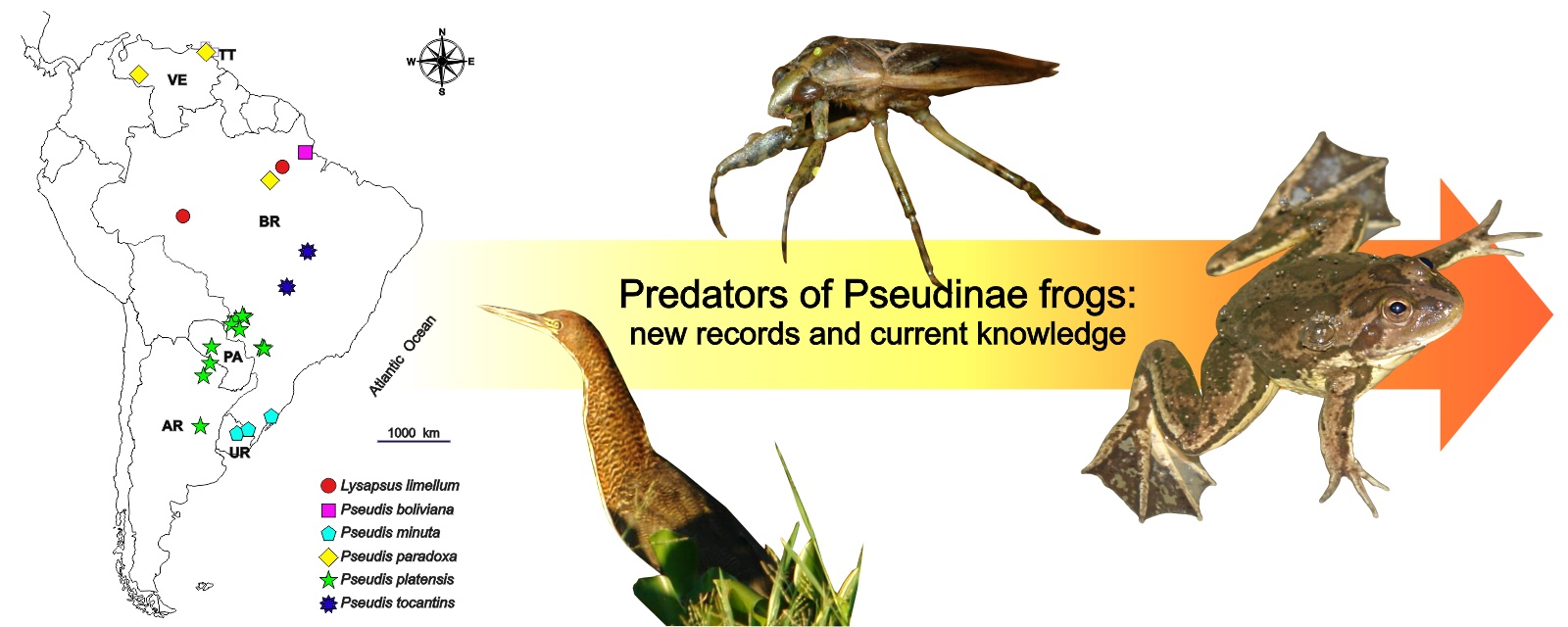
Neotropical amphibians play important roles as preys and predators in freshwater and terrestrial ecosystems. The subfamily Pseudinae includes small and medium-sized frogs within three genera representing 13 valid species. Most published records of predation on Pseudinae frogs are anecdotic and scarce. Herein, we provide five new reports of predation and presenting a detailed literature review on Pseudinae predation, with 15 studies published between 1983-2017. Pseudinae species were preyed at both day and night by a wide variety of predators, principally birds. Adults were preyed upon more frequently than juveniles and tadpoles. In the present study, most predators were diurnal, with birds accounting for most records. A variety of invertebrates prey on anurans, but water bugs and spiders are the most common ones. In the present study, water bugs comprised 75 % of the Pseudinae predation records by invertebrates. However, anuran predation by invertebrates remains poorly documented. Thus, the description of new cases of predation accompanied by a review of the data available in the literature is crucial to understanding Neotropical food webs.
Los anfibios neotropicales desempeñan papeles importantes como depredadores y presas en los ecosistemas dulce acuícolas y terrestres. La subfamilia Pseudinae incluye ranas pequeñas y medianas, distribuidas en tres géneros y representando 13 especies válidas. Los registros de depredación de Pseudinae son escasos y anecdóticos. Por lo tanto, el conocimiento de nuevos casos puede mejorar nuestra comprensión de las relaciones depredador-presa entre estas ranas y su papel en la cadena trófica. Presentamos cinco nuevos registros de depredación y revisamos los casos de depredación de la literatura, que incluyen 15 estudios publicados entre 1983 y 2017. Las especies de Pseudinae son depredadas, tanto durante el día como en la noche, por una gran variedad de depredadores, principalmente aves. Los adultos son más frecuentemente depredados que los juveniles y los renacuajos. En el presente estudio, las chinches de agua representan 75 % de los registros de depredación de Pseudinae por invertebrados. Sin embargo, depredación de anuros por invertebrados permanece poco documentada. Por lo tanto, la descripción de nuevos casos de depredación, junto a una revisión de los datos disponibles en la literatura es crucial para entender redes tróficas neotropicales.
Referencias
Ávila RW, Ferreira VL. Riqueza e densidade de vocalizações de anuros (Amphibia) em uma área urbana de Corumbá, Mato Grosso do Sul, Brasil. Rev Bras Zool. 2004;21(4):887-892. Doi: https://doi.org/10.1590/S0101-81752004000400024
Baía RRJ, Costa-Campos CE, Furtado MFM, Silva e Silva YB. Pseudis boliviana (Harlequin Frog). Predation. Herpetol Rev. 2016;47(1):118.
Brandão RA, Peres Jr AK. Levantamento da Herpetofauna na área de influência do Aproveitamento Hidroelétrico da UHE Luís Eduardo Magalhães, Palmas, TO. Humanitas. 2001;3(1):35-50.
Brandão RA, Garda A, Braz V, Fonseca B. Observations on the ecology of Pseudis bolbodactyla (Anura, Pseudidae) in central Brazil. Phyllomedusa. 2003;2(1):3-8. Doi: https://doi.org/10.11606/issn.2316-9079.v2i1p03-08
Buxton VL, Sperry JH. Reproductive decisions in anurans: A review of how predation and competition effects the deposition of eggs and tadpoles. BioScience. 2016;67(1):26-38. Doi: https://doi.org/10.1093/biosci/biw149
Campos Z. Caiman crocodilus yacare (Pantanal Caiman). Food-Related Movement. Herpetol Rev. 2003;34(2):140-141.
Ceron K, Ferreira VL, Tomas WM, Santana DJ. Battle of giants: Predation on giant tadpole of Pseudis platensis (Anura: Hylidae) by a giant water bug (Hemiptera: Belostomatidae). Herpetol Notes. 2017;10:263-265.
Chase JM, Abrams PA, Grover JP, Diehl S, Chesson P, Holt RD, Richards SA, Nisbet RM, Case TJ. The interaction between predation and competition: a review and synthesis. Ecol Lett. 2002;5(2):302-315. Doi: http://www.doi.org/10.1046/j.1461-0248.2002.00315.x
Cortés-Gomez AM, Ruiz-Agudelo CA, Valencia-Aguilar A, Ladle RJ. Ecological functions of neotropical amphibians and reptiles: a review. Univ Sci. 2015;20(2):229-245. Doi: http://www.doi.org/10.11144/Javeriana.SC20-2.efna
Downie JR, Ramnarine I, Sams K, Walsh PT. The paradoxical frog Pseudis paradoxa: larval habitat, growth and metamorphosis. Herpetol J. 2009;19(1):11-19.
Duellman WE, Marion AB, Hedges SB. Phylogenetics, classification, and biogeography of the tree frogs (Amphibia: Anura: Arboranae). Zootaxa. 2016;4104(1):1-109. Doi: http://www.doi.org/10.11646/zootaxa.4104.1.1.
Frey-Dargas JH, Landgref-Filho P, Aoki C, Sousa DLH, Souza EO. Pseudis platensis (Paradox frog) predation. Herpetol Rev. 2014;45(2):306-307.
Frost DR. Amphibian species of the world: an online reference [Version 6.0]. Available at: http://research.amnh.org/vz/herpetology/amphibia/. Cited 1 Aug 2018.
Garda AA, Costa GC, França FGR, Mesquita DO. Ecology of Lysapsus limellum in the Brazilian Amazon river basin. Herpetol J. 2007;17(3):141-148.
Gobel N, Cortizas S, Mautone JM, Borteiro C, Laufer G. Predation of Pseudis minuta Günther 1858, by Lethocerus annulipes (Heteroptera: Belostomatidae). Cuad Herpetol. 2013;27(1):63.
González JA. Seasonal variation in the foraging ecology of the Wood Stork in the southern Llanos of Venezuela. The Condor. 1997;99(3):671-680.
Hamer AJ, Parris KM. Predation modifies larval amphibian communities in urban wetlands. Wetlands. 2013;33(4):641-652. Doi: https://doi.org/10.1007/s13157-013-0420-2
Hocking DJ, Babbitt KJ. Amphibian contributions to ecosystem services. Herpetol Conserv Biol. 2014;9(1):1-17.
Landgref Filho P, Aoki C, Godoi MN. Pseudis platensis (Paradox Frog). Predation. Herpetol Rev. 2011;42(1):90.
Lema T, Araujo ML, Azevedo ACP. Contribuição ao conhecimento da alimentação e do modo alimentar de serpentes do Brasil. Comum Mus Ciênc Tecnol PUCRS, Sér Zool. 1983;26:41-121.
Lima SL, Dill LM. Behavioral decisions made under the risk of predation – a review and prospectus. Can J Zool. 1990;68(4):619-640. Doi: https://doi.org/10.1139/z90-092.
Lombardo I, Maneyro R, Carreira S. Pseudis minuta (Lesser Swimming Frog). Cannibalism. Herpetol Rev. 2010;41(3):341.
López MS, Giraudo AR. Diet of the large water snake Hydrodynastes gigas (Colubridae) from northeast Argentina. Amphib-reptil. 2004;25(2):178-184. Doi: https://doi.org/10.1163/1568538041231148.
Morin PJ. Predation, competition, and the composition of larval anuran guilds. Ecol Monograph. 1983;53(2):119-138. Doi: https://doi.org/10.2307/1942491.
Morin PJ. Interactions between intraspecific competition and predation in an amphibian predator-prey system. Ecology. 1986;67(3):713-720. Doi: https://doi.org/10.2307/1937694.
Morlon H, Kefi S, Martinez ND. Effects of trophic similarity on community composition. Ecol Lett. 2014;17(12):1495-1506. Doi: https://doi.org/10.1111/ele.1235.
Oda FH, Gambale PG, Batista VG. Leptodactylus chaquensis (Anura, Leptodactylidae) as a predator of Pseudis platensis (Anura, Hylidae) in southern Brazil. Lundiana. 2016;12(1):45-48.
Pombal Jr JP. Notas sobre predação em uma taxocenose de anfíbios anuros no sudeste do Brasil. Rev Bras Zool. 2007;24:841-843. Doi: https://doi.org/10.1590/S0101-81752007000300034.
Poulin B, Lefebvre G, Ibáñez R, Jaramillo C, Hernández C, Rand AS. Avian predation upon lizards and frogs in a neotropical forest understorey. J Trop Ecol. 2001;17(1):21-40. Doi: https://doi.org/10.1017/S026646740100102X.
Prado CPA. Leptodactylus chaquensis (NCN), Pseudis paradoxa (Paradox Frog), and Phrynohyas venulosa (Veined Treefrog). Predation. Herpetol Rev. 2003;34(3):231-232.
Santos SA, Stoll MN, Pinheiro MS, Campos Z, Magnusson WE, Mourão G. Diets of Caiman crocodilus yacare from different habitats in the Brazilian Pantanal. Herpetol J. 1996;6(4):111-117.
Smith P, Atkinson K. Observations of two predation events involving herps and birds. Herpetol Notes. 2017;10:635-637.
Teixeira CC, Montag LFA, Santos-Costa MC. Diet composition and foraging habitat use by three species of water snakes, Helicops Wagler, 1830, (Serpentes: Dipsadidae) in eastern Brazilian Amazonia. J Herpetol. 2017;51(2):215-222. Doi: https://doi.org/10.1670/15-161.
Toledo LF. Predation of juvenile and adult anurans by invertebrates: current knowledge and perspectives. Herpetol Rev. 2005;36(4):395-400.
Toledo LF, Ribeiro RS, Haddad CFB. Anurans as prey: an exploratory analysis and size relationships between predators and their prey. J Zool. 2007;271(2):170-177. Doi: https://doi.org/10.1111/j.1469-7998.2006.00195.x.
Van Noorden R. The impact gap: South America by the numbers. Nature. 2014;510(7504):202-203. Doi: https://doi.org/10.1038/510202a.
Dimensions
PlumX
Visitas a la página del resumen del artículo
Descargas
Cómo citar
Licencia
Derechos de autor 2019 Acta Biológica Colombiana

Esta obra está bajo una licencia internacional Creative Commons Atribución-NoComercial-CompartirIgual 4.0.
1. La aceptación de manuscritos por parte de la revista implicará, además de su edición electrónica de acceso abierto bajo licencia Attribution-NonCommercial-ShareAlike 4.0 (CC BY NC SA), la inclusión y difusión del texto completo a través del repositorio institucional de la Universidad Nacional de Colombia y en todas aquellas bases de datos especializadas que el editor considere adecuadas para su indización con miras a incrementar la visibilidad de la revista.
2. Acta Biológica Colombiana permite a los autores archivar, descargar y compartir, la versión final publicada, así como las versiones pre-print y post-print incluyendo un encabezado con la referencia bibliográfica del articulo publicado.
3. Los autores/as podrán adoptar otros acuerdos de licencia no exclusiva de distribución de la versión de la obra publicada (p. ej.: depositarla en un archivo telemático institucional o publicarla en un volumen monográfico) siempre que se indique la publicación inicial en esta revista.
4. Se permite y recomienda a los autores/as difundir su obra a través de Internet (p. ej.: en archivos institucionales, en su página web o en redes sociales cientificas como Academia, Researchgate; Mendelay) lo cual puede producir intercambios interesantes y aumentar las citas de la obra publicada. (Véase El efecto del acceso abierto).




