
Publicado
DEPREDACIÓN EN NIDOS ARTIFICIALES DE AVES EN UN GRADIENTE DE INTERVENCIÓN ANTRÓPICA EN LA AMAZONIA COLOMBIANA
Nest predation in artificial bird nests across an anthropic intervention gradient in the Colombian Amazon
DOI:
https://doi.org/10.15446/abc.v27n3.90766Palabras clave:
Bosque, Experimentos, Urbanización (es)Forest, Experiments, Urbanization (en)
Descargas
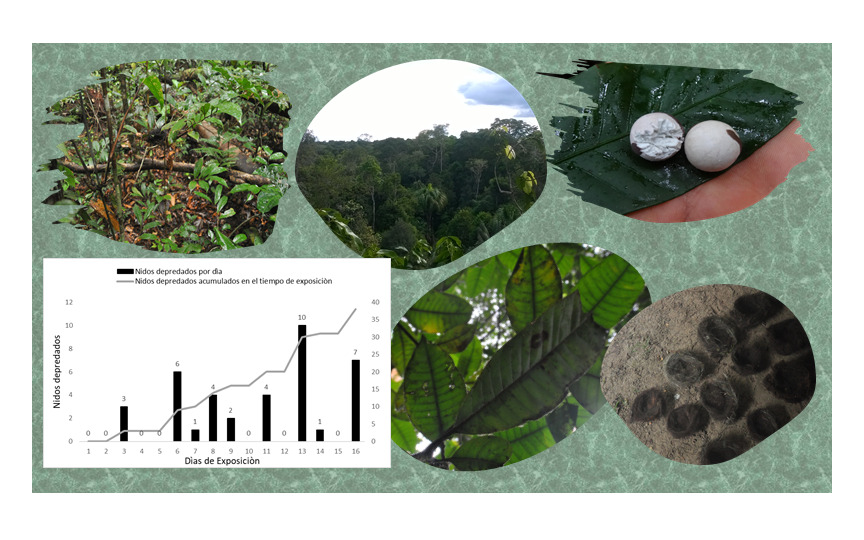
Las coberturas de los bosques naturales están cambiando por el avance de la frontera urbana, agrícola y ganadera, afectando la disponibilidad de refugios y recursos para la reproducción de algunas aves. A pesar del avance en el conocimiento del efecto de las intervenciones antrópicas sobre la biodiversidad, son limitadas las investigaciones que evidencien el efecto antrópico sobre la historia de vida de las aves, incluida la reproducción. Para describir el efecto antrópico sobre la depredación de nidos, se establecieron 108 nidos artificiales en un gradiente de intervención antrópica en la jurisdicción de Leticia, Amazonas, Colombia. De los 38 nidos que fueron depredados, 6 fueron en el sitio con menos intervención antrópica, 15 en el sitio de intervención intermedia y 17 en el sitio con mayor intervención. En particular, se evalúa cómo los cambios en la cobertura vegetal mediadas por las intervenciones antrópicas afectan la incubación de las aves, esperando que una mayor cobertura vegetal alrededor del nido, aumentara su probabilidad de éxito. Se encontró que las variables asociadas a la estructura de la vegetación cercana a los nidos (e.g. Cobertura a un metro alrededor del nido, Cobertura vegetal baja, Abertura de dosel), mostraron una relación significativa y positiva con el destino del nido. Esta investigación sugiere que procesos de urbanización (p. ej. Construcción de casas y carreteras) presentes en el contexto de la región amazónica, influyen en la pérdida de nidos artificiales de aves, y que cambios en la estructura de la vegetación mediados por la degradación de las coberturas naturales podrían jugar un papel fundamental en la depredación de nidos.
Natural forest´s covers are changing due to the spread of the urban, agricultural and livestock frontier, affecting the availability of shelters and resources for the breeding of birds. Despite our knowledge of the influence of anthropic interventions on biodiversity, investigations that show the anthropic effect on natural history of birds, included the breeding phase, are limited. To describe the anthropic effect on nest predation, 108 artificial nests were established in an anthropic intervention gradient in the jurisdiction of Leticia, Amazonas, Colombia. The 38 nests that were predated, six were in the site with the least anthropic intervention, 15 in the intermediate intervention site and 17 in the site with the highest intervention. In particular, the effect of changes in the vegetation cover mediated by anthropic disturbance on bird nests is assessed, expecting that denser vegetation cover around the nest will positively affect the nest success. Variables associated with the structure of the vegetation near the nests (e.g., Coverage around the nest, low vegetation cover, canopy opening), showed a significant positive relationship with the destination of the nest. This research suggests that the ongoing urbanization process (e.g., house construction and roads) in the Amazon region influences loss of artificial nests, and that changes in the structure of the vegetation mediated by the degradation of natural covers could play a fundamental role in the predation of nests.
Referencias
Bakermans, M. H., Rodewald, A. D., y Andrew, C. (2012). Influence of the forest structure on density and nest success of mature forest birds in Managed landscapes. The Journal of Wildlife Management, 76(6), 1225–1234. https://doi.org/10.1002/jwmg.349
Battin, J. (2004). When good animals love bad habitats: Ecological traps and the conservation of animal population. Conservation Biology, 18(6), 1482–1491. https://doi.org/10.1111/j.1523-1739.2004.00417.x
Bayne, E. M., Hobson, K. A., y Fargey, P. (1997). Predation on artificial nest in relation of forest type: contrasting the use of quial and plasticine eggs. Ecography, 20(3), 233–239. https://doi.org/10.1111/j.1600-0587.1997.tb00366.x
Blair, R. (2004). The effects of urban sprawl on birds at multiple levels of biological organization. Ecology and Society, 9(5), 2. https://doi.org/10.5751/ES-00688-090502
Bocz, R., Szép, D., Witz, D., Ronczyk, L., Kurucz, K., y Purger, J. J. (2017). Human disturbances and predation on artificial ground nests across an urban gradient. Animal Biodiversity and Conservation, 40(2), 153–157. https://doi.org/10.32800/abc.2017.40.0153
Borgmann, K. L., y Rodewald, A. D. (2004). Nest predation in an urbanizing landscape: The role of exotic shrubs. Ecological Applications, 14(6), 1757–1765. https://doi.org/10.1890/03-5129
Burke, D. M., Elliott, K., Moore, L., Dunford, W., Nol, E., Phillips, J., y Holmes, S., y Freemark, K. (2004). Patterns of Nest Predation on Artificial and Natural Nests in Forests. Conservation Biology, 18(2), 381–388. https://doi.org/10.1111/j.1523-1739.2004.00014.x
Burnham, K. P., y Anderson, D. R. (2002). Model Selection and Multimodal Inference: A practical information-theoretical Approach (2nd ed., pp. 352-436). Springer-Verlag New York. https://doi.org/10.1007/b97636
Cervantes, C. E. (2006). Depredación de nidos artificiales en bordes agrícolas de un paisaje agro-urbano en el estado de Hidalgo (pp.1-58). [Tesis de Licenciado]. Hidalgo: Instituto de Ciencias Basìcas e Ingenieria. Licenciatura en Biologìa. Universidad Autònoma del estado de Hidalgo.
CEPAL y patrimonio natural. (2013). Amazonia Posible y Sostenible (pp.12-30).
Chmel, K., Riegert, J., Paul, L., Mulau, M., Sam, K., y Novotny, V. (2018). Predation on artificial and natural nests in the lowland rainforest of Papua New Guinea. Bird Study. 65(1), 114–122. https://doi.org/10.1080/00063657.2017.1420751
Clergeau, P., Savard, J. P. L., Mennechez, G., y Falardeau, G. (1998). Bird abundance and diversity along an urbanrural gradient: Acomparative study between two cities on different continents. Condor, 100(3), 413–425. https://doi.org/10.2307/1369707
Colombelli-Négrel, D., y Kleindorfer, S. (2009). Nest height, nest concealment, and predatorty pepredict nest predation in superb fairy-wrens (Maluruscyaneus). EcologicalResearch, 24(4), 921–928. https://doi.org/10.1007/s11284-008-0569-y
Colorado, Z. G. J., y Rodewald, A. D. (2015). Response of mixed-species flocks to habitat alteration and deforestation in the Andes. Biological Conservation, 188, 72–81. https://doi.org/10.1016/j.biocon.2015.02.008
Filliater, T. S., Breitwisch, R., y Nealen, P. M. (1994). Predation on nothern cardinal nests: Does choice of nest site matter? Condor, 96(3), 761–768. https://doi.org/10.2307/1369479
Gering, J. C., y Blair, R. B. (1999). Predation on Artificial Bird Nests along an Urban Gradient: Predatory Risk or Relaxation in Urban Environments? Ecography, 22(5), 532–541.
IDEAM, INVEMAR, IIAP, IAvH. (2016). Informe del Estado del Ambiente y de los Recursos Naturales Renovables (pp. 1-100).
Jokimaki, J., y Huhta, E. (2000). Artificial nest predation and abundance of birds along an urban gradient. Condor, 102(4), 838–847. https://doi.org/10.1093/condor/102.4.838
López-Flores, V., MacGregor-Fors, I., y Schondube, J. E. (2009). Artificial nest predation along a Neotropical urban gradient. Landscape and Urban Planning, 92(2), 90–95. https://doi.org/10.1016/j.landurbplan.2009.03.001
Major R. E., y Kendall, C. (1996). The contribution of artificial nest experiments to our understanding of avian reproductive success: a review of methods and conclusions. Ibis, 138(2), 298–307. https://doi.org/10.1111/j.1474-919X.1996.tb04342.x
Malhi, Y., Roberts, J. T., Betts, R. A., Killeen, T. J., Li, W., y Nobre, C. A. (2008). Climate change, deforestation, and the fate of the Amazon. Science, 319(5860), 169–172. https://doi.org/10.1126/science.1146961
Martin, T. E. (1987). Artificial Nest Experiments: Effects of Nest Appearance and Type of Predator. Condor, 89(4), 925-928. https://doi.org/10.2307/1368547
Martin, T. E. (1992). Interaction of Nest Predation and Food Limitation in Reproductive Strategies (Vol. 9, pp.163-197.). En D. N. Power, (Eds). Current Ornithology; Springer. https://doi.org/doi.org/10.1007/978-1-4757-9921-7_5
Martin, T. E. (1995). Avian life history evolution in relation to nest sites, nest predation and food. Ecological Monographs, 65(1), 101–127.
Martin, T. E., Auer, S. K., Bassar, R. D., Niklison, A. M., y Lloyd, P. (2007). Geographic variation in avian incubation periods and parental influences on embryonic temperature. Evolution, 61(11), 2558–2569. https://doi.org/10.1111/j.1558-5646.2007.00204.x
Martin, T. E., Paine, C., Conway, C. J., Hochachka, W. M., Allen, P., y Jenkins, W. (1997). BBIRD (Breeding Biology Research and Monitoring Database) (pp.1-64.). Field protocol.
Marzluff, J. M., Bowman, R., y Donnelly, R. (2001). A historical perspective on urban bird research: trends, terms, and approaches. En J. M. Marzluff, R. Bowman, R. Donnelly (Eds). Avian Ecology and Conservation in an Urbanizing world (pp. 1-21). Kluwer academic Publishers. https://doi.org/10.1007/978-1-4615-1531-9_1
Mezquida, E. T., y Marone, L. (2003). Are results of artificial nest experiments a valid indicator of success of natural nests? The Wilson Bulletin, 115(3), 270–276. https://doi.org/10.1676/02-117
Michalski, F., y Norris, D. (2014). Artificial nest predation rates vary depending on visibility in the eastern Brazilian Amazon. Acta Amazonica, 44(3), 393–396. https://doi.org/10.1590/1809-4392201302553
Miniambiente, IDEAM. (2016). Reporte: Estrategia Integral de Control a la Deforestaciòn (pp.1-35).
Moore, R. P., y Robinson, W. D. (2004). Artificial Bird Nests, External Validity. Ecology, 85(6), 1562–1567. https://doi.org/10.1890/03-0088
Nalwanga, D., Lloyd, P., du Plessis, M. A., y Martin, T. E. (2004). The influence of nest-site characteristics on the nesting success of the Karoo Prinia (Prinia maculosa). Ostrich, 75(4), 269–274. https://doi.org/10.2989/00306520409485454
Ocampo, D., Estrada, F. M. C., Muñoz, J. M., Londoño, L. V., David, S., Valencia, G., Morales, P. A., Garizálbal, J. A., y Cuervo, A. M. (2012). Breeding biology of the red-bellied grackle (Hypopyrrhus Pyrohypogaster): A cooperative breeder of the Colombian Andes. The Wilson J. of Ornithology, 124(3), 538–546. https://doi.org/10.1676/11-117.1
Ortega, C. P., Ortega, J. C., Rapp, C. A., y Beckensto, S. A. (1998). Validating the Use of Artificial Nests in Predation Experiments. The Journal of Wildlife Management, 62(3), 925–932. https://doi.org/10.2307/3802544
Remeí, V. (2005). Short communication Birds and rodents destroy different nests: a study of Blackcap Sylvia atricapilla using the removal of nest. Ibis, 147, 213–216.
RStudio Team. (01 de enero de 2019). RStudio, PBC.Versiòn 3.5.3. Boston, MA. https://www.rstudio.com/products
Siatac-AC. (01 de enero de 2015). Instituto Amazónico de Investigaciones Científicas SINCHI. Población de la Amazonia Colombiana. https://siatac.co
Spanhove, T., Lehouck, V., Boets, P., y Lens, L. (2009). Forest fragmentation relaxes natural nest predation in an Afromontane forest. Animal Conservation, 12(4), 267–275. https://doi.org/doi.org/10.1111/j.1469-1795.2009.00249.x
Thompson, III F. R., y Burhans, D. E. (2004). Differences in predators of artificial and real songbird nests: Evidence of bias in artificial nest studies. Conservation Biology, 18(2), 373–380. https://doi.org/10.1111/j.1523-1739.2004.00167.x
Thorington, K. K., y Bowman, R. (2003). Predation rate on artificial nests increases with human housing density in suburban habitats. Ecography, 26(2), 188–196. https://doi.org/10.1034/j.1600-0587.2003.03351.x
Weidinger, K. (2002). Interactive effects of concealment, parental behaviour and predators on the survival of open passerine nests. Journal of Animal Ecology, 71(3), 424–437. https://doi.org/doi.org/10.1046/j.1365-2656.2002.00611.x
Wilcove, D. S. (1985). Nest predation in forest tracts forest: an artificial nest experiment. Ecology, 66(4), 1211–1214. https://doi.org/10.2307/1939174
Winter, M., Johnson, D. H., y Shaffer, J. A. (2005). Variability in Vegetation Effects on Density and Nesting Success of Grassland Birds. JournalofWildlifeManagement, 69(1), 185–197. https://doi.org/10.2193/0022-541x(2005)069<0185:viveod>2.0.co;2
Dimensions
PlumX
Visitas a la página del resumen del artículo
Descargas
Cómo citar
Licencia
Derechos de autor 2022 Acta Biológica Colombiana

Esta obra está bajo una licencia internacional Creative Commons Atribución-NoComercial-CompartirIgual 4.0.
1. La aceptación de manuscritos por parte de la revista implicará, además de su edición electrónica de acceso abierto bajo licencia Attribution-NonCommercial-ShareAlike 4.0 (CC BY NC SA), la inclusión y difusión del texto completo a través del repositorio institucional de la Universidad Nacional de Colombia y en todas aquellas bases de datos especializadas que el editor considere adecuadas para su indización con miras a incrementar la visibilidad de la revista.
2. Acta Biológica Colombiana permite a los autores archivar, descargar y compartir, la versión final publicada, así como las versiones pre-print y post-print incluyendo un encabezado con la referencia bibliográfica del articulo publicado.
3. Los autores/as podrán adoptar otros acuerdos de licencia no exclusiva de distribución de la versión de la obra publicada (p. ej.: depositarla en un archivo telemático institucional o publicarla en un volumen monográfico) siempre que se indique la publicación inicial en esta revista.
4. Se permite y recomienda a los autores/as difundir su obra a través de Internet (p. ej.: en archivos institucionales, en su página web o en redes sociales cientificas como Academia, Researchgate; Mendelay) lo cual puede producir intercambios interesantes y aumentar las citas de la obra publicada. (Véase El efecto del acceso abierto).




