Publicado
Socrates: Platonic Political Ideal
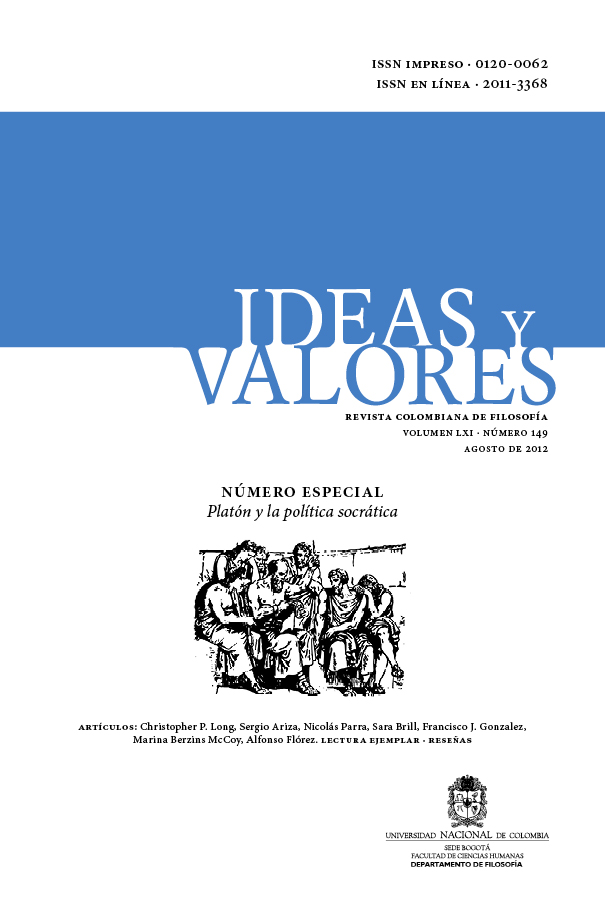
This essay articulates the differences and suggests the similarities between the practices of Socratic political speaking and those of Platonic political writing. The essay delineates Socratic speaking and Platonic writing as both erotically oriented toward ideals capable of transforming the lives of individuals and their relationships with one another. Besides it shows that in the Protagoras the practices of Socratic political speaking are concerned less with Protagoras than with the individual young man, Hippocrates. In the Phaedo, this ideal of a Socrates is amplified in such a way that Platonic writing itself emerges as capable of doing with readers what Socratic speaking did with those he encountered. Socrates is the Platonic political ideal. The result is a picture of the transformative political power of Socratic speaking and Platonic writing both.
Referencias
Ahl, F. M. "Amber, Avallon, and Apollo's Singing Swan", The American Journal of Philology 103/4 (1982): 373-411.
Benardete, S., R. Burger, and Michael Davis. The Argument of the Action: Essays on Greek Poetry and Philosophy. Chicago, IL: University of Chicago Press, 2000.
Bluck, R. S. "The Second Platonic Epistle", Phronesis 5/2 (1960): 140-51.
Boeder, H. "Der frühgriechische Wortgebrauch von Logos und Aletheia", Archiv für Begriffsgeschichte 4 (1959): 82-112.
Brann, E., P. Kalkavage, and E. Salem (eds.). Plato: Phaedo.
Newburyport, MA: Focus Publishing / R. Pullins Company, 1998.
Burger, R. Phaedo A Platonic Labyrinth. Chicago, IL: St. Augustines Press, 1999.
Burnet, J. (ed.). Plato's Phaedo. Oxford: Clarendon Press, 1963.
Denyer, N. Plato: Protagoras. Cambridge: Cambridge University Press, 2008. Cambridge Greek and Latin Classics.
Dorter, K. Plato's Phaedo: An Interpretation. Toronto: University of Toronto Press, 1982.
Friedländer, Paul. Plato, Vol. 1. Princeton, NJ: Princeton University Press, 1964. Bollingen Series. 59.
Gadamer, H. G. Truth and Method, Vol. 2. New York, NY: Continuum, 1994.
Gallop, D. (ed.). Phaedo. Oxford: Clarendon Press, 1975.
Griswold, C. L. "Relying on Your Own Voice: An Unsettled Rivalry of Moral Ideals in Plato's Protagoras", The Review of Metaphysics 53/2 (1999): 283-307.
Hackforth, R. R. The Authorship of the Platonic Epistles. Hildesheim / New York: Olms, 1985.
Harward, J. The Platonic Epistles: Spurious and Doubtful Works. New York, NY: Arno Press, 1976.
Klein, J. "Plato's Phaedo". Lectures and Essays. Annapolis, MD: St. John's College Press, 1985. 375-93.
Laertius, D. Diogenes Laertius: Lives of Eminent Philosophers, Vol. II, books VI-X. Cambridge, MA / London: Harvard University Press, 1925. Loeb Classical Library.
Liddell, G. H. and R. Scott. A Greek-English Lexicon, Vol. 9. Oxford: The Clarendon Press, 1968.
Long, C. P. Aristotle on the Nature of Truth. Cambridge University Press, 2011a.
Long, C. P. "Attempting the Political Art". Proceedings of the Boston Area Colloquium in Ancient Philosophy 27 (forthcoming): n. pag.
Long, C. P. "Crisis of Community: The Topology of Socratic Politics in the Protagoras", Epoché: a Journal for the History of Philosophy 15/2 (2011b): 361-77.
Luther, W. Wahrheit und Lüge im Ältesten Griechentum. Borna-Leipzig: Verlag Robert Noske, 1935.
Madison, L. A. "Have We Been Careless with Socrates' Last Words?: A Rereading of the Phaedo", Journal of the History of Philosophy 40/4 (2002): 421-36. Web. 14 June 2011.
McCoy, M. "Socrates on Simonides: The Use of Poetry in Socratic and Platonic Rhetoric", Philosophy & Rhetoric 32/4 (1999): 349-67.
Morrow, Glenn R. [Glenn Raymond]. Plato's Epistles: A Translation, with Critical Essays and Notes. Indianapolis, IN: Bobbs-Merrill, 1962.
Olympiodorus. Commentary on the first Alcibiades of Plato. Westerink, L. G. (ed.). Amsterdam: A. M. Hakkert, 1956.
Plato. Platonis Opera, Vol. V. New York, NY: Oxford University Press, 1995.
Riginos, A. S. Platonica: The Anecdotes Concerning the Life and Writings of Plato. Leiden: Brill Archive, 1976.
Schürmann, R. Heidegger, On Being and Acting: From Principles to Anarchy. Bloomington, IN: Indiana University Press, 1987.
Walsh, J. "The Dramatic Dates of Plato's Protagoras and the Lesson of Arete", The Classical Quarterly 34/1 (1984): 101-06.
Wood, J. L. "Commentary of Woolf", Proceedings of the Boston Area Colloquium in Ancient Philosophy 23 (2007): 17-23.
Woolf, R. "Misology and Truth". Proceedings of the Boston Area Colloquium in Ancient Philosophy 23 (2007): 1-16.
Zuckert, C. H. Plato's Philosophers: The Coherence of the Dialogues, 1st ed. Chicago, IL: University Of Chicago Press, 2009.
Visitas a la página del resumen del artículo
Descargas
Cómo citar
Licencia
Derechos de autor 2016 Universidad Nacional de Colombia

Esta obra está bajo una licencia internacional Creative Commons Atribución-NoComercial-SinDerivadas 4.0.
De acuerdo con la Licencia Creative Commons Atribución-No Comercial-SinDerivar 4.0 Internacional. Se autoriza copiar, redistribuir el material en cualquier medio o formato, siempre y cuando se conceda el crédito a los autores de los textos y a Ideas y Valores como fuente de publicación original. No se permite el uso comercial de copia o distribución de contenidos, así como tampoco la adaptación, derivación o transformación alguna de estos sin la autorización previa de los autores y de la dirección de Ideas y Valores. Para mayor información sobre los términos de esta licencia puede consultar: http://creativecommons.org/licenses/by-nc-nd/4.0/legalcode.





.jpg)