Publicado
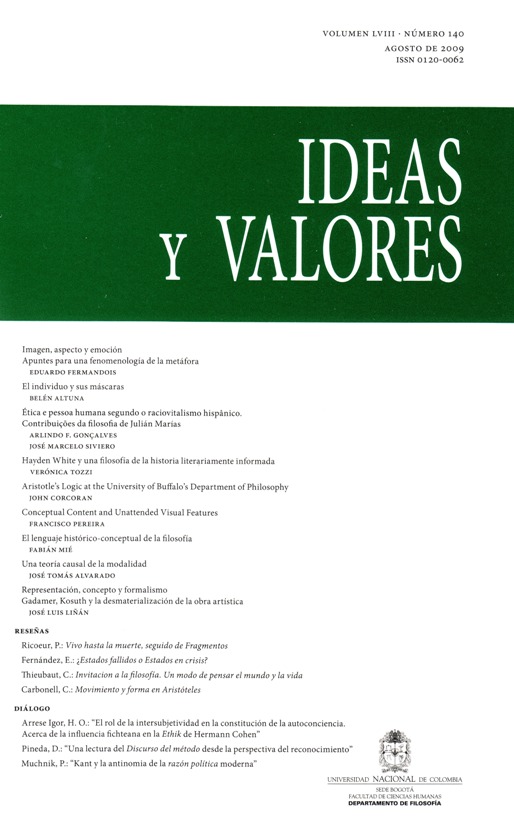
Conceptual Content and Unattended Visual Features
Palabras clave:
McDowell, perceptual content, conceptualism, experiential richness, sensory memory, attention (es)Referencias
Blackmore, S., Brelstaff, G., Nelson, K. & Troscianko, T. "Is the Richness of Our Visual World an Illusion? Transsaccadic Memory for Complex Scenes", Perception 24 (1995): 1075-1081.
Brewer, B. Perception and Reason. Oxford, New York: Clarendon Press; Oxford UP, 1999.
Chuard, P. "The Riches of Experience", Journal of Consciousness Studies 14/9-10 (2007): 20-42.
Crane, T. Elements of Mind: An Introduction to the Philosophy of Mind. Oxford: Oxford UP, 2001.
De Gaynesford, M. John McDowell. Polity, 2004.
Dretske, F. Seeing and Knowing. London: Routledge & K. Paul, 1969.
Dretske, F. Knowledge and the Flow of Information. Cambridge, MA: MIT Press, 1981.
Dretske, F. "What Change Blindness Teaches About Consciousness", Philosophical Perspectives 21 (2007): 216-230.
Evans, G. The Varieties of Reference. Oxford, New York: Clarendon Press; Oxford UP, 1982.
Johnston, M. "The Function of Sensory Awareness". Perceptual Experience, ed. Gendler, T. & Hawthorne, J. Oxford UP, 2006. 260-290.
Kelly, T., Chun, M. & Chua, K.-P. "Effects of Scene Inversion on Change Detection of Targets Matched for Visual Salience", Journal of Vision 3 (2003): 1-5.
Martin, M. G. F. "Perceptions, Concepts and Memory", Philosophical Review 101 (1992): 745-763.
McDowell, J. Mind and World. Cambridge, MA: Harvard UP, 1994.
Noë, A. "Is the Visual World a Grand Illusion?", Journal of Consciousness Studies 9 (2002): 1-12.
O'Regan, K. & Noë, A. "A Sensorimotor Account of Vision and Visual Consciousness", Behavioural and Brain Sciences 24 (2001): 939-1011.
Pearsall, J, ed. The Concise Oxford Dictionary. Tenth Edition. Oxford: Oxford UP, 2001.
Rensink, R., O'Regan, K. & Clark, J. "On the Failure to Detect Changes in Scenes across Brief Interruptions", Visual Cognition (2000): 127-146.
Sperling, G. "The Information Available in Brief Visual Presentations", Psychological Monographs 74/11 (1960): 1-29.
Tye, M. "Nonconceptual Content, Richness, and Fineness of Grain". Perceptual Experience, eds. Gendler, T. & Hawthorne, J. Oxford: Oxford UP, 2006. 504-530.
Visitas a la página del resumen del artículo
Descargas
Cómo citar
Licencia
Derechos de autor 2016 Universidad Nacional de Colombia

Esta obra está bajo una licencia internacional Creative Commons Atribución 4.0.
De acuerdo con la Licencia Creative Commons Atribución-No Comercial-SinDerivar 4.0 Internacional. Se autoriza copiar, redistribuir el material en cualquier medio o formato, siempre y cuando se conceda el crédito a los autores de los textos y a Ideas y Valores como fuente de publicación original. No se permite el uso comercial de copia o distribución de contenidos, así como tampoco la adaptación, derivación o transformación alguna de estos sin la autorización previa de los autores y de la dirección de Ideas y Valores. Para mayor información sobre los términos de esta licencia puede consultar: http://creativecommons.org/licenses/by-nc-nd/4.0/legalcode.










.jpg)