Publicado
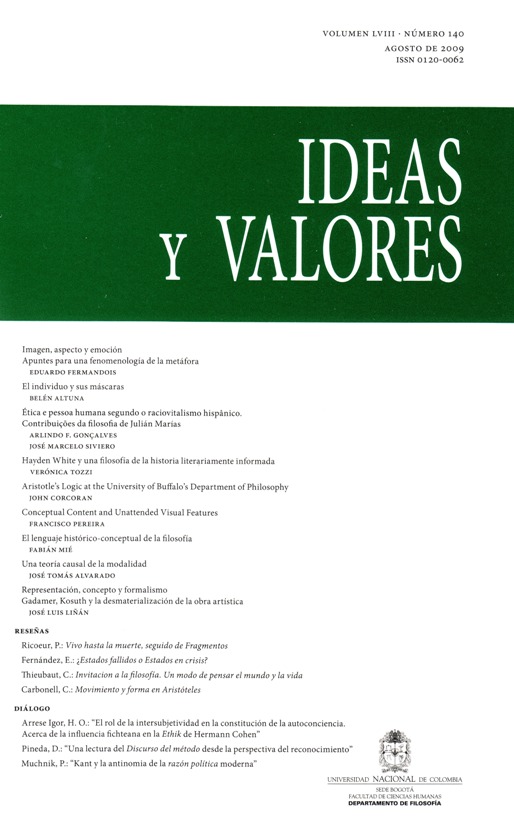
Una teoría causal de la modalidad
Palabras clave:
modalidad, mundos posibles, causalidad, relaciones de accesibilidad, necesidad de origen (es)Referencias
Adams, R. "Primitive Thisness and Primitive Identity", Journal of Philosophy 76 (1979): 5-26.
Alvarado, J. T. "La noción de mundo determinista", Eikasia, en prensa.
Armstrong, D. M. Universals and Scientific Realism, Volume II. A Theory of Universals. Cambridge: Cambridge UP, 1978.
Armstrong, D. M. A Combinatorial Theory of Possibility. Cambridge: Cambridge UP, 1989.
Cresswell, M. "The World is Everything that is the Case". The Possible and the Actual: Readings in the Metaphysics of Modality, ed. M. J. Loux. Ithaca: Cornell UP, 1979. 129-145.
Divers, J. Possible Worlds. London: Routledge, 2002.
Hempel, C. Aspects of Scientific Explanation. New York: Free Press, 1965.
Nagel, E. The Structure of Science: Problems in the Logic of Scientific Explanation. Indianápolis: Hackett, 1960.
Mackie, J. The Cement of the Universe. Oxford: Clarendon Press, 1974.
Mackie, P. How Things Might Have Been: Individuals, Kinds, and Essential Properties. Oxford: Clarendon Press, 2006.
Hume, D. [Treatise]. A Treatise of Human Nature. Oxford: Clarendon Press, 1978.
Kim, J. "Events as Property Exemplifications". Supervenience and Mind. Cambridge: Cambridge UP, 1993. 33-52.
Kripke, S. Naming and Necessity. Oxford: Blackwell, 1980.
Mellor, D. H. The Facts of Causation. London: Routledge, 1995.
Menzies, P. "A Unified Account of Causal Relata", Australasian Journal of Philosophy 67 (1989): 59-83.
Nolan, D. Topics in the Philosophy of Possible Worlds. London: Routledge, 2002.
Noone, T. B. "Universals and Individuation". The Cambridge Companion to Scotus, ed. T. Williams. Cambridge: Cambridge UP, 2003. 100-128.
Lewis, D. Counterfactuals. Oxford: Blackwell, 1973.
Lewis, D. "Counterpart Theory and Quantified Modal Logic". Philosophical Papers, Volume I. Oxford: Oxford UP, 1983. 26-46.
Lewis, D. "Causation". Philosophical Papers, Volume II. Oxford: Oxford UP, 1986a. 159-213.
Lewis, D. On the Plurality of Worlds. Oxford: Blackwell, 1986b.
Lewis, D. & Langton, R. "Defining 'intrinsic'". Papers in Metaphysics and Epistemology. Cambridge: Cambridge UP, 1999. 116-132.
Plantinga, A. The Nature of Necessity. Oxford: Clarendon Press, 1974.
Robertson, T. "Possibilities and the Arguments for Origin Essentialism", Mind 107 (1998): 729-749.
Tooley, M. Causation: A Realist Approach. Oxford: Clarendon Press, 1987.
Tooley, M. Time, Tense, and Causation. Oxford: Clarendon Press, 1997.
Visitas a la página del resumen del artículo
Descargas
Cómo citar
Licencia
Derechos de autor 2016 Universidad Nacional de Colombia

Esta obra está bajo una licencia internacional Creative Commons Atribución 4.0.
De acuerdo con la Licencia Creative Commons Atribución-No Comercial-SinDerivar 4.0 Internacional. Se autoriza copiar, redistribuir el material en cualquier medio o formato, siempre y cuando se conceda el crédito a los autores de los textos y a Ideas y Valores como fuente de publicación original. No se permite el uso comercial de copia o distribución de contenidos, así como tampoco la adaptación, derivación o transformación alguna de estos sin la autorización previa de los autores y de la dirección de Ideas y Valores. Para mayor información sobre los términos de esta licencia puede consultar: http://creativecommons.org/licenses/by-nc-nd/4.0/legalcode.









.jpg)