Publicado
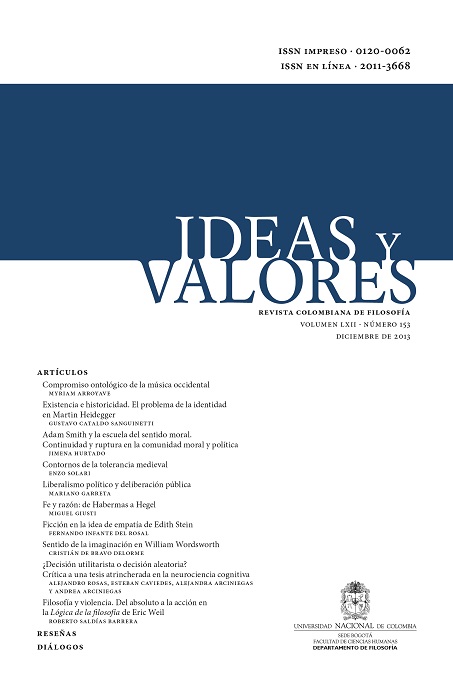
¿Decisión utilitarista o decisión aleatoria? Crítica a una tesis atrincherada en la neurociencia cognitiva
Palabras clave:
ciencia cognitiva, deontología, empatía, juicio moral, utilitarismo. (es)Diversos estudios han concluido que los pacientes con daño en la Corteza Frontal –CF– o Corteza Prefrontal Ventromedial –CPV– muestran una disposición a herir directamente a otra persona con el fin de salvar varias vidas en sus respuestas a los “dilemas morales personales”, revelando una posible carencia de empatía. No obstante, cuando evalúan conductas carentes de empatía sin justificación utilitarista, sus respuestas son normales. Defendemos aquí que los pacientes sufren una deficiencia cognitiva relacionada con la hipótesis de marcador somático de Damasio y con juicios de valor. Criticamos la hipótesis del “paciente utilitarista”, que se ha atrincherado en la neurociencia cognitiva.
Referencias
Bartels, D. M. & Pizarro, D. A. "The Mismeasure of Morals: Antisocial Personality Traits predict Utilitarian Responses to Moral Dilemmas", Cognition 121/1 (2011): 154-161.
Batson, C. D. "These Things called Empathy: Eight Related but Distinct Phenomena". The Social Neuroscience of Empathy, Decety, J. & Ickes, W. (eds.). Cambridge, MA: MIT Press, 2009. 3-15.
Bechara, A., Damasio, H., Tranel, D. & Damasio, A. R. "Deciding Advantageously before knowing the Advantageous Strategy", Science 275/5308 (1997): 1293-1295.
Bechara, A., Tranel, D. & Damasio, H. "Characterization of the Decision-making Deficit of Patients with Ventromedial Prefrontal Cortex Lesions", Brain 123/11 (2000): 2189-2202.
Bechara, A. & Damasio, A. R. "The Somatic Marker Hypothesis: A Neural Theory of Economic Decision", Games and Economic Behavior 52 (2005): 336-372.
Blair, R. "A Cognitive Developmental Approach to Morality: Investigating the Psychopath", Cognition 57/1 (1995): 1-29.
Brownell, H., Griffin, R., Winner, E., Friedman, O. & Happé, F. "Cerebral Lateralization and Theory of Mind". Understanding Other Minds. Perspectives From Developmental Cognitive Neuroscience, Baron-Cohen, S., Tager-Flusberg, H. & Cohen, D. J. (eds.). Oxford/New York: Oxford University Press, 2000. 306-333.
Ciaramelli, E., Muccioli, M., Làdavas, E. & di Pellegrino, G. "Selective Deficit in Personal Moral Judgment following Damage to Ventromedial Prefrontal Cortex", Social Cognitive and Affective Neuroscience 2/2 (2007): 84-92.
Damasio, A. "The Somatic Marker Hypothesis and the Possible Functions of the Prefrontal Cortex", Philosophical Transactions of the Royal Society London Series B. 1346/351 (1996): 1413-1420.
Damasio, A. El error de Descartes, Ros, J. (trad.). Barcelona: Crítica, 2007.
Gleichgerrcht, E., Torralva, T., Roca, M., Pose, M., & Manes, F. "The Role of Social Cognition in Moral Judgment in Frontotemporal Dementia", Social Neurocience 6/2 (2011): 113-122.
Greene, J. D., Sommerville, R. B., Nystrom, L. E., Darley, J. M. & Cohen, J. D. "An fMRI Investigation of Emotional Engagement in Moral Judgment", Science 293 (2001): 2105-2108.
Greene, J. D., Nystrom, L. E., Engell, A. D., Darley, J. M. & Cohen, J. D. "The Neural Bases of Cognitive Conflict and Control in Moral Judgment", Neuron 44/2 (2004): 389-400.
Haidt, J. "The Emotional Dog and Its Rational Tail: A Social Intuitionist Approach to Moral Judgment", Psychological Review 108/4 (2001): 814-834.
Hauser, M. D. "The Liver and the Moral Organ", Social Cognitive and Affective Neuroscience Advance 1/3 (2006): 214-220.
Hauser, M. D., Young, L. & Cushman, F. "'Reviving Rawls' Linguistic Analogy: Operative Principles and the Causal Structure of Oral Actions". Moral Psychology. The Cognitive Science of Morality: Intuition and Diversity. Vol. 2, Sinnott-Armstrong, W. (ed.). New York: Oxford University Press, 2008. 107-143.
Knobe, J. & Nichols, S. "An Experimental Philosophy Manifiesto". Experimental Philosophy, Knobe, J. & Nichols, S. (eds.). New York: Oxford University Press, 2008. 3-14.
Koenigs, M., Young, L., Adolphs, R., Tranel, D., Cushman, F., Hauser, M. & Damasio, A. "Damage to the Prefrontal Cortex increases Utilitarian Moral Jugdements", Nature 446/7138 (2007a): 908-911.
Koenigs, M., Young, L., Adolphs, R., Tranel, D., Cushman, F., Hauser, M. & Damasio, A. (2007b) Supplementary Information to "Damage to the Prefrontal Cortex increases Utilitarian Moral Judgments". Recuperado de http://www.nature.com/nature/journal/v446/n7138/suppinfo/nature05631.html
Koenigs, M., Kruepke, M., Zeier, J. & Newman, J. P. "Utilitarian Moral Judgment in Psychopathy", Social Cognitive and Affective Neuroscience 7/6 (2012): 708-714.
Maia, T. V. & McClelland, J. L. "A Reexamination of the Evidence for the Somatic Marker Hypothesis: What Participants Really Know in the Iowa Gambling Task", Proceedings of the National Academy of Sciences of the United States of America 101/45 (2004): 16075-16080.
Mendez, M. F., Chen, A. K., Shapira, J. S. & Miller, B. L. "Acquired Sociopathy and Frontotemporal Dementia", Dementia and Geriatric Cognitive Disorders 20/2-3 (2005a): 99-104.
Mendez, M. F., Anderson, E. & Shapira, J. S. "An Investigation of Moral Judgement in Frontotemporal Dementia", Cognitive and Behavioral Neurology 18/4 (2005b): 193-197.
Mendez, M. F. "What Frontotemporal Dementia reveals about the Neurobiological Basis of Morality", Medical Hypotheses 67/2 (2006): 411-418.
Mendez, M. F. "The Neurobiology of Moral Behavior: Review and Neuropsychiatric Implications", CNS Spectrums 14/11 (2009): 608-620.
Montañés, P. & Brigard, F. Neuropsicología clínica y cognoscitiva. Bogotá: Universidad Nacional de Colombia, 2011.
Moretto, G., Làdavas, E., Mattioli, F. & Pellegrino, G. "A Psychophysiological Investigation of Moral Judgment after Ventromedial Prefrontal Damage", Journal of Cognitive Neuroscience 22/8 (2010): 1888-1899.
Preston, S. D. & Waal, F. B. "Empathy: its Ultimate and Proximate Bases", Behavioral and Brain Sciences 25/1 (2002): 1-20.
Prinz, J. The Emotional Construction of Morals. New York: Oxford University Press, 2007.
Rosas, A., Arciniegas, A., Arciniegas, M. A. & Caviedes, E. "Neuropsicología del juicio moral: sobre las causas de las respuestas contra-intuitivas a los dilemas morales" (sometido).
Stone, V. E. "The Role of the Frontal Lobes and the Amygdala in Theory of Mind". Understanding Other Minds. Perspectives From Developmental Cognitive Neuroscience, Baron-Cohen, S., Tager-Flusberg, H. & Cohen, D. J. (eds.). Oxford/New York: Oxford University Press, 2000. 253-273.
Thomas, B. C., Croft, K. E. & Tranel, D. "Harming Kin to save Strangers: Further Evidence for Abnormally Utilitarian Moral Judgments after Ventromedial Prefrontal Damage", Journal of Cognitive Neuroscience 23/9 (2011): 2186-2196.
Thomson, J. J. "The Trolley Problem". Rights, Restitution, and Risk: Essays in Moral Theory. Thomson, J. J. (ed.). Cambridge, MA: Harvard University Press, 1986. 94-116.
Viskontas, I. V. & Miller, B. L. "Frontotemporal Dementia". The Behavioral Neurology of Dementia. Miller, B. L. & Boeve, B. F. (eds.). Cambridge: Cambridge University Press, 2009. 45-55.
Waal, F. B. Primates and Philosophers. How morality evolved. Princeton: Princeton University Press, 2006.
Visitas a la página del resumen del artículo
Descargas
Cómo citar
Licencia
Derechos de autor 2016 Universidad Nacional de Colombia

Esta obra está bajo una licencia internacional Creative Commons Atribución 4.0.
De acuerdo con la Licencia Creative Commons Atribución-No Comercial-SinDerivar 4.0 Internacional. Se autoriza copiar, redistribuir el material en cualquier medio o formato, siempre y cuando se conceda el crédito a los autores de los textos y a Ideas y Valores como fuente de publicación original. No se permite el uso comercial de copia o distribución de contenidos, así como tampoco la adaptación, derivación o transformación alguna de estos sin la autorización previa de los autores y de la dirección de Ideas y Valores. Para mayor información sobre los términos de esta licencia puede consultar: http://creativecommons.org/licenses/by-nc-nd/4.0/legalcode.










.jpg)