Publicado
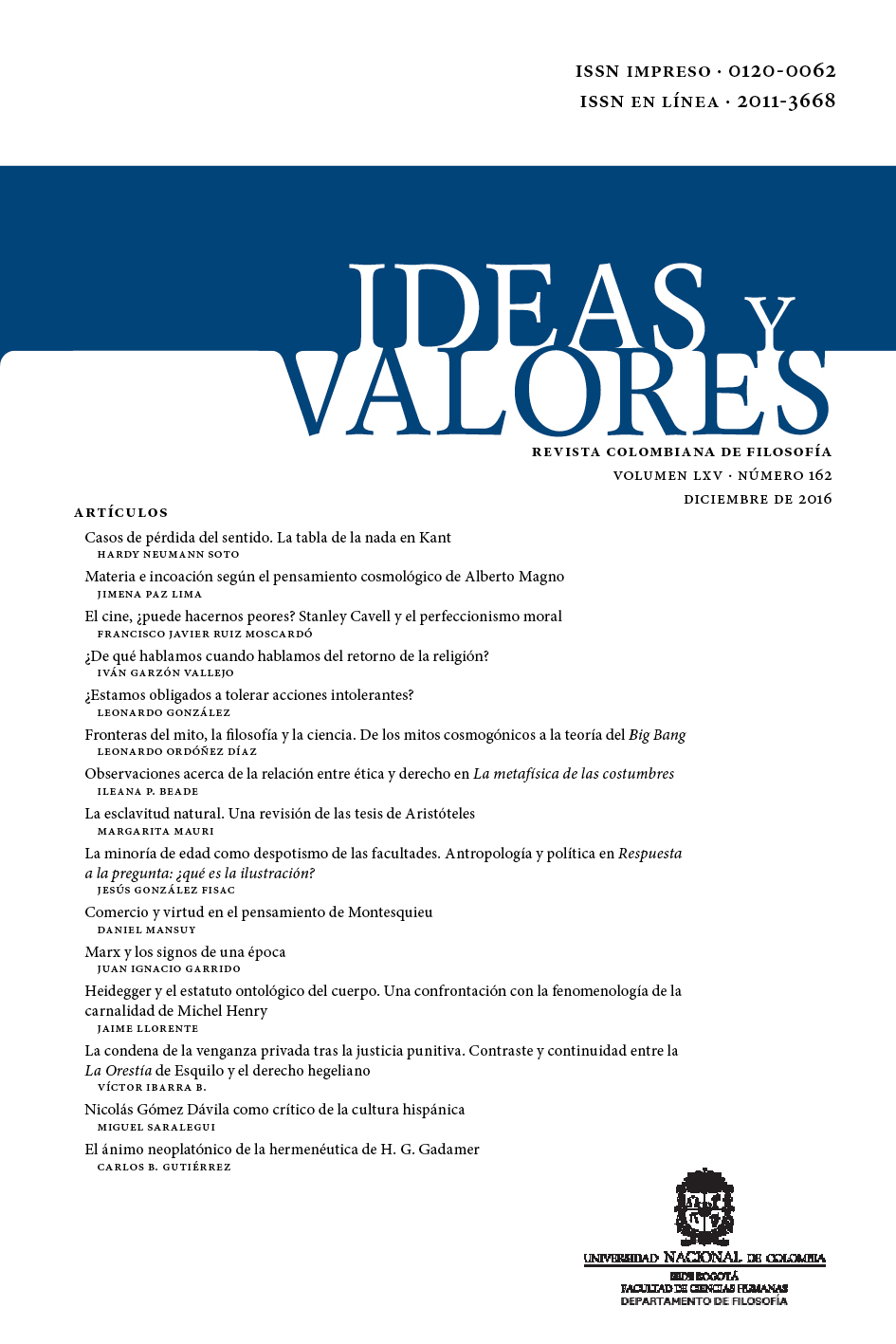
La esclavitud natural. Una revisión de las tesis de Aristóteles
DOI:
https://doi.org/10.15446/ideasyvalores.v65n162.47676Palabras clave:
Aristóteles, esclavitud, mujer, oikos (es)Frente a la esclavitud natural defendida por Aristóteles, algunos intentan salvaguardar la coherencia interna del discurso, mientras que otros la niegan. Sin pretender un juicio valorativo, se busca esclarecer la naturaleza del esclavo, de la mujer y de las relaciones entre señor, mujer y esclavo en el oikos.
Referencias
Aristóteles. Retórica [Rhet.]. Trad. Antonio Tovar. Madrid: Centro de Estudios Constitucionales, 1971.
Aristóteles. Acerca del alma [An.]. Trad. Tomás Calvo Martínez. Madrid: Gredos, 1978.
Aristóteles. Ética a Nicómaco [en]. Trads. María Araujo y Julián Marías. Madrid: Centro de Estudios Constitucionales, 1981.
Aristóteles. Política [Pol.]. Trads. Julián Marías y María Araujo. Madrid: Centro de Estudios Constitucionales, 1983.
Aristóteles. Ética Nicomáquea. Ética eudemia [ee]. Trad. Julio Pallí Bonet. Madrid: Gredos, 1985.
Abbà, G. Felicità, vita buona e virtù: saggio di filosofia morale. Roma: LAS, 1989.
Bentley, R. “Loving Freedom: Aristotle on Slavery and the Good Life.” Political Studies 47.1 (1999): 100-113. http://dx.doi.org/10.1111/1467-9248.00190.
Bodeüs, R. “The Natural Foundations of Right.” Action and Contemplation. Eds. Robert C. Bartlett and Susan D. Collins. Albany: State University of New York Press, 1999. 69-103.
Browning Cole, E. “Women, Slaves and ‘Love of Toil’.” Engendering Origins. Critical Feminist Readings in Plato and Aristotle. Ed. Bat-Ami Bar On. Albany: State University New York Press, 1994. 127-144.
De Aquino, T. Comentario de la Ética a Nicómaco. Trad. Ana María Maella. Buenos Aires: CIAFIC, 1983.
De Rodas, A. Argonáuticas. Trad. Mariano Valverde Sánchez. Madrid: Gredos, 1996.
Deslauries, M. “Aristotle and the Virtues of Slaves and Women.” Oxford Studies in Ancient Philosophy 25 (2003): 213-231.
Dobbs, D. “Natural Right and the Problem of Aristotle’s Defense of Slavery.” The Journal of Politics 56.1 (1994): 69-94. http://dx.doi.org/10.2307/2132346
Fortenbaugh, W. W. “Aristotle on Sleaves and Women.” Articles on Aristotle 2: Ethics and Politics. Eds. Jonathan Barnes, Malcolm Schofield and Richard Sorabji. London: Duckworth, 1977. 135-139.
Frank, J. “Citizens, Slaves, and Foreigners: Aristotle on Human Nature.” American Political Science Review 98.1 (2004): 91-104. http://dx.doi.org/10.1017/S0003055404001029.
Garver, E. “Aristotle’s Natural Slaves: Incomplete Praxeis and Incomplete Human Beings.” Journal of the History of Philosophy 32.2 (1994): 173-195. http://dx.doi.org/10.1353/hph.1994.0038
Goldschmith, V. “La théorie aristotelicienne de l’esclavage et sa method.” Zetesis: bijdragen op het gebied van de klassieke filologie, filosofie, byzantinistiek, patrologie en theologie. Ed. Émile De Strycker. Antwerpen: Nederlandsche Boekhandel. 1973. 147-163.
Harvey, M. “Deliberation and Natural Slavery.” Social Theory and Practice 27.1 (2001): 41-64. http://dx.doi.org/10.5840/soctheorpract200127120
Heath, M. “Aristotle on Natural Slavery.” Phronesis 53.3 (2008): 243-270. http://dx.doi.org/10.1163/156852808X307070
José, C. El mal moral en l’ètica d’Aristòtil. Fonaments psicològics i aspectes sociopolítics. Universitat de Barcelona. 2013. Web. 20 de agosto 2016. http://www.tdx.cat/bitstream/handle/10803/98512/CJM_TESI.pdf?sequence=1
Just, R. “Freedom, Slavery and the Female Psyche.” Essays in Greek History presented to G.E.M. de Ste. Croix on his 75th Birthday. Ed. Paul Cartledge, David Harvey and G. E. M. De Ste Croix. London: Duckworth, 1985. 169-188.
Martín López, E. “El problema de la esclavitud en Aristóteles y sus implicaciones en la sociología actual.” Sociologia Internationalis 3.2 (1965): 169-188.
Mirón, M. D. “El gobierno de la casa en la Atenas clásica: género y poder en el oikos.” Studia Historica. Historia Antigua 18 (2000): 103-117.
Modrak, D. K. W. “Aristotle: Women, Deliberation, and Nature.” Engendering Origins. Critical Feminist Readings in Plato and Aristotle. Ed. Bat-Ami Bar On. New York: State University New York Press, 1994. 207-222.
Mosse, C. La mujer en la Grecia clásica. 2da ed. Madrid: Nerea, 1991, 2ª edición.
Platón. “Menón [Men.].” Diálogos II. Trad. F. J. Oliveiri. Madrid: Gredos, 1987.
Senack, C. M. “Aristotle on the Woman’s Soul.” Engendering Origins. Critical Feminist Readings in Plato and Aristotle. Ed. Bat-Ami Bar On. Albany: State University New York Press, 1994. 223-240.
Sherman, N. The Fabric of Character: Aristotle’s Theory of Virtue. Oxford: Clarendon Press, 1989.
Spelman, E. V. “Aristotle and the Politicization of the Soul.” Discovering Reality: Feminist Perspectives on Epistemology, Metaphysics, Methodology, and Philosophy of Science. Ed. Sandra G. Harding and Merrill B. Hintikka. Dordrecht: Reidel Pub., 1983. 17-30. http://dx.doi.org/10.1007/978-94-010-0101-4_2
Swanson, J. A. The Public and the Private in Aristotle’s Political Philosophy. Ithaca: Cornell University Press, 1992.
Swanson, J. A. “Aristotle on Nature, Human Nature, and Justice.” Action and Contemplation: Studies in the Moral and Political Thought of Aristotle. Eds. Robert C. Bartlett and Susan D. Collins. Albany: State University of New York Press, 1999. 225-243.
Dimensions
PlumX
Visitas a la página del resumen del artículo
Descargas
Cómo citar
Licencia
Derechos de autor 2016 Copy and redistribute the material in any medium or format. The licensor cannot revoke these freedoms as long as you follow the license terms

Esta obra está bajo una licencia internacional Creative Commons Atribución-NoComercial-SinDerivadas 4.0.
De acuerdo con la Licencia Creative Commons Atribución-No Comercial-SinDerivar 4.0 Internacional. Se autoriza copiar, redistribuir el material en cualquier medio o formato, siempre y cuando se conceda el crédito a los autores de los textos y a Ideas y Valores como fuente de publicación original. No se permite el uso comercial de copia o distribución de contenidos, así como tampoco la adaptación, derivación o transformación alguna de estos sin la autorización previa de los autores y de la dirección de Ideas y Valores. Para mayor información sobre los términos de esta licencia puede consultar: http://creativecommons.org/licenses/by-nc-nd/4.0/legalcode.







.jpg)