Published
Leachate Treatment via TiO2/UV Heterogeneous Photocatalysis: A Multiple Polynomial Regression Model
Tratamiento de lixiviados mediante fotocatálisis heterogénea TiO2/UV: un modelo de regresión polinomial múltiple
DOI:
https://doi.org/10.15446/ing.investig.101497Keywords:
leachates, TiO2, heterogeneous photocatalysis, model, polynomial regression (en)lixiviado, TiO2, fotocatálisis heterogénea, modelo, regresión polinómica (es)
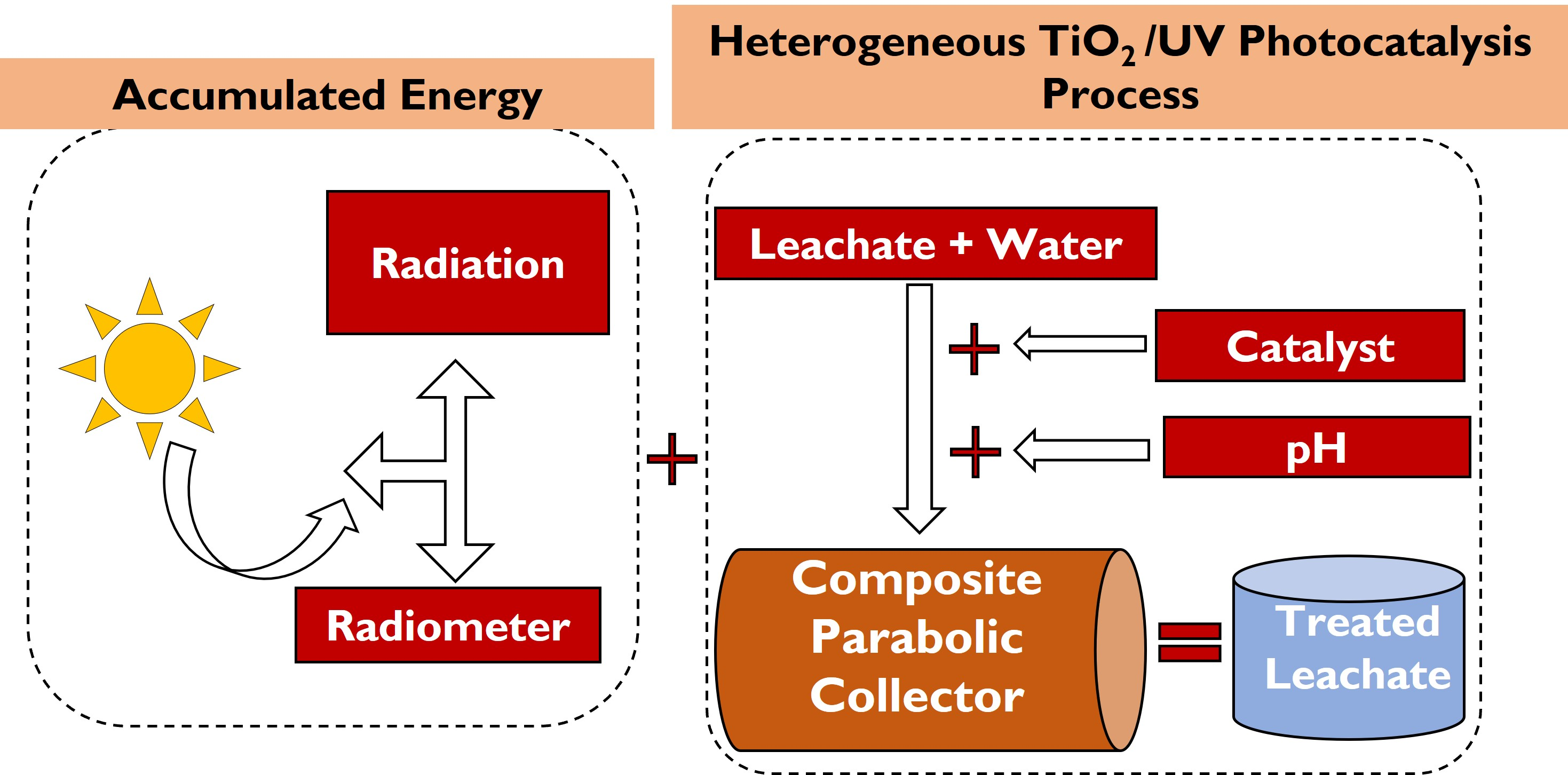
Advanced oxidation processes such as TiO2/UV heterogeneous photocatalysis are suitable treatment methods for wastewater with high pollutant loads such as landfill leachates. Optimizing the variables that influence the process is a fundamental aspect. However, in this regard, experimental conditions are limited in terms of resources and time, which is why modeling allows obtaining a general understanding of the phenomenon from a set of experimental data. This work sought to model the photocatalytic process via multivariate polynomial regression, considering variables such as the catalyst concentration, the pH level, and the accumulated energy concerning the percentage of degradation in terms of dissolved organic carbon (DOC). The implemented fitting method resulted in a third-degree polynomial with an R2 of 0,8652, concluding that the model and its conclusions are valid. Moreover, with greater degrees, the model curve overfitted, even with better R2. DOC abatement showed a negative correlation with pH and the catalyst dose, while an opposite trend was observed for the accumulated energy. The model predictions allow inferring that, at low catalyst doses and medium and high pH levels, it is possible to find maximum degradations at low cumulative energies.
Los procesos de oxidación avanzada como la fotocatálisis heterogénea TiO2/UV son métodos de tratamiento adecuados para aguas residuales con altas cargas contaminantes como los lixiviados de rellenos sanitarios. La optimización de las variables que influyen en el proceso es un aspecto fundamental. Sin embargo, en este aspecto, las condiciones experimentales son limitadas en términos de recursos y tiempo, por lo que el modelado permite obtener una comprensión general del fenómeno a partir de un conjunto de datos experimentales. Este trabajo pretendió modelar el proceso fotocatalítico mediante regresión polinómica multivariada, teniendo en cuenta variables como la concentración del catalizador, el nivel de pH y la energía acumulada en relación con el porcentaje de degradación en términos de carbón orgánico disuelto (DOC). El método de ajuste implementado dio como resultado un polinomio de grado 3 con un R2 de 0,8652, concluyendo que el modelo y sus conclusiones son válidos. Además, a mayor grado, la curva del modelo se sobreajustó, incluso con mejor R2. La remoción de DOC mostró una correlación negativa con el pH y la dosis de catalizador, y se observó una tendencia opuesta para la energía acumulada. Finalmente, las predicciones del modelo permiten inferir que, a dosis bajas del catalizador y niveles medios y altos de pH, es posible encontrar degradaciones máximas con bajas energías acumuladas
References
Acosta-Herazo, R., Mueses, M. Á., Puma, G. L., and Machuca-Martínez, F. (2019). Impact of photocatalyst optical properties on the efficiency of solar photocatalytic reactors rationalized by the concepts of initial rate of photon absorption (IRPA) dimensionless boundary layer of photon absorption and apparent optical thickness. Chemical Engineering Journal, 356, 839–849. https://doi.org/10.1016/j.cej.2018.09.085
Akter, S., Islam, M. S., Kabir, M. H., Shaikh, M. A. A., and Gafur, M. A. (2022). UV/TiO2 photodegradation of metronidazole, ciprofloxacin and sulfamethoxazole in aqueous solution: An optimization and kinetic study. Arabian Journal of Chemistry, 15(7), 103900. https://doi.org/10.1016/j.arabjc.2022.103900
Al-Mamun, M.R., Kader, S., Islam, M. S., and Khan, M. Z. H. (2019). Photocatalytic activity improvement and application of UV-TiO2 photocatalysis in textile wastewater treatment: A review. Journal of Environmental Chemical Engineering, 7(5), 103248. https://doi.org/10.1016/j.jece.2019.103248
Al-Mamun, M. R., Kader, S., and Islam, M. S. (2021). Solar-TiO2 immobilized photocatalytic reactors performance assessment in the degradation of methyl orange dye in aqueous solution. Environmental Nanotechnology, Monitoring & Management, 16, 100514. https://doi.org/10.1016/j.enmm.2021.100514
Amigh, P., and Mokhtarani, N. (2022). Leachate post treatment, using Ag-TiO2 nanoparticles immobilized on rotating vanes. Journal of Water Process Engineering, 47, 102842. https://doi.org/10.1016/j.jwpe.2022.102842
Ateia, M., Alalm, M. G., Awfa, D., Johnson, M. S., and Yoshimura, C. (2020). Modeling the degradation and disinfection of water pollutants by photocatalysts and composites: A critical review. Science of The Total Environment, 698, 134197. https://doi.org/10.1016/j.scitotenv.2019.134197
Azadi, S., Karimi-Jashni, A., and Javadpour, S. (2018). Modeling and optimization of photocatalytic treatment of landfill leachate using tungsten-doped TiO2 nano-photocatalysts: Application of artificial neural network and genetic algorithm. Process Safety and Environmental Protection, 117, 267–277. https://doi.org/10.1016/j.psep.2018.03.038
Balarabe, B. Y., and Maity, P. (2022). Visible light-driven complete photocatalytic oxidation of organic dye by plasmonic Au-TiO2 nanocatalyst under batch and continuous flow condition. Colloids and Surfaces A: Physicochemical and Engineering Aspects, 655, 130247. https://doi.org/10.1016/j.colsurfa.2022.130247
Becerra, D., Soto, J., Villamizar, S., Machuca-Martínez, F., and Ramírez, L. (2020). Alternative for the treatment of leachates generated in a landfill of Norte de Santander – Colombia, by Means of the coupling of a photocatalytic and biological aerobic process. Topics in Catalysis, 63, 1336-1349. https://doi.org/10.1007/s11244-020-01284-1
Berberidou, C., Kitsiou, V., Lambropoulou, D. A., Antoniadis, Α., Ntonou, E., Zalidis, G. C., and Poulios, I. (2017). Evaluation of an alternative method for wastewater treatment containing pesticides using solar photocatalytic oxidation and constructed wetlands. Journal of Environmental Management, 195, 133-139. https://doi.org/10.1016/j.jenvman.2016.06.010
Borges, M. E., Sierra, M., Cuevas, E., García, R. D., and Esparza, P. (2016). Photocatalysis with solar energy: Sunlight-responsive photocatalyst based on TiO2 loaded on a natural material for wastewater treatment. Solar Energy, 135, 527-535. https://doi.org/10.1016/j.solener.2016.06.022
Cecen, A. (2021). Multivariate polynomial regression - File exchange - MATLAB central. https://github.com/ahmetcecen/MultiPolyRegress-MatlabCentral
Chaturvedi, H., and Kaushal, P. (2018). Comparative study of different Biological Processes for non-segregated Municipal Solid Waste (MSW) leachate treatment. Environmental Technology and Innovation, 9, 134–139. https://doi.org/10.1016/j.eti.2017.11.008
Chicco, D., Warrens, M. J., and Jurman, G. (2021). The coefficient of determination R-squared is more informative than SMAPE, MAE, MAPE, MSE and RMSE in regression analysis evaluation. PeerJ Computer Science, 7, e623. https://doi.org/10.7717/peerj-cs.623
Çifçi, D. I., and Meriç, S. (2015). Optimization of suspended photocatalytic treatment of two biologically treated textile effluents using TiO2 and ZnO catalysts. Global Nest Journal, 17(4), 653–663. https://doi.org/10.30955/GNJ.001715
Ciresan, D. C., Meier, U., and Schmidhuber, J. (2012, June 10-15). Transfer learning for Latin and Chinese characters with Deep Neural Networks [Conference presentation]. 2012 International Joint Conference on Neural Networks (IJCNN), Brisbane, QLD, Australia. https://doi.org/10.1109/IJCNN.2012.6252544
Colombo, R., Ferreira, T. C. R., Alves, S. A., Carneiro, R. L., and Lanza, M. R. V. (2013). Application of the response surface and desirability design to the Lambda-cyhalothrin degradation using photo-Fenton reaction. Journal of Environmental Management, 118, 32–39. https://doi.org/10.1016/j.jenvman.2012.12.035
Florea, O. A. (2019). Mathematical modeling of some physical phenomena through dynamical systems. In C. Flaut, Š. Hošková-Mayerová, and D. Flaut (Eds.), Models and Theories in Social Systems. Studies in Systems, Decision and Control (vol. 179, pp. 77-93). https://doi.org/10.1007/978-3-030-00084-4_4
Frost, J. (2020). Introduction to statistics: An intuitive guide for analyzing data and unlocking discoveries. Statistics By Jim Publishing.
Gout, E., Monnot, M., Boutin, O., Vanloot, P., Claeys-Bruno, M., and Moulin, P. (2022). Assessment and optimization of wet air oxidation for treatment of landfill leachate concentrated with reverse osmosis. Process Safety and Environmental Protection, 162, 765-774. https://doi.org/10.1016/j.psep.2022.04.046
Hasan Khan Neon, M., and Islam, M. S. (2019). MoO3 and Ag co-synthesized TiO2 as a novel heterogeneous photocatalyst with enhanced visible-light-driven photocatalytic activity for methyl orange dye degradation. Environmental Nanotechnology, Monitoring & Management, 12, 100244. https://doi.org/10.1016/j.enmm.2019.100244
Hassan, M., Wang, X., Wang, F., Wu, D., Hussain, A., and Xie, B. (2017). Coupling ARB-based biological and photochemical (UV/TiO 2 and UV/S 2 O 8 2− ) techniques to deal with sanitary landfill leachate. Waste Management, 63, 292-298. https://doi.org/10.1016/j.wasman.2016.09.003
Hassan, M., Zhao, Y., and Xie, B. (2016). Employing TiO2 photocatalysis to deal with landfill leachate: Current status and development. Chemical Engineering Journal, 285, 264-275. https://doi.org/10.1016/j.cej.2015.09.093
Jia, C.-Z., Zhu, J.-Q., and Qin, Q.-Y. (2013, January 16-18). Variation characteristics of different fractions of dissolved organic matter in landfill leachate during UV-TiO2 photocatalytic degradation [Conference presentation]. 2013 Third International Conference on Intelligent System Design and Engineering Applications, Hong Kong, China. https://doi.org/10.1109/ISDEA.2012.383
Jing, L., Chen, B., Wen, D., Zheng, J., and Zhang, B. (2017). Pilot-scale treatment of atrazine production wastewater by UV/O3 /ultrasound: Factor effects and system optimization. Journal of Environmental Management, 203, 182-190. https://doi.org/10.1016/j.jenvman.2017.07.027
Marien, C. B. D., Le Pivert, M., Azaïs, A., M’Bra, I. C., Drogui, P., Dirany, A., and Robert, D. (2019). Kinetics and mechanism of Paraquat’s degradation: UV-C photolysis vs. UV-C photocatalysis with TiO2/SiC foams. Journal of Hazardous Materials, 370, 164-171. https://doi.org/10.1016/j.jhazmat.2018.06.009
Moura, L., and Picão, R. C. (2022). Removal of antimicrobial resistance determinants from wastewater: A risk perspective on conventional and emerging technologies. In H. Sarma, D. C. Domínguez, and W.-Y. Lee (Eds.), Emerging Contaminants in the Environment (pp. 603-642). Elsevier. https://doi.org/10.1016/B978-0-323-85160-2.00023-8
Müller, G. T., Giacobbo, A., dos Santos Chiaramonte, E. A., Rodrigues, M. A. S., Meneguzzi, A., and Bernardes, A. M. (2015). The effect of sanitary landfill leachate aging on the biological treatment and assessment of photoelectrooxidation as a pre-treatment process. Waste Management, 36, 177-183. https://doi.org/10.1016/j.wasman.2014.10.024
Nomura, Y., Fukahori, S., and Fujiwara, T. (2020). Removal of 1,4-dioxane from landfill leachate by a rotating advanced oxidation contactor equipped with activated carbon/TiO2 composite sheets. Journal of Hazardous Materials, 383, 121005. https://doi.org/10.1016/j.jhazmat.2019.121005
Nugraha, J., and Fatimah, I. (2016). Modeling of photocatalytic activity of ZnO/AC by using linear probability model, logit and complementary log transformation. Procedia Engineering, 148, 1112-1120. https://doi.org/10.1016/j.proeng.2016.06.613
Ohtani, B., Prieto-Mahaney, O. O., Li, D., and Abe, R. (2010). What is Degussa (Evonik) P25? Crystalline composition analysis, reconstruction from isolated pure particles and photocatalytic activity test. Journal of Photochemistry and Photobiology A: Chemistry, 216(2-3), 179-182. https://doi.org/10.1016/j.jphotochem.2010.07.024
Oller, I., Malato, S., and Sánchez-Pérez, J. A. (2011). Combination of advanced oxidation processes and biological treatments for wastewater decontamination – A review. https://doi.org/10.1016/j.scitotenv.2010.08.061
Pawlowski, L. (1994). Standard methods for the examination of water and wastewater, 18th edition: Arnold E. Greenberd, Lenore S. Clesceri, Andrew D. Eaton (Editors) Water Environment Federation, Alexandria, USA, 1992; 1025 pp; US$120 (Hardcover); ISBN 0-87553-207-1. Science of The Total Environment, 142(3), 227-228. https://doi.org/10.1016/0048-9697(94)90332-8
Paździor, K., Bilińska, L., and Ledakowicz, S. (2019). A review of the existing and emerging technologies in the combination of AOPs and biological processes in industrial textile wastewater treatment. Chemical Engineering Journal, 376, 120597. https://doi.org/10.1016/j.cej.2018.12.057
Rizzo, L., Della Sala, A., Fiorentino, A., and Li Puma, G. (2014). Disinfection of urban wastewater by solar driven and UV lamp – TiO2 photocatalysis: Effect on a multi drug resistant Escherichia coli strain. Water Research, 53, 145-152. https://doi.org/10.1016/j.watres.2014.01.020
Rocha, E. M. R., Vilar, V. J. P., Fonseca, A., Saraiva, I., and Boaventura, R. A. R. (2011). Landfill leachate treatment by solar-driven AOPs. Solar Energy, 85(1), 46-56. https://doi.org/10.1016/J.SOLENER.2010.11.001
Ruiz-Delgado, A., Plaza-Bolaños, P., Oller, I., Malato, S., and Agüera, A. (2020). Advanced evaluation of landfill leachate treatments by low and high-resolution mass spectrometry focusing on microcontaminant removal. Journal of Hazardous Materials, 384, 121372. https://doi.org/10.1016/j.jhazmat.2019.121372
Satuf, M. L., Brandi, R. J., Cassano, A. E., and Alfano, O. M. (2005). Experimental method to evaluate the optical properties of aqueous titanium dioxide suspensions. Industrial & Engineering Chemistry Research, 44(17), 6643-6649. https://doi.org/10.1021/ie050365y
Thanekar, P., Murugesan, P., and Gogate, P. R. (2018). Improvement in biological oxidation process for the removal of dichlorvos from aqueous solutions using pretreatment based on Hydrodynamic Cavitation. Journal of Water Process Engineering, 23, 20-26. https://doi.org/10.1016/j.jwpe.2018.03.004
Vahabian, M., Hassanzadeh, Y., and Marofi, S. (2019). Assessment of landfill leachate in semi-arid climate and its impact on the groundwater quality case study: Hamedan, Iran. Environmental Monitoring and Assessment, 191, 109. https://doi.org/10.1007/s10661-019-7215-8
Villamizar, S., Maturana Cordoba, A., and Soto, J. (2022). Leachate decontamination through biological processes coupled to advanced oxidation: A review. Journal of the Air & Waste Management Association, 72(12), 1341-1365. https://doi.org/10.1080/10962247.2021.1985012
Xu, B., Ahmed, M. B., Zhou, J. L., and Altaee, A. (2020). Visible and UV photocatalysis of aqueous perfluorooctanoic acid by TiO2 and peroxymonosulfate: Process kinetics and mechanistic insights. Chemosphere, 243, 125366. https://doi.org/10.1016/j.chemosphere.2019.125366
Yashni, G., Al-Gheethi, A., Radin Mohamed, R. M. S., Dai-Viet, N. V., Al-Kahtani, A. A., Al-Sahari, M., Nor Hazhar, N. J., Noman, E., and Alkhadher, S. (2021). Bio-inspired ZnO NPs synthesized from Citrus sinensis peels extract for Congo red removal from textile wastewater via photocatalysis: Optimization, mechanisms, techno-economic analysis. Chemosphere, 281, 130661. https://doi.org/10.1016/j.chemosphere.2021.130661
Yasmin, C., Lobna, E., Mouna, M., Kais, D., Mariam, K., Rached, S., Abdelwaheb, C., and Ismail, T. (2020). New trend of Jebel Chakir landfill leachate pre-treatment by photocatalytic TiO2/Ag nanocomposite prior to fermentation using Candida tropicalis strain. International Biodeterioration & Biodegradation, 146, 104829. https://doi.org/10.1016/j.ibiod.2019.104829
Dimensions
PlumX
Article abstract page views
Downloads
How to Cite




License
Copyright (c) 2023 Dorance Becerra Moreno, Fiderman Machuca-Martínez, Aymer Maturana, Salvador Enrique Villamizar Mosquera, Joseph Wbeimar Soto Verjel, Ángelo Joseph Soto Vergel

This work is licensed under a Creative Commons Attribution 4.0 International License.
The authors or holders of the copyright for each article hereby confer exclusive, limited and free authorization on the Universidad Nacional de Colombia's journal Ingeniería e Investigación concerning the aforementioned article which, once it has been evaluated and approved, will be submitted for publication, in line with the following items:
1. The version which has been corrected according to the evaluators' suggestions will be remitted and it will be made clear whether the aforementioned article is an unedited document regarding which the rights to be authorized are held and total responsibility will be assumed by the authors for the content of the work being submitted to Ingeniería e Investigación, the Universidad Nacional de Colombia and third-parties;
2. The authorization conferred on the journal will come into force from the date on which it is included in the respective volume and issue of Ingeniería e Investigación in the Open Journal Systems and on the journal's main page (https://revistas.unal.edu.co/index.php/ingeinv), as well as in different databases and indices in which the publication is indexed;
3. The authors authorize the Universidad Nacional de Colombia's journal Ingeniería e Investigación to publish the document in whatever required format (printed, digital, electronic or whatsoever known or yet to be discovered form) and authorize Ingeniería e Investigación to include the work in any indices and/or search engines deemed necessary for promoting its diffusion;
4. The authors accept that such authorization is given free of charge and they, therefore, waive any right to receive remuneration from the publication, distribution, public communication and any use whatsoever referred to in the terms of this authorization.