
Published
Mask Detection and Categorization during the COVID-19 Pandemic Using Deep Convolutional Neural Network
Detección y categorización de máscaras durante la pandemia del COVID-19 utilizando una red neuronal convolucional profunda
DOI:
https://doi.org/10.15446/ing.investig.101817Keywords:
Classification, Deep Learning, Mask Detection, COVID-19 (en)COVID-19, aprendizaje profundo, clasificación, detección de mascarillas (es)
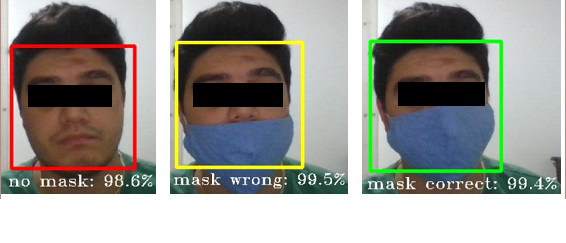
With COVID-19 spreading all over the world and restricting our daily lives, the use of face masks has become very important, as it is an efficient way of slowing down the spread of the virus and an important piece to continue our daily tasks until vaccination is completed. People have been fighting this disease for a long time, and they are bored with the precautions, so they act carelessly. In this case, automatic detection systems are very important to keep the situation under control. In this research, deep learning models are trained with as little input data as possible in order to obtain an accurate face mask-wearing condition classification. These classes are mask-correct, mask wrong, and no mask, which refers to proper face mask use, improper face mask use, and no mask use, respectively. DenseNets, EfficientNets, InceptionResNetV2, InceptionV3, MobileNets, NasNets, ResNets, VGG16, VGG19, and Xception are the networks used in this study. The highest accuracy was obtained by the InceptionResNetV2 and Xception networks, with 99,6%. When other performance parameters are taken into consideration, the Xception network is a step forward. VGG16 and VGG19 also show an accuracy rate over 99%, with 99,1 and 99,4%, respectively. These two networks also had higher FPS and the two lowest initialization times during implementation. A comparison with recent studies was also carried out to evaluate the obtained accuracy. It was found that a higher accuracy can be obtained with the possible minimum input size.
Con el COVID-19 extendiéndose por todo el mundo y restringiendo nuestra vida diaria, el uso de mascarillas se ha vuelto muy importante, pues es una forma eficiente de frenar la propagación del virus, y una pieza importante para continuar con nuestras tareas diarias hasta que se complete la vacunación. La gente ha estado luchando contra la enfermedad durante mucho tiempo y se aburre con las precauciones, por lo que actúa con descuido. En este caso, los sistemas de detección automática son muy importantes para mantener la situación bajo control. En esta investigación se entrenan modelos de aprendizaje profundo con el mínimo de datos de entrada posibles para obtener una clasificación precisa de las condiciones de uso de las mascarillas. Estas clases son mask-correct, mask-wrong y no mask, que se refieren al uso adecuado, a un uso inadecuado y al no uso de la mascarilla facial, respectivamente. DenseNets, EfficientNets, InceptionResNetV2, InceptionV3, MobileNets, NasNets, ResNets, VGG16, VGG19 y Xception son las redes utilizadas en este estudio. La mayor precisión la obtuvieron las redes InceptionResNetV2 y Xception, con un 99,6 %. Cuando se tienen en cuenta otros parámetros de rendimiento, la red Xception un paso adelante. VGG16 y VGG19 presentan una tasa de precisión superior al 99 %, con 99,1 y 99,4 % respectivamente. Estas dos redes también presentaron FPS más altos y los dos tiempos de inicialización más bajos en la implementación. También se realizó una comparación con estudios recientes para evaluar la precisión obtenida. Se encontró que se puede obtener una mayor precisión con el mínimo tamaño de entrada posible.
References
Adusumalli, H., Kalyani, D., Sri, R. K., Pratapteja, M., and Rao, P. P. (2021). Face mask detection using Opencv. In IEEE (Eds/), 2021 Third International Conference on Intelligent Communication Technologies and Virtual Mobile Networks (ICICV) (pp. 1304-1309). IEEE. https://doi.org/10.1109/ICICV50876.2021.9388375
Agarwal, C., Kaur, I., and Yadav, S. (2022). Hybrid CNN-SVM Model for Face Mask Detector to Protect from COVID-19. In M. Gupta, S. Ghatak, A. Gupta, and A. L. Mukherjee (Eds.), Artificial Intelligence on Medical Data: Proceedings of International Symposium, ISCMM 2021 (pp. 419-426). Springer. https://doi.org/10.1007/978-981-19-0151-5_35
Amin, P. N., Moghe, S. S., Prabhakar, S. N., and Nehete, C. M. (2021). Deep learning-based face mask detection and crowd counting. In IEEE (Eds.), 2021 6th International Conference for Convergence in Technology (I2CT) (pp. 1-5). IEEE. https://doi.org/10.1109/I2CT51068.2021.9417826
Atlam, M., Torkey, H., El-Fishawy, N., and Salem, H. (2021). Coronavirus disease 2019 (COVID-19): Survival analysis using deep learning and Cox regression model. Pattern Analysis and Applications, 24, 993-1005. https://doi.org/10.1007/s10044-021-00958-0
Aydemir, E., Yalcinkaya, M. A., Barua, P. D., Baygin, M., Faust, O., Dogan, S., Chakraborty, S., Tuncer, T., Acharya, U. R. (2022). Hybrid deep feature generation for appropriate face mask use detection. International Journal of Environmental Research and Public Health, 19(4), 1939. https://doi.org/10.3390/ijerph19041939
Baluprithviraj, K. N., Bharathi, K. R., Chendhuran, S., and Lokeshwaran, P. (2021). Artificial intelligence based smart door with face mask detection. In IEEE (Eds.), 2021 International Conference on Artificial Intelligence and Smart Systems (ICAIS) (pp. 543-548). IEEE. https://doi.org/10.1109/ICAIS50930.2021.9395807
Chavda, A., Dsouza, J., Badgujar, S., and Damani, A. (2021). Multi-stage CNN architecture for face mask detection. In IEEE (Eds.), 2021 6th International Conference for Convergence in Technology (i2ct) (pp. 1-8). IEEE. https://doi.org/10.1109/I2CT51068.2021.9418207
Cheng, V. C. C., Wong, S. C., Chuang, V. W. M., So, S. Y. C., Chen, J. H. K., Sridhar, S., Kai-Wang To, K., Fuk-Woo C., Fan-Ngai, I. H., Pak-Leung, H., and Yuen, K. Y. (2020). The role of community-wide wearing of face mask for control of coronavirus disease 2019 (COVID-19) epidemic due to SARS-CoV-2. Journal of Infection, 81(1), 107-114. https://doi.org/10.1016/j.jinf.2020.04.024
Crespo, F., Crespo, A., Sierra-Martínez, L. M., Peluffo-Ordóñez, D. H., and Morocho-Cayamcela, M. E. (2022). A computer vision model to identify the incorrect use of face masks for COVID-19 awareness. Applied Sciences, 12(14), 6924. https://doi.org/10.3390/app12146924
Das, A., Ansari, M. W., and Basak, R. (2020). Covid-19 face mask detection using TensorFlow, Keras and OpenCV. In IEEE (Eds.), 2020 IEEE 17th India Council International Conference (INDICON) (pp. 1-5). IEEE. https://doi.org/10.1109/INDICON49873.2020.9342585
Dey, S. K., Howlader, A., and Deb, C. (2020). MobileNet mask: A multi-phase face mask detection model to prevent person-to-person transmission of SARS-CoV-2. In M. S. Kaiser, A. Bandyopadhyay, M. Mahmud and K. Ray (Eds.), Proceedings of International Conference on Trends in Computational and Cognitive Engineering: Proceedings of TCCE 2020 (pp. 603-613). Springer. https://doi.org/10.1007/978-981-33-4673-4_49
Dimililer, K. (2017). IBFDS: Intelligent bone fracture detection system. Procedia Computer Science, 120, 260-267.https://doi.org/10.1016/j.procs.2017.11.237
Dimililer, K. (2022). DCT-based medical image compression using machine learning. Signal, Image and Video Processing, 16(1), 55-62. https://doi.org/10.1007/s11760-021-01951-0
Dimililer, K., Dindar, H., and Al-Turjman, F. (2021). Deep learning, machine learning and Internet of Things in geophysical engineering applications: An overview. Microprocessors and Microsystems, 80, 103613. https://doi.org/10.1016/j.micpro.2020.103613
Dimililer, K., Ever, Y. K., and Ugur, B. (2016). ILTDS: Intelligent lung tumor detection system on CT images. In J. Corchado-Rodríguez, S. Mitra, S. Thampi, and E. S. El-Alfy (Eds.), Intelligent Systems Technologies and Applications 2016 (pp. 225-235). Springer. https://doi.org/10.1007/978-3-319-47952-1_17
Dimililer, K., and Kayalı, D. (2021). Image enhancement in healthcare applications: A review. In F. Al-Turjman (Ed.), Artificial Intelligence and Machine Learning for COVID-19, (pp. 111-140). Springer. https://doi.org/10.1007/978-3-030-60188-1_6
Dimililer, K., and Zarrouk, S. (2017). ICSPI: Intelligent classification system of pest insects based on image processing and neural arbitration. Applied Engineering in Agriculture, 33(4), 453. https://doi.org/10.13031/aea.12161
Eyiokur, F. I., Ekenel, H. K., and Waibel, A. (2022). Unconstrained face mask and face-hand interaction datasets: building a computer vision system to help prevent the transmission of COVID-19. Signal, Image and Video Processing, 2022, 1-8. https://doi.org/10.1007/s11760-022-02308-x
Goyal, H., Sidana, K., Singh, C., Jain, A., and Jindal, S. (2022). A real time face mask detection system using convolutional neural network. Multimedia Tools and Applications, 81(11), 14999-15015. https://doi.org/10.1007/s11042-022-12166-x
Guo, S., Li, L., Guo, T., Cao, Y., and Li, Y. (2022). Research on mask-wearing detection algorithm based on improved YOLOv5. Sensors, 22(13), 4933. https://doi.org/10.3390/s22134933
Han, Z., Huang, H., Fan, Q., Li, Y., Li, Y., and Chen, X. (2022). SMD-YOLO: An efficient and lightweight detection method for mask wearing status during the COVID-19 pandemic. Computer Methods and Programs in Biomedicine, 221, 106888. https://doi.org/10.1016/j.cmpb.2022.106888
Huang, G. B., Ramesh, M., Berg, T., and Learned-Miller, E. (2007). Labeled faces in the wild: A database for studying face recognition in unconstrained environments (tech. rep. No. 07-49). University of Massachusetts.
Hussain, S., Yu, Y., Ayoub, M., Khan, A., Rehman, R., Wahid, J. A., and Hou, W. (2021). IoT and deep learning-based approach for rapid screening and face mask detection for infection spread control of COVID-19. Applied Sciences, 11(8), 3495. https://doi.org/10.3390/app11083495
Jayaswal, R., and Dixit, M. (2023). AI-based face mask detection system: a straightforward proposition to fight with Covid-19 situation. Multimedia Tools and Applications, 82, 13241-13273.https://doi.org/10.1007/s11042-022-13697-z
Kayali, D., Olawale, P., Kirsal-Ever, Y., and Dimililer, K. (2022). The effect of compressor-decompressor networks with different image sizes on mask detection using Convolutional Neural Networks-VGG-16. In IEEE (Eds.), 2022 Innovations in Intelligent Systems and Applications Conference (ASYU) (pp. 1-5). IEEE. https://doi.org/10.1109/ASYU56188.2022.9925317
Khamlae, P., Sookhanaphibarn, K., and Choensawat, W. (2021). An application of deep-learning techniques to face mask detection during the COVID-19 pandemic. In IEEE (Eds.), 2021 IEEE 3rd Global Conference on Life Sciences and Technologies (LifeTech) (pp. 298-299). IEEE. https://doi.org/10.1109/LifeTech52111.2021.9391922
Kodali, R. K., and Dhanekula, R. (2021). Face mask detection using deep learning. In IEEE (Eds.), 2021 International Conference on Computer Communication and Informatics (ICCCI) (pp. 1-5). IEEE. https://doi.org/10.1109/ICCCI50826.2021.9402670
Mar-Cupido, R., García, V., Rivera, G., and Sánchez, J. S. (2022). Deep transfer learning for the recognition of types of face masks as a core measure to prevent the transmission of COVID-19. Applied Soft Computing, 125, 109207. https://doi.org/10.1016/j.asoc.2022.109207
Mohan, P., Paul, A. J., and Chirania, A. (2021). A tiny CNN architecture for medical face mask detection for resource-constrained endpoints. In S. Mekhilef, M. Favorskaya, R. K. Pandey, and R. N. Shaw (Eds.), Innovations in Electrical and Electronic Engineering: Proceedings of ICEEE 2021 (pp. 657-670). Springer. https://doi.org/10.1007/978-981-16-0749-3_52
Nagrath, P., Jain, R., Madan, A., Arora, R., Kataria, P., and Hemanth, J. (2021). SSDMNV2: A real time DNN-based face mask detection system using single shot multibox detector and MobileNetV2. Sustainable Cities and Society, 66, 102692. https://doi.org/10.1016/j.scs.2020.102692
Narin, A., Kaya, C., and Pamuk, Z. (2021). Automatic detection of coronavirus disease (covid-19) using X-ray images and deep convolutional neural networks. Pattern Analysis and Applications, 24, 1207-1220. https://doi.org/10.1007/s10044-021-00984-y
Naufal, M. F., Kusuma, S. F., Prayuska, Z. A., Yoshua, A. A., Lauwoto, Y. A., Dinata, N. S., and Sugiarto, D. (2021). Comparative analysis of image classification algorithms for face mask detection. Journal of Information Systems Engineering and Business Intelligence, 7(1), 56-66. https://doi.org/10.20473/jisebi.7.1.56-66
Pandey, V. (2020). Artificial intelligence based face mask detection system. International Journal of Innovative Science and Research Technology, 5(8), 467-470. https://doi.org/10.38124/IJISRT20AUG410
Pinki and Garg, S. (2020) Face mask detection system using deep learning. International Journal for Modern Trends in Science and Technology, 6(12), 161-164. https://doi.org/10.46501/IJMTST061231
Rudraraju, S. R., Suryadevara, N. K., and Negi, A. (2020). Face mask detection at the fog computing gateway. In IEEE (Eds.), 2020 15th Conference on Computer Science and Information Systems (FedCSIS) (pp. 521-524). IEEE. https://doi.org/10.15439/2020F143
Sakshi, S., Gupta, A. K., Yadav, S. S., and Kumar, U. (2021). Face mask detection system using CNN. In IEEE (Eds.), 2021 International Conference on Advance Computing and Innovative Technologies in Engineering (ICACITE) (pp. 212-216). IEEE. https://doi.org/10.1109/ICACITE51222.2021.9404731
Sanjaya, S. A., and Rakhmawan, S. A. (2020). Face mask detection using MobileNetV2 in the era of COVID-19 pandemic. In IEEE (Eds.), 2020 International Conference on Data Analytics for Business and Industry: Way Towards a Sustainable Economy (ICDABI) (pp. 1-5). IEEE. https://doi.org/10.1109/ICDABI51230.2020.9325631
Sen, S., and Patidar, H. (2020). Face mask detection system for COVID 19 pandemic precautions using deep learning method. International Journal of Emerging Technologies and Innovative Research, 7(10), 16-21. https://www.jetir.org/view?paper=JETIR2010003
Shete, I. (2020). Social distancing and face mask detection using deep learning and computer vision [Doctoral dissertation, National College of Ireland]. https://norma.ncirl.ie/id/eprint/4419
Singh, A., Jindal, V., Sandhu, R., and Chang, V. (2022). A scalable framework for smart COVID surveillance in the workplace using deep neural networks and cloud computing. Expert Systems, 39(3), e12704. https://doi.org/10.1111/exsy.12704
Nandhis, S., Amarthya, R., Gokul, D., and Jacob, M. S. (2021). Realtime face mask detection using machine learning. In IEEE (Eds.), 2021 International Conference on System, Computation, Automation and Networking (ICSCAN) (pp. 1-4). IEEE. https://doi.org/10.1109/ICSCAN53069.2021.9526418
SivaKumar, M., Saranprasath, N., Sridharan, N. S., and Praveen, V. S. (2021, May). Comparative analysis of CNN and Viola-Jones for face mask detection. Journal of Physics: Conference Series, 1916(1), 012043. https://doi.org/10.1088/1742-6596/1916/1/012043
Snyder, S. E., and Husari, G. (2021). Thor: A deep learning approach for face mask detection to prevent the COVID-19 pandemic. In IEEE (Eds.), SoutheastCon 2021 (pp. 1-8). IEEE. https://doi.org/10.1109/SoutheastCon45413.2021.9401874
Srinivasan, S., Singh, R. R., Biradar, R. R., and Revathi, S. A. (2021). COVID-19 monitoring system using social distancing and face mask detection on surveillance video datasets. In IEEE (Eds.), 2021 International Conference on Emerging Smart Computing and Informatics (ESCI) (pp. 449-455). IEEE. https://doi.org/10.1109/ESCI50559.2021.9396783
Suresh, K., Palangappa, M. B., and Bhuvan, S. (2021). Face mask detection by using optimistic convolutional neural network. In IEEE (Eds.), 2021 6th International Conference on Inventive Computation Technologies (ICICT) (pp. 1084-1089). IEEE. https://doi.org/10.1109/ICICT50816.2021.9358653
Venkateswarlu, I. B., Kakarla, J., and Prakash, S. (2020). Face mask detection using mobilenet and global pooling block. In IEEE (Eds.), 2020 IEEE 4th Conference on Information and Communication Technology (CICT) (pp. 1-5). IEEE. https://doi.org/10.1109/CICT51604.2020.9312083
Vijitkunsawat, W., and Chantngarm, P. (2020). Study of the performance of machine learning algorithms for face mask detection. In IEEE (Eds.) 2020-5th International Conference on Information technology (InCIT) (pp. 39-43). IEEE. https://doi.org/10.1109/InCIT50588.2020.9310963
Waleed, J., Abbas, T., and Hasan, T. M. (2022). Facemask wearing detection based on deep CNN to control COVID-19 transmission. In IEEE (Eds.), 2022 Muthanna International Conference on Engineering Science and Technology (MICEST) (pp. 158-161). IEEE. https://doi.org/10.1109/MICEST54286.2022.9790197
Wang, Z., Wang, P., Louis, P. C., Wheless, L. E., and Huo, Y. (2021). Wearmask: Fast in-browser face mask detection with serverless edge computing for covid-19. arXiv preprint. https://doi.org/10.48550/arXiv.2101.00784
Wu, P., Li, H., Zeng, N., and Li, F. (2022). FMD-Yolo: An efficient face mask detection method for COVID-19 prevention and control in public. Image and Vision Computing, 117, 104341. https://doi.org/10.1016/j.imavis.2021.104341
Yadav, S. (2020). Deep learning based safe social distancing and face mask detection in public areas for covid-19 safety guidelines adherence. International Journal for Research in Applied Science and Engineering Technology, 8(7), 1368-1375. https://doi.org/10.22214/ijraset.2020.30560
Dimensions
PlumX
Article abstract page views
Downloads
How to Cite




License
Copyright (c) 2023 Kamil Dimililer, Devrim Kayali

This work is licensed under a Creative Commons Attribution 4.0 International License.
The authors or holders of the copyright for each article hereby confer exclusive, limited and free authorization on the Universidad Nacional de Colombia's journal Ingeniería e Investigación concerning the aforementioned article which, once it has been evaluated and approved, will be submitted for publication, in line with the following items:
1. The version which has been corrected according to the evaluators' suggestions will be remitted and it will be made clear whether the aforementioned article is an unedited document regarding which the rights to be authorized are held and total responsibility will be assumed by the authors for the content of the work being submitted to Ingeniería e Investigación, the Universidad Nacional de Colombia and third-parties;
2. The authorization conferred on the journal will come into force from the date on which it is included in the respective volume and issue of Ingeniería e Investigación in the Open Journal Systems and on the journal's main page (https://revistas.unal.edu.co/index.php/ingeinv), as well as in different databases and indices in which the publication is indexed;
3. The authors authorize the Universidad Nacional de Colombia's journal Ingeniería e Investigación to publish the document in whatever required format (printed, digital, electronic or whatsoever known or yet to be discovered form) and authorize Ingeniería e Investigación to include the work in any indices and/or search engines deemed necessary for promoting its diffusion;
4. The authors accept that such authorization is given free of charge and they, therefore, waive any right to receive remuneration from the publication, distribution, public communication and any use whatsoever referred to in the terms of this authorization.








