Published
Optimization in Territorial Partitioning to Improve the Performance of a Common Building Maintenance Service Contract: A Case Study of a Public Agency in Paraná State, Brazil
Optimización en la partición territorial para mejorar el desempeño de un contrato común de servicios de mantenimiento de edificios: un estudio de caso de una agencia pública en el Estado de Paraná, Brasil
DOI:
https://doi.org/10.15446/ing.investig.105143Keywords:
Public administration contracts, Facility Location Problem, maintenance management, binary integer linear programming (en)contratos de administración pública, gestión de mantenimiento, programación lineal entera binaria, problema de ubicación de instalaciones (es)
All public administration contracts must be evaluated in order to improve their performance while respecting the limits established by laws and regulations. The purpose of this article is to apply an approach to improve the performance of a common building maintenance service contract for the Paraná State Court of Justice (PRCJ), which has a total built area of 544 283,79 m² in 224 buildings distributed over 161 counties, by optimizing the territorial partitioning of Paraná State. To partition the state into 14 regions, a binary integer linear programming (BILP) mathematical model is applied to the facilities location problem (FLP) in three scenarios. The results show that Scenario 3 (in which the location of the 14 maintenance offices and the configuration of their areas of activity were optimized) is the best in terms of minimizing the distances traveled by maintenance teams. In this scenario, the total distance traveled would be 9 775 km per day (instead of the current 11 150 km), achieving savings of around 12,3% when compared to the current solution. With this solution, in addition to the distance, the direct and indirect costs associated with the displacement of work teams and the time spent on their corresponding trips would be minimized. Furthermore, the users of maintenance services could be served more quickly, resulting in a higher number of services and greater satisfaction for the target audience of the contract.
Todos los contratos de la administración pública deben ser evaluados a fin de mejorar su ejecución, respetando los límites establecidos por las leyes y los reglamentos. El objetivo de este artículo es aplicar un enfoque para mejorar el desempeño de un contrato de servicio común de mantenimiento de edificios en la Corte de Justicia del Estado de Paraná (PRCJ), que tiene un área total construida de 544 283,79 m² en 224 edificios distribuidos en 161 municipios, optimizando la partición territorial del Estado de Paraná. Para dividir el estado en 14 regiones, se aplicó un modelo matemático de programación lineal entera binaria (BILP) al problema de ubicación de instalaciones (FLP) en tres escenarios. Los resultados muestran que el Escenario 3 (en el que se optimizó la ubicación de las 14 oficinas de mantenimiento y la configuración de sus áreas de actividad) es el mejor escenario en cuanto a la minimización de las distancias recorridas por los equipos de mantenimiento. En este escenario, la distancia total recorrida sería de 9 775 km diarios (en lugar de los 11 150 km actuales), consiguiendo un ahorro en torno al 12,3 % respecto a la solución actual. Con esta solución, además de la distancia, se minimizarían los costos directos e indirectos relacionados con el desplazamiento de los equipos de trabajo y el tiempo empleado en sus respectivos viajes. Además, los usuarios de los servicios de mantenimiento podrían ser atendidos más rápidamente, lo que redundaría en un mayor número de servicios y una mayor satisfacción del público objetivo del contrato.
Recibido: 6 de octubre de 2022; Aceptado: 24 de agosto de 2023
ABSTRACT
All public administration contracts must be evaluated in order to improve their performance while respecting the limits established by laws and regulations. The purpose of this article is to apply an approach to improve the performance of a common building maintenance service contract for the Paraná State Court of Justice (PRCJ), which has a total built area of 544 283,79 m2 in 224 buildings distributed over 161 counties, by optimizing the territorial partitioning of Paraná State. To partition the state into 14 regions, a binary integer linear programming (BILP) mathematical model is applied to the facilities location problem (FLP) in three scenarios. The results show that Scenario 3 (in which the location of the 14 maintenance offices and the configuration of their areas of activity were optimized) is the best in terms of minimizing the distances traveled by maintenance teams. In this scenario, the total distance traveled would be 9 775 km per day (instead of the current 11 150 km), achieving savings of around 12,3% when compared to the current solution. With this solution, in addition to the distance, the direct and indirect costs associated with the displacement of work teams and the time spent on their corresponding trips would be minimized. Furthermore, the users of maintenance services could be served more quickly, resulting in a higher number of services and greater satisfaction for the target audience of the contract.
Keywords:
public administration contracts, maintenance management, binary integer linear programming, facility location problem.RESUMEN
Todos los contratos de la administración pública deben ser evaluados a fin de mejorar su ejecución, respetando los límites establecidos por las leyes y los reglamentos. El objetivo de este artículo es aplicar un enfoque para mejorar el desempeño de un contrato de servicio común de mantenimiento de edificios en la Corte de Justicia del Estado de Paraná (PRCJ), que tiene un área total construida de 544 283,79 m2 en 224 edificios distribuidos en 161 municipios, optimizando la partición territorial del Estado de Paraná. Para dividir el estado en 14 regiones, se aplicó un modelo matemático de programación lineal entera binaria (BILP) al problema de ubicación de instalaciones (FLP) en tres escenarios. Los resultados muestran que el Escenario 3 (en el que se optimizó la ubicación de las 14 oficinas de mantenimiento y la configuración de sus áreas de actividad) es el mejor escenario en cuanto a la minimización de las distancias recorridas por los equipos de mantenimiento. En este escenario, la distancia total recorrida sería de 9 775 km diarios (en lugar de los 11 150 km actuales), consiguiendo un ahorro en torno al 12,3 % respecto a la solución actual. Con esta solución, además de la distancia, se minimizarían los costos directos e indirectos relacionados con el desplazamiento de los equipos de trabajo y el tiempo empleado en sus respectivos viajes. Además, los usuarios de los servicios de mantenimiento podrían ser atendidos más rápidamente, lo que redundaría en un mayor número de servicios y una mayor satisfacción del público objetivo del contrato.
Palabras clave:
contratos de administración pública, gestión de mantenimiento, programación lineal entera binaria, problema de ubicación de instalaciones.Introduction
Contracts signed by public authorities at the municipal, state, and federal levels must comply with legal obligations that are governed by the National Bidding Law, federal and state decrees, and by the rulings handed down by the Court of Accounts.
These contracts must be based on the use of traditional management methods, applying the principles of governance to provide adequate instructions for managers regarding the reasons for and the purpose of the contract, as well as matters pertaining to taxation. Consideration should also be given to compliance with the legislation concerning the way in which the bidding process is conducted.
Furthermore, all public administration contracts must be evaluated with the aim of improving their performance while respecting the limits established by laws and norms.
The aim of this article is to implement an approach aimed at improving the performance of a common building maintenance service contract. This is done by optimizing the territorial partitioning of Paraná State.
In addition to this introduction, a literature review is presented in the next section, with a description of common building maintenance services and works related to the subject under study. Then, the case study is addressed, including, among other aspects, a description of the scenario currently adopted by the Paraná State Court of Justice (PRCJ) regarding the partitioning of the state into regions. Subsequently, the methodology is described, and the results achieved through it are outlined. The final section presents the conclusions of the study.
Literature review
This section contains a brief description of building maintenance experiences and articles related to the studied topic, addressing territorial partitioning applied to a wide range of situations.
Building maintenance services
Every building must have effective maintenance processes and methods that should be systematically planned throughout its lifespan. For public buildings, this need is even more important because, in addition to being public property, they are the nerve center where civil servants perform their duties.
Buildings have a profound impact on people's quality of life, providing the basic structure required for conducting their productive activities, in addition to playing an important social role (Brandão and Santos 2020).
According to Barbosa and Pusch (2011), depending on the form of use, conservation, and especially the frequency of adequate maintenance, a building may exhibit early signs of wear and performance capacity loss.
According to Fontoura et al. (2019), maintenance should always be regarded as one of the precepts for ensuring the safety, health, and well-being of a building's users. Non-compliance with legislation on the compulsory maintenance of equipment and systems can lead to putting people's safety at risk and holding managers accountable.
In a study of public buildings conducted by the researchers, it was found that 66% of the probable causes of accidents involving equipment are related to inadequate maintenance, early loss of performance, and rapid deterioration. All of these aspects can be directly addressed with good and correct maintenance. Meanwhile, the cause and origin of the remaining 34% of accidents are related to so-called constructive defects, or endogenous anomalies.
Figure 1: Building performance, lifespan, and maintenance
From a legal viewpoint, it is important to highlight the NBR 14037 technical norms (ABNT, 2011) regarding the drafting of manuals on the use and maintenance of buildings, in addition to norm NBR 5674 (ABNT, 2012), which addresses the requirements for building maintenance management systems.
The definition of maintenance, identifying its different forms, is that of Dos Santos (2010), with the basic purpose of keeping equipment running most of the time at a low cost. The author also understands that maintenance, depending on how it is done, can be divided into corrective, preventive, and predictive aspects.
Meanwhile, technical norm NBR 5674 (ABNT, 1999) divides maintenance management into three groups: routine maintenance (characterized by a constant flow of standardized and cyclical services); corrective maintenance (characterized by services that require immediate action or intervention to enable the continuous use of the systems, elements, or components of buildings, or to avoid serious risks to people and/or the property of users or owners); and preventive maintenance (characterized by services that are scheduled in advance, prioritizing user requests, estimates of the expected durability of systems, the elements or components of buildings in use, severity and urgency, and periodic reports to gauge their state of disrepair).
In addition to the maintenance services themselves, there is also a need to optimally define the regions of Paraná State that each building maintenance team must serve. When defining this aspect, it must be considered that teams should travel the minimum distance from their place of origin to the locations that require maintenance, in order to guarantee a rapid service for users, which is the aim of this article.
Related works
Within the broad scope of the territorial partitioning problem, several mathematical models have been presented to group smaller territorial units into larger units with application to different domains. Although mixed integer linear programming (MILP) is the most suitable approach to deal with these problems, it has proven to be inadequate for large real-world problems. Therefore, different metaheuristic procedures have been developed for the territorial partitioning problem. Some of these approaches, which have been reported in the specialized literature over the last decade, are presented below in chronological order.
D'Amico et al. (2002) applied the simulated annealing metaheuristic to the problem of police management in the city of Buffalo (USA), with the goal of elaborating a map with optimized regions to minimize the disparity between the extreme workloads of police officers, specifically in the process of determining the number of patrol vehicles in use at various times of the day. Muyldermans et al. (2002) studied the salt spreading operation in the province of Antwerp (Belgium) through multi-purpose heuristic search procedures, where the road network was partitioned to minimize the distance traveled, as well as the number of trucks needed for the operation. Applying a genetic algorithm with multiple objectives to partition the electricity grid of the Republic of Ghana into economically viable districts, Bergey et al. (2003) identified some fundamental characteristics to model and solve a district's electric power problem.
Bozkaya et al. (2003) proposed an approach using the tabu search metaheuristic with an adaptive memory heuristic procedure for a districting problem in the city of Edmonton (Canada). Galvão et al. (2006) presented a Voronoi diagram for a logistics districting problem applied to parcel delivery in the city of São Paulo (Brazil), which resulted in a more balanced time/capacity use when compared to other approaches. A delivery planning system was studied by Haugland et al. (2007) in two steps using the tabu search and multi-start metaheuristics with the regions defined in the first stage, while the vehicle routing problem was solved for each district in the second stage. Combining a local search procedure with a multipurpose genetic algorithm, Tavares-Pereira et al. (2007) analyzed the public transport system in the region of Paris to suggest a reform of its pricing system.
A multipurpose genetic algorithm was studied by Datta et al. (2007) for the problem of land use management in Baixo Alentejo (Portugal), aiming to achieve the natural balance of the environment and financial profit. Ricca and Simeone (2008) compared several heuristic and metaheuristic procedures for the electoral districting problem in a set of regions of Italy with multiple goals, seeking to achieve population equality, compactness, and administrative compliance. Ricca et al. (2008) compared two methods for locating Italian polling stations using weighted Voronoi regions with two aims: population equality and compactness.
Also using Voronoi diagrams, but associated with continuous approximation models, Novaes et al. (2009) solved location-districting problems related to transport and logistics applied to an urban distribution service covering part of the city of São Paulo (Brazil). Salazar-Aguilar et al. (2011) solved the distribution of beverages in the city of Monterrey (Mexico) via a bi-objective programming model, aiming to achieve an equilibrium between dispersion and balance in territories regarding the number of customers and the sales volume. Datta et al. (2012), applied a multi-objective genetic algorithm to a problem with census tracts in order to aggregate census units to obtain better compactness and population/area uniformity in the Metropolitan Census area of London (Ontario, Canada).
Shirabe (2012) used a heuristic procedure to solve a MILP model with several illustrative school bus instances. Benzarti and Dallery (2013) addressed home care as a districting problem, modeling it as a MILP to achieve, among other things, compactness, and workload balance. Ríos-Mercado and López-Pérez (2013) used a branch-and-bound approach to solve the problem of a bottled beverage distribution company located in the city of Monterrey (Mexico). A GRASP procedure was used by Assis et al. (2014) to solve a territorial partitioning problem applied to the reading of energy meters in the city of São Paulo (Brazil) while striving for compactness and homogeneity.
Aiming to optimize truck routes for urban waste collection, Vecchi et al. (2016) presented a sequential approach involving three phases: the clustering of arcs based on a model adapted from the p-median problem, formulated as a binary integer linear programming (BILP) problem; the development of a model for the solution of the capacitated arc routing problem, formulated as a MILP problem; and, finally, the application of an adapted Hierholzer algorithm to sequence the arcs obtained in the previous phase. Ferreira et al. (2017) presented a vehicle routing problem solved in two steps: the definition of demand point clusters as a facility location problem (PLF) and the definition of routes within each cluster, i.e., an asymmetric traveling salesman problem (ATSP). For the ATSP, the simulated annealing and tabu search metaheuristics were used, as well as a hybrid algorithm.
Corn and soy production, which has grown continuously in Brazil, was also researched in the context of territorial partitioning with the intention of analyzing how to increase the number of grain silos. To this effect, Steiner Neto et al. (2017) proposed aggregating the municipalities of Paraná State into regions for the effective transport of grains. Their work organized the storage regions, aggregating the municipalities as a multi-objective graph (territories) partitioning problem, aiming to maximize the homogeneity of the storage deficit and minimize the cost of inter-region transport from the production sources to the silos. The authors made use, among other procedures, of genetic algorithms. Endler et al. (2018) evaluated the spatial distribution of public daycare centers in the city of Curitiba (Paraná, Brazil), based on three types of analysis: the analysis of the current location of daycare centers, the analysis of the possible expansions for existing units, and the analysis of opening new units. The authors solved the problem using mathematical modeling.
Franco et al. (2021) used the concept of the FLP to find the best configuration for clusters of municipalities (consortia) for the municipal solid waste (MSW) landfill network in Paraná State, Brazil. To this effect, they used the BILP mathematical model. In 2022, Franco et al. used a MILP mathematical model to analyze the current and future scenarios (2021 and 2033) for the location of MSW landfills in the State of Rio Grande do Sul (Brazil).
This work, in comparison with those analyzed above, deals with territorial partitioning aimed at improving the performance of a common building maintenance service contract in Paraná State. To this effect, following data collection and processing, a BILP mathematical model was used for several scenarios, the results of which were analyzed.
Case study
The case study involved a common building maintenance contract for the PRCJ. The PRCJ is an organ of the Judiciary that provides jurisdictional services in the counties located within Paraná State.
Ranked as one of the five largest courts of justice in the country, alongside São Paulo, Minas Gerais, Rio de Janeiro, and Rio Grande do Sul, the PRCJ had, in 2020, a total of 929 judges and 18 592 civil servants (CNJ, 2021). Table 1 shows the classification of these Brazilian justice courts with their corresponding numbers of cases, judges, and civil servants.
Source: CNJ (2021)Table 1: Classification of the major Justice Courts, highlighting the PRCJ
COURT
New cases
Cases pending
Judges
Civil Servants
São Paulo CJ
4 456 839
19 432 935
2 620
65 179
Minas Gerais CJ
1 428 480
3 940277
1 085
27 334
Rio de Janeiro CJ
1 463 530
7 897 304
877
24 629
Paraná CJ
1 287 624
3 754 090
929
18 592
Rio Grande do Sul CJ
1 095 931
3 035 797
759
16 603
According to data presented by the PRCJ regarding the Term of Reference published for the Bidding Notice for Electronic Auction No. 87/2022, as shown by the public in its own survey conducted in 2020, the physical structure consisted of a total of 224 occupied buildings, including units owned, leased, and assigned, distributed over 161 counties, consisting of a total built area of 544 283,79 m2. This dimension of the area to be served requires careful optimization procedures to be followed by common building maintenance teams.
Description of the common building maintenance contract
The PRCJ experienced problems due to the retirement of civil servants from its own staff who worked in the maintenance services of its buildings in Paraná State.
With no interest in holding public tenders for the hiring of operational maintenance workforce, the administration opted to hire a company that would supply outsourced labor to establish service stations for preventive and corrective maintenance operations.
As the solution required outsourced labor, the project was led by the technical engineering and maintenance sector, together with the outsourced services sector, as they had detailed knowledge of policies and management related to outsourcing services.
The following criteria were used as the basic premises with regard to labor laws in order to optimize the human resources that were hired: 1) employees could work a maximum of nine hours and 48 minutes per day, with a 1 h break; 2) activities would be carried out exclusively during daytime; 3) any necessary action on the weekends would be compensated for on working days; and 4) it was not possible to pay expenses or fund overnight stays for employees.
Current scenario (solution)
Due to legal requirements, it was determined that the buildings occupied by the PRCJ should be divided into regions, with the outsourced work teams headquartered in one of the counties belonging to the region in which they operated. The division of Paraná State (which comprises 399 municipalities) into 11 regions (a number obtained through preliminary experiments), is shown in Figure 2. These regions are duly named as follows, beginning on the right: the state capital, Curitiba; Santo Antônio da Platina; Ponta Grossa; Telêmaco Borba; Londrina; Guarapuava; Francisco Beltrão; Maringá; Campo Mourão; Umuarama; and Cascavel.
Figure 2: Map of Paraná State partitioned into 11 regions for building maintenance
Based on the areas and the number of buildings to be serviced in each region, the number of service stations for the outsourced teams (headquarters/maintenance offices) in each region was determined. Each work team was made up of four people: one supervisor and three building maintenance officers with multiple specialties. These data are presented in Table 2.
Source: AuthorsTable 2: Team offices characteristics
Due to the substantial number of buildings and areas served, it was decided that six work teams would be allocated to the Curitiba regional office. There are also outsourced professionals distributed in pairs to permanently service buildings that have a high number of requests for service. It was also determined that it would be necessary to have three administrative supervisors from the outsourced company for direct and daily dialogue with the management and inspection team.
Each work team has a company vehicle for traveling between cities, as well as tools, equipment, and smartphones. These smartphones are used for timekeeping, displacement, and service provision through the company's own application for team management regarding outsourced maintenance services, mainly for evaluating and monitoring displacement and the duration of services.
Services are provided primarily through visits for scheduled preventive maintenance. Emergency services are also provided based on local demand and on assessments by the contract management team regarding their urgency. If the demand is not identified as an emergency, the problem will be recorded in the building's list, to be addressed during the next technical visit by the team for preventive and corrective maintenance services.
The scheduled service cycle of each maintenance team is 45 to 60 consecutive days at its regional office, which means that a service routine is conducted in each building six to eight times a year. As these are services of a common nature, with no need for specialized knowledge to evaluate them, but rather only the identification of their performance and result, the documentation regarding the performance of the activities is done directly by the requesting customers, in other words, the claimants of the services, represented by the Assistants of the Court Directors or the supervisors of administrative units.
To determine and select the offices of the work teams in each of the 11 regions, an investigation was conducted with the Court Boards to consider the possibility of using a small room (headquarters/office) to accommodate the structure of the team, simply furnished with lockers and shelves for storing tools and equipment. The initial objective was to allocate the teams to the district after which the region is named. However, due to insufficient space in some buildings, this goal was not achieved.
It should be highlighted that a county is defined as the territory over which the first instance judge has jurisdiction, and it may cover one or more municipalities depending on the number of residents and voters, the caseload, and the territorial extension of the municipalities, among other aspects (CNJ, 2016).
Some counties were chosen to function as the headquarters/ offices of maintenance teams according to the availability of office space and distributed as shown in Table 2. Other counties were chosen as host municipalities, so that the teams' maintenance facilities could be properly located, in such a way that the travel distance to the buildings to be served did not exceed 161 km. It is important to note that, due to the large built area, the cities of Londrina, Maringá, Cascavel, and Guarapuava have a maintenance team in permanent operation, i.e., they do not have to travel to other cities.
Figure 3 shows the territorial division of the state into municipalities, indicating, in the colored areas, those that house the county offices, i.e., the locations that have at least one building occupied by the PRCJ which must be serviced within the framework of the building maintenance contract. Thus, the problem in question consists of 161 clients to be served (the counties, represented in color in Figure 3). The other 238 municipalities in the state do not have judiciary structures for maintenance.
Figure 3: Map of Paraná State, partitioned according to the location of the municipalities for the 14 maintenance offices/headquarters (small circles) and their 14 areas of activity for building maintenance services
Early work on the scope of the contract indicated that the region of Santo Antônio da Platina should have two offices instead of one, and the chosen ones were Ribeirão Claro and Cornélio Procópio. The Cascavel region had an additional team allocated to Foz do Iguaçu to better serve a large local building. Cruzeiro do Oeste was chosen as the headquarters for the Umuarama region, and Pato Branco was chosen as the location of the office in Francisco Beltrão. Finally, União da Vitória was chosen to host an additional team in the Ponta Grossa region due to its considerable distance to the main city, which would require long travel times. All these 14 cities for the maintenance teams are represented in the fourth column of Table 2 and the map in Figure 3, consequently generating 14 areas of action. It should be mentioned that the configuration of the map in Figure 3 is the same as in Figure 2, only with the inclusion of the areas of operation of the regions' additional host municipalities. Figure 3 highlights the data necessary for this work: the 161 counties and the 14 offices.
The contracting process was managed by the PRCJ, following a bidding procedure in the electronic trading modality, in February 2021, and services began in April of the same year.
For this scenario, as contracted by the PRCJ, the data regarding the work teams' displacement are presented in Table 3.
Source: AuthorsTable 3: Displacement of work teams considering the current scenario
Table 3 shows that the sum of all the distances traveled by the maintenance teams from their offices to the serviced buildings is 11 150 km. Out of the distances traveled, the longest was 161 km, and the average was 69,3 km.
Analyzing the clusters in the current solution, we have five offices in Curitiba, Cruzeiro do Oeste, Maringá, Londrina, and Pato Branco, serving around 53% of the counties. The complete distribution of counties regarding the offices in the current solution is presented in Table 4.
Source: AuthorsTable 4: Characteristics of work teams considering the current scenario
Table 4 also shows that the five offices that serve the fewest counties are Ribeirão Claro, União da Vitória, Cornélio Procópio, Ponta Grossa, and Foz do Iguaçu. Combined, they serve approximately 19,3% of the counties. Regarding the maintenance area, the highest numbers are those in Curitiba, Londrina, and Cascavel, which represent 62,0% of the total area.
Methodology
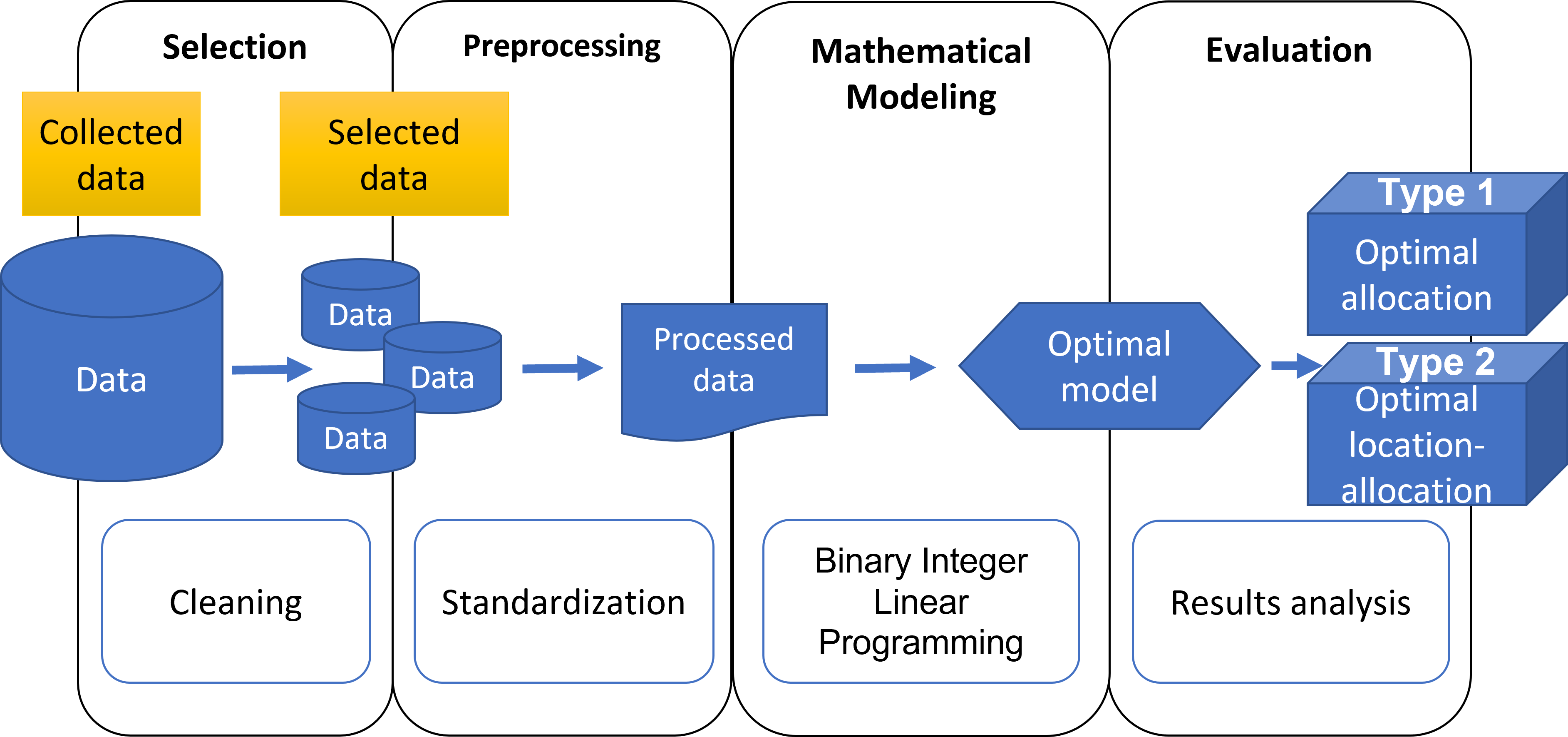
The methodology used in the study is shown in Figure 4 and comprises four stages: data selection, pre-processing, mathematical modeling, and results evaluation.
Figure 4: Research methodology
The collected data include the location of the municipalities, i.e., their geographical centers; the distances between the municipalities; the total areas of building maintenance in the Paraná legal system; and the current configuration of the maintenance teams. With these data, data cleaning and standardization were carried out for the later implementation of the BILP mathematical model for facility location, which was divided into two types: the allocation problem, where only the configuration of maintenance consortia is optimized; and the location-allocation problem, where both the location of the offices of the consortia and their configuration are optimized.
The data regarding the distances between municipalities were obtained through the Google Distance Matrix API platform, which provides the road distance between a user-defined origin and a destination. A total of 25 760 distances were collected (corresponding to the combination of 161 municipalities, two by two).
Facility location problem
The facility location problem (FLP) is applied in the planning and optimization of the location of production facilities - including public agencies - and considers the distances between origin and destination. Therefore, in addition to determining the number of facilities to be opened, it is also responsible for determining their locations, which makes it an NP-hard problem (Laporte, 2019, Franco et al., 2022, Franco and Steiner, 2023).
The FLP can be solved using BILP, in accordance with the model presented in Equations (1) to (5), where J and I are the sets of consumers (counties) and facilities (headquarters), respectively. The decision variables are X ij , which represents the number of counties bein g assigned to the headquarters, and y i , denoting which headquarters are open.
In this general model, Equation (1) minimizes the cost c ij of transport between the consumers j and the facilities i . Equation (2) guarantees that each consumer (county) j will be served by only one facility (headquarters). Constraint (3) ensures that each client (county) is designated to a facility only if it is open. Finally, Equations (4) and (5) define the decision variables' domain: X ij . must be equal to zero or positive, and y i must be binary (the county can 'receive' or 'not receive' the facility).
For the optimization, LINGO 19 software was used on an Intel Core i7-2600 computer with 16 GB RAM and Windows 10. The execution time varied between 0,14 and 0,87 s.
Results
Regarding the optimal definition of the regions in Paraná State to be served by the building maintenance teams, three scenarios were taken into account. It should be mentioned again that the regional offices had to be defined while minimizing the distances to be covered by the teams from their places of origin (headquarters/offices) to the maintenance locations. Although the centroids of the municipalities were used as a reference for calculating the distances, this does not affect the performance of the solution, since the maintenance teams move mainly between the districts, and it is this relationship between municipalities that affects the choice of the facilities.
Scenario 1
The first scenario optimizes the maintenance offices' areas of operation while keeping their current location unchanged. The result is shown in Figure 5 below.
Figure 5: Optimization of the establishment of regional offices considering the current location of the 14 host municipalities of the maintenance offices (Scenario 1)
The main difference regarding the existing solution (Figure 3) is a better concentration of municipality clusters in certain regions, as well as reductions of 6,20% in the average distance traveled and 6,13% in total distance traveled. The results of optimized Scenario 1 are shown in Table 5.
Source: AuthorsTable 5: Displacement of work teams under Scenario 1
An analysis of the clusters in Scenario 1 shows five offices serving around 52% of the counties: Curitiba, Maringá, Cruzeiro do Oeste, Cascavel, and Londrina, unlike the current solution (Table 4), which had Pato Branco among the five largest instead of Cascavel. The entire distribution of counties among the offices in Scenario 1 is presented in Table 6.
Source: AuthorsTable 6: Characteristics of work teams under Scenario 1
Table 6 also shows that the five offices serving the fewest counties are Ribeirão Claro, Guarapuava, Telêmaco Borba, Foz do Iguaçu, and União da Vitória, which, combined, serve approximately 19,3% of all the counties. Regarding the area in which the building maintenance will be conducted, the highest numbers continue to be those of Curitiba, Londrina, and Cascavel, representing 62,8% of the total area served.
Scenario 1 could be easily implemented in practice, as the municipalities with offices would remain unchanged and there would be few adjustments to be made to the areas of operation. This could mean a reduction of about 6% in the total distance traveled by the teams.
Scenario 2
In the second scenario, the current configuration of the 11 regions (areas of operation), presented in the first column of Table 2, was fixed, aiming to optimize the location of 11 offices rather than 14. In other words, there should only be 11 areas of operation in accordance with the original division of regions to gauge the distances traveled with a lower number of offices. The result is shown in Figure 6.
Figure 6: Optimization of the location of the host municipalities for 11 maintenance offices, maintaining the current configuration of regions (Scenario 2)
By comparing Scenario 2 with the current scenario, an increase can be observed in the total distance traveled, i.e., around 0,56%, due to the decrease in the number of maintenance offices. Analyzing the maintenance cost of the new scenario with 11 offices (rather than the current 14) would make it be possible to identify if this reduction is worthwhile. The findings in terms of the distances traveled are shown in Table 7.
Source: AuthorsTable 7: Displacement of work teams under Scenario 2
In this scenario, there are two routes that do not comply with the constraint on the maximum distance to be covered (161 km). These are the routes between Curiúva and Cândido de Abreu, with 197 km, and between Ponta Grossa and União da Vitória, with 208 km.
An analysis of the clusters in Scenario 2 shows five offices serving around 53,4% of the counties: Curitiba, Maringá, Umuarama, Londrina, and Cascavel. Table 8 presents the complete distribution of counties among the offices in Scenario 2.
Source: AuthorsTable 8: Characteristics of work teams under Scenario 2
The five offices serving the fewest counties in this scenario are União da Vitória, Foz do Iguaçu, Pontal do Paraná, Santo Antônio do Sudoeste, and Guarapuava. Combined, they serve approximately 18,6% of the total number of counties and are responsible for 13,8% of the maintenance area.
Scenario 3 would be the most interesting for implementation in terms of reducing transportation costs. However, as practically nothing was maintained regarding the current scenario (the definition of both the offices and the areas of operation), the entire procedure concerning the location of the offices, distances traveled, and number of teams presented in the Terms of Reference of the bids for the contract would have to be reassessed. Therefore, this case would also require an in-depth study by the PRCJ administration to gauge whether the reformulation work would have legal and technical support, especially considering that it would ensure a reduction of over 12% in the total distance traveled per day by the teams.
Conclusions and future research
The aim of this study was to evaluate the possible application of an approach to improving the performance of a common building maintenance service contract for the PRCJ, which has 224 buildings with a total built area of 544 283,79 m2, distributed over 161 counties in the State of Paraná.
To this effect, the BILP mathematical model was used, together with the FLP, to optimize the existing territorial partitioning of Paraná State into 11 regions with 14 host municipalities (maintenance offices or headquarters). Three scenarios were considered. In Scenario 1, the areas of operation of the 14 host-municipalities for the maintenance offices were optimized. In Scenario 2, the locations of 11 maintenance offices (instead of 14) were optimized, maintaining the original areas of the regions in order to gauge the distances traveled for this case. Meanwhile, Scenario 3 optimized both the location of the host municipalities for
the 14 maintenance offices and their areas of operation. A summary of the solutions found is shown in Table 9.
Source: AuthorsTable 9: Comparison of costs (distances) regarding the three scenarios
Although all the solutions obtained have advantages and disadvantages, it can clearly be perceived that the best scenario in terms of total distance and average distance traveled is Scenario 3, which optimizes the location of the 14 maintenance offices, as well as the configuration of their areas of operation. In this scenario, the teams will have to cover a total distance of 9 775 km per day (instead of the current 11 150 km), from their headquarters to the maintenance locations, achieving a reduction of around 12,3% in the total distance traveled when compared to the solution with the current contract.
With the solution in Scenario 3, the PRCJ would minimize, in addition to the distance, the operating and maintenance costs of displacing the teams, in addition to the time spent on the corresponding trips. Furthermore, the time spent providing maintenance services in each building would increase, which also implies a higher level of satisfaction for the people served through the contract.
In addition to the fact that Scenario 3 is the best, it was shown that starting an optimization procedure 'from scratch' will always yields the best results. However, starting from scratch is costly, and, whenever possible, one should make use of existing facilities/criteria.
Future research could explore the fixed upkeep cost of maintenance offices, with a view to optimizing their number as a function of the trade-off between fixed and variable costs in scenarios for optimizing facility location. Another future research could consider the location of the buildings (instead of the municipalities' geographical center) in the mathematical model which will require a (slightly) larger dataset.
Acknowledgements
The study was financed in part by the Coordenação de Aperfeiçoamento de Pessoal de Nível Superior - Brasil (CAPES) - Finance Code 001
References
References
Associação brasileira de normas técnicas (ABNT) (1999). NBR 5674. Manutenção de edificações-procedimentos. ABNT.
Associação brasileira de normas técnicas (ABNT) (2011). NBR 14037. Diretrizes para elaboração de manuais de uso, operação e manutenção das edificações – Requisitos para ela-boração e apresentação dos conteúdos. ABNT.
Associação brasileira de normas técnicas (ABNT) (2012). NBR 5674. Segunda edição. Manutenção de edificações – requisitos para o sistema de gestão de manutenção. ABNT.
Assis, L. S., França, P. M., and Usberti, F. L. (2014). A redistricting problem applied to meter reading in power distribution net-works. Computers & Operations Research, 41, 65-75. https://doi.org/10.1016/j.cor.2013.08.002
Barbosa, P. B., and Pusch, J. (2011). Da intenção de projeto ao uso do edifício: a busca da excelência profissional. Programa de Excelência em Projetos CREA-PR.
Benzarti, E., and Dallery, E. S. (2013). Operations management applied to home care services: Analysis of the districting problem. Decision Support Systems, 55(2), 587-598. https://doi.org/10.1016/j.dss.2012.10.015
Bergey, P. K., Ragsdale, C. T., and Hoskote, M. (2003). A deci-sion support system for the electrical power districting problem. Decision Support Systems, 36(1), 1-17. https://doi.org/10.1016/S1344-6223(02)00033-0
Bozkaya, B., Erkut, E., and Laporte, G. (2003). A tabu search heuristic and adaptative memory procedure for political districting. European Journal of Operational Research, 144(1), 12-26. https://doi.org/10.1016/S0377-2217(01)00380-0
Brandão, N. L. S., and Santos, D. G. (2020). Manutenção predial em edificações públicas: um mapeamento sistemático da literatura. Encontro Nacional de Tecnologia do Ambiente Construído, 18(1),1251. https://doi.org/10.46421/entac.v18i.1251
Conselho Nacional de Justiça (CNJ) (2016). Saiba a diferença entre comarca, vara, entrância e instância. https://www.cnj.jus.br/cnj-servico-saiba-a-diferenca-entre-comarca-vara-entrancia-e-instancia/
Conselho Nacional de Justiça (CNJ) (2021). Justiça em núme-ros 2021. https://www.cnj.jus.br/pesquisas-judiciarias/justica-em-numeros/
D'Amico, S. J., Wang, S.-J., Batta, R., and Rump, C. M. (2002). A simulated annealing approach to police district design. Computers & Operations Research, 29(6), 667-684. https://doi.org/10.1016/S0305-0548(01)00056-9
Datta, D., Deb, K., Fonseca, C. M., Lobo, F. G., Condado, P. A., and Seixas, J. (2007). Multi-objective evolutionary algorithm for land-use management problem. International Journal of Computational Intelligence Research, 3(4), 371-384. DOI: https://doi.org/10.5019/j.ijcir.2007.118
Datta, D., Malczewski, J., and Figueira, J. R. (2012). Spatial aggregation and compactness of census areas with a multi-objective genetic algorithm: a case study in Canada. Envi-ronment and Planning B: Planning and Design, 39, 376-392. https://doi.org/10.1068/b38078
Dos Santos, V. A. (2010). Prontuário para a Manutenção Me-cânica. Ícone Editora.
Endler, K. D., Scarpin, C. T., and Steiner, M. T. A. (2018). Evalua-tion of the of public network location day care center: Mod-els and case study. IEEE Latin America Transactions, 16, 2013-2019. https://doi.org/10.1109/TLA.2018.8447370
Ferreira, J. C., Steiner, M. T. A., and Guersola, M. S. (2017). A vehicle routing problem solved through some metaheuristics procedures: A case study. IEEE Latin America Transactions, 15, 943-949. https://doi.org/10.1109/TLA.2017.7910210
Fontoura, L. H. N., Santos, C. H. S., and Oliveira, C. C. (2019). Manutenção de prédios públicos: uma questão de gestão. Revista eletrônica e Administração, 18(2), 322-346. http://periodicos.unifacef.com.br/rea/article/view/1648
Franco, D. G. de B., Steiner, M. T. A., and Assef, F. M. (2021). Optimization in waste landfilling partitioning in Paraná State, Brazil. Journal of Cleaner Production, 283, 125353. https://doi.org/10.1016/j.jclepro.2020.125353
Franco, D. G. B., Steiner, M. T. A., Fernandes, R., and Nascimen-to, V. F. (2022). Modeling municipal solid waste disposal consortia on a regional scale for present and future scenarios. Socio-economic Planning Sciences, 82(B), 101333. https://doi.org/10.1016/j.seps.2022.101333
Franco, D. G. B., and Steiner, M. T. A. (2023). Optimization of municipal solid waste transportation in the State of Paraná: Rethinking the location of landfills based on mathematical modeling. Revista Engenharia Sanitaria e Ambiental, 27(5), 987-993. https://doi.org/10.1590/S1413-415220210282
Galvão, L. C., Novaes, A. G. N., Cursi, J. E., and Souza, J. C. (2006). A multiplicatively-weighted Voronoi diagram ap-proach to logistics districting. Computers & Operations Re-search, 33(1), 93-114. https://doi.org/10.1016/j.cor.2004.07.001
Haugland, D., Ho, S. C., and Laporte, G. (2007). Designing delivery districts for the vehicle routing problem with stochas-tic demands. European Journal of Operational Research, 18(3), 997-1010. https://doi.org/10.1016/j.ejor.2005.11.070
Laporte, G. (2019). Location science. Springer International Publishing. https://doi.org/10.1007/978-3-030-32177-2
Muyldermans, L., Cattrysse, D., Oudheusden, D. V., and Lotan, T. (2002). Districting for salt spreading operations. European Journal of Operational Research, 139(3), 521-532. https://doi.org/10.1016/S0377-2217(01)00184-9
Novaes, A. G. N., Cursi, J. E. S., Silva, A. C. L., and Souza, J.C. (2009). Solving continuous location-districting problems with Voronoi diagrams. Computers & Operations Research, 36(1), 40-59. https://doi.org/10.1016/j.cor.2007.07.004
Poli, C. M. B. (2017). Manual de uso, operação e manutenção das edificações residenciais: avaliação do conteúdo a fim de aumentar a utilidade para a construção civil e para o usuário. UFRGS. http://hdl.handle.net/10183/170982
Ricca, F., and Simeone, B. (2008). Local search algorithms for political districting. European Journal of Operational Research, 189(3), 1409-1426. https://doi.org/10.1016/j.ejor.2006.08.065
Ricca, F., Scorazzi, A., and Simeone, B. (2008). Weighted Voro-noi region algorithms for political districting. Mathematical and Computer Modelling, 48(9-10), 1468-1477. https://doi.org/10.1016/j.mcm.2008.05.041
Ríos-Mercado, R. Z., and López-Pérez, F.J. (2013). Commercial territory design planning with realignment and disjoint assignment requirements. Omega, 41(3), 525-535. https://doi.org/10.1016/j.omega.2012.08.002
Salazar-Aguilar, M. A., Ríos-Mercado, R. Z., and González-Velarde, J. L. (2011). A bi-objective programming model for designing compact and balanced territories in commercial districting. Transportation Research – Part C, 19(5), 885-895. https://doi.org/10.1016/j.trc.2010.09.011
Shirabe, T. (2012). Prescriptive modeling with map algebra for multi-zone allocation with size constraints. Computers, Environment and Urban Systems, 36(5), 456-469. https://doi.org/10.1016/j.compenvurbsys.2011.12.003
Steiner Neto, P. J., Datta, D., Steiner, M. T. A., Canciglieri Júnior, O., Figueira, J. R., Detro, S. P., and Scarpin, C. T. (2017). A mul-ti-objective genetic algorithm-based approach for location of grain silos in Paraná State of Brazil. Computers & Industrial Engineering, 111, 381-390. https://doi.org/10.1016/j.cie.2017.07.019
Tavares-Pereira, F., Figueira, J. R., Mousseau, V., and Roy, B. (2007). Multiple criteria districting problems. Annals of Operations Research, 154, 69-92. https://doi.org/10.1007/s10479-007-0181-5
Vecchi, T. P. B., Fukunaga, D. S., Constantino, A., and Steiner, M. T. A. (2016). A sequential approach for the optimization of truck routes for solid waste collection. Process Safety and Environmental Protection, 102, 238-250. https://doi.org/10.1016/j.psep.2016.03.014
How to Cite
APA
ACM
ACS
ABNT
Chicago
Harvard
IEEE
MLA
Turabian
Vancouver
Download Citation
License
Copyright (c) 2024 Alexandre Arns Steiner, David Gabriel de Barros Franco, Elpídio O. B. Nara, Maria Teresinha Arns Steiner

This work is licensed under a Creative Commons Attribution 4.0 International License.
The authors or holders of the copyright for each article hereby confer exclusive, limited and free authorization on the Universidad Nacional de Colombia's journal Ingeniería e Investigación concerning the aforementioned article which, once it has been evaluated and approved, will be submitted for publication, in line with the following items:
1. The version which has been corrected according to the evaluators' suggestions will be remitted and it will be made clear whether the aforementioned article is an unedited document regarding which the rights to be authorized are held and total responsibility will be assumed by the authors for the content of the work being submitted to Ingeniería e Investigación, the Universidad Nacional de Colombia and third-parties;
2. The authorization conferred on the journal will come into force from the date on which it is included in the respective volume and issue of Ingeniería e Investigación in the Open Journal Systems and on the journal's main page (https://revistas.unal.edu.co/index.php/ingeinv), as well as in different databases and indices in which the publication is indexed;
3. The authors authorize the Universidad Nacional de Colombia's journal Ingeniería e Investigación to publish the document in whatever required format (printed, digital, electronic or whatsoever known or yet to be discovered form) and authorize Ingeniería e Investigación to include the work in any indices and/or search engines deemed necessary for promoting its diffusion;
4. The authors accept that such authorization is given free of charge and they, therefore, waive any right to receive remuneration from the publication, distribution, public communication and any use whatsoever referred to in the terms of this authorization.













