Published
Accelerated Adaptive Backstepping Control of the Chaotic MEMS Gyroscope by Using the Type-2 Sequential FNN
Control acelerado del backstepping adaptativo del giroscopio caótico MEMS por medio de la FNN Secuencial de tipo 2
DOI:
https://doi.org/10.15446/ing.investig.v41n1.85825Keywords:
MEMS gyroscope, type-2 sequential fuzzy neural network, accelerated backstepping control, chaotic oscillation, speed function (en)giroscopio MEMS, red neuronal difusa secuencial de tipo 2, control acelerado de backstepping, oscilación caótica, función de velocidad (es)
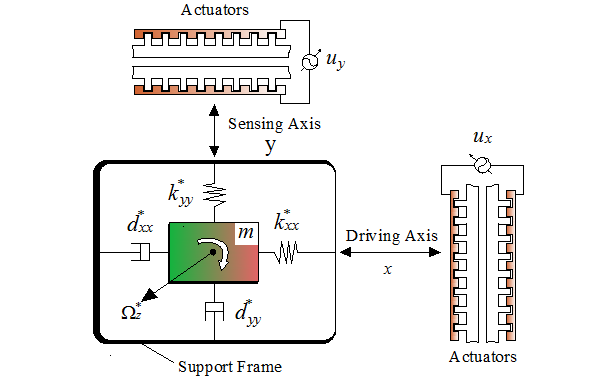
In this paper, we propose an accelerated adaptive backstepping control algorithm based on the type2 sequential fuzzy neural network (T2SFNN) for the microelectromechanical system (MEMS) gyroscope with deadzone and constraints. Firstly, the mathematical model of the MEMS gyroscope is established to perform dynamical analyses and controller design. Then, the phase diagrams and Lyapunov exponents are presented to reveal its chaotic oscillation, which is harmful to system stability. In order to suppress oscillations derived from chaos and deadzone, an accelerated adaptive backstepping controller is proposed wherein an adaptive auxiliary is established to compensate the influence of nonsymmetric deadzone on stability performance, along with the T2SFNN designed to approximate unknown functions of dynamic systems. Furthermore, the speed function is introduced to accelerate convergence speed of the control system, and the problem of complex term explosion in traditional backstepping is successfully solved by a secondorder tracking differentiator. Finally, simulation results show that the proposed control scheme can guarantee asymptotic convergence of all signals in the closedloop system, as well as satisfying states constraints and fulfilling the purposes of chaos suppression and accelerated convergence.
En este artículo se propone un algoritmo de control acelerado y autoadaptado de backstepping basado en la red neural analgésica de tipo 2 (T2SFNN) para giroscopios del sistema microeléctrico (MEMS) con zona muerta y limitaciones. En primer lugar, se establece el modelo matemático del giroscopio MEMS para realizar análisis dinámicos y diseño de controladores. Luego, se presentan los diagramas de fase y los exponentes de Lyapunov para revelar su oscilación caótica, que es perjudicial para la estabilidad del sistema. Con el fin de suprimir las oscilaciones derivadas del caos y la zona muerta, se propone un controlador de backstepping adaptativo acelerado en el que se establece un auxiliar adaptativo para compensar la influencia de la zona muerta no simétrica en el rendimiento de estabilidad, junto con el T2SFNN diseñado para aproximar funciones desconocidas de sistema dinámico. Además, se introduce la función de velocidad para acelerar la velocidad de convergencia del sistema de control, y el problema de la explosión de términos complejos en el backstepping tradicional es resuelto exitosamente por un diferenciador de seguimiento de segundo orden. Finalmente, los resultados de la simulación muestran que el esquema de control propuesto puede garantizar la convergencia asintótica de todas las señales en el sistema de circuito cerrado, además de satisfacer las restricciones de los estados y lograr los propósitos de supresión del caos y convergencia acelerada.
References
Chong, S., Rui, S., Jie, L., Xiaoming, Z., Jun, T., Yunbo, S., Jun, L., and Huiliang, C. (2016). Temperature drift modeling of MEMS gyroscope based on genetic-Elman neural network. Mechanical Systems And Signal Processing, 72, 897-905. https://doi.org/10.1016/j.ymssp.2015.11.004
Delavari, H., Lanusse, P., and Sabatier, J. (2013). Fractional order controller design for a flexible link manipulator robot. Asian Journal of Control, 15(3), 783-795. https://doi.org/10.1002/asjc.677
Fang, Y., Fei, J., and Yang, Y. (2018). Adaptive Backstepping Design of a Microgyroscope. Micromachines, 9(7), 338. https://doi.org/10.3390/mi9070338
Fang, Y., Yuan, Z., and Fei, J. (2015). Adaptive Fuzzy Backstepping Control of MEMS Gyroscope Using Dynamic Sliding Mode Approach. Information Technology & Control, 44(4). https://doi.org/10.5755/j01.itc.44.4.9110
Fei, J., and Chu, Y. (2016). Dynamic Global PID Sliding Mode Control for MEMS Gyroscope Using Adaptive Neural Controller. In IEEE (Eds.) 2016 Joint 8th International Conference on Soft Computing and Intelligent Systems (SCIS) and 17th International Symposium on Advanced Intelligent Systems (ISIS) (pp. 16-21). New York, NY: IEEE. https://doi.org/10.1109/SCIS-ISIS.2016.0018
Fei, J., and Zhou, J. (2012). Robust adaptive control of MEMS triaxial gyroscope using fuzzy compensator. IEEE Transactions on Systems, Man, and Cybernetics, Part B (Cybernetics), 42(6), 1599-1607. https://doi.org/10.1109/TSMCB.2012.2196039
Liu, Y. J., Gao, Y., Tong, S., and Li, Y. (2016). Fuzzy Approximation-Based Adaptive Backstepping Optimal Control for a Class of Nonlinear Discrete-Time Systems With Dead-Zone. IEEE Transactions on Fuzzy Systems: A Publication of the IEEE Neural Networks Council, 24(1), 16-28. https://doi.org/10.1109/TFUZZ.2015.2418000
Gao, S., Dong, H., Ning, B., Tang, T., and Li, Y. (2018). Nonlinear mapping-based feedback technique of dynamic surface control for the chaotic PMSM using neural approximation and parameter identification. IET Control Theory and Applications, 12(6), 819-827. https://doi.org/10.1049/iet-cta.2017.0550
Juan, W., and Fei, J. (2013). Adaptive fuzzy approach for nonlinearity compensation in MEMS gyroscope. Transactions of the Institute of Measurement and Control, 35(8), 1008-1015. https://doi.org/10.1177/0142331212472224
Lei, D., Cao, D., Wang, T. and Fei, J. (2017). Adaptive Dynamic Surface Control of MEMS Gyroscope Sensor Using Fuzzy Compensator. IEEE Access, 4, 4148-4154. https://doi.org/10.1109/ACCESS.2016.2596538
Li, Z. and Kang, Y. (2010). Dynamic coupling switching control incorporating support vector machines for wheeled mobile manipulators with hybrid joints. Automatica, 46(5), 832-842. https://doi.org/10.1016/j.automatica.2010.02.019
Lin, J., Li, Y., and Yang, G. (2020). FPGAN: Face deidentification method with generative adversarial networks for social robots. Neural Networks. https://doi.org/10.1016/j.neunet.2020.09.001
Liu, Y.J., Gao, Y., Tong, S., and Li, Y. (2015). Fuzzy approximation-based adaptive backstepping optimal control for a class of nonlinear discrete-time systems with dead-zone. IEEE Transactions on Fuzzy Systems, 24(1), 16-28. https://doi.org/10.1109/TFUZZ.2015.2418000
Luo, S., Li, J., Li, S., and Hu, J. (2020). Dynamical analysis of the fractional-order centrifugal flywheel governor system and its accelerated adaptive stabilization with the optimality. International Journal of Electrical Power & Energy Systems, 118, 105792. https://doi.org/10.1016/j.ijepes.2019.105792
Luo, S. and Song, Y. (2016). Chaos analysis-based adaptive backstepping control of the microelectromechanical resonators with constrained output and uncertain time delay. IEEE Transactions on Industrial Electronics, 63(10), 6217-6225. https://doi.org/10.1109/TIE.2016.2569462
Mohammadzadeh, A., and Ghaemi, S. (2018). Robust synchronization of uncertain fractional-order chaotic systems with time-varying delay. Nonlinear Dynamics. https://doi.org/10.1007/s11071-018-4290-2
Na, J. (2013). Adaptive prescribed performance control of nonlinear systems with unknown dead zone. International Journal of Adaptive Control and Signal Processing, 27(5), 426-446. https://doi.org/10.1002/acs.2322
Ouakad, H. M., Nayfeh, A. H., Choura, S., and Najar, F. (2015). Nonlinear feedback controller of a microbeam resonator. Journal of Vibration and Control, 21(9), 1680-1697. https://doi.org/10.1177/1077546313494112
Pan, Y., Wang, H., Li, X., and Yu, H. (2017). Adaptive command-filtered backstepping control of robot arms with compliant actuators. IEEE Transactions on Control Systems Technology, 26(3), 1149-1156. https://doi.org/10.1109/TCST.2017.2695600
Rahmani, M. (2018). MEMS gyroscope control using a novel compound robust control. ISA transactions, 72, 37-43. https://doi.org/10.1016/j.isatra.2017.11.009
Rahmani, M. and Rahman, M. H. (2018). A new adaptive fractional sliding mode control of a MEMS gyroscope. Microsystem Technologies. https://doi.org/10.1007/s00542-018-4212-8
Rahmani, M. and Rahman, M. H. (2019). A novel compound fast fractional integral sliding mode control and adaptive PI control of a MEMS gyroscope. Microsystem Technologies, 1-7. https://doi.org/10.1007/s00542-018-4284-5
Sambas, A., Chang, H. L., Dolvis, L. G., Jacques, K., and Vaidyanathan, S. (2019). A new five-dimensional four-wing hyperchaotic system with hidden attractor, its electronic circuit realisation and synchronisation via integral sliding mode control. International Journal of Modelling Identification & Control, 32(1), 30-45. https://doi.org/10.1504/IJMIC.2019.10023534
Sambas, A., Mamat, M., Arafa, A. A., Mahmoud, G. M., and Sanjaya, W. S. M. (2019). A new chaotic system with line of equilibria: dynamics, passive control and circuit design. International Journal of Electrical and Computer Engineering, 9(4), 2365-2376. https://doi.org/10.11591/ijece.v9i4.pp2336-2345
Sambas, A., Vaidyanathan, S., Mamat, M., and Mohamed, M. A. (2020). Investigation of Chaos Behavior in a New Two-Scroll Chaotic System with Four Unstable Equilibrium Points, its Synchronization via Four Control Methods and Circuit Simulation. IAENG International Journal of Applied Mathematics, 50(1), 1-10. http://www.iaeng.org/IJAM/issues_v50/issue_1/IJAM_50_1_03.pdf
Silva-Juarez, A., Rodriguez-Gomez, G., de la Fraga, L. G., Guillen-Fernandez, O., and Tlelo-Cuautle, E. (2019). Optimizing the kaplan–yorke dimension of chaotic oscillators applying de and pso. Technologies, 7(2), 38. https://doi.org/10.3390/technologies7020038
Su, Z., Li, Y., and Yang, G. (2020). Dietary Composition Perception Algorithm Using Social Robot Audition for Mandarin Chinese. IEEE Access, (99), 1-1. https://doi.org/10.1109/ACCESS.2019.2963560
Sun, G. and Ma, Z. (2017). Practical tracking control of linear motor with adaptive fractional order terminal sliding mode control. IEEE/ASME Transactions on Mechatronics, 22(6), 2643-2653.
Sun, T. and Pan, Y. (2019). Robust adaptive control for prescribed performance tracking of constrained uncertain nonlinear systems. Journal of the Franklin Institute, 356(1), 18-30. https://doi.org/10.1016/j.jfranklin.2018.09.005
Tian, D. P., Shen, H. H., and Dai, M. (2014). Improving the Rapidity of Nonlinear Tracking Differentiator via Feedforward. IEEE Transactions on Industrial Electronics, 61(7), 3736-3743. https://doi.org/10.1109/TIE.2013.2262754
Tong, S. and Li, Y. (2011). Adaptive fuzzy output feedback tracking backstepping control of strictfeedback nonlinear systems with unknown dead zones. IEEE Transactions on Fuzzy Systems, 20(1), 168-180. https://doi.org/10.1109/TFUZZ.2011.2171189
Vaidyanathan, S., Sambas, A., and Mamat, M. (2018). A new chaotic system with axeshaped equilibrium, its circuit implementation and adaptive synchronization. Archives of Control Sciences, 28. https://doi.org/10.24425/acs.2018.124711
Xiong, L., Wang, J., Mi, X., and Khan, M. W. (2017). Fractional order sliding mode based direct power control of grid-connected DFIG. IEEE Transactions on Power Systems, 33(3), 3087-3096. https://doi.org/10.1109/TPWRS.2017.2761815
Xu, B., Zhang, R., Li, S., He, W., and Shi, Z. (2019). Composite Neural Learning-Based Nonsingular Terminal Sliding Mode Control of MEMS Gyroscopes. IEEE Transactions on Neural networks and learning systems. https://doi.org/10.1109/TNNLS.2019.2919931
Yan, W., Hou, S., Fang, Y., and Fei, J. (2016). Robust adaptive nonsingular terminal sliding mode control of MEMS gyroscope using fuzzy-neural-network compensator. International Journal of Machine Learning & Cybernetics. https://doi.org/10.1007/s13042-016-0501-7
hang, X., Zhang, H., Liu, D., and Kim, Y. (2009). Neural-network-based reinforcement learning controller for nonlinear systems with nonsymmetric dead-zone inputs. Paper presented at the 2009 IEEE Symposium on Adaptive Dynamic Programming and Reinforcement Learning. https://doi.org/10.1109/ADPRL.2009.4927535
Dimensions
PlumX
Article abstract page views
Downloads
How to Cite




License
Copyright (c) 2021 Le Zhao, Shao hua Luo, Guan ci Yang, Jun yang Li

This work is licensed under a Creative Commons Attribution 4.0 International License.
The authors or holders of the copyright for each article hereby confer exclusive, limited and free authorization on the Universidad Nacional de Colombia's journal Ingeniería e Investigación concerning the aforementioned article which, once it has been evaluated and approved, will be submitted for publication, in line with the following items:
1. The version which has been corrected according to the evaluators' suggestions will be remitted and it will be made clear whether the aforementioned article is an unedited document regarding which the rights to be authorized are held and total responsibility will be assumed by the authors for the content of the work being submitted to Ingeniería e Investigación, the Universidad Nacional de Colombia and third-parties;
2. The authorization conferred on the journal will come into force from the date on which it is included in the respective volume and issue of Ingeniería e Investigación in the Open Journal Systems and on the journal's main page (https://revistas.unal.edu.co/index.php/ingeinv), as well as in different databases and indices in which the publication is indexed;
3. The authors authorize the Universidad Nacional de Colombia's journal Ingeniería e Investigación to publish the document in whatever required format (printed, digital, electronic or whatsoever known or yet to be discovered form) and authorize Ingeniería e Investigación to include the work in any indices and/or search engines deemed necessary for promoting its diffusion;
4. The authors accept that such authorization is given free of charge and they, therefore, waive any right to receive remuneration from the publication, distribution, public communication and any use whatsoever referred to in the terms of this authorization.