Published
Methodology for Classifying the Structural State of Uninspected Pipes in Sewer Networks Based on Support Vector Machines
Metodología para clasificar la condición estructural de tuberías no inspeccionadas de las redes de alcantarillado basada en máquinas de soporte vectorial
DOI:
https://doi.org/10.15446/ing.investig.v42n2.85917Keywords:
Support Vector Machine, sewer asset management, structural state, sewer system (en)Máquina de Soporte Vectorial, gestión patrimonial de alcantarillados, condición estructural, sistemas de alcantarillados (es)
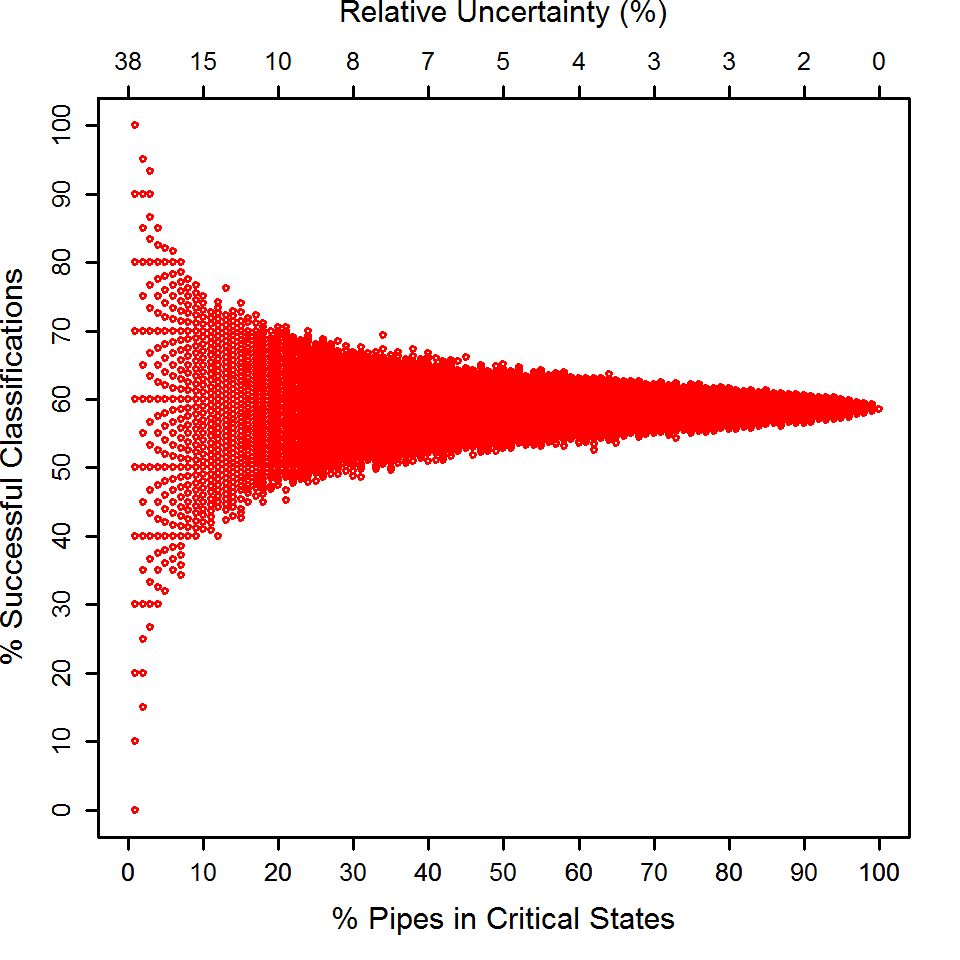
The nearly unmitigated growth of cities has placed ever-greater pressure on urban water systems regarding climate change, environmental pollution, resource limitations, and infrastructure aging. Therefore, the development of methods to classify and assess the structural state of urban drainage infrastructure becomes very important, given that they can be used as support tools for proactive management plans. This paper presents a method for predicting and classifying the structural state of uninspected sewer pipes using Support Vector Machines, based on the physical characteristics, age, and geographical location of the pipes. According to the results, the methodology: i) correctly classified more than 75% of uninspected pipes; (ii) identified pipes in critical structural states, with low importance prediction error for 69% of pipes; and (iii) provided a guide for establishing the number or percentage of pipes that require inspection or intervention.
El crecimiento casi descontrolado de las ciudades ha puesto una creciente presión en los hidrosistemas urbanos en términos de cambio climático, contaminación ambiental, limitaciones presupuestales y envejecimiento de la infraestructura. Por lo tanto, la exploración de diferentes métodos para clasificar y evaluar la condición estructural de los alcantarillados ha adquirido gran importancia, dado que estos pueden ser utilizados para herramientas de apoyo para planes de gestión proactiva. Este trabajo presenta un método para predecir y clasificar la condición estructural de tuberías de alcantarillado no inspeccionadas usando Máquinas de Soporte Vectorial basado en las características físicas, edad y ubicación geográfica de las tuberías. De acuerdo con los resultados, la metodología: (i) clasificó correctamente más del 75% de tuberías no inspeccionadas; (ii) identificó las tuberías que estaban en condiciones estructurales críticas, con errores de predicción de baja importancia para el 69 % de las tuberías; y (iii) proporcionó una guía para establecer el número o porcentaje de tuberías que requieren inspección o intervención.
References
Baik, H. S., Jeong, H. S., and Abraham, D. M. (2006). Estimating transition probabilities in Markov chain-based deterioration
models for management of wastewater systems. Journal of Water Resources Planning and Management, 132(1), 15-24. https://doi.org/10.106(ASCE)0733-9496(2006)132:1(15)
Caradot, N., Sonnenberg, H., Kropp, I., Ringe, A., Denhez, S., Hartmann, A., and Rouault, P. (2017). The relevance of sewer deterioration modelling to support asset management strategies. Urban Water Journal, 14(10), 1007-1015. https://doi.org/10.1080/1573062X.2017.1325497
Cardoso, M. A., Silva, M. S., Coelho, S. T., Almeida, M. C., and Covas, D. I. C. (2012). Urban water infrastructure asset management–a structured approach in four water utilities. Water Science and Technology, 66(12), 2702-2711. https://doi.org/10.2166/wst.2012.509
Carletta, J. (1996). Assessing agreement on classification tasks: the kappa statistic. Computational Linguistics, 22(2), 249-254. https://arxiv.org/abs/cmp-lg/9602004
Davies, J. P., Clarke, B. A., Whiter, J. T., and Cunningham, R. J. (2001). Factors influencing the structural deterioration and collapse of rigid sewer pipes. Urban Water, 3(1-2), 73-89. https://doi.org/10.1016/S1462-0758(01)00017-6
Empresa de Acueducto y Alcantarillado de Bogotá (EAAB) (2001). NS-058. Aspectos Técnicos para inspección y mantenimiento de redes y estructuras de alcantarillado. EAAB-E.S.P.
Geisser, S. (2017). Predictive inference. Routledge. Hernández, N., Caradot, N., Sonnenberg, H., Rouault, P., and Torres, A. (2021). Optimizing SVM models as predicting tools for sewer pipes conditions in the two main cities in Colombia for different sewer asset management purposes. Structure and Infrastructure Engineering, 17(2) 156-169, https://doi.org10.1080/15732479.2020.1733029
Hao, T., Rogers, C. D. F., Metje, N., Chapman, D. N., Muggleton, J. M., Foo, K. Y., Wang, P., Pennock, S. R., Atkins, P. R., Swingler, S. G., Parker, J., Costello, S. B., Burrow, M. P. N., Anspach, J. H., Armitage, R. J., Cohn, A. G., Goddard, P. L., Orlando, G., ... and Saul, A. J. (2012). Condition assessment of the buried utility service infrastructure. Tunnelling and Underground Space Technology, 28, 331-344. https://doi.org/10.1016/j.tust.2011.10.011
Huang, S., Cai, N., Pacheco, P. P., Narrandes, S., Wang, Y., and Xu, W. (2018). Applications of support vector machine (SVM) learning in cancer genomics. Cancer Genomics-Proteomics, 15(1), 41-51. https://doi.org/10.21873/cgp.20063
Jahed Armaghani, D., Asteris, P. G., Askarian, B., Hasanipanah, M., Tarinejad, R., and Huynh, V. V. (2020). Examining hybrid and single SVM models with different kernels to predict rock brittleness. Sustainability, 12(6), 2229. https://doi.org/10.3390/su12062229
Karatzoglou, A., Smola, A., Hornik, K., and Zeileis, A. (2004). kernlab-an S4 package for kernel methods in R. Journal of Statistical Software, 11(9), 1-20. https://doi.org/10.18637/jss.v011.i09
Kleidorfer, M., Möderl, M., Tscheikner-Gratl, F., Hammerer, M., Kinzel, H., and Rauch, W. (2013). Integrated planning of rehabilitation strategies for sewers. Water Science and Technology, 68(1), 176-183. https://doi.org/10.2166/wst.2013.223
Lee, J., Jeong, Y., Oh, Y. S., Lee, J. C., Ahn, N., Lee, J., and Yoon, S. H. (2013). An integrated approach to intelligent urban facilities management for real-time emergency response. Automation in Construction, 30, 256-264. https://doi.org/10.1016/j.autcon.2012.11.008
Liu, Z. and Kleiner, Y. (2013). State of the art review of inspection technologies for condition assessment of water pipes. Measurement, 46(1), 1-15. https://doi.org/10.1016/j.measurement.2012.05.032
López-Kleine, L., and Torres, A. (2014). UV-vis in situ spectrometry data mining through linear and non linear analysis methods. Dyna, 81(185), 182-188. https://doi.org/10.15446/dyna.v81n185.37718
López-Kleine, L., Hernández, N., and Torres, A. (2016). Physical characteristics of pipes as indicators of structural state for decision-making considerations in sewer asset management. Ingeniería e Investigación, 36(3), 15-21. https://doi.org/10.15446/ing.investig.v36n3.56616
Mashford, J., Marlow, D., Tran, D., and May, R. (2010). Prediction of sewer condition grade using support vector machines. Journal of Computing in Civil Engineering, 25(4), 283-290. https://doi.org/10.1061/(ASCE)CP.1943-5487.0000089
Micevski, T., Kuczera, G., and Coombes, P. (2002). Markov model for storm water pipe deterioration. Journal of Infrastructure Systems, 8(2), 49-56. https:/doi.org/10.1061/(ASCE)1076-0342(2002)8:2(49)
Niño, P., Angarita, H., Vargas, D., and Torres, A. (2012, 9-12 September). Identificación factores de riesgo para la gestión patrimonial óptima de sistemas de drenaje urbano: Estudio Piloto en la Ciudad de Bogotá [Conference presentation]. XXV Congreso Latinoamericano de Hidráulica San José, Costa Rica.
Osman, H. (2012). Agent-based simulation of urban infrastructure asset management activities. Automation in Construction, 28, 45-57. https://doi.org/10.1016/j.autcon.2012.06.004
Rodríguez, J. P., McIntyre, N., Díaz-Granados, M., and Maksimović, Č. (2012). A database and model to support proactive management of sediment-related sewer blockages. Water Research, 46(15), 4571-4586. https://doi.org/10.1016/j.watres.2012.06.037
Sægrov, S. and Schilling, W. (2002). Computer Aided Rehabilitation of sewer and storm water networks. In E. W. Strecker and W. C. Huber (Eds.) Global Solutions for Urban Drainage (pp. 1-15). ASCE. https://doi.org/10.1061/40644(2002)88
Shawe-Taylor, J. and Cristianini, N. (2004). Kernel methods for pattern analysis. Cambridge University Press. https://doi.org/10.1017/CBO9780511809682
R Core Team (2019). R: A language and environment for statistical computing. https://www.R-project.org/
Ward, B. and Savić, D. A. (2012). A multi-objective optimisation model for sewer rehabilitation considering critical risk of failure. Water Science and Technology, 66(11), 2410-2417. https://doi.org/10.2166/wst.2012.393
Wirahadikusumah, R., Abraham, D., and Iseley, T. (2001). Challenging issues in modeling deterioration of combined sewers. Journal of Infrastructure Systems, 7(2), 77-84. https://doi.org/10.1061/(ASCE)1076-0342(2001)7:2(77)
Younis, R. and Knight, M. A. (2014). Development and implementation of an asset management framework for wastewater collection networks. Tunnelling and Underground Space Technology, 39, 130-143. https://doi.org/10.1016/j.tust.2012.09.007
Zhang, X., Srinivasan, R., and Van Liew, M. (2009). Approximating SWAT model using artificial neural network and support vector machine 1. Journal of the American Water Resources Association, 45(2), 460-474. https://doi.org/10.1111/j.17521688.2009.00302.x
Zhang, Y. (2008). Fault detection and diagnosis of nonlinear processes using improved kernel independent component analysis (KICA) and support vector machine (SVM). Industrial and Engineering Chemistry Research, 47(18), 6961-6971. https://doi.org/10.1021/ie071496x
Dimensions
PlumX
Article abstract page views
Downloads
How to Cite




License
Copyright (c) 2022 Nathalie Hernandez, Miguel Cañon, Andrés Torres

This work is licensed under a Creative Commons Attribution 4.0 International License.
The authors or holders of the copyright for each article hereby confer exclusive, limited and free authorization on the Universidad Nacional de Colombia's journal Ingeniería e Investigación concerning the aforementioned article which, once it has been evaluated and approved, will be submitted for publication, in line with the following items:
1. The version which has been corrected according to the evaluators' suggestions will be remitted and it will be made clear whether the aforementioned article is an unedited document regarding which the rights to be authorized are held and total responsibility will be assumed by the authors for the content of the work being submitted to Ingeniería e Investigación, the Universidad Nacional de Colombia and third-parties;
2. The authorization conferred on the journal will come into force from the date on which it is included in the respective volume and issue of Ingeniería e Investigación in the Open Journal Systems and on the journal's main page (https://revistas.unal.edu.co/index.php/ingeinv), as well as in different databases and indices in which the publication is indexed;
3. The authors authorize the Universidad Nacional de Colombia's journal Ingeniería e Investigación to publish the document in whatever required format (printed, digital, electronic or whatsoever known or yet to be discovered form) and authorize Ingeniería e Investigación to include the work in any indices and/or search engines deemed necessary for promoting its diffusion;
4. The authors accept that such authorization is given free of charge and they, therefore, waive any right to receive remuneration from the publication, distribution, public communication and any use whatsoever referred to in the terms of this authorization.