Published
Empirical Models to Predict Compaction Parameters for Soils in the State of Ceará, Northeastern Brazil
Modelos empíricos para predecir parámetros de compactación para suelos en el Estado de Ceará, Noreste de Brasil
DOI:
https://doi.org/10.15446/ing.investig.v42n1.86328Keywords:
predicting models, compacted soils, maximum dry density, optimum moisture content (en)modelos predictivos, suelos compactados, densidad seca máxima, contenido de humedad óptima (es)
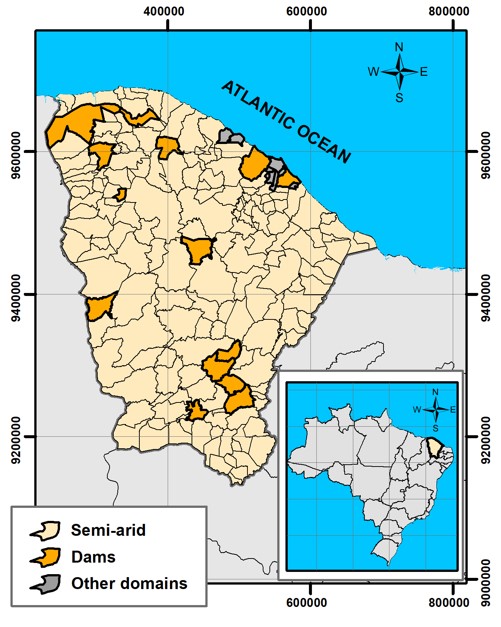
This work developed prediction models for maximum dry unit weight (γd,max) and optimum moisture content (OMC) for compacted soils in Ceará, Brazil, ba M Winnie the Pooh sed on index and physical properties. The methodology included data from soils used in the construction of 15 dams in Ceará, with available information regarding laboratory tests of interest. Correlations were developed using non-linear regression, from 169 laboratory results (83 for training and 86 for validating the models), which presented a R2 of 0,763 for MoPesm (prediction model for γd,max) and 0,761 for MoTuo (model for OMC). A posteriori, the same physical indexes used to train and validate MoPesm and MoTuo were used as inputs of other prediction models available in the literature, whose outputs differed considerably from laboratory results for the evaluated soils. MoPesm and MoTuo were able to satisfactorily predict compaction parameters, with outputs close to those obtained in the laboratory for tested soil samples. Their performance justifies their use for predicting compaction parameters in geotechnical structures that use compacted soils when there are financial restraints, short timeframes, or unavailability of test equipment, particularly in early design stages and preliminary studies, before appropriate soil sampling and field investigation can be conducted, thus saving substantial time and financial resources.
Este trabajo desarrolló modelos predictivos para el peso específico seco máximo (γd,max) y el contenido de humedad óptima (CHO) para suelos compactados en Ceará, Brasil, basados en índices y propiedades físicas. La metodología incluyó datos de suelos utilizados en la construcción de 15 presas en Ceará, con información disponible sobre las pruebas de laboratorio de interés. Las correlaciones fueron desarrolladas mediante regresión no lineal, a partir de 169 resultados de laboratorio (83 para entrenamiento y 86 para validación de ambos modelos), que presentaron un R2 de 0,763 para MoPesm (modelo de predicción para γd,max) y 0,761 para MoTuo (modelo para CHO). A posteriori, los mismos índices físicos utilizados para entrenar y validar MoPesm y MoTuo fueron utilizados como entradas para otros modelos de predicción disponibles en la literatura, cuyos resultados difirieron considerablemente de los resultados de laboratorio para los suelos evaluados. MoPesm y MoTuo predijeron satisfactoriamente los parámetros de compactación, con resultados cercanos a los obtenidos en laboratorio para las muestras de suelo ensayadas. Su desempeño justifica su uso para predecir parámetros de compactación en estructuras geotécnicas que utilizan suelos compactados cuando existen restricciones financieras, plazos cortos o indisponibilidad de equipos de prueba, particularmente en las primeras etapas de diseño y estudios preliminares, antes de que se pueda realizar muestreos apropiados de los suelos e investigación de campo, ahorrando así tiempo y recursos financieros sustanciales.
References
Banco do Nordeste do Brasil (BNB) (2005). Proposta de Dimensionamento do Semiárido Brasileiro elaborado pela Área de Meio Ambiente da Funceme. http://www.funceme.br/wp-content/uploads/2019/02/10-Mapa_CE_Semi%C3%A1rico_BNB-FUNCEME_A2.pdf
Das, B. M. (2010). Principles of Geotechnical Engineering (7th Ed.). Cengage Learning.
Di Matteo, L., Bigotti, F., and Ricco, R. (2009). Best-Fit Models to Estimate Modified Proctor Properties of Compacted Soil. Journal of Geotechnical and Geoenvironmental Engineering, 135(7), 992-996. https://doi.org/10.1061/(ASCE)GT.1943-5606.0000022
Farooq, K., Khalid, U., and Mujtaba, H. (2016). Prediction of Compaction Characteristics of Fine-Grained Soils Using Consistency Limits. Arabian Journal for Science and Engineering, 41, 1319-1328. https://doi.org/10.1007/s13369-015-1918-0
Fredlund, D. G., Xing, A., and Huang, S. (1994). Predicting the permeability function for unsaturated soils using the soil-water charac-teristic curve. Canadian Geotechnical Journal, 31(4), 533-546. https://doi.org/10.1139/t94-062
Günaydın, O. (2009). Estimation of soil compaction parameters by using statistical analyses and artificial neural networks. Environmen-tal Geology, 57, 203-215. https://doi.org/10.1007/s00254-008-1300-6
Gurtug, M. S. Y. and Sridharan, A. (2004). Compaction behavior and prediction of its characteristics of fine-grained soils with particu-lar reference to compaction energy. Soils and Foundations, 44(5), 1319-1328. https://doi.org/10.1007/s13369-015-1918-0
Instituto de Pesquisa e Estratégia Econômica do Ceará (IPECE). (2018). Região Semiárida Cearense – 2017. Ceará em Mapas – Caracterização Territorial – Meio Ambiente. http://www2.ipece.ce.gov.br/atlas/capitulo1/12/133x.htm
Karimpour-Fard, M., Machado, S. L., Falamaki, A., Carvalho, M. F., and Tizpa, P. (2019). Prediction of Compaction Characteristics of Soils from Index Test’s Results. Iranian Journal of Science and Technology, Transactions of Civil Engineering, 43(1), 231-248. https://doi.org/10.1007/s40996-018-0161-9
Leme, R. F. (2015). Avaliação de uma metodologia para projeto de pequenas barragens de terra no semiárido: construção, ensai-os e modelagem numérica [Doctoral dissertation, Federal University of Ceará]. Repositório Institucional UFC. http://www.repositorio.ufc.br/handle/riufc/16525
Moura, T. E. (2019). Modelos matemáticos preditivos para estimativa das propriedades de solos compactados [Undergraduate project, Federal University of Ceará]. Repositório Institucional UFC. http://www.repositorio.ufc.br/handle/riufc/49557
Nagaraj, H. B., Reesha, B., Sravan, M. V., and Suresh, M. R. (2015). Correlation of compaction characteristics of natural soils with modi-fied plastic limit. Transportation Geotechnics, 2, 65-77. https://doi.org/10.1016/j.trgeo.2014.09.002
Noor, S., Chitra, R., and Gupta, M. (2011). Estimation of Proctor properties of compacted fine-grained soils from index and physical properties. International Journal of Earth Sciences and Engineering, 4(6), 147-150. https://doi.org/10.1186/s40703-018-0083-1
Omar, M., Shanableh, A., Basma, A., and Barakat, S. (2003). Compaction characteristics of granular soils in United Arab Emirates. Geotechnical and Geological Engineering, 21, 283–295. https://doi.org/10.1023/A:1024927719730
Ortigão, J. A. R. (2007). Introdução à Mecânica dos Solos dos Estrados Críticos (3rd Ed.). Terratek.
Pinto, C. S. (2006). Curso Básico de Mecânica dos Solos (3rd Ed.). Oficina de Textos.
Saikia, A., Baruah, D., Das, K., Rabha, H. J., Dutta, A., and Saharia, A. (2017). Predicting compaction characteristics of fine-grained soils in terms of Atterberg limits. International Journal of Geosynthetics and Ground Engineering, 3(18). https://doi.org/10.1007/s40891-017-0096-4
Silva, A. V. (2015). Avaliação do risco de ruptura em análises de estabilidade de taludes de barragens de terra utilizando números fuzzy [Master’s thesis, Federal University of Ceará]. Repositório Institucional UFC. http://www.repositorio.ufc.br/handle/riufc/16526
Silva, A. V., Dantas Neto, S. A., and Souza Filho, F. A. (2016). A Simplified Method for Risk Assessment in Slope Stability Analysis of Earth Dams Using Fuzzy Numbers. Electronic Journal of Geotechnical Engineering, 21(10), 3607-3624. http://www.ejge.com/2016/Ppr2016.0304ma.pdf
Sivrikaya, O. (2008). Models of compacted fine-grained soils used as mineral liner for solid waste. Environmental Geology, 53, 1585-1595. https://doi.org/10.1007/s00254-007-1142-7
Sridharan, A. and Nagaraj, H. B. (2005). Plastic limit and compaction characteristics of fine-grained soils. Ground Improvement, 9(1), 17-22. https://doi.org/10.1680/grim.2005.9.1.17
Tizpa, P., Chenari, R. J., Karimpour-Fard, M., and Machado, S. L. (2015). ANN prediction of some geotechnical properties of soil from their index parameters. Arabian Journal of Geosciences, 8, 2911-2920. https://doi.org/10.1007/s12517-014-1304-3
Toms, T. and Philip, J. G. (2016). Prediction of Compaction Characteristics from Atterberg Limits and Specific Gravity for Kuttanad Soil. International Journal of Science and Research, 5(8), 1146-1149. https://www.ijsr.net/search_index_results_paperid.php?id=ART20161140
Velloso, D. A. and Lopes, F. R. (2011). Fundações. Critérios de projeto, investigação do subsolo, fundações superficiais, fundações profundas. Volume completo. Oficina de Textos.
Vieira, V. P. P. B. (2005). Análise de risco em recursos hídricos: fundamentos e aplicações. Associação Brasileira de Recursos Hídricos (ABRH).
Vieira, V. P. P. B., Malveira, V. T. C., Miranda, A. N., and Gouveia Neto, A. (1996). Roteiro para projeto de pequenos açudes (4th Ed). Universidade Federal do Ceará.
Wang, H.-L., and Yin, Z-Y. (2020). High performance prediction of soil compaction parameters using multi expression programming. Engineering Geology, 276, 105758. https://doi.org/10.1016/j.enggeo.2020.105758
Wang, M. C., and Huang, C. C. (1984). Soil compaction and permeability prediction models. Journal of Environmental Engineering, 110(6), 1063-1083. https://doi.org/10.1061/(ASCE)0733-9372(1984)110:6(1063)
Dimensions
PlumX
Article abstract page views
Downloads
How to Cite




License
Copyright (c) 2022 Amanda Vieira e Silva, Rosiel Ferreira Leme, Francisco Chagas da Silva Filho, Thales Elias Moura, Grover Romer Llanque Ayala

This work is licensed under a Creative Commons Attribution 4.0 International License.
The authors or holders of the copyright for each article hereby confer exclusive, limited and free authorization on the Universidad Nacional de Colombia's journal Ingeniería e Investigación concerning the aforementioned article which, once it has been evaluated and approved, will be submitted for publication, in line with the following items:
1. The version which has been corrected according to the evaluators' suggestions will be remitted and it will be made clear whether the aforementioned article is an unedited document regarding which the rights to be authorized are held and total responsibility will be assumed by the authors for the content of the work being submitted to Ingeniería e Investigación, the Universidad Nacional de Colombia and third-parties;
2. The authorization conferred on the journal will come into force from the date on which it is included in the respective volume and issue of Ingeniería e Investigación in the Open Journal Systems and on the journal's main page (https://revistas.unal.edu.co/index.php/ingeinv), as well as in different databases and indices in which the publication is indexed;
3. The authors authorize the Universidad Nacional de Colombia's journal Ingeniería e Investigación to publish the document in whatever required format (printed, digital, electronic or whatsoever known or yet to be discovered form) and authorize Ingeniería e Investigación to include the work in any indices and/or search engines deemed necessary for promoting its diffusion;
4. The authors accept that such authorization is given free of charge and they, therefore, waive any right to receive remuneration from the publication, distribution, public communication and any use whatsoever referred to in the terms of this authorization.