Published
Comparison of Treatments by Mercerization and Plasma Glow Discharge on Residues of the Amazon Chestnut Shell (Bertholletia Excelsa)
Comparación de tratamientos por mercerización y descarga intensa de plasma sobre residuos de la cáscara de castaña amazónica (Bertholletia excelsa)
DOI:
https://doi.org/10.15446/ing.investig.v42n1.86698Keywords:
Amazonian chestnut, Bertholletia excelsa, plasma glow discharge, cellulose (en)Castaña amazónica, Bertholletia excelsa, descarga intensa de plasma, celulosa (es)
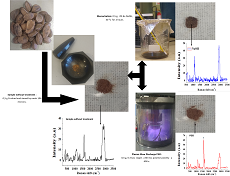
The chestnut shell from the Amazon region shared between Colombia, Brazil, and Perú is an abundant residue of the walnut used for obtaining food and cosmetic products. This residue is not yet usable due to the lack of knowledge of its properties and the environmental impact generated by its treatment through methods such as mercerization. This work presents the results of the characterization of Amazon chestnut shell residues treated by two methods, mercerization with NaOH solution and intense plasma discharge (Glow Discharge Plasma), in a reactor with argon gas in a 0,3-bar vacuum and discharge conditions of 80 mA and 600 s. The microstructural, morphological, topographic, and nanomechanical changes of the chestnut residues without treatment and with the two proposed treatments were evaluated by means of the µRaman, scanning electron microscopy, and atomic force microscopy techniques. The results showed the effectiveness of the plasma method over the mercerization method at obtaining more crystalline cellulose structures due to the reduction of hemicellulose, lignin, and the aqueous phase of walnut shell waste.
La cáscara de castaña proveniente de la región amazónica, compartida entre Colombia, Brasil y Perú, es un residuo abundante de la nuez empleada en la obtención de productos alimenticios y cosméticos. Este residuo no es utilizable por la falta de conocimiento de sus propiedades y del impacto ambiental generado por su tratamiento por métodos como la mercerización. En este trabajo se muestran los resultados de la caracterización de los residuos de cáscara de castaña amazónica tratados por dos métodos, mercerización con solución de NaOH y descarga intensa de plasma (Glow Discharge Plasma), en un reactor con gas de argón en un vacío de 0,3 bar y condiciones de descarga de 80 mA y 600 s. Los cambios microestructurales, morfológicos, topográficos y nanomecánicos de los residuos de castaña sin tratamiento y con los dos tratamientos propuestos se evaluaron mediante las técnicas de µRaman, microscopía electrónica de barrido y microscopía de fuerza atómica. Los resultados mostraron la efectividad del método por plasma, por encima del método de mercerización, para la obtención de estructuras más cristalinas de celulosa debido a la reducción de la hemicelulosa, la lignina y la fase acuosa de los desechos de cáscara de nuez.
References
Agarwal, U., Reiner, R. S., and Ralph, S. A. (2010). Cellulose I crystallinity determination using FT–Raman spectroscopy: univariate and multivariate methods. Cellulose, 17, 721-733. https://doi.org/10.1007/s10570-010-9420-z
Agarwal, U. P., Reiner, R. R., Ralph, S. A., Forest, A., Gi, O., and Drive, P. (2013). Estimation of Cellulose Crystallinity of Lignocel-luloses Using Near-IR. Journal of Agricultural and Food Chemistry, 61,103-113. https://doi.org/10.1021/jf304465k
Bonelli, P., Della Rocca, P., Cerrella, E., and Cukierman, A. (2001). Effect of pyrolysis temperature on composition, surface properties and thermal degradation rates of Brazil Nutshells. Bioresource Technology, 76(1), 15-22. https://doi.org/10.1016/S0960-8524(00)00085-7
Álvarez Rodriguez, A., Pizarro-Garcia, C., and Folgueras-Díaz, M.-B. (2012). Caracterización química de biomasa y su rela-ción con el poder calorífico. Repositorio Institucional de La Universidad de Oviedo, 1-12. https://digibuo.uniovi.es/dspace/bitstream/handle/10651/17777/TFM_Ana_AlvarezProteg.pdf;jsessionid=61CEC16628EFBE55B4399447CD243E32?sequence=6
Cardozo, E., Erlich, C., Alejo, L., and Fransson, T. H. (2014). Combustion of agricultural residues: An experimental study for small-scale applications. Fuel, 115, 778-787. https://doi.org/10.1016/J.FUEL.2013.07.054
Cheng, Q. and Wang, S. (2008). A method for testing the elastic modulus of single cellulose fibrils via atomic force microscopy. Composites Part A, 39(12), 1838-1843. https://doi.org/10.1016/j.compositesa.2008.09.007
Cousins, W. J. (1978). Young’s modulus of hemicellulose as related to moisture content. Wood Science and Technology, 12(3), 161-167. https://doi.org/10.1007/BF00372862
Eichhorn, S. J. and Young, R. J. (2001). The Young’s modulus of a microcrystalline cellulose. Cellulose, 8, 197-207. https://doi.org/10.1023/A:1013181804540
Hepworth, D. and Bruce, D. (2000). The Mechanical Properties of a Composite Manufactured from Non-Fibrous Vegetable Tissue and PVA. Composites Part A: Applied Science and Manufacturing, 31(3). 283-285. https://doi.org/10.1016/S1359-835X(99)00100-1
Gierlinger, N., Keplinger, T., Harrington, M., and Schwanninger, M. (2013). Raman Imaging of Lignocellulosic Feedstock. IntechOpen. https://doi.org/10.5772/50878
Baruah, J., Nath, B. K., Sharma, R., Kumar, S., Deka, R. C., Ba-ruah, D. C., and Kalita, E. (2018). Recent Trends in the Pre-treatment of Lignocellulosic Biomass for Value-Added Products. Frontiers in Energy Research, 6, 141. https://doi.org/10.3389/fenrg.2018.00141
Jaramillo-Quiceno, N. (2016). Efecto del proceso de merceri-zación en el comportamiento de la fibra de hoja de piña (FHP) como refuerzo en una matriz de polipropileno. https://www.semanticscholar.org/paper/Efecto-del-proceso-de-mercerizaci%C3%B3n-en-el-de-la-de-Quiceno/13945ae8739e1372c068a89d71cd96e6d9a896ac
Kathirselvam, M., Kumaravel, A., Arthanarieswaran, V. P., and Saravanakumar, S. S. (2019). Isolation and characterization of cellulose fibers from Thespesia populnea barks: A study on physicochemical and structural properties. International Journal of Biological Macromolecules, 129, 396-406. https://doi.org/10.1016/j.ijbiomac.2019.02.044
López-Durán, V., Larsson, P. A., and Wågberg, L. (2018). Chemi-cal modification of cellulose-rich fibres to clarify the influence of the chemical structure on the physical and mechanical properties of cellulose fibres and thereof made sheets. Carbohydrate Polymers, 182, 1-7. https://doi.org/10.1016/j.carbpol.2017.11.006
Marcuello, C., Foulon, L., Chabbert, B., Aguié-béghin, V., and Molinari, M. (2019). Young’s modulus of lignocellulosic polymers and their adhesion with. International Journal of Biological Macromolecules, 147, 1064-1075. https://doi.org/10.1016/j.ijbiomac.2019.10.074
Melo, V. F., Batista, A. H., Barbosa, J. Z., Barbeiro, L., Gomes, R., and Dultra, M. T. M. (2018). Soil quality and reforestation of the Brazil nut tree (Bertholletia excelsa Bonpl.) after laterite-type bauxite mining in the Brazilian Amazon forest. Ecological Engineering, 125, 111-118. https://doi.org/10.1016/j.ecoleng.2018.10.016
Naduparambath, S., Jinitha, T. V., Shaniba, V., Serejith, M. P., Balan, A. K., and Purushothaman, E. (2018). Isolation and characterization of cellulose nanocrystals from sago seed shells. Carbohydrate Polymers, 180, 13-20. https://doi.org/10.1016/J.CARBPOL.2017.09.088
Carrión-Prieto, P., Martín-Ramos, P. Hernández-Navarro, S., Sánchez-Sastre, L. F., Marcos-Robles, J. L., and Martín-Gil, J. (2019). Crystallinity of cellulose microfibers derived from Cistus ladanifer and Erica arborea shrubs. Maderas. Ciencia y tecnología, 21(4), 447-456. https://doi.org/10.4067/S0718-221X2019005000402
Rodriguez-Álvarez, A., Pizarro, C., and Folgueras, M. (2012). Caracterización Química De Biomasa Y Su Relación. Universidad de Oviedo. https://digibuo.uniovi.es/dspace/bitstream/handle/10651/17777/TFM_Ana_AlvarezProteg.pdf;jsessionid=61CEC16628EFBE55B4399447CD243E32?sequence=6
Rosa, M. F., Medeiros, E. S., Malmonge, J. A., Gregorski, K. S., Wood, D. F., Mattoso, L. H. C., Glenn, G., Orts, W. J., and Imam, S. H. (2010). Cellulose nanowhiskers from coconut husk fibers: Effect of preparation conditions on their thermal and morphological behavior. Carbohydrate Polymers, 81(1), 83-92. https://doi.org/10.1016/j.carbpol.2010.01.059
Salo, M., Sirén, A., and Kalliola, R. (2013). Collect Locally, Eat Globally – The Journey of the Brazil nut. Diagnosing Wild Species Harvest, 2013, 143-160. https://doi.org/10.1016/B978-0-12-397204-0.00008-5
Segmehl, J. S., Keplinger, T., Krasnobaev, A., Berg, J. K., Willa, C., and Burgert, I. (2019). Facilitated delignification in CAD deficient transgenic poplar studied by confocal Raman spectroscopy imaging. Spectrochimica Acta Part A: Molecular and Biomolecular Spectroscopy, 206, 177-184. https://doi.org/10.1016/j.saa.2018.07.080
de Souza, A. G., Rocha, D. B., Kano, F. S., and Rosa, D. d. S. (2019). Valorization of industrial paper waste by isolating cellulose nanostructures with different pretreatment methods. Resources, Conservation and Recycling, 143, 133-142. https://doi.org/10.1016/J.RESCONREC.2018.12.031
de Souza, E. S., Dias, Y. N., da Costa, H. S. C., Pinto, D. A., de Oliveira, D. M., de Souza Falção, N. P., Texeira, R. A., and Fer-nandes, A. R. (2019). Organic residues and biochar to immobilize potentially toxic elements in soil from a gold mine in the Amazon. Ecotoxicology and Environmental Safety, 169, 425-434. https://doi.org/10.1016/J.ECOENV.2018.11.032
Sun, S., Sun, S., Cao, X., and Sun, R. (2016 delete that). The role of pretreatment in improving the enzymatic hydrolysis of lignocellulosic materials. Bioresource Technology, 199, 49-58. https://doi.org/10.1016/j.biortech.2015.08.061
Tezcan, E. and Atıcı, O. G. (2017). A new method for recovery of cellulose from lignocellulosic bio-waste: Pile processing. Waste Management, 70, 181-188. https://doi.org/10.1016/J.WASMAN.2017.09.017
Tsai, G., Montero, J., Calle, W., Quinde, M., and Sarmiento, P. (2010). Plasma: una tecnología de gran potencial para la industria y la ciencia. Ingenius, 4, 66-72. https://doi.org/10.17163/ings.n4.2010.07
U.S. Department of Agriculture (2010). National Nutrient Database for Standard Reference, Food, nut and seed products Group: 12. https://fdc.nal.usda.gov/ndb/search/list%20United
U.S. Department of Agriculture, Agricultural Research Service (ARS-US) (2019). Food Data Central. https://fdc.nal.usda.gov
Vacková, T., Špatenka, P., and Balakrishna, S. (2019). Plasma Treatment of Powders and Fibers. In Thomas, S., Mozetič, M., Cvelbar, U., Špatenka, P., and Praveen, K. M. (Eds.) Non-Thermal Plasma Technology for Polymeric Materials (pp. 193-210). Elsevier. https://doi.org/10.1016/b978-0-12-813152-7.00007-x
Dimensions
PlumX
Article abstract page views
Downloads
How to Cite




License
Copyright (c) 2022 Ximena Zapata Londoño, James Janderson Rosero Romo, Hugo Armando Estupiñan Duran

This work is licensed under a Creative Commons Attribution 4.0 International License.
The authors or holders of the copyright for each article hereby confer exclusive, limited and free authorization on the Universidad Nacional de Colombia's journal Ingeniería e Investigación concerning the aforementioned article which, once it has been evaluated and approved, will be submitted for publication, in line with the following items:
1. The version which has been corrected according to the evaluators' suggestions will be remitted and it will be made clear whether the aforementioned article is an unedited document regarding which the rights to be authorized are held and total responsibility will be assumed by the authors for the content of the work being submitted to Ingeniería e Investigación, the Universidad Nacional de Colombia and third-parties;
2. The authorization conferred on the journal will come into force from the date on which it is included in the respective volume and issue of Ingeniería e Investigación in the Open Journal Systems and on the journal's main page (https://revistas.unal.edu.co/index.php/ingeinv), as well as in different databases and indices in which the publication is indexed;
3. The authors authorize the Universidad Nacional de Colombia's journal Ingeniería e Investigación to publish the document in whatever required format (printed, digital, electronic or whatsoever known or yet to be discovered form) and authorize Ingeniería e Investigación to include the work in any indices and/or search engines deemed necessary for promoting its diffusion;
4. The authors accept that such authorization is given free of charge and they, therefore, waive any right to receive remuneration from the publication, distribution, public communication and any use whatsoever referred to in the terms of this authorization.