
Published
A Structural Design Comparison Between Two Reinforced Concrete Regular 6-Level Buildings using Soil-Structure Interaction in Linear Range
Comparación de diseño estructural entre dos edificaciones de concreto armado de seis niveles utilizando interacción suelo-estructura en el rango lineal
DOI:
https://doi.org/10.15446/ing.investig.v42n1.86819Keywords:
Seismic response, foundation system, soil-structure interaction, Linear range (en)Respuesta sísmica, Sistema de Fundación, interacción suelo-estructura, rango lineal (es)
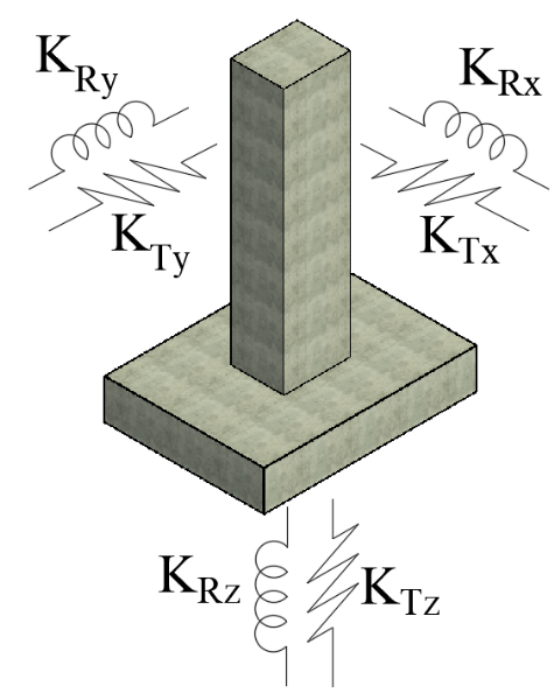
Structural engineers commonly design superstructures as fixed at the base and transmit the reactions to the infrastructure in order to design the foundation system and estimate the displacement of the soil while disregarding the change in seismic response that this induces. In this article, the foundation system was transformed into equivalent springs, and the seismic response in the linear range was compared and quantified, obtaining results such as increased periods, increased amounts of steel reinforcement in beams (between 7% and 25%) and columns (between 29% and 39%), an increase in the number of stirrups per linear meter (between 3% and 11% in columns and between 5% and 45% in beams) and drifts (between 1% and 14%), and a decrease in basal shear (up to 20%), which directly affects the design of the structure. This study concludes that the inclusion of the soil-structure interaction is necessary for structural design in the linear range.
Comúnmente, los ingenieros estructurales diseñan superestructuras como empotradas en la base y transmiten las reacciones a la infraestructura para diseñar el sistema de cimientos y estimar los desplazamientos del suelo, obviando el cambio en la respuesta sísmica que esto induce. En este artículo se transformó el sistema de cimientos en resortes equivalentes y se comparó y cuantifico la respuesta sísmica en el rango lineal, obteniendo resultados como aumento de los periodos, aumento de las cuantías de acero de refuerzo en vigas (entre 7% y 25 %) y columnas (entre 29% y 39 %) un aumento de la cantidad de estribos por metro lineal (entre 3% y 11% en columnas y entre 5% y 45% en vigas) y las derivas (entre 1% y 14 %), y una disminución de cortantes basales (hasta 20 %), lo que afecta de forma directa el diseño de la estructura. Este estudio concluye que es necesaria la inclusión de la interacción suelo estructura en el diseño estructural en el rango lineal.
References
American Concrete Institute, Committee 318 (ACI) (2014). Building Code Requirements or Structural Concrete (ACI 318-14) and Commentary (ACI 318R-14). ACI.
American Concrete Institute, Committee 318 (ACI) (2019). Building Code Requirements or Structural Concrete (ACI 318-19) and Commentary (ACI 318R-19). ACI.
ASCE/FEMA (2000). Prestandard and Commentary for the Seismic Rehabilitation of Buildings (FEMA 356). Federal Emergency Management Agency.
Castro-Pilco, C. F. and Pérez-Martínez, G. E. (2020). Análisis de la interacción suelo-estructura estática para una edificación regular de hormigón armado y 3 tipos de suelos [Bachelor’s thesis].
Chopra, A. K. (1980). Dynamics of structures. Earthquake Engineering Research Institute.
Cruz, C. and Miranda, E. (2017). Evaluation of soil-structure interaction effects on the damping ratios of buildings subjected to earthquakes. Soil Dynamics and Earthquake Engineering, 100, 183-195. https://doi.org/10.1016/j.soildyn.2017.05.034
DAS, B. M. (2011). Principles of Foundation Engineering (7th ed.). Braja Das.
Diaz-Guzmán, F. D., Espinoza-Barreras, F., Sánchez-Vergara, R., and Huerta-López, C. I. (2012). Respuesta dinámica de un edificio considerando el efecto de interacción suelo-estructura. Centro Internacional de Métodos Numéricos en Ingeniería. https://core.ac.uk/reader/41779960
Falconí, R. A. (2008). Análisis sísmico de edificios. Centro de Investigaciones Científicas, Escuela Politécnica del Ejercito.
FEMA (2006). NEHRP recommended provisions: Design examples (FEMA 451). Federal Emergency Management Agency.
FEMA, P. (2018). Assessing Seismic Performance of Buildings with Configuration Irregularities. Calibrating Current Standards and Practices.
Galicia, W. and León, J. (2007). Interacción sísmica suelo-estructura en edificaciones de albañilería confinada con plateas de cimentación. Universidad Privada Antenor Orrego.
Garza-Vásquez, L. (2000). Diseño y construcción de cimentaciones. Escuela de Ingeniería Civil.
Hernández-Velasco, E. (2013). Análisis de la interacción dinámica suelo - estructura de un edificio desplantado en la zona de Lago de la Ciudad de México. Universidad Nacional Autónoma de México.
López, N., Vielma, J., López, L., and Montesinos, V. (2019). Using Microsoft Excel Macros to Analyze Planar Structures. Revista internacional de ingeniería de estructuras, 24(1), 123-139. http://dx.doi.org/10.24133/riie.v24i1.1169
Lutes, L. D. and Sarkani, S. (1995). Structural damping for soilstructure interaction studies. Structural Engineering and Mechanics, 3(2), 107-120. https://doi.org/10.12989/sem.1995.3.2.107
Mejía-Bermejo, L. A. (2017). Interacción dinámica suelo-estructura [Bachelor’s Thesis, Universidad Nacional Autónoma de México, México]. https://repositorio.unam.mx/contenidos/215732
Meli Piralla, R. (1986). Diseño estructural. LIMUSA.
Norma Ecuatoriana de la Construcción (NEC) (2015). Estructuras de hormigón armado. Cámara de la Industria y la Construcción.
Paz, M. (1992). Structural Dynamics, theory and computations. Van Nostrand Reinhold Company Inc.
Pérez-Valcárcel, J. (2013). Métodos de cálculo de cimentaciones superficiales. https://www.udc.es/dep/dtcon/estructuras/ETSAC/Publicaciones/pub-val/Suelos/Zapatas%20EHE.pdf
Reyes, L. E. G. (1998). Dinámica estructural aplicada al diseño sísmico. Universidad de los Andes, Facultad de Ingeniería, Departamento de Ingeniería Civil.
Norma Ecuatoriana de la Construcción (NEC) (2014). Peligro Sísmica. Cámara de la Industria y la Construcción.
Uribe-Escamilla, J. (2000). Análisis de estructuras. ECOE.
Villareal, G. (2009). Interacción sísmica suelo-estructura en edificaciones con zapatas aisladas. Asamblea Nacional de Rectores. http://blog.pucp.edu.pe/blog/wp-content/uploads/sites/109/2009/07/Interaccion-suelo-zapata.pdf
Wahrhaftig, A. de M. and Brasil, R. M. (2017). Initial undamped resonant frequency of slender structures considering nonlinear geometric effects: the case of a 60.8 m-high mobile phone mast. Journal of the Brazilian Society of Mechanical Sciences and Engineering, 39(3), 725-735. https://doi.org/10.1007/s40430-016-0547-1
Wahrhaftig, A. de M. (2020). Time-dependent analysis of slender, tapered reinforced concrete columns. Steel and Composite Structures, 36(2), 229-247. https://doi.org/10.12989/scs.2020.36.2.229
Weaver, W. and Gere, J. M. (1990). Finite-Element Method for Framed Structures.In Matrix Analysis of Framed Structures (pp. 447-467). Springer. https://doi.org/10.1007/978-1-4684-7487-9_7
Wu, R. Y. and Pantelides, C. P. (2019). Seismic evaluation of repaired multi-column bridge bent using static and dynamic analysis. Construction and Building Materials, 208, 792-807. https://doi.org/10.1016/j.conbuildmat.2019.03.027
Zeevaert, L. (1980) Interacción suelo-estructura, estática y sísmica de cimentaciones monolíticas superficiales [Conference presentation]. VI Seminario de Mecánica de Suelos Interacción Suelo-Estructura, Caracas, Venezuela. https://docplayer.es/14218639-Interaccion-suelo-estructura-estatica-y-sismica-de-cimentaciones-monoliticas-superficiales-1-por-dr-leonardo-zeevaert.html
Dimensions
PlumX
Article abstract page views
Downloads
How to Cite




License
Copyright (c) 2021 Nelson Andrés López Machado, Gabriela Perez, Christian Castro, Juan Carlos Vielma Perez, Leonardo José López Machado, José Domingo Alviar Malabet, Carlos Alberto Romero Romero, David Patricio Guerrero Cuasapaz, Vanessa Viviana Montesinos Machado

This work is licensed under a Creative Commons Attribution 4.0 International License.
The authors or holders of the copyright for each article hereby confer exclusive, limited and free authorization on the Universidad Nacional de Colombia's journal Ingeniería e Investigación concerning the aforementioned article which, once it has been evaluated and approved, will be submitted for publication, in line with the following items:
1. The version which has been corrected according to the evaluators' suggestions will be remitted and it will be made clear whether the aforementioned article is an unedited document regarding which the rights to be authorized are held and total responsibility will be assumed by the authors for the content of the work being submitted to Ingeniería e Investigación, the Universidad Nacional de Colombia and third-parties;
2. The authorization conferred on the journal will come into force from the date on which it is included in the respective volume and issue of Ingeniería e Investigación in the Open Journal Systems and on the journal's main page (https://revistas.unal.edu.co/index.php/ingeinv), as well as in different databases and indices in which the publication is indexed;
3. The authors authorize the Universidad Nacional de Colombia's journal Ingeniería e Investigación to publish the document in whatever required format (printed, digital, electronic or whatsoever known or yet to be discovered form) and authorize Ingeniería e Investigación to include the work in any indices and/or search engines deemed necessary for promoting its diffusion;
4. The authors accept that such authorization is given free of charge and they, therefore, waive any right to receive remuneration from the publication, distribution, public communication and any use whatsoever referred to in the terms of this authorization.








