Published
Embedded Discrete Fracture Networks to Analyze Groundwater Inflows during Tunnel Drilling
Redes de fracturas discretas embebidas para el análisis de infiltraciones de agua subterránea durante la excavación de túneles
DOI:
https://doi.org/10.15446/ing.investig.v42n1.89889Keywords:
Discrete Fracture Networks, Groundwater Inflows, Numerical Model, Tunnel. (en)Redes de Fracturas Discretas, Flujo de agua subterranea, Modelacion numerica, Tunel. (es)
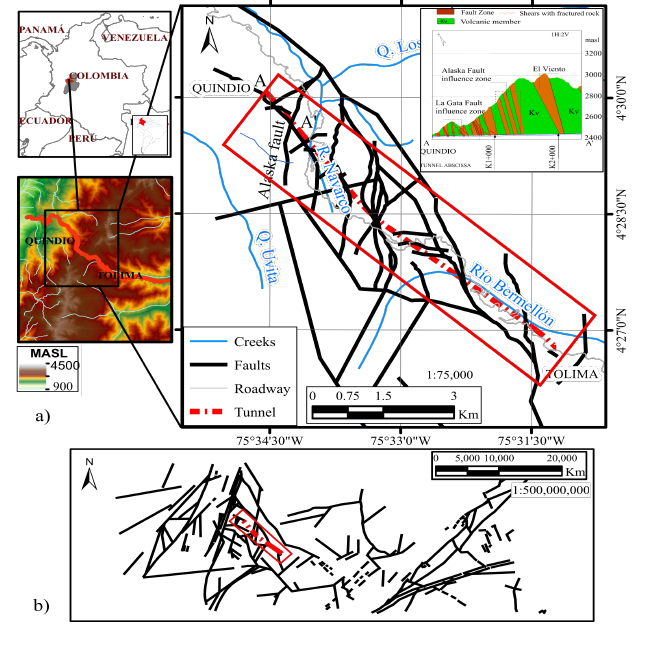
Tunnels commonly go through fracture zones that used to be analyzed as an equivalent porous medium with homogeneous permeability. However, it is a rough simplification that overlooks the connection triggered by underground works in fractured massifs. This study introduces the use of synthetic discrete fracture networks (DFN) to analyze groundwater inflows through tunnel excavation in a fractured zone considering the daily advance of the drilling front. First, a hypothetical case with six different settings varying the fracture density, the fracture length, and the aperture distribution is analyzed. Each setting has about 100 iterations. DFN hydraulic properties were estimated and compared with previous DFN studies, displaying the same behavior even though the magnitude of the estimated parameters differs. As an application example, structural measurements of the Alaska fault zone in the La Linea massif (Colombia) are used to obtain the statistical parameters of the fracture length and aperture distributions to generate the DFN. Five settings varying the fracture density are built, obtaining measured and simulated groundwater inflows of the same order of magnitude. These results highlight the potential of the synthetic DFN to analyze tunnels’ effects on groundwater flow.
Los túneles usualmente atraviesan zonas geológicamente fracturadas, que suelen ser analizadas como medios porosos equivalentes de permeabilidad homogénea. Sin embargo, esta es una simplificación que ignora las conexiones que generan las obras subterráneas en un macizo fracturado. En este trabajo se introduce el uso de redes de fracturas sintéticas (DFN) para analizar los flujos de agua subterránea generados por la perforación de túneles, considerando el avance diario en el frente de excavación. En primer lugar, se analizó un caso hipotético con seis configuraciones diferentes, variando la densidad y longitud de las fracturas, así como la distribución de aperturas. Cada configuración tenía alrededor de 100 realizaciones. Las propiedades hidráulicas de la DFN fueron estimadas y comparadas con estudios previos sobre DFNs, mostrando el mismo comportamiento aun cuando la magnitud de los parámetros estimados difería. Como ejemplo de aplicación, se usó con información estructural de la falla Alaska en el macizo de la Línea (Colombia), con el fin de obtener los parámetros estadísticos de las distribuciones de longitud y apertura de las fracturas para la generación de las DFNs. Se crearon cinco configuraciones, obteniendo caudales de infiltración medidos y simulados del mismo orden de magnitud. Estos resultados resaltan el potencial del uso de redes sintéticas de fracturas para analizar el efecto de la construcción de túneles en el flujo de agua subterránea.
References
Adler, P., Thovert, J.-F., and Mourzenko, V. (2012). Fractured Porous Media (1st ed.). Oxford University Press. https://doi.org/10.1093/acprof:oso/9780199666515.003.0001
Akaike, H. (1974). A New Look at the Statistical Model Identification. IEEE Transactions on Automatic Control, 19(6), 716-723. https://doi.org/10.1109/TAC.1974.1100705
Anderson, M., Woessner, W., and Hunt, R. (2015). Applied Groundwater Modeling Simulation of Flow and Advective Transport (2nd ed.). Elsevier.
Aquanty Inc. (2013). HydroGeoSphere user manual. https://www.aquanty.com/hydrogeosphere
Attanayake, P. M. and Waterman, M. K. (2006). Identifying environmental impacts of underground construction. Hydrogeology Journal, 14, 1160-1170. https://doi.org/10.1007/s10040-006-0037-0
Bonnet, E., Bour, O., Odling, N. E., Davy, P., Main, I., Cowie, P., and Berkowitz, B. (2001). Scaling of fracture systems in geological media. Reviews of Geophysics, 39(3), 347-383. https://doi.org/10.1029/1999RG000074
Butscher, C., Einstein, H. H., and Huggenberger, P. (2011). Effects of tunneling on groundwater flow and swelling of clay-sulfate rocks. Water Resources Research, 47(11), 1-17. https://doi.org/10.1029/2011WR011023
Butscher, C. (2012). Steady-state groundwater inflow into a circular tunnel. Tunnelling and Underground Space Technology, 32, 158-167. https://doi.org/10.1016/j.tust.2012.06.007
Cavanaugh, J. E. (1997). Unifying the derivations for the Akaike and corrected Akaike information criteria. Statistics & Probability Letters, 33(2), 201-208. https://doi.org/10.1016/S0167-7152(96)00128-9
Chiu, Y.-C. and Chia, Y. (2012). The impact of groundwater discharge to the Hsueh-Shan tunnel on the water resources in northern Taiwan. Hydrogeology Journal, 20, 1599-1611. https://doi.org/10.1007/s10040-012-0895-6
Celico, P., Fabbrocino, S., Petitta, M., and Tallini, M. (2005). Hydrogeological impact of the Gran Sasso motor-way tunnels (Central Italy). Giornale di Geologia Applicata, 1, 157-165.
Davy, P., Le Goc, R., Darcel, C., Bour, O., de Dreuzy, J.-R., and Munier, R. (2010). A likely universal model of fracture scaling and its consequence for crustal hydromechanics. Journal of Geophysical Research: Solid Earth, 115(B10), 1-13. https://doi.org/10.1029/2009JB007043
de Dreuzy, J.-R., Davy, P., and Bour, O. (2001a). Hydraulic properties of two-dimensional random fracture networks following a power law length distribution: 1. Effective connectivity. Water Resources Research, 37(8), 2065-2078. https://doi.org/10.1029/2001WR900011
de Dreuzy, J.-R., Davy, P., and Bour, O. (2001b). Hydraulic properties of two-dimensional random fracture networks following power law distributions of length and aperture. Water Resources Research, 38(12), 12-1-12-9. https://doi.org/10.1029/2001WR001009
El Tani, M. (2003). Circular tunnel in a semi-infinite aquifer. Tunnelling and Underground Space Technology, 18(1), 49-55. https://doi.org/10.1016/S0886-7798(02)00102-5
Escobar, G. (2017). Manual de geología para ingenieros. Universidad Nacional de Colombia – Sede Manizales. https://repositorio.unal.edu.co/handle/unal/3145
Evans, D. D., Nicholson, T. J., and Rasmussen, T. C. (Eds.) (2001). Flow and Transport Through Unsaturated Fractured Rock. American Geophysical Union. https://doi.org/10.1029/GM042
Fadakar Alghalandis, Y. (2017). ADFNE: Open source software for discrete fracture network engineering, two and three dimensional applications. Computers and Geosciences, 102, 1-11. https://doi.org/10.1016/j.cageo.2017.02.002
Farhadian, H., Katibeh, H., Huggenberger, P., and Butscher, C. (2016). Optimum model extent for numerical simulation of tunnel inflow in fractured rock. Tunnelling and Underground Space Technology, 60, 21–29. https://doi.org/10.1016/j.tust.2016.07.014
Font-Capó, J., Vázquez-suñé, E., Carrera, J., and Martí, D. (2011). Groundwater in flow prediction in urban tunneling with a tunnel boring machine (TBM). Engineering Geology, 121(1-2), 46-54. https://doi.org/10.1016/j.enggeo.2011.04.012
Golder Associates Inc. (2018) FracMan. https://www.golder.com/fracman/
Golian, M., Teshnizi, E. S., and Nakhaei, M. (2018). Prediction of water inflow to mechanized tunnels during tunnel-boring-machine advance using numerical simulation. Hydrogeology Journal, 26, 2827-2851. https://doi.org/10.1007/s10040-018-1835-x
Goodman, R., Moye, D., Schalkwyk, A., and Javandel, I. (1965). Groundwater inflows during tunnel driving. Bulletin of the International Association of Geologists, 2, 35-56.
Hartley, L., and Joyce, S. (2013). Approaches and algorithms for groundwater flow modeling in support of site investigations and safety assessment of the Forsmark site, Sweden. Journal of Hydrology, 500, 200-216. https://doi.org/10.1016/j.jhydrol.2013.07.031
Hawkins, I. R. and Swift, B. T., Hoch, a. R., and Wendling, J. (2011). Comparing flows to a tunnel for single porosity, double porosity and discrete fracture representations of the EDZ. Physics and Chemistry of the Earth, Parts A/B/C, 36(17-18), 1990-2002. https://doi.org/10.1016/j.pce.2011.07.029
Hernández, F. and Kammer, A. (2016). Caracterización estructural de los complejos Cajamarca y Quebradagrande en la zona del túnel de la línea, con implicaciones hidrogeológicas [Undergraduate thesis].
Heuer, R. (1995). Estimating rock-tunnel water inflow. In G. E. Williamson (Ed.) Proceedings of the Rapid Excavation and Tunneling Conference (pp. 41-60). SME.
Hokr, M., Škarydová, I., and Frydrych, D. (2012). Modelling of tunnel inflow with combination of discrete fractures and continuum. Computing and Visualization in Science, 15, 21-28. https://doi.org/10.1007/s00791-013-0194-3
Hokr, M., Shao, H., Gardner, W. P., Balvín, A., Kunz, H., Wang, Y., and Vencl, M. (2016). Real-case benchmark for flow and tracer transport in the fractured rock. Environmental Earth Sciences, 75(18), 1273. https://doi.org/10.1007/s12665-016-6061-z
Hu, L. T. and Chen, C. X. (2008). Analytical methods for transient flow to a well in a confined- unconfined aquifer. Ground Water, 46(4), 642-646. https://doi.org/10.1111/j.1745-6584.2008.00436.x
Hyman, J. D., Karra, S., Makedonska, N., Gable, C. W., Painter, S. L., and Viswanathan, H. S. (2015). DFN WORKS: A discrete fracture network framework for modeling subsurface flow and transport. Computers and Geosciences, 84, 10-19. https://doi.org/10.1016/j.cageo.2015.08.001
IRENA (2007). Estudios hidrogeológicos e hidrológicos en el área de influencia del túnel piloto de la línea, enmarcado dentro de la gestión ambiental. IRENA.
IRENA (2010). Actualización a 2009 del modelo hidrogeológico del Túnel de la Línea. INIVIAS - Ministerio del Transporte.
Karlsrud, K. (2003). Water control when tunneling under urban areas in the Olso region. NFF publication, 12, 27-33.
Kashyap, R. L. (1982). Optimal Choice of AR and MA Parts in Autoregressive Moving Average Models. IEEE Transactions on Pattern Analysis and Machine Intelligence, PAMI-4(2), 99-104. https://doi.org/10.1109/TPAMI.1982.4767213
Lee, H., Son, B., Kim, Y., and Jeon, S. (2006). Discrete fracture network and equivalent hydraulic conductivity for tunnel seepage analysis in rock mass. Tunnelling and Underground Space Technology, 21(3-4), 403. https://doi.org/10.1016/j.tust.2005.12.212
Leung, C. T. O. and Zimmerman, R. W. (2012). Estimating the Hydraulic Conductivity of Two-Dimensional Fracture Networks Using Network Geometric Properties. Transport in Porous Media, 93, 777-797. https://doi.org/10.1007/s11242-012-9982-3
Liu, R., Li, B., and Jiang, Y. (2016). A fractal model based on a new governing equation of fluid flow in fractures for characterizing hydraulic properties of rock fracture networks. Computers and Geotechnics, 75, 57-68. https://doi.org/10.1016/j.compgeo.2016.01.025
Liu, R., Yu, L., Jiang, Y., Wang, Y., and Li, B. (2017). Recent developments on relationships between the equivalent permeability and fractal dimension of two-dimensional rock fracture networks. Journal of Natural Gas Science and Engineering, 45, 771–785. https://doi.org/10.1016/j.jngse.2017.06.013
Loew, S., Lutzenkirchen, V., Hansmann, J., Ryf, A., and Guntli, P. (2015). Transient surface deformations caused by the Gotthard Base Tunnel. International Journal of Rock Mechanics and Mining Sciences, 75, 82-101. https://doi.org/10.1016/j.ijrmms.2014.12.009
Maillot, J., Davy, P., Le Goc, R., Darcel, C., and de Dreuzy, J.-R. (2016). Connectivity, permeability and channeling in randomly-distributed and kinematically-defined discrete fracture network models. Water Resources Research, 52(11), 613-615. https://doi.org/10.1002/2016WR018973
Maréchal, J.-C., Perrochet, P., and Tacher, L. (1999). Long-term simulations of thermal and hydraulic characteristics in a mountain massif: The Mont Blanc case study, French and Italian Alps. Hydrogeology Journal, 7, 341-354. https://doi.org/10.1007/s100400050207
Maréchal, J.-C. and Etcheverry, J. (2003). The use of 3H and 18O tracers to characterize water inflows in Alpine tunnels. Applied Geochemistry, 18(3), 339-351. https://doi.org/10.1016/S0883-2927(02)00101-4
Maréchal, J.-C., Lanini, S., Aunay, B., and Perrochet, P. (2014). Analytical solution for modeling discharge into a tunnel drilled in a heterogeneous unconfined aquifer, Ground Water, 52(4), 597-605. https://doi.org/10.1111/gwat.12087
Mirarco (2018). MoFrac: Discrete fracture network modeling. https://mofrac.com
Molinero, J., Samper, J., and Juanes, R. (2002). Numerical modeling of the transient hydrogeological response produced by tunnel construction in fractured bedrocks. Engineering Geology, 64(4), 369-386. https://doi.org/10.1016/S0013-7952(01)00099-0
Moon, J. and Fernandez, G. (2010) Effect of Excavation-Induced Groundwater Level Drawdown on Tunnel Inflow in a Jointed Rock Mass. Engineering Geology, 110(3-4), 33-42. https://doi.org/10.1016/j.enggeo.2009.09.002
Nikvar Hassani, A., Farhadian, H., and Katibeh, H. (2018). A comparative study on evaluation of steady-state groundwater inflow into a circular shallow tunnel. Tunnelling and Underground Space Technology, 73, 15-25. https://doi.org/10.1016/j.tust.2017.11.019
Perrochet, P. (2005). Confined flow into a tunnel during progressive drilling: An analytical solution. Ground Water, 43(6), 943-946. https://doi.org/10.1111/j.1745-6584.2005.00108.x
Perrochet, P. and Dematteis, A. (2007). Modeling transient discharge into a tunnel drilled in a heterogeneous formation. Ground Water, 45(6), 786-790. https://doi.org/10.1111/j.1745-6584.2007.00355.x
Preisig, G. (2013). Regional simulation of coupled hydromechanical processes in fractured and granular porous aquifer using effective stress-dependent parameters. [Doctoral thesis, University of Neuchâtel].
Preisig, G., Dematteis, A., Torri, R., Monin, N., Milnes, E., and Perrochet, P. (2014). Modelling discharge rates and ground settlement induced by tunnel excavation. Rock Mechanics and Rock Engineering, 47, 869-884. https://doi.org/10.1007/s00603-012-0357-4
Rizzo, R. E., Healy, D., and de Siena, L. (2017). Benefits of maximum likelihood estimators for fracture attribute analysis: Implications for permeability and up-scaling, Journal of Structural Geology, 95, 17-31. https://doi.org/10.1016/j.jsg.2016.12.005
Schwarz, G. (1978). Estimating the Dimension of a Model. The Annals of Statistics, 6(2), 461-464. https://doi.org/10.1214/aos/1176344136
Shen, S.-L., Wu, H.-N., Cui, Y.-J., and Yin, Z.-Y. (2014). Long-term settlement behaviour of metro tunnels in the soft deposits of Shanghai. Tunnelling and Underground Space Technology, 40, 309-323. https://doi.org/10.1016/j.tust.2013.10.013
Siena, M., Riva, M., Giamberini, M., Gouze, P., and Guadagnini, A. (2017). Statistical modeling of gas-permeability spatial variability along a limestone core. Spatial Statistics, 34, 100249. https://doi.org/10.1016/j.spasta.2017.07.007
Singhal, B. B. S. and Gupta, R. (2010). Applied Hydrogeology of Fractured Rocks. Springer. https://doi.org/10.1007/978-90-481-8799-7
Somogyvári, M., Jalali, M., Jiménez-Parras, S., and Bayer, P. (2017). Synthetic fracture network characterization with transdimensional inversion. Water Resources Research, 53(6), 5104-5123. https://doi.org/10.1002/2016WR020293
Su, K., Zhou, Y., Wu, H., Shi, C., and Zhou L. (2017). An Analytical Method for Groundwater Inflow into a Drained Circular Tunnel. Ground Water, 55(5), 1-10. https://doi.org/10.1111/gwat.12513
Universidad Nacional de Colombia (UNAL) (2010). Evaluación del impacto de la construcción de los túneles viales del Sumpaz y de La Línea en los hidrosistemas circunvecinos [Doctoral thesis, Universidad Nacional de Colombia]. Grupo de Investigación en Ingeniería de Recursos Hídricos. https://repositorio.unal.edu.co/handle/unal/68766
Universidad Nacional de Colombia (UNAL) (2015). Informe Final Ensayos Hidráulicos Especiales en el Macizo Fracturado de La Línea. Grupo de Investigación en Ingeniería de Recursos Hídricos, 2015.
Valenzuela, P., Domínguez-Cuesta, M. J., Meléndez-Asensio, M. J., Jiménez-Sánchez, M., and de Santa María, J. A. S. (2015). Active sinkholes: A geomorphological impact of the Pajares Tunnels (Cantabrian Range, NW Spain). Engineering Geology, 196, 158-170. https://doi.org/10.1016/j.enggeo.2015.07.007
Vincenzi, V., Gargini, A., and Goldscheider, N. (2009). Using tracer tests and hydrological observations to evaluate effects of tunnel drainage on groundwater and surface waters in the Northern Apennines (Italy). Hydrogeology Journal, 17, 135-150. https://doi.org/10.1007/s10040-008-0371-5
Wang, X. and Cai, M. (2020). A DFNDEM Multi-scale Modeling Approach for Simulating Tunnel Excavation Response in Jointed Rock Masses. Rock Mechanics and Rock Engineering, 53, 1053-1077. https://doi.org/10.1007/s00603-019-01957-8
Woods, J. A., Teubner, M. D., Simmons, C. T., Narayan, K. A. (2003). Numerical error in groundwater flow and solute transport simulation. Water Resources Research, 39(6). https://doi.org/10.1029/2001WR000586
Xia, Q., Xu, M., Zhang, H., Zhang, Q. and Xiao, X. (2018). A dynamic modeling approach to simulate groundwater discharges into a tunnel from typical heterogenous geological media during continuing excavation. KSCE Journal of Civil Engineering, 22, 341-350. https://doi.org/10.1007/s12205-017-0668-9
Yang, F.-R., Lee, C.-H., Kung, W.-J., and Yeh, H.-F. (2009). The impact of tunneling construction on the hydrogeological environment of “Tseng-Wen Reservoir Transbasin Diversion Project" in Taiwan. Engineering Geology, 103(1-2), 39-58. https://doi.org/10.1016/j.enggeo.2008.07.012
Ye, M., Meyer, P. D., and Neuman, S. P. (2008). On model selection criteria in multimodel analysis. Water Resources Research, 44(3), 1-12. https://doi.org/10.1029/2008WR006803
Zarei, H. R., Uromeihy, A., and Sharifzadeh, M. (2011). Evaluation of high local groundwater inflow to a rock tunnel by characterization of geological features. Tunnelling and Underground Space Technology, 26(2), 364-373. https://doi.org/10.1016/j.tust.2010.11.007
Dimensions
PlumX
Article abstract page views
Downloads
How to Cite




License
Copyright (c) 2022 Adriana Piña, Diego Cortes, David Leonardo Donado, Daniela Blessent

This work is licensed under a Creative Commons Attribution 4.0 International License.
The authors or holders of the copyright for each article hereby confer exclusive, limited and free authorization on the Universidad Nacional de Colombia's journal Ingeniería e Investigación concerning the aforementioned article which, once it has been evaluated and approved, will be submitted for publication, in line with the following items:
1. The version which has been corrected according to the evaluators' suggestions will be remitted and it will be made clear whether the aforementioned article is an unedited document regarding which the rights to be authorized are held and total responsibility will be assumed by the authors for the content of the work being submitted to Ingeniería e Investigación, the Universidad Nacional de Colombia and third-parties;
2. The authorization conferred on the journal will come into force from the date on which it is included in the respective volume and issue of Ingeniería e Investigación in the Open Journal Systems and on the journal's main page (https://revistas.unal.edu.co/index.php/ingeinv), as well as in different databases and indices in which the publication is indexed;
3. The authors authorize the Universidad Nacional de Colombia's journal Ingeniería e Investigación to publish the document in whatever required format (printed, digital, electronic or whatsoever known or yet to be discovered form) and authorize Ingeniería e Investigación to include the work in any indices and/or search engines deemed necessary for promoting its diffusion;
4. The authors accept that such authorization is given free of charge and they, therefore, waive any right to receive remuneration from the publication, distribution, public communication and any use whatsoever referred to in the terms of this authorization.