Published
A Study on the Performance and Emission Characteristics of a Diesel Engine Operated with Ternary Higher Alcohol Biofuel Blends
Un estudio sobre las características de rendimiento y emisión de un motor diésel operado con mezclas ternarias de biocombustible de alcohol superior
DOI:
https://doi.org/10.15446/ing.investig.93696Keywords:
diesel engine, higher alcohol biofuel, performance, emissions (en)motor diésel, biocombustible con alto contenido de alcohol, rendimiento, emisiones (es)
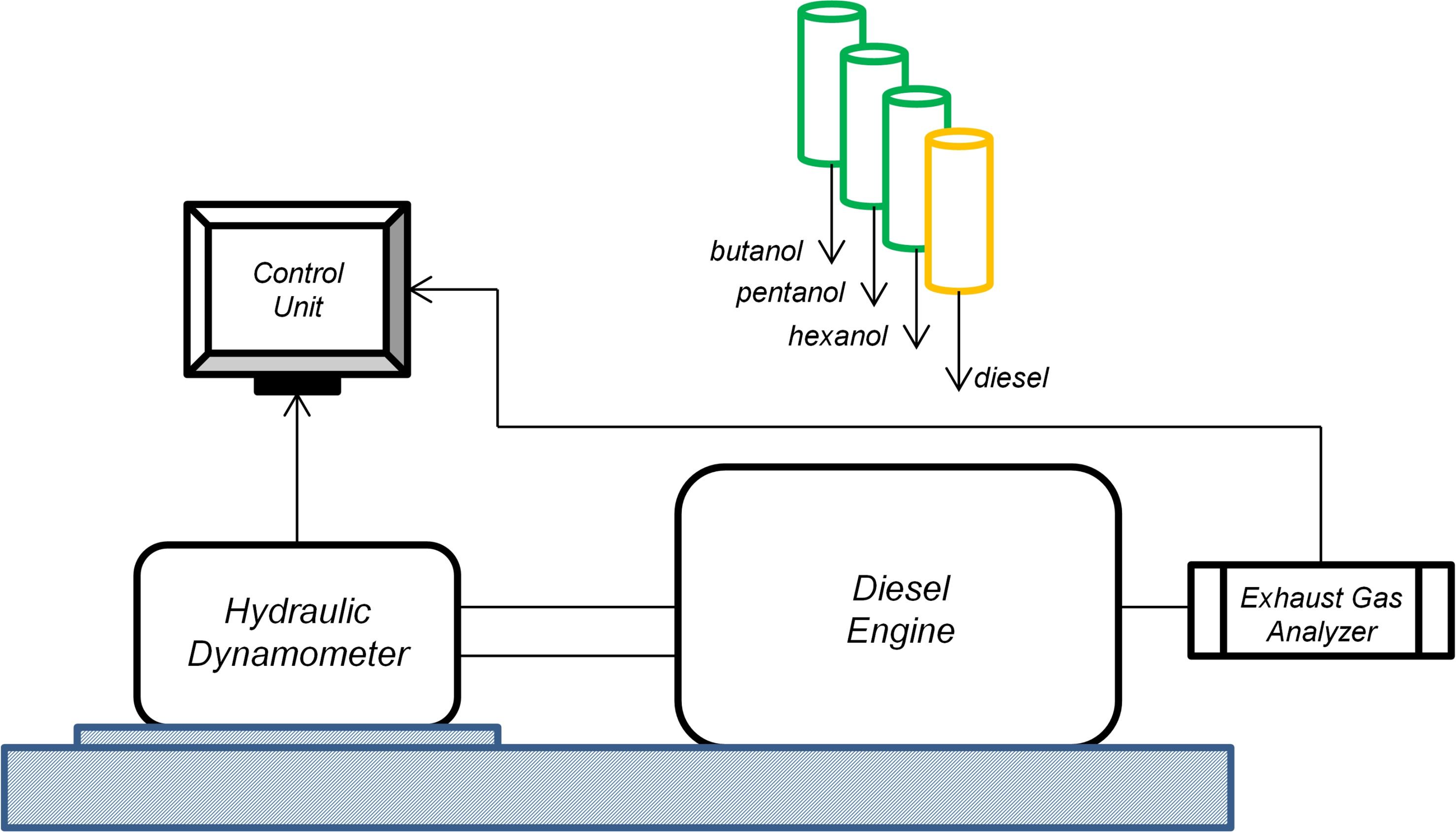
This study focused experimentally on the evaluation of a higher alcohol biofuel utilization with diesel fuel in a compression ignition engine. To this effect, two different ternary higher alcohol biofuel blends with different percentages by volume were used, i.e., DA5 (85% diesel + 5% butanol +5% pentanol + 5% hexanol) and DA10 (70% diesel + 10% butanol + 10% pentanol + 10% hexanol). The performance and emission results were compared against reference standard diesel fuel. Experiments revealed the brake power (BP) values of the engine to be reduced due to the lower calorific value of the alcohols. In addition, this phenomenon led to increased levels of brake-specific fuel consumption (BSFC), which resulted in a higher fuel consumption to obtain unit power. Regarding emissions, carbon monoxide (CO) was reduced as a result of the additional oxygen content of alcohols, which triggered the more oxidized CO with oxygen. The results regarding unwanted nitrogen oxides (NOx) emissions were also attractive according to the alcohol utilized. Considerable reductions were obtained with alcohol mixtures when compared to diesel fuel, which can be explained by the reduced combustion temperatures in the cylinder, given the higher latent heat in the evaporation of alcohols.
Este estudio se centró experimentalmente en la evaluación de una mayor utilización de biocombustible de alcohol con combustible diésel en un motor de encendido por compresión. Para ello, se utilizaron dos mezclas ternarias de biocombustible de alcohol superior distintas y con diferentes porcentajes en volumen DA5 (85 % diésel + 5 % butanol + 5 % pentanol + 5 % hexanol) y DA10 (70 % diésel + 10 % butanol + 10 % pentanol + 10 % hexanol). Los resultados de rendimiento y emisiones se compararon con combustible diésel estándar de referencia. Los experimentos revelaron que los valores de la potencia de frenado (BP) del motor se redujeron debido al menor poder calorífico de los alcoholes. Además, este fenómeno llevó a obtener mayores niveles de consumo de combustible específico de frenado (BSFC), lo que resultó en un mayor consumo de combustible para obtener potencia unitaria. Con respecto a las emisiones, el monóxido de carbono (CO) se redujo como resultado del contenido de oxígeno adicional de los alcoholes, lo cual activó el CO más oxidado con oxígeno. Los resultados de la emisión no deseada de óxidos de nitrógeno (NOx) también fueron atractivos según el alcohol utilizado. Se obtuvieron reducciones considerables con las mezclas de alcoholes en comparación con el combustible diésel, lo que puede deberse a temperaturas de combustión reducidas en el cilindro, dado el mayor calor latente en la evaporación de alcoholes.
References
Aneeque, M., Alshahrani, S., Kareemullah, M., Afzal, A., Saleel, C. A., Soudagar, M. E. M., Hossain, N., Subbiah, R., and Ahmed, M. H. (2021). The combined effect of alcohols and calophyllum inophyllum biodiesel using response surface methodology optimization. Sustaina-bility, 13(13), 7345. https://doi.org/10.3390/su13137345
Appavu, P., Madhavan, V. R., Venu, H., and Jayaraman, J. (2020). A novel alternative fuel mixture (diesel–biodiesel–pentanol) for the existing unmodified direct in-jection diesel engine: performance and emission char-acteristics. Transactions of the Canadian Society for Mechanical Engineering, 44(1), 1-9. https://doi.org/10.1139/tcsme-2019-0049
Çelebi, Y., and Aydın, H. (2019). An overview on the light alcohol fuels in diesel engines. Fuel, 236, 890-911. https://doi.org/10.1016/j.fuel.2018.08.138
De Poures, M. V., Sathiyagnanam, A. P., Rana, D., Rajesh Kumar, B., and Saravanan, S. (2017). 1-Hexanol as a sus-tainable biofuel in DI diesel engines and its effect on combustion and emissions under the influence of injec-tion timing and exhaust gas recirculation (EGR). Applied Thermal Engineering, 113, 1505-1513. https://doi.org/10.1016/j.applthermaleng.2016.11.164
Devarajan, Y., Munuswamy, D. B., and Nagappan, B. K. (2017). Emissions analysis on diesel engine fuelled with cashew nut shell biodiesel and pentanol blends. Envi-ronmental Science and Pollution Research, 24(14), 13136-13141. https://doi.org/10.1007/s11356-017-8915-7
Jeyakumar, N., and Narayanasamy, B. (2019). Effect of pen-tanol-biodiesel blends on performance and emission characteristics of the diesel engine. International Jour-nal of Ambient Energy, 42(8), 900-906. https://doi.org/10.1080/01430750.2019.1568910
Joy, N., Balan, K. N., Nagappan, B., and Justin Abraham baby, S. (2020). Emission analysis of diesel and butanol blends in research diesel engine. Petroleum Science and Technology, 38(4), 289-296. https://doi.org/10.1080/10916466.2019.1702680
Karabektas, M., and Hosoz, M. (2009). Performance and emis-sion characteristics of a diesel engine using isobutanol-diesel fuel blends. Renewable Energy, 34(6), 1554-1559. https://doi.org/10.1016/j.renene.2008.11.003
Kattela, S. P., Vysyaraju, R. K. R., Surapaneni, S. R., and Ganji, P. R. (2019). Effect of n-butanol/diesel blends and piston bowl geometry on combustion and emission character-istics of CI engine. Environmental Science and Pollution Research, 26(2), 1661-1674. https://doi.org/10.1007/s11356-018-3704-5
Khan, H., Kareemullah, M., Ravi, H. C., Rehman, K. F., Kumar, R. H., Afzal, A., Soudagar, M. E. M., and Fayaz, H. (2020). Combined effect of synthesized waste milk scum oil methyl ester and ethanol fuel blend on the diesel en-gine characteristics. Journal of The Institution of Engi-neers (India): Series C, 101(6), 947-962. https://doi.org/10.1007/s40032-020-00605-3
Koivisto, E., Ladommatos, N., and Gold, M. (2015). Systematic study of the effect of the hydroxyl functional group in alcohol molecules on compression ignition and exhaust gas emissions. Fuel, 153, 650-663. https://doi.org/10.1016/j.fuel.2015.03.042
Kumar, V., Singh, A. P., and Agarwal, A. K. (2020). Gaseous emissions (regulated and unregulated) and particulate characteristics of a medium-duty CRDI transportation diesel engine fueled with diesel-alcohol blends. Fuel, 278, 118269. https://doi.org/10.1016/j.fuel.2020.118269
No, S.-Y. (2020). Utilization of pentanol as biofuels in compres-sion ignition engines. Frontiers in Mechanical Engineer-ing, 6, 15. https://doi.org/10.3389/fmech.2020.00015
Nour, M., Attia, A. M. A., and Nada, S. A. (2019). Combustion, performance and emission analysis of diesel engine fuelled by higher alcohols (butanol, octanol and hep-tanol)/diesel blends. Energy Conversion and Manage-ment, 185, 313-329. https://doi.org/10.1016/j.enconman.2019.01.105
Nour, M., Kosaka, H., Sato, S., Bady, M., Abdel-Rahman, A. K., and Uchida, K. (2017). Effect of ethanol/water blends addition on diesel fuel combustion in RCM and DI diesel engine. Energy Conversion and Management, 149, 228-243. https://doi.org/10.1016/j.enconman.2017.07.026
Pan, M., Huang, R., Liao, J., Jia, C., Zhou, X., Huang, H., and Huang, X. (2019). Experimental study of the spray, com-bustion, and emission performance of a diesel engine with high n-pentanol blending ratios. Energy Conversion and Management, 194, 1-10. https://doi.org/10.1016/j.enconman.2019.04.054
Pan, M., Tong, C., Qian, W., Lu, F., Yin, J., and Huang, H. (2020). The effect of butanol isomers on diesel engine performance, emission and combustion characteristics under different load conditions. Fuel, 277, 118188. https://doi.org/10.1016/j.fuel.2020.118188
Radheshyam, Santhosh, K., and Kumar, G. N. (2020). Effect of 1-pentanol addition and EGR on the combustion, per-formance and emission characteristic of a CRDI diesel engine. Renewable Energy, 145, 925-936. https://doi.org/10.1016/j.renene.2019.06.043
Rajesh Kumar, B., and Saravanan, S. (2016). Use of higher alcohol biofuels in diesel engines: A review. Renewable and Sustainable Energy Reviews, 60, 84-115. https://doi.org/10.1016/j.rser.2016.01.085
Ramesh, A., Ashok, B., Nanthagopal, K., Ramesh Pathy, M., Tambare, A., Mali, P., Phuke, P., Patil, S., and Sub-barao, R. (2019). Influence of hexanol as additive with Calophyllum Inophyllum biodiesel for CI engine appli-cations. Fuel, 249, 472-485. https://doi.org/10.1016/j.fuel.2019.03.072
Singh, R., Singh, S., and Kumar, M. (2020). Impact of n-butanol as an additive with eucalyptus biodiesel-diesel blends on the performance and emission parameters of the diesel engine. Fuel, 277, 118178. https://doi.org/10.1016/j.fuel.2020.118178
Sundar Raj, C., and Saravanan, G. (2011). Influence of hexa-nol-diesel blends on constant speed diesel engine. Thermal Science, 15(4), 1215-1222. https://doi.org/10.2298/TSCI101001089S
Thomas, J. J., Sabu, V. R., Nagarajan, G., Kumar, S., and Basrin, G. (2020). Influence of waste vegetable oil bio-diesel and hexanol on a reactivity controlled compres-sion ignition engine combustion and emissions. Energy, 206, 118199. https://doi.org/10.1016/j.energy.2020.118199
Tüccar, G., Tosun, E., Özgür, T., and Aydin, K. (2014). Diesel engine emissions and performance from blends of citrus sinensis biodiesel and diesel fuel. Fuel, 132, 7-11. https://doi.org/10.1016/j.fuel.2014.04.065
Yesilyurt, M. K. (2020). A detailed investigation on the perfor-mance, combustion, and exhaust emission characteris-tics of a diesel engine running on the blend of diesel fuel, biodiesel and 1-heptanol (C7 alcohol) as a next-generation higher alcohol. Fuel, 275, 117893. https://doi.org/10.1016/j.fuel.2020.117893
Yilmaz, N., Atmanli, A., and Trujillo, M. (2017). Influence of 1-pentanol additive on the performance of a diesel en-gine fueled with waste oil methyl ester and diesel fuel. Fuel, 207, 461-469. https://doi.org/10.1016/j.fuel.2017.06.093
Dimensions
PlumX
Article abstract page views
Downloads
How to Cite




License
Copyright (c) 2023 Tayfun Ozgur

This work is licensed under a Creative Commons Attribution 4.0 International License.
The authors or holders of the copyright for each article hereby confer exclusive, limited and free authorization on the Universidad Nacional de Colombia's journal Ingeniería e Investigación concerning the aforementioned article which, once it has been evaluated and approved, will be submitted for publication, in line with the following items:
1. The version which has been corrected according to the evaluators' suggestions will be remitted and it will be made clear whether the aforementioned article is an unedited document regarding which the rights to be authorized are held and total responsibility will be assumed by the authors for the content of the work being submitted to Ingeniería e Investigación, the Universidad Nacional de Colombia and third-parties;
2. The authorization conferred on the journal will come into force from the date on which it is included in the respective volume and issue of Ingeniería e Investigación in the Open Journal Systems and on the journal's main page (https://revistas.unal.edu.co/index.php/ingeinv), as well as in different databases and indices in which the publication is indexed;
3. The authors authorize the Universidad Nacional de Colombia's journal Ingeniería e Investigación to publish the document in whatever required format (printed, digital, electronic or whatsoever known or yet to be discovered form) and authorize Ingeniería e Investigación to include the work in any indices and/or search engines deemed necessary for promoting its diffusion;
4. The authors accept that such authorization is given free of charge and they, therefore, waive any right to receive remuneration from the publication, distribution, public communication and any use whatsoever referred to in the terms of this authorization.