Published
Near-Infrared Spectroscopy: Assessment of Soil Organic Carbon Stock in a Colombian Oxisol
Espectroscopia de infrarrojo cercano: evaluación del almacenamiento de carbono orgánico del suelo en un oxisol colombiano
DOI:
https://doi.org/10.15446/ing.investig.99102Keywords:
soil organic carbon, bulk density, soil spectroscopy, spline, geostatistics (en)carbono orgánico del suelo, densidad aparente, espectroscopía de suelos, spline, geoestadística (es)
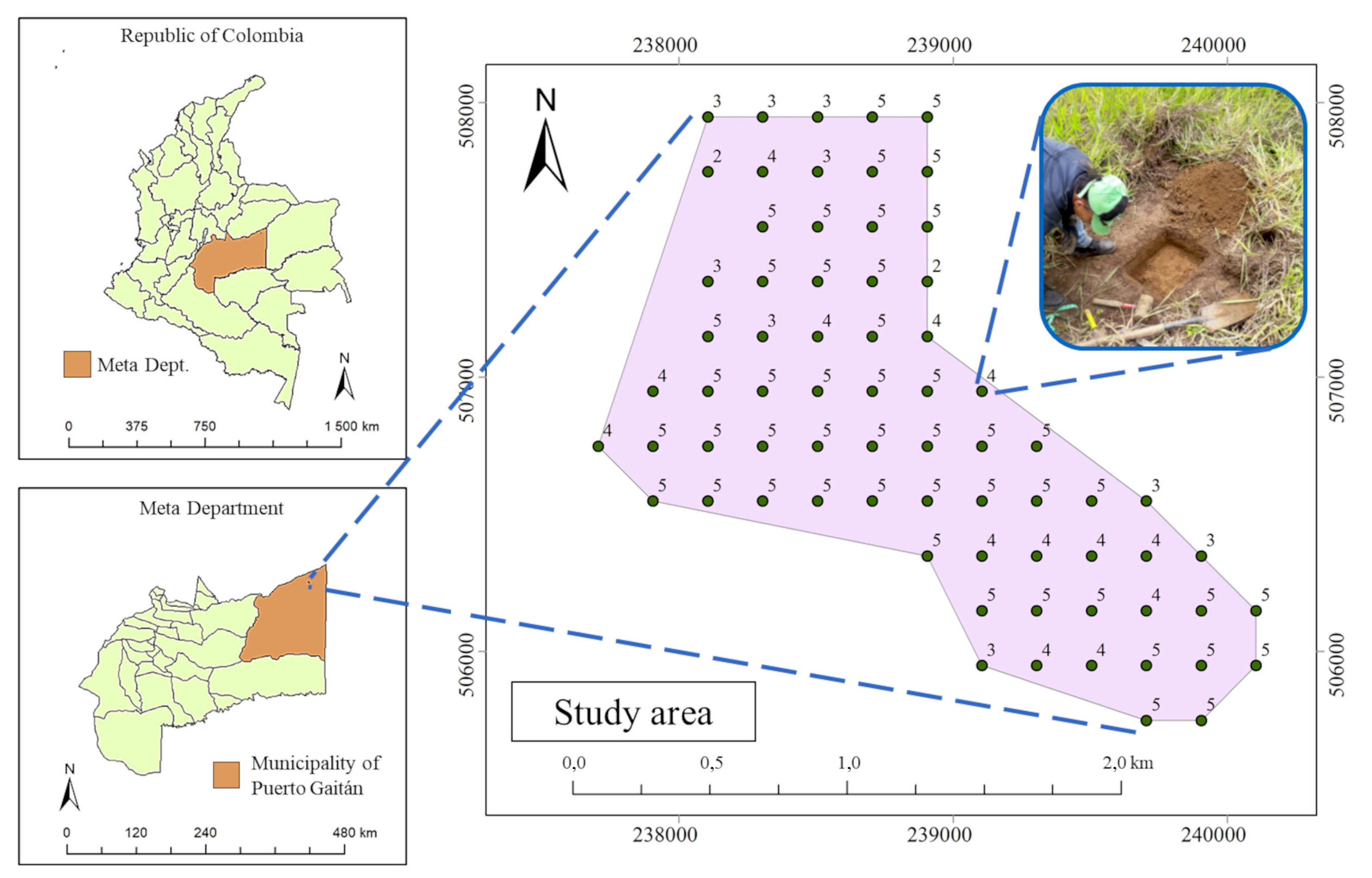
Soil organic carbon (SOC) is a property known for its influence on the physical, chemical, and biological characteristics of soils, which are essential when assessing their quality. SOC stock (SOCS) monitoring is a key task in climate change mitigation studies. However, the resources necessary to obtain the information required by these studies tend to be high. The objective of this study was to develop a model for estimating the SOCS of a Colombian oxisol using near-infrared (NIR) diffuse reflectance spectroscopy. In a sampling scheme of 70 points distributed over 248 ha, 313 soil samples were collected in five defined depth intervals of 10 cm each, from 0 to 50 cm. SOC was determined through an elemental analyzer, and bulk density (BD) by means of sampling cylinders. A NIRFlex spectrometer was used to acquire spectral signatures in the NIR range from the processed soil samples, and, together with the data measured in the laboratory, a statistical analysis was performed using partial least squares regression (PLSR) in order to calibrate the spectral models. Based on the residual prediction deviation (RPD), the root mean square error (RMSE), and the coefficient of determination (R2) of the validation groups, a highly representative model was achieved for the estimation of SOCS (R2 = 0,93; RMSE = 2,12 tC ha-1; RPD = 3,69), which was also corroborated with geostatistical interpolation surfaces and depth splines. This research showed NIR diffuse reflectance spectroscopy to be a viable technique for SOCS estimation in the study area.
El carbono orgánico del suelo (COS) es una propiedad conocida por su influencia en las propiedades físicas, químicas y biológicas de los suelos, que son fundamentales para evaluar su calidad. El monitoreo del stock de COS (SCOS) es una labor clave en los estudios de mitigación del cambio climático. Sin embargo, los recursos necesarios para obtener la información requerida en estos estudios suelen ser elevados. El objetivo de este estudio fue desarrollar un modelo para estimar el SCOS de un oxisol colombiano utilizando espectroscopía de reflectancia difusa de infrarrojo cercano (NIR). En un esquema de muestreo de 70 puntos distribuidos en 248 ha, se recolectaron 313 muestras de suelo en cinco intervalos de profundidad definidos de 10 cm cada uno, de 0 a 50 cm. El COS se determinó mediante un analizador elemental, y la densidad aparente (DA) mediante cilindros de muestreo. Se utilizó un espectrómetro NIRFlex para adquirir firmas espectrales en el rango NIR de las muestras de suelo procesadas, y, junto con datos medidos en laboratorio, se realizó un análisis estadístico usando regresión de mínimos cuadrados parciales (RMCP) para calibrar los modelos espectrales. Con base en la desviación de predicción residual (DRP), raíz del error cuadrático medio (RECM) y el coeficiente de determinación (R2) de los grupos de validación, se logró un modelo de alta representatividad para la estimación de SCOS (R2 = 0,93; RECM = 2,12 tC ha-1; DRP = 3,69), lo cual también se corroboró con superficies de interpolación geoestadística y splines de profundidad. Esta investigación mostró que la espectroscopia de reflectancia difusa NIR es una técnica viable para la estimación de SOCS en el área de estudio.
References
Ahmadi, A., Emami, M., Daccache, A., and He, L. (2021). Soil properties prediction for precision agriculture using visible and near-infrared spectroscopy: A systematic review and meta-analysis. Agronomy, 11(3), 1-14. https://doi.org/10.3390/agronomy11030433
Al-Asadi, R. A., and Mouazen, A. M. (2014). Combining frequency domain reflectometry and visible and near infrared spectroscopy for assessment of soil bulk density. Soil and Tillage Research, 135, 60-70. https://doi.org/10.1016/j.still.2013.09.002
Allo, M., Todoroff, P., Jameux, M., Stern, M., Paulin, L., and Albrecht, A. (2020). Prediction of tropical volcanic soil organic carbon stocks by visible-near- and mid-infrared spectroscopy. Catena, 189, 104452. https://doi.org/10.1016/j.catena.2020.104452
Allory, V., Cambou, A., Moulin, P., Schwartz, C., Cannavo, P., Vidal-Beaudet, L., and Barthès, B. G. (2019). Quantification of soil organic carbon stock in urban soils using visible and near infrared reflectance spectroscopy (VNIRS) in situ or in laboratory conditions. Science of the Total Environment, 686, 764-773. https://doi.org/10.1016/j.scitotenv.2019.05.192
Araújo, S. R., Söderström, M., Eriksson, J., Isendahl, C., Stenborg, P., and Demattê, J. A. M. (2015). Determining soil properties in Amazonian Dark Earths by reflectance spectroscopy. Geoderma, 237, 308-317. https://doi.org/10.1016/j.geoderma.2014.09.014
Askari, M. S., Cui, J., O’Rourke, S. M., and Holden, N. M. (2015). Evaluation of soil structural quality using VIS-NIR spectra. Soil and Tillage Research, 146, 108-117. https://doi.org/10.1016/j.still.2014.03.006
Ben Dor, E., Ong, C., and Lau, I. C. (2015). Reflectance measurements of soils in the laboratory: Standards and protocols. Geoderma, 245-246, 112-124. https://doi.org/10.1016/j.geoderma.2015.01.002
Bonett, J., Camacho-Tamayo, J. H., and Vélez-Sánchez, J. (2016). Estimating soil properties with mid-infrared spectroscopy. Revista U.D.C.A Actualidad & Divulgación Científica, 19(1), 55-66. http://www.scielo.org.co/scielo.php?script=sci_arttext&pid=S0123-42262016000100007
Camacho-Tamayo, J. H., Forero-Cabrera, N. M., Ramírez-López, L., and Rubiano-Sanabria, Y. (2017). Evaluación de textura del suelo con espectroscopía de infrarrojo cercano en un oxisol de colombia. Colombia Forestal, 20(1), 5-18. http://dx.doi.org/10.14483/udistrital.jour.colomb.for.2017.1.a01
Camacho-Tamayo, J. H., Rubiano-Sanabria, Y., and Hurtado, M. del P. (2014). Near-infrared (NIR) diffuse reflectance spectroscopy for the prediction of carbon and nitrogen in an Oxisol. Agronomía Colombiana, 32(1), 86-94. http://www.redalyc.org:9081/html/1803/180330697012/
Cambardella, C. A., Moorman, T. B., Novak, J. M., Parkin, T. B., Karlen, D. L., Turco, R. F., and Konopka, A. E. (1994). Field-Scale Variability of Soil Properties in Central Iowa Soils. Soil Science Society of America Journal, 58(5), 1501-1511. https://doi.org/10.2136/sssaj1994.03615995005800050033x
Cambou, A., Cardinael, R., Kouakoua, E., Villeneuve, M., Durand, C., and Barthès, B. G. (2016). Prediction of soil organic carbon stock using visible and near infrared reflectance spectroscopy (VNIRS) in the field. Geoderma, 261, 151-159. https://doi.org/10.1016/j.geoderma.2015.07.007
Davari, M., Karimi, S. A., Bahrami, H. A., Taher Hossaini, S. M., and Fahmideh, S. (2021). Simultaneous prediction of several soil properties related to engineering uses based on laboratory Vis-NIR reflectance spectroscopy. Catena, 197, 1-12. https://doi.org/10.1016/j.catena.2020.104987
FAO (2019). Measuring and modelling soil carbon stocks and stock changes in livestock production systems Guidelines for assessment (Version 1). FAO. http://www.fao.org/3/ca2934en/CA2934EN.pdf
Huang, J., Hartemink, A. E., and Zhang, Y. (2019). Climate and land-use change effects on soil carbon stocks over 150 years in Wisconsin, USA. Remote Sensing, 11(12), 1504. https://doi.org/10.3390/rs11121504
IPCC (2019). 2019 Refinement to the 2006 IPCC Guidelines for National Greenhouse Gas Inventories: Volume 4 - Agriculture, forestry and other land use. The Intergovernmental Panel on Climate Change (IPCC). https://www.ipcc-nggip.iges.or.jp/public/2019rf/vol4.html
Jia, X., Chen, S., Yang, Y., Zhou, L., Yu, W., and Shi, Z. (2017). Organic carbon prediction in soil cores using VNIR and MIR techniques in an alpine landscape. Scientific Reports, 7(1), 2144. https://doi.org/10.1038/s41598-017-02061-z
Katuwal, S., Knadel, M., Norgaard, T., Moldrup, P., Greve, M. H., and de Jonge, L. W. (2020). Predicting the dry bulk density of soils across Denmark: Comparison of single-parameter, multi-parameter, and vis–NIR based models. Geoderma, 361, 1-10. https://doi.org/10.1016/j.geoderma.2019.114080
Liland, K. H., Mevik, B.-H., and Wehrens, R. (2021). pls: Partial least squares and principal component regression (R package version 2.8-0). https://cran.r-project.org/package=pls
Liu, S., Shen, H., Chen, S., Zhao, X., Biswas, A., Jia, X., Shi, Z., and Fang, J. (2019). Estimating forest soil organic carbon content using vis-NIR spectroscopy : Implications for large-scale soil carbon spectroscopic assessment. Geoderma, 348, 37-44. https://doi.org/10.1016/j.geoderma.2019.04.003
Malone, B. (2016). ithir: Functions and algorithms specific to pedometrics. R package version 1.0/r126. https://rdrr.io/rforge/ithir/
Moreira, C. S., Brunet, D., Verneyre, L., Sá, S. M. O., Galdos, M. V., Cerri, C. C., and Bernoux, M. (2009). Near infrared spectroscopy for soil bulk density assesment. European Journal of Soil Science, 60, 785-791. https://doi.org/10.1111/j.1365-2389.2009.01170.x
Nawar, S., and Mouazen, A. M. (2019). On-line vis-NIR spectroscopy prediction of soil organic carbon using machine learning. Soil and Tillage Research, 190, 120-127. https://doi.org/10.1016/j.still.2019.03.006
Nocita, M., Stevens, A., Toth, G., Panagos, P., van Wesemael, B., and Montanarella, L. (2014). Prediction of soil organic carbon content by diffuse reflectance spectroscopy using a local partial least square regression approach. Soil Biology and Biochemistry, 68, 337-347. https://doi.org/10.1016/j.soilbio.2013.10.022
Oliver, M. A., and Webster, R. (2015). Basics steps in geostatistics: The variogram and kriging. Springer. https://doi.org/10.1007/978-3-319-15865-5
Ponce‐Hernandez, R., Marriott, F. H. C., and Beckett, P. H. T. (1986). An improved method for reconstructing a soil profile from analyses of a small number of samples. Journal of Soil Science, 37(3), 455-467. https://doi.org/10.1111/j.1365-2389.1986.tb00377.x
Poppiel, R. R., Lacerda P., M., Pereira, M., Almeida Junior, D. O., Demattê, J., Romero, D. J., Sato, M., Almeida J, L. R., and Moreira C, L. F. (2018). Surface spectroscopy of oxisols, entisols and inceptisol and relationships with selected soil properties. Revista Brasilera de Ciencia Do Solo, 42, 1-26. https://doi.org/http://dx.doi.org/10.1590/18069657rbcs20160519
Ramirez-Lopez, L., Reina-Sánchez, A., and Camacho-Tamayo, J. H. (2008). Variabilidad espacial de atributos físicos de un Typic Haplustox de los Llanos Orientales de Colombia. Engenharia Agrícola, 28(1), 55-63. https://doi.org/10.1590/S0100-69162008000100006
Sommer, R., & Bossio, D. (2014). Dynamics and climate change mitigation potential of soil organic carbon sequestration. Journal of Environmental Management, 144, 83-87. https://doi.org/10.1016/j.jenvman.2014.05.017
Stevens, A., and Ramírez-López, L. (2020). An introduction to the prospectr package (R package Vignette R package version 0.2.0). https://github.com/l-ramirez-lopez/prospectr
Stockmann, U., Adams, M. A., Crawford, J. W., Field, D. J., Henakaarchchi, N., Jenkins, M., Minasny, B., McBratney, A. B., Courcelles, V. de R. de, Singh, K., Wheeler, I., Abbott, L., Angers, D. A., Baldock, J., Bird, M., Brookes, P. C., Chenu, C., Jastrow, J. D., Lal, R., … Zimmermann, M. (2013). The knowns, known unknowns and unknowns of sequestration of soil organic carbon. Agriculture, Ecosystems and Environment, 164, 80-99. https://doi.org/10.1016/j.agee.2012.10.001
Viscarra Rossel, R. A., McGlynn, R. N., and McBratney, A. B. (2006). Determining the composition of mineral-organic mixes using UV-vis-NIR diffuse reflectance spectroscopy. Geoderma, 137(1-2), 70-82. https://doi.org/10.1016/j.geoderma.2006.07.004
Viscarra Rossel, R. A., and Webster, R. (2012). Predicting soil properties from the Australian soil visible – near infrared spectroscopic database. European Journal of Soil Science, 63, 848-860. https://doi.org/10.1111/j.1365-2389.2012.01495.x
Wetterlind, J., Stenberg, B., and Söderström, M. (2008). The use of near infrared (NIR) spectroscopy to improve soil mapping at the farm scale. Precision Agriculture, 9(1-2), 57-69. https://doi.org/10.1007/s11119-007-9051-z
Dimensions
PlumX
Article abstract page views
Downloads
How to Cite




License
Copyright (c) 2023 Felipe Fernández Martínez, Jesús Hernán Camacho Tamayo, Yolanda Rubiano Sanabria

This work is licensed under a Creative Commons Attribution 4.0 International License.
The authors or holders of the copyright for each article hereby confer exclusive, limited and free authorization on the Universidad Nacional de Colombia's journal Ingeniería e Investigación concerning the aforementioned article which, once it has been evaluated and approved, will be submitted for publication, in line with the following items:
1. The version which has been corrected according to the evaluators' suggestions will be remitted and it will be made clear whether the aforementioned article is an unedited document regarding which the rights to be authorized are held and total responsibility will be assumed by the authors for the content of the work being submitted to Ingeniería e Investigación, the Universidad Nacional de Colombia and third-parties;
2. The authorization conferred on the journal will come into force from the date on which it is included in the respective volume and issue of Ingeniería e Investigación in the Open Journal Systems and on the journal's main page (https://revistas.unal.edu.co/index.php/ingeinv), as well as in different databases and indices in which the publication is indexed;
3. The authors authorize the Universidad Nacional de Colombia's journal Ingeniería e Investigación to publish the document in whatever required format (printed, digital, electronic or whatsoever known or yet to be discovered form) and authorize Ingeniería e Investigación to include the work in any indices and/or search engines deemed necessary for promoting its diffusion;
4. The authors accept that such authorization is given free of charge and they, therefore, waive any right to receive remuneration from the publication, distribution, public communication and any use whatsoever referred to in the terms of this authorization.