Published
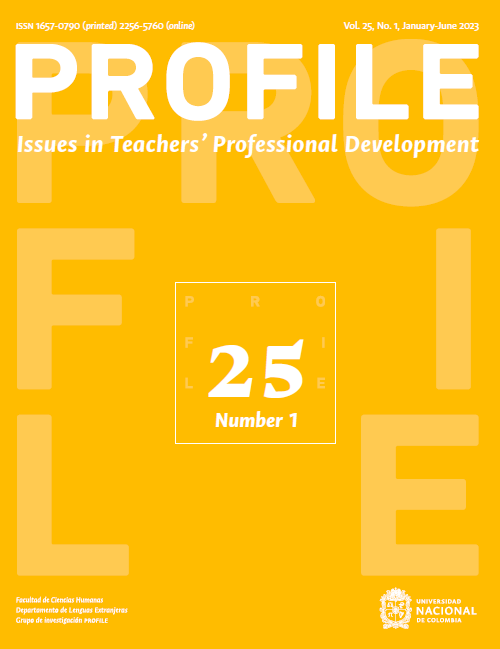
Challenges and Complexities in Teacher Conceptualization of Dynamic Assessment in the L2 Classroom: A Case Study in Türkiye
Desafíos y complejidades en la conceptualización docente de la evaluación dinámica en el aula L2: un estudio de caso en Turquía
DOI:
https://doi.org/10.15446/profile.v25n1.101065Keywords:
dynamic assessment, teacher beliefs, teacher professional development, Türkiye (en)creencias del maestro, desarrollo profesional docente, evaluación dinámica, Turquía (es)
Dynamic assessment is a dialectic procedure requiring teachers to assess learners’ progress by paying attention to students’ errors while providing graduated prompts to help them fix them. Although previous studies have focused on the teachers’ competence in carrying out the dynamic assessment, this case study explores the dynamic assessment conceptualization of two English language teachers. Data were gathered through video-recorded sessions, reflective reports, semi-structured interviews, and classroom observations. Results showed that while one of the teachers reconceptualized her role as a graduated prompt provider, the other teacher resisted adopting any roles that dynamic assessment requires. The study implies careful consideration of personal and contextual factors shaping teachers’ assumptions to make a change in teacher practice.
La evaluación dinámica es un procedimiento dialéctico para evaluar el progreso de los alumnos prestando atención a sus errores a fin de brindarles indicaciones graduales para corregirlos. Mientras estudios anteriores analizan la competencia de los docentes para implementar la evaluación dinámica, este estudio de caso exploró la conceptualización de la evaluación dinámica por parte de dos profesoras de inglés. Los datos se recopilaron mediante videos, reflexiones, entrevistas semiestructuradas y observaciones en el aula. Se encontró que mientras una participante conceptualizaba la evaluación dinámica como una forma de proporcionar indicaciones graduales, la otra se resistía a adoptar las funciones que requiere la evaluación dinámica. Para cambiar la práctica docente, se sugiere la importancia de considerar los factores personales y contextuales detrás de las suposiciones de los docentes.
References
Ableeva, R., & Lantolf, J. (2011). Mediated dialogue and the microgenesis of second language listening comprehension. Assessment in Education: Principles, Policy & Practice, 18(2), 133–149. https://doi.org/10.1080/0969594X.2011.555330
Aljaafreh, A., & Lantolf, J. P. (1994). Negative feedback as regulation and second language learning in the zone of proximal development. Modern Language Journal, 78(4), 465–483. https://doi.org/10.1111/j.1540-4781.1994.tb02064.x
Antón, M. (2009). Dynamic assessment of advanced second language learners. Foreign Language Annals, 42(3), 576–598. https://doi.org/10.1111/j.1944-9720.2009.01030.x
Babaii, E., Molana, K., & Nazari, M. (2021). Contributions of assessment-related critical incidents to language teacher identity development. Innovation in Language Learning and Teaching, 15(5), 442–457. https://doi.org/10.1080/17501229.2020.1824234
Borg, S. (2003). Teacher cognition in language teaching: A review of research on what language teachers think, know, believe, and do. Language Teaching, 36(2), 81–109. https://doi.org/10.1017/S0261444803001903
Braun, V., & Clarke, V. (2006). Using thematic analysis in psychology. Qualitative Research in Psychology, 3(2), 77–101. https://doi.org/10.1191/1478088706qp063oa
Davin, K. J., & Herazo, J. D. (2020). Reconceptualizing classroom dynamic assessment: Lessons from teacher practice. In M. E. Poehner & O. Inbar-Lourie (Eds.), Toward a reconceptualization of second language classroom assessment: Praxis and researcher–teacher partnership (pp. 197–217). Springer. https://doi.org/10.1007/978-3-030-35081-9_10
Davin, K. J., Herazo, J. D., & Sagre, A. (2017). Learning to mediate: Teacher appropriation of dynamic assessment. Language Teaching Research, 21(5), 632–651. https://doi.org/10.1177/1362168816654309
Freeman, D. (2002). The hidden side of the work: Teacher knowledge and learning to teach. A perspective from North American educational research on teacher education in English language teaching. Language Teaching, 35(1), 1–13. https://doi.org/10.1017/S0261444801001720
Freeman, D., & Johnson, K. A. (1998). Reconceptualizing the knowledge-base of language teacher education. TESOL Quarterly, 32(3), 397–417. https://doi.org/10.2307/3588114
Golombek, P. R. (1998). A study of language teachers’ personal practical knowledge. TESOL Quarterly, 32(3), 447–464. https://doi.org/10.2307/3588117
Herazo, J. D., Davin, K. J., & Sagre, A. (2019). L2 dynamic assessment: An activity theory perspective. The Modern Journal, 103(2), 443–458. https://doi.org/10.1111/modl.12559
Johnson, K. E. (2006). The sociocultural turn and its challenges for second language teacher education. TESOL Quarterly, 40(1), 235–257. https://doi.org/10.2307/40264518
Johnson, K. E., & Golombek, P. R. (2003). “Seeing” teacher learning. TESOL Quarterly, 37(4), 729–737. https://doi.org/10.2307/3588221
Karimi, M. N., & Nazari, M. (2021). Growth in language teachers’ understanding of differentiated instruction: A sociocultural theory perspective. Journal of Education for Teaching, 47(3), 322–336. https://doi.org/10.1080/02607476.2021.1884973
Kvasova, O. (2021). TEFL test practices at a Ukrainian university: Summative test design through teacher collaboration. In B. Lanteigne, C. Coombe, & J. D. Brown (Eds.), Challenges in language testing around the world. Springer. https://doi.org/10.1007/978-981-33-4232-3_17
Lantolf, J. P., & Johnson, K. E. (2007). Extending Firth and Wagner’s (1997) ontological perspective to L2 classroom praxis and teacher education. The Modern Language Journal, 91(s1), 877–892. https://doi.org/10.1111/j.1540-4781.2007.00675.x
Lantolf, J. P., & Poehner, M. E. (2004). Dynamic assessment of L2 development: Bringing the past into the future. Journal of Applied Linguistics, 1(1), 49–72. https://doi.org/10.1558/japl.1.1.49.55872
Lantolf, J. P., & Poehner, M. E. (2010). Dynamic assessment in the classroom: Vygotskian praxis for second language development. Language Teaching Research, 15(1), 11–33. https://doi.org/10.1177/1362168810383328
Lantolf, J. P., & Poehner, M. (2011). Dynamic assessment in the foreign language classroom: A teacher’s guide (2nd ed.). CALPER Publications.
Leung, C. (2007). Dynamic assessment: Assessment for and as teaching. Language Assessment Quarterly, 4(3), 257–278. https://doi.org/10.1080/15434300701481127
Lewkowicz, J., & Leung, C. (2021). Classroom-based assessment. Language Teaching, 54(1), 47–57. https://doi.org/10.1017/S0261444820000506
Lortie, D. C. (1975). Schoolteacher: A sociological analysis (1st ed.). University of Chicago Press.
McNeil, L. (2018). Understanding and addressing the challenges of learning computer-mediated dynamic assessment: A teacher education study. Language Teaching Research, 22(3), 289–309. https://doi.org/10.1177/1362168816668675
Özdemir-Yılmazer, M. (2018). Transformation of English language instructors in dynamic assessment: An oral skill teaching experience in university preparatory program [Unpublished doctoral dissertation]. Cukurova University.
Poehner, M. E. (2007). Beyond the test: L2 dynamic assessment and the transcendence of mediated learning. The Modern Language Journal, 91(3), 323–340. https://doi.org/10.1111/j.1540-4781.2007.00583.x
Poehner, M. E. (2008). Dynamic assessment: A Vygotskian approach to understanding and promoting L2 development. Springer.
Poehner, M. E., & van Compernolle, R. A. (2013). L2 development around tests: Learner response processes and dynamic assessment. International Review of Applied Linguistics in Language Teaching, 51(4), 353–377. https://doi.org/10.1515/iral-2013-0015
Poehner, M. E., & Wang, Z. (2021). Dynamic assessment and second language development. Language Teaching, 54(4), 472–490. https://doi.org/10.1017/S0261444820000555
Sagre, A., Herazo, J. D., & Davin, K. J. (2022). Contradictions in teachers’ classroom dynamic assessment implementation: An activity system analysis. TESOL Quarterly, 56(1), 154–177. https://doi.org/10.1002/tesq.3046
Smagorinsky, P., Cook, L. S., & Johnson, T. S. (2003). The twisting path of concept development in learning to teach. Teachers College Record, 105(8), 1399–1436. https://doi.org/10.1111/1467-9620.00296
Torrance, H., & Pryor, J. (2001). Developing formative assessment in the classroom: Using action research to explore and modify theory. British Educational Research Journal, 27(5), 615–631. https://doi.org/10.1080/01411920120095780
van Compernolle, R. A., & Henery, A. (2014). Learning to do concept-based pragmatics instruction: Teacher development and L2 pedagogical content knowledge. Language Teaching Research, 19(3), 351–372. https://doi.org/10.1177/1362168814541719
van der Veen, C., Dobber, M., & van Oers, B. (2016). Implementing dynamic assessment of vocabulary development as a trialogical learning process: A practice of teacher support in primary education schools. Language Assessment Quarterly, 13(4), 329–340. https://doi.org/10.1080/15434303.2016.1235577
Vygotsky, L. (1978). Mind in society: The development of higher psychological process. Harvard University Press.
Williams, L., Abraham, L. B., & Negueruela-Azarola, E. (2013). Using concept-based instruction in the L2 classroom: Perspectives from current and future language teachers. Language Teaching Research, 17(3), 363–381. https://doi.org/10.1177/1362168813482950
Yin, R. K. (2003). Case study research: Design and methods. Sage Publications.
Dimensions
PlumX
Article abstract page views
Downloads
How to Cite
License
Copyright (c) 2023 Meryem Özdemir-Yılmazer, Yonca Özkan

This work is licensed under a Creative Commons Attribution-NonCommercial-NoDerivatives 4.0 International License.
You are authorized to copy and redistribute the material in any medium or format as long as you give appropriate credit to the authors of the articles and to Profile: Issues in Teachers' Professional Development as original source of publication. The use of the material for commercial purposes is not allowed. If you remix, transform, or build upon the material, you may not distribute the modified material.
Authors retain the intellectual property of their manuscripts with the following restriction: first publication is granted to Profile: Issues in Teachers' Professional Development.