Published
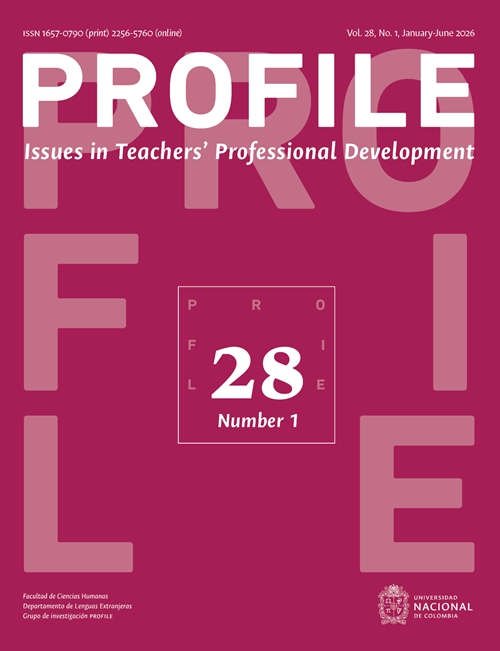
English Language Teachers’ Grit and Pronunciation Teaching Practices in a Time of Crisis
La perseverancia de los profesores de inglés y sus prácticas de enseñanza de la pronunciación en tiempos de crisis
DOI:
https://doi.org/10.15446/profile.v28n1.117864Keywords:
COVID-19 pandemic, L2 teacher cognitions, Longitudinal research, Pronunciation teaching, Student wellbeing (en)Pandemia de COVID-19, Cogniciones de profesores de L2, Investigación longitudinal, Enseñanza de la pronunciación, Bienestar estudiantil (es)
Longitudinal research contributes to the understanding of teachers’ beliefs and practices, but few such studies have examined teacher development during a time of crisis. This gap is particularly significant in pronunciation pedagogy, where research on teachers’ adaptive strategies remains limited. Building on a six-year study, this paper explores the development of second language teachers’ practices and cognitions (knowledge, beliefs, perceptions) regarding English pronunciation pedagogy during the COVID-19 pandemic. Findings demonstrate a complete initial cessation of pronunciation instruction, but its later reemergence as a priority once lockdown conditions relaxed. These findings further highlight the dynamic nature of teacher cognition in response to crises, and the need for gritty teachers and an enhanced focus on hybrid learning in second language teacher education programs.
La investigación longitudinal ayuda a comprender las creencias y prácticas docentes, pero pocos estudios han examinado el desarrollo del docente en tiempos de crisis. Este artículo, basado en un estudio de seis años, explora cómo evolucionaron las prácticas y las cogniciones de docentes de segunda lengua en la enseñanza de la pronunciación del inglés durante la pandemia de COVID-19. Los hallazgos demuestran una interrupción inicial completa de la instrucción, seguida de su reaparición tras el levantamiento de las restricciones. Se destaca la naturaleza dinámica de la cognición docente ante las crisis, así como la necesidad de contar con docentes resilientes y de integrar el aprendizaje híbrido en los programas de formación de docentes de segundas lenguas.
References
Alhusban, H. A. (2022). A novel synchronous hybrid learning method: Voices from Saudi Arabia. The Electronic Journal of e-Learning, 20(4), 400–418. https://doi.org/10.34190/ejel.20.4.2340
Asmawi, A., & Sun, L. (2023). The effects of online production-oriented approach (POA) on Chinese undergraduates’ English speaking competence development during COVID-19 pandemic era. Journal of Language Teaching and Research, 14(2), 416–424. https://doi.org/10.17507/jltr.1402.18
Azizah, N., & Aloysius, S. (2023). The effectiveness of blended learning with problem based learning-group investigation (PBL-GI) model on students’ critical thinking and problem-solving ability in senior high school. In N. A. Airyanti, K. R. Pertiwi, H. Sukoco, F. Fauzi, & P. C. Kuswandi (Eds.), AIP Conference Proceedings (Vol. 2556). AIP Publishing. https://doi.org/10.1063/5.0130783
Bailey, D. R., & Lee, A. R. (2020). Learning from experience in the midst of COVID-19: Benefits, challenges, and strategies in online teaching. Computer Assisted Language Learning Electronic Journal, 21(2), 178–198.
Baker, A. (2014). Exploring teachers’ knowledge of second language pronunciation techniques: Teacher cognitions, observed classroom practices, and student perceptions. TESOL Quarterly, 48(1), 136–163. https://doi.org/10.1002/tesq.99
Baker, A. (2021). “She’ll be right”: Development of a coaching model to clear and fluent pronunciation in Australia. English Australia Journal, 37(1), 27–39.
Bao, W. (2020). COVID‐19 and online teaching in higher education: A case study of Peking University. Human Behavior and Emerging Technologies, 2(2), 113–115. https://doi.org/10.1002/hbe2.191
Benson, V., Anderson, D., & Ooms, A. (2011). Educator’s perceptions, attitudes and practices: Blended learning in business and management education. Research in Learning Technology, 19(2), 143–154. https://doi.org/10.3402/rlt.v19i2.10353
Burri, M., & Baker, A. (2021). “I feel… slightly out of touch”: A longitudinal study of teachers learning to teach English pronunciation over a six-year period. Applied Linguistics, 42(4), 791–809. https://doi.org/10.1093/applin/amab009
Burri, M., Baker, A., & Chen, H. (2017). “I feel like having a nervous breakdown”: Pre-service and in-service teachers’ developing beliefs and knowledge about pronunciation instruction. Journal of Second Language Pronunciation, 3(1), 109–135. https://doi.org/10.1075/jslp.3.1.05bur
Capello, S. A., Gyimah-Concepcion, M., & Buckley-Hughes, B. (2022). Using telepresence robots for doctoral education: Student and faculty experiences. American Journal of Distance Education, 38(4), 374–388. https://doi.org/10.1080/08923647.2022.2125252
Couper, G. (2017). Teacher cognition of pronunciation teaching: Teachers’ concerns and issues. TESOL Quarterly, 51(4), 820–839. https://doi.org/10.1002/tesq.354
Crandall, J., & Christison, M. (Eds.). (2016). Teacher education and professional development in TESOL: Global perspectives. Routledge. https://doi.org/10.4324/9781315641263
Crawford, J., Butler-Henderson, K., Rudolph, J., Malkawi, B., Glowatz, M., Burton, R., Magni, P. A., & Lam, S. (2020). COVID-19: 20 countries’ higher education intra-period digital pedagogy responses. Journal of Applied Learning & Teaching, 3(1), 1–20. https://doi.org/10.37074/jalt.2020.3.1.7
Daniel, E., & Van Bergen, P. (2023). Teacher burnout during COVID-19: Associations with instructional self-efficacy but not emotion regulation. Teachers and Teaching, 29(3), 310–328. https://doi.org/10.1080/13540602.2023.2179615
Duckworth, A. (2016). Grit: Why passion and resilience are the secrets to success. Vermilion.
Duckworth, A. L., Peterson, C., Matthews, M. D., & Kelly, D. R. (2007). Grit: Perseverance and passion for long-term goals. Journal of Personality and Social Psychology, 92(6), 1087–1101. https://doi.org/10.1037/0022-3514.92.6.1087
Foote, J. A., Trofimovich, P., Collins, L., & Soler Urzúa, F. (2016). Pronunciation teaching practices in communicative second language classes. The Language Learning Journal, 44(2), 181–196. https://doi.org/10.1080/09571736.2013.784345
Fu, H., & Wang, J. (2021). Cultivation of critical thinking skills in college English writing under blended learning model. Creative Education, 12(7), 1485–1493. https://doi.org/10.4236/ce.2021.127113
Gao, L. X., & Zhang, L. J. (2020). Teacher learning in difficult times: Examining foreign language teachers’ cognitions about online teaching to tide over COVID-19. Frontiers in Psychology, 11, 1–14. https://doi.org/10.3389/fpsyg.2020.549653
Goh, C. C. M., & Burns, A. (2012). Teaching speaking: A holistic approach. Cambridge University Press.
Gramenz, J. (2020, September 11). TikTok, Facebook suicide video can’t be stopped by laws, expert warns. News.com.au. https://bit.ly/4jQqlNU
Gudoniene, D., Staneviciene, E., Huet, I., Dickel, J., Dieng, D., Degroote, J., Rocio, V., Butkiene, R., & Casanova, D. (2025). Hybrid teaching and learning in higher education: A systematic literature review. Sustainability, 17(2), 756. https://doi.org/10.3390/su17020756
Henderson, A., Curnick, L., Frost, D., Kautzsch, A., Kirkova-Naskova, A., Levey, D., Tergujeff, E., & Waniek-Klimczak, E. (2015). The English pronunciation teaching in Europe survey: Factors inside and outside the classroom. In J. A. Mompean & J. Fouz-González (Eds.), Investigating English pronunciation: Trends and directions (pp. 260–291). Palgrave Macmillan. https://doi.org/10.1057/9781137509437_12
Inceoglu, S. (2019). Exploring the effects of instruction on L2 French learner pronunciation, accentedness, comprehensibility, and fluency: An online classroom study. Journal of Second Language Pronunciation, 5(2), 223–246. https://doi.org/10.1075/jslp.18004.inc
Jandrić, P., Bozkurt, A., McKee, M., & Hayes, S. (2021). Teaching in the age of Covid-19: A longitudinal study. Postdigital Science and Education, 3(3), 743–770. https://doi.org/10.1007/s42438-021-00252-6
Jeffrey, L. M., Milne, J., Suddaby, G., & Higgins, A. (2014). Blended learning: How teachers balance the blend of online and classroom components. Journal of Information Technology Education: Research, 13, 121–140. https://doi.org/10.28945/1968
Karataş, T. Ö., & Tuncer, H. (2020). Sustaining language skills development of pre-service EFL teachers despite the COVID-19 interruption: A case of emergency distance education. Sustainability, 12(19), 8188. https://doi.org/10.3390/su12198188
Kim, L. E., Bowling, A., & Asbury, K. (2024). ‘I had forgotten what it was like to feel like you’re doing a good job’: A longitudinal thematic analysis of teachers’ experiences during the COVID-19 pandemic. Cambridge Journal of Education, 54(2), 199–220. https://doi.org/10.1080/0305764X.2024.2336138
Kochem, T. (2022). Exploring the connection between teacher training and teacher cognitions related to L2 pronunciation instruction. TESOL Quarterly, 56(4), 1136–1162. https://doi.org/10.1002/tesq.3095
Lee, J., Jang, J., & Plonsky, L. (2015). The effectiveness of second language pronunciation instruction: A meta-analysis. Applied Linguistics, 36(3), 345–366. https://doi.org/10.1093/applin/amu040
Levis, J. M. (2025). Key issues in L2 pronunciation research: A look back at 10 years of JSLP. Journal of Second Language Pronunciation, 10(3), 293–308. https://doi.org/10.1075/jslp.25009.lev
Majed, N., Ara, A., & Chowdhury, S. R. (2024). Meeting the challenges of online education during Covid-19 pandemic: Implications for blended learning. Shanlax International Journal of Education, 12(2), 20–31. https://doi.org/10.34293/education.v12i2.6837
Martin, I. A. (2020). Pronunciation can be acquired outside the classroom: Design and assessment of homework‐based training. The Modern Language Journal, 104(2), 457–479. https://doi.org/10.1111/modl.12638
Meirovitz, T., Russak, S., & Zur, A. (2022). English as a foreign language teachers’ perceptions regarding their pedagogical-technological knowledge and its implementation in distance learning during COVID-19. Heliyon, 8(4), e09175. https://doi.org/10.1016/j.heliyon.2022.e09175
Meritan, C. (2022). Integrating online pronunciation instruction: The case of learners of French. Foreign Language Annals, 55(3), 877–893. https://doi.org/10.1111/flan.12646
Moser, K., & Wei, T. (2021). COVID-19 and the pre-existing language teacher supply crisis. Language Teaching Research, 28(5), 1940–1975. https://doi.org/10.1177/13621688211040297
Murphy, J. (2014). Teacher training programs provide adequate preparation in how to teach pronunciation. In L. Grant (Ed.), Pronunciation myths: Applying second language research to classroom teaching (pp. 188–234). The University of Michigan Press.
Namaziandost, E., Heydarnejad, T., & Saeedian, A. (2022). Language teacher professional identity: The mediator role of L2 grit, critical thinking, resilience, and self-efficacy beliefs. Iranian Journal of Applied Language Studies, 14(2), 107–130. https://doi.org/10.22111/ijals.2022.7486
Orygen. (2020). International students and their mental health and physical safety. https://bit.ly/4iKGByl
Panisoara, I. O., Lazar, I., Panisoara, G., Chirca, R., & Ursu, A. S. (2020). Motivation and continuance intention towards online instruction among teachers during the COVID-19 pandemic: The mediating effect of burnout and technostress. International Journal of Environmental Research and Public Health, 17(21), 8002. https://doi.org/10.3390/ijerph17218002
Popa, D., Repanovici, A., Lupu, D., Norel, M., & Coman, C. (2020). Using mixed methods to understand teaching and learning in COVID 19 times. Sustainability, 12(20), 8726. https://doi.org/10.3390/su12208726
Saito, K., & Plonsky, L. (2019). Effects of second language pronunciation teaching revisited: A proposed measurement framework and meta-analysis. Language Learning, 69(3), 652–708. https://doi.org/10.1111/lang.12345
Shevchenko, V., Malysh, N., & Tkachuk-Miroshnychenko, O. (2024). Distance learning in Ukraine in COVID-19 emergency. Open Learning: The Journal of Open, Distance and e-Learning, 39(1), 4–19. https://doi.org/10.1080/02680513.2021.1967115
Sudina, E., Vernon, T., Foster, H., Del Villano, H., Hernandez, S., Beck, D., & Plonsky, L. (2021). Development and initial validation of the L2-teacher grit scale. TESOL Quarterly, 55(1), 156–184. https://doi.org/https://doi.org/10.1002/tesq.581
Tan, C. Y., Jang, S. T., Lam, S. M., An, A. Q., & Lo, U. K. V. (2025). Teaching and learning challenges due to the COVID-19 pandemic: A systematic review. Educational Research Review, 47, 100667. https://doi.org/https://doi.org/10.1016/j.edurev.2025.100667
Thompson, A. (2020, August 12). Silence and other suggestions, for a Kiama community grappling with suicide. Illawarra Mercury. https://bit.ly/3EI1XyH
Zhao, Y., & Watterston, J. (2021). The changes we need: Education post COVID-19. Journal of Educational Change, 22(1), 3–12. https://doi.org/10.1007/s10833-021-09417-3
Dimensions
PlumX
Article abstract page views
Downloads
How to Cite
License
Copyright (c) 2026 Amanda Baker, Michael Burri, & Bianca Mister

This work is licensed under a Creative Commons Attribution-NonCommercial-NoDerivatives 4.0 International License.
You are authorized to copy and redistribute the material in any medium or format as long as you give appropriate credit to the authors of the articles and to Profile: Issues in Teachers' Professional Development as original source of publication. The use of the material for commercial purposes is not allowed. If you remix, transform, or build upon the material, you may not distribute the modified material.
Authors retain the intellectual property of their manuscripts with the following restriction: first publication is granted to Profile: Issues in Teachers' Professional Development.