Published
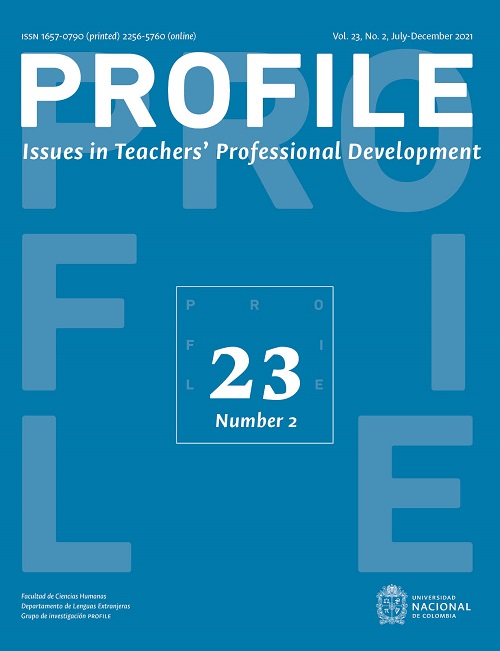
Configuration of Racial Identities of Learners of English
Configuración de identidades raciales de aprendientes de inglés
DOI:
https://doi.org/10.15446/profile.v23n2.90374Keywords:
English language learning, English language learners, race, racial identity (en)aprendientes de inglés, aprendizaje del inglés, identidad racial, raza (es)
Racial identity, as well as other social identities, is intrinsically related to language learning. Nevertheless, this relationship has been taken for granted. Despite research done in the area, not a lot has centred explicitly on finding the connections between race and language learning. This article addresses that point in an attempt to shed light specifically on English language learning and teaching. We used a qualitative research methodology to analyse oral and written narratives that were produced by participants telling their experience as English language learners. This article underscores the results that relate language learners’ racial experiences as a crucial factor in the configuration of their identity as well as the economic, social, and cultural factors involved.
La identidad racial, como otras categorías sociales, está intrínsecamente relacionada con el aprendizaje de idiomas. Sin embargo, esta relación se ha dado por sentado. A pesar de las investigaciones realizadas, no mucho se ha centrado explícitamente en encontrar conexiones entre la raza y el aprendizaje de idiomas. Este artículo aborda ese punto en un intento por iluminar el aprendizaje y la enseñanza del idioma inglés. Se utilizó una metodología de investigación cualitativa para analizar las narraciones orales y escritas, producidas por participantes aprendices de inglés, sobre su experiencia. Este artículo resalta los resultados que relacionan las experiencias raciales de los estudiantes con los idiomas como un factor crucial en la configuración de su identidad, así como los factores económicos, sociales y culturales involucrados.
References
Agudelo, J. J. (2007). An intercultural approach for language teaching: Developing critical cultural awareness. Íkala, Revista de Lenguaje y Cultura, 12(1), 185–217.
Alexander, C., & Knowles, C. (Eds.). (2005). Making race matter: Bodies, space and identity. Palgrave Macmillan.
Banton, M. (2002). Racial theories (2nd ed.). Cambridge University Press.
Bernasconi, R. (Ed.). (2001). Race. Blackwell Publishers.
Bonilla-Medina, S. X. (2018). Racial identity in educational practices in the context of Colombia [Unpublished doctoral dissertation]. University of East London, London, UK.
Bonnett, A. (2000). White identities: Historical and international perspectives. Prentice Hall.
Bourdieu, P. (1986). Forms of capital. In J. Richardson (Ed.), Handbook of theory and research for the sociology of education (pp. 241–258). Greenwood Press.
Carbado, D. W., & Gulati, M. (2003). The law and economics of critical race theory [Review of the book Crossroads, directions, and a new critical race theory by F. Valdes, J. McCristal-Culp, & A. P. Harris]. The Yale Law Journal, 112(7), 1787–1828. https://doi.org/10.2307/3657500
Castro-Gómez, S. (2000). Ciencias sociales, violencia epistémica y el problema de la “invención del otro” [Social sciences, epistemic violence and the problem of the “invention of the other”]. In E. Lander (Ed.), La colonialidad del saber: eurocentrismo y ciencias sociales. Perspectivas latinoamericanas (pp. 145–163). CLACSO.
Chadderton, C. (2009). Discourses of Britishness, race and difference: Minority ethnic students’ shifting perceptions of their school experience [Unpublished doctoral dissertation). The Manchester Metropolitan University, Manchester, UK.
Charles, Q. D. (2019). Black teachers of English in South Korea: Constructing identities as a native English speaker and English language teaching professional. TESOL Journal, 10(4). https://doi.org/10.1002/tesj.478
Clarke, S., & Garner, S. (2009). White identities: A critical sociological approach. Pluto Press.
Clavijo, A. (2017). Voces invisibles de las minorías indígenas en Colombia bilingüe [Invisible voices of indigenous minorities in bilingual Colombia]. In E. Mateus & J. Reichert Assunção Tonelli (Eds.), Diálogos (im)pertinentes entre formação de professores e aprendizagem de línguas. Blucher. https://doi.org/10.5151/9788580392708-08
Davies, B., & Harré, R. (1990). Positioning: The discursive production of selves. Journal for the Theory of Social Behaviour, 20(1), 43–63. https://doi.org/10.1111/j.1468-5914.1990.tb00174.x
De Fina, A., & Georgakopoulou, A. (2012). Analyzing narrative: Discourse and sociolinguistic perspectives. Cambridge University Press. https://doi.org/10.1017/CBO9781139051255
DeCuir, J. T., & Dixson, A. D. (2004). “So, when it comes out, they aren’t that surprised that it is there”: Using critical race theory as a tool of analysis of race and racism in education. Educational Researcher, 33(5), 26–31. https://doi.org/10.3102/0013189X033005026
Delgado, R., & Stefancic, J. (Eds.). (2000). Critical race theory: The cutting edge. Temple University Press.
Delgado, R., & Stefancic, J. (2001). Critical race theory: An introduction (1st ed.). New York University Press. https://doi.org/10.1093/acref/9780195301731.013.51089
Du Bois, W. E. B. (2001). The conservations of races. In R. Bernasconi (Ed.), Race (pp. 84–92). Blackwell Publishers.
Gillborn, D. (2006). Citizenship education as placebo “standards”, institutional racism and education policy. Education, Citizenship and Social Justice, 1(1), 83–104. https://doi.org/10.1177/1746197906060715
Gillborn, D. (2010). Reform, racism and the centrality of whiteness: Assessment, ability and the “new eugenics”. Irish Educational Studies, 29(3), 231–252. https://doi.org/10.1080/03323315.2010.498280
Granados-Beltrán, C. (2016). Critical interculturality: A path for pre-service ELT teachers. Íkala, Revista de Lenguaje y Cultura, 21(2), 169–185. https://doi.org/10.17533/udea.ikala.v21n02a04
Harré, R., Moghaddam, F. M., Cairnie, T. P., Rothbart, D., & Sabat, S. R. (2009). Recent advances in positioning theory. Theory & Psychology, 19(1), 5–31. https://doi.org/10.1177/0959354308101417
King, J. E. (1991). Dysconscious racism: Ideology, identity, and the miseducation of teachers. The Journal of Negro Education, 60(2), 133–146. https://doi.org/10.2307/2295605
Koopman, S. (2012). “Mona, mona, mona!” Whiteness, tropicality, and international accompaniment in Colombia [Paper presentation]. SFU/UBC Latin American Studies Working Paper Series, Vancouver, Canada. http://summit.sfu.ca/item/10695
Ladson-Billings, G., & Tate, W. F. (Eds.). (2006). Education research in the public interest: Social justice, action, and policy. Teachers College Press.
Leonardo, Z. (2002). The souls of white folk: Critical pedagogy, whiteness studies, and globalization discourse. Race, Ethnicity and Education, 5(1), 29–50. https://doi.org/10.1080/13613320120117180
Leung, C., Harris, R., & Rampton, B. (1997). The idealised native speaker, reified ethnicities, and classroom realities. TESOL Quarterly, 31(3), 543–560. https://doi.org/10.2307/3587837
Lott, T. (2001). Du Bois’s anthropological notion of race. In R. Bernasconi (Ed.), Race (pp. 59–83). Blackwell Publishers.
Mamani, C. (2020, June 11). Racismo estructural, (¿susceptibilidad, veracidad o qué?) [Structural racism: Susceptibility, veracity or what?]. LATFEM. https://bit.ly/3ptic5t
McIntosh, P. (2004). White privilege: Unpacking the invisible knapsack. Race, Class, and Gender in the United States, 6, 188–192.
Mignolo, W. (2000). La colonialidad a lo largo y a lo ancho: el hemisferio occidental en el horizonte colonial de la modernidad [Coloniality far and wide: The Western hemisphere on the colonial horizon of modernity]. In E. Lander (Ed.), La colonialidad del saber: eurocentrismo y ciencias sociales. Perspectivas latinoamericanas (pp. 55–86). CLACSO.
Mignolo, W. (2005). Cambiando las éticas y las políticas del conocimiento: lógica de la colonialidad y postcolonialidad imperial [Changing the ethics and politics of knowledge: logic of coloniality and imperial postcoloniality]. Tabula Rasa, 3, 47–72. https://doi.org/10.25058/20112742.228
Norton, B. (1997). Language, identity and the ownership of English. TESOL Quarterly, 31(3), 409–429. https://doi.org/10.2307/3587831
Norton, B. (2013). Identity and language learning: Extending the conversation. Multilingual Matters. https://doi.org/10.21832/9781783090563
Runge-Peña, A. K., & Muñoz-Gaviria, D. A. (2005). El evolucionismo social, los problemas de la raza y la educación en Colombia, primera mitad del siglo XX: el cuerpo en las estrategias eugenésicas de línea dura y de línea blanda [Social evolutionism, race problems, and education in Colombia, first half of the 20th century: The body in soft and hard line eugenic strategies]. Revista Iberoamericana de Educación, (39), 127–168. https://doi.org/10.35362/rie390808
Said, E. W. (1976). Orientalism. Penguin Books.
Solorzano, D. G., & Yosso, T. J. (2001). Maintaining social justice hopes within academic realities: A Freirean approach to critical race/LatCrit pedagogy. Denver University Law Review, 78(4), 595–621.
Somers, M. R. (1994). The narrative constitution of identity: A relational and network approach. Theory and Society, 23(5), 605–649. https://doi.org/10.1007/BF00992905
Spector-Mersel, G. (2010). Narrative research: Time for a paradigm. Narrative Inquiry, 20(1), 204–224. https://doi.org/10.1075/ni.20.1.10spe
Spivak, G. C. (1988). Can the subaltern speak? In R. Morris (Ed.), Can the subaltern speak? Reflections on the history of an idea (pp. 1–21). Columbia University Press.
Telles, E., & Flores, R. (2013). Not just color: Whiteness, nation, and status in Latin America. Hispanic American Historical Review, 93(3), 411–449. https://doi.org/10.1215/00182168-2210858
Thesen, L. (1997). Voices, discourse and transition: In search of new categories in EAP. TESOL Quarterly, 31(3), 487–511. https://doi.org/10.2307/3587835
Usma, J., Ortiz, J., & Gutierrez, C. (2018). Indigenous students learning English in higher education: Challenges and hopes. Íkala, Revista de Lenguaje y Cultura, 23(2), 229–254. https://doi.org/10.17533/udea.ikala.v23n02a03
Vela, J. (2012, June 16). Racismo, clasismo, servilismo y discriminación social en Colombia [Racism, classism, servility and social discrimination in Colombia]. El Bogotano.
Wade, P. (1995). Blackness and race mixture: The dynamics of racial identity in Colombia. Johns Hopkins University Press.
Yosso, T. J. (2005). Whose culture has capital? A critical race theory discussion of community cultural wealth. Race Ethnicity and Education, 8(1), 69–91. https://doi.org/10.1080/1361332052000341006
Zentella, A. C. (1995). La hispanofobia del movimiento “inglés oficial” en los Estados Unidos por la oficialización del inglés [The hispanophobia of the “official English” movement in the United States for the officialization of English]. Alteridades, 5(10), 55–65.
Dimensions
PlumX
Article abstract page views
Downloads
How to Cite
License
Copyright (c) 2021 Sandra Ximena Bonilla-Medina, Karen Vanessa Varela, Katherine García

This work is licensed under a Creative Commons Attribution-NonCommercial-NoDerivatives 4.0 International License.
You are authorized to copy and redistribute the material in any medium or format as long as you give appropriate credit to the authors of the articles and to Profile: Issues in Teachers' Professional Development as original source of publication. The use of the material for commercial purposes is not allowed. If you remix, transform, or build upon the material, you may not distribute the modified material.
Authors retain the intellectual property of their manuscripts with the following restriction: first publication is granted to Profile: Issues in Teachers' Professional Development.