 Correo Electrónico
 DNINFOA - SIA
 Bibliotecas
 Convocatorias
 Identidad U.N.


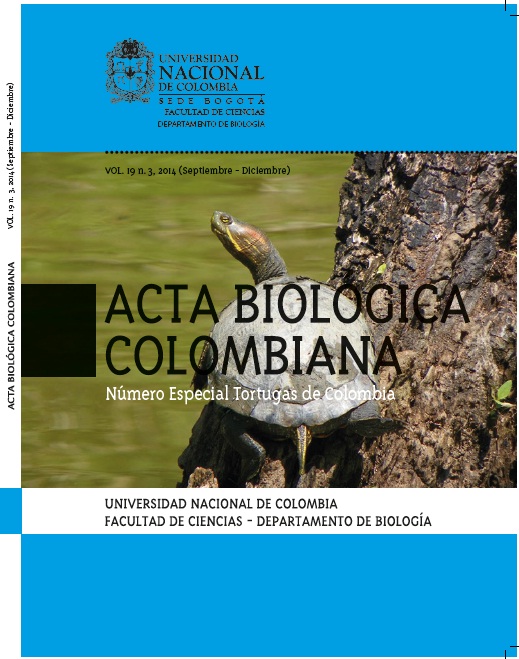
Publicado
Reproduction and conservation of the Magdalena river turtle (Podocnemis lewyana) in the claro Corcorná Sur river, Colombia
Reproducción y Esfuerzos de Conservación de la Tortuga del Río Magdalena (Podocnemis lewyana, Podocnemididae) en el Río Claro Cocorná Sur, Antioquia, Colombia.
DOI:
https://doi.org/10.15446/abc.v19n3.41366Palabras clave:
growth, incubation temperatures, nesting. (en)anidación, crecimiento, temperaturas de incubación. (es)
Descargas
The Magdalena River Turtle, Podocnemis lewyana, is an endangered and endemic turtle from Colombia. Among the most important information needed to conserve endangered species is to identify, monitor, and protect the sites used by the species to reproduce and grow. In this study we report, for the first time, the reproductive output and the nesting beaches of P. lewyana in the Claro Cocorná Sur River, a tributary of the Magdalena River drainage. We systematically examined a river transect of 8 km with 14 sandy beaches during two nesting seasons in one year. We recorded a yearly production of 47 clutches, 957 eggs, and two preferred nesting beaches: Alto Bonito with 51 %, and Bélgica with 28.3 % of this reproductive output. AAFUVER, a community-based organization, has led a headstarting program since 2010 to decrease in-situ egg mortality due to predation on nesting beaches. AAFUVER collects and incubates the eggs ex-situ, raises the hatchlings for one to five months and then releases them into the same river. To understand potential effects of such egg manipulation, we monitored and compared in-situ and ex-situ incubation temperatures. We found exsitu temperatures below the pivotal temperature known for P. lewyana and below the temperatures in nesting beaches. Finally, we monitored hatchlings growth under AAFUVER captive conditions, and found that hatchlings duplicated their body mass during the first three months of age. Egg weight was strongly associated to body weight at hatching, however this association is lost by the third month of age. We strongly encourage supporting this community-based conservation program, and the protection of the Claro Cocorná Sur River as an important nesting and growth habitat for the conservation of P. lewyana.
La tortuga del Río Magdalena, Podocnemis lewyana, es una tortuga categorizada como amenazada y además endémica colombiana. Dentro de la información más necesaria para entender el estado de conservación de estas especies está el identificar, monitorear y proteger sus sitios de reproducción y crecimiento. En este estudio se reporta, por primera vez, el potencial reproductivo y las principales playas de anidación de P. lewyana en el río Claro Cocorná Sur, un tributario del río Magdalena. Un trayecto de 8 km del río que albergaba 14 playas arenosas fueron monitoreados sistemáticamente durante dos estaciones de anidación en un año. Durante este tiempo se registraron 47 nidos, 957 huevos y dos playas de mayor anidación: Alto Bonito con el 51 %, y Bélgica con el 28,3 % de dicha producción anual. AAFUVER, una organización de la comunidad local, ha liderado un programa de reforzamiento poblacional para disminuir la mortalidad de los huevos incubados in-situ. AAFUVER colecta e incuba los huevos ex-situ, cría los neonatos durante uno a cinco meses, y los libera en el río de origen. Para entender los efectos potenciales de esta manipulación de los huevos las temperaturas de incubación in-situ y exsitu fueron monitoreadas y comparadas. Se encontró que las temperaturas ex-situ son inferiores a la temperatura pivotal de P. lewyana y a las temperaturas en las playas de anidación. Finalmente, se reporta el crecimiento corporal de los tortuguillos dadas las condiciones de cautiverio de AAFUVER. Se encontró una fuerte asociación entre el peso del huevo y el peso de los neonatos a los siete días de edad, sin embargo esta asociación se perdió a los tres meses de edad. Nosotros enfatizamos en la importancia de apoyar este programa de conservación liderado por la comunidad local, y la protección del Río Claro Cocorná Sur como un hábitat importante de anidación y crecimiento de P. lewyana
Artículo de investigación
REPRODUCTION AND CONSERVATION OF THE MAGDALENA RIVER TURTLE (Podocnemis lewyana) IN THE CLAROCOCORNÁ SUR RIVER, COLOMBIA
Reproducción y conservación de la tortuga del Río Magdalena (Podocnemis lewyana) en el Río Claro Cocorná Sur, Colombia
CLAUDIA P. CEBALLOS1, Ph.D.; ISABEL ROMERO2, Bachiller; CATALINA GÓMEZ-SALDARRIAGA1, M.V.; KARLA MIRANDA3, M.V.
1 Grupo Centauro, Escuela de Medicina Veterinaria, Facultad de Ciencias Agrarias, Universidad de Antioquia UdeA, Carrera 75 No. 65-87, Medellín, Colombia. claudiaceb@gmail.com; cgsaldarriaga@gmail.com
2 Asociación Ambientalista Futuro Verde, AAFUVER, carrera 12 N#º 12-04, Corregimiento Estación Cocorná, Puerto Triunfo, Antioquia, Colombia. irgded@hotmail.com
3 Carrera 75 n#º 65-87, Facultad de Ciencias Agrarias, Universidad de Antioquia UdeA, Medellín, Colombia.
Author for correspondence: Claudia Ceballos, claudiaceb@gmail.com
Received 28th december 2013, first decision 6th may 2014, accepted 10th may 2014.
Citation / Citar este artículo como: CEBALLOS CP, ROMERO I, GÓMEZ-SALDARRIAGA C, MIRANDA K. Reproduction and conservation of the magdalena River turtle (Podocnemis lewyana) in the Claro Cocorná sur River, Colombia. Acta Biol. Colomb. 2014;19(3):393-400.
ABSTRACT
The Magdalena River Turtle, Podocnemis lewyana, is an endangered and endemic turtle from Colombia. Among the most important information needed to conserve endangered species is to identify, monitor, and protect the sites used by the species to reproduce and grow. In this study we report, for the first time, the reproductive output and the nesting beaches of P. lewyana in the Claro Cocorná Sur River, a tributary of the Magdalena River drainage. We systematically examined a river transect of 8 km with 14 sandy beaches during two nesting seasons in one year. We recorded a yearly production of 47 clutches, 957 eggs, and two preferred nesting beaches: Alto Bonito with 51 %, and Bélgica with 28.3 % of this reproductive output. AAFUVER, a community-based organization, has led a headstarting program since 2010 to decrease in-situ egg mortality due to predation on nesting beaches. AAFUVER collects and incubates the eggs ex-situ, raises the hatchlings for one to five months and then releases them into the same river. To understand potential effects of such egg manipulation, we monitored and compared in-situ and ex-situ incubation temperatures. We found ex-situ temperatures below the pivotal temperature known for P. lewyana and below the temperatures in nesting beaches. Finally, we monitored hatchlings growth under AAFUVER captive conditions, and found that hatchlings duplicated their body mass during the first three months of age. Egg weight was strongly associated to body weight at hatching, however this association is lost by the third month of age. We strongly encourage supporting this community-based conservation program, and the protection of the Claro Cocorná Sur River as an important nesting and growth habitat for the conservation of P. lewyana.
Keywords: growth, incubation temperatures, nesting.
RESUMEN
La tortuga del Río Magdalena, Podocnemis lewyana, es una tortuga categorizada como amenazada y además endémica colombiana. Dentro de la información más necesaria para entender el estado de conservación de estas especies está el identificar, monitorear y proteger sus sitios de reproducción y crecimiento. En este estudio se reporta, por primera vez, el potencial reproductivo y las principales playas de anidación de P. lewyana en el río Claro Cocorná Sur, un tributario del río Magdalena. Un trayecto de 8 km del río que albergaba 14 playas arenosas fueron monitoreados sistemáticamente durante dos estaciones de anidación en un año. Durante este tiempo se registraron 47 nidos, 957 huevos y dos playas de mayor anidación: Alto Bonito con el 51 %, y Bélgica con el 28,3 % de dicha producción anual. AAFUVER, una organización de la comunidad local, ha liderado un programa de reforzamiento poblacional para disminuir la mortalidad de los huevos incubados in-situ. AAFUVER colecta e incuba los huevos ex-situ, cría los neonatos durante uno a cinco meses, y los libera en el río de origen. Para entender los efectos potenciales de esta manipulación de los huevos las temperaturas de incubación in-situ y ex-situ fueron monitoreadas y comparadas. Se encontró que las temperaturas ex-situ son inferiores a la temperatura pivotal de P. lewyana y a las temperaturas en las playas de anidación. Finalmente, se reporta el crecimiento corporal de los tortuguillos dadas las condiciones de cautiverio de AAFUVER. Se encontró una fuerte asociación entre el peso del huevo y el peso de los neonatos a los siete días de edad, sin embargo esta asociación se perdió a los tres meses de edad. Nosotros enfatizamos en la importancia de apoyar este programa de conservación liderado por la comunidad local, y la protección del Río Claro Cocorná Sur como un hábitat importante de anidación y crecimiento de P. lewyana.
Palabras clave: anidación, crecimiento, temperaturas de incubación.
INTRODUCTION
The Magdalena River Turtle (Podocnemis lewyana) is an endemic turtle of the Magdalena, Sinú and San Jorge rivers and their tributaries in Colombia. In addition to its restricted distribution, this species faces high mortality of eggs and adults due to animal and human predation and habitat alteration associated with artificial manipulations of rivers by hydroelectric dams, river beach mining and forest destruction to grow pasture for cattle (Vargas-Ramírez et al., 2007; Gallego-García and Castaño-Mora, 2008; Páez et al., 2012). These threats have driven this species to be categorized as Endangered at the national and international level (Tortoise and Freshwater Turtle Specialist Group, 1996; Castaño-Mora, 2002). Other authors however consider its conservation status is even worse, and have suggested listing it as Critically Endangered. The species P. lewyana has been reviewed recently (Páez et al., 2009b, Páez et al., 2012) and of particular interest for conservation actions are those studies providing information on the status of natural populations throughout its distributional range for conservation actions. During the last decade several researchers have studied the reproductive ecology and conservation status of populations of P. lewyana in different rivers across its range. For example, a population of P. lewyana inhabiting the Prado River in Tolima, a tributary of the Magdalena River was monitored as part of an initiative to create a community-based conservation program (Vargas-Ramírez et al., 2007). As part of this program nesting beaches were monitored for two months in 2007, but in spite of their search efforts the authors were able to locate only two nests, perhaps due to the lack of native guides trained to find nests (Vargas-Ramírez et al., 2007). The following year the Sinú River was monitored in search of nesting beaches and individuals to estimate the species home range and population structure (Gallego-García and Castaño-Mora, 2008). Five nesting beaches were reported in the mid and low basin of the Sinú River. Though nesting reports were based on anecdotal information, and in spite of the high egg predation by fishermen, authors were able to locate two clutches and report their size and egg morphometry. At the same time, the distribution and abundance of P. lewyana in the Magdalena River drainage was also studied (Restrepo et al., 2008). Out of the 18 different sites that were visited by the authors, the Chicagua River was found to be the most important for the species, and was classified as exhibiting a high abundance of turtles. Four more sites were reported exhibiting an intermediate abundance, and 13 other sites a low abundance. Among these sites, the Cocorná River was also visited and the authors confirmed the turtle's presence by means of carcasses of depredated turtles, but no live animals were observed. Using anecdotal information from locals the turtle abundance was classified as low (Restrepo et al., 2008, Páez et al., 2009b).
Currently there is a community-based program for the conservation of P. lewyana in the Claro Cocorná Sur River, a program led by the non-governmental organization Asociación Ambientalista Futuro Verde (AAFUVER). This program started in 2010 and works in the lower reaches of the Claro Cocorná Sur River, specifically in the river segment between the municipalities of Puerto Nare and Puerto Triunfo, Department of Antioquia (Romero, 2011). Sponsored by the local authorities, this program has included training of the AAFUVER members on fieldwork techniques, and the implementation of a conservation center in the town of Estación Cocorná. The project has now moved on to monitor the nesting activity of P. lewyana of neighboring river beaches. Because egg mortality in the river beaches is high due to human and animal predation and river flooding, AAFUVER built a small incubation room to incubate eggs ex-situ. After hatching the neonates are maintained in an outdoor pool for one to five months until they are released in wetlands of the same river (Romero, 2011). This headstarting program is expected to increase egg survival and in this way to contribute to the conservation of the local population at this site as has been shown in the congeneric Podocnemis expansa (Hernández and Espin, 2006). Data from this monitoring during the last two years have been collected in spite of economic and logistic difficulties; they have not been analyzed previously and thus are included in this study. The present study had three objectives. First, we quantified the reproductive output of P. lewyana at this site by carrying out a systematic monitoring of nesting activity during one year. This data is complemented with unpublished data previously collected by AAFUVER. We specifically recorded the number of nests per beach, clutch size, and egg morphometry. To understand how reproduction varies across space and time we compared our findings across nesting beaches and seasons. Second, given the effects of incubation temperature on sex, size, and growth of neonates (Páez et al., 2009a) we compared the incubation temperatures in-situ in river beaches with the ex-situ temperatures at the AAFUVER incubation room. Finally, we estimated hatchlings body growth given maternal effects and the captive conditions during the first three months at the AAFUVER station before being released into the river.
MATERIALS AND METHODS
Study area
This study was carried out in the lowland of the Claro Cocorná Sur River that runs by the town of Estación Cocorná (6°2'8"N, 74°38'20''W) in the municipality of Puerto Triunfo, Department of Antioquia, Colombia. We monitored 14 sand beaches during two nesting seasons: from 10 December 2012 to 12 January 2013 (herein called the "December season"), and from 13 June to 19 July 2013 ("June season"). These beaches were chosen because AAFUVER had reported them as the main nesting sites of P. lewyana in this transect of the river (Romero, 2011).
Egg collection
Boat trips were made every morning starting at approximately 5:00 h. All beaches were inspected for fresh turtle tracks left on the sand the night before with the guidance of AAFUVER members native to this region. Once a nest was found, eggs were recovered with special care to avoid egg rotation and transported to the incubation room within 1-6 hours of collection. Eggs were marked with a pencil to individually identify them, weighed (g), and length and width measured (mm). Most of the clutches from the December season, plus all clutches from the June season were incubated following the AAFUVER protocol as part of their headstarting program. Ten clutches from the December season were incubated as part of another study published elsewhere.
Nest location and incubation temperatures
All natural nests on river beaches were characterized in terms of their depth and relative location with respect to the water and vegetation. This is particularly important because this river is highly dynamic and nesting beaches can be flooded after a strong rain. Likewise, to compare the incubation temperatures in-situ (in the natural nests in the river nesting beaches) and ex-situ (in the incubation room at AAFUVER center) we recorded temperatures in both locations. In-situ incubation temperatures were recorded by inserting packs of three HOBO dataloggers within a zip-lock bag. To facilitate its location, the bag was tied with a rope to the trunk of a nearby plant, or to a wooden stick buried in the sand. Dataloggers were set to record the temperature every one hour and were left buried for 60 days. We buried dataloggers in16 emptied nests at four different beaches: Alto Bonito (n = 8), Bélgica (n = 4), Normandía (n = 3), and Costa Rica (n = 1). Ex-situ incubation temperatures were recorded by inserting one datalogger in ten different incubation containers, each with a different clutch. These clutches came from the same beaches: Alto Bonito (n = 6), Bélgica (n = 3) and Normandía (n = 1). The incubation protocol was the same used regularly by AAFUVER as described below.
AAFUVER headstarting program
Podocnemis lewyana nests two times during the year in this region: near the middle and at the end of the year. AAFUVER has been slowly improving their protocol since they started in 2010. Specifically, they have monitored the nesting activity during these seasons: December 2010, June 2011, December 2011, and June 2012. Monitoring results from December 2012 and June 2013 were a joint effort with AAFUVER. Because foxes and humans heavily depredate turtle eggs when they are left in-situ in the nesting river beaches, all eggs were transported and incubated at the AAFUVER station.
The incubation room (2 x 3 m) is equipped with shelves, where eggs are incubated in plastic containers fully buried in river sand collected from where the nest was collected. The room temperature varies with natural day and night cycles and additional heat is provided by a light bulb for the entire room. The containers are covered with plastic tied with rubber to maintain humidity. After hatching, neonates are left within the incubation containers a few more days until they completely emerge from the eggshell and the remaining yolk is internalized. Afterwards, hatchlings are moved to an outdoor pool for one to five months. The pool is made of cement, 3 m long x 2 m wide x 1 m deep, with 40 cm of water column, and is provided with a continuous river water (dechlorinated) flow-through system. To avoid bird predation, the pool is covered with a polyethylene mesh. Live "buchón de agua" (Eichornia crassipens) are provided to serve as perches and hiding places for hatchlings. In addition, turtles are fed daily with "dinder" or "árbol de mora"(Chlorophora tinctoria), "lenteja de agua" (Lemma minor), and "plátano topocho" (Musa paradisiaca). To monitor the effect of these captivity conditions, we recorded the body growth of hatchlings before being released. The neonates hatched between 3 February and 7 March 2013, and they were weighed at 7 days and 3 to 3.5 months of age. To monitor individual growth, hatchlings were tagged by attaching colored beads to the marginal scutes of their carapace (Galbraith and Brooks, 1984), a technique that has been useful in monitoring individual growth in captive young turtles for several months (Ceballos y Valenzuela, 2011).
RESULTS Nesting beaches
A total of 47 clutches of Podocnemis lewyana were recorded along the Claro Cocorná Sur River in one year. Of this total, 21 clutches were laid during the December 2012 season and 26 nests during the June 2013 season. We missed egg collection from nine nests at the beginning of the June season, and thus we were able to record clutch size in only 17 nests. Including clutches with size data in both seasons (n = 38), we estimated a yearly production of 957 eggs at this site (Table 1). Out of the 14 river beaches that we monitored in a transect of 8 km of this river, we observed that turtles nested on only seven beaches, and of these, turtles heavily used two beaches. The main nesting site was Alto Bonito beach, with a yearly production of 24 clutches containing 488 eggs (51 %). The second main nesting site was Bélgica beach with 13 clutches containing 271 eggs (28.3 %) (Fig. 1). Linear length of nesting beaches varied from approximately 170 to 1.312 m. Nesting beaches were highly dynamic, with a new beach, Buenos Aires, that appeared towards the end of the December season.


The distance of clutches respect to the water and vegetation was measured and we found that clutches (n = 17) were laid closer to the vegetation than to the river water during the June season. Clutches were 25.4 m on average away from the vegetation (range 6.8 to 60 m) and 54.2 m on average from the river (range 15 to 96 m). Nest depth was also recorded during the June season. On average, nests were 16.8 cm deep with a wide variability that ranged from 13 to 27 cm deep. Clutch size was also highly variable during the June season, ranging from 15 to 30 eggs, however we found no relationship between nest depth and clutch size (p = 0.4272, n = 17). We suspect that nest width may have correlated with clutch size; however we did not measure nest width and cannot confirm this idea.
Number of clutches and clutch size variability by season
Counting both nesting seasons, and excluding the nine clutches that we missed in June, we found average clutch size was 21.6 eggs (n = 38), egg weight was 26.3 g, and egg size was 42.4 x 32.5 mm (Table 2).

To better understand the reproductive cycle of P. lewyana, we tested for a difference between the two nesting seasons in terms of clutch size and egg size. In absolute numbers, the number of clutches and the number of eggs per clutch were higher in the middle of the year, the June season; nevertheless we found no statistical difference between the number of eggs laid each season (p = 0.411). Interestingly however, eggs laid at the end of the year were heavier (p< 0.0001) and wider (p< 0.0001) than eggs laid in the middle of the year (Table 1). Egg morphometry has not been recorded in previous seasons, thus we do not know if these differences are consistent through time.
Incubation temperatures
Out of the 16 packs of dataloggers buried in four nesting beaches for two months, we recovered the dataloggers in only seven sites (empty nests): three in Normandia, three in Bélgica and one in Costa Rica. Unfortunately we lost all dataloggers buried in Alto Bonito beach, and because the ropes used to fix them to nearby trees were found sharply cut, we suspect they were stolen. Average sand temperatures were as follows: Normandia: 34.1°C (st. dev. = 4.2°C), Bélgica: 32.8°C (st. dev. = 2.5°C), Costa Rica: 33.7°C (st. dev. = 2.0°C). On the other hand, the temperatures maintained by AAFUVER in their incubation room were lower (average = 31.81°C) and less variable (st. dev. = 1.83°C) than those of natural beaches.
Hatchlings growth
We followed individual body growth of a sample of hatchlings. Their egg weight was 27.2 g (st. dev. = 3.5, n = 175). Body weight at seven days of age was lower, averaging 20.1 g (st. dev. = 2.6, n = 175), but at three months of age their body weight doubled, averaging 40.6 g (st. dev. = 7.8, n = 159). We observed a positive relationship between egg weight and hatchling body weight (p<0.0001, R2 = 0.78). Nevertheless, three months later, this relationship was diluted as its variance increased considerably (R2 = 0.22) making this association weak (Fig. 2).

DISCUSSION Reproductive output
We monitored two nesting seasons of P. lewyana at the Rio Claro Cocorná Sur River and were able to document a production of 957 eggs from 47 nests, with an average clutch of 21.6 eggs at this site. The hatching success given the incubation conditions of AAFUVER in recent years has been high: 93 % (n = 65) in 2010, 97.9 % (n = 285) in 20102011 (Romero, 2011), and 84 % (n = 432) in December 2012. Hatching success data from June 2013 was not recorded. Thus, assuming an average hatching success from all these years of 91.6 %, applied to the two seasons that were systematically monitored (n = 957 eggs), we estimate that at least 877 P. lewyana neonates were produced at this site during that year. This number however may be even higher if we missed nests at the monitored or nearby river beaches. This river then provides an important nesting habitat, and we urge its preservation for the conservation of this endangered species.
In addition to nesting beaches, it is important to mention that this river also provides refuge for juveniles in its associated swamps. AAFUVER and the regional environmental authorities, CORNARE and CORANTIOQUIA, recently started a capture-recapture program aimed at estimating population size at this site. The first monitoring was carried out between 7 July and 4 August 2011 with 72 turtles captured (42 males, 19 females and 11 juveniles) in four swamps: Paticos, La Culebra, La Posada, and Buenos Aires (García-Hernández, 2011). The second monitoring was carried out between Dec 30 2012 and 23 Feb 2013, with 109 turtles captured (44 males, 29 females and 36 juveniles) in the same four swamps (García-Hernández, 2013). Most (80.9 %) of these individuals in the second monitoring were under 20 cm of linear carapace length. Considering the total area of these four swamps is 17.68 ha (Londoño et al., 2009), the population density counted so far varies between 4.1 and 6.3 juvenile turtles/ha. The fact that these swamps are shallow areas between 1 and 2.7 m deep (Londoño et al., 2009), and that larger turtles are mainly found in deeper areas above 3 m (Gallego-García and Castaño-Mora, 2008), explains the high percentage of small turtles found by this capture-recapture studies. One recommendation to improve the AAFUVER conservation program is to encourage capture using different techniques (e.g., traps, nets, diving) in deeper areas of the river in order to include larger turtles in their capture-recapture program.
Nesting seasons and nesting beaches
As in the Sinú, Magdalena and Prado Rivers (Vargas-Ramírez et al., 2007; Gallego-García and Castaño-Mora, 2008; Restrepo et al., 2008), P. lewyana has two nesting seasons in the Rio Claro Cocorná Sur River (this study), December to January and June to July approximately. We found a higher number of nests during the June season; however, egg weight was significantly greater in the December season, and egg weight has an important association on hatchling growth. Thus it is important to keep monitoring and protecting both nesting seasons at this site.
In addition, we found that during the last three years nesting has been concentrated on two river beaches: Alto Bonito and Bélgica beaches (Table 3). These two beaches were not the largest, and cattle were often seen resting or walking on them; however, these livestock do not seem to deter turtles from nesting there. We did not monitored nesting in more distant beaches but it seems important to highlight that these two beaches were the farthest sites from the town of Estación Cocorná, and perhaps turtles prefer these sites because they are less disturbed by human activities.

Incubation temperatures
The average incubation temperature from all nesting beaches monitored in the Claro Cocorná Sur was calculated as 33.5 °C. This temperature is very close to 33.4°C the pivotal temperature reported for P. lewyana (Páez et al., 2009a), above 32.8 °C reported for nesting beaches in the Magdalena River (Páez et al., 2012), and a little above the 33.2 °C reported for nesting beaches in the Sinú River (Gallego-García and Castaño-Mora, 2008). The effect of natural temperatures on sex ratios is hard to predict because it is not only the average temperature during the middle third of the incubation period that is important, but also the temperature variability that defines the accumulated heat experienced by the embryos (Valenzuela, 2001). In addition, the information available on the effect of temperature on sex determination of P. lewyana was obtained using a population in the Mompox Depression of the Magdalena River (Páez et al., 2009a) and pivotal temperatures may vary with genetics, the environment, and even geographic trends (Ewert et al., 2004). However, the incubation temperature achieved with a light bulb at the AAFUVER incubation room was much lower (31.8 °C) than in natural beaches of the Claro Cocorná Sur River. Another recommendation to improve the AAFUVER headstarting program is to increase their ex-situ incubation temperature by 1.5 to 2 °C to match temperatures under natural conditions.
HATCHLINGS GROWTH
The positive relationship between egg weight and initial hatchling size and one month later in P. lewyana had been documented already (Páez et al., 2009a). Here we find this association is lost by the third month of age; it is likely that other environmental factors such as available food resources (Ceballos et al., 2014) are also influencing body weight. Further studies on the effect of different types and amount of food offered in captivity are encouraged to foster hatchlings growth.
CONCLUSIONS
We highlight the Claro Cocorná Sur River as a very important site for the conservation of P. lewyana because it provides nesting and growing habitat for this population. We emphasize the importance of community-based programs to conserve native endangered species, as it is the local communities that are live with them every day. The institutional support from the environmental authorities has been vital to empower the community towards a truly long-term conservation goal.
ACKNOWLEDGMENTS
We thank Alvaro Díaz-Pineda, Aurelio Delgado and Alvaro Díaz-Romero for their logistic help and sharing their expertise to locate nests in the field, A. Gómez for designing the map in Fig. 1. Funding was provided by the Comité para el Desarrollo de la Investigación, CODI, and the 20132014 Sustainability Program of the University of Antioquia. This work was carried out under protocol approved by the Animal Experimentation Ethics Committee of the University of Antioquia in Act 76, and research permit N#º134-0067 issued by the local government authority CORNARE.
REFERENCES
Castaño-Mora OV. Libro Rojo de Reptiles de Colombia. Bogotá, D.C., Colombia: Instituto de Ciencias Naturales, Universidad Nacional, Ministerio del Medio Ambiente, Conservación Internacional-Colombia; Santa Fe de Bogotá; 2002. p. 160.
Ceballos CP, Hernandez P OE, Valenzuela N. Divergent Sex-specific Plasticity in Long-lived Vertebrates with Contrasting Sexual Dimorphism. Evol Biol. 2014;41(1):81-98. DOI: 10.1007/s11692-013-9249-0.
Ewert MA, Etchberger CR, Nelson CE. Turtle sex-determining modes and TSD patterns, and some TSD pattern correlates in temperature-dependent sex determination in vertebrates. In: Valenzuela N, Lance VA, editors. Temperature-Dependent Sex Determination in Vertebrates. Smithsonian Books. Washington, DC; 2004. p. 21-32.
Gallego-García N, Castaño-Mora OV. Ecology and status of the Magdalena River turtle, Podocnemis lewyana, a Colombian endemic. Chelonian Conserv Biol. 2008;7(1):37-44.
García-Hernández CJ. Primer monitoreo: Estructura poblacional de la tortuga de río (Podocnemis lewyana) en la Cuenca Baja del río Claro Cocorná Sur, corregimiento de Estación Cocorná, municipio de Puerto Triunfo, Antioquia. Reporte. Convenio interinstitucional CORNARE CORANTIOQUIA y AAFUVER, 2011. 18 p.
Hernández O, Espin R. Effectos del reforzamiento sobre la poblacion de tortuga Arrau (Podocnemis expansa) en el Orinoco Medio, Venezuela. Interciencia. 2006;31(6):424-430.
Londoño G, Hoyos-Marín S, Lopera-Henao A, López F. Los humedales aledaños al río Claro Cocorná Sur. CORNARE, CORANTIOQUIA, Asociación Ambientalista Futuro Verde, y Asociación de Pescadores y Medio Ambiente. Antioquia; 2009. p. 22.
Páez VP, Correa JC, Cano AM, Bock BC. A comparison of maternal and temperature effects on sex, size, and growth of hatchlings of the Magdalena river turtle (Podocnemis lewyana) incubated under field and controlled laboratory conditions. Copeia. 2009a;4:698-704. DOI: 10.1643/ce08-149.
Páez VP, Restrepo A, Vargas-Ramirez M, Bock BC. Podocnemis lewyana Duméril 1852–Magdalena River Turtle. Chelon Res Monogr. 2009b;5:024.1-024.6.
Páez VP, Restrepo A, Vargas-Ramírez M, Bock BC, Gallego-García N. Podocnemis lewyana. In: Páez VP, Morales-Betancourt MA, Lasso CA, Castaño-Mora OV, Bock BC, editors. V Biología y conservación de las tortugas continentales de Colombia. Bogotá, D. C., Colombia: Instituto de Investigación de Recursos Biológicos Alexander von Humboldt (IAvH); 2012. p. 375-381.
Restrepo A, Páez V, Lopez C, Bock B. Distribution and Status of Podocnemis lewyana in the Magdalena River Drainage of Colombia. Chelonian Conserv Biol. 2008;7:45-51.
Romero I. Proyecto de Conservación de la tortuga de río Podocnemis lewyana en la Cuenca baja del río Claro Cocorná Sur. 2011. p. 40.
Tortoise and Freshwater Turtle Specialist Group. Podocnemis lewyana. In: IUCN 2013. IUCN Red List of Threatened Species. Version 2013.2. Available at URL: http://www.iucnredlist.org. Downloaded 22 Nov 2013.
Vargas-Ramírez M, Meza-Fernández N, Castaño-Mora OV. Participatory research towards the conservation of the endangered-endemic river turtle Podocnemis lewyana in the upper Magdalena river, Colombia. Final report. Fundación Biodiversa, 2007. 60 p. Available at URL: http://www.fundacionbiodiversa.org/proyectos_tortuga.htm.
Referencias
Castaño-Mora OV. Libro Rojo de Reptiles de Colombia. Bogotá, D.C., Colombia: Instituto de Ciencias Naturales, Universidad Nacional, Ministerio del Medio Ambiente, Conservación Internacional-Colombia; Santa Fe de Bogotá; 2002. p. 160.
Ceballos CP, Hernandez P OE, Valenzuela N. Divergent Sex-specific Plasticity in Long-lived Vertebrates with Contrasting Sexual Dimorphism. Evol Biol. 2014;41(1):81-98. DOI: 10.1007/s11692-013-9249-0.
Ewert MA, Etchberger CR, Nelson CE. Turtle sex-determining modes and TSD patterns, and some TSD pattern correlates in temperature-dependent sex determination in vertebrates. In: Valenzuela N, Lance VA, editors. Temperature-Dependent Sex Determination in Vertebrates. Smithsonian Books. Washington, DC; 2004. p. 21-32.
Gallego-García N, Castaño-Mora OV. Ecology and status of the Magdalena River turtle, Podocnemis lewyana, a Colombian endemic. Chelonian Conserv Biol. 2008;7(1):37-44.
García-Hernández CJ. Primer monitoreo: Estructura poblacional de la tortuga de río (Podocnemis lewyana) en la Cuenca Baja del río Claro Cocorná Sur, corregimiento de Estación Cocorná, municipio de Puerto Triunfo, Antioquia. Reporte. Convenio interinstitucional CORNARE CORANTIOQUIA y AAFUVER, 2011. 18 p.
Hernández O, Espin R. Effectos del reforzamiento sobre la poblacion de tortuga Arrau (Podocnemis expansa) en el Orinoco Medio, Venezuela. Interciencia. 2006;31(6):424-430.
Londoño G, Hoyos-Marín S, Lopera-Henao A, López F. Los humedales aledaños al río Claro Cocorná Sur. CORNARE, CORANTIOQUIA, Asociación Ambientalista Futuro Verde, y Asociación de Pescadores y Medio Ambiente. Antioquia; 2009. p. 22.
Páez VP, Correa JC, Cano AM, Bock BC. A comparison of maternal and temperature effects on sex, size, and growth of hatchlings of the Magdalena river turtle (Podocnemis lewyana) incubated under field and controlled laboratory conditions. Copeia. 2009a;4:698-704. DOI: 10.1643/ce08-149.
Páez VP, Restrepo A, Vargas-Ramirez M, Bock BC. Podocnemis lewyana Duméril 1852–Magdalena River Turtle. Chelon Res Monogr. 2009b;5:024.1-024.6.
Páez VP, Restrepo A, Vargas-Ramírez M, Bock BC, Gallego-García N. Podocnemis lewyana. In: Páez VP, Morales-Betancourt MA, Lasso CA, Castaño-Mora OV, Bock BC, editors. V Biología y conservación de las tortugas continentales de Colombia. Bogotá, D. C., Colombia: Instituto de Investigación de Recursos Biológicos Alexander von Humboldt (IAvH); 2012. p. 375-381.
Restrepo A, Páez V, Lopez C, Bock B. Distribution and Status of Podocnemis lewyana in the Magdalena River Drainage of Colombia. Chelonian Conserv Biol. 2008;7:45-51.
Romero I. Proyecto de Conservación de la tortuga de río Podocnemis lewyana en la Cuenca baja del río Claro Cocorná Sur. 2011. p. 40.
Tortoise and Freshwater Turtle Specialist Group. Podocnemis lewyana. In: IUCN 2013. IUCN Red List of Threatened Species. Version 2013.2. Available at URL: http://www.iucnredlist.org. Downloaded 22 Nov 2013.
Vargas-Ramírez M, Meza-Fernández N, Castaño-Mora OV. Participatory research towards the conservation of the endangered-endemic river turtle Podocnemis lewyana in the upper Magdalena river, Colombia. Final report. Fundación Biodiversa, 2007. 60 p. Available at URL: http://www.fundacionbiodiversa.org/proyectos_tortuga.htm.
Cómo citar
APA
ACM
ACS
ABNT
Chicago
Harvard
IEEE
MLA
Turabian
Vancouver
Descargar cita
CrossRef Cited-by
1. German Forero-Medina, Vivian P. Páez, Mario F. Garcés-Restrepo, John L. Carr, Alan Giraldo, Mario Vargas-Ramírez. (2016). Research and Conservation Priorities for Tortoises and Freshwater Turtles of Colombia. Tropical Conservation Science, 9(4) https://doi.org/10.1177/1940082916673708.
2. Andrés Camilo Sánchez Ospina, Berardo Rodríguez, Claudia Patricia Ceballos. (2014). Histological description of the reproductive tract of male and female hatchlings of the Magdalena river turtle (Podocnemis lewyana).. Acta Biológica Colombiana, 19(3), p.427. https://doi.org/10.15446/abc.v19n3.42334.
3. Vivian P. Páez, Brian C. Bock, Paula A. Espinal-García, Beatriz H. Rendón-Valencia, Diego Alzate-Estrada, Viviana M. Cartagena-Otálvaro, Selina S. Heppell. (2015). Life History and Demographic Characteristics of the Magdalena River Turtle (Podocnemis lewyana): Implications for Management. Copeia, 103(4), p.1058. https://doi.org/10.1643/CE-14-191.
4. Débora Regina Santos Arraes, Helenilza Ferreira Albuquerque Cunha, Marcos Tavares-Dias. (2016). ANTHROPOGENIC IMPACTS ON YELLOW-SPOTTED RIVER TURTLE Podocnemis unifilis (REPTILIA: PODOCNEMIDIDAE) FROM THE BRAZILIAN AMAZON. Acta Biológica Colombiana, 21(2), p.413. https://doi.org/10.15446/abc.v21n2.49196.
5. Craig B. Stanford, John B. Iverson, Anders G.J. Rhodin, Peter Paul van Dijk, Russell A. Mittermeier, Gerald Kuchling, Kristin H. Berry, Alberto Bertolero, Karen A. Bjorndal, Torsten E.G. Blanck, Kurt A. Buhlmann, Russell L. Burke, Justin D. Congdon, Tomas Diagne, Taylor Edwards, Carla C. Eisemberg, Josh R. Ennen, Germán Forero-Medina, Matt Frankel, Uwe Fritz, Natalia Gallego-García, Arthur Georges, J. Whitfield Gibbons, Shiping Gong, Eric V. Goode, Haitao T. Shi, Ha Hoang, Margaretha D. Hofmeyr, Brian D. Horne, Rick Hudson, James O. Juvik, Ross A. Kiester, Patricia Koval, Minh Le, Peter V. Lindeman, Jeffrey E. Lovich, Luca Luiselli, Timothy E.M. McCormack, George A. Meyer, Vivian P. Páez, Kalyar Platt, Steven G. Platt, Peter C.H. Pritchard, Hugh R. Quinn, Willem M. Roosenburg, Jeffrey A. Seminoff, H. Bradley Shaffer, Ricky Spencer, James U. Van Dyke, Richard C. Vogt, Andrew D. Walde. (2020). Turtles and Tortoises Are in Trouble. Current Biology, 30(12), p.R721. https://doi.org/10.1016/j.cub.2020.04.088.
6. Alexandre Fernandes Veloso, Odair Diogo da Silva, Tatiane Dias Santana, Márcia Karine de Souza Santos, Letícia Carina Pinheiro Camilo, Dionei José da Silva. (2024). Entre o sucesso e o risco: padrões de ninhos e biometria de Podocnemis unifilis, uma espécie introduzida no Rio Paraguai. Cuadernos de Educación y Desarrollo, 16(9), p.e5684. https://doi.org/10.55905/cuadv16n9-117.
Dimensions
PlumX
Visitas a la página del resumen del artículo
Descargas
Licencia
Derechos de autor 2014 Acta Biológica Colombiana

Esta obra está bajo una licencia internacional Creative Commons Atribución 4.0.
1. La aceptación de manuscritos por parte de la revista implicará, además de su edición electrónica de acceso abierto bajo licencia Attribution-NonCommercial-ShareAlike 4.0 (CC BY NC SA), la inclusión y difusión del texto completo a través del repositorio institucional de la Universidad Nacional de Colombia y en todas aquellas bases de datos especializadas que el editor considere adecuadas para su indización con miras a incrementar la visibilidad de la revista.
2. Acta Biológica Colombiana permite a los autores archivar, descargar y compartir, la versión final publicada, así como las versiones pre-print y post-print incluyendo un encabezado con la referencia bibliográfica del articulo publicado.
3. Los autores/as podrán adoptar otros acuerdos de licencia no exclusiva de distribución de la versión de la obra publicada (p. ej.: depositarla en un archivo telemático institucional o publicarla en un volumen monográfico) siempre que se indique la publicación inicial en esta revista.
4. Se permite y recomienda a los autores/as difundir su obra a través de Internet (p. ej.: en archivos institucionales, en su página web o en redes sociales cientificas como Academia, Researchgate; Mendelay) lo cual puede producir intercambios interesantes y aumentar las citas de la obra publicada. (Véase El efecto del acceso abierto).













