Publicado
First record of the family Piesmatidae Amyot and Serville, 1843 (Hemiptera: Heteroptera: Lygaeoidea) from Colombia
Primer registro de la familia Piesmatidae Amyot y Serville, 1843 (Hemiptera: Heteroptera: Lygaeoidea) para Colombia
DOI:
https://doi.org/10.15446/abc.v25n1.76594Palabras clave:
Caribbean, insect taxonomy, new geographic record, phytophagous insect (en)Caribe, insectos fitófagos, nuevo registro geográfico, taxonomía de insectos (es)
Descargas
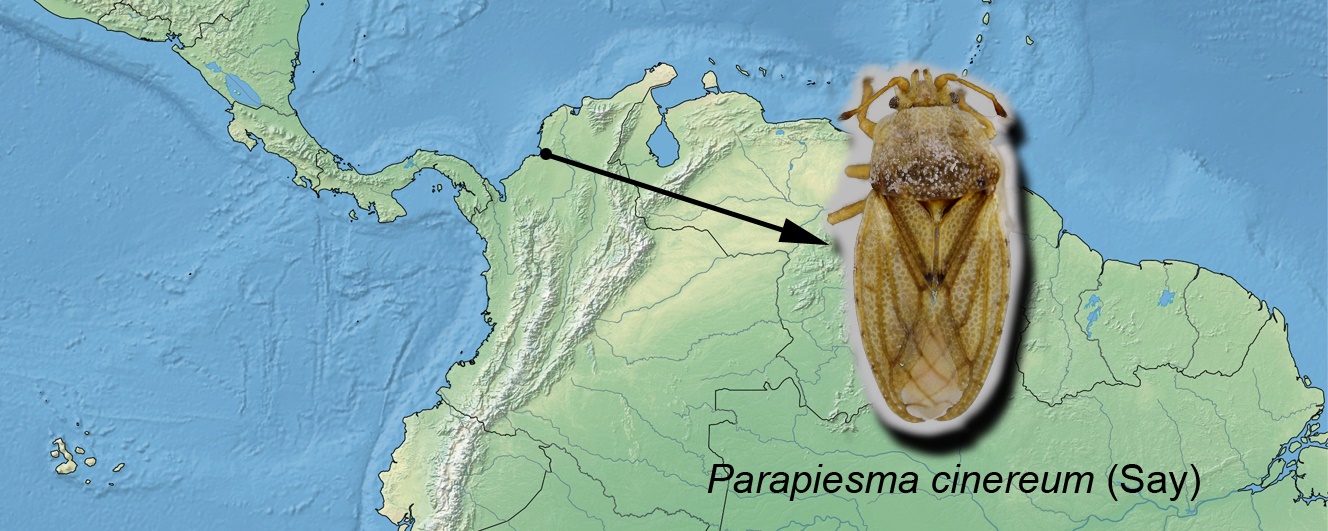
Piesmatidae Amyot and Serville, are relatively small phytophagous hemipterans (less than 5 mm) with a wide world distribution. We record for the first time the family for Colombia, with the species Parapiesma cinereum (Say). The specimens were collected in Sincelejo – Sucre (Caribbean coast) on plants of the family Amaranthaceae.
Piesmatidae Amyot y Serville, es un grupo de hemípteros fitófagos relativamente pequeños (menos de 5 mm) con una amplia distribución en el mundo. Se registra para Colombia por primera vez la presencia de la familia Piesmatidae con la especie Parapiesma cinereum (Say). Los especímenes fueron recolectados en Sincelejo – Sucre (Caribe colombiano) en plantas de la familia Amaranthaceae.
Recibido: 3 de diciembre de 2018; Revisión recibida: 6 de febrero de 2019; Aceptado: 14 de marzo de 2019
ABSTRACT
Piesmatidae Amyot and Serville, are relatively small phytophagous hemipterans (less than 5 mm) with a wide world distribution. We record for the first time the family for Colombia, with the species Parapiesma cinereum (Say). The specimens were collected in Sincelejo - Sucre (Caribbean coast) on plants of the family Amaranthaceae.
Keywords:
Caribbean, insect taxonomy, new geographic record, phytophagous insect.RESUMEN
Piesmatidae Amyot y Serville, es un grupo de hemípteros fitófagos relativamente pequeños (menos de 5 mm) con una amplia distribución en el mundo. Se registra para Colombia por primera vez la presencia de la familia Piesmatidae con la especie Parapiesma cinereum (Say). Los especímenes fueron recolectados en Sincelejo - Sucre (Caribe colombiano) en plantas de la familia Amaranthaceae.
Palabras clave:
Caribe, insectos fitófagos, nuevo registro geográfico, taxonomía de insectos.Piesmatidae Amyot and Serville, 1843, are a small group of phytophagous hemipterans of cosmopolitan distribution (Drake and Davis, 1958; Brailovsky, 1984). They feed primarily on various species of Chenopodiaceae, but also on Amaranthaceae, Caryophyllaceae, and Fabaceae (Schaefer, 1981). Among Pentatomomorpha, i.e., those Heteroptera with abdominal trichobothria, Piesmatidae can be recognized because they are relatively small (less than 5 mm), dull colored, and have the hemelytra areolate or reticulated (Henry etal., 2015).
The family was thought to be related to Tingidae Laporte, based on the two segmented tarsi and areolate hemelytra, but this was clarified and showed that it belongs not in the Cimicomorpha but in the Pentatomomorpha (Drake and Davis, 1958), where it is now ofplaced within the Lygaeoidea (Henry, 1997).
The family comprises ten genera, two extinct (Eopiesma and Heissiana) and eight extant (Piesmatinae: Afropiesma, Mcateella, Miespa, Parapiesma, and Piesma; Psamminae: Psammium, Saxicoris, and Sympeplus), and about 45 species known worldwide (Slater and Sweet, 1965; Slater, 1970; Henry, 1997; Elias and Cassis, 2012; Henry etal., 2015; Henry, 2017). Recent taxa are most diversified in the Palearctic and Australia, with fewer species in the Western Hemisphere (Drake and Davis, 1958; Elias and Cassis, 2012). Only two genera are present in the New World, Parapiesma and Miespa, the former widely distributed and the latter restricted to Chile. Parapiesma cinereum, the most widespread species, is distributed from Canada to Argentina, but without records from certain South American countries (Drake and Davis, 1958; Dellapé, 2014). Despite being a relatively small group, some species of Piesmatidae are important vectors of virus diseases of some plant crops (Drake and Davis, 1958; Narisu, 2000). The goal of this paper is to record for the first time the family Piesmatidae from Colombia.
Specimens belonging to Piesmatidae were collected in the Department of Sucre, municipality of Sincelejo, at the Universidad de Sucre campus, on May 31st of 2016, by L. E. Salcedo and P. J. Alvarez. The specimens are deposited in the Museo Zoológico de la Universidad de Sucre (MZUSU) and Entomological collection of the Museo Javeriano de Historia Natural de la Pontificia Universidad Javeriana, Bogotá (MPUJ) as follows: MZUSU, 2 ♀♀ (MZUSU-E02676, MZUSU-E02677), 2 ♂♂ (MZUSU-E02678, MZUSU-E02679); MPUJ, 3 ♂♂ (MPUJ_ENT 0064078-MPUJ_ENT 0064080), 3 ♀♀ (MPUJ_ENT 0064081-MPUJ_ENT 0064083). The specimens were determined following Brailovsky (1984) and Drake and Davis (1958). Habitus image was taken at MPUJ with a Nikon D5300 attached to a Nikon SMZ1270 dissecting microscope using a light dome illumination system (Kawada and Buffington, 2016).
South American countries with records of Parapiesma cinereum include Venezuela, Brazil, Paraguay, Uruguay, and Argentina (Drake and Davis, 1958; Dellapé, 2014).
Collected specimens (Figure 1) represent a new country record of Piesmatidae from Colombia.
Figure 1: Dorsal habitus view of Parapiesma cinereum (Say). Scale 0.5 mm.
The specimens were collected in a tropical dry forest in an area with shrubs and herbaceous plants. The specimens were found on Amaranthus dubius (Amaranthaceae); this data is consistent with what has been documented before (Drake and Davis, 1958; Bailey, 1959; Brailovsky, 1984). Piesmatidae species are commonly found on Amaranthaceae, Caryophyllaceae, Chenopodiaceae, Cistaceae, and Fabaceae (Drake and Davis, 1958; Schaefer, 1981; 1983; Narisu, 2000). Some of the specimens were in copula when collected, indicating that A. dubius might be a host plant for this species in Colombia.
Also, in a different collecting event, three complete specimens were found in the gut content of the Rainbow lizard Cnemidophorus lemniscatus (Teiidae). No previous data exist for predators of Piesmatidae, or at least specifically for P. cinereum.
The Colombian record for P. cinereum updates the actual distribution of this species in South America. Further field work on other areas in Colombia will clarify if this species is restricted to the Caribbean coast or if on the other hand can be found in other biogeographic areas.
ACKNOWLEDGMENTS
We are thankful for the comments of the reviewers which improved the paper.
REFERENCES
Referencias
Bailey NS. Additions to the bioecology of the New England Tingidae and Piesmatidae (Heteroptera). Psyche. 1959;66(4):63-69.
Brailovsky H. Hemiptera-Heteroptera de México XXXIV revisión de la familia Piesmatidae Spinola. An Inst Biol Univ Nal Autón México, Ser Zool. 1984;55(1):177-182.
Dellapé PM. Lygaeoidea. In: Roig-Juñent L, Claps E, Morrone JJ (eds) Biodiversidad de artrópodos Argentinos, vol 3. Editorial INSUE; 2014. p. 89-106.
Drake CJ, Davis NT. The morphology and systematics of the Piesmatidae (Hemiptera), with keys to world genera and American species. Ann Entomol Soc Am. 1958;51:567-581.
Elias MA, Cassis G. Systematic revision, phylogeny and host plant associations of the Australian endemic genus Mcateella Drake (Hemiptera : Heteroptera : Piesmatidae). Invertebr Syst. 2012;26(1):83-114. Doi: https://doi.org/10.1071/IS11043.
Henry TJ. Phylogenetic analysis of family groups within the infraorder Pentatomomorpha (Hemiptera: Heteroptera), with emphasis on the Lygaeoidea. Ann Entomol Soc Am. 1997;90(3):275-301. Doi: https://doi.org/10.1093/aesa/90.3.275.
Henry TJ. Biodiversity of Heteroptera. In: Foottit RG, Adler PH. (eds) Insect Biodiversity: Science and Society, Second Ed. John Wiley & Sons, Chichester, UK; 2017. p. 279-335.
Henry TJ, Dellapé PM, Paula AS. The big-eyed bugs, chinch bugs, and seed bugs (Lygaeoidea). In: Panizzi AR and Grazia J. (eds) True Bugs (Heteroptera) of the Neotropics. Springer; 2015. p. 459-514.
Kawada R, Buffington ML. A scalable and modular dome illumination system for scientific microphotography on a budget. PLOS ONE. 2016;11(5):e0153426. Doi: https://doi.org/10.1371/journal.pone.0153426.
Narisu N. Ash-gray leaf bugs (Piesmatidae). In: Schaefer CW and Panizzi AR. (eds) Heteroptera of economic importance. CRC Press; 2000. p. 265-270.
Schaefer CW. Improved cladistic analysis of the Piesmatidae and consideration of known host plants. Ann Entomol Soc Am. 1981;74(6):536-539. Doi: https://doi.org/10.1093/aesa/74.6.536.
Schaefer CW. Host plants and morphology of the Piesmatidae and Podopinae (Hemiptera: Heteroptera): further notes. Ann Entomol Soc Am. 1983;76(1):134-137. Doi: https://doi.org/10.1093/aesa/76.1.134.
Slater JA. Saxicoris, a new genus of Psamminae from South Africa (Hemiptera: Lygaeidae). J Entomol Soc South Afr. 1970;33(2):261-265.
Slater JA, Sweet MH. The systematic position of the Psamminae (Heteroptera: Lygaeidae). Proc Entomol Soc Wash. 1965;67(4):255-262.
Cómo citar
APA
ACM
ACS
ABNT
Chicago
Harvard
IEEE
MLA
Turabian
Vancouver
Descargar cita
Licencia
Derechos de autor 2020 Acta Biológica Colombiana

Esta obra está bajo una licencia internacional Creative Commons Atribución-NoComercial-CompartirIgual 4.0.
1. La aceptación de manuscritos por parte de la revista implicará, además de su edición electrónica de acceso abierto bajo licencia Attribution-NonCommercial-ShareAlike 4.0 (CC BY NC SA), la inclusión y difusión del texto completo a través del repositorio institucional de la Universidad Nacional de Colombia y en todas aquellas bases de datos especializadas que el editor considere adecuadas para su indización con miras a incrementar la visibilidad de la revista.
2. Acta Biológica Colombiana permite a los autores archivar, descargar y compartir, la versión final publicada, así como las versiones pre-print y post-print incluyendo un encabezado con la referencia bibliográfica del articulo publicado.
3. Los autores/as podrán adoptar otros acuerdos de licencia no exclusiva de distribución de la versión de la obra publicada (p. ej.: depositarla en un archivo telemático institucional o publicarla en un volumen monográfico) siempre que se indique la publicación inicial en esta revista.
4. Se permite y recomienda a los autores/as difundir su obra a través de Internet (p. ej.: en archivos institucionales, en su página web o en redes sociales cientificas como Academia, Researchgate; Mendelay) lo cual puede producir intercambios interesantes y aumentar las citas de la obra publicada. (Véase El efecto del acceso abierto).




