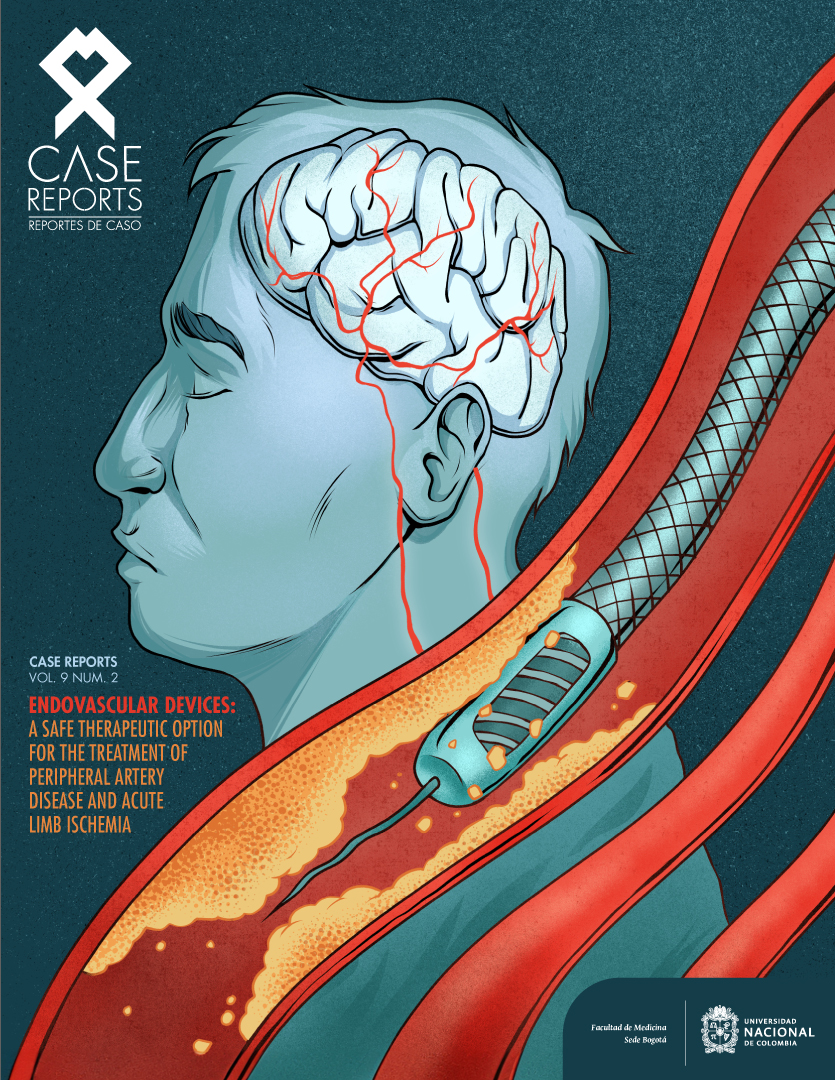
Dispositivos endovasculares: una opción terapéutica segura para el tratamiento de la enfermedad arterial periférica e isquemia aguda de extremidad
Endovascular devices: a safe therapeutic option for the treatment of peripheral artery disease and acute limb ischemia
DOI:
https://doi.org/10.15446/cr.v9n2.112209Palabras clave:
Enfermedad arterial periférica, Arteriopatías Oclusivas, Recuperación del Miembro, Trombectomía, Terapia Trombolítica (es)Peripheral Arterial Disease, Arterial Occlusive Diseases, Limb Salvage, Thrombectomy, Thrombolytic Therapy (en)
Descargas
https://doi.org/10.15446/cr.v9n2.112209
Endovascular devices: a safe therapeutic option for the treatment of peripheral artery disease and acute limb ischemia
Keywords: Peripheral Arterial Disease; Arterial Occlusive Diseases; Limb Salvage; Thrombectomy; Thrombolytic Therapy.
Palabras clave: Enfermedad Arterial Periférica; Arteriopatías Oclusivas; Recuperación del Miembro; Trombectomía; Terapia Trombolítica.
Paula Camila Florez-Amaya
Hospital Universitario San Rafael de Tunja
- Vascular Surgery Service -
Tunja - Boyacá - Colombia.
Corresponding author
Paula Camila Florez-Amaya.
Servicio de Cirugía Vascular,
Hospital San Rafael de Tunja.
Tunja. Boyacá. Colombia.
E-mail: paula.floreza@gmail.com
Received: 06/10/2023 Accepted: 12/10/2023
Editorial
Peripheral artery disease (PAD) is a condition that causes atherosclerosis in the limbs. It is characterized by a progressive decrease in peripheral blood flow, so the clinical manifestations vary from an asymptomatic state to even acute ischemia, which jeopardizes the viability of the limbs (1).
The most common clinical presentation is intermittent claudication, which is characterized by muscle pain in the limbs when walking that subsides with rest. The affected limb correlates clinically with the arterial segment involved. When the disease is at an advanced stage, pain may be present at rest and improve with the leg in a dependent position. The limb may show skin lesions, especially on the interdigital and arthrodial areas, in the form of chronic ulcers that do not heal (1).
PAD can also occur as a rapidly progressing severe hypoperfusion, also called acute limb ischemia (ALI), which develops in a period lasting less than 15 days. Its clinical manifestation is characterized by the six P’s: pain, pulselessness, poikilothermia, paresthesia, pallor, and paralysis. This hypoperfusion develops in 15-20% of patients with pre-existing peripheral arterial disease and is caused by arterial thrombosis or thromboembolism involving native vessels or existing bypass grafts (2).
Surgical treatment of PAD is indicated in patients with persistent claudication (even when optimal medical treatment has been followed), in patients with limb-threatening ischemia (to restore pulsatile flow to the foot), and in patients with acute limb ischemia. The latter are treated using a comprehensive approach, taking into account the location and extent of the lesion, the general health status, and the patient’s life expectancy (3-5).
The identification of the stage of the disease is necessary to establish the strategy for revascularization of the arteries since patients frequently present multilevel involvement; they will often require treatment of both inflow (aorta, iliac, and femoral arteries) and outflow (femoral, popliteal, and tibioperoneal arteries) (4). The intervention can be endovascular, surgical or hybrid, depending on the patient’s underlying conditions and the anatomical characteristics of the lesions (5).
Endovascular therapies are presented as a minimally invasive option to treat hemodynamically significant lesions with an occlusion range of 75-100% and are the therapeutic method of choice to treat patients with comorbidities or with a high risk of morbidity and mortality before a major surgical procedure. These include conventional or drug-coated balloon angioplasty, stenting, and thrombectomy and thrombolysis devices (5).
Salvageable limb revascularization should be performed within 6 hours for Rutherford II classification patients and 24 hours for Rutherford I classification patients (6). Endovascular therapy may include catheter-directed thrombolysis and/or percutaneous mechanical thrombectomy with or without immediate or subsequent revascularization. Additionally, fasciotomy is sometimes required to treat compartment syndrome (3).
This issue of the journal presents two clinical cases about the use of endovascular devices (mechanical thrombectomy and catheter-directed pharmacological thrombolysis) as a treatment for vascular diseases. These devices offer multiple advantages, however, different complications must also be considered.
Endovascular devices
Catheter-directed pharmacological thrombolysis
Catheter-directed pharmacological thrombolysis can restore arterial flow by dissolving an occlusive thrombus. It involves intra-arterial administration of an anticoagulant (streptokinase) at low doses (2 000 to 5 000 units/hour) directly on or close to the thrombus (7). It can be used together with mechanical methods of thrombectomy and/or percutaneous aspiration to aid in rapid restoration of blood flow (6). However, its use is contraindicated in cases where the limb is not salvageable, if there is severe hypertension, if there is active bleeding, if there is evidence of an intracranial tumor, if the patient had a recent trauma, or if the patient had an ischemic stroke in the previous 6 months. Some complications of this type of device include brain hemorrhage, severe hemorrhage, embolization, and recurrence of thrombosis (6).
Aspiration thrombectomy
Percutaneous aspiration thrombectomy is usually effective in eliminating embolic occlusions and short thrombotic occlusions. Large thrombi may require pretreatment (2). Mortality rates at 30 days are 5.9% compared to surgical embolectomy, which has a rate of 8.8% (6).
Mechanical thrombectomy
It can reduce the dose of thrombolytic drugs or even avoid thrombolysis; however, its use should be limited to cases with a recent thrombus, incomplete clot clearance, or damage to the vessel wall (7). These devices work in several ways: according to the vortex principle (they fragment the thrombus without extracting it) or following the Bernoulli method, an aspiration system in which a high-velocity retrograde fluid jet generates a low-pressure zone around the catheter, resulting in thrombus rupture and aspiration (8).
There are also rotational thrombectomy systems such as the Rotarex® System, a 6 Fr or 8 Fr polyurethane catheter containing a steel coil powered by an electric motor, which removes the thrombus as it advances. This device was evaluated in the treatment of thromboembolic occlusions with a technical success rate of 70% to 96% (9). However, these devices may be unable to remove older or larger thrombi adhered to the wall of the peripheral arteries (7).
Moreover, there are different methods for the treatment of chronic occlusive disease such as atherectomy devices, which are used for the elimination of endovascular atheromas or as co-adjuvants in in-stent restenosis and impassable lesions using a balloon. They are very useful in lesions where anatomical stenting is not recommended, such as in flexural sites. There are currently four types of atherectomy devices: directional (excisional), rotational, orbital, and laser (10).
References
1.Campia U, Gerhard-Herman M, Piazza G, Goldhaber SZ. Peripheral Artery Disease: Past, Present, and Future. Am J Med . 2019;132(10):1133-41. https://doi.org/gsn6d9.
2.Zeller T, Tepe G. Treatment of acute limb ischemia with focus on endovascular techniques. Vasa. 2009;38(2):123-33. https://doi.org/kx6g.
3.De Maeseneer MG, Kakkos SK, Aherne T, Baekgaard N, Black S, Blomgren L, et al. Editor’s Choice - European Society for Vascular Surgery (ESVS) 2022 Clinical Practice Guidelines on the Management of Chronic Venous Disease of the Lower Limbs. Eur J Vasc Endovasc Surg. 2022;63(2):184-267. https://doi.org/gpqvgk.
4.Mustapha JA, Anose BM, Martinsen BJ, Pliagas G, Ricotta J, Boyes CW, et al. Lower extremity revascularization via endovascular and surgical approaches: A systematic review with emphasis on combined inflow and outflow revascularization. SAGE Open Med. 2020;8(1):1-9. https://doi.org/kx6j.
5.Abramson BL, Al-Omran M, Anand SS, Albalawi Z, Coutinho T, de Mestral C, et al. Canadian Cardiovascular Society 2022 Guidelines for Peripheral Arterial Disease. Can J Cardiol. 2022;38(5):560-87. https://doi.org/gqrtdt.
6.Byrne RM, Taha AG, Avgerinos E, Marone LK, Makaroun MS, Chaer RA. Contemporary outcomes of endovascular interventions for acute limb ischemia. J Vasc Surg. 2014;59(4):988-95. https://doi.org/f5wcpd.
7.Laird JR. The Management of Acute Limb Ischemia: Techniques for Dealing with Thrombus.
J Interv Cardiol. 2001;14(5):539-46. https://doi.org/dh7p5n.
8.Fernández-Pereira CF, Curotto V, Rodríguez-Pagani C, Renes MP, Rodríguez A. Embolectomía percutánea reolítica en la tromboembolia pulmonar masiva. Rev Argent Cardiol. 2010;78(5):442-4.
9.Fluck F, Augustin AM, Bley T, Kickuth R. Current Treatment Options in Acute Limb Ischemia. RoFo. 2020;192(4):319–26. https://doi.org/krh4.
10.Mosarla RC, Armstrong E, Bitton-Faiwiszewski Y, Schneider PA, Secemsky EA. State-of-the-Art Endovascular Therapies for the Femoropopliteal Segment: Are We There Yet?. J Soc Cardiovasc Angiogr Interv. 2022;1(5):100439. https://doi.org/kx6n.
Referencias
References
Campia U, Gerhard-Herman M, Piazza G, Goldhaber SZ. Peripheral Artery Disease: Past, Present, and Future. Am J Med . 2019;132(10):1133-41. https://doi.org/gsn6d9.
Zeller T, Tepe G. Treatment of acute limb ischemia with focus on endovascular techniques. Vasa. 2009;38(2):123-33. https://doi.org/kx6g.
De Maeseneer MG, Kakkos SK, Aherne T, Baekgaard N, Black S, Blomgren L, et al. Editor's Choice - European Society for Vascular Surgery (ESVS) 2022 Clinical Practice Guidelines on the Management of Chronic Venous Disease of the Lower Limbs. Eur J Vasc Endovasc Surg. 2022;63(2):184-267. https://doi.org/gpqvgk.
Mustapha JA, Anose BM, Martinsen BJ, Pliagas G, Ricotta J, Boyes CW, et al. Lower extremity revascularization via endovascular and surgical approaches: A systematic review with emphasis on combined inflow and outflow revascularization. SAGE Open Med. 2020;8(1):1-9. https://doi.org/kx6j.
Abramson BL, Al-Omran M, Anand SS, Albalawi Z, Coutinho T, de Mestral C, et al. Canadian Cardiovascular Society 2022 Guidelines for Peripheral Arterial Disease. Can J Cardiol. 2022;38(5):560-87. https://doi.org/gqrtdt.
Byrne RM, Taha AG, Avgerinos E, Marone LK, Makaroun MS, Chaer RA. Contemporary outcomes of endovascular interventions
for acute limb ischemia. J Vasc Surg. 2014;59(4):988-95. https://doi.org/f5wcpd.
Laird JR. The Management of Acute Limb Ischemia: Techniques for Dealing with Thrombus. J Interv Cardiol. 2001;14(5):539-46. https://doi.org/dh7p5n.
Fernández-Pereira CF, Curotto V, Rodríguez-Pagani C, Renes MP, Rodríguez A. Embolectomía percutánea reolítica en la tromboembolia pulmonar masiva. Rev Argent Cardiol. 2010;78(5):442-4.
Fluck F, Augustin AM, Bley T, Kickuth R. Current Treatment Options in Acute Limb Ischemia. RoFo. 2020;192(4):319–26. https://doi.org/krh4.
Mosarla RC, Armstrong E, Bitton-Faiwiszewski Y, Schneider PA, Secemsky EA. State-of-the-Art Endovascular Therapies for the Femoropopliteal Segment: Are We There Yet?. J Soc Cardiovasc Angiogr Interv. 2022;1(5):100439. https://doi.org/kx6n.
Cómo citar
APA
ACM
ACS
ABNT
Chicago
Harvard
IEEE
MLA
Turabian
Vancouver
Descargar cita
Licencia
Derechos de autor 2023 Case reports

Esta obra está bajo una licencia internacional Creative Commons Atribución 4.0.
Los autores al someter sus manuscritos conservarán sus derechos de autor. La revista tiene el derecho del uso, reproducción, transmisión, distribución y publicación en cualquier forma o medio. Los autores no podrán permitir o autorizar el uso de la contribución sin el consentimiento escrito de la revista.
El Formulario de Divulgación Uniforme para posibles Conflictos de Interés y los oficios de cesión de derechos y de responsabilidad deben ser entregados junto con el original.
Aquellos autores/as que tengan publicaciones con esta revista, aceptan los términos siguientes:
Los autores/as conservarán sus derechos de autor y garantizarán a la revista el derecho de primera publicación de su obra, el cual estará simultáneamente sujeto a la Licencia de reconocimiento de Creative Commons 4.0 que permite a terceros compartir la obra siempre que se indique su autor y su primera publicación en esta revista.
Los autores/as podrán adoptar otros acuerdos de licencia no exclusiva de distribución de la versión de la obra publicada (p. ej.: depositarla en un archivo telemático institucional o publicarla en un volumen monográfico) siempre que se indique la publicación inicial en esta revista.
Se permite y recomienda a los autores/as difundir su obra a través de Internet (p. ej.: en archivos telemáticos institucionales o en su página web) antes y durante el proceso de envío, lo cual puede producir intercambios interesantes y aumentar las citas de la obra publicada. (Véase El efecto del acceso abierto).