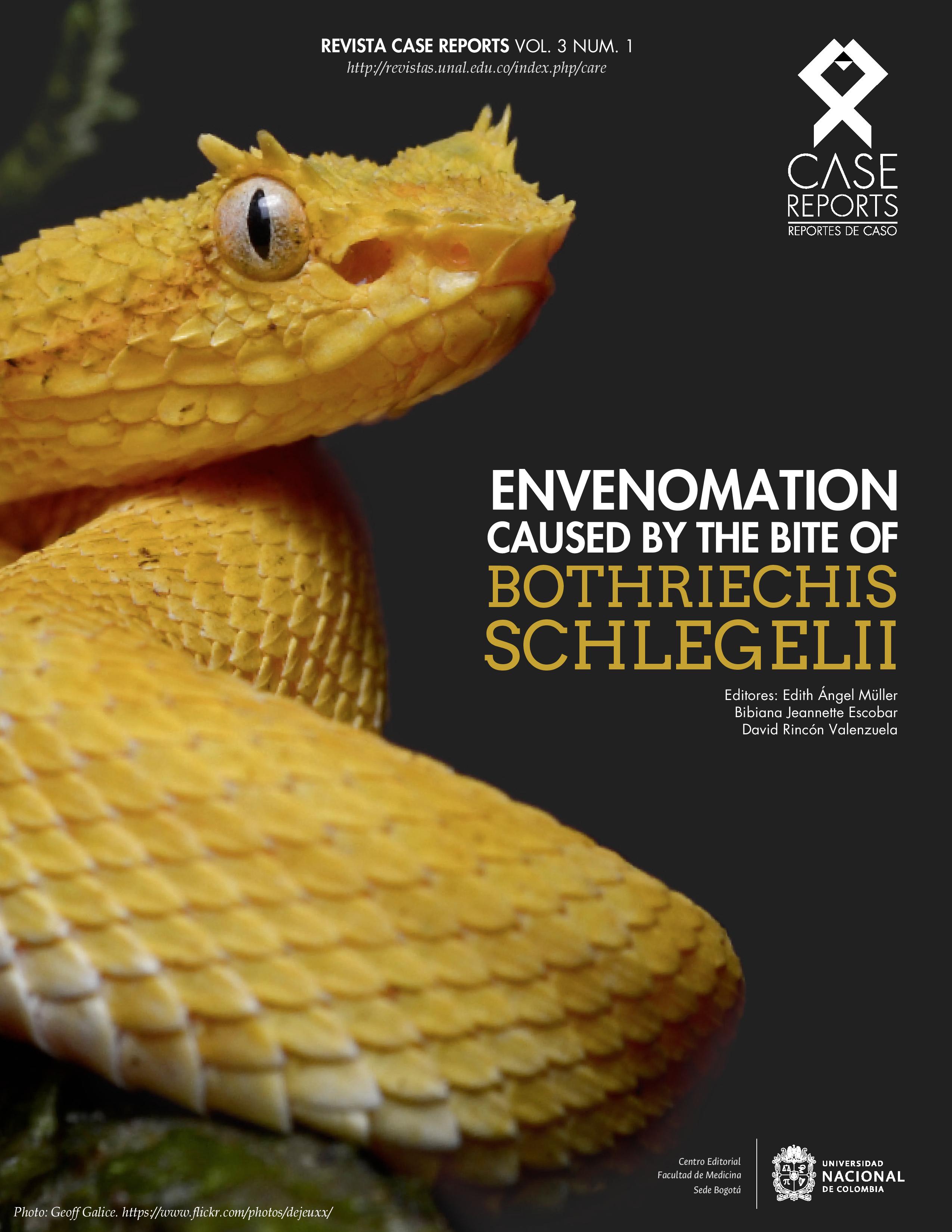
Envenomation caused by the bite of the snake Bothriechis schlegelii. Report of two cases in Colombia
Emponzoñamiento causado por mordedura de la serpiente bothriechis schlegelii. Reporte de dos casos ocurridos en Colombia
DOI:
https://doi.org/10.15446/cr.v3n1.58625Palabras clave:
Bothriechis schlegelii, Snake bites, Blood clotting (en)Bothriechis schlegelii, Mordeduras de serpientes, Coagulación sanguínea (es)
The bite by snakes of the Bothriechis genus is common in certain areas of Colombia such as the Coffee-growing Region. Due to their arboreal habits and defensiveness, these snakes usually bite farmers in their upper limbs and face. In Colombia, the incidence of accidents caused by these snakes has not been accurately estimated yet because of deficiencies in recording this type of cases, as well as of the ignorance on this reptile by health personnel working in its area of influence.
This paper describes two cases of bites by B. schlegelii occurred in Colombia during 2015. The first case is about a 55-year-old man who was bitten on the left hand, and subsequently developed paresthesia and edema until the forearm, with no other findings; the patient underwent treatment with polyvalent antivenin from Probiol®, with complete resolution of the event. The second case portrays a 62-year-old man, bitten on the left hand, presenting with emesis, diaphoresis, edema until shoulder, prolonged clotting times, and no bleeding; the patient required eight vials of polyvalent antivenin from Instituto Nacional de Salud (National Institute of Health, Colombia), thereby normalizing clotting times. Complete resolution of the event was achieved.
https://revistas.unal.edu.co/index.php/care/article/view/58625
Envenomation caused by the bite of the snake Bothriechis schlegelii. Report of two cases in Colombia
Palabras clave: Bothriechis schlegelii; Mordeduras de serpientes; Coagulación sanguínea; Colombia.
Keywords: Bothriechis schlegelii; Snake bites; Blood coagulation; Colombia.
Mario Galofre-Ruiz, MD, MSc Tox
Centro de Información de Seguridad
sobre Productos Químicos CISPROQUIM
Consejo Colombiano de Seguridad
Bogotá D.C. – Colombia
Corresponding author
mdgalofrer@unal.edu.co
Phone number.: (057)3157261026
ABSTRACT
The bite by snakes of the Bothriechis genus is common in certain areas of Colombia such as the Coffee-growing Region. Due to their arboreal habits and defensiveness, these snakes usually bite farmers in their upper limbs and face. In Colombia, the incidence of accidents caused by these snakes has not been accurately estimated yet because of deficiencies in recording this type of cases, as well as of the ignorance on this reptile by health personnel working in its area of influence.
This paper describes two cases of bites by B. schlegelii occurred in Colombia during 2015. The first case is about a 55-year-old man who was bitten on the left hand, and subsequently developed paresthesia and edema until the forearm, with no other findings; the patient underwent treatment with polyvalent antivenin from Probiol®, with complete resolution of the event. The second case portrays a 62-year-old man, bitten on the left hand, presenting with emesis, diaphoresis, edema until shoulder, prolonged clotting times, and no bleeding; the patient required eight vials of polyvalent antivenin from Instituto Nacional de Salud (National Institute of Health, Colombia), thereby normalizing clotting times. Complete resolution of the event was achieved.
IntroducTIOn
The name Bothriechis schlegelii derives from the Greek word bothros, which means “pit” and echis, “snake”, referring to the loreal pit that is located between the nostrils and eyes on each side of the face, and also after the German zoologist Hermann Schlegel (1).
The length of B. schlegelii, also known as eyelash pit viper, varies between 50 and 120 cm, being females larger than males. The variety of its colors (emerald or dark green, yellow, brown and black), helps it mimic its surroundings. It has prehensile tail, and from two to four small superciliar scales, in the way of “eyelashes”. It feeds on baby birds, lizards, frogs and rodents, inhabits tropical forests and corn and coffee crops, at altitudes ranging from 0 to 2600 m; the viper reaches the highest altitude in Colombia (2,3).
In the regions in which it inhabits, it is also known as cabeza de candado, granadilla, víbora de tierra fría, víbora de pestañas, yaruma, veinticuatro, guacamaya, víbora rayo, mortiñera, colgadora and grano de oro (these are different names to refer to this snake in diverse regions of Latin America) (2,4).
B. schlegelii extends from southern Mexico, throughout Central America, to the east of Venezuela, and in the Pacific through Costa Rica, Panama, El Salvador and Ecuador (5). In Colombia, it lives in the Pacific and Andean regions, and in the Western, Central and Eastern Ranges. In addition, it can be found from the south to the north of the country, on the border with the Venezuelan Andes, and is endemic in the coffee region (2).
Until epidemiological week 32 in 2016, 2 791 cases of snakebite accidents were reported to Sistema Nacional de Vigilancia en Salud Pública (National System of Public Health Surveillance), of which 65.6% corresponded to Bothrops (6). However, the number of cases related to snakebites of Bothriechis genus specimens was not certain.
Clinical cases
Case 1
Reason for consultation
55-year-old patient, from Pensilvania, Caldas, who was bitten on the back of the left hand by a 25 cm, thin, triangular head snake during his work in a coffee crop (Figure 1 and 2). The patient denies hypertension, diabetes, kidney disease, bleeding disorders or previous surgeries.
Fig 1. Specimen of Bothriechis schlegelii which caused this event, in defensive position.
Source: Own elaboration based on the data obtained in the study.
Fig 2. Head of the specimen. Multiple scales, vertical pupil and loreal pit can be seen.
Note: The specimen was handed over to environmental authorities and returned to its natural habitat.
Source: Own elaboration based on the data obtained in the study.
Clinical manifestations and physical examination
The patient presented with pain when moving the affected hand, paresthesia and 2cm edema in the right hand, which spread to the left forearm. No fang punctures nor local bleeding were observed (Figure 3).
Fig 3. Appearance of the bite by Bothriechis schlegelii. Edema in the left hand and part of the forearm is shown.
Source: Own elaboration based on the data obtained in the study.
Laboratory tests
Complete blood count, blood urea nitrogen, creatinine and coagulation tests were performed and no alterations were found. Total CPK was not determined.
Treatment
First, the patient was administered intravenous fluids, analgesia with tramadol, and tetanus prophylaxis (after confirming normal coagulation tests). Then, he was referred to a nearby hospital where three vials of polyvalent antivenom Probiol® were administered intravenously; afterwards, the patient developed fever, which was controlled with acetaminophen. The pain and edema decreased and, finally, he was discharged after two days of observation.
Case 2
Reason for consultation
62-year-old man, from Fresno, Tolima, who was bitten on the third finger of the left hand during agricultural work by a thin snake, known in the area as “cabeza de candado (head lock)” (Figure 4 and 5). He denies hypertension, diabetes, kidney disease, bleeding disorders or previous surgeries.
Fig 4. Bothriechis schlegelii. Triangular head.
Source: Own elaboration based on the data obtained in the study.
Fig 5. Bothriechis schlegelii. Prehensile tail. Note: The specimen was sacrificed before consultation with the attending physician.
Source: Own elaboration based on the data obtained in the study.
Clinical manifestations and physical examination
The patient was admitted with pain in the left hand, edema of 1 cm in the right hand, paresthesia in the left shoulder, emesis and diaphoresis (Figure 6).
Fig 6. Appearance of bothriechis schlegelii bite. Edema in the left hand.
Source: Own elaboration based on the data obtained in the study.
Laboratory tests
The following tests were performed: unaltered blood count and prolonged prothrombin time, and partial thromboplastin time. Total CPK was not determined.
Treatment
The patient received intravenous fluids, analgesia and six vials of polyvalent antivenin produced by Instituto Nacional de Salud intravenously, without adverse reactions. After finding an alteration in clotting, the patient was given two additional vials of polyvalent antivenin, for a total of eight, and was referred to a third level hospital level in Ibagué. In the referral hospital, the patient’s condition improved, and coagulation tests were normal 48 hours after the event; finally, he was discharged after 72 hours of observation.
Discussion
The venom of B. schlegelii consists, mostly, of phospholipase A2, followed by metalloproteinases, bradykinin potentiating peptides, Kazal type proteinase inhibitor, serine proteinases, L-amino acid oxidase and cysteine-rich secretory proteins (CRISPs), therefore, its properties are hypotensive, edema-forming, procoagulant, myotoxic, necrotizing and hemorrhagic (7).
When dealing with bites by a Bothriechis snake, assessing the severity of the bite through the clinical grading adapted by Otero is important (8), which also serves to determine the amount of antivenin to use.
The grades presented by Otero (8) are: Grade 1, absent, only minimal pain; Grade 2, mild, presence of edema (<4 cm) that compromises one or two segments of the bitten limb, ecchymosis, scarce bleeding with normal coagulation or incoagulable blood; Grade 3, moderate, with edema (> 4 cm) that compromises three segments of the bitten limb, blisters, local incoagulable bleeding or presence of systemic hemorrhage; Grade 4, severe, presence of edema beyond the bitten limb, necrosis, compartment syndrome, local hemorrhage with incoagulable blood, systemic hemorrhage (including brain hemorrhage), hypotension or shock, disseminated intravascular coagulation, renal failure and multiple organ dysfunction. According to this, the two cases were considered as mild.
The symptoms manifested by the patient in the first case —localized pain and progressive edema— correspond to the initial symptoms caused by the bite of this snake, which in some cases may be accompanied by hemorrhagic blisters, itching, bruising and necrosis (9, 10). In Colombia, severe poisoning by Bothrops asper, Bothrops punctatus, Porthidium nasutum and Bothriechis schlegelii bite has been characterized and includes local necrosis, systemic and local bleeding, hypotension and renal failure (11).
In the second case, although no marked local symptoms were observed, there was a significant commitment of clotting, which can be explained by two reasons: the direct inoculum of poison inside a blood vessel, and the presence of metalloproteinases in the protein composition of the poison, because their concentration in the venom of B. schlegelii (17.7%) is lower compared to that of B. lateralis (55.1%). This specimen has shown a wide range of biological activities, such as hemorrhagic fibrinogenolytic degradation of components in the extracellular matrix, and activation of prothrombin and factor X, resulting in extensive local tissue damage and systemic bleeding (12,13).
Treatment Considerations
Appropriate initial measures for such events include complete medical history; cardiovascular, respiratory and neurological evaluation; intravenous fluids in a limb other than the affected one; bite site antisepsis; gastric protection and oral rest due to the risk of bleeding; prophylaxis for tetanus with tetanus toxoid when coagulation times are normal or normalized after treatment; broad spectrum antibiotic therapy in case of documented infection, and analgesia with opioids. Non-steroidal anti-inflammatory drugs should be avoided (14).
Currently, three types of antivenins are available in Colombia: one manufactured by Instituto Nacional de Salud, one manufactured by Laboratory Probiol® produced in Colombia, and another manufactured by Bioclon Institute of Mexico. The first two act against the venom of B. schlegelii and, according to their availability, should be used taking into account possible adverse reactions such as anaphylaxis, serum sickness, acute renal failure or pyrogenic reactions, which are treated with corticosteroids if they are mild to moderate, or adrenaline if anaphylactic shock occurs (2,8).
The polyvalent antivenin produced by Bioclon Institute of Mexico has also been used to treat this type of envenomation; also, it showed that it can reverse the procoagulant effect of the venom of B. schlegelii, as well as the polyvalent serum antivenin produced by Instituto Clodomiro Picado in Costa Rica (15).
Conclusions
Due to the correct classification of the severity of envenomation cases, the accurate identification of the causative specimens, the adequate dose and the quality of the antivenin used, a satisfactory outcome was achieved in both patients.
B. schlegelii bite produces poisoning, but this fact is underestimated in Colombia, partly because of the ignorance that health personnel have of this snake and because of the characteristics of their venom. Accurate diagnosis and specific treatment with polyvalent antivenin are crucial to prevent further morbidity in these patients.
Funding
None declared by the author.
Conflict of interest
None declared by the author.
References
1.Arteaga A, Bustamante L, Guayasamin JM. The amphibians and reptiles of Mindo. Quito: Universidad Tecnológica Indoamérica; 2013 [cited 2016 Dec 27]. Available from: https://goo.gl/kGlJ19.
2.Charry H. Aspectos biomédicos del accidente Bothrópico. In: Memorias del Primer Simposio de Toxinología Clínica “César Gómez Villegas”. Bogotá: Laboratorios Probiol Ltda. Facultad de Medicina, Fundación Universitaria San Martín; 2006 [cited 2016 Dec 27]. p. 1-24. Available from: https://goo.gl/MIuhQD.
3.Vásquez C, Avendaño Ch. Manual para la identificación, prevención y tratamiento de mordeduras de serpientes venenosas en Centro América, Volumen I: Guatemala. Washington D.C.: Organización Panamericana de la Salud-OPS, Organización Mundial de la Salud-OMS; 2009.
4.Ayerbe-González S, Rodríguez-Buitrago JR. Accidente Ofídico Bothrópico. In: Ministerio de la Protección Social de Colombia. Guías para el manejo de Urgencias Toxicológicas. Bogotá: Ministerio de Protección Social de Colombia, Universidad Nacional de Colombia; 2010 [cited 2016 Dec 27]. p 277–80. Available from: https://goo.gl/uXNVsT.
5.Toxinology Department, Women’s & Children’s Hospital. Snakebite Management Overview Document. North Adelaide: State Toxinology Services; 2011.
6.León-Núñez LJ. Informe del evento accidente ofídico hasta el periodo epidemiológico VIII, Colombia, 2016. Bogotá: Instituto Nacional de Salud de Colombia; 2016.
7.Lomonte B, Escolano J, Fernández J, Sanz L, Angulo Y, Gutiérrez J, et al. Snake venomics and antivenomics of the arboreal neotropical pitvipers Bothriechis lateralis and Bothriechis schlegelii. J Proteome Res. 2008;7(6):2445-57. http://doi.org/bs7h73.
8.Otero-Patiño R. Epidemiological, clinical and therapeutic aspects of Bothrops asper bites. Toxicon. 2009;54(7):998-1011. http://doi.org/c38pdn.
9.Gutiérrez J, Lomonte B. Local tissue damage induced by Bothrops snake venoms. A review. Mem. Inst. Butantan. 1989;51:211-23.
10.Warrell D. Snakebites in Central and South America: Epidemiology, Clinical Features, and Clinical Management. In: Campbell JA, Lamar WW, editors. The Venomous Reptiles of the Western Hemisphere; Campbell J, Lamar W, editors. Ithaca: Comstock Publishing Associates; 2004. p. 709-61.
11. Otero R, Gutiérrez J, Mesa MB, Duque E, Rodríguez O, Arango JL, et al. Complications of Bothrops, Porthidium, and Bothriechis snakebites in Colombia. A clinical and epidemiological study of 39 cases attended in a university hospital. Toxicon. 2002;40(8):1107-14.
12.Gutiérrez JM, Rucavado A, Escalante T, Díaz C. Hemorrhage induced by snake venom metalloproteinases: biochemical and biophysical mechanisms involved in microvessel damage. Toxicon. 2005;45(8):997-1011.
13. Fox JW, Serrano, SM. Structural considerations of the snake venom metalloproteinases, key members of the M12 reprolysin family of metalloproteinases. Toxicon. 2005;45(8):969-85.
14.Alarcón J, Ángel LM, Rojas C. Accidente ofídico en pediatría. Revista Gastrohnup. 2012;14:S14-S26.
15. Buschek S, Ignjatovic V, Summerhayes R, Lowe R. The effect of different snake venoms and anti-venoms on thrombin clotting time in human plasma. Thromb Res. 2012;125(4):e149-52. http://doi.org/dwn8bm.
Emponzoñamiento causado por mordedura de la serpiente Bothriechis schlegelii. Reporte de dos casos ocurridos en Colombia
Mario Galofre-Ruiz, MD, MSc Tox
Centro de Información de Seguridad sobre Productos Químicos CISPROQUIM -Consejo Colombiano de Seguridad - Bogotá D.C. - Colombia.
Correspondencia:
mdgalofrer@unal.edu.co, Tel.: (057)3157261026
La mordedura de serpiente del género Bothriechis es frecuente en regiones de Colombia como el eje cafetero. Debido a sus costumbres arborícolas y su actitud defensiva, por lo general estas serpientes muerden a agricultores en sus miembros superiores y rostro. En Colombia, la incidencia de accidentes provocados por este tipo de serpiente aún no ha sido estimada con exactitud, ya que existen deficiencias en el registro de los mismos, así como desconocimiento de este reptil por parte del personal de salud que trabaja en su área de influencia. En este artículo se presentan dos casos de mordeduras por B. schlegelii ocurridos en Colombia en 2015. El primero, un hombre de 55 años con mordedura en mano izquierda, que desarrolló parestesias y edema hasta antebrazo sin otros hallazgos y que fue sometido a tratamiento con antivipérido polivalente de Probiol®, con resolución completa del evento. Por su parte, el segundo caso es el de un hombre de 62 años que fue mordido en mano izquierda, presentando emesis, diaforesis, edema hasta el hombro y tiempos de coagulación prolongados, sin sangrado; el paciente requirió ocho ampollas de antivipérido polivalente del Instituto Nacional de Salud (Colombia), con lo que se logró normalización de tiempos de coagulación y resolución completa del evento.
Palabras clave: Bothriechis schlegelii; Mordeduras de serpientes; Coagulación sanguínea; Colombia.
Introducción
El nombre de la serpiente Bothriechis schlegelii deriva del griego bothros que significa “foso” y echis, “víbora”, en referencia a la foseta loreal (cavidad termorreceptora) que se sitúa entre las fosas nasales y el ojo de cada lado del rostro, y en honor al zoólogo alemán Hermann Schlegel (1).
La longitud de la B. schlegelii, también conocida como crótalo cornudo de Schlegel, varía entre 50 y 120 cm, siendo más grandes las hembras. Su variedad de colores (verdes esmeralda u oscuro, amarillo, marrón y negro), le confiere mimetismo con su entorno. Posee cola prensil y dos a cuatro pequeñas escamas superciliares, a manera de “pestañas”. Se alimenta de crías de aves, lagartijas, ranas y roedores, y habita en selvas tropicales y en cultivos de maíz y café, en altitudes que van de 0 a 2600 msnm, siendo la víbora que alcanza la mayor altitud en Colombia (2,3).
En las regiones que habita se le conoce, entre otros nombres, como cabeza de candado, granadilla, víbora de tierra fría, víbora de pestañas, yaruma, veinticuatro, guacamaya, víbora rayo, mortiñera, colgadora y grano de oro (2,4).
B. schlegelii se extiende desde el sur de México, pasando por Centroamérica, hasta el este de Venezuela, y por el lado del Pacífico de Costa Rica, Panamá, El Salvador y Ecuador (5). En Colombia, habita en las regiones Pacífica y Andina y en las cordilleras Occidental, Central y Oriental. Además, se encuentra desde el sur del país hasta el norte, en la frontera con los andes venezolanos, y es endémica en el eje cafetero (2).
Hasta la semana epidemiológica 32 de 2016 se habían notificado 2 791 casos de accidente ofídico al Sistema Nacional de Vigilancia en Salud Pública, de ellos 65.6% correspondían al género Bothrops (6), sin embargo no se tenía certeza de cuántos de estos casos correspondían a mordeduras de serpientes del género Bothriechis.
Casos clínicos
Caso 1
Motivo de consulta
Paciente de sexo masculino de 55 años, natural, residente y procedente del municipio de Pensilvania, Caldas, quien, durante sus labores de caficultura, fue mordido en el dorso de la mano izquierda por una serpiente de 25 cm, delgada, de cabeza triangular (Figura 1 y 2). Niega hipertensión, diabetes, enfermedad renal, coagulopatías o cirugías previas.
Figura 1. Ejemplar de Bothriechis schlegelii causante de este evento, en posición defensiva. Fuente: Imagen obtenida a partir de los datos del estudio.
Figura 2. Cabeza del espécimen. Se aprecian múltiples escamas, pupila vertical y foseta loreal. Nota: el espécimen fue entregado a autoridades ambientales y devuelto a su hábitat natural. Fuente: Imagen obtenida a partir de los datos del estudio.
Manifestaciones clínicas y examen físico
El paciente presentaba dolor al mover la mano afectada, parestesias y edema de 2 cm con respecto a la mano derecha y que se extendió hasta el antebrazo izquierdo. No se visualizaron las punciones de los colmillos ni se observó sangrado local (Figura 3).
Figura 3. Aspecto de la mordedura de Bothriechis Schlegelii. Se aprecia edema de la mano y parte de antebrazo izquierdos. Fuente: Imagen obtenida a partir de los datos del estudio.
Exámenes de laboratorio
Se realizaron los siguientes exámenes: hemograma, nitrógeno ureico, creatinina y pruebas de coagulación, sin alteraciones. No se determinó la CPK total.
Tratamiento
En principio, al paciente se le administraron líquidos endovenosos, analgesia con tramadol, profilaxis antitetánica (después de corroborar la normalidad de las pruebas de coagulación). Luego fue remitido a un hospital cercano donde le aplicaron, por vía intravenosa, tres viales de antivipérido polivalente de Probiol®, después de esto tuvo fiebre, la cual fue controlada con acetaminofén. El paciente presentó disminución del dolor y del edema y fue dado de alta tras dos días de observación.
Caso 2
Motivo de consulta
Hombre de 62 años, natural, residente y procedente del municipio de Fresno, Tolima, quien, durante labores de agricultura, fue mordido en el tercer dedo de la mano izquierda por una serpiente delgada, conocida en el área como “cabeza de candado” (Figura 4 y 5). Niega hipertensión, diabetes, enfermedad renal, coagulopatías o cirugías previas.
Figura 4. Bothriechis schlegelii. Cabeza triangular. Fuente: Imagen obtenida a partir de los datos del estudio.
Figura 5. Bothriechis schlegelii. Cola prensil. Nota: el espécimen fue sacrificado antes de ser presentado al médico tratante. Fuente: Imagen obtenida a partir de los datos del estudio.
Manifestaciones clínicas y examen físico
El paciente ingresó presentando dolor en la mano izquierda, edema de 1 cm con respecto a la mano derecha, parestesias hasta el hombro izquierdo, emesis y diaforesis (Figura 6).
Figura 6. Aspecto de mordedura de Bothriechis Schlegelii. Edema de mano izquierda. Fuente: Imagen obtenida a partir de los datos del estudio.
Exámenes de laboratorio
Se realizaron los siguientes exámenes: hemograma sin alteraciones, tiempo de protrombina y tiempo parcial de tromboplastina prolongados. No se determinó la CPK total.
Tratamiento
El paciente recibió líquidos endovenosos, analgesia y aplicación intravenosa de seis viales de antivipérido polivalente del Instituto Nacional de Salud, sin presentar reacciones adversas. Después de evidenciar alteración en la coagulación se le administraron dos viales adicionales de antivipérido polivalente, para un total de ocho, y fue remitido a un hospital de III nivel en la ciudad de Ibagué. En el hospital de remisión el paciente presentó mejoría clínica, con normalización de las pruebas de coagulación 48 horas después del evento, por lo que fue dado de alta luego de 72 horas de observación.
Discusión
El veneno de B. schlegelii está conformado, en su mayoría, por fosfolipasa A2, seguida de metaloproteinasas, péptidos potenciadores de bradiquinina, inhibidor de proteinasas tipo Kazal, serina proteinasas, L-amino ácido oxidasa y proteínas secretoras ricas en cisteínas (CRISP), lo que confiere propiedades hipotensoras, edematizantes, pro-coagulantes, miotóxicas, necrosantes y hemorrágicas (7).
Al momento de tratar con un paciente mordido por una serpiente género Bothriechis es importante evaluar la gravedad de la mordedura mediante la graduación clínica adaptada por Otero (8), la cual también sirve para determinar la cantidad de antivipérido a utilizar.
Los grados presentados por Otero (8) son: grado 1, ausente, cuando solo hay dolor mínimo; grado 2, leve, presencia de edema (<4 cm) que compromete uno o dos segmentos de la extremidad mordida, equimosis, sangrado escaso con coagulación normal o sangre incoagulable; grado 3, moderado, con edema (>4 cm) que compromete tres segmentos de la extremidad mordida, flictenas, sangrado local incoagulable o presencia de hemorragia sistémica; grado 4, severo, presencia de edema más allá de la extremidad mordida, necrosis, síndrome compartimental, hemorragia local con sangre incoagulable, hemorragia sistémica (incluyendo cerebral), hipotensión o choque, coagulación intravascular diseminada, falla renal y disfunción orgánica múltiple (8). De acuerdo a lo anterior, los dos casos fueron considerados como leves.
Los síntomas manifestados por el paciente del primer caso, dolor localizado y edema progresivo, corresponden a los síntomas iniciales de una mordedura de esta serpiente, los cuales, en algunos casos, pueden ser acompañados de ampollas hemorrágicas, prurito, equimosis y necrosis (9,10). En Colombia, el envenenamiento severo por mordedura de Bothrops asper, Bothrops punctatus, Porthidium nasutum y Bothriechis schlegelii ha sido caracterizado y comprende necrosis local, hemorragia sistémica y local, hipotensión y falla renal (11).
En el segundo caso, pese a no haberse observado síntomas locales marcados, sí existió un compromiso importante de la coagulación, lo que puede explicarse por dos razones: el inóculo del veneno dentro de un vaso sanguíneo directamente y la presencia de metaloproteinasas en la composición proteica del veneno, ya que pese a que su concentración en el veneno de B. schlegelii (17.7%) es menor comparada con la de B. lateralis (55.1%), esta especia ha mostrado un amplio rango de actividades biológicas, tales como degradación hemorrágica fibrinogenolítica de componentes en la matriz extracelular, activación de protrombina y de factor X, lo que resulta en daño tisular local extenso y hemorragia sistémica (12,13).
Consideraciones sobre tratamiento
Las medidas iniciales apropiadas ante este tipo de eventos incluyen: historia clínica completa; evaluación cardiovascular, respiratoria y neurológica; líquidos endovenosos en un miembro diferente al mordido; antisepsia del sitio de la mordedura; protección gástrica y reposo de vía oral por el riesgo de sangrado; profilaxis para el tétanos con toxoide tetánico, cuando se corrobore que los tiempos de coagulación son normales o se hayan normalizado después del tratamiento; antibioterapia de amplio espectro en caso de infección documentada, y analgesia con opioides. Se debe evitar el uso de antiinflamatorios no esteroideos (14).
En la actualidad, en Colombia existen tres tipos de antivipéridos: el del Instituto Nacional de Salud, el de Laboratorios Probiol®, producidos en Colombia, y el de Instituto Bioclón de México; los dos primeros tienen actividad contra el veneno de B. schlegelii y, de acuerdo con su disponibilidad, deben usarse teniendo en cuenta posibles reacciones adversas a su administración, tales como anafilaxia, enfermedad del suero, insuficiencia renal aguda o reacciones por pirógenos, las cuales se tratan con corticoides, si son leves a moderadas, y adrenalina, si se presenta choque anafiláctico (2,8).
El antivipérido polivalente del Instituto Bioclón de México también se ha usado para tratar este emponzoñamiento; además, se demostró que el efecto procoagulante del veneno de B. schlegelii puede ser revertido por este antivipérido, así como por el suero antivipérido polivalente del Instituto Clodomiro Picado de Costa Rica (15).
Conclusiones
Gracias a la correcta clasificación de la gravedad de los casos de emponzoñamiento, a la acertada identificación de los especímenes causantes, a la dosis adecuada y a la calidad de los antivipéridos utilizados, se logró un desenlace clínico satisfactorio en ambos pacientes.
La mordedura de B. schlegelii produce un envenenamiento subestimado en Colombia, en parte por el desconocimiento que el personal de salud tiene de esta serpiente, así como de las características de su veneno. Su diagnóstico preciso y tratamiento específico con antivipérido polivalente son determinantes para evitar una mayor morbilidad en estos pacientes.
Financiación
Ninguna declarada por el autor.
Conflicto de intereses
Ninguno declarado por el autor.
ReferencIAs
1.Arteaga A, Bustamante L, Guayasamin JM. The amphibians and reptiles of Mindo. Quito: Universidad Tecnológica Indoamérica; 2013 [cited 2016 Dec 27]. Available from: https://goo.gl/kGlJ19.
2.Charry H. Aspectos biomédicos del accidente Bothrópico. In: Memorias del Primer Simposio de Toxinología Clínica “César Gómez Villegas”. Bogotá: Laboratorios Probiol Ltda. Facultad de Medicina, Fundación Universitaria San Martín; 2006 [cited 2016 Dec 27]. p. 1-24. Available from: https://goo.gl/MIuhQD.
3.Vásquez C, Avendaño Ch. Manual para la identificación, prevención y tratamiento de mordeduras de serpientes venenosas en Centro América, Volumen I: Guatemala. Washington D.C.: Organización Panamericana de la Salud-OPS, Organización Mundial de la Salud-OMS; 2009.
4.Ayerbe-González S, Rodríguez-Buitrago JR. Accidente Ofídico Bothrópico. In: Ministerio de la Protección Social de Colombia. Guías para el manejo de Urgencias Toxicológicas. Bogotá: Ministerio de Protección Social de Colombia, Universidad Nacional de Colombia; 2010 [cited 2016 Dec 27]. p 277–80. Available from: https://goo.gl/uXNVsT.
5.Toxinology Department, Women’s & Children’s Hospital. Snakebite Management Overview Document. North Adelaide: State Toxinology Services; 2011.
6.León-Núñez LJ. Informe del evento accidente ofídico hasta el periodo epidemiológico VIII, Colombia, 2016. Bogotá: Instituto Nacional de Salud de Colombia; 2016.
7.Lomonte B, Escolano J, Fernández J, Sanz L, Angulo Y, Gutiérrez J, et al. Snake venomics and antivenomics of the arboreal neotropical pitvipers Bothriechis lateralis and Bothriechis schlegelii. J Proteome Res. 2008;7(6):2445-57. http://doi.org/bs7h73.
8.Otero-Patiño R. Epidemiological, clinical and therapeutic aspects of Bothrops asper bites. Toxicon. 2009;54(7):998-1011. http://doi.org/c38pdn.
9.Gutiérrez J, Lomonte B. Local tissue damage induced by Bothrops snake venoms. A review. Mem. Inst. Butantan. 1989;51:211-23.
10.Warrell D. Snakebites in Central and South America: Epidemiology, Clinical Features, and Clinical Management. In: Campbell JA, Lamar WW, editors. The Venomous Reptiles of the Western Hemisphere; Campbell J, Lamar W, editors. Ithaca: Comstock Publishing Associates; 2004. p. 709-61.
11.Otero R, Gutiérrez J, Mesa MB, Duque E, Rodríguez O, Arango JL, et al. Complications of Bothrops, Porthidium, and Bothriechis snakebites in Colombia. A clinical and epidemiological study of 39 cases attended in a university hospital. Toxicon. 2002;40(8):1107-14.
12.Gutiérrez JM, Rucavado A, Escalante T, Díaz C. Hemorrhage induced by snake venom metalloproteinases: biochemical and biophysical mechanisms involved in microvessel damage. Toxicon. 2005;45(8):997-1011.
13.Fox JW, Serrano, SM. Structural considerations of the snake venom metalloproteinases, key members of the M12 reprolysin family of metalloproteinases. Toxicon. 2005;45(8):969-85.
14.Alarcón J, Ángel LM, Rojas C. Accidente ofídico en pediatría. Revista Gastrohnup. 2012;14:S14-S26.
15.Buschek S, Ignjatovic V, Summerhayes R, Lowe R. The effect of different snake venoms and anti-venoms on thrombin clotting time in human plasma. Thromb Res. 2012;125(4):e149-52. http://doi.org/dwn8bm.
Referencias
Arteaga A, Bustamante L, Guayasamin JM. The amphibians and reptiles of Mindo. Quito: Universidad Tecnológica Indoamérica; 2013 [cited 2016 Dec 27]. Available from: https://goo.gl/kGlJ19
Charry H. Aspectos biomédicos del accidente Bothrópico. In: Memorias del Primer Simposio de Toxinología Clínica “César Gómez Villegas”. Bogotá: Laboratorios Probiol Ltda. Facultad de Medicina, Fundación Universitaria San Martín; 2006 [cited 2016 Dec 27]. p. 1-24. Available from: https://goo.gl/MIuhQD
Vásquez C, Avendaño Ch. Manual para la identificación, prevención y tratamiento de mordeduras de serpientes venenosas en Centro América, Volumen I: Guatemala. Washington D.C.: Organización Panamericana de la Salud-OPS, Organización Mundial de la Salud-OMS; 2009
Ayerbe-González S, Rodríguez-Buitrago JR. Accidente Ofídico Bothrópico. In: Ministerio de la Protección Social de Colombia. Guías para el manejo de Urgencias Toxicológicas. Bogotá: Ministerio de Protección Social de Colombia, Universidad Nacional de Colombia; 2010 [cited 2016 Dec 27]. p 277–80. Available from: https://goo.gl/uXNVsT
Toxinology Department, Women’s & Children’s Hospital. Snakebite Management Overview Document. North Adelaide: State Toxinology Services; 2011
León-Núñez LJ. Informe del evento accidente ofídico hasta el periodo epidemiológico VIII, Colombia, 2016. Bogotá: Instituto Nacional de Salud de Colombia; 2016.
Lomonte B, Escolano J, Fernández J, Sanz L, Angulo Y, Gutiérrez J, et al. Snake venomics and antivenomics of the arboreal neotropical pitvipers Bothriechis lateralis and Bothriechis schlegelii. J Proteome Res. 2008;7(6):2445-57. http://doi.org/bs7h73
Otero-Patiño R. Epidemiological, clinical and therapeutic aspects of Bothrops asper bites. Toxicon. 2009;54(7):998-1011. http://doi.org/c38pdn
Gutiérrez J, Lomonte B. Local tissue damage induced by Bothrops snake venoms. A review. Mem. Inst. Butantan. 1989;51:211-23.
Warrell D. Snakebites in Central and South America: Epidemiology, Clinical Features, and Clinical Management. In: Campbell JA, Lamar WW, editors. The Venomous Reptiles of the Western Hemisphere; Campbell J, Lamar W, editors. Ithaca: Comstock Publishing Associates; 2004. p. 709-61.
Otero R, Gutiérrez J, Mesa MB, Duque E, Rodríguez O, Arango JL, et al. Complications of Bothrops, Porthidium, and Bothriechis snakebites in Colombia. A clinical and epidemiological study of 39 cases attended in a university hospital. Toxicon. 2002;40(8):1107-14.
Gutiérrez JM, Rucavado A, Escalante T, Díaz C. Hemorrhage induced by snake venom metalloproteinases: biochemical and biophysical mechanisms involved in microvessel damage. Toxicon. 2005;45(8):997-1011.
Fox JW, Serrano, SM. Structural considerations of the snake venom metalloproteinases, key members of the M12 reprolysin family of metalloproteinases. Toxicon. 2005;45(8):969-85.
Alarcón J, Ángel LM, Rojas C. Accidente ofídico en pediatría. Revista Gastrohnup. 2012;14:S14-S26.
Buschek S, Ignjatovic V, Summerhayes R, Lowe R. The effect of different snake venoms and anti-venoms on thrombin clotting time in human plasma. Thromb Res. 2012;125(4):e149-52. http://doi.org/dwn8bm
Cómo citar
APA
ACM
ACS
ABNT
Chicago
Harvard
IEEE
MLA
Turabian
Vancouver
Descargar cita
CrossRef Cited-by
1. Alejandro Arteaga, R. Alexander Pyron, Abel Batista, Jose Vieira, Elson Meneses Pelayo, Eric N. Smith, César L. Barrio Amorós, Claudia Koch, Stefanie Agne, Jorge H. Valencia, Lucas Bustamante, Kyle J. Harris. (2024). Systematic revision of the Eyelash Palm-Pitviper Bothriechis schlegelii (Serpentes, Viperidae), with the description of five new species and revalidation of three. Evolutionary Systematics, 8(1), p.15. https://doi.org/10.3897/evolsyst.8.114527.
Dimensions
PlumX
Visitas a la página del resumen del artículo
Descargas
Licencia
Derechos de autor 2017 Case reports

Esta obra está bajo una licencia internacional Creative Commons Atribución 4.0.
Los autores al someter sus manuscritos conservarán sus derechos de autor. La revista tiene el derecho del uso, reproducción, transmisión, distribución y publicación en cualquier forma o medio. Los autores no podrán permitir o autorizar el uso de la contribución sin el consentimiento escrito de la revista.
El Formulario de Divulgación Uniforme para posibles Conflictos de Interés y los oficios de cesión de derechos y de responsabilidad deben ser entregados junto con el original.
Aquellos autores/as que tengan publicaciones con esta revista, aceptan los términos siguientes:
Los autores/as conservarán sus derechos de autor y garantizarán a la revista el derecho de primera publicación de su obra, el cual estará simultáneamente sujeto a la Licencia de reconocimiento de Creative Commons 4.0 que permite a terceros compartir la obra siempre que se indique su autor y su primera publicación en esta revista.
Los autores/as podrán adoptar otros acuerdos de licencia no exclusiva de distribución de la versión de la obra publicada (p. ej.: depositarla en un archivo telemático institucional o publicarla en un volumen monográfico) siempre que se indique la publicación inicial en esta revista.
Se permite y recomienda a los autores/as difundir su obra a través de Internet (p. ej.: en archivos telemáticos institucionales o en su página web) antes y durante el proceso de envío, lo cual puede producir intercambios interesantes y aumentar las citas de la obra publicada. (Véase El efecto del acceso abierto).