Published
Trends in Electrochromic Materials: Industrial Perspective in Colombia
Tendencias en materiales electrocrómicos: perspectiva industrial en Colombia
DOI:
https://doi.org/10.15446/ing.investig.101173Keywords:
electrochromic devices, eco-energy technologies, resources assessment (en)dispositivos electrocrómicos, tecnologías eco-energéticas, evaluación de recursos (es)
Dissertations across various sectors (industrial, governmental, and research) advocate for the manufacture of products with innovative scientific and technological developments as a driving force to generate added value and, in a dual approach, respond to the expectations of domestic consumers and encourage exports in the country. This analytical and descriptive bibliometric review on electrochromism, a property of some materials that allows them to reversibly change their optical transmittance via the repeated and consecutive intercalation and extraction of electric charges under a small alternating polarity electric potential, contributes by describing the fundamentals, recent research advances, and the feasibility of national industrial application, given the existence of mineral resources, chemical inputs, companies, and qualified human talent at different levels of sectors related to chromic devices and energy storage.
Disertaciones en diferentes sectores (industriales, gubernamentales y de investigación) abogan por la fabricación de productos con desarrollos científicos y tecnológicos innovadores como un motor para generar valor agregado y, en un enfoque dual, responder a las expectativas de los consumidores nacionales y fomentar las exportaciones en el país. Esta revisión bibliométrica de carácter analítico y descriptivo sobre el electrocromismo, una propiedad de algunos materiales que les permite cambiar de manera reversible su transmitancia óptica a través de la intercalación y extracción consecutiva y repetida de cargas eléctricas bajo un pequeño potencial eléctrico de polaridad alterna, hace aportes en la descripción de los fundamentos, los avances recientes en la investigación y la viabilidad de la aplicación industrial nacional, dada la existencia de recursos minerales, insumos químicos, empresas y talento humano calificado en diferentes niveles de sectores relacionados con dispositivos crómicos y almacenamiento de energía.
Recibido: 21 de febrero de 2022; Aceptado: 13 de mayo de 2023
ABSTRACT
Dissertations across various sectors (industrial, governmental, and research) advocate for the manufacture of products with innovative scientific and technological developments as a driving force to generate added value and, in a dual approach, respond to the expectations of domestic consumers and encourage exports in the country. This analytical and descriptive bibliometric review on electrochromism, a property of some materials that allows them to reversibly change their optical transmittance via the repeated and consecutive intercalation and extraction of electric charges under a small alternating polarity electric potential, contributes by describing the fundamentals, recent research advances, and the feasibility of national industrial application, given the existence of mineral resources, chemical inputs, companies, and qualified human talent at different levels of sectors related to chromic devices and energy storage.
Keywords:
electrochromic devices, eco-energy technologies, resources assessment.RESUMEN
Disertaciones en diferentes sectores (industriales, gubernamentales y de investigación) abogan por la fabricación de productos con desarrollos científicos y tecnológicos innovadores como un motor para generar valor agregado y, en un enfoque dual, responder a las expectativas de los consumidores nacionales y fomentar las exportaciones en el país. Esta revisión bibliométrica de carácter analítico y descriptivo sobre el electrocromismo, una propiedad de algunos materiales que les permite cambiar de manera reversible su transmitancia óptica a través de la intercalación y extracción consecutiva y repetida de cargas eléctricas bajo un pequeño potencial eléctrico de polaridad alterna, hace aportes en la descripción de los fundamentos, los avances recientes en la investigación y la viabilidad de la aplicación industrial nacional, dada la existencia de recursos minerales, insumos químicos, empresas y talento humano calificado en diferentes niveles de sectores relacionados con dispositivos crómicos y almacenamiento de energía.
Palabras clave:
dispositivos electrocrómicos, tecnologías eco-energéticas, evaluación de recursos.Introduction
Between 2000 and 2019, the increase in the per capita gross domestic product (GDP) of Colombia has reached 3,3%, the highest since 2014 (DANE, 2020a). This has not been enough to circumvent structural weaknesses at the international level in terms of technological change. The Colombian economy has a low complexity and is poorly diversified; although the Gini, a measure of a country's inequality, went from 0,56 in 2010 to 0,476 in 2017 (OECD, 2019), it is still one of the highest in Latin America. In 2019, the monetary poverty gap was 35,7%, and extreme monetary poverty was 9,6% in the national total (DANE, 2020b). Exports based mainly on unprocessed mining and total factor productivity (TFP) generated negligible growth between 2000 and 2019, which is associated with low leverage in research and development (R&D) and industrial interest in technology-based process innovation.
Reflections on improving the GDP converge to the interaction between science, technology, and innovation through the creation of products or services where public or private investment generates added value to the country's resources, with an important impact on social and environmental challenges (MINICIENCIAS, 2020). The introduction of technologies with chromic properties, in the form of materials with usable characteristics in the country's glass and mirror industry, could significantly contribute to the assertive engagement of research groups in the technological innovation required by this sector.
Chromic properties include the displacement of the absorption and emission spectra of certain dyes upon application of an electric field, an effect called electrochromism, which can analogously be referred to as thermochromism and photochromism, which describe the color changes produced by heat and light, respectively. In particular, an electrochromic material experiences persistent but reversible color change via an electrochemical reaction, as a result of different visible electronic absorption bands between redox states. The color change is caused by a transition of electrons in the region of the molecule (i.e., the chromophore) to a higher energy orbital.
The first report of thin tungsten oxide films as an electrochromic material under potentiostatic or galvanostatic control dates to 1960 (Shi et al., 2020a). This was achieved using three-electrode circuits, electrochemical techniques such as cyclic voltammetry, coulumbimetry, and chronoamperometry, and in situ spectroscopic measurements. In the 1960s, the American Cyanamide Corporation found analogous results for tungsten oxide films (Sorar et al., 2019). Parallel developments in the Soviet Union showed similar results for niobium oxide (Bulja, 2017), and electrochromic materials started to attract research interest with a view to develop applied technologies.
Electrochromism was first considered for use in information displays, and, during the first half of the 1970s, several companies such as IBM, Philips, and Canon undertook research efforts (Yang et al., 2016). However, this technology became less important in the 1970s due to the rise of liquid crystal in displays. In 1984, its use was proposed in energy-efficient buildings, and, since then, electrochromism research evidences a powerful momentum. The term smart window came into being between 1984 and 1985 and attracted immediate attention, not only from scientists but also from the media and the general public since smart optical variation can be used in saving energy (Bulja, 2017).
In the last two decades, scientific and technological interest in applications involving electrochromic materials, substrate, and binding electrolytes has been evident, given their potential applications in smart windows and conductive materials in the fields of energy conversion and nanotechnology (Varghese-Hansen et al., 2018). Correspondingly, the question arises whether Colombia would be able to consolidate industries for the manufacture of chromic devices such as smart windows, solar cells, photometric mirrors, and thermochromic or gasochromic glasses, utilizing its mining resources for industrial infrastructure and national scientific agendas.
The analytical review presented herein has two purposes: on the one hand, to present the lines of research from the last five years which have focused on scientific advances regarding electrochromic materials and their components for manufacturing chromic devices; and, on the other hand, to define opportunities for establishing Colombian technology-based companies in this sector.
Methodology
Our descriptive and systematic review on electrochromism, including the definition of the concept, its applications, and research gaps, used primary sources (research articles) and secondary sources (review articles and technical reports) published between 2015-2022, which were retrieved from databases such as ScienceDirect, Springer, Taylor & Francis online, Redalyc, Ebsco, and SciELO. Scopus statistics associated with citations and other characteristics (e.g., country of origin) were evaluated. The search strategy considered the following concepts in addition to electrochromism: photochromism, thermochromism, gasochromism, electrochromic material deposition techniques, and electrochromic material types (organic and inorganic). Since 2 634 articles were found, those with the highest number of citations were selected, for a total of 130 documents.
To determine the feasibility of implementing chromic technologies in the country, we analyzed the tertiary information detailed in technical reports and databases of governmental entities, such as the National Administrative Department of Statistics (DANE), the Ministry of Science, Technology, and Innovation (MinCiencias), the Ministry of National Education, the Ministry of Commerce, the Ministry of Mines and Energy, the Geological Service, and the National Mining Agency.
Results and discussion
Smart windows
An electrochromic device, also called a smart window, is a display unit that allows for electrochemically driven modulations of light transmission and reflections (Li et al., 2019; Kumar et al., 2016; Tsige et al., 2020). The potential market for smart windows is very large and includes rear-view mirrors, sunroofs, and side and smart windows in the automotive sector. Other uses include large-area information displays for use in airports and railroad stations and electrochromic eyeglasses and sunglasses.
In smart windows, the entire system is in the optical path, which imposes some restrictions on the electrolyte used. This electrolyte must be transparent or electrochromic and complementary to the primary electrochromic electrode. These requirements are not easy to meet, and, therefore, most research is devoted to the characterization of materials capable of ensuring the desired switchable complementary optical function. Electrochromic windows can be combined with solar cells, so the energy required for electrochromic color switching can be obtained from them (Yun et al., 2019).
The physicochemical principle of electrochromism in the manufacture of smart windows
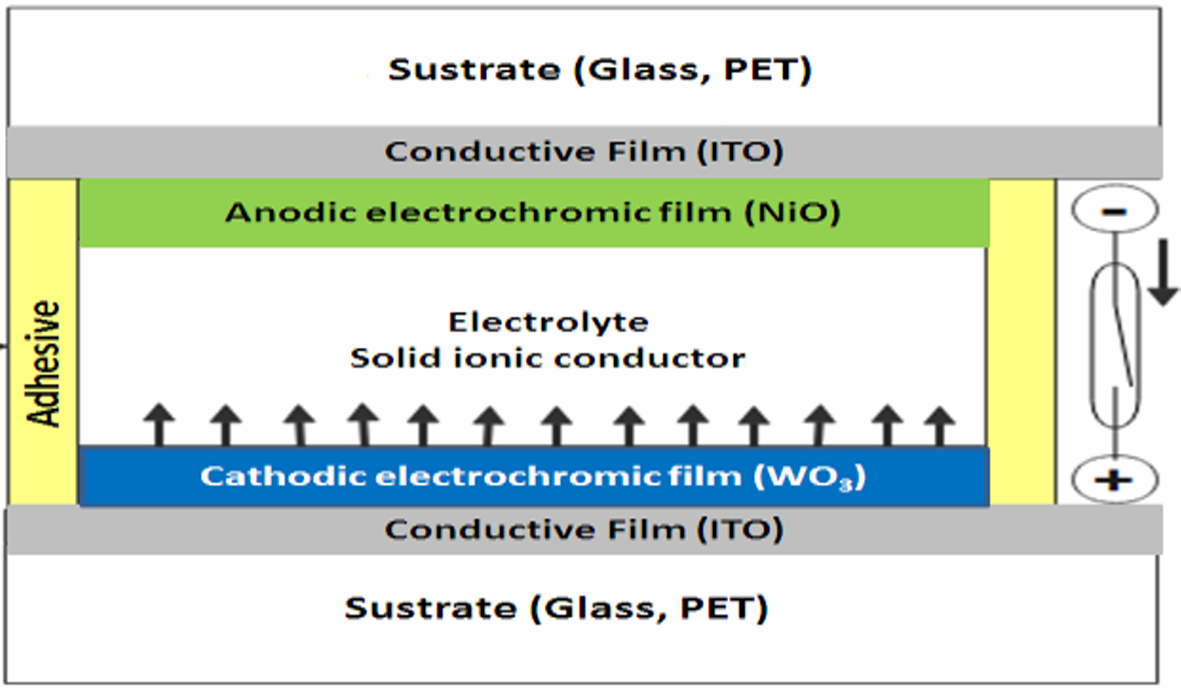
The reversible change in the optical properties of a material, which is produced by oxidation-reduction induced by electrochemical processes, is called electrochromism (Shi et al., 2020a). This process is exploited in the fabrication of electrodes by coating the surface of a transparent conductor with a thin film made of a conductive electrochromic material and by applying potentials that are sufficiently positive to induce oxidation (i.e., the extraction of electrons from the electrochromic material to the transparent electrode) and sufficiently negative to generate reduction, where a color change is observed (Fletcher, 2015) (Figure 1). These oxidation and reduction processes give rise to variations in the electronic structure of the material, i.e., a new distribution of occupied and unoccupied electronic levels, with exchanges in energy distances.
Figure 1: Electrochromic device design
Electrochromic films can be elaborated using different methods and techniques. Figure 2 consolidates the reports associated with electrochromism and different chromic film deposition methods. Regarding the number of publications, the magnetron sputtering technique far outperforms the others, including sol gel chemical deposition (dip coating) (Wen-Cheun et al., 2019). Other techniques with a smaller number of publications are electrochemical deposition (Kimura et al., 2018), thermal evaporation (El-Nahass et al., 2015), pulsed laser deposition (Farhad, 2021), spray pyrolysis, and spin coating (Paipitak et al., 2011).
Figure 2: Number of publications on different types of chromic material deposition.
Electrochromic devices must include at least two electrodes and an electrolyte layer. The color change takes place when electrochromic species transition from a transparent to a colored state. In general, electrochromic devices can be classified into three categories: in the first one, both the colored and transparent (bleached) species are soluble in the electrolyte (Marchisio et al., 2015); in the second one, the transparent state is soluble, while the colored state coats one of the electrolytes (Mendieta-Reyes et al., 2020); and, in the third one, both the bleached and colored species coat one electrode (Hidalgo-Rodríguez, 2002). Some important aspects considered in the development of electrochromic devices include a high transmittance (>50) in the transparent state and a low transmittance in the colored state (<10%), color change times of a few minutes, good durability (5-20 years), costs, potentials of 1-3 V for small areas and 10-24 V for large areas, high open circuit durability (1-12 h). The open circuit must also be able to operate within a wide range of temperatures (between -20 and 85 °C).
Multilayer devices, which consider sandwich structures, consist of inner active ion storage or counter electrode layers, an ion conductive layer (electrolyte), and an electrochromic film (working electrode), utilizing both organic and inorganic substances (Figure 3). Transparent electrode layers are designed while prioritizing a high transparency, low resistance, and easy deposition. Finally, the protective layers use substrates that can be rigid (e.g., glass) or made up of polymers, allowing for flexible systems such as polyethylene terephthalate (TEP).
Figure 3: Electrochromic device with different conductive polymers
The publications on electrochromism from 1960 to 2020 amount to 8 405, with a steeper slope in the last decade (Figure 4).
Figure 4: Evolution of publications on electrochromism
These figures reveal a more pronounced trend in Eastern countries, where technological application is in constant growth, followed by the United States. Figure 5 shows the countries reporting at least 200 related publications.
Figure 5: Publications on electrochromism by country
The Americas account for 16,84% of the publications. However, excluding the United States, only 473 contributions were considered (Figure 6). The particular case of Colombia exhibits a deficit in associated studies. According to Scopus, only five contributions feature Colombian researchers and three are linked to national universities (Chen P., 2020; Kalay et al., 2020), even though this country has mining resources such as W, Mo, Ni, Ti, and Zn, among others, which could be oriented towards the manufacture of electrochromic devices with technological added value (Zhang et al., 2020).
Figure 6: Publications in the Americas without the contribution of the United States
Electrochromic materials
Electrochromic materials fall into three categories: metal oxide films (De Ribamar-Martins-Neto et al., 2016), molecular dyes (Barile et al., 2017), and conducting polymers (Barus et al., 2018). Electrochromic layers switch their optical properties between their oxidized and reduced forms. In an electrochromic device based on cathodic and anodic layers, applying a voltage to transport ions between the two films in one direction causes both films to become colored, and transporting ions in the opposite direction decolorizes them. Thus, optical modulation and visual appearance can be extended by optimizing both electrochromic layers.
Table 1 exemplifies some electrochromic materials and their potential technological use: transition metal oxides, widely used in smart windows, thermochromics, satellite systems, and chemical paper; Prussian blue systems and metallic phthalocyanines that allow for different color ranges, which are used in monitors; viologen compounds, with applications in smart windows and smart mirrors (such as rear-view mirrors); and conductive polymers, which, in addition to mobile devices, are used in solar cells, artificial muscles, and smart windows.
Source: AuthorsTable 1: Electrochromic materials and potential technological applications
Metal oxides
Transition metal oxide films, e.g., iridium (Sun, 2015; Jang and Lee, 2020), rhodium (Jeong, 2020), ruthenium (Wang Y. et al., 2019), tungsten (Atak et al., 2020; Pan, 2020), molybdenum (Hasani, 2017), possess electrochromic properties, with tungsten oxide and molybdenum oxide being the most widely studied. This type of electrochromic material can be classified into inorganic electrochromic materials that can be deposited through vacuum evaporation (Sahu et al., 2017; Gupta et al., 2022b), sputtering (Murphy et al., 2016; Kumar et al., 2022; Kumar et al., 2022a; Kumar et al., 2022b), electrodeposition (Dulgerbaki et al., 2018), tungsten metal electrochemical oxidation (Lin, 2020), and the sol-gel method (Zhang et al., 2019), among others. Metal oxide films can be electrochemically modulated to a non-stoichiometric redox state, which has an intense electrochromic absorption band due to optical range charge transfer.
Transition metal oxides with electrochromic properties can be colored cathodically or anodically, depending on the material that is colored under ion injection or extraction, i.e., via a reduction or oxidation (Besnardiere, 2019). Cathodic coloration (blue) has been reported for Ti, Nb, Mo, Ta, and W oxides, with tungsten oxide (WO3) being the first and most widely studied. Anodic coloration (red) is associated with Cr, Mn, Fe, Co, Ni, Rh, and Ir oxides, with nickel oxide (NiO) and iridium oxide (Ir2O) being the most reported (Wang Z. et al., 2020; Ding, 2021).
Table 2 presents some examples of coloration changes in both oxidized and reduced states, as well as the applied potential range of cathodic and anodic ionic insertion materials that are colored through electrochemical oxidation. The studies are aimed at obtaining the highest contrast between the oxidized and reduced state, as well as shades in the entire color range.
Source: AuthorsTable 2: Electrochromic characteristics of some metal oxides
For cathodic oxides, the color variation can be established at any absorption level between states with maximum and minimum absorption. The mechanisms for optical absorption are still scarcely understood. However, they generally associated with charge transfer and polaron absorption (Sun, 2020; Szkoda et al., 2020; Rathika, 2020).
For example, WO3 exhibits a highly efficient blue coloration in amorphous films, which can reversibly change from transparent to dark blue by electrochemical redox reactions (Jittiarporn et al., 2017; ' Gupta et al., 2021; Gupta et al., 2022a). Coloration characteristics depend on the constitution and composition of the film, as well as on the atomic structure and size of the nanoparticles, pores, and adsorbed substances. The insertion/extraction process can be represented via the following Equations:
Tungsten trioxide, with all tungsten atoms in a W4+ oxidation state, is a transparent thin film. During electrochemical reduction, W5+ sites are generated to provide the electrochromic effect. The applications of electrochromism include manufacturing solid-state devices, where Li+ is most often used. Applications have also been reported with Al+3 ions, given their affinity with tungsten trioxide (Li W., 2020; Tang et al., 2020; Yao, 2020; Kumar et al., 2022b).
The properties of WO3 are combined with other electrochromic materials such as Nb2O5 (Tang, 2019), conductive polymers (Brooke et al., 2018), and viologens (Yu, 2020) to improve contrast and color change efficiency. In commercial applications, as is the case of prototype alphanumeric displays, electrochromic mirrors are employed (Kim, 2016).
Although the W4+/W5+ interval transition model mentioned above is the most accepted theory, which implies electron delocalization and is consistent with the conductivity enhancement that accompanies the insertion processes (Gesheva, 2016), other models involving non-localized electrons or band interaction (Meenakshi et al., 2016) have been proposed to explain the electrochromic mechanism of tungsten oxide and inorganic ion insertion compounds in general.
The characteristics of the electrochromic process can be conventionally examined by directly comparing the optical and electrochemical response of the WO3 electrode. The cyclic voltammetry and optical transmittance of a WO3 electrode has been measured in a cell with a Li+ ion-conducting electrolyte and a counter electrode (Dong,2018).
Among the anodic oxides, nickel oxides with Li+ electrolytes have been comprehensively studied. Nickel oxide can be bleached or colored by moving the Fermi level near the top of the valence band up or down. The electrochemical cycling of nickel oxide in different electrolytes takes place through the exchange of H+ and OH-. Given the nature of the film and the electrolyte, as well as the coloration mechanism of NiO, this is regarded as a surface phenomenon (Dong, 2020). After ion insertion and removal, the lattice constant of NiO exhibits changes in the grain unit cells (Kalanur et al., 2020). The coloration of nickel oxide is based on the transition between Ni2+ and Ni3+ (Morales-Torres et al., 2009)
Electrochromism has been studied under two possible cycling modes: the response between coloration and bleaching in steps of increasing potential (shift) and stepwise modulation towards coloration with increasing power and back to bleaching (modulation), observing that NiO films during oxidation exhibit a change in coloration (Chen P. et al., 2020). However, NiO films experience some issues such as inferior optical modulation and poor transparency in the bleached state. In this vein, doping with other transition metals such as Cu improves electrochromic performance with p-type conductivity for the films (Firat and Peksoz, 2019; Huang et al., 2018). Likewise, the addition of surfactants such as dodecyl sulfate entails changes in the microstructure, morphology, and electrochromic performance of NiO films (Pham et al., 2020).
Electrochromism and energy exchange functions can be achieved through redox reactions, indicating that the design of a bifunctional electrochromic energy storage device is feasible. In this context, NiO has been studied regarding its stability and compatibility with WO3 electrodes (Thummavichai et al., 2017). Interfacial charge transfer and ion transport generally cause a decrease in performance, which is due to irreversible redox reactions and ion accumulation or overpotential at the solution/electrode interface of a highperformance material. With the advent of multifunctional devices with electrochromic behavior and electrochemical energy storage capabilities, the complementary design of film structures using inorganic-organic materials has sparked great interest for applications in the field of optoelectronic research, as is the case of ambipolar electrochromic devices based on color-complementary WO3 films (Zeng, 2021). In the technological architecture of hybrid systems in the construction of multifunctional tandem devices, replacing the conventional counter electrodes in a sensitized solar cell based on n-type titanium dioxide with a p-type nickel oxide photocathode yields energy conversion efficiencies close to 8,0%.
The hybrid cell design of WO3 and NiO films obtained by sputtering reports a coloration efficiency of 360 cm2C-1 at 640 nm, which depends on sputtering conditions (Koo et al., 2020). The hexagonal electrode assembly of WO3 and NiO nanoplates allows obtaining optical modulation values of 67,6% at 630 nm, a coloration efficiency of 109,6 cm2C-1, fast switching speeds (7,9 s), and a cycle life with a remaining AT of 84,1% after 4 000 cycles (Thummavichai et al., 2017).
Another important factor affecting the electrochromic performance of NiO films is thickness; the optical transmission of the films decreases as their thickness increases. X-ray diffraction patterns reveal that polycrystalline phase and peak density increase with film thickness. The optical forbidden band decreases by about 0,2 eV with increasing film thickness, with values of 480 nm boasting a good performance (Atak and Cojkun, 2019). NiO nanocomposite films with gold for supercapacitor applications exhibit greatly enhanced pseudo-capacitive properties, 1,5 times higher than those of pure NiO (Jung, 2020).
Reports show more interest in NiO electrochromophores at the counter electrode, i.e., as a redox reagent at the second electrode of an electrochromic cell. Here, there is a reactive primary electrochrome, such as WO3 (Zheng, 2018) and conductive polymers such as poly(pyrrole), poly(thiophene), and poly(methylthiophene) (Liu Z., 2019). When it comes to the coloring mechanism, it should be noted that cathodic oxide (WO3) and anodic oxide (NiO) films are different regarding their electrochemical performance. Ions can enter the lattice structure of cathodic oxide, whereas, in a Li+-containing electrolyte, surface electrochemical processes dominate NiO films.
Viologens
The term viologen was coined by Michaelis and Hills for 4,4r-dipyridium compounds because they turn deep blue purple upon reduction. The ion may exhibit a two-step reduction, i.e., one electron, or a two-state reduction (Monk et al., 2015).
The most widely studied material in the viologen family is methyl viologen (MV). Elofson and Edsberg reported the first electron reduction of MV at 0,6 V vs. ECS. The coplanarity of the two heterocyclic nuclei facilitates a pH-independent, reversible reduction. The second electron reduction is not electrochemically reversible, but MV can be reoxidized by air. Reports state that the second reduction at 1,038 V vs. ECS is independent between 5,0 and 13,0 pH units and slightly dependent at a pH below 5,0 (Gugole, 2020).
Electrodes can be functionalized with electrochemically active polymeric materials derived from the hydrolytically unstable viologen, N, Nr-bis [-3-(trimethoxysilyl) propyl]-4,4r-bipyridinium dibromide, which shows potential for improved electrochromic efficiency in solid-state devices. Conventionally, electrochromic displays achieve contrast change by modulating light via the optical absorption of the electrodeposited film (Gugole, 2020).
The color change experienced by viologens is related to the functioning of the nitrogen substituent. For example, if the substituent is n-heptyl, a purple deposit is obtained; if it is p-cyano-phenyl, a green deposit is obtained. In addition, the electrical properties of the deposit can be tailored via the selection of the anion. Thus, for viologens of n-heptyl and bromide anions, the deposit is conductive, whereas the substitution of bromide with dihydrogen phosphate anions generates precipitates with insulating characteristics (Mishra, 2017). It has been reported that electrochromic devices based on viologens exhibit reversible multicolor changes at low voltages, with optical contrast values reaching 62,5% between 617 and 716 nm (Xu Z., 2020).
Conductive polymers
Conductive polymers have a leading role in the current challenges associated with efficient energy production. An example of this is their applications in fuel cells, with benefits for the economy and the versatility of shape and weight. Electroactive polymers show potential in technological applications such as electrodes in batteries (Wang L., 2020), microelectronics (Li S., 2020), electrochromic materials for sensor devices (Tsai et al., 2021), and catalyst support in fuel cells (Liu et al., 2019), among others. Conventionally, electrochromic displays achieve contrast change by modulating light via the optical absorption of the electrodeposited film, and they are good ionic and electronic conductors, with low processing costs and weight when compared to metallic materials used as electrodes.
Resistance to corrosive conditions in the cell and a porosity that enables permeability to ions (e.g., hydrogen ions) significantly increase the reaction area. The low thickness in comparison with metal oxides facilitates the serial assembly of several cells in reduced sizes, which has made electroactive polymers the most widely applied materials in fuel cells (Pandey, 2016). These are electrochromic materials that offer a high degree of color matching by coupling various polymer systems through functionalization and/or copolymerization of monomers, as well as through the use of blends, laminates, and composites. Complex colors are achieved by mixing two existing colors in a dual-polymer device. Electrochromic changes are induced by redox processes accompanied by ion insertion/expulsion, and the color exhibited by the polymer is closely related to the band gap and the doping ions. A focus area in the study of electrochromic polymeric materials is the control of their colors by modifying the structure of the main and pendant chain group. Polyheterocycles have proven to be of special interest in this regard due to their stability under ambient conditions (Gao et al., 2020). Table 3 provides a comparison of the electrochromic properties observed in the most widely studied conductive polymers.
Source: AuthorsTable 3: Electrochromic effect of some conductive polymers
Polypyrrole (PPy). The first PPy films were usually prepared via the electrochemical polymerization of pyrrole (Py) in an aqueous or organic solvent solution such as acetonitrile, together with a suitable electrolyte. This process involves the oxidation and dimerization of Py (Yin, 2020). The polymerization reaction involves two electrons per reacting Py molecule, and the resulting polymer is produced in an oxidized state with 0,25-0,33 cation centers per unit of Py depending on the electrolyte (Matysiak et al., 2020). The doped (oxidized) PPy film is blue-violet (Л max 670 nm), and electrochemical reduction produces an 'undoped' yellow-green form (Л max 420 nm) (Kazazi, 2019). PPy and polyindole (Pln)-based electrodes exhibit a high degree of flexibility, which makes them remarkably suitable and applicable for fabricating flexible supercapacitors. Py derivatives with methyl red (PMRPy) electropolymerized on glass electrodes improve chromatic contrast (A%T=34,2%), switching times (т=10 s), and stability (A%T=15% in the 100th cycle) with respect to Ppy films. Their coloration changes (magenta in acidic media and yellow in basic ones) can be used in pH sensors (Choudhary et al., 2020).
Polythiophene. The electrochromic properties of polythiophene and polymers of various substituted thiophenes are a matter of great interest, as color states can be tuned via the appropriate choice of thiophene monomer. For example, the electrochromic properties of polymer films prepared with 3-methylthiophene-based oligomers strongly depend on the relative positions of the methyl groups in the polymer's main chain (Table 4), and multicolor systems can be constructed by combining different conducting polymer species. Polyethylenedioxythiophene (PEDOT) can prevent halogen ion poisoning in the reactive area in protic media (Dias et al., 2019). PPy thin films can be prepared via the electrochemical polymerization of 3,4-ethylenedioxythiophene. During the electropolymerization process, the anion in the electrolyte directly influences the uniformity, morphology, and electrochromic performance of PEDOT films (Xu D., 2020).
Source: Zhang and Feng (2020)
Table 4: Most common polytyophenes and their coloration
Electrochromic layers of PEDOT copolymerized with polystyrene sulfonate (PSS) and intercalated on a Ni lattice (Chen, C. 2020), Au/PEDOT/Pt microtubes on WO3 films (Karaca et al., 2019), the imidazole/Fe(III) p-toluensulfonate weight ratio (Wang W., 2020), the adhesion to acidified nanostructured tubular nanostructured silicoaluminate clays, and Halloysite (HNT) (Hu et al., 2019) allow obtaining devices with short staining and decolorization times (less than 20 s), high optical contrast (close to 90%), staining efficiency (higher than 300 cm2C-1), and excellent mechanical reliability, which corresponds to optical contrast retention after 1 000 cycles (Zhang and Feng, 2020).
Polyaniline (PANI). The electrical and electrochromic properties of PANI depend on its oxidation state, its protonation state, the pH of the electrolyte used, the redox mechanisms involving protonation/deprotonation, and/ or the input/output of anions, which allows it to exhibit reversible color changes at the potential: transparent leukoesmeraldine to yellowish green emeraldine to dark blue-black pernigraniline in the potential range of -0,2 to + 1,0 V vs. SCE (Begum et al., 2013).
The use of donor-acceptor systems between PANI films and the porous spaces between them facilitates the diffusion of the ions involved in charge transfer reactions, exhibiting increased device performance, contrast parameters close to 38,5%, redox reaction efficiencies close to 200 cm2C-1, response speeds close to 1,0 s, and cyclic stability, with optical modulations of 98% for at least 5 000 cycles.
Some examples of multifunctional electrochromic devices that also exhibit energy storage capabilities and are based on organic/inorganic composites include the insertion of Cu(II) ions in PANI films (Deshmukh et al., 2017), nanostructured mesoporous Ni-PANI thin film electrodes (Inamdar et al., 2019), nanofibers of PANI entrapped in antimony-doped tin oxide, nanofilaments using aminophenyl diazonium cations as precursors of growth by electro-polymerization in silica mesochannels (Ullah et al., 2021), NiO nanoparticles functionalized with (3-aminopropyl) trimethoxysilane (3-APTS) subsequently attached to aniline monomers (Jamdegni and Kaur, 2020), W18O49/PANI hybrid films (Chang, 2018), and V2O5/ PANI composites obtained through in situ chemical oxidation polymerization (Zhang, 2018).
The versatility of polymers allows for couplings of different families, self-assemblies (e.g., polystyrene and PANI films using natural sedimentation and in situ polymerization of aniline monomers) (Wu, 2019), thin core/film structure formation through тт-тт stacking between aromatic rings of polydiphenylamine and monodisperse PANI via oxidative polymerization (Han et al., 2020), and semiconducting enzymatic polygalic acid (PGAL) templates with PEDOT and PANI in complexes that can be processed by sputter coating to produce flexible electrochromic devices (Díaz-Sánchez et al., 2019), among others, improving features such as the efficiency, contrast, and permutation cycles of smart windows.
The color change and conductivity of PANI films are applied in the design of other types of devices, such as multicolor immunoassay platforms for clinical diagnostics. With visible light excitation, Ag2S NPs@ZnO NTs generate electron holes. The photoelectrons pass into the PB and the photoinduced holes oxidize the PANI, causing color changes from emerald green to purple-blue and black depending on the carcinoembryonic antigen's concentration (Wang Y. et al., 2020). Conductive emulsions of PANI and polyacrylate (PA) obtained via chemical polymerization in the presence of poly (maleic anhydride-co-co-acrylic acid-co-sodium p-styrenesulfonate) as a stabilizer exhibit the electrical conductivity and mechanical properties necessary for applications in antistatic fabric finishing and functional textile development (Wu L. et al., 2018). Likewise, the structural stabilization of PANI films obtained by coating conductive carbon nanotube networks provides multiple directions for electron transfer and, therefore, improves charge capacity by forming 3D networks and enhancing optical transmittance and capacity, which is relevant in the construction of smart supercapacitors (Xu K., 2020).
Electrolytes
In electrochromic devices, when a potential is applied, the ions in the electrolyte are transported between the layers, generating a change in the transparency of the chromic material. The initial electrolyte prototypes had aqueous characteristics, entailing conductivities that were nowhere near the expected values (around 1 mS.cm-1) for industrial applications, which demand reliable, safe, and easily transportable and implementable architectures. Hence, there is a global search for electrolytes that allow manufacturing solid-state electrochromic devices.
Lithium-based electrolytes have gained great attention due to their environmental stability. They are made up of mixtures of LiClO4 and one or more polymers such as polyvinyl chloride (PVC) (Hernández, 2020), propylene carbonate (PC) and ethylene carbonate (EC) (Dalavi et al., 2020), and aprotic salt with polymethylmethacrylate (PMMA) (Ganesh et al., 2015), which entails a transmittance higher than 90% and a durability greater than 5 000 cycles. However, there are other types of electrolytes, e.g., ionic liquids such as coPIL, which is composed of trioxyethylene and tetraoxyethylene spacers containing 1,2,3-triazolium and offers high degradation temperatures (230 °C) and an ionic conductivity lower than 9x10⁻⁵ Scm-1. This has allowed for conversion times shorter than 12 s and stability after 3 000 cycles (Puguan and Kim, 2019). Gelatin-based solid electrolytes, cross-linked with formaldehyde, glycerol, acetic acid, and/ or HCl have also been used, obtaining ionic conductivity values of 1,28x10⁻⁵ Scm-1 and a percent transmittance of 98% at wavelengths above 580 nm (Ramadan et al., 2017). Environmentally friendly hydrogels containing deionized water, sodium carboxymethylchitosan, and vitamin C are used as electrolytes of the electrochromophore bis (2-(2-(2-(2-hydroxyethoxy) ethoxy) ethyl) viologen bromide, with colorless to purple shifts between 0 and -1,2 V (Zhang Y. et al., 2021), among others. Some authors integrate ITO/VO2/LiTaO3/WO3/ITO-type devices on glass substrates, where several chromic processes are evidenced: a thermochromic layer passively responding to ambient temperature, another electrochromic layer actively and simultaneously responding to external voltage, and reversible Li+ migration within the lattice at low bias voltages (Jia, 2019).
Table 5 compiles some focus points regarding potential electrochromic devices for use in smart windows.
Source: AuthorsTable 5: Electrochromic effect of some conductive polymers
Possibilities for chromic materials innovation in the Colombian industry
Colombia exhibits a significant extraction of Fe, Co, Ni, Mo, C, W, and Ti, mainly in the northern part of the country, Cundinamarca, and the coffee axis region, which would allow consolidating industrial applications with tungsten and nickel oxide inputs. There are also tungsten deposits in the departments of Guaviare, Vichada, and Caquetá, where extraction activities were carried out between 2012 and 2016. Although the country lacks information on the extraction or production of tungsten as a mineral, information from DANE allows stating that the national industries' consumption is centered on tungsten plates. Imports of tungsten come in the form of sintered bars (industrial materials composed of tungsten) and not in the mineral's raw form. On the other hand, the country showed exports of 87 metric tons between 2012 and 2015 (Prieto et al., 2019). Likewise, in Colombia, there are six nickel deposits, three of which are in the Caribbean region, i.e., in the department of Córdoba: Cerro Matoso, Planeta Rica, and Uré. The remaining three are in the department of Antioquia: Ituango, Morro Pelón, and Medellín. Colombian nickel production remains above 40 000 tons since 2012 (DNP, 2017). Data as of 2018 establish Colombia as the first producer of nickel in South America and the third in Central America and the Caribbean, only after Cuba and the Dominican Republic (MinMinas, 2018).
A strategic union between academia and national companies could be the link that the national glass industry needs to become a beacon of electrochromic, gasochromic, or thermochromic technologies. Colombia has industries in the manufacture of flat glass whose inputs are national, such as Tecnoglass SA, Cristar SAS, Cristalería Peldar SA, AGP de Colombia SA, and Fiberglass Colombia SA, among others. The import of raw materials does not exceed 16%, and, regarding mirrors and fibers, it does not reach 19%. Plates and smooth sheets of cast or laminated, unassembled, colored, opacified, and plated glass, as well as glass with absorbent, reflective, or anti-reflective coating, are the most traded products abroad. The United States accounts for 60,25% of the exports, followed by Mexico with 7,76%, Ecuador with 7,65%, and Peru 7,15% (Legis-Comex, 2017).
The manufacture of chemical products in Colombia, which has all the necessary inputs to produce chromic technologies, grew with a compound annual rate of 8,5% between 2000 and 2018. The departments with the highest production of chemical products are Cundinamarca, Antioquia, Valle, and Bolívar. Between 2014 and 2016, the gross production of this sector increased by 21,1%. However, 8,4% of their production facilities closed. Projections for 2030 show a compound annual growth rate of 6,5%, with a market growth rate higher in proportion than that of production (4,7% by 2032) (MinCIT, 2019a). The expectations regarding innovation programs and the strengthening of the chemical supply chain, which include chromic devices, should provide added value, allowing the Colombian chemical industry to replace current imports (MinCIT, 2019b).
Industrial-level scientific initiatives on topics related to smart windows and mirrors can be covered by the lines of research that MINCIENCIAS has been promoting, which focus on converging technologies and the Industry 4.0, especially on nanotechnology, competitiveness, and productivity; sustainable energy, aiming for energy efficiency in heating systems, lighting in urban areas, direct and indirect heat, and/or efficient energy management; and geosciences, promoting the identification, characterization, quantification, and industrial exploitation of mineral deposits with added value (MinCiencias and Vicepresidencia de la República de Colombia, 2020).
The qualified human resources for the implementation and research of chromic devices or related technologies and materials can be supported by more than 50 research groups endorsed by MinCiencias in the 2021 call for proposals (MinCiencias, 2022). In addition, the higher education system has more than 180 professional technical and technological programs, technological specializations, and professional technical specializations, as well as more than 140 professional programs and more than 170 postgraduate programs in areas such as nanotechnology, materials, geology, electronics, clean technologies, energy resources, automation of industrial processes, mines, and chemistry, among others (SNIES, 2021). These programs can be oriented towards theoretical and experimental competencies in innovation in the implementation of industries associated with electrochromic, photochromic, and gasochromic technological devices, in addition to fuel cells, smart windows, and mirrors, among others.
Finally, as for the feasibility of implementing industries that apply chromic properties, the differential capabilities of the Colombian industry should be highlighted. The availability of natural resources; the country's location; free trade agreements with consumer and producer countries; the culture of cost reduction, quality, and compliance with requirements, regulations, and standards; the institutions that promote the culture of continuous improvement to the production process (Colombia Productiva, INNpulsa and Pro-Colombia); and customer service levels are all factors to be leveraged by companies. However, there is a need to streamline government processes, to train personnel in export policies, to promote internalization in productive clusters that project the acquisition of investors, to support new regulations, and to establish productive linkages in the chemical sector through dialogues aimed at collective development.
Conclusions
Studíes on the physíca! and chemícaI properties of diverse organíc and ¡norgamc eIectrochrom¡c matenaIs show potent¡aI for the manufacture of eIectrochrom¡c dev¡ces w¡th ¡ndustr¡aI appI¡cat¡ons such as rear-v¡ew m¡rrors ¡n the automot¡ve sector, aIphanumer¡c screens, mon¡tors, and ¡nteII¡gent w¡ndows, among others. Among the ¡norgan¡c mater¡aIs used, N¡O (anod¡c ox¡de) and WO3 (cathod¡c ox¡de) stand out, wh¡ch couId be regarded as classical electrochromic materials s¡nce they boast a better eIectrochrom¡c performance. CoupI¡ngs have been made for them w¡th organ¡c mater¡aIs such as conduct¡ve and v¡oIogen poIymers ¡n the construct¡on of soI¡d-state dev¡ces. In add¡t¡on to eIectrochrom¡c propert¡es, stud¡es on eIectrochrom¡c dev¡ces have shown a tendency towards the moduIat¡on of rad¡at¡on ¡n the near-¡nfrared, thermaI-¡nfrared, and m¡crowave reg¡ons. 'CoIor' may represent the detectors' response to these waveIengths (i.e., thermochrom¡c, photochrom¡c) as weII as energy storage capac¡ty ¡n the manufacture of supercapac¡tors. W¡despread appI¡cat¡ons of arch¡tecturaI eIectrochrom¡c dev¡ces reIy on reduc¡ng costs, ¡ncreas¡ng the usefuI I¡fe of the dev¡ce, and overcom¡ng the ¡ssue of degradat¡on. Thus, the use of poIymer eIectroIytes w¡th I¡th¡um ¡ons has been w¡deIy stud¡ed, as weII as ¡nnovat¡ons w¡th ¡on¡c I¡qu¡ds and poIymers w¡th a Iow env¡ronmentaI ¡mpact.
The trajectory of the CoIomb¡an ¡ndustr¡aI sector, together w¡th the human taIent ¡n IocaI research groups, and the tra¡n¡ng offer for personnel at all levels (technical, professional, and postgraduate) are ¡nputs for the potent¡aI ¡mpIementat¡on of an ¡ndustry w¡th great soc¡aI and econom¡c ¡mpact. CoIomb¡a has m¡n¡ng resources and compan¡es ¡n the gIass sector and ¡n the manufacture of chem¡caI products that, ¡f d¡rected towards industrial innovation clusters and leveraged by different sectors of the government and nat¡onaI and ¡nternat¡onaI Investors, couId enta¡I the estabI¡sh¡ng of compan¡es w¡thchrom¡c apphcations ¡n the med¡um term, espec¡aIIy regardmg the use of ¡norgan¡c ¡nputs. In the Iong term, ¡f the countr''s chem¡caI ¡ndustry, wh¡ch works w¡th petroIeum der¡vat¡ves, shows ¡nterest ¡n obta¡n¡ng ¡nputs reIated to conduct¡ve poIymer monomers and v¡oIogens appI¡cabIe ¡n chrom¡c dev¡ces, the need to project the manufacture of organ¡c and ¡norgan¡c chrom¡c mater¡aIs couId be resoIved.
Acknowledgements
The authors wouId I¡ke to thank D¡recc¡ón GeneraI de Invest¡gac¡ones (DGI) of Un¡vers¡dad Sant¡ago de CaI¡ for fund¡ng the project 939-621119-477.
References
CRediT author statement ConceptuaI¡zat¡on L.F.H.P. and S.P.C.N. MethodoIogy: aII authors. VaI¡dat¡on and formaI anaIys¡s: aII authors. Wr¡t¡ng (or¡g¡naI draft, rev¡ew): L.F.H.P. and S.P.C.N. Ed¡t¡ng: S.P.C.N. and A.J.A. AII authors have read and agreed to the pubI¡shed vers¡on of the manuscr¡pt
References
Atak, G., and Coşkun, Ö. D. (2019). Effects of anodic layer thickness on overall performance of all-solid-state electrochromic device. Solid State Ionics, 341, 115045. https://doi.org/10.1016/j.ssi.2019.115045
Atak, G., Bayrak Pehlivan, İ., Montero, J., Primetzhofer, D., Granqvist, C., G., and Niklasson, G. A. (2020). Electrochromism of nitrogen-doped tungsten oxide thin films. Materials Today Proceedings, 33(6), 2434-2439. https://doi.org/10.1016/j.matpr.2020.01.332
Barile, C. J. Slotcavage, D. J. Hou, J. Strand, M. T. Hernandez, T. S., and McGehee, M. D. (2017). Dynamic windows with neutral color, high contrast, and excellent durability using reversible metal electrodeposition. Joule, 1(1), 133-145, https://doi.org/10.1016/j.joule.2017.06.001
Barus, D. A., Sebayang, K., Ginting, J., and Ginting, R. T. (2018). Effect of chemical treatment on conducting polymer for flexible smart window application. Journal of Physics: Conference Series, 1116(3), 4-9. https://doi.org/10.1088/1742-6596/1116/3/032006
Bayrak Pehlivan, İ., Atak, G., Niklasson, G. A., Stolt, L., Edoff, M., and Edvinsson, T. (2021). Electrochromic solar water splitting using a cathodic WO3 electrocatalyst, Nano Energy, 81, 105620. https://doi.org/10.1016/j.nanoen.2020.105620
Begum, A. N., Dhachanamoorthi, N., Saravanan, M. E. R., Jayamurugan, P., Manoharan, D., and Ponnuswamy, V. (2013). Influence of annealing effects on polyaniline for good microstructural modification. Optik, 124(3), 238-242. https://doi.org/10.1016/j.ijleo.2011.11.096
Besnardiere J. (2019). Structure and electrochromism of two-dimensional octahedral molecular sieve h’-WO 3. Nature Communications, 10(1), 1-9. https://doi.org/10.1038/s41467-018-07774-x
Brooke, R., Edberg, J., Iandolo, D., Berggren, M., Crispin, X., and Engquist, I. (2018). Controlling the electrochromic properties of conductive polymers using UV-light. Journal of Materials Chemistry C, 6, 4663-4670. https://doi.org/10.1039/c7tc05833k
Bulja, S. (2017). Tuneable dielectric and optical characteristics of tailor-made inorganic electro-chromic materials. Nature Scientific Reports, 7, 3-10. https://doi.org/10.1038/s41598-017-13941-9
Chang, X. (2018). Sunlight-charged electrochromic battery based on hybrid film of tungsten oxide and polyaniline. Applied Surface Science, 441, 105-112. https://doi.org/10.1016/j.apsusc.2018.02.003
Chen, C. (2020). High-performance embedded nickel grid electrodes for fast-response and bendable all-solid PEDOT: PSS electrochromic devices. Organic Electronics, 77, 105506. https://doi.org/10.1016/j.orgel.2019.105506
Chen, X. (2020). Bio-inspired flexible vibration visualization sensor based on piezo-electrochromic effect. Journal of Materiomics, 6(4), 643-650. https://doi.org/10.1016/j.jmat.2020.06.002
Chen, P. W., Te-Chang, C., Ko, T. F., Hsu, S. C., Li, K. D., and Wu, J. Y. (2020). Fast response of complementary electrochromic device based on WO3/NiO electrodes. Nature Scientific Reports, 10, 1-12, https://doi.org/10.1038/s41598-020-65191-x
Choudhary, R. B., Ansari, S., and Purty, B. (2020). Robust electrochemical performance of polypyrrole (PPy) and polyindole (PIn) based hybrid electrode materials for supercapacitor application: A review. Journal of Energy Storage, 29, 101302. https://doi.org/10.1016/j.est.2020.101302
Dalavi, D. S., Bhosale, A. K., Desai, R. S., and Patil, P. S. (2020). Energy efficient electrochromic smart windows based on highly stable CeO2-V2O5 optically passive counter electrode. Materials Today: Proceedings, 43, 4, 2702-2706. https://doi.org/10.1016/j.matpr.2020.06.146
DANE (2020a). Boletín técnico PIB IV trimestre 2019. https://www.dane.gov.co/files/investigaciones/boletines/pib/bol_PIB_IVtrim19_producion_y_gasto.pdf
DANE (2020b). Boletín técnico pobreza monetaria en Colombia año 2019. https://www.dane.gov.co/files/investigaciones/condiciones_vida/pobreza/2019/Boletin-pobreza-monetaria_2019.pdf
De Ribamar-Martins-Neto, J., Torresi, R. M., and Cordoba De Torresi, S. I. (2016). Electrochromic behavior of WO3 nanoplate thin films in acid aqueous solution and a protic ionic liquid. Journal of Electroanalytical Chemistry, 765, 111-117. https://doi.org/10.1016/j.jelechem.2015.08.032
Deshmukh, M. A., Gicevicius, M., Ramanaviciene, A., Shirsat, M. D., Viter, R., and Ramanavicius, A. (2017). Hybrid electrochemical/electrochromic Cu(II) ion sensor prototype based on PANI/ITO-electrode. Sensors and Actuators B: Chemical, 248(II), 527-535. https://doi.org/10.1016/j.snb.2017.03.167
Dias, O. A. T., Konar, S., Leão, A. L., and Sain, M. (2019). Flexible electrically conductive films based on nanofibrillated cellulose and polythiophene prepared via oxidative polymerization. Carbohydrate Polymers, 220, 79-85. https://doi.org/10.1016/j.carbpol.2019.05.057
Díaz-Sánchez, J., Roquero, P., Hernández-Alcántara, J. M., Rosas-Aburto, A., Vázquez-Torres, H., and Gimeno, M. (2019). Complementary electrochromic devices of PANI and PEDOT using the enzymatic poly(gallic acid). Solar Energy Materials and Solar Cells, 200, 109973. https://doi.org/10.1016/j.solmat.2019.109973.
Ding, S. (2021). High-temperature flame spray pyrolysis induced stabilization of Pt single-atom catalysts. Applied Catalysis B: Environmental, 281, 119471. https://doi.org/10.1016/j.apcatb.2020.119471
Departamento Nacional de Planeación (DNP) (2017). Vidrio en Colombia. https://www.revistaespacios.com/a02v23n01/02230122.htm
Dong D. (2018). Enhanced electrochromism in short wavelengths for NiO:(Li, Mg) films in full inorganic device ITO/NiO:(Li, Mg)/Ta2O5/WO3/ITO. Electrochimical Acta, 263, 277-285. https://doi.org/10.1016/j.electacta.2018.01.049
Dong, D. (2020). Electrochromic and colorimetric properties of anodic NiO thin films: Uncovering electrochromic mechanism of NiO. Electrochimical Acta, 335, 135648. https://doi.org/10.1016/j.electacta.2020.135648
Dulgerbaki, C., Maslakci, N. N., Komur, A. I., and Oksuz, A. U. (2018) Electrochromic strategy for tungsten oxide/polypyrrole hybrid nanofiber materials. European Polymer Journal, 107, 173-180. https://doi.org/10.1016/j.eurpolymj.2018.07.050
El-Nahass, M. M., Saadeldin, M. M., Ali, H. A. M., and Zaghllol, M. (2015). Electrochromic properties of amorphous and crystalline WO3 thin films prepared by thermal evaporation technique. Materials Science in Semiconductor Processing, 29, 201-205. https://doi.org/10.1016/j.mssp.2014.02.051
Farhad, S. F. U. (2021). The effect of substrate temperature and oxygen partial pressure on the properties of nanocrystalline copper oxide thin films grown by pulsed laser deposition. Data in Brief, 34, 106644. https://doi.org/10.1016/j.dib.2020.106644
First, Y. E., and Peksoz, A. (2019). Efficiency enhancement of electrochromic performance in NiO thin film via Cu doping for energy-saving potential. Electrochimica Acta, 295, 645-654. https://doi.org/10.1016/j.electacta.2018.10.166
Fletcher, S. (2015). The definition of electrochromism. Journal of Solid State Electrochemistry, 19, 3305-3308. https://doi.org/10.1007/s10008-015-3039-9
Ganesh, G. P. T., Ravi, R., and Deb, B. (2015). A pragmatic approach to methyl methacrylate based solid polymer electrolyte processing: A case study for electrochromism. Solar Energy Materials and Solar Cells, 140, 17-24. https://doi.org/10.1016/j.solmat.2015.03.022
Gao, S., Sun, F., Liu, N., Yang, H., and Cao, P.-F. (2020). Ionic conductive polymers as artificial solid electrolyte interphase films in Li metal batteries–A review, Materials Today, 40, 140-159. https://doi.org/10.1016/j.mattod.2020.06.011
Gesheva, K. (2016). Optical, structural and electrochromic properties of sputter-deposited W-Mo oxide thin films. Journal of Physics: Conference Series, 764, 012010. https://doi.org/10.1088/1742-6596/764/1/012010
Gugole, M. (2020). High-contrast switching of plasmonic structural colors: Inorganic versus organic electrochromism. ACS Photonics, 7(7), 1762-1772. https://doi.org/10.1021/acsphotonics.0c00394.
Gupta, J., Shaik, H., Kumar, K. N. (2021). A review on the prominence of porosity in tungsten oxide thin films for electrochromism. Ionics, 27(6), 2307-2334. https://doi.org/10.1007/s11581-021-04035-8
Gupta, J., Shaik, H., Kumar, K. N., and Sattar, S. A. (2022a). PVD techniques proffering avenues for fabrication of porous tungsten oxide (WO3) thin films: A review. Materials Science in Semiconductor Processing, 143, 106534. https://doi.org/10.1016/j.mssp.2022.106534
Gupta, J., Shaik, H., Kumar, K. N., Sattar, S. A., and Reddy, G. A. (2022). Optimization of deposition rate for E-beam fabricated tungsten oxide thin films towards profound electrochromic applications. Applied Physics A, 128(6), 498. https://doi.org/10.1007/s00339-022-05609-7
Han, W. J., Lee, J. H., and Choi, H. J. (2020). Poly(diphenylamine)/polyaniline core/shell composite nanospheres synthesized using a reactive surfactant and their electrorheology. Polymer, 188, 122161. https://doi.org/10.1016/j.polymer.2020.122161
Hasani A. (2017). Facile solution synthesis of tungsten trioxide doped with nanocrystalline molybdenum trioxide for electrochromic devices. Scientific Reports, 7(1), 1-10. https://doi.org/10.1038/s41598-017-13341-z
Hernández, T. S. (2020). Electrolyte for improved durability of dynamic windows based on reversible metal electrodeposition. Joule, 4(7), 1501-1513. https://doi.org/10.1016/j.joule.2020.05.008
Hidalgo-Rodríguez., J. (2002). Electrocromismo de los metales de transición. [Undergraduate thesis, Universidad Nacional de Ingeniería]. http://repositorio.uni.edu.pe/bitstream/uni/9151/1/hidalgo_rj.pdf
Ho, C. H., Kuo, Y. M., Chan, C. H., and Ma, Y. R. (2015). Optical characterization of strong UV luminescence emitted from the excitonic edge of nickel oxide nanotowers. Scientific Reports, 5, 1-7. https://doi.org/10.1038/srep15856
Hu, F., Peng, H., Zhang, S., Gu, Y., Yan, B., and Chen, S. (2019). PEDOT nanoparticles fully covered on natural tubular clay for hierarchically porous electrochromic film. Solar Energy Materials and Solar Cells, 199, 59-65. https://doi.org/10.1016/j.solmat.2019.04.017
Huang, Q., Zhang, Q., Xiao, Y., He, Y., and Diao, X. (2018). Improved electrochromic performance of NiO-based thin films by lithium and tantalum co-doping. Journal of Alloys and Compounds, 747, 416-422. https://doi.org/10.1016/j.jallcom.2018.02.232
Inamdar, A. I., Chavan, H. S., Kim, H., and Im, H. (2019). Mesoporous Ni-PANI composite electrode for electrochromic energy storage applications. Solar Energy Materials and Solar Cells, 201, 110121. https://doi.org/10.1016/j.solmat.2019.110121
Jamdegni, M., and Kaur, A. (2020). Highly efficient dark to transparent electrochromic electrode with charge storing ability based on polyaniline and functionalized nickel oxide composite linked through a binding agent. Electrochimica Acta, 331, 135359. https://doi.org/10.1016/j.electacta.2019.135359
Jang, H., and Lee, J. (2020). Iridium oxide fabrication and application: A review. Journal of Energy Chemistry, 46, 152-172. https://doi.org/10.1016/j.jechem.2019.10.026
Jeong, C. Y. (2020). Electrochromic properties of sputter-deposited rhodium oxide thin films of varying thickness. Thin Solid Films, 709, 138226. https://doi.org/10.1016/j.tsf.2020.138226
Jia, H. (2019). Dual-response and Li+-insertion induced phase transition of VO2-based smart windows for selective visible and near-infrared light transmittance modulation. Solar Energy Materials and Solar Cells, 200, 110045. https://doi.org/10.1016/j.solmat.2019.110045
Jiang, F., Zheng, T., and Yang, Y. (2008). Preparation and electrochromic properties of tungsten oxide and iridium oxide porous films. Journal of Non-Crystalline Solids, 354(12-13), 1290-1293. https://doi.org/10.1016/j.jnoncrysol.2006.10.083
Jittiarporn, P., Badilescu, S., Al-Sawafta, M. N., Sikong, L., and Van-Truong, V. (2017). Electrochromic properties of sol-gel prepared hybrid transition metal oxides – A short review. Journal of Science: Advanced Materials and Devices, 2(3), 286-300. https://doi.org/10.1016/j.jsamd.2017.08.005
Jung, H. K. (2020). Au-incorporated NiO nanocomposite thin films as electrochromic electrodes for supercapacitors. Electrochimica Acta, 330, 135203. https://doi.org/10.1016/j.electacta.2019.135203
Kalanur, S. S., Noh, Y. G., and Seo, H. (2020). Engineering band edge properties of WO3 with respect to photoelectrochemical water splitting potentials via a generalized doping protocol of first-row transition metal ions. Applied Surface Science, 509, 145253. https://doi.org/10.1016/j.apsusc.2020.145253
Kalay, I., Yiğit, D., Güllü, M., Depci, T., Toppare, L., and Hacioglu, S. O. (2020). Enhancing electrochemical and electrochromic performances of carbazole comprising monomer via copolymerization with 3,4-ethylenedioxythiophene (EDOT). Synthetic Metals, 267, 116449. https://doi.org/10.1016/j.synthmet.2020.116449
Karaca, G. Y., Eren, E., Cogal, G. C., Uygun, E., Oksuz, L., and Uygun A. Oksuz (2019). Enhanced electrochromic characteristics induced by Au/PEDOT/Pt microtubes in WO3 based electrochromic devices. Opical Materials, 88, 472–478, https://doi.org/10.1016/j.optmat.2018.11.052
Kazazi, M. (2019). High-performance electrode based on electrochemical polymerization of polypyrrole film on electrophoretically deposited CNTs conductive framework for supercapacitors. Solid State Ionics, 336, 80-86. https://doi.org/10.1016/j.ssi.2019.03.021
Kim, H. N. (2016). Electrochromic mirror using viologen-anchored nanoparticles. Materials Research Bulletin, 82, 16-21. https://doi.org/10.1016/j.materresbull.2016.03.010
Kimura, R., Tsuboi, A., Nakamura, K., and Kobayashi, N. (2018). Effects of silver halide complexes on optical and electrochemical properties of silver deposition-based electrochromic device. Solar Energy Materials and Solar Cells, 177, 128-133. https://doi.org/10.1016/j.solmat.2017.01.014
Koo, B. R., Jo, M. H., Kim, K. H., and Ahn, H. J. (2020). Multifunctional electrochromic energy storage devices by chemical cross-linking: Impact of a WO3·H2O nanoparticle-embedded chitosan thin film on amorphous WO3 films. NPG Asia Materials, 12(1), 10. https://doi.org/10.1038/s41427-019-0193-z
Kumar, N., Alam, F., Dwivedi, C., and Dutta, V. (2016). In-situ fabrication of metal-semiconductor (M-S) plasmonic thin films by a chemical spray pyrolysis technique: Optical properties. Solar Energy Materials and Solar Cells, 144, 352-358. https://doi.org/10.1016/j.solmat.2015.09.030
Kumar, K. N., Shaik, H., Gupta, J., Sattar, S. A., Jafri, R. I., Pawar, A., Madhavi, H., Reddy G. V., A., and Nithya, G. (2022). Sputter deposited tungsten oxide thin films and nanopillars: electrochromic perspective. Materials Chemistry and Physics, 278, 125706. https://doi.org/10.1016/j.matchemphys.2022.125706
Kumar, K. N., Nithya, G., Shaik, H., Hemanth, B., Chethana, M., Kishore, K., Madhavi, V., Imran Jafri, R., Sattar, S. A., Gupta, and Reddy, G. V. A. (2022a). Simulation and fabrication of tungsten oxide thin films for electrochromic applications. Physica B: Condensed Matter, 640, 413932. https://doi.org/10.1016/j.physb.2022.413932
Kumar, K. N., Shaik, H., Pawar, A., Chandrashekar, L. N., Sattar, S. A., Nithya, G., Imran Jafri, R., Madhavi, V., Gupta, J., and Reddy, G. V. A. (2022b). Effect of annealing and oxygen partial pressure on the RF sputtered WO3 thin films for electrochromic applications. Materials Today: Proceedings, 59, 339-344. https://doi.org/10.1016/j.matpr.2021.11.185
Kumar, K. N., Shaik, H., Chandrashekar, L. N., Aishwarya, P., Sattar, S. A., Nithya, G., Madhavi, V., Imran Jafri, R., Gupta, J., and Reddy, G. V. A. (2022c). On ion transport during the electrochemical reaction on plane and GLAD deposited WO3 thin films. Materials Today: Proceedings, 59, 275-282. https://doi.org/10.1016/j.matpr.2021.11.113
Legis-Comex, Sistema de Inteligencia Comercial, Inteligencia de Mercados (2017). Informe sectorial de vidrio en Colombia 2017. https://www.legiscomex.com/BancoMedios/Documentos%20PDF/informe-sectorial-sector-vidrio-colombia-2017-completo-rci318.pdf
Li W. (2020). Preparation and performance of fast-response ITO/Li-NiO/Li-WO3/ITO all-solid-state electrochromic devices by evaporation method. Materials Letters, 265, 127464. https://doi.org/10.1016/j.matlet.2020.127464
Li, B., Liu, J., Tian, S., Liu, B., Yang, X., Yu, Z., and Zhao, X. (2019). VO2-ZnO composite films with enhanced thermochromic properties for smart windows. Ceramics International, 46(13), 2758-2763. https://doi.org/10.1016/j.ceramint.2019.09.264
Li, S. (2020). Grafting polymer from oxygen-vacancy-rich nanoparticles to enable protective layers for stable lithium metal anode. Nano Energy, 76, 105046. https://doi.org/10.1016/j.nanoen.2020.105046
Lin K. (2020). Star-shaped trithiophene and hexathiophene functionalized truxenes: Synthesis, electropolymerization, and electrochromism. Reactive & Functional Polymers, 154, 104. https://doi.org/10.1016/j.reactfunctpolym.2020.104674
Liu, Z. (2019). Three-dimensional ordered porous electrode materials for electrochemical energy storage. NPG Asia Materials, 11, 12. https://doi.org/10.1038/s41427-019-0112-3
Liu, Z., Shang, S., Chiu, K.-I., Jiang, S., and Dai, F. (2019). Fabrication of conductive and flame-retardant bifunctional cotton fabric by polymerizing pyrrole and doping phytic acid. Polymer Degradation and Stability, 167, 277-282. https://doi.org/10.1016/j.polymdegradstab.2019.06.029
Marchisio, S., Lerro, F., and Von Pamel, O. (2015). Empleo de un laboratorio remoto para promover aprendizajes significativos en la enseñanza de los dispositivos electrónicos. Píxel-Bit. Revista de Medios y Educación, 38, 129-139. http://www.redalyc.org/pdf/368/36816200010.pdf
Matysiak, W., Tański, T., Smok, W., Gołombek, K., and Schab-Balcerzak, E. (2020). Effect of conductive polymers on the optical properties of electrospun polyacrylonitryle nanofibers filled by polypyrrole, polythiophene and polyaniline. Applied Surface Science, 509, 145068. https://doi.org/10.1016/j.apsusc.2019.145068
Meenakshi, M., Sivakumar, R., Perumal, P., and Sanjeeviraja, C. (2016). Studies on electrochromic properties of RF sputtered vanadium oxide: Tungsten oxide thin films. Materials Today: Proceedings, 3, S30-S39. https://doi.org/10.1016/j.matpr.2016.01.005
Mendieta-Reyes, N. E., Cheuquepán, W., Rodes, A., and Gómez, R. (2020). Spectroelectrochemical study of CO2 reduction on TiO2 electrodes in acetonitrile. ACS Catalysis, 10(1), 103-113. https://doi.org/10.1021/acscatal.9b02932
Ministerio Colombiano de Ciencia, Tecnología e innovación (MINCIENCIAS) and Vicepresidencia de la República de Colombia (2020). Misión Internacional de sabios: Colombia y la nueva revolución industrial. https://doi.org/10.17230/9789585135116vdyc
Ministerio Colombiano de Ciencia, Tecnología e innovación (MINCIENCIAS) (2022). Base de datos, grupos de investigación. https://minciencias.gov.co/sites/default/files/convocatoria/listado_resultados_preliminares_-_convocatoria_894_de_2021_-_grupos.pdf
Ministerio Colombiano de Comercio (MINCIT) (2019a). Plan de Negocios Sector de Plásticos a 2032. https://www.colombiaproductiva.com/ptp-capacita/publicaciones/sectoriales/publicaciones-plasticos-y-pinturas/plan-de-negocio-industria-de-plasticos-2019-2032
Ministerio Colombiano de Comercio (MINCIT). Plan de Negocios Sector de Químicos Visión a 2032. https://www.colombiaproductiva.com/ptp-capacita/publicaciones/sectoriales/publicaciones-quimica-basica/plan-de-negocio-industria-quimica-basica-2019-2032
Ministerio Colombiano de Minas y Energía (MINMINAS) (2018). Níquel caracterización y análisis de mercado internacional de minerales en el corto, mediano, y largo plazo con vigencia al año 2035. https://www1.upme.gov.co/simco/Cifras-Sectoriales/Datos/mercadointer/Producto2_Niquel_FINAL_12DIC2018.pdf#search=niquel
Mishra, S. (2017). Live spectroscopy to observe electrochromism in viologen based solid state device. Solid State Communications, 261, 17-20, https://doi.org/10.1016/j.ssc.2017.05.020
Monk, P. M. S., Rosseinsky, D. R., and Mortimer, R. J. (2015). Electrochromic materials and devices based on viologens. Electrochromic Materials and Devices, 77, 57-90. https://doi.org/10.1002/9783527679850.ch3
Morales-Torres, J.A., Olaya-Florez, J.-J., and Rojas, H. F. (2009). Evaluación de la capacidad protectora de recubrimientos Ni-SiC y Ni-Co-W depositados por proyección térmica. Dyna, 76(160) 195-206. http://www.scielo.org.co/scielo.php?script=sci_arttext&pid=S0012-73532009000400019
Murphy, N. R., Moreno-Tarango, A. J., Ramana, C. V., Sun, L., Jones, J. G., and Grant, J. T. (2016). Hybrid co-deposition of molybdenum doped niobium pentoxide (NbxMoyOz) thin films. Journal of Alloys and Compounds, 681, 350-358. https://doi.org/10.1016/j.jallcom.2016.04.233
OECD (2019) Economic Surveys, 48. http://www.oecd.org/economy/surveys/Overview_Colombia_ESP.pdf
Paipitak, K., Kahattha, C., Techitdheera, W., Porntheeraphat, S., and Pecharapa, W. (2011). Characterization of Sol-gel derived Ti-doped tungsten oxide electrochromic thin films. Energy Procedia, 9, 446-451. https://doi.org/10.1016/j.egypro.2011.09.050
Pan, J. (2020). A high-performance electrochromic device assembled with hexagonal WO3 and NiO/PB composite nanosheet electrodes towards energy storage smart window. Solar Energy Materials and Solar Cells, 207, 110337. https://doi.org/10.1016/j.solmat.2019.110337
Pandey, S. (2016). Highly sensitive and selective chemiresistor gas/vapor sensors based on polyaniline nanocomposite: A comprehensive review” Journal of Science: Advanced Materials and Devices, 1(4), 431-453. https://doi.org/10.1016/j.jsamd.2016.10.005
Pham, N. S., Seo, Y. H., Park, E., Nguyen, T. D. D., and Shin, I. S. (2020). Implementation of high-performance electrochromic device based on all-solution-fabricated Prussian blue and tungsten trioxide thin film. Electrochimica Acta, 353, 136446. https://doi.org/10.1016/j.electacta.2020.136446
Prieto R. G., Guatame, C. L., and Cárdenas, S. C. (Comps.) (2019). Recursos minerales de Colombia. Servicio Geológico Colombiano. https://www2.sgc.gov.co/Publicaciones/Cientificas/NoSeriadas/Documents/recursos-minerales-de-colombia-vol-2.pdf
Puguan, J. M. C., and Kim, H. (2019). Ionene copolymer electrolyte obtained from cyclo-addition of di-alkyne and di-azide monomers for solid-state smart glass windows. Journal of Industrial and Engineering Chemistry, 74, 1-6. https://doi.org/10.1016/j.jiec.2019.03.006
Ramadan, R., Elshorbagy, M. H., Kamal, H., Hashem, H. M., and Abdelhady, K. (2017). Preparation and characterization of protonic solid electrolyte applied to a smart window device with high optical modulation. Optik, 135, 85-97. https://doi.org/10.1016/j.ijleo.2017.01.056
Rathika, R. (2020). Tailoring the properties of spray deposited V2O5 thin films using swift heavy ion beam irradiation. Nuclear Engineering and Technology, 52(11), 2585-2593. https://doi.org/10.1016/j.net.2020.04.013
Richardson, T. J., Slack, J. L., and Rubin, M. D. (2018). Electrochromism in copper oxide. Thin Films, 46, 13-14. https://doi.org/10.1016/S0013-4686(01)00397-8
Sahu, D. R., Wu, T. J., Wang, S. C., and Huang, J. L. (2017). Electrochromic behavior of NiO film prepared by e-beam evaporation. Journal of Science: Advanced Materials and Devices, 2, 225-232. https://doi.org/10.1016/j.jsamd.2017.05.001
Shi, Y., Chen, Q., Zheng, J., and Xu, C. (2020a). Electrochromism of substituted phthalate derivatives and outstanding performance of corresponding multicolor electrochromic devices. Electrochimica Acta, 341, 136023. https://doi.org/10.1016/j.electacta.2020.136023
Shi, Y., Wang, G., Chen, Q., Zheng, J., and Xu, C. (2020b). Electrochromism and electrochromic devices of new extended viologen derivatives with various substituent benzene. Solar Energy Materials and Solar Cells, 208, 110413. https://doi.org/10.1016/j.solmat.2020.110413
Sistema Nacional de Información para la Educación Superior en Colombia (SNIES) (2021). Base de datos programas académicos en Colombia. https://hecaa.mineducacion.gov.co/consultaspublicas/programas.
Sorar., I., Pehlivan, B., Granqvist, C. G., and Niklasson, G. A. (2019). Electrochromism of W–In oxide thin films: Implications for cycling durability. Thin Solid Films, 697(1) 137830. https://doi.org/10.1016/j.tsf.2020.137830
Sun H. (2015). Smart responsive phosphorescent materials for data recording and security protection. Nature Communications, 5, 2-10. https://doi.org/10.1038/ncomms4601
Sun, S. (2020). Flexible and rechargeable electrochromic aluminium-ion battery based on tungsten oxide film electrode. Solar Energy Materials and Solar Cells, 207, 110. https://doi.org/10.1016/j.solmat.2019.110332
Szkoda, M., Trzciński, K., Nowak, A. P., Gazda, M., Sawczak, M., and Lisowska-Oleksiak, A. (2020). The effect of morphology and crystalline structure of Mo/MoO3 layers on photocatalytic degradation of water organic pollutants. Materials Chemistry and Physics, 248, 122908. https://doi.org/10.1016/j.matchemphys.2020.122908
Tang, C. J. (2019). An all-solid-state electrochromic device based on WO3-Nb2O5 composite films prepared by fast-alternating bipolar-pulsed reactive magnetron sputtering. Coatings, 9(1), 9. https://doi.org/10.3390/coatings9010009
Tang, X., Chen, G., Liao, H., Li, Z., Zhang, J., and Luo, J. (2020). Unveiling mechanical degradation for a monolithic electrochromic device: Glass/ITO/WO3/LiClO4 (PEO)/TiO2/ITO/glass. Electrochimica. Acta, 329, 135182. https://doi.org/10.1016/j.electacta.2019.135182
Thummavichai, K., Xia, Y., and Zhu, Y. (2017). Recent progress in chromogenic research of tungsten oxides towards energy-related applications. Progress Materials Science, 88, 281-324. https://doi.org/10.1016/j.pmatsci.2017.04.003
Tsai, H., Ceretti, E., Rizzi, D., Ginestra, P., Kao, T., and Leu, M. C. (2021). Laser induced metallization on flexible polymer coating: Analysis and application. Progress in Materials Science, 290, 116986. https://doi.org/10.1016/j.jmatprotec.2020.116986
Tsige, A., Ganesh, T., Mensur, D., and Tesfaye, D. (2020). Thermal studies on chemical bath deposited thermochromic VO2 thin film for energy efficient glass windows. Materials Today: Proceedings, 45(Part 7), 6171-6175. https://doi.org/10.1016/j.matpr.2020.10.480
Ullah, W., Herzog, G., Vilà, N., and Walcarius, A. (2021). Electrografting and electropolymerization of nanoarrays of PANI filaments through silica mesochannels. Electrochemistry Communications, 122, 106896. https://doi.org/10.1016/j.elecom.2020.106896
Varghese-Hansen, R., Yang, J., and Zheng., L. (2018). Flexible electrochromic materials based on CNT/PDA hybrids. Advances in Colloid and Interface Science, 258, 21-35. https://doi.org/10.1016/j.cis.2018.07.003
Vicepresidencia de la República de Colombia and Ministerio de Ciencia, Tecnología e Innovación (MINCIENCIAS) (2020). Misión Internacional de Sabios: Colombia hacia una sociedad del conocimiento https://minciencias.gov.co/sites/default/files/upload/paginas/ebook_colombia_hacia_una_sociedad_del_conocimiento.pdf
Wang, L. (2020). Polymer of intrinsic microporosity (PIM) films and membranes in electrochemical energy storage and conversion: A mini-review. Electrochemistry Communications, 118, 106798. https://doi.org/10.1016/j.elecom.2020.106798
Wang, W. (2020). Controllable vapor phase polymerization of PEDOT films using imidazole as an inhibitor and their electrical and electrochromic properties. Synthetic Metals, 269, https://doi.org/10.1016/j.synthmet.2020.116523.
Wang, Y. C., Lu, H. C., Hsiao, L. Y., Lu, Y. A, and Ho, K. C. (2019). A complementary electrochromic device composed of nanoparticulated ruthenium purple and Fe(II)-based metallo-supramolecular polymer. Solar Energy Materials and Solar Cells, 200, 10. https://doi.org/10.1016/j.solmat.2019.109929
Wang, Y., Lei, Q., Dong, W., Mo, X., and Li, H. (2020). Photoelectric effect driving PANI/PB multicolor visualized detection of CEA based on Ag2S NPs@ZnO NTs. Analytica Chimica Acta, 1108, 61-69. https://doi.org/10.1016/j.aca.2020.02.053
Wang, Z., Wang, X., Cong, S., Geng, F., and Zhao, Z. (2020). Fusing electrochromic technology with other advanced technologies: A new roadmap for future development. Materials Science & Engineering R: Reports, 140, 54. https://doi.org/10.1016/j.mser.2019.100524
Wen-Cheun Au, B., Chan, K. Y., and Knipp, D. (2019). Effect of film thickness on electrochromic performance of sol-gel deposited tungsten oxide (WO3). Optical Materials, 94, 387-392. https://doi.org/10.1016/j.optmat.2019.05.051
Wu, H. (2019). Electrically responsive structural colors from colloidal crystal arrays of PS@PANI core–shell nanoparticles. Colloids and Surfaces A: Physicochemical and Engineering Aspects, 577, 75-83. https://doi.org/10.1016/j.colsurfa.2019.05.049
Wu, L., Ge, Y., Zhang, L., Yu, D., Wu, M., and Ni, H. (2018). Enhanced electrical conductivity and competent mechanical properties of polyaniline/polyacrylate (PANI/PA) composites for antistatic finishing prepared at the aid of polymeric stabilizer. Progress in Organic Coatings, 125, 99-108. https://doi.org/10.1016/j.porgcoat.2018.09.002
Xu, D. (2020). Effect of counter anion on the uniformity, morphology and electrochromic properties of electrodeposited poly(3,4-ethylenedioxythiophene) film. Journal of Electroanalytical Chemistry, 861, 113833. https://doi.org/10.1016/j.jelechem.2020.113833
Xu, K. (2020). Integrated electrochromic supercapacitors with visual energy levels boosted by coating onto carbon nanotube conductive networks. Solar Energy Materials and Solar Cells, 206, 110330. https://doi.org/10.1016/j.solmat.2019.110330
Xu, Z. (2020). Color tuning for black-to-transmissive conjugated copolymer with excellent electrochromic properties via electrochemical copolymerization of two donor-acceptor type monomers. Materials and Design, 194, 108903. https://doi.org/10.1016/j.matdes.2020.108903
Yao, Y., Zhao, Q., Wei, W., Chen, Z., Zhu, Y., Zhang, P., and Gao, Y. (2020). WO3 quantum-dots electrochromism. Nano Energy, 68, 104350. https://doi.org/10.1016/j.nanoen.2019.104350
Yang, P., Sun, P., and Mai, W. (2016). Electrochromic energy storage devices. Materials Today, 19, 394-401. https://doi.org/10.1016/j.mattod.2015.11.007
Yin, J., Liu, Q., Zhou, J., Zhang, L., Zhang, Q., Rao, R., Liu, S., and Jiao, T. (2020). Self-assembled functional components-doped conductive polypyrrole composite hydrogels with enhanced electrochemical performances. RSC Advances, 10(18), 10546-10551. https://doi.org/10.1039/d0ra00102c
Yu, H., Guo, J., Wang, C., Zhang, J., Liu, J., Dong, G., Zhong, X., and Diao, X. (2020). Essential role of oxygen vacancy in electrochromic performance and stability for WO3-y films induced by atmosphere annealing. Electrochimica Acta, 332, 135504. https://doi.org/10.1016/j.electacta.2019.135504.
Yun, T. Y., Li, X., Bae, J., Kim, S. H., and Moon, H. C. (2019). Non-volatile, Li-doped ion gel electrolytes for flexible WO3-based electrochromic devices. Materials and Design, 162, 45-51. https://doi.org/10.1016/j.matdes.2018.11.016
Zeng, J., Yang, H., Zhong, C., Rajan, K., Rehman Sagar, R., Qi, X., Deng, Y., Jiang, H., Liu, P., Liang, T. (2021). Colorless-to-black electrochromic devices based on ambipolar electrochromic system consisting of cross-linked poly(4-vinyltriphenylamine) and tungsten trioxide with high optical contrast in visible and near-infrared regions. Chemical Engineering Journal, 404, 126402. https://doi.org/10.1016/j.cej.2020.126402
Zhang, B., Xu, C., Xu, G., Tan, S., and Zhang, J. (2019). Amorphous titanium dioxide film with improved electrochromism in near-infrared region. Optical Materials, 89, 191-196. https://doi.org/10.1016/j.optmat.2019.01.034
Zhang, F., Feng, Y., and Feng, W. (2020). Three-dimensional interconnected networks for thermally conductive polymer composites: Design, preparation, properties, and mechanisms. Materials Science and Engineering: R: Reports, 142, 100580. https://doi.org/10.1016/j.mser.2020.100580
Zhang, H., Xu, H., Endres, F., and Li, Y. (2020). Multi-color poly(3-methylthiophene) films prepared by a novel pre-nucleation electrodeposition grown method for enhancing electrochromic stability. Electrochimica Acta, 362, 137103. https://doi.org/10.1016/j.electacta.2020.137103
Zhang, Y., Shi, X., Xiao, S., and Xiao, D. (2021). Visible and infrared electrochromism of bis(2-(2-(2-hydroxyethoxy)ethoxy)ethyl) viologen with sodium carboxymethyl chitosan-based hydrogel electrolytes. Dyes and Pigments, 185(PA), 108893. https://doi.org/10.1016/j.dyepig.2020.108893
Zheng, M., Xiao, X., Li, L., Gu, P., Dai, X., Tang, H., Hu, Q., Xue, H., and Pang, H. (2018). Hierarchically nanostructured transition metal oxides for supercapacitors. Science China Materials, 61(2), 185-209. https://doi.org/10.1007/s40843-017-9095-4
How to Cite
APA
ACM
ACS
ABNT
Chicago
Harvard
IEEE
MLA
Turabian
Vancouver
Download Citation
License
Copyright (c) 2024 Luis Felipe Hurtado-Palacios, Sandra Patricia Castro Narvaéz, Alonso Jaramillo-Aguirre

This work is licensed under a Creative Commons Attribution 4.0 International License.
The authors or holders of the copyright for each article hereby confer exclusive, limited and free authorization on the Universidad Nacional de Colombia's journal Ingeniería e Investigación concerning the aforementioned article which, once it has been evaluated and approved, will be submitted for publication, in line with the following items:
1. The version which has been corrected according to the evaluators' suggestions will be remitted and it will be made clear whether the aforementioned article is an unedited document regarding which the rights to be authorized are held and total responsibility will be assumed by the authors for the content of the work being submitted to Ingeniería e Investigación, the Universidad Nacional de Colombia and third-parties;
2. The authorization conferred on the journal will come into force from the date on which it is included in the respective volume and issue of Ingeniería e Investigación in the Open Journal Systems and on the journal's main page (https://revistas.unal.edu.co/index.php/ingeinv), as well as in different databases and indices in which the publication is indexed;
3. The authors authorize the Universidad Nacional de Colombia's journal Ingeniería e Investigación to publish the document in whatever required format (printed, digital, electronic or whatsoever known or yet to be discovered form) and authorize Ingeniería e Investigación to include the work in any indices and/or search engines deemed necessary for promoting its diffusion;
4. The authors accept that such authorization is given free of charge and they, therefore, waive any right to receive remuneration from the publication, distribution, public communication and any use whatsoever referred to in the terms of this authorization.