
Published
Multimetric Analysis of a Simulated Mixed Traffic of Motorcycles and Automobiles: Flow, Energy, CO2 and Costs
Análisis multimétrico de un tráfico mixto simulado de motocicletas y automóviles: flujo, energía, CO2 y costos
DOI:
https://doi.org/10.15446/ing.investig.v41n2.83114Keywords:
car, motorcycle, traffic, CO2, Costs, cellular automata (en)automóviles, motocicletas, trafico, CO2, Costos, autómata celular (es)
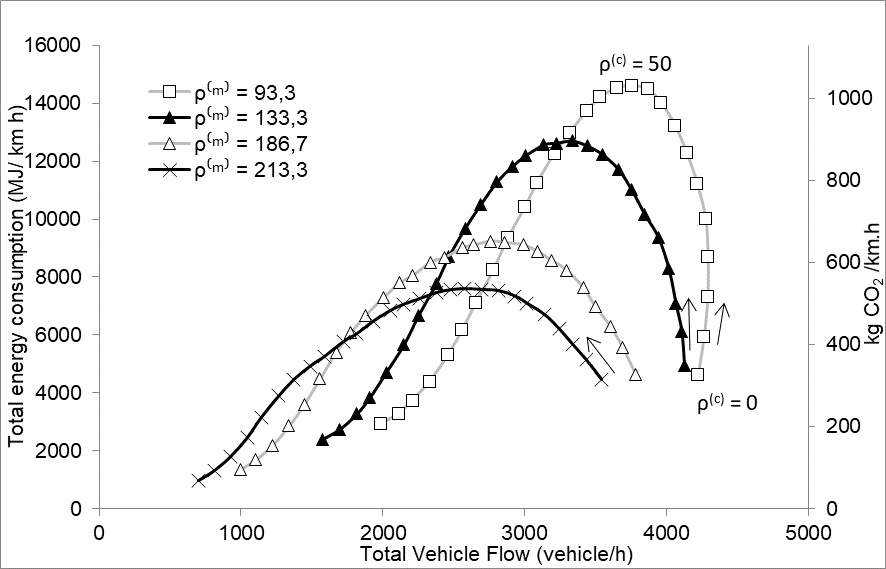
The fleet of developing countries consists of motorcycles and cars. This heterogeneous traffic condition has its advantages and disadvantages, which results in conflicting points of view (e.g., motorcyclists enjoying a higher mobility while car drivers resent their decreased speed). In this paper, we corroborated the notion that traffic evaluation depends on the chosen metric (e.g., vehicle flow, fuel consumption, monthly costs) and the point of view (driver, rider, and policy makers). To this effect, we studied a mixed traffic condition, considering that the vehicle performance is affected by three scales: engine, vehicle, and traffic. We modeled the engine using empirical correlations of power and energy efficiency, the vehicle based on a balance of propulsive and resistive forces, and traffic with a cellular automata model. We simulated 189 traffic conditions and evaluated vehicle flow, average energy consumption, total CO2 emission of the road, and monthly costs. We also discussed the results from the point of view of the driver, rider, and society. We concluded that the optimal condition depends both on the choice of metric and point of view, and that is not appropriate to use results from homogeneous traffic to analyze heterogeneous traffic conditions, even if both scenarios present the same total vehicle flow.
La flota de los países en vías de desarrollo está compuesta por motocicletas y automóviles. Esta condición heterogénea en el tráfico presenta ventajas y desventajas, lo que resulta en puntos de vista conflictivos (por ejemplo, los motociclistas que disfrutan de su mayor movilidad mientras que los conductores de automóviles se resienten con su velocidad disminuida). En este artículo corroboramos la idea de que la evaluación del tráfico depende de la métrica escogida (por ejemplo, flujo de vehículos, consumo de combustible, costos mensuales) y del punto de vista (conductor, motociclista y responsables de formular políticas). Para ello, estudiamos una condición de tráfico mixto, considerando que el rendimiento del vehículo se ve afectado por tres escalas: motor, vehículo y tráfico. Modelamos el motor usando correlaciones empíricas de potencia y eficiencia energética, la del vehículo a través de un equilibrio de fuerzas propulsoras y resistivas, y la del tráfico mediante un modelo de autómata celular. Simulamos 189 condiciones de tráfico y evaluamos el flujo de vehículos, el consumo de energía promedio, la emisión total de CO2 de la vía y los costos mensuales. También discutimos los resultados desde el punto de vista del conductor, el motociclista y la sociedad. Llegamos a la conclusión de que la condición óptima depende tanto de la elección de la métrica como del punto de vista, además de que no es apropiado usar los resultados del tráfico homogéneo para analizar condiciones de tráfico heterogéneo, incluso si ambos escenarios presentan el mismo flujo total de vehículos.
References
Agarwal, A., Zilske, M., Rao, K. R., and Nagel, K. (2015).An elegant and computationally efficient approach for heterogeneous traffic modelling using agent based simulation. Procedia Computer Science, 52(1), 962-967. https://doi.org/10.1016/j.procs.2015.05.173
Andrade, G. M. S. de, Araújo, F. W. C. de, Santos, M. P. M. de N., and Magnani, F. S. (2020). Standardized Comparison of 40 Local Driving Cycles: Energy and Kinematics. Energies, 13(20), 5434. https://doi.org/10.3390/en13205434
Arun, N. H., Mahesh, S., Ramadurai, G., and Shiva Nagendra, S. M. (2017). Development of driving cycles for passenger cars and motorcycles in Chennai, India. Sustainable Cities and Society, 32(March), 508-512. https://doi.org/10.1016/j.scs.2017.05.001
BenChaim, M., Shmerling, E., and Kuperman, A. (2013). Analytic modeling of vehicle fuel consumption. Energies, 6(1), 117-127. https://doi.org/10.3390/en6010117
Chen, Q. and Wang, Y. (2016). A cellular automata (CA) model for motorized vehicle flows influenced by bicycles along the roadside. Journal of Advanced Transportation, 50(6), 949966. https://doi.org/10.1002/atr.1382
Cossalter, V. (2006). Motorcycle Dynamics (2nd Ed.). Morrisville, NC: LULU.com
Daganzo, C. F. (1994). The cell transmission model: a dynamic representation of highway traffic consistent with the hydrodynamic theory. Transportation Research Part B: Methodological, 28(4), 269-287. https://doi.org/10.1016/0191-2615(94)90002-7
Ehsani, M., Ahmadi, A., and Fadai, D. (2016). Modeling of vehicle fuel consumption and carbon dioxide emission in road transport. Renewable and Sustainable Energy Reviews, 53, 1638-1648. https://doi.org/10.1016/j.rser.2015.08.062
Gossling, S. and Choi, A. S. (2015). Transport transitions in Copenhagen: Comparing the cost of cars and bicycles. Ecological Economics, 113, 106-113. https://doi.org/10.1016/j.ecolecon.2015.03.006
Hua, W., Yue, Y., Wei, Z., Chen, J., and Wang, W. (2020). A cellular automata traffic flow model with spatial variation in the cell width. Physica A: Statistical Mechanics and Its Applications, 556, 124777. https://doi.org/10.1016/j.physa.2020.124777
Jazar, R. N. (2014). Vehicle Dynamics (2nd Ed.). New York, NY: SpringerVerlag. https://doi.org/10.1007/978-1-4614-8544-5
Koossalapeerom, T., Satiennam, T., Satiennam, W., Leelapatra, W., Seedam, A., and Rakpukdee, T. (2019). Comparative study of realworld driving cycles, energy consumption, and CO2 emissions of electric and gasoline motorcycles driving in a congested urban corridor. Sustainable Cities and Society, 45(September 2018). https://doi.org/10.1016/j.scs.2018.12.031
Lan, L. W. and Chang, C.W. (2005). Inhomogeneous cellular automata modeling for mixed traffic with cars and motorcycles. Journal of Advanced Transportation, 39(3), 323-349. http://dx.doi.org/10.1002/atr.5670390307
Lan, L. W., Chiou, Y. C., Lin, Z. S., and Hsu, C. C. (2010). Cellular automaton simulations for mixed traffic with erratic motorcycles’ behaviours. Physica A: Statistical Mechanics and Its Applications, 389(10), 2077-2089. https://doi.org/10.1016/j.physa.2010.01.028
Lv, W., Song, W. G., Liu, X. D., and Ma, J. (2013). A microscopic lane changing process model for multilane traffic. Physica A: Statistical Mechanics and Its Applications, 392(5), 1142-1152. https://doi.org/10.1016/j.physa.2012.11.012
Meng, J., Dai, S., Dong, L., and Zhang, J. (2007). Cellular automaton model for mixed traffic flow with motorcycles. Physica A: Statistical Mechanics and Its Applications, 380, 470-480. https://doi.org/10.1016/j.physa.2007.02.091
Nagel, K. and Schreckenberg, M. (1992). A cellular automaton model for freeway traffic. Journal de Physique, 2, 2221-2229. https://doi.org/10.1051/jp1:1992277
Ni, D. and Henclewood, D. (2008). Simple engine models for VIIenabled invehicle applications. IEEE Transactions on Vehicular Technology, 57(5), 2695-2702. https://doi.org/10.1109/TVT.2008.917229
Qian, Z., Li, J., Li, X., Zhang, M., and Wang, H. (2017). Modeling heterogeneous traffic flow: A pragmatic approach. Transportation Research Part B: Methodological, 99, 183-204. https://doi.org/10.1016/j.trb.2017.01.011
Ruan, X., Zhou, J., Tu, H., Jin, Z., and Shi, X. (2017). An improved cellular automaton with axis information for microscopic traffic simulation. Transportation Research Part C: Emerging Technologies, 78, 63-77. https://doi.org/10.1016/j.trc.2017.02.023
Stoecker, W. F. (1989). Design of Thermal Systems (3rd Ed.). New York, NY: McGrawHill.
Tranter, P. (2012). Effective Speed: Cycling Because It’s “Faster.” In J. Pucher and R. Buehler (Eds.) City Cycling (Urban and Industrial Environments). Boston, MA: MIT Press.
WHO (World Health Organization). (2015). Global status report on road safety. http://apps.who.int/iris/bitstream/10665/189242/1/9789241565066_eng.pdf
Yang, D., Qiu, X., Yu, D., Sun, R., and Pu, Y. (2015). A cellular automata model for cartruck heterogeneous traffic flow considering the cartruck following combination effect. Physica A: Statistical Mechanics and Its Applications, 424, 62-72. https://doi.org/10.1016/j.physa.2014.12.020
Zegeye, S. K., De Schutter, B., Hellendoorn, J., Breunesse, E. A., and Hegyi, A. (2013). Integrated macroscopic traffic flow, emission, and fuel consumption model for control purposes. Transportation Research Part C: Emerging Technologies, 31, 158-171. https://doi.org/10.1016/j.trc.2013.01.002
Zeng, J., Qian, Y., Mi, P., Zhang, C., Yin, F., Zhu, L., and Xu, D. (2021). Freeway traffic flow cellular automata model based on mean velocity feedback. Physica A: Statistical Mechanics and its Applications, 562, 125387. https://doi.org/10.1016/j.physa.2020.125387
Dimensions
PlumX
Article abstract page views
Downloads
How to Cite




License
Copyright (c) 2021 Fábio Santana Magnani, Paulo D'Avila Garcia Neto, Fernando Wesley Cavalcanti de Araujo, Alcides Luiz dos Anjos Hora, Daniel Arraes de Alencar Valença

This work is licensed under a Creative Commons Attribution 4.0 International License.
The authors or holders of the copyright for each article hereby confer exclusive, limited and free authorization on the Universidad Nacional de Colombia's journal Ingeniería e Investigación concerning the aforementioned article which, once it has been evaluated and approved, will be submitted for publication, in line with the following items:
1. The version which has been corrected according to the evaluators' suggestions will be remitted and it will be made clear whether the aforementioned article is an unedited document regarding which the rights to be authorized are held and total responsibility will be assumed by the authors for the content of the work being submitted to Ingeniería e Investigación, the Universidad Nacional de Colombia and third-parties;
2. The authorization conferred on the journal will come into force from the date on which it is included in the respective volume and issue of Ingeniería e Investigación in the Open Journal Systems and on the journal's main page (https://revistas.unal.edu.co/index.php/ingeinv), as well as in different databases and indices in which the publication is indexed;
3. The authors authorize the Universidad Nacional de Colombia's journal Ingeniería e Investigación to publish the document in whatever required format (printed, digital, electronic or whatsoever known or yet to be discovered form) and authorize Ingeniería e Investigación to include the work in any indices and/or search engines deemed necessary for promoting its diffusion;
4. The authors accept that such authorization is given free of charge and they, therefore, waive any right to receive remuneration from the publication, distribution, public communication and any use whatsoever referred to in the terms of this authorization.








