Published
Comparative study of theoretical and real deflection of a simple and reinforced concret joist
Estudio comparativo de la deflexión teórica y real de una vigueta de concreto simple y reforzado
DOI:
https://doi.org/10.15446/ing.investig.v41n2.86742Keywords:
Joist deflection, elasticity theory, double integration method. (en)Deflexión en viguetas, teoría de la elasticidad, método de la doble integración. (es)
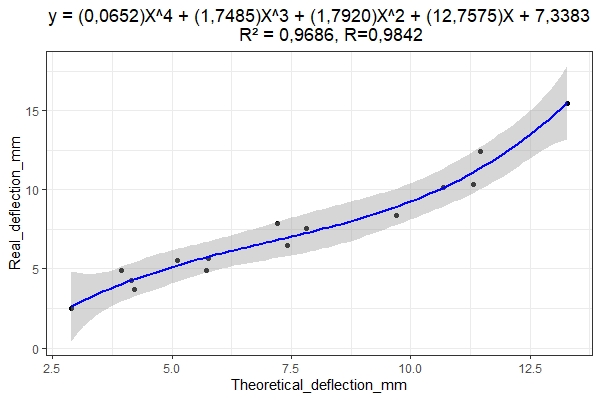
This research aims to determine the actual deflection of a concrete joist and to correlate the result with the theoretical deflection. This is based on the theories of elasticity as the double integration method, considering the homogeneous, isotropic and linearly elastic material from an ideal theoretical model. The construction of a concrete joist does not make a 100% homogeneous, isotropic and linearly elastic element, since its manufacture depends on many conditions such as the choice of aggregates, water, the manufacture of cement, tests carried out for the elaboration of the mix design, the operator who is going to perform the mix and the construction of the joist. The variation of the real deflection with respect to the theoretical one has been investigated. For this, 30 simple concrete joists and 30 reinforced concrete joists were manufactured. The dimensions of these joists were 15cm x15cmx53.5cm (b x h x L). The reinforcement of the last 30 joists was 4 Փ 1/4 "as longitudinal reinforcement and Փ 1/4" @ 0.10 m of transverse reinforcement. The joists were tested for flexion by measuring the maximum deflection and compared with the theoretical one, calculated by the double integration method, having much greater experimental results than those calculated with the theory of the double integration method, not being within the ranges expected in literature
La presente investigación tiene como objetivo determinar la deflexión real de una vigueta de concreto y correlacionar el resultado con la deflexión teórica. Esta se fundamenta en las teorías de la elasticidad como el método de la doble integración, considerando el material homogéneo, isótropo y linealmente elástico a partir de un modelo teórico ideal. La construcción de una vigueta con concreto no conforma un elemento 100% homogéneo, isótropo y linealmente elástico, ya que su fabricación depende de muchas condiciones como la elección de los agregados, el agua, la fabricación del cemento, los ensayos realizados para la elaboración del diseño de mezclas, el operario que va a realizar la mezcla y la construcción de la vigueta. Se ha investigado la variación de la deflexión real respecto de la teórica. Para ello, se fabricaron 30 viguetas de concreto simple y 30 viguetas de concreto armado. Las dimensiones de estas viguetas fueron de 15cm x15cmx53.5cm (b x h x L) la armadura de las últimas 30 viguetas fue de 4Փ1/4” como refuerzo longitudinal y Փ1/4” @0.10 m de refuerzo transversal. Las viguetas se ensayaron a flexión midiendo la deflexión máxima y se comparó con la teórica, calculada por el método de la doble integración, teniendo resultados experimentales mucho mayores que las calculadas con la teoría del método de la doble integración, no estando dentro de los rangos esperados en la literatura.
References
Alhajri, T., Tahir, M., Azimi, M., Mirza, J., and Ragaee, M. (2016). Behavior of precast U-shaped composite beam integrating cold formed steel with ferro cement slab. Thin Walled Structures, 102, 18-29. https://doi.org/10.1016/j.tws.2016.01.014
Arabnejad Khanouki, M., Ramli Sulong, N., Mahdi Shariati, and Tahir, M. (2016). Investigation of through beam connection to concrete filled circular steel tube (CFCST) column. Journal of Constructional Steel Research, 121, 144-162. https://doi.org/10.1016/j.jcsr.2016.01.002
Belendez, T., Neipp, C., and Belendez, A. (2002). Estudio de la Flexión de una Viga de Material Elástico no Lineal. Revista Brasileira de Ensino de Física, 24(4). https://www.scielo.br/scielo.php?script=sci_arttext&pid=S1806-11172002000400004
Carrillo, J. and SilvaPáramo, D. (2016). Flexural Tests of Concrete SlabsonGround Reinforced with Steel Fibers. Ingeniería Investigación y Tecnología, 17(3), 317-330. https://doi.org/10.1016/j.riit.2016.07.003
Carrillo, J., Blandón Valencia, J., and Rubiano, A. (2013). A review of conceptual transparency in US and Colombian seismic design building codes. Ingeniería e Investigación, 33(2), 24-29.
Carrillo, J., Cárdenas Pulido, J., and Aperador, W. (2017). Flexural mechanical properties os steel fiber reinforced concrete under corosive environments. Revista Ingeniería de Construcción RIC, 32(2), 59-72. https://www.ricuc.cl/index.php/ric/article/view/582
Comisión de Normalización y Fiscalización de Barreras Comerciales no Arancelarias - INDECOPI. (2012). Norma Técnica Peruana N.T.P. 339.079 2012. Concreto. Método de Ensayo para determinar la resistencia a la flexión del concreto en vigas simplemente apoyadas con cargas en el centro del tramo, Tercera Edición. Lima, San Borja, Peru: R.00922012/ CNB - INDECOPI.
Falope, F., Lanzoni, L., and Tarantino, A. (2019). The bending of fully nonlinear beams. Theoretical, numerical and experimental analyses. International Journal of Engineering Science, 145. https://doi.org/10.1016/j.ijengsci.2019.103167
FEMA and ASCE. (2000). Prestandard And Commentary for the seismic rehabilitation of buildings. FEMA 356. https://www.conservationtech.com/FEMApublications/ FEMA3562000.Pdf
G. Chiorean, C., and M. Buru, S. (2017). Practical non-linear inelastic analysis method of composite steel concrete beams with partial composite action. Engineering Structures, 134, 74-106. https://doi.org/10.1016/j.engstruct.2016.12.017
Hamrat, M., Bouziadi, F., Boulekbache, B., Daouadji, H., Chegui, S., Labed, A., and Amziane, S. (2020). Experimental and numerical investigation on the deflaction behavior of precracked and repaired reinforced concrete beams with fiber-reinforced polymer. Construction and Building Materials, 249. https://doi.org/10.1016/j.conbuildmat.2020.118745
Hemn Qader, A., Dishad Kakasor, J., and Abdulkhaleq, Y. (2020). Flexual capacity and behaviour of geopolymer concrete beams reinforced wiht glass fibre reinforced polymer bars. International Jornal of Concrete, 14(4), 1-16. https://doi.org/10.1186/s4006901903891
Ismail, M., Shariati, M., Abdul Awal, A., Chiong, C., Chahnasir, E., Porbar, A., Heydari, A., and Khorami, M. (2018). Strengthening of bolted shear joints in industrialized ferrocement construction. Steel and Composite Structures, 28(6), 681-690. https://doi.org/10.12989/scs.2018.28.6.681
Luo, Z., Sinaei, H., Ibrahim, Z., Shariatit, M., Jumaat, Z., Wakil, K., Pham, B. T., Mohamad, E. T., and Khorami, M. (2019). Computational and experimental analysis of beam to column joints reinforced with CFRP plates. Steel and Composite Structures, 30(3), 271-280. https://doi.org/10.12989/scs.2019.30.3.271
Mander, B., Priestley, M., Park, R., Fellow, and ASCE. (1988). Theoretical StressStrain Model for confined concrete. Journal of Structural Engineering, 144(8), 1804-1826. https://doi.org/10.1061/(ASCE)0733-9445(1988)114:8(1804)
Mander, J. (1983). Seismic Design of Bridge Piers. (Doctoral thesis, University of Canterbury, Christchurch, Australia) http://dx.doi.org/10.26021/3134
Ministerio de Vivienda, Construcción y Saneamiento. (2009). Norma E 060 Concreto Armado Reglamento Nacional de Edificaciones. Servicio Nacional de Capacitación para la Industria de la Construcción – SENCICO. https://drive.google.com/file/d/1YygoHSNpu2UfJLmSaC1Wxr6oFAfCwA/view
Purushothama Raj, P., and Ramasamy, V. (2012). Strength of Materials. Chennai, India: Pearson India.Rodriguez, M., and Restrepo, J. (2012). Práctica y diseño sísmico de edificios en México - cambios necesarios. Revista de Ingeniería Sísmica, 86, 89-118. https://doi.org/10.18867/ris.86.154
Sahmani, S., and Safaei, B. (2020). Influence of homogenization models on size dependent nonlinear bending and post-buckling of bidirectional functionally graded micro/nano beams. Applied Mathematical Modelling, 82, 336-358. https://doi.org/10.1016/j.apm.2020.01.051
Sinaei, H., Mohd Zamin , J., and Mahdi , S. (2011). Numerical investigation on exterior reinforced concrete BeamColumn joint strengthened by composite fiber reinforced polymer (CFRP). International Journal of the Physical Sciences, 6(28), 6572-6579,. https://academicjournals.org/journal/IJPS/article-full-text-pdf/AF8A14119898
Dimensions
PlumX
Article abstract page views
Downloads
How to Cite




License
Copyright (c) 2021 Sócrates Pedro Muñoz, Angel Antonio Ruiz Pico, Juan Manuel Anton Perez, Dandy B. Roca-Loayza

This work is licensed under a Creative Commons Attribution 4.0 International License.
The authors or holders of the copyright for each article hereby confer exclusive, limited and free authorization on the Universidad Nacional de Colombia's journal Ingeniería e Investigación concerning the aforementioned article which, once it has been evaluated and approved, will be submitted for publication, in line with the following items:
1. The version which has been corrected according to the evaluators' suggestions will be remitted and it will be made clear whether the aforementioned article is an unedited document regarding which the rights to be authorized are held and total responsibility will be assumed by the authors for the content of the work being submitted to Ingeniería e Investigación, the Universidad Nacional de Colombia and third-parties;
2. The authorization conferred on the journal will come into force from the date on which it is included in the respective volume and issue of Ingeniería e Investigación in the Open Journal Systems and on the journal's main page (https://revistas.unal.edu.co/index.php/ingeinv), as well as in different databases and indices in which the publication is indexed;
3. The authors authorize the Universidad Nacional de Colombia's journal Ingeniería e Investigación to publish the document in whatever required format (printed, digital, electronic or whatsoever known or yet to be discovered form) and authorize Ingeniería e Investigación to include the work in any indices and/or search engines deemed necessary for promoting its diffusion;
4. The authors accept that such authorization is given free of charge and they, therefore, waive any right to receive remuneration from the publication, distribution, public communication and any use whatsoever referred to in the terms of this authorization.