
Published
The Gender Gap in Engineering Programs in Colombia
La brecha de género en los programas de ingeniería en Colombia
DOI:
https://doi.org/10.15446/ing.investig.v41n2.86758Keywords:
gender gap, engineering , undergraduate program, graduate program (en)brecha de género, ingeniería , Pregrado, Posgrado (es)
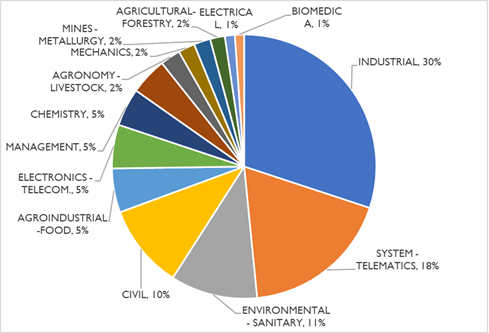
In Colombia, engineering is an unattractive field for women. As of 2018, 63,7% of undergraduate engineering graduates were men, and only 36,3% were women. This gap has not changed significantly between 2001 and 2018. This paper analyzes the gap between women and men who obtain undergraduate or graduate engineering degrees in Colombia. The analysis is based on data from the Labor Observatory for Education (OLE) and the National Information System for Higher Education (SNIES) between 2001 to 2018, and it is presented according to degree levels (undergraduate, master and Ph.D.), regions, specific fields of engineering, and salary. The data show a clear difference between the number of women and men graduating from engineering programs at all levels. This gap disappears in programs related to environmental, biomedical, and chemical engineering, where more than 50% of the graduates are women; but, in programs such as electrical, electronic, and mechanical engineering, the gap is more critical, with less than 20% of women’s representation. To propose public policies or national programs to improve this situation, this paper also presents a review of international initiatives that have succeeded in improving the representation of women in engineering programs.
En Colombia, la ingeniería es un campo poco atractivo para las mujeres. Para 2018, 63,7% de los egresados de los programas de pregrado en ingeniería eran hombres y solamente el 36,3% eran mujeres. Esta brecha no ha cambiado significativamente entre el 2001 y el 2018. Este articulo analiza la brecha entre mujeres y hombres graduados de programas de ingeniería tanto a nivel de pregrado como posgrado en Colombia. El análisis se basa en datos disponibles en el Observatorio Laboral para la Educación (OLE) y el Sistema Nacional de Información de Educación Superior (SNIES) entre 2001 y 2018, y se presenta de acuerdo con el nivel de formación (pregrado, maestría y doctorado), región, campo especifico de ingeniería y salario. Los datos muestran una clara diferencia entre el número de mujeres y hombres graduados de programas de ingeniería en todos los niveles. Esta brecha desaparece en programas relacionados con las ingenierías ambiental, biomédica y química, donde más del 50 % de los graduados son mujeres; pero, en programas como ingeniería eléctrica, electrónica y mecánica, esta brecha es más crítica, con menos del 20 % de representación de mujeres. Para proponer políticas públicas o programas nacionales que ayuden a mejorar esta situación, este artículo también presenta una revisión de iniciativas internacionales que han logrado mejorar la representación de mujeres en programas de ingeniería.
References
Ainane, S., Bouabid, A., and El Sokkary, W. (2019). Factors that influence the high percentage of women enrolled in engineering in the UAE and preparing for careers in the oil and gas industry. Global Journal of Engineering Education, 21(1), 62-68. http://www.wiete.com.au/journals/GJEE/Publish/vol21no1/08-Bouabid-A.pdf
Arredondo Trapero, F. G., Vázquez Parra, J. C., and Velázquez Sánchez, L. M. (2019). STEM y brecha de género en Latinoamérica. Revista de El Colegio de San Luis, 9(18), 137-158. https://doi.org/10.21696/rcsl9182019947
Barone, C. and Assirelli, G. (2020). Gender segregation in higher education: an empirical test of seven explanations. Higher Education, 79(1), 5578. https://doi.org/10.1007/s10734-019-00396-2
Betancur, N. E. H. and Torres-Madronero, M. C. (2015). Acreditación de programas en ingeniería en la región: Análisis comparativo. Revista Educación en Ingeniería, 10(19), 80-89. https://educacioneningenieria.org/index.php/edi/article/view/522
Blosser, E. (2017). Gender segregation across engineering majors: How engineering professors understand women’s underrepresentation in undergraduate engineering. Engineering Studies, 9(1), 24-44. https://doi.org/10.1080/19378629.2017.1311902
Botella, C., Rueda, S., López-Iñesta, E., and Marzal, P. (2019). Gender diversity in STEM disciplines: A multiple factor problem. Entropy, 21(1), 30. https://doi.org/10.3390/e21010030
Breda, T., Grenet, J., Monnet, M., and Van Effenterre, C. (2020). Do female role models reduce the gender gap in science? Evidence from French high schools (No. 13163). Bonn, Germany: Institute of Labor Economics (IZA). http://ftp.iza.org/dp13163.png
Buse, K.R. and Bilimoria, D. (2014). Personal vision: enhancing work engagement and the retention of women in the engineering profession. Frontiers in Psychology, 5, 1-13. https://doi.org/10.3389/fpsyg.2014.01400
Charlesworth, T. E. and Banaji, M. R. (2019). Gender in Science, Technology, Engineering, and Mathematics: Issues, Causes, Solutions. Journal of Neuroscience, 39(37), 7228-7243. https://doi.org/10.1523/JNEUROSCI.0475-18.2019
Cheryan, S., Ziegler, S. A., Montoya, A. K., and Jiang, L. (2017). Why are some STEM fields more gender balanced than others? Psychological Bulletin, 143(1), 1-35. https://doi.org/10.1037/bul0000052
Cimpian, J. R., Kim, T. H., and McDermott, Z. T. (2020). Understanding persistent gender gaps in STEM. Science, 368(6497), 1317-1319. https://doi.org/10.1126/science.aba7377
Gándara, F. and Silva, M. (2016). Understanding the gender gap in science and engineering: Evidence from the Chilean college admissions tests. International Journal of Science and Mathematics Education, 14(6), 1079-1092. https://doi.org/10.1007/s10763-015-9637-2
García-Holgado, A., Mena Marcos, J. J., García Peñalvo, F. J., Pascual, J., Heikkinen, M., Harmoinen, S., ... and Amores, L. (2020). Gender equality in STEM programs: a proposal to analyse the situation of a university about the gender gap. In IEEE (Eds.) 2020 IEEE Global Engineering Education Conference (EDUCON) (pp. 1824-1830). Piscataway, NJ: IEEE. https://doi.org/10.1109/EDUCON45650.2020.9125326
González-Gutiérrez, N. R., Sepúlveda-Delgado, O., and Espejo-Lozado, R.L. (2018). Formación matemática en Colombia: una mirada desde una perspectiva de género. Revista de Investigación, Desarrollo, e Innovación, 8, 251-264. https://doi.org/10.19053/20278306.v8.n2.2018.7519
Katz, L. A., Aloisio, K. M., Horton, N. J., Ly, M., Pruss, S., Queeney, K., Rowen, C., and DiBartolo, P. M. (2017). A program aimed toward inclusive excellence for underrepresented undergraduate women in the sciences. CBE–Life Sciences Education, 16(1). https://doi.org/10.1187/cbe.16-01-0029
Mahajan, P. (2017). Engineering a Woman: Marketing Opportunities and Challenges. The Turkish Online Journal of Educational Technology, 2017(Special Issue for INTE 2017), 1050-1066. https://www.researchgate.net/publication/326674962_Engineering_a_Woman_Marketing_Opportunities_and_Challenges
OECD (2017). The Pursuit of Gender Equality: An Uphill battle. Paris, France: OECD Publishing.
OLE (2019). Vinculación laboral de graduados. http://bi.mineducacion.gov.co:8380/eportal/web/men-observatorio-laboral/tasa-de-cotizacion-por-genero
Paderewski-Rodríguez, P., García-Arenas, M. I., Gil-Iranzo, R. M., González, C. S., Ortigosa, E. M., and Padilla-Zea, N. (2017). Initiatives and strategies to encourage women into engineering. IEEE Revista Iberoamericana de Tecnologías del Aprendizaje, 12(2), 106-114. https://doi.org/10.1109/RITA.2017.2698719
Parra, L. (2008). Breve recuento histórico de las mujeres colombianas en la ciencia y la ingeniería. Revista de Antropología y Sociología: Virajes, 10, 155-166. https://revistasojs.ucaldas.edu.co/index.php/virajes/article/view/805/728
Quintero, O. A. (2016). La creciente exclusión de las mujeres de la Universidad Nacional de Colombia. Nómadas, 44, 123-145. https://doi.org/10.30578/nomadas.n44a7
Rodríguez-Rodríguez, I., Rodríguez, J. V., Ramallo-González, A., and Elizondo-Moreno, A. (2020). Percepción del profesorado español de diferentes etapas educativas respecto a cuestiones de igualdad de género en el ámbito docente. Cuestiones de género, de la igualdad y la diferencia, 15, 313-340. https://doi.org/10.18002/cg.v0i15.6217
SNIES (2019). Estadísticas. https://www.mineducacion.gov.co/sistemasinfo/Informacion-a-la-mano/212400:Estadisticas
Sterling, A. D., Thompson, M. E., Wang, S., Kusimo, A., Gilmartin, S., and Sheppard, S. (2020). The confidence gap predicts the gender pay gap among STEM graduates. Proceedings of the National Academy of Sciences, 117(48), 30303-30308. https://doi.org/10.18002/cg.v0i15.6217
Dimensions
PlumX
Article abstract page views
Downloads
How to Cite




License
Copyright (c) 2021 Nancy Elena Hamid Betancur, Maria C. Torres-Madronero

This work is licensed under a Creative Commons Attribution 4.0 International License.
The authors or holders of the copyright for each article hereby confer exclusive, limited and free authorization on the Universidad Nacional de Colombia's journal Ingeniería e Investigación concerning the aforementioned article which, once it has been evaluated and approved, will be submitted for publication, in line with the following items:
1. The version which has been corrected according to the evaluators' suggestions will be remitted and it will be made clear whether the aforementioned article is an unedited document regarding which the rights to be authorized are held and total responsibility will be assumed by the authors for the content of the work being submitted to Ingeniería e Investigación, the Universidad Nacional de Colombia and third-parties;
2. The authorization conferred on the journal will come into force from the date on which it is included in the respective volume and issue of Ingeniería e Investigación in the Open Journal Systems and on the journal's main page (https://revistas.unal.edu.co/index.php/ingeinv), as well as in different databases and indices in which the publication is indexed;
3. The authors authorize the Universidad Nacional de Colombia's journal Ingeniería e Investigación to publish the document in whatever required format (printed, digital, electronic or whatsoever known or yet to be discovered form) and authorize Ingeniería e Investigación to include the work in any indices and/or search engines deemed necessary for promoting its diffusion;
4. The authors accept that such authorization is given free of charge and they, therefore, waive any right to receive remuneration from the publication, distribution, public communication and any use whatsoever referred to in the terms of this authorization.









