
Published
Study of Carbohydrate Hydrolysis From Arracacha Roots (Arracacia Xanthorriza Bancroft) to Produce Fermentable Sugars
Estudio de hidrólisis de carbohidratos en raíces de Arracacha (Arracacia Xanthorriza Bancroft) para producir azúcares fermentables
DOI:
https://doi.org/10.15446/ing.investig.v41n2.87365Keywords:
Chemical hydrolysis, Enzymatic hydrolysis, Fermentation inhibitors, Reducing sugars (en)Hidrólisis química, Hidrólisis enzimática, Inhibidores de fermentación, Azúcares reductores (es)
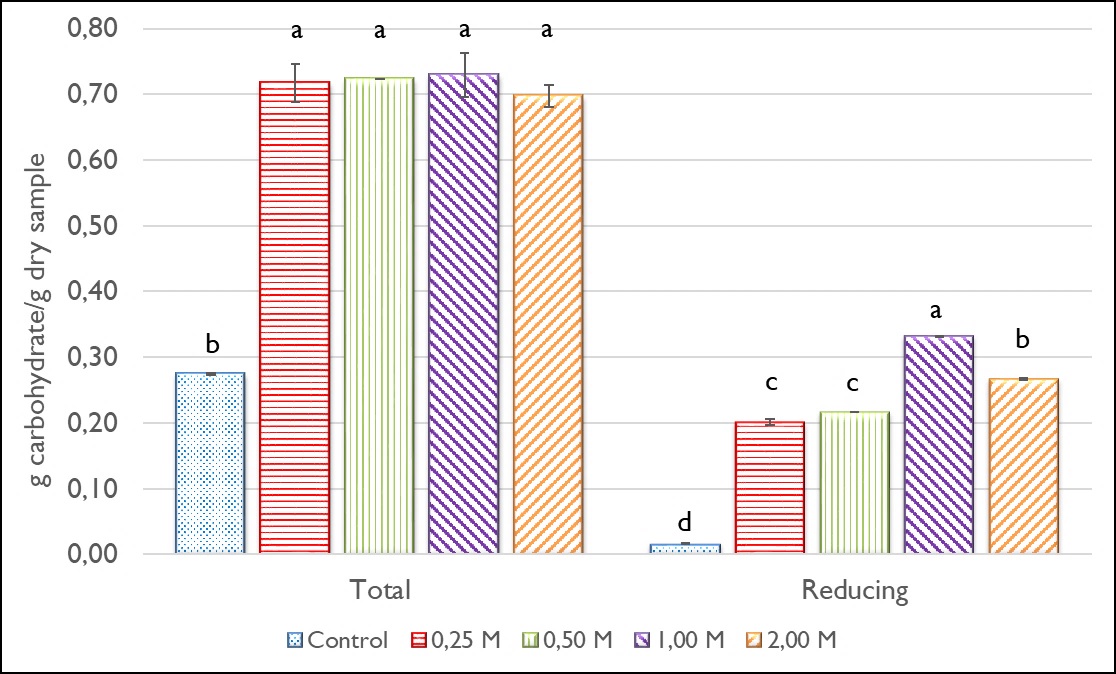
In Colombia, approximately 855 840 tons of arracacha are produced each year. The unsalable postharvest arracacha root (Arracacia xanthorriza Bancroft) is not commercialized, mainly due to mechanical damage or small and misshapen roots. In this work, dry samples were characterized and subjected to two treatments: one using thermal hydrolysis, applying saturated steam at pressures of 0,1034 MPa, 0,2068 MPa, and 0,4137 MPa; and another one using hydrolysis with sulfuric acid in concentrations between 0,252,00 M. Then, the cake resulting from the hydrolysis and filtration process was enzymatically hydrolyzed (Liquozyme SC DS, Novozymes) at 1,5, 5 and 10 KNU/g (pH 6, 80 _C, 2 h). Fermentation inhibitors (acetic acid and furfural) were evaluated in the best pretreatment. The results showed that the treatment with sulfuric acid at 1,00 M (2 h) has high yields in reducing sugars added to enzymatic hydrolysis. The maximum level of fermentable carbohydrates per gram of dry sample (1,04 g/g) was also reached. Regarding the fermentation inhibitors of the reducing sugar, a higher concentration of acetic acid was found with a lower furfural content. Therefore, arracacha discards are a promising raw material to increase the supply of bioethanol.
En Colombia se producen aproximadamente 855 840 toneladas anuales de arracacha. La raíz de arracacha postcosecha no vendible (Arracacia xanthorriza Bancroft) no se comercializa, principalmente debido a daños mecánicos o raíces pequeñas y deformadas. En este trabajo, las muestras secas fueron caracterizadas y sometidas a dos tratamientos: uno con hidrólisis térmica aplicando vapor saturado a presiones de 0,1034 MPa, 0,2068 MPa y 0,4137 MPa; y el otro de hidrólisis con ácido sulfúrico en concentraciones entre 0,252,00 M. Luego, la torta resultante del proceso de hidrólisis y filtración se hidrolizó enzimáticamente (Liquozyme SC DS, Novozymes) a 1,5, 5 y 10 KNU/g (pH 6, 80 _C, 2 h). Se evaluaron los inhibidores de fermentación (ácido acético y furfural) en el mejor pretratamiento. Los resultados mostraron que el tratamiento con ácido sulfúrico a 1,00 M (2 h) tiene altos rendimientos en azúcares reductores adicionados a hidrólisis enzimática. También se alcanzó el nivel máximo de carbohidratos fermentables por gramo de muestra seca (1,04 g/g). En cuanto a los agentes inhibidores de la fermentación del azúcar reductor, se encontró una mayor concentración de ácido acético con contenido furfural menor. Por tanto, los residuos de arracacha son una materia prima prometedora para incrementar la oferta de bioetanol
References
Aditiya, H., Mahlia, T. M. I., Chong, W., Nur, H., and Sebayang, A. (2016). Second generation bioethanol production: A critical review. Renewable Sustainable Energy Reviews, 66, 631-653. https://doi.org/10.1016/j.rser.2016.07.015
Aloui, D., Goutte, S., Guesmi, K., and Hchaichi, R. (2020). COVID 19’s impact on crude oil and natural gas S&P GS Indexes. SSRN. http://dx.doi.org/10.2139/ssrn.3587740
AOAC. (2000).Official Methods of Analysis. (17th. ed.). Gaithersburg, USA: Association of Official Analytical Chemists.
Awad, O. I., Mamat, R., Ali, O. M., Sidik, N., Yusaf, T., Kadirgama, K., and Kettner, M. (2018). Alcohol and ether as alternative fuels in spark ignition engine: A review. Renewable Sustainable Energy Reviews, 82(3), 2586-2605. https://doi.org/10.1016/j.rser.2017.09.074
Carranza Saavedra, D., Alvarado Núñez, J. A., Méndez Reyes, D. A., Valenzuela Real, C. P., and Solanilla Duque, J. F. (2015). Pretratamiento de residuos de plátano (Musa paradisiaca (L.) AAB) y arracacha (Arracacia xanthorrhiza Bancroft) para la obtención de azúcares fermentables. Revista Venezolana de Ciencia y Tecnología de Alimentos, 6(1), 019-035. http://oaji.net/articles/2017/4924-1495586231.pdf
Cheng, K.-K., Cai, B.-Y., Zhang, J.-A., Ling, H.-Z., Zhou, Y.-J., Ge, J.-P., and Xu, J.-M. (2008). Sugarcane bagasse hemicellulose hydrolysate for ethanol production by acid recovery process. Biochemical Engineering Journal, 38(1), 105-109. https://doi.org/10.1016/j.bej.2007.07.012
Congreso de Colombia (2001). LEY 693 de 2001. Por la cual se dictan normas sobre el uso de alcoholes carburantes, se crean estímulos para su producción, comercialización y consumo, y se dictan otras disposiciones. September 27, 2001. D.O. Nr. 44564. http://www.secretariasenado.gov.co/senado/basedoc/ley_0693_2001.html
Didaskalou, C., Buyuktiryaki, S., Kecili, R., Fonte, C. P., and Szekely, G. (2017). Valorisation of agricultural waste with an adsorption/nanofiltration hybrid process: from materials to sustainable process design. Green Chemistry, 19(13), 3116-3125. doi:http://dx.doi.org/10.1039/c7gc00912g
Galford, G. L., Peña, O., Sullivan, A. K., Nash, J., Gurwick, N., Pirolli, G., Richards, M., White, J., and Wollenberg, E. (2020). Agricultural development addresses food loss and waste while reducing greenhouse gas emissions. Science of The Total Environment, 699, 134318. https://doi.org/10.1016/j.scitotenv.2019.134318
Guerrero, A. B., Ballesteros, I., and Ballesteros, M. (2017). Optimal conditions of acid‐catalysed steam explosion pretreatment of banana lignocellulosic biomass for fermentable sugar production. Journal of Chemical Technology Biotechnology, 92(9), 2351-2359. https://doi.org/10.1002/jctb.5239
Huang, C., Jeuck, B., and Yong, Q. (2017). Using pretreatment and enzymatic saccharification technologies to produce fermentable sugars from agricultural wastes. In Kalla, V. C. and Singh, L. (Eds.) Waste Biomass Management–A Holistic Approach (pp. 15-38) Berlin, Germany: Springer.
Huang, D., Cao, G., Geng, Y., Wang, L., Chen, X., and Liang, A. (2019). Impact of agricultural waste return on soil greenhouse gas emissions. Applied Ecology Environmental Research, 17(1), 1321-1335. http://dx.doi.org/10.15666/aeer/1701_13211335
Kong, W., Zhang, T., Feng, D., Xue, Y., Wang, Y., Li, Z., Yang, W., and Xue, C. (2016). Effects of modified starches on the gel properties of Alaska Pollock surimi subjected to different temperature treatments. Food Hydrocolloids, 56, 20-28. https://doi.org/10.1016/j.foodhyd.2015.11.023
Leja, M., Kamińska, I., Kramer, M., Maksylewicz-Kaul, A., Kammerer, D., Carle, R., and Baranski, R. (2013). The content of phenolic compounds and radical scavenging activity varies with carrot origin and root color. Plant Foods for Human Nutrition, 68(2), 163-170. https://doi.org/10.1007/s11130-013-0351-3
Leyva, A., Quintana, A., Sánchez, M., Rodríguez, E. N., Cremata, J., and Sánchez, J. C. (2008). Rapid and sensitive anthrone–sulfuric acid assay in microplate format to quantify carbohydrate in biopharmaceutical products: Method development and validation. Biologicals, 36(2), 134-141. https://doi.org/10.1016/j.biologicals.2007.09.001
Li, H., Yan, S., Mao, H., Ji, J., Xu, M., Zhang, S., Wang, J., Yingli, L., and Sun, B. (2020). Insights into maize starch degradation by sulfuric acid from molecular structure changes. Carbohydrate polymers, 229, 115542. https://doi.org/10.1016/j.carbpol.2019.115542
Li, Z., Wang, D., and Shi, Y. C. (2019). High‐Solids Bio‐Conversion of Maize Starch to Sugars and Ethanol. Starch‐Stärke, 71(1-2), 1800142. https://doi.org/10.1002/star.201800142
Londoño-Restrepo, S. M., Rincón-Londoño, N., Contreras-Padilla, M., Millan-Malo, B. M., and Rodriguez-Garcia, M. E. J. I. (2018). Morphological, structural, thermal, compositional, vibrational, and pasting characterization of white, yellow, and purple Arracacha lego-like starches and flours (Arracacia xanthorrhiza). Journal of Biological Macromolecules, 113, 1188-1197. https://doi.org/10.1016/j.ijbiomac.2018.03.021
Lupton, S. (2017). Markets for waste and waste–derived fertilizers. An empirical survey. Journal of Rural Studies, 55, 83-99. https://doi.org/10.1016/j.jrurstud.2017.07.017
Maiti, S., Gallastegui, G., Suresh, G., Sarma, S. J., Brar, S. K., Drogui, P., LeBihan, Y., Buelna, G., Verna M., and Soccol, C. R. (2018). Hydrolytic pre-treatment methods for enhanced biobutanol production from agro-industrial wastes. Bioresource technology, 249, 673-683. https://doi.org/10.1016/j.biortech.2017.09.132
Miller, G. L. (1959). Use of dinitrosalicylic acid reagent for determination of reducing sugar. Analytical chemistry, 31(3), 426-428. https://doi.org/10.1021/ac60147a030
MinAgricultura and Agronet. (2018). Reporte: Área, Producción y Rendimiento Nacional por Cultivo. https://www.agronet.gov.co/estadistica/Paginas/home.aspx?cod=1
Nair, R., Lennartsson, P. R., and Taherzadeh, M. J. (2017). Bioethanol production from agricultural and municipal wastes. In Pandey, A., Larroche, C., Angeles Saronman, M., and Du, G. (Eds.) Current developments in biotechnology and bioengineering (pp. 157-190). Amsterdam, Netherlands: Elsevier.
Oliveira, H. M., Pinheiro, A. Q., Fonseca, A. J., Cabrita, A. R., and Maia, M. R. (2019). Flexible and expeditious assay for quantitative monitoring of alpha-amylase and amyloglucosidase activities. MethodsX, 6, 246-258. https://doi.org/10.1016/j.mex.2019.01.007
Otache, M. A., Ubwa, S. T., and Godwin, A. K. (2017). Proximate analysis and mineral composition of peels of three sweet cassava cultivars. Asian Journal of Physical Chemical Sciences, 3(4), 1-10. https://doi.org/10.9734/AJOPACS/2017/36502
Palacios, R., Morales, M., and Arias, G. C. (2011). Evaluación químico bromatológica de tres variedades de Arracacia xanthorrhiza" arracacha". Ciencia e Investigación, 14(2), 12-14. https://doi.org/10.15381/ci.v14i2.3161
Peñaranda Contreras, O. I., Perilla Perilla, J. E., and Algecira Enciso, N. A. (2008). Revisión de la modificación química del almidón con ácidos orgánicos. Ingeniería e Investigación, 28(3), 47-52. https://doi.org/10.15446/ing.investig.v28n3.15119
Rana, M., and Kumar, S. (2017). Arracacha. In M. K. Rana (Ed.), Vegetable Crop Science (pp. 923-932). Boca Raton, FL: CRC Press.
Rathore, S., Paulsen, M. R., Vidal Jr, B., and Singh, V. (2009). Monitoring liquefaction unit operation in dry-grind ethanol process: Factors affecting hydrolysis and methods for analysis. Transactions of the ASABE, 52(5), 1639-1647. https://doi.org/10.13031/2013.29115
Sánchez-Riaño, A., Barrero, C. R., and Murillo, E. (2010). Perspectivas de uso de subproductos agroindustriales para la producción de bioetanol. Scientia et Technica, 3(46), 232-235. https://revistas.utp.edu.co/index.php/revistaciencia/article/view/259
Sarkar, N., Ghosh, S. K., Bannerjee, S., and Aikat, K. J. R. e. (2012). Bioethanol production from agricultural wastes: an overview. Renewable Energy, 37(1), 19-27. https://doi.org/10.1016/j.renene.2011.06.045
Shigematsu, T., Furukawa, N., Takaoka, R., Hayashi, M., Sasao, S., Ueno, S., . . . Iguchi, A. (2017). Effect of high pressure on the saccharification of starch in the tuberous root of sweet potato (Ipomoea batatas). Biophysical chemistry, 231, 105-110. doi:https://doi.org/10.1016/j.bpc.2017.04.012
Van Soest, P. and Wine, R. (1968). Determination of lignin and cellulose in acid-detergent fiber with permanganate. Journal of the association of official analytical chemists, 51(4), 780-785. https://doi.org/10.1093/jaoac/51.4.780
Van Soest, P. J. (1963). Use of detergents in the analysis of fibrous feeds. 2. A rapid method for the determination of fiber and lignin. Journal of the Association of Official Agricultural Chemists, 46(5), 829-835. https://doi.org/10.1093/jaoac/46.5.829
Venn, F. (2016). The oil crisis. New York, NY: Routledge.
Wojtusik, M., Villar, J. C., Zurita, M., Ladero, M., and Garcia-Ochoa, F. (2017). Study of the enzymatic activity inhibition on the saccharification of acid pretreated corn stover. Biomass Bioenergy, 98, 1-7. https://doi.org/10.1016/j.biombioe.2017.01.010
Zabed, H., Sahu, J., Suely, A., Boyce, A., and Faruq, G. (2017). Bioethanol production from renewable sources: Current perspectives and technological progress. Renewable Sustainable Energy Reviews, 71, 475-501. https://doi.org/10.1016/j.rser.2016.12.076
Zhang, B., Li, H., Wang, S., Junejo, S. A., Liu, X., and Huang, Q. (2020). In Vitro Starch Digestion: Mechanisms and Kinetic Models. In Wang, S. (Ed.), Starch Structure, Functionality and Application in Foods (pp. 151-167). Singapore: Springer Singapore.
Dimensions
PlumX
Article abstract page views
Downloads
How to Cite




License
Copyright (c) 2021 Darwin Carranza Saavedra, Jorge Andrés Alvarado Nuñez, José Fernando Solanilla Duque, Claudia Patricia Valenzuela Real

This work is licensed under a Creative Commons Attribution 4.0 International License.
The authors or holders of the copyright for each article hereby confer exclusive, limited and free authorization on the Universidad Nacional de Colombia's journal Ingeniería e Investigación concerning the aforementioned article which, once it has been evaluated and approved, will be submitted for publication, in line with the following items:
1. The version which has been corrected according to the evaluators' suggestions will be remitted and it will be made clear whether the aforementioned article is an unedited document regarding which the rights to be authorized are held and total responsibility will be assumed by the authors for the content of the work being submitted to Ingeniería e Investigación, the Universidad Nacional de Colombia and third-parties;
2. The authorization conferred on the journal will come into force from the date on which it is included in the respective volume and issue of Ingeniería e Investigación in the Open Journal Systems and on the journal's main page (https://revistas.unal.edu.co/index.php/ingeinv), as well as in different databases and indices in which the publication is indexed;
3. The authors authorize the Universidad Nacional de Colombia's journal Ingeniería e Investigación to publish the document in whatever required format (printed, digital, electronic or whatsoever known or yet to be discovered form) and authorize Ingeniería e Investigación to include the work in any indices and/or search engines deemed necessary for promoting its diffusion;
4. The authors accept that such authorization is given free of charge and they, therefore, waive any right to receive remuneration from the publication, distribution, public communication and any use whatsoever referred to in the terms of this authorization.








