Published
Phenolic Compounds, Antioxidant Capacity, and Protein Content of Three Varieties of Germinated Quinoa (Chenopodium quinoa Willd)
Compuestos fenólicos, capacidad antioxidante y contenido proteico de tres variedades de quinua germinada (Chenopodium quinoa Willd)
DOI:
https://doi.org/10.15446/ing.investig.v41n2.89831Keywords:
quinoa, bioactives, antioxidant activity, proteins, germinated (en)quinua, bioactivos, actividad antioxidante, proteínas, germinado (es)
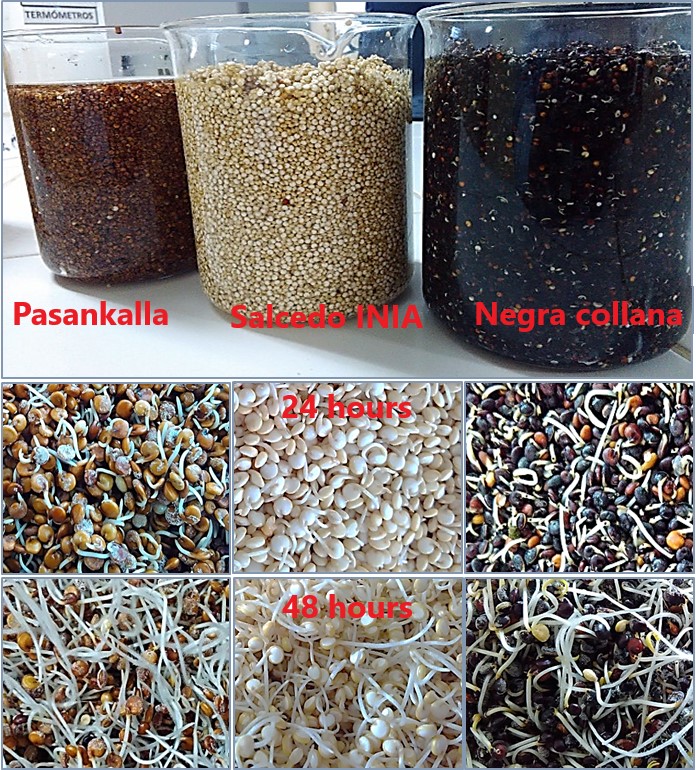
Quinoa (Chenopodium quinoa Willd) is a pseudocereal with a high nutritional potential and a significant content of bioactive compounds, which is consumed mainly by the inhabitants of the South American Andes. The aim of this study was to evaluate the protein content, total phenols, and antioxidant activity of quinoa grains of the Salcedo INIA, Pasankalla, and Negra collana varieties, germinated for 24 and 48 hours at 35 °C. Organic quinoa grains were grown in the Andahuaylas province in Peru, at an altitude of 3582 m. The protein content was determined through the Kjeldahl method, total phenols, in turn, by spectrophotometry with the Folin-Ciocalteu reagent, and the antioxidant activity of the DPPH type were registered. The data were analyzed through an Analysis of Variance (ANOVA), a Tukey test, and Pearson’s correlation at 5% significance. The germinated quinoa grains showed a considerable increase (p < 0,05) in their protein content, total phenolic compounds, and antioxidant activity, as well as a strong positive correlation with the size of sprouts during the germination time. Therefore, germinated quinoa could be considered as a promising product for human nutrition and health.
La quinua (Chenopodium quinoa Willd) es un pseudocereal con alto potencial nutricional y un contenido significativo de compuestos bioactivos, el cual es consumido principalmente por los habitantes de los Andes sudamericanos. El objetivo del presente estudio fue evaluar el contenido de proteínas, fenoles totales y actividad antioxidante de granos de quinua de las variedades Salcedo INIA, Pasankalla y Negra collana, germinados a 24 y 48 horas y 35 °C. Los granos de quinua orgánica fueron cultivados en la provincia de Andahuaylas, Perú, a 3582 m de altitud. Se determinaron el contenido proteico a través del método Kjeldahl, los fenoles totoles por espectrofotometría con el reactivo Folin-Ciocalteu, y la actividad antioxidante del tipo DPPH. Los datos fueron analizados a través de un análisis de la varianza (ANOVA), un test de Tukey y la correlación de Pearson al 5% de significancia. Los granos de quinua desaponificados y germinados presentaron un incremento considerable (p < 0,05) en contenido proteico, compuestos fenólicos totales y actividad antioxidante, así como una fuerte correlación positiva con el tamaño de brotes durante el tiempo de germinación. Por lo tanto, la quinua germinada podría considerarse un producto prometedor para la nutrición y salud humana.
References
Abderrahim, F., Huanatico, E., Segura, R., Arribas, S., Gonzalez, M. C., and Condezo-Hoyos L. (2015). Physical features, phenolic compounds, betalains and total antioxidant capacity of coloured quinoa seeds (Chenopodium quinoa Willd.) from Peruvian Altiplano. Food Chemistry, 183, 83-90. https://doi.org/10.1016/j.foodchem.2015.03.029
Ah-Hen, K., Fuenzalida, C., Hess, S., Contreras, A., Vega-Gálvez, A., and Lemus-Mondaca, R. (2012). Antioxidant capacity and total phenolic compounds of twelve selected potato landrace clones grown in southern Chile. Chilean journal of agricultural research, 72(1), 3-9. https://doi.org/10.4067/S0718-58392012000100001
Alvarez-Jubete L., Wijngaard, H., Arendt, E. K., and Gallagher, E. (2010). Polyphenol composition and in vitro antioxidant activity of amaranth, quinoa, buckwheat and wheat as affected by sprouting and baking. Food Chemistry, 119(2): 770-778. https://doi.org/10.1016/j.foodchem.2009.07.032
Angeli, V., Silva, P., Massuela, D., Khan, M. W., Hamar, A., Khajehei, F., and Piatti, C. (2020). Quinoa (Chenopodium quinoa Willd.): An Overview of the Potentials of the “Golden Grain” and Socio-Economic and Environmental Aspects of Its Cultivation and Marketization. Foods, 9(2), 216. https://doi.org/10.3390/foods9020216
AOAC (2016). Official Methods of Analysis (20th Ed.). Washington DC: Association of Official Analytical Chemists.
Banchuen, J., Thammarutwasik, P., Ooraikul, B., Wuttijumnong, P., and Sirivongpaisal, P. (2009). Effect of germinating processes on bioactive component of sangyodmuangphatthalung rice. Thai Journal of Agricultural Science. 42(4), 191-199. http://www.thaiscience.info/Journals/Article/TJAS/10594529.pdf
Bhargava, A., Shukla, S., and Ohri, D. (2006). Chenopodium quinoa - An Indian perspective. Industrial Crops and Products, 23(1), 73-87. https://doi.org/10.1016/j.indcrop.2005.04.002
Brand- Williams, W., Cuvelier, M. E., and Berset, C. (1995). Use of a free radical method to evaluate antioxidant activity. Lebensmittel, Wissenchaft und Technologie, 28(1), 25-30. https://doi.org/10.1016/S0023-6438(95)80008-5
Bravo, M., Reyna, J., Gómez, I., and Huapaya, M. (2013). Estudio químico y nutricional de granosandinos germinados de quinua (Chenopodium quinoa) y kiwicha (Amarantuscaudatus). Revista Peruana de química e IngenieríaQuímica, 16(1), 54-60. https://revistasinvestigacion.unmsm.edu.pe/index.php/quim/article/view/6558
Chaparro, D. C., Pismag, R. Y., and Elizalde, A. (2011). Efecto de la germinación sobre el contenido de hierro y calcio de amaranto, quinua, guandul y soya. Biotecnología en el Sector Agropecuario y Agroindustrial, 9(1), 51-59. https://revistas.unicauca.edu.co/index.php/biotecnologia/article/view/763
Contreras-Jiménez, B., Torres-Vargas, O. L., and Rodríguez-García, M.E. (2019). Physicochemical characterization of quinoa (Chenopodium quinoa) flour and isolated starch. Food Chemistry, 298, 1-7. https://doi.org/10.1016/j.foodchem.2019.124982
Dakhili, S., Abdolalizadeh, L., Hosseini, S. M., Shojaee-Aliabadi, S., and Mirmoghtadaie, L. (2019). Quinoa protein: Composition, structure and functional properties. Food Chemistry, 299, 125161. https://doi.org/10.1016/j.foodchem.2019.125161
Dávila, M. A., Sangronis, E., and Granito, M. (2003). Leguminosas germinadas o fermentadas: alimentos o ingredientes de alimentos funcionales. Artículos latinoamericanos de nutrición, 53(4), 348-354. https://www.alanrevista.org/ediciones/2003/4/art-2/
El-Safy, S., Mukhtar, E., and Salem, R. (2013). The impact of soaking and germination on chemical composition, carbohydrate fractions, digestibility, antinutritional factors and minerals content of some legumes and cereals grain seeds. Alexandria Science Exchange Journal, 34(4), 499-513. https://doi.org/10.21608/ASEJAIQJSAE.2013.3112
Elsohaimy, S. A., Refaay, T M., and Zaytoun, M. A. M. (2015). Physicochemical and functional properties of quinoa protein isolate. Annals of Agricultural Science, 60(2), 297-305. https://doi.org/10.1016/j.aoas.2015.10.007
Escribano, J., Cabanes, J., Jimenez-Atiénzar, M., Ibañez, M., Gomez-Pando, L., García-Carmona, F., and Gandía-Herrero, F. (2017). Characterization of betalains, saponins and antioxidant power in differently colored quinoa (Chenopodium quinoa) varieties. Food Chemistry, 234, 285-294. https://doi.org/10.1016/j.foodchem.2017.04.187
FAO (2011). Quinoa: An Ancient Crop to Contribute to World Food Security. Santiago de Chile, Chile: FAO, Regional Office for Latin America and the Caribbean.
Fernández-Orozco, R., Frías, J., Zielinski, H., Piskula, M. K., Kozlowska, H., and Vidal-Valverde, C. (2008). Estudio cinético de los compuestos antioxidantes y la capacidad antioxidante durante la germinación de Vigna radiatacv. Emmerald, Glycine max cv. Jutro y Glicina max cv. Mérito. Food Chemistry, 111(3), 622-630. https://doi.org/10.1016/j.foodchem.2008.04.028
Filho, A. M., Ribeiro, M., Da Silva, J T., Pinheiro, H. M. Santana, J. B., and Dos Reis, J. S. (2015): Quinoa: Nutritional, Functional and Antinutritional Aspects. Critical reviews in Food Science and Nutrition, 57(8), 1618-1630. https://doi.org/10.1080/10408398.2014.1001811
Gan, R. Y., Wang, M. F., Lui, W. Y. Wu, K., and Corke, H. (2016). Dynamic changes in phytochemical composition and antioxidant capacity in green and black mung bean (Vigna radiata) sprouts. International Journal of Food Science and Technology, 51(9), 2090-2098. https://doi.org/10.1111/ijfs.13185
Gawlik-Dziki, U., Swieca, M., Sułkowski, M., Dziki, D., Baraniak, B., and Czyz, J. (2013). Antioxidant and anticancer activities of Chenopodium quinoa leaves extracts - In vitro study. Food Chemical Toxicology 57, 154-160. https://doi.org/10.1016/j.fct.2013.03.023
Graf, B. L., Poulev, A., Kuhn, P., Grace, M. H., Lila, M. A., and Raskin, I. (2014). Quinoa seeds leach phytoecdysteroids and other compounds with anti-diabetic properties. Food Chemistry, 163, 178-185. https://doi.org/10.1016/j.foodchem.2014.04.088
Han, Y., Chi, J., Zhang, M., Zhang, R., Fan, S., Huang, F., Xue, K., and Liu, L. (2019). Characterization of saponins and phenolic compounds: antioxidant activity and inhibitory effects on α-glucosidase in different varieties of colored quinoa (Chenopodium quinoa Willd). Bioscience, Biotechnology, and Biochemistry, 83(11), 2128-2139. https://doi.org/10.1080/09168451.2019.1638756
Huang, J., Qin, L., Shi, Q., and Wen, A. (2017). Effect of quinoa saponins extraction and sprouting on saponins content. Journal of the Chinese Cereals and Oils Association, 32(11), 34-39. https://en.cnki.com.cn/Article_en/CJFDTotal-ZLYX201711008.htm
Jacobsen, S. E., Mujica, A., and Jensen, C. R., (2003). The resistance of quinoa (Chenopodium quinoaWilld.) to adverse abiotic factors. Food Reviews International, 19(1-2), 99-109. https://doi.org/10.1081/FRI-120018872
Li, Y. C., Qian, H., Sun, X. L., Cui, Y., Wang, H. Y., Du, C., and Xia, X. H. (2014). The Effects of Germination on Chemical Composition of Peanut Seed. Food Science and Technology Research, 20(4), 883-889. https://doi.org/10.3136/fstr.20.883
Liberal, A., Calhelha, R. C., Pereira, C., and Adega, F. (2016). A comparison of the bioactivity and phytochemical profile of three different cultivars of globe amaranth: red, white, and pink. Food and Function, 7(2), 679-688. https://doi.org/10.1039/c5fo01342a
Mariod, A. A., and Salama, S. M. (2020). The Efficacy of Processing Strategies on the Gastroprotective Potentiality of Chenopodium quinoa Seeds. The Scientific World Journal, 6326452, 1-16. https://doi.org/10.1155/2020/6326452
Mbithi, S., Van Camp, J., Rodríguez, R., and Huyghebaert, A. (2001). Efectos de la germinación en la composición de nutrientes y antinutrientes de los frijoles (Phaseolusvulgarisvar. Rose coco). European Food Research and Technology, 212, 188-191. https://doi.org/10.1007/s002170000200
Navruz-Varli, S. and Sanlier, N. (2016). Nutritional and health benefits of quinoa (Chenopodium quinoa Willd.). Journal of Cereal Science, 69, 371-376. https://doi.org/10.1016/j.jcs.2016.05.004
Nickel, J., Spanier, L. P., Botelho, F. T., Gularte, M. A., and Helbig, E. (2016). Effect of different types of processing on the total phenolic compound content, antioxidant capacity, and saponin content of Chenopodium quinoa Willd grains. Food Chemistry, 209, 139-143. https://doi.org/10.1016/j.foodchem.2016.04.031
Nsimba, R. Y., Kikuzaki, H., and Konishi, Y. (2008). Antioxidant activity of various extracts and fractions of Chenopodium quinoa and Amaranthus spp. seeds. Food Chemistry, 106(2), 760-766. DOI: 10.1016/J.FOODCHEM.2007.06.004.
Oghbaei M., and Prakash J. (2017). Nutritional properties of green gram germinated in mineral fortified soak water: I. Effect of dehulling on total and bioaccessible nutrients and bioactive components. Journal of Food Science and Technology, 54, 880-889. https://doi.org/10.1007/s13197-016-2460-0
Pasko, P., Barton, H., Zagrodzki, P., Gorinstein, S., Folta, M., and Zachwieja, Z. (2009). Anthocyanins, total polyphenols and antioxidant activity in amaranth and quinoa seeds and sprouts during their growth. Food Chemistry, 115(3), 994-998. DOI: 10.1016/j.foodchem.2009.01.037
Pereira, E., Encina-Zelada, C., Barros, L., Gonzales-Barron, U., Cadavez, V., and Ferreira, I. (2018). Chemical and nutritional characterization of Chenopodium quinoa Willd (quinoa) grains: A good alternative to nutritious food. Food Chemistry, 280, 110-114. https://doi.org/10.1016/j.foodchem.2018.12.068
Piñuel, L., Boeri, P., Zubillaga, F., Barrio, D. A., Torreta, J., Cruz, A., Vásquez, G., Pinto, A., and Carrillo, W. (2019). Production of White, Red and Black Quinoa (Chenopodium quinoa Willd Var. Real) Protein Isolates and Its Hydrolysates in Germinated and Non-Germinated Quinoa Samples and Antioxidant Activity Evaluation. Plants, 8(8), 257. https://doi.org/10.3390/plants8080257
Repo-Carrasco-Valencia, R. (2020). Nutritional Value and Bioactive Compounds in Andean Ancient Grains. Proceedings, 53(1), 1-5. https://doi.org/10.3390/proceedings2020053001
Repo-Carrasco-Valencia, R. A. M., and Serna, L. A. (2011). Quinoa (Chenopodium quinoa, Willd.) as a source of dietary fiber and other functional components. Food Science and Technology, 31(1), 225-230. https://doi.org/10.1590/S0101-20612011000100035
Saad-Allah, K. M., and Youssef, M. S. (2018). Phytochemical and genetic characterization of five quinoa (Chenopodium quinoa Willd.) genotypes introduced to Egypt. Physiology and Molecular Biology of Plants, 24(4), 617-629. https://doi.org/10.1007/s12298-018-0541-4
Sani, I. M., Iqbal, S., Chan, K. W., and Ismail, M. (2012). Effect of acid and base catalyzed hydrolysis on the yield of phenolics and antioxidant activity of extracts from germinated brown rice (GBR). Molecules, 17(6), 7584-7594. https://doi.org/10.3390/molecules17067584
Sarvajeet, S. G. and Narendra, T. (2010). Especies reactivas de oxígeno y maquinaria antioxidante en tolerancia al estrés abiótico en plantas de cultivo. Plant Physiology and Biochemistry, 48(12), 909-930. https://doi.org/10.1016/j.plaphy.2010.08.016
Shetty, K. (2004). Papel de la ruta del fosfato de pentosa ligado a la prolina en la biosíntesis de fenoles vegetales para aplicaciones funcionales alimentarias y ambientales: una revisión. Process Biochemistry, 39(7), 789-804. https://doi.org/10.1016/S0032-9592(03)00088-8
Shulaev, V., Cortes, D., Miller, G., and Mittler, R. (2008). Metabolómica para la respuesta al estrés de la planta. Physiologia Plantarum, 132(2), 199-208. https://doi.org/10.1111/j.1399-3054.2007.01025.x
Tang, Y., Zhang, B., Li, X., Chen, P. X., Zhang, H., Liu, R., and Tsao, R. (2016). Bound phenolics of quinoa seeds released by acid, alkaline, and enzymatic treatments and their antioxidant and a-glucosidase and pancreatic lipase inhibitory effects. Journal of Agricultural and Food Chemistry, 64(8), 1712-1719. https://doi.org/10.1021/acs.jafc.5b05761
Tang, Y. and Tsao, R. (2017). Phytochemicals in quinoa and amaranth grains and their antioxidant, anti-inflammatory, and potential health beneficial effects: a review. Molecular Nutrition and Food Research, 61(7), 1600767. https://doi.org/10.1002/mnfr.201600767
Tang, Y., Li, X., Chen, P. X., Zhang, B., Hernandez, M., Zhang, H., Marcone, M. F., Liu, R., and Tsao, R. (2014). Characterisation of fatty acid, carotenoid, tocopherol/tocotrienol compositions and antioxidant activities in seeds of three Chenopodium quinoa Willd. genotypes. Food Chemistry, 174, 502-508. https://doi.org/10.1016/j.foodchem.2014.11.040
Tang, Y., Li, X., Zhang, B., Chen, P. X., Liu, R., and Tsao, R. (2015). Characterisation of phenolics, betanins and antioxidant activities in seeds of three Chenopodium quinoa Willd. genotypes. Food Chemistry, 166, 380-388. https://doi.org/10.1016/j.foodchem.2014.06.018
Televičiūtė, D., Tarasevičienė, Ž., Danilčenko, H., Barčauskaitė, K., Kandaraitė, M., and Paulauskienė, A. (2020). Changes in chemical composition of germinated leguminous under abiotic stress conditions. Food Science and Technology, 40(2), 415-421. https://doi.org/10.1590/fst.23019
Torres, A., Cova, A., and Valera, D. (2018). Efecto del proceso de germinación de granos de Cajanuscajan en la composición nutricional, ácidos grasos, antioxidantes y bioaccesibilidad mineral. Revista chilena de nutrición, 45(4), 323-330. https://doi.org/10.4067/S0717-75182018000500323
Vilcacundo, R., and Hernández-Ledesma, B. (2017). Nutritional and biologicalvalueof quinoa (Chenopodium quinoa Willd.). Current Opinion in Food Science, 14, 1-6. https://doi.org/10.1016/j.cofs.2016.11.007
Zhu, F. (2018). Chemical composition and food uses of teff (Eragrostistef). Food Chemistry, 239, 402-415. https://doi.org/10.1016/j.foodchem.2017.06.101
Dimensions
PlumX
Article abstract page views
Downloads
How to Cite




License
Copyright (c) 2021 David Choque-Quispe, Carlos Alberto Ligarda-Samanez, Betsy Suri Ramos-Pacheco, Saida Leguía Damiano, Miriam Calla-Florez, Lourdes Magaly Zamalloa Puma, Luisa Colque Condeña

This work is licensed under a Creative Commons Attribution 4.0 International License.
The authors or holders of the copyright for each article hereby confer exclusive, limited and free authorization on the Universidad Nacional de Colombia's journal Ingeniería e Investigación concerning the aforementioned article which, once it has been evaluated and approved, will be submitted for publication, in line with the following items:
1. The version which has been corrected according to the evaluators' suggestions will be remitted and it will be made clear whether the aforementioned article is an unedited document regarding which the rights to be authorized are held and total responsibility will be assumed by the authors for the content of the work being submitted to Ingeniería e Investigación, the Universidad Nacional de Colombia and third-parties;
2. The authorization conferred on the journal will come into force from the date on which it is included in the respective volume and issue of Ingeniería e Investigación in the Open Journal Systems and on the journal's main page (https://revistas.unal.edu.co/index.php/ingeinv), as well as in different databases and indices in which the publication is indexed;
3. The authors authorize the Universidad Nacional de Colombia's journal Ingeniería e Investigación to publish the document in whatever required format (printed, digital, electronic or whatsoever known or yet to be discovered form) and authorize Ingeniería e Investigación to include the work in any indices and/or search engines deemed necessary for promoting its diffusion;
4. The authors accept that such authorization is given free of charge and they, therefore, waive any right to receive remuneration from the publication, distribution, public communication and any use whatsoever referred to in the terms of this authorization.