Published
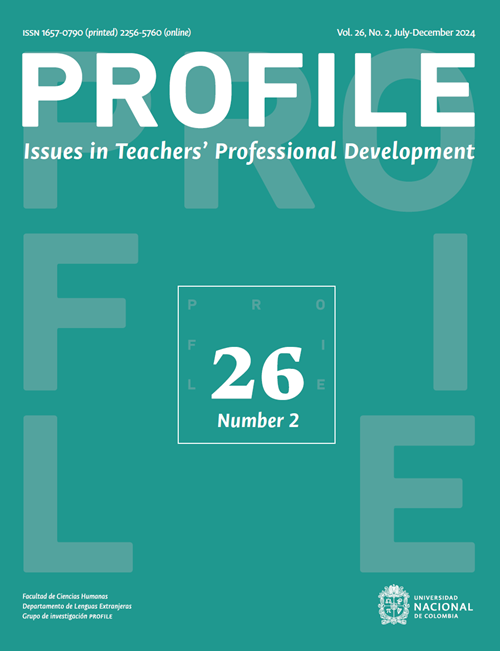
Exploring Non-Native-English-Speaking Preservice EFL Teachers’ Cognitions: What Teaching Philosophy Statements Can Tell Us
Exploración de las cogniciones de docentes de inglés no nativos: lo que las declaraciones de filosofía de enseñanza pueden decirnos
DOI:
https://doi.org/10.15446/profile.v26n2.108741Keywords:
English as a foreign language, language teacher cognition, language teacher education, preservice teachers, teaching philosophy statement (en)cognición del docente de lengua, declaración de filosofía de la enseñanza, formación docente, futuros docentes, inglés como lengua extranjera (es)
This study investigates the content and characteristics of the cognitions of 30 Turkish English-as-a-foreign-language preservice teachers as manifested in their teaching philosophy statements. The study showed that the preservice teachers’ cognition was focused on both the pedagogical (teaching-learning and language teaching methods) and the personal and interpersonal (learners’ and teachers’ roles and the relationship between them) aspects of teaching and was characterized by high idealism and naïveté, but they also demonstrated a certain level of awareness of the future contexts in which they would be teaching. Although their past experiences significantly shaped their cognition, they found that their current teacher education program helped them develop a critical view of these experiences.
Este estudio investiga el contenido y las características de las cogniciones de treinta futuros docentes turcos de inglés, tal como se manifiestan en sus declaraciones de filosofía de la enseñanza. Se encontró que la cognición de los docentes se centraba en los aspectos pedagógicos (enseñanza-aprendizaje y métodos de enseñanza de lengua) y en los aspectos personales e interpersonales (papeles de los alumnos y docentes y la relación entre ellos) de la enseñanza. Esta cognición se caracterizó por un alto idealismo e ingenuidad, aunque los docentes también demostraron ser conscientes de los contextos futuros en los que estarían enseñando. Aunque sus experiencias pasadas desempeñaron un papel importante en la formación de su cognición, descubrieron que su actual programa de formación docente les ayudó a desarrollar una visión crítica de estas experiencias.
References
Abad, M. (2023). EFL teachers’ beliefs about listening and their actual listening instructional practices. Profile: Issues in Teachers’ Professional Development, 25(1), 113–127. https://doi.org/10.15446/profile.v25n1.98510
Aloud, R. E. (2022). Saudi female EFL teachers’ cognition and practices regarding online corrective feedback in speaking class. Arab World English Journal, (8), 56–69. https://doi.org/10.24093/awej/call8.4
Anspal, T., Eisenschmidt, E., & Löfström, E. (2012). Finding myself as a teacher: Exploring the shaping of teacher identities through student teachers’ narratives. Teachers and Teaching, 18(2), 197–216. https://doi.org/10.1080/13540602.2012.632268
Arslan, F. Y. (2019). Reflection in pre-service teacher education: Exploring the nature of four EFL pre-service teachers’ reflections. Reflective Practice, 20(1), 111–124. https://doi.org/10.1080/14623943.2018.1564652
Ayres, L. (2008). Thematic coding and analysis. In L. M. Given (Ed.), The SAGE encyclopedia of qualitative research methods (pp. 867–868). Sage. https://doi.org/10.4135/9781412963909
Barr, S., & Askell-Williams, H. (2020). Changes in teachers’ epistemic cognition about self-regulated learning as they engaged in a researcher-facilitated professional learning community. Asia-Pacific Journal of Teacher Education, 48(2), 187–212. https://doi.org/10.1080/1359866X.2019.1599098
Ben-Peretz, M. (2011). Teacher knowledge: What is it? How do we uncover it? What are its implications for schooling? Teaching and Teacher Education, 27(1), 3–9. https://doi.org/10.1016/j.tate.2010.07.015
Borg, S. (2003). Teacher cognition in language teaching: A review of research on what language teachers think, know, believe, and do. Language Teaching, 36(2), 81–109. https://doi.org/10.1017/s0261444803001903
Borg, S. (2019). Language teacher cognition: Perspectives and debates. In X. Gao (Ed.), Second handbook of English language teaching (pp. 1149–1170). Springer. https://doi.org/10.1007/978-3-030-02899-2_59
Borg, S., & Sanchez, H. S. (2020). Cognition and good language teachers. In C. Griffiths & Z. Tajeddin (Eds.), Lessons from good language teachers (pp. 16–27). Cambridge University Press. https://doi.org/10.1017/9781108774390.005
Bowne, M. (2017). Developing a teaching philosophy. The Journal of Effective Teaching, 17(3), 59–63. https://eric.ed.gov/?id=EJ1175767
Buitink, J. (2009). What and how do student teachers learn during school-based teacher education. Teaching and Teacher Education, 25(1), 118–127. https://doi.org/10.1016/j.tate.2008.07.009
Caukin, N. G., & Brinthaupt, T. M. (2017). Using a teaching philosophy statement as a professional development tool for teacher candidates. International Journal for the Scholarship of Teaching and Learning, 11(2), 1–9. https://doi.org/10.20429/ijsotl.2017.110218
Chmarkh, M. (2021). English as a second language and English as a foreign language preservice teacher cognitions: Research insights from around the world (2005–2021). Arab World English Journal, 12(4), 487–502. https://doi.org/10.24093/awej/vol12no4.32
Chou, C.-H. (2008). Exploring elementary English teachers’ practical knowledge: A case study of EFL teachers in Taiwan. Asia Pacific Education Review, 9(4), 529–541. https://doi.org/10.1007/bf03025668
Connelly, F. M., & Clandinin, D. J. (1988). Teachers as curriculum planners: Narratives of experience. Teachers College Press.
Couper, G. (2017). Teacher cognition of pronunciation teaching: Teachers’ concerns and issues. TESOL Quarterly, 51(4), 820–843. https://doi.org/10.1002/tesq.354
Creswell, J. W. (2013). Qualitative inquiry and research design: Choosing among five approaches (3rd ed.). Sage Publications.
Crookes, G. V. (2003). A practicum in TESOL: Professional development through teaching practice. Cambridge University Press.
Crookes, G. V. (2015). Redrawing the boundaries on theory, research, and practice concerning language teachers’ philosophies and language teacher cognition: Toward a critical perspective. Modern Language Journal, 99(3), 485–499. https://doi.org/10.1111/modl.12237
Ellis, E. M. (2006). Language learning experience as a contributor to ESOL teacher cognition. TESL-EJ, 10(1), 1–20.
Fenstermacher, G. D. (1994). The knower and the known: The nature of knowledge in research on teaching. Review of Research in Education, 20, 3–56. https://doi.org/10.2307/1167381
Golombek, P. (1998). A study of language teachers’ personal practical knowledge. TESOL Quarterly, 32(3), 447–464. https://doi.org/10.2307/3588117
Hayes, D. (2009). Non-native English-speaking teachers, context and English language teaching. System, 37(1), 1–11. https://doi.org/10.1016/j.system.2008.06.001
Hegarty, N. C. (2015). The growing importance of teaching philosophy statements and what they mean for the future: Why teaching philosophy statements will affect you. Journal of Adult Education, 44(2), 28–30.
İnceçay, G. (2011). Effects of learning beliefs of pre-service teachers at an English as a Foreign Language certificate program on their practice teaching. Turkish Online Journal of Qualitative Inquiry, 2(4), 29–38. https://eric.ed.gov/?id=ED537778
Johnson, K. E. (1994). The emerging beliefs and instructional practices of preservice English as a second language teachers. Teaching and Teacher Education, 10(4), 439–452. https://doi.org/10.1016/0742-051x(94)90024-8
Johnson, K. E. (2015). Reclaiming the relevance of L2 teacher education. The Modern Language Journal, 99(3), 515–528. https://doi.org/10.1111/modl.12242
Kochem, T. (2022). Exploring the connection between teacher training and teacher cognitions related to L2 pronunciation instruction. TESOL Quarterly, 56, 1136–1162. https://doi.org/10.1002/tesq.3095
Kuckartz, U. (2014). Qualitative text analysis: A guide to methods, practice, and using software. Sage. https://doi.org/10.4135/9781446288719
Levin, B., & He, Y. (2008). Investigating the content and sources of teacher candidates’ personal practical theories (PPTs). Journal of Teacher Education, 59(1), 55–68. https://doi.org/10.1177/0022487107310749
Lin, S.-W. (2022). Analysis of teacher cognitions and practices from a Global Englishes perspective: Cases of high school English teachers in Taiwan. Taiwan Journal of TESOL, 19(1), 35–58. https://doi.org/10.30397/TJTESOL.202204_19(1).0002
Liviero, S. (2017). Grammar teaching in secondary school foreign language learning in England: Teachers’ reported beliefs and observed practices. The Language Learning Journal, 45(1), 26–50. https://doi.org/10.1080/09571736.2016.1263677
Maaranen, K., Pitkäniemi, H., Stenberg, K., & Karlsson, L. (2016). An idealistic view of teaching: Teacher students’ personal practical theories. Journal of Education for Teaching, 42(1), 80–92. https://doi.org/10.1080/02607476.2015.1135278
Maaranen, K., & Stenberg, K. (2017). Portraying reflection: The contents of student teachers’ reflection on personal practical theories and practicum experience. Reflective Practice, 18(5), 699–712. https://doi.org/10.1080/14623943.2017.1323729
Meijer, P. C., Verloop, N., & Beijaard, D. (1999). Exploring language teachers’ practical knowledge about teaching reading comprehension. Teaching and Teacher Education, 15(1), 59–84. https://doi.org/10.1016/s0742-051x(98)00045-6
Merriam, S. B., & Tisdell, E. J. (2016). Qualitative research: A guide to design and implementation (4th ed.). Jossey-Bass.
Moodie, I. (2016). The anti-apprenticeship of observation: How negative prior language learning experience influences English language teachers’ beliefs and practices. System, 60, 29–41. https://doi.org/10.1016/j.system.2016.05.011
Payant, C. (2017). Teaching philosophy statements: In-service ESL teachers’ practices and beliefs. TESOL Journal, 8(3), 636–656. https://doi.org/10.1002/tesj.290
Payant, C., & Hirano, E. (2018). Recurring topics in English language teachers’ written teaching philosophy statements. TESL Canada Journal, 35(1), 29–51. https://doi.org/10.18806/tesl.v35i1.1283
Pitkäniemi, H. (2010). How the teacher’s practical theory moves to teaching practice: A literature review and conclusions. Education Inquiry, 1(3), 157–175. https://doi.org/10.3402/edui.v1i3.21940
Pratt, D. D. (2005). Personal philosophies of teaching: A false promise? Academe, 91(1), 32–35. https://doi.org/10.2307/40252734
Schönwetter, D. J., Sokal, L., Friesen, M., & Taylor, K. L. (2002). Teaching philosophies reconsidered: A conceptual model for the development and evaluation of teaching philosophy statements. International Journal for Academic Development, 7(1), 83–97. https://doi.org/10.1080/13601440210156501
Schulman, L. (1986). Those who understand: Knowledge growth in teaching. Educational Researcher, 15(7), 4–14. https://doi.org/10.3102/0013189x015002004
Tajeddin, Z., & Aryaeian, N. (2017). A collaboration-mediated exploration of nonnative L2 teachers’ cognition of language teaching methodology. Australian Journal of Teacher Education, 42(6), 81–99. https://doi.org/10.14221/ajte.2017v42n6.6
Tercanlioglu, L. (2001). Pre-service teachers as readers and future teachers of EFL reading. TESL-EJ, 5(3). http://tesl-ej.org/ej19/a2.html
Tsang, W. K. (2004). Teachers’ personal practical knowledge and interactive decisions. Language Teaching Research, 8(2), 163–198. https://doi.org/10.1191/1362168804lr139oa
Verloop, N., Van Driel, J., & Meijer, P. (2001). Teacher knowledge and the knowledge base of teaching. International Journal of Educational Research, 35(5), 441–461. https://doi.org/10.1016/S0883-0355(02)00003-4
Wall, C. R. G. (2016). From student to teacher: Changes in preservice teacher educational beliefs throughout the learning-to-teach journey. Teacher Development, 20(3), 364–379. https://doi.org/10.1080/13664530.2016.1149509
Warford, M. K., & Reeves, J. (2003). Falling into it: Novice TESOL teacher thinking. Teachers and Teaching: Theory and Practice, 9(1), 47–65. https://doi.org/10.1080/1354060032000049904
Webster, S. (2019). Understanding lack of development in early career teachers’ practical knowledge of teaching speaking skills. System, 80, 154–164. https://doi.org/10.1016/j.system.2018.10.010
Yigitoglu, N., & Belcher, D. (2014). Exploring L2 writing teacher cognition from an experiential perspective: The role learning to write may play in professional beliefs and practices. System, 47, 116–124. https://doi.org/10.1016/j.system.2014.09.021
Dimensions
PlumX
Article abstract page views
Downloads
How to Cite
License
Copyright (c) 2024 Sibel Tatar

This work is licensed under a Creative Commons Attribution-NonCommercial-NoDerivatives 4.0 International License.
You are authorized to copy and redistribute the material in any medium or format as long as you give appropriate credit to the authors of the articles and to Profile: Issues in Teachers' Professional Development as original source of publication. The use of the material for commercial purposes is not allowed. If you remix, transform, or build upon the material, you may not distribute the modified material.
Authors retain the intellectual property of their manuscripts with the following restriction: first publication is granted to Profile: Issues in Teachers' Professional Development.