Published
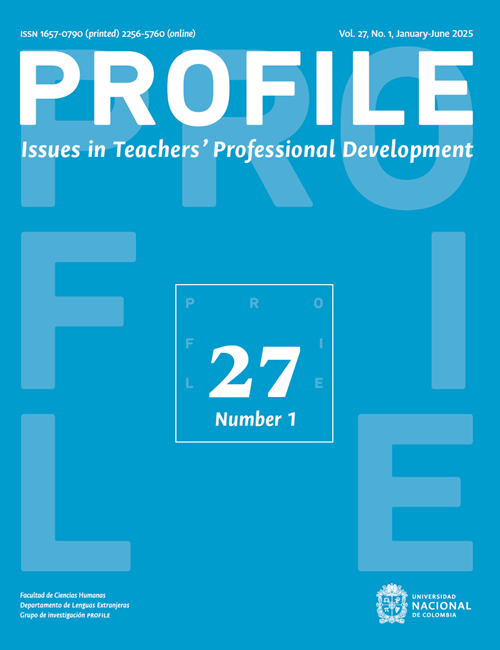
Developing English Language Teachers’ Action Research Competencies Through an Exploratory Action Research Project
Desarrollo de las competencias de investigación-acción de docentes de inglés mediante un proyecto de investigación-acción exploratoria
DOI:
https://doi.org/10.15446/profile.v27n1.113465Keywords:
action-research competencies, continuing professional development, English language teachers, exploratory action research, teacher research (en)competencias de investigación-acción, docentes de inglés, formación profesional continua, investigación-acción exploratoria, investigación docente (es)
This article reports the impact of an exploratory action research (EAR) project on developing teachers’ action research competencies. Through various face-to-face and online activities, the project facilitated four English language teachers to conduct EAR in their teaching contexts. Qualitative data were collected through reflective journals and WhatsApp group chats. Data reveal that each participating teacher critically reflected on the teaching context, selected a research question, collected and interpreted evidence, designed and evaluated an action, and disseminated their research. The findings imply that teachers’ participation in EAR can develop their action-research competencies and ability to integrate teaching and research for their continuing professional development.
En este artículo se reporta el impacto de un proyecto de investigación-acción exploratoria en el desarrollo de las competencias de investigación-acción de los docentes. Mediante actividades presenciales y en línea, el proyecto facilitó que cuatro profesores de inglés realizaran investigación-acción exploratoria en sus contextos de enseñanza. Los datos cualitativos se recolectaron a través de diarios reflexivos y mensajes grupales de WhatsApp. Los datos revelan que cada participante reflexionó críticamente sobre el contexto de enseñanza, seleccionó una pregunta de investigación, recopiló e interpretó evidencia, diseñó y evaluó una acción y difundió su investigación. Los hallazgos implican que la participación de los docentes en investigación-acción exploratoria puede desarrollar sus competencias de investigación-acción y su capacidad para integrar la enseñanza y la investigación para su formación profesional continua.
References
Abakah, E., Widin, J., & Ameyaw, E. K. (2022). Continuing professional development (CPD) practices among basic school teachers in the central region of Ghana. Sage Open, 12(2). https://doi.org/10.1177/21582440221094597
Anderson, J. (2023). Researching and developing teacher expertise in the Global South: Local and transferable solutions. In R. Khan, A. Bashir, B. L. Basu, & M. E. Uddin (Eds.), Local research and glocal perspectives in English language teaching: Teaching in the changing times (pp. 399–417) Springer. https://doi.org/10.1007/978-981-19-6458-9_25
Atay, D. (2006). Teachers’ professional development: Partnerships in research. TESL-EJ, 10(2), 1–14.
Atay, D. (2008). Teacher research for professional development. ELT Journal, 62(2), 139–147. https://doi.org/10.1093/elt/ccl053
Borg, S. (2009). English language teachers’ conceptions of research. Applied Linguistics, 30(3), 358–388. https://doi.org/10.1093/applin/amp007
Borg, S. (2010). Language teacher research engagement. Language Teaching, 43(4), 391–429. https://doi.org/10.1017/S0261444810000170
Braun, V., & Clarke, V. (2006). Using thematic analysis in psychology. Qualitative Research in Psychology, 3(2), 77–101. https://doi.org/10.1191/1478088706qp063oa
Buğra, C., & Wyatt, M. (2021). English language teachers collaborating in practitioner research and loving it. Educational Action Research, 29(3), 483–499. https://doi.org/10.1080/09650792.2020.1842778
Burns, A. (2014). Professional learning in Australian ELICOS: An action research orientation. English Australia Journal, 29(2), 3–20.
Burns, A. (Ed.). (2023). Exploratory action research in Thai schools: English teachers identifying problems, taking action and assessing results. British Council. https://www.britishcouncil.or.th/sites/default/files/exploratory_action_research_in_thai_schools_english_teachers_identifying_problems_taking_action_and_assessing_results.pdf
Burns, A., Westmacott, A., & Hidalgo Ferrer, A. (2016). Initiating an action research programme for university EFL teachers: Early experiences and responses. Iranian Journal of Language Teaching Research, 4(3), 55–73. https://doi.org/10.30466/IJLTR.2016.20354
Croll, P. (2023). The nature of contemporary studies of education: An analysis of articles published in leading journals. British Journal of Educational Studies, 71(5), 537–547. https://doi.org/10.1080/00071005.2023.2231523
Dikilitaş, K., & Comoglu, I. (2022). Pre-service English teachers’ reflective engagement with stories of exploratory action research. European Journal of Teacher Education, 45(1), 26–42. https://doi.org/10.1080/02619768.2020.1795123
Edwards, E. (2021). The ecological impact of action research on language teacher development: A review of the literature. Educational Action Research, 29(3), 396–413. https://doi.org/10.1080/09650792.2020.1718513
Edwards, E., & Burns, A. (2016). Language teacher action research: Achieving sustainability. ELT Journal, 70(1), 6–15. https://doi.org/10.1093/elt/ccv060
Hiebert, J., Gallimore, R., & Stigler, J. W. (2002). A knowledge base for the teaching profession: What would it look like and how can we get one? Educational Researcher, 31(5), 3–15. https://doi.org/10.3102/0013189X031005003
Hobson, A. J., Ashby, P., Malderez, A., & Tomlinson, P. D. (2009). Mentoring beginning teachers: What we know and what we don’t. Teaching and Teacher Education, 25(1), 207–216. https://doi.org/10.1016/j.tate.2008.09.001
Johnson, K. E., & Golombek, P. R. (2011). The transformative power of narrative in second language teacher education. TESOL Quarterly, 45(3), 486–509. https://doi.org/10.5054/tq.2011.256797
Kayaoglu, M. N. (2015). Teacher researchers in action research in a heavily centralized education system. Educational Action Research, 23(2), 140–161. https://doi.org/10.1080/09650792.2014.997260
Khanjani, A., Vahdany, F., & Jafarigohar, M. (2018). Effects of journal writing on EFL teacher trainees’ reflective practice. Research in English Language Pedagogy, 6(1), 56–77. https://doi.org/10.30486/relp.2018.538761
Mann, S., & Tang, E. H. H. (2012). The role of mentoring in supporting novice English language teachers in Hong Kong. TESOL Quarterly, 46(3), 472–495. https://doi.org/10.1002/tesq.38
Pérez Berbain, M., Payaslian, L., Sauer Rosas, A., García, B., & La Porta, A. (2023). The impact of mentoring on English language teachers: A case from Argentina. Profile: Issues in Teachers’ Professional Development, 25(1), 49–64. https://doi.org/10.15446/profile.v25n1.101711
Pinninti, L. R. (2022). Teacher research for continuing professional development: 3R approach. In S. P. Dhanavel (Ed.), Continuing professional development of English language teachers: Perspectives and practices from India (pp. 117–133). Springer. https://doi.org/10.1007/978-981-19-5069-8_8
Rebolledo, P., Smith, R., & Bullock, D. (Eds.). (2016). Champion teachers: Stories of exploratory action research. British Council.
Sadeghi, K., & Richards, J. C. (2021). Professional development among English language teachers: Challenges and recommendations for practice. Heliyon, 7(9), e08053. https://doi.org/10.1016/j.heliyon.2021.e08053
Shrestha, S., Laudari, S., & Gnawali, L. (2023). Exploratory action research: Experiences of Nepalese EFL teachers. ELT Journal, 77(4), 407–415. https://doi.org/10.1093/elt/ccac029
Smith, R. (2015). Exploratory action research as workplan: Why, what, and where from? In K. Dikilitas, R. Smith, & W. Trotman (Eds.), Teacher-researchers in action (pp. 37–45). IATEFL.
Smith, R. (2020). Mentoring teachers to research their classrooms: A practical handbook. British Council.
Smith, R., & Rebolledo, P. (2018). A handbook for exploratory action research. British Council.
Wang, Q., & Zhang, H. (2014). Promoting teacher autonomy through university–school collaborative action research. Language Teaching Research, 18(2), 222–241. https://doi.org/10.1177/1362168813505942
Wyatt, M., & Dikilitaş, K. (2016). English language teachers becoming more efficacious through research engagement at their Turkish university. Educational Action Research, 24(4), 550–570. https://doi.org/10.1080/09650792.2015.1076731
Wyatt, M., & Ončevska Ager, E. (2017). Teachers’ cognitions regarding continuing professional development. ELT Journal, 71(2), 171–185. https://doi.org/10.1093/elt/ccw059
Yuan, E. R. (2016). The dark side of mentoring on pre-service language teachers’ identity formation. Teaching and Teacher Education, 55, 188–197. https://doi.org/10.1016/j.tate.2016.01.012
Yuan, R., & Burns, A. (2017). Teacher identity development through action research: A Chinese experience. Teachers and Teaching, 23(6), 729–749. https://doi.org/10.1080/13540602.2016.1219713
Dimensions
PlumX
Article abstract page views
Downloads
How to Cite
License
Copyright (c) 2025 Lakshmana Rao Pinninti

This work is licensed under a Creative Commons Attribution-NonCommercial-NoDerivatives 4.0 International License.
You are authorized to copy and redistribute the material in any medium or format as long as you give appropriate credit to the authors of the articles and to Profile: Issues in Teachers' Professional Development as original source of publication. The use of the material for commercial purposes is not allowed. If you remix, transform, or build upon the material, you may not distribute the modified material.
Authors retain the intellectual property of their manuscripts with the following restriction: first publication is granted to Profile: Issues in Teachers' Professional Development.