Published
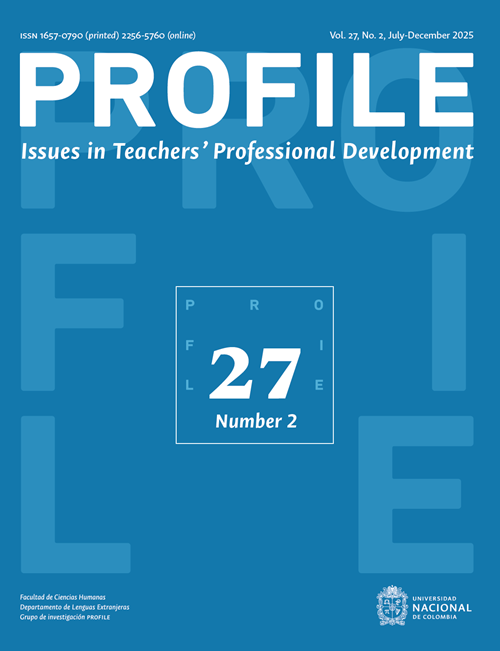
Research Engagement Among University EFL Lecturers in Vietnam: A Positioning Theory Perspective
Participación en la investigación entre docentes universitarios de inglés en Vietnam: una perspectiva desde la teoría del posicionamiento
DOI:
https://doi.org/10.15446/profile.v27n2.116028Keywords:
EFL research practice, EFL university lecturer, positioning theory, research culture, research engagement (en)compromiso con la investigación, cultura de la investigación, investigación en inglés como lengua extranjera, docentes universitarios de inglés, teoría del posicionamiento (es)
Most Vietnamese university lecturers, especially those who teach English as a foreign language (EFL), have always considered research practice an unfamiliar area and seem disempowered from conducting research activities. Hence, this qualitative study investigates the research engagement of 21 Vietnamese EFL lecturers from a positioning theory perspective, as evidenced in semi-structured interviews. The findings revealed the participants’ insights into research when they play different roles: (a) lecturer, (b) action researcher, (c) EFL teacher, and (d) impossible-mission accomplisher. Regardless of the participants’ positions, their research engagement was low and depended on their perception of such roles. The study discusses implications for fostering academics’ research in higher education within and beyond Vietnam.
La mayoría de los profesores universitarios vietnamitas, especialmente aquellos que enseñan inglés, consideran la práctica investigativa un área poco familiar y parecen desmotivados para llevar a cabo actividades investigativas. Este estudio cualitativo analiza la participación en la investigación de 21 profesores vietnamitas de inglés desde la perspectiva de la teoría del posicionamiento, utilizando entrevistas semiestructuradas. Los hallazgos revelaron las percepciones de los participantes sobre la investigación cuando asumen diferentes roles: (a) profesor, (b) investigador de acción, (c) docente de inglés y (d) realizador de misiones imposibles. Independientemente de sus roles, la participación en la investigación fue baja y dependió de cómo percibían dichos roles. El estudio discute implicaciones para fomentar la investigación académica en la educación superior dentro y fuera de Vietnam.
References
Barkhuizen, G. (2009). Topics, aims and constraints in English research: A Chinese case study. TESOL Quarterly, 43(1), 113–125. https://doi.org/10.1002/j.1545-7249.2009.tb00231.x
Borg, S. (2007). Research engagement in English language teaching. Teaching and Teacher Education, 23(5), 731–747. https://doi.org/10.1016/j.tate.2006.03.012
Borg, S. (2009). English language teachers’ conceptions of research. Applied Linguistics, 30(3), 358–388. https://doi.org/10.1093/applin/amp007
Borg, S. (2010). Language teacher research engagement. Language Teaching, 43(4), 391–429. https://doi.org/10.1017/S0261444810000170
Borg, S. (2015). Teacher cognition and language education: Research and practice. Bloomsbury.
Borg, S., & Alshumaimeri, Y. (2012). University teacher educators’ research engagement: Perspectives from Saudi Arabia. Teaching and Teacher Education, 28(3), 347–356. https://doi.org/10.1016/j.tate.2011.10.011
Borg, S. & Liu, Y. D. (2013). Chinese college English teachers’ research engagement. TESOL Quarterly, 47(2), 270–299. https://doi.org/10.1002/tesq.56
Braun, V., & Clarke, V. (2006). Using thematic analysis in psychology. Qualitative Research in Psychology, 3(2), 77–101. https://doi.org/10.1191/1478088706qp063oa
Dahlberg, L., & McCaig, C. (Eds.). (2010). Practical research and evaluation: A start-to-finish guide for practitioners. SAGE Publications. https://doi.org/10.4135/9781446268346
Dao, P., Nguyen, M., Iwashita, N., & Spinelli, F. (2022). A dialogic approach to fostering TESOL teacher-learners’ research engagement: Insights from a ‘learning-to-research’ procedure. TESOL Quarterly, 56(2), 775–787. https://doi.org/10.1002/tesq.3127
Davies, B., & Harré, R. (1990). Positioning: The discursive production of selves. Journal for the Theory of Social Behaviour, 20(1), 43–63. https://doi.org/10.1111/j.1468-5914.1990.tb00174.x
Farsani, M. A., & Babaii, E. (2019). EFL faculty members’ research engagement: Voices from Iran. Research in Post-Compulsory Education, 24(1), 37–59. https://doi.org/10.1080/13596748.2019.1584437
Gao, X., Barkhuizen, G., & Chow, A. W. (2011). Research engagement and educational decentralisation: Problematising primary school English teachers’ research experiences in China. Educational Studies, 37(2), 207–219. https://doi.org/10.1080/03055698.2010.506338
Hall, G. (2023). Teachers’ engagement with published research: How do teachers who read research navigate the field, what do they read, and why? British Council. https://doi.org/10.57884/B04W-E417
Harré, R. (2012). Positioning theory: Moral dimensions of social-cultural psychology. In J. Valsiner (Ed.), The Oxford handbook of culture and psychology (pp. 191–206). Oxford University Press. https://doi.org/10.1093/oxfordhb/9780195396430.013.0010
Harré, R., & Van Langenhove, L. (Eds.). (1999). Positioning theory: Moral contexts of international action. Wiley-Blackwell.
Kayı-Aydar, H. (2019). Positioning theory in applied linguistics: Research design and applications. Palgrave Macmillan. https://doi.org/10.1007/978-3-319-97337-1
Kirkwood, M., & Christie, D. (2006). The role of teacher research in continuing professional development. British Journal of Educational Studies, 54(4), 429–448. https://doi.org/10.1111/j.1467-8527.2006.00355.x
Lam, H. T. L. (2018). The representations of life outside Vietnam in first-year technical university textbooks in Hanoi and their influence on students’ intercultural communicative competence in English learning [Doctoral dissertation, The University of Newcastle]. NOVA. http://hdl.handle.net/1959.13/1355499
Liamputtong, P. (2010). Performing qualitative cross-cultural research. Cambridge University Press. https://doi.org/10.1017/CBO9780511812705
Merriam, S. B., & Tisdell, E. J. (2016). Qualitative research: A guide to design and implementation (4th ed). Jossey-Bass.
Nguyen, Q., Klopper, C., & Smith, C. (2016). Affordances, barriers, and motivations: Engagement in research activity by academics at the research-oriented university in Vietnam. Open Review of Educational Research, 3(1), 68–84. https://doi.org/10.1080/23265507.2016.1170627
Pham, H. H. (2006). Researching the research culture in English language education in Vietnam. TESL-EJ, 10(2). http://tesl-ej.org/ej38/a10.pdf
Rahimi, M., Yousof, N., & Moradkhani, S. (2021). How research is conceived and practised in higher education? Assumptions of masters/doctoral students and instructors. Research Papers in Education, 36(1), 1–26. https://doi.org/10.1080/02671522.2019.1615119
Sato, M., & Loewen, S. (2019). Do teachers care about research? The research–pedagogy dialogue. ELT Journal, 73(1), 1–10. https://doi.org/10.1093/elt/ccy048
Sousa, V. D., & Rojjanasrirat, W. (2011). Translation, adaptation and validation of instruments or scales for use in cross-cultural health care research: A clear and user- friendly guideline. Journal of Evaluation in Clinical Practice, 17(2), 268–274. https://doi.org/10.1111/j.1365-2753.2010.01434.x
Uştuk, Ö., & Curtis, J. H. (2024). Introducing a culture of research in TESOL: Global perspectives, local practices. In J. H. Curtis & Ö. Uştuk (Eds.), Building a culture of research in TESOL: Collaborations and communities (pp. 1–10). Springer. https://doi.org/10.1007/978-3-031-62142-0_1
Van Langenhove, L., & Harré, R. (1999). Introducing positioning theory. In R. Harré & L. Van Langenhove (Eds.), Positioning theory: Moral contexts of intentional action (pp. 14–31). Wiley-Blackwell.
Vu, M. T. (2021). Between two worlds? Research engagement dilemmas of university English language teachers in Vietnam. RELC Journal, 52(3), 574–587. https://doi.org/10.1177/0033688219884782
Walker, M., Nelson, J., Bradshaw, S., & Brown, C. (2019). Teachers’ engagement with research: What do we know? A research briefing. Education Endowment Foundation.
Wisker, G. (2019). Developing scientific thinking and research skills through the research thesis or dissertation. In M. Murtonen & K. Balloo (Eds.), Redefining scientific thinking for higher education (pp. 203–232). Palgrave Macmillan. https://doi.org/10.1007/978-3-030-24215-2_9
Dimensions
PlumX
Article abstract page views
Downloads
How to Cite
License
Copyright (c) 2025 Van Son Nguyen, Hong-Anh Thi Nguyen, Huong Thi Lan Lam

This work is licensed under a Creative Commons Attribution-NonCommercial-NoDerivatives 4.0 International License.
You are authorized to copy and redistribute the material in any medium or format as long as you give appropriate credit to the authors of the articles and to Profile: Issues in Teachers' Professional Development as original source of publication. The use of the material for commercial purposes is not allowed. If you remix, transform, or build upon the material, you may not distribute the modified material.
Authors retain the intellectual property of their manuscripts with the following restriction: first publication is granted to Profile: Issues in Teachers' Professional Development.