Published
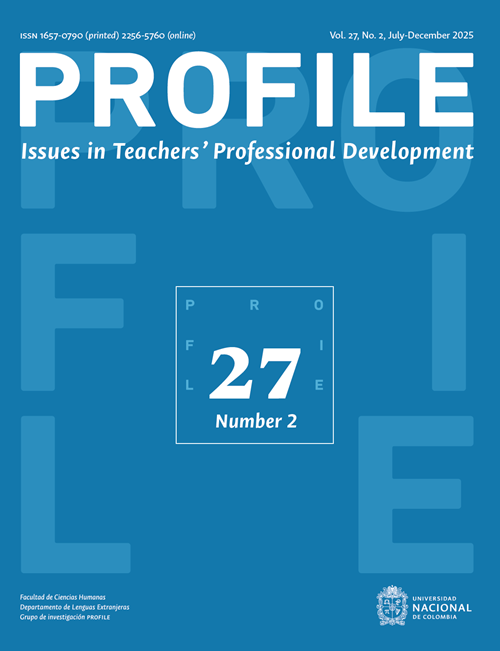
Preservice Teachers’ Self-Efficacy Beliefs for Promoting Learner Autonomy in English Language Education
Creencias de autoeficacia de docentes en formación para promover la autonomía de los estudiantes en la enseñanza de inglés
DOI:
https://doi.org/10.15446/profile.v27n2.117405Keywords:
English language education, initial teacher education, pedagogy for autonomy, self-efficacy beliefs (en)creencias de autoeficacia, enseñanza del inglés, formación docente inicial, pedagogía para la autonomía (es)
Preservice teachers’ self-efficacy beliefs influence their willingness and ability to promote learner autonomy in schools. This study aimed to investigate the self-efficacy beliefs of a group of preservice teachers in an initial English language teacher education programme, where they were prepared and encouraged to promote pedagogy for autonomy. Data were gathered through questionnaires and focus group interviews. Findings indicate a relatively high sense of self-efficacy regarding the promotion of learner autonomy. Personal and contextual factors that enable or constrain those beliefs were identified, with implications for how initial teacher education programmes may foster preservice teachers’ readiness to value and enact learner-centred pedagogies.
Las creencias de autoeficacia de los docentes en formación influyen en su disposición y habilidad para promover la autonomía en las escuelas. Este estudio investiga las creencias de autoeficacia de un grupo de docentes en formación en un programa de formación docente inicial en enseñanza de inglés que promovía la pedagogía para la autonomía. Los datos se recopilaron mediante cuestionarios y grupos focales. Los resultados indican un sentido relativamente alto de autoeficacia con respecto a la promoción de la autonomía. Se identificaron factores personales y contextuales que permiten o limitan estas creencias, con implicaciones sobre cómo los programas de formación docente inicial pueden fomentar la preparación de futuros docentes para valorar e implementar pedagogías centradas en el aprendiz.
References
Arnold, J., & Fonseca-Mora, M. C. (2017). Autonomy and affect in language learning: A dynamic relationship. In M. Jiménez Raya, J. J. Martos Ramos, & M. G. Tassinari (Eds.), Learner and teacher autonomy in higher education: Perspectives from modern language teaching (pp. 37–54). Peter Lang.
Bandura, A. (1986). Social foundations of thought and action: A social cognitive theory. Prentice-Hall.
Bandura, A. (1997). Self-efficacy: The exercise of control. Freeman.
Bassey, M. (1999). Case study research in educational settings. Open University Press.
Benson, P. (2011). Teaching and researching autonomy in language learning (2nd ed.). Longman.
Berg, D. A. G., & Smith, L. F. (2016). Preservice teacher self-efficacy beliefs: An opportunity to generate “good research” in the Asia-Pacific region. In S. Garvis & D. Pendergast (Eds.), Asia-Pacific perspectives on teacher self-efficacy (pp. 1–17). Brill. https://doi.org/10.1007/978-94-6300-521-0_1
Cotterall, S. (2017). The pedagogy of learner autonomy: Lessons from the classroom. Studies in Self-Access Learning Journal, 8(2), 102–115. https://doi.org/10.37237/080204
Council of Europe. (2018). Reference framework of competences for democratic culture. https://bit.ly/4iE1LPu
Crawford-Garrett, K., Anderson, S., Grayson, A. N., & Suter, C. (2015). Transformational practice: Critical teacher research in pre-service teacher education. Educational Action Research, 23(4), 479–496. https://doi.org/10.1080/09650792.2015.1019902
Edwards, E. (2020). The ecological impact of action research on language teacher development: A review of the literature. Educational Action Research, 29(3), 396–413. https://doi.org/10.1080/09650792.2020.1718513
Gregoire, M. (2003). Is it a challenge or a threat? A dual-process model of teachers’ cognition and appraisal processes during conceptual change. Educational Psychology Review, 15(2), 147–179. https://doi.org/10.1023/A:1023477131081
Henson, R. K. (2001). The effects of participation in teacher research on teacher efficacy. Teaching and Teacher Education, 17(7), 819–836. https://doi.org/10.1016/S0742-051X(01)00033-6
Jiménez Raya, M., Lamb, T., & Vieira, F. (2017). Mapping autonomy in language education: A framework for learner and teacher development. Peter Lang. https://doi.org/10.3726/b11095
Jiménez Raya, M., Manzano Vázquez, B., & Vieira, F. (Eds.). (2024). Pedagogies for autonomy in language teacher education: Perspectives on professional learning, identity, and agency. Routledge. https://doi.org/10.4324/9781003412021
Jiménez Raya, M., & Vieira, F. (2015). Enhancing autonomy in language education: A case-based approach to teacher and learner development. Mouton de Gruyter. https://doi.org/10.1515/9781614511359
Kennedy, M. M. (2016). How does professional development improve teaching? Review of Educational Research, 86(4), 945–980. https://doi.org/10.3102/0034654315626800
Kumaravadivelu, B. (2012). Language teacher education for a global society: A modular model for knowing, analyzing, recognizing, doing, and seeing. Routledge.
Lin, L., & Reinders, H. (2019). Students’ and teachers’ readiness for autonomy: Beliefs and practices in developing autonomy in the Chinese context. Asia Pacific Education Review, 20, 69–89. https://doi.org/10.1007/s12564-018-9564-3
Manzano Vázquez, B. (2017). Teacher education for autonomy: A study of modern language student teachers’ professional development [Doctoral dissertation, Universidad de Granada]. Digibug. http://hdl.handle.net/10481/48343
Manzano Vázquez, B. (2021). A study into pre-service FL teachers’ perceptions of their willingness, ability and opportunity to promote learner autonomy. In M. Jiménez Raya & F. Vieira (Eds.), Autonomy in language education: Theory, research and practice (pp. 191–207). Routledge. https://doi.org/10.4324/9780429261336-15
Manzano Vázquez, B. (2024). Teacher education for autonomy: An analysis of language teacher education initiatives for learner and teacher autonomy. In M. Jiménez Raya, B. Manzano Vázquez, & F. Vieira (Eds.), Pedagogies for autonomy in language teacher education: Perspectives on professional learning, identity and agency (pp. 12–28). Routledge. https://doi.org/10.4324/9781003412021-2
McPherson, G. E., & Renwick, J. M. (2011). Self-regulation and mastery of musical skills. In B. J. Zimmerman & D. H. Schunk (Eds.), Handbook of self-regulation of learning and performance (1st ed., pp. 234–248). Routledge.
Nakata, Y. (2011). Teachers’ readiness for promoting learner autonomy: A study of Japanese EFL high school teachers. Teaching and Teacher Education, 27(5), 900–910. https://doi.org/10.1016/j.tate.2011.03.001
Palfreyman, D. M., & Benson, P. (2019). Autonomy and its role in English language learning: Practice and research. In X. Gao (Ed.), Second handbook of English language teaching (pp. 661–681). Springer. https://doi.org/10.1007/978-3-030-02899-2_38
Tassinari, M. G. (2016). Assessment for learning; Assessment for autonomy. In C. Gitsaki & C. Coombe (Eds.), Current issues in language evaluation, assessment and testing: Research and practice (pp. 118–136). Cambridge Scholars Publishing.
Thompson, G., & Woodman, K. (2019). Exploring Japanese high school English teachers’ foreign language teacher efficacy beliefs. Asia-Pacific Journal of Teacher Education, 47(1), 48–65. https://doi.org/10.1080/1359866X.2018.1498062
Tschannen-Moran, M., & Woolfolk Hoy, A. (2007). The differential antecedents of self-efficacy beliefs of novice and experienced teachers. Teaching and Teacher Education, 23(6), 944–956. https://doi.org/10.1016/j.tate.2006.05.003
Vieira, F. (2024). Enhancing autonomy through inquiry in practicum settings: Insights from a narrative of practice in primary English teaching. In M. Jiménez Raya, B. Manzano Vázquez, & F. Vieira (Eds.), Pedagogies for autonomy in language teacher education. Perspectives on professional learning, identity, and agency (pp. 64–79). Routledge. https://doi.org/10.4324/9781003412021-5
Vieira, F., Jiménez Raya, M., & Manzano Vázquez, B. (2024). Language teacher education for autonomy: Critical issues and possible pathways. In M. Jiménez Raya, B. Manzano Vázquez, & F. Vieira (Eds.), Pedagogies for autonomy in language teacher education. Perspectives on professional learning, identity, and agency (pp. 204–210). Routledge. https://doi.org/10.4324/9781003412021-13
Wigfield, A., Klauda, S. L., & Cambria, J. (2011). Influences on the development of academic self-regulatory processes. In B. J. Zimmerman & D. H. Schunk (Eds.), Handbook of self-regulation of learning and performance (1st ed., pp. 33–48). Routledge.
Woolfolk Hoy, A., Hoy, W. K., & Davis, H. A. (2009). Teachers’ self-efficacy beliefs. In K. R. Wentzel & A. Wigfield (Eds.), Handbook of motivation at school (1st ed., pp. 627–653). Routledge.
Wyatt, M. (2018). Language teachers’ self-efficacy beliefs: A review of the literature (2005–2016). Australian Journal of Teacher Education, 43(4), 92–120. https://doi.org/10.14221/ajte.2018v43n4.6
Zimmerman, B. J. (2011). Motivational sources and outcomes of self-regulated learning and performance. In B. J. Zimmerman & D. H. Schunk (Eds.), Handbook of self-regulation of learning and performance (1st ed., pp. 49–64). Routledge.
Dimensions
PlumX
Article abstract page views
Downloads
How to Cite
License
Copyright (c) 2025 Borja Manzano Vázquez, Flávia Vieira, Manuel Jiménez Raya

This work is licensed under a Creative Commons Attribution-NonCommercial-NoDerivatives 4.0 International License.
You are authorized to copy and redistribute the material in any medium or format as long as you give appropriate credit to the authors of the articles and to Profile: Issues in Teachers' Professional Development as original source of publication. The use of the material for commercial purposes is not allowed. If you remix, transform, or build upon the material, you may not distribute the modified material.
Authors retain the intellectual property of their manuscripts with the following restriction: first publication is granted to Profile: Issues in Teachers' Professional Development.