Published
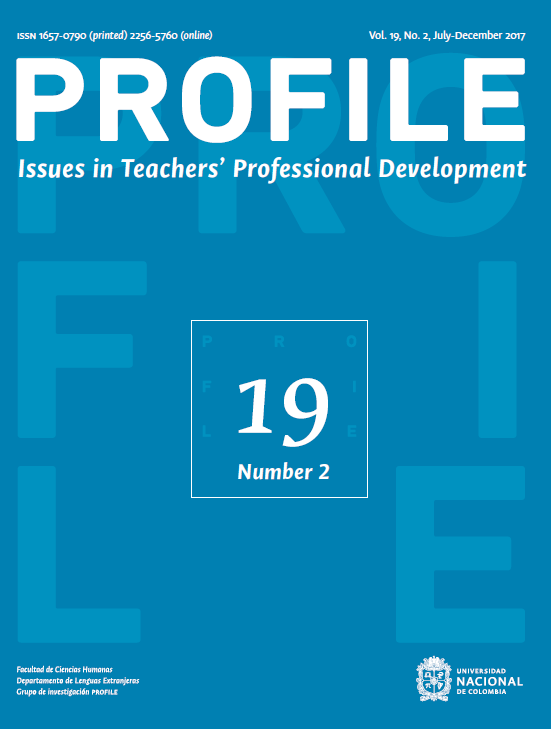
Making Sense of Alternative Assessment in a Qualitative Evaluation System
Entendiendo los procedimientos alternativos de valoración de desempeño en un sistema de evaluación cualitativo
DOI:
https://doi.org/10.15446/profile.v19n2.57178Keywords:
Alternative assessment, qualitative evaluation, quantitative evaluation (en)evaluación cualitativa, evaluación cuantitativa, métodos alternativos de valoración (es)
In a Colombian private English institution, a qualitative evaluation system has been incorporated. This type of evaluation poses challenges to students who have never been evaluated through a system that eliminates exams or quizzes and, as a consequence, these students have to start making sense of it. This study explores the way students face the new qualitative evaluation system and their views on alternative assessment as a way to help them make headway with their English learning process.
References
Areiza Restrepo, H. N. (2013). Role of systematic formative assessment on students’ views of their learning. PROFILE Issues in Teachers’ Development, 15(2), 165-183.
Baleghizadeh, S., & Zarghami, Z. (2012). The impact of conferencing assessment on EFL students’ grammar learning. PROFILE Issues in Teachers’ Development, 14(2),131-144.
Brown, D. H. (2001). Teaching by principles: An interactive approach to language pedagogy (2nd ed.). New York, US: Pearson Longman.
Brown, D. H. (2004). Language assessment: Principles and practices. New York, US: Pearson.
Cohen, A. D. (1994). Assessing language ability in the classroom. Boston, US: Heinle.
Stake, R. E. (1999). Investigación con estudio de casos [Case study research]. Madrid, ES: Morata.
Tedick, D. J., & Klee, C. A. (1998). Alternative assessment in the language classroom. Washington D.C.: Center for International Education.
Dimensions
PlumX
Article abstract page views
Downloads
How to Cite
License
Copyright (c) 2017 PROFILE Issues in Teachers' Professional Development

This work is licensed under a Creative Commons Attribution-NonCommercial-NoDerivatives 4.0 International License.
You are authorized to copy and redistribute the material in any medium or format as long as you give appropriate credit to the authors of the articles and to Profile: Issues in Teachers' Professional Development as original source of publication. The use of the material for commercial purposes is not allowed. If you remix, transform, or build upon the material, you may not distribute the modified material.
Authors retain the intellectual property of their manuscripts with the following restriction: first publication is granted to Profile: Issues in Teachers' Professional Development.