Published
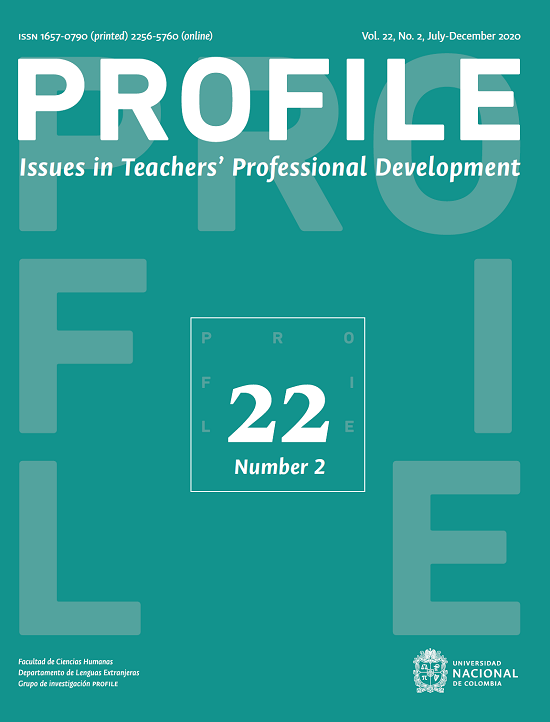
Exploring the Code-Switching Behaviours of Chilean EFL High School Teachers: A Function-Focused Approach
Exploración de las conductas de cambio de código lingüístico en profesores de lengua extranjera de secundaria: una perspectiva enfocada en las funciones
DOI:
https://doi.org/10.15446/profile.v22n2.81152Keywords:
code-switching, English as a foreign language teaching, functional analysis, L1 use (en)análisis funcional, cambio de código lingüístico, enseñanza del inglés, uso de L1 (es)
References
Barahona, M. (2016). Challenges and accomplishments of ELT at primary level in Chile: Towards the aspiration of becoming a bilingual country. Education Policy Analysis Archives, 24(82). https://doi.org/10.14507/epaa.24.2448
Butzkamm, W. (2003). We only learn language once. The role of the mother tongue in FL classrooms: Death of a dogma. The Language Learning Journal, 28(1), 29–39. https://doi.org/10.1080/09571730385200181
Cook, V. (2001). Using the first language in the classroom. Canadian Modern Language Review, 57(3), 402–423. https://doi.org/10.3138/cmlr.57.3.402
Copland, F., & Neokleous, G. (2010). L1 to teach L2: Complexities and contradictions. ELT Journal, 65(3), 270–280. https://doi.org/10.1093/elt/ccq047
De la Campa, J. C., & Nassaji, H. (2009). The amount, purpose, and reasons for using L1 in L2 classrooms. Foreign Language Annals, 42(4), 742–759.
Duff, P., & Polio, C. (1990). How much foreign language is there in the foreign language classroom? The Modern Language Journal, 74(2), 154–166. https://doi.org/10.1111/j.1540-4781.1990.tb02561.x
Ellis, R. (2012). Language teaching research and language pedagogy. John Wiley & Sons.
Ford, K. (2009). Principles and practices of L1/L2 use in the Japanese University EFL classrooms. JALT Journal, 31(1), 63–80.
Forman, R. (2012). Six functions of bilingual EFL teacher talk: Animating, translating, explaining, creating, prompting and dialoguing. RELC Journal, 43(2), 239–253.
Foster, P., Tonkyn, A., & Wigglesworth, G. (2000). Measuring spoken language: A unit for all reasons. Applied Linguistics, 21(3), 354–375.
Glas, K. (2008). El inglés abre puertas ... ¿a qué? Análisis del discurso sobre la enseñanza del inglés en Chile, 2003–2006. Revista Educación y Pedagogía, 20(51), 111–122.
Gómez, E., & Pérez, S. (2015). Chilean 12th graders’ attitudes towards English as a foreign language. Colombian Applied Linguistics Journal, 17(2), 313–324. https://doi.org/10.14483/udistrital.jour.calj.2015.2.a10
Grant, L. E., & Nguyen, T. H. (2017). Code-switching in Vietnamese university EFL teachers’ classroom instruction: A pedagogical focus. Language Awareness, 26(3), 244–259. https://doi.org/10.1080/09658416.2017.1402915
Haryanto, E., Sulistiyo, U, & Khairani, M. (2016). Indonesian or English? EFL student teachers’ preference and perception on the language use in the classroom. Indonesian Journal of English Education (IJEE), 3(1), 46–59. https://doi.org/10.15408/ijee.v3i1.3941
Hosoda, Y. (2000). Teacher code switching in the EFL classroom. JALT Journal, 12, 69–93.
Kim, S. (2001). Language alternation behaviour among native-speaker foreign language teachers in New Zealand secondary schools [Unpublished master’s thesis]. The University of Auckland.
Kim, S, & Elder, C. (2005) Language choices and pedagogic functions in the foreign language classroom: A cross-linguistic functional analysis of teacher talk. Language Teaching Research, 9(4), 355–380. https://doi.org/10.1191/1362168805lr173oa
Kim, S., & Elder, C. (2008). Target language use in foreign language classrooms: Practices and Perceptions of two native speaker teachers in New Zealand. Language, Culture and Curriculum, 21(2), 167–185. https://doi.org/10.1080/07908310802287574
Lee, J.-H. (2007). Where to start teaching English through English: Based on perceived effectiveness of teachers’ English use. English Teaching, 62(4), 335–354. https://doi.org/10.15858/engtea.62.4.200712.335
Lin, A. (2013). Classroom code-switching: Three decades of research. Applied Linguistics Review, 4(1), 195–218. https://doi.org/10.1515/applirev-2013-0009
Liu, D., Ahn, G.-S., Baek, K.-S., & Han, N.-O. (2004). South Korean high school English teachers’ code switching: Questions and challenges in the drive for maximal use of English in teaching. TESOL Quarterly, 38(4), 605–638. https://doi.org/10.2307/3588282
Lowe, R. J., & Kiczkowiak, M. (2016). Native-speakerism and the complexity of personal experience: A duoethnographic study. Teacher Education & Development, 3(1). https://doi.org/10.1080/2331186X.2016.1264171
Macaro, E. (2014). Overview: Where should we be going with classroom code-switching research? In R. Barnard & J. McLellan (Eds.), Code-switching in university English-medium classes: Asian perspectives (pp. 10–23). Multilingual Matters. https://doi.org/10.21832/9781783090914-004
Ministerio de Educación. (2009). Fundamentos del ajuste curricular en el sector de idioma extranjero, inglés. Gobierno de Chile.
Ministerio de Educación. (2019). Plan English in English. Retrieved from https://www.mineduc.cl/2019/06/11/plan-english-in-english/
Muñoz, J. E., & Mora, Y. F. (2006). Functions of code-switching: Tools for learning and communicating in English classes. How, 13(1), 31–45.
Poplack, S. (2010). Code-switching (linguistic). In L. Wei (Ed.), Bilingualism and multilingualism: Critical concepts in linguistics (Vol. 1). Routledge.
Promnath, K., & Tayjasanant, C. (2016). English-Thai code-switching in ESP classes. PASAA: Journal of Language Teaching and Learning in Thailand, 51, 97–126.
Schendl, H., & Wright, L. (Eds.). (2011). Code-switching in early English. de Gruyter Mouton. https://doi.org/10.1515/9783110253368
Sinclair, J., & Coulthard, M. (1975). Towards an analysis of discourse: The English used by teachers and pupils. Oxford University Press.
Tian, L., & Macaro, E. (2012). Comparing the effect of teacher codeswitching with English-only explanations on the vocabulary acquisition of Chinese university students: A lexical focus-on-form study. Language Teaching Research, 16(3), 367–391. https://doi.org/10.1177/1362168812436909
Turnbull, M. (2001). There is a role for the L1 in second and foreign language teaching, but… Canadian Modern Language Review, 57(4), 531–540. https://doi.org/10.3138/cmlr.57.4.531
Üstünel, E. (2016). EFL classroom codeswitching. Palgrave MacMillan.
Üstünel, E., & Seedhouse, P. (2005). Why that, in that language, right now? Code-switching and pedagogical focus. International Journal of Applied Linguistics, 15(3), 302–325. https://doi.org/10.1111/j.1473-4192.2005.00093.x
Walsh, S. (2006). Investigating classroom discourse. Routledge. https://doi.org/10.4324/9780203015711
Wang, H., & Mansouri, B. (2017). Revisiting code-switching practice in TESOL: A critical perspective. The Asia-Pacific Education Researcher, 26(6), 407–415. https://doi.org/10.1007/s40299-017-0359-9
Zhao, T., & Macaro, E. (2014). What works better for the learning of concrete and abstract words: Teachers’ L1 use or L2-only explanations? International Journal of Applied Linguistics, 26(1), 75–98. https://doi.org/10.1111/ijal.12080
Dimensions
PlumX
Article abstract page views
Downloads
How to Cite
License
Copyright (c) 2020 Marco Cancino; Gabriela Díaz

This work is licensed under a Creative Commons Attribution-NonCommercial-NoDerivatives 4.0 International License.
You are authorized to copy and redistribute the material in any medium or format as long as you give appropriate credit to the authors of the articles and to Profile: Issues in Teachers' Professional Development as original source of publication. The use of the material for commercial purposes is not allowed. If you remix, transform, or build upon the material, you may not distribute the modified material.
Authors retain the intellectual property of their manuscripts with the following restriction: first publication is granted to Profile: Issues in Teachers' Professional Development.