Published
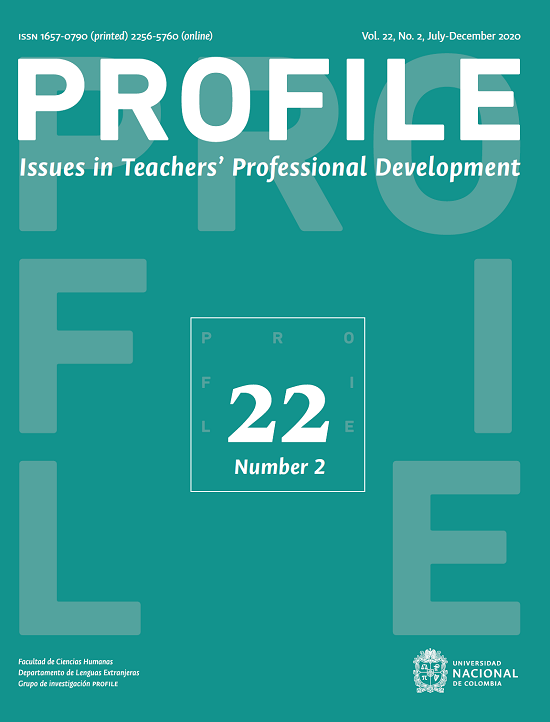
EFL Learners’ Perceptions About Language Learning and Culture When Using Telecollaboration
Percepciones de estudiantes de inglés como lengua extranjera acerca del aprendizaje del lenguaje y la cultura mediante la telecolaboración en el aula
DOI:
https://doi.org/10.15446/profile.v22n2.82213Keywords:
cultural awareness, English as a foreign language, language learning, telecollaboration (en)aprendizaje de una lengua, conciencia cultural, inglés como lengua extranjera, telecolaboración (es)
This phenomenological study explores students’ perceptions about the relationship between foreign language learning and culture when using telecollaboration. Three main concerns underlie this work: the lack of studies that explore how students perceive the relationship between foreign language learning and culture in the local context, the need to explore the incidence of culture in language learning, and the role of telecollaboration in cultural exchange. Data were collected through questionnaires, focus groups, video recordings, field notes, and students’ artifacts. The findings show students’ understanding of the nature of language situated within functional and humanistic perspectives. Furthermore, participants alluded to the importance of language learning as a means to understand the scope of culture and cultural identity.
Este estudio fenomenológico explora las percepciones de unos estudiantes sobre la relación entre el aprendizaje de un idioma extranjero y la cultura, mediante la telecolaboración. Tres problemáticas guiaron este trabajo: la falta de investigaciones sobre cómo perciben los estudiantes la relación entre el aprendizaje de idiomas y la cultura dentro del contexto local; la necesidad de explorar la incidencia de la cultura en el aprendizaje de idiomas; y el papel de la telecolaboración en intercambios culturales. Los datos se recogieron de cuestionarios, grupos focales, videos, diarios de campo y trabajos de estudiantes. Los hallazgos muestran que los estudiantes comprenden la naturaleza del lenguaje en perspectivas funcionales y humanistas. Además, los participantes reconocen la importancia del aprendizaje de idiomas como medio para entender el alcance de la cultura y la identidad cultural.
References
Álvarez, J. A., & Bonilla, X. (2009). Addressing culture in the EFL classroom: A dialogic proposal. Profile: Issues in Teachers’ Professional Development, 11(2), 151–170.
Ariza, D. (2007). La cultura en el salón de clase en EFL en la Universidad de La Salle: un proyecto innovador [Culture in the EFL classroom at Universidad de La Salle: An innovation project]. Actualidades Pedagógicas, 1(50), 9–17.
Baker, W. (2009). The cultures of English as a lingua franca. TESOL Quarterly, 43(4), 567–592. https://doi.org/10.1002/j.1545-7249.2009.tb00187.x
Barletta, N. (2009). Intercultural competence: Another challenge. Profile: Issues in Teachers’ Professional Development, 11(1), 143–158.
Burns, A. (1999). Collaborative action research for English language teachers. Cambridge University Press.
Chomsky, N. (1959). A review of B. F. Skinner’s verbal behavior. Language, 35(1), 26–58. https://doi.org/10.2307/411334
Clément, R., & Gardner, R. C. (2001). Second language mastery. In W. P. Robinson & H. Giles (Eds.), The new handbook of language and social psychology (pp. 489–504). John Wiley & Sons.
Corbin, J., & Strauss, A. (2008). Basics of qualitative research: Techniques and procedures for developing grounded theory (3rd ed.). Sage Publications. https://doi.org/10.4135/9781452230153
Creswell, J. W. (2007). Qualitative inquiry and research design: Choosing among five approaches (2nd ed.). Sage Publications.
Creswell, J. W. (2012). Educational research: Planning, conducting, and evaluating quantitative and qualitative research (4th ed.). Pearson.
Godwin-Jones, R. (2013). Integrating intercultural competence into language learning through technology. Language Learning & Technology, 17(2), 1–11. https://doi.org/10125/44318
Goetz, J. P., & LeCompte, M. D. (1984). Ethnography and qualitative design in educational research. Academic Press.
Gulbinskienė, D., & Lasauskienė, R. (2014). Intercultural communicative competence (ICC) of EFL students at university level. Man and the Word: Foreign Languages, 16(3), 150–159. https://doi.org/10.15823/zz.2014.020
Guth, S., & Helm, F. (Eds.). (2010). Telecollaboration 2.0: Language, literacies and intercultural learning in the 21st century. Peter Lang. https://doi.org/10.3726/978-3-0351-0013-6
Heigham, J., & Croker, R. (Eds.). (2009). Qualitative research in applied linguistics: A practical introduction. Palgrave Macmillan. https://doi.org/10.1057/9780230239517
Kramsch, C. (1998). Language and culture. Oxford University Press.
Kramsch, C. (2013). Culture in foreign language teaching. Iranian Journal of Language Teaching Research, 1(1), 57–78.
Liaw, M.-L., & Bunn-Le Master, S. (2010). Understanding telecollaboration through an analysis of intercultural discourse. Computer Assisted Language Learning, 23(1), 21–40. https://doi.org/10.1080/09588220903467301
Liddicoat, A. J., & Scarino, A. (2013). Intercultural language teaching and learning. Wiley-Blackwell. https://doi.org/10.1002/9781118482070
Mahboob, A. (2011). English: The industry. Journal of Postcolonial Cultures and Societies, 2(4), 46–61.
McConachy, T. (2018). Developing intercultural perspectives on language use: Exploring pragmatics and culture in foreign language learning. Multilingual Matters. https://doi.org/10.21832/9781783099337
Moran, P. (2001). Teaching culture: Perspectives in practice. Heinle & Heinle.
O’Dowd, R. (Ed.). (2007). Online intercultural exchange: An introduction for foreign language teachers. Multilingual Matters. https://doi.org/10.21832/9781847690104
O’Dowd, R., & Waire, P. (2009). Critical issues in telecollaborative task design. Computer Assisted Language Learning, 22(2), 173–188. https://doi.org/10.1080/09588220902778369
Project Zero. (2016). PZ’s thinking routines tool. Harvard, Graduate School of Education. http://www.pz.harvard.edu/thinking-routines
Richards, K. (2003). Qualitative inquiry in TESOL. Palgrave Macmillan. https://doi.org/10.1057/9780230505056
Scarino, A. (2014). Learning as reciprocal, interpretive meaning-making: A view from collaborative research into the professional learning of teachers of languages. The Modern Language Journal, 98(1), 386–401. https://doi.org/10.1111/j.1540-4781.2014.12068.x
Seelye, H. N. (1984). Teaching culture: Strategies for inter-cultural communication (Rev. ed.). National Textbook Company.
Sercu, L., Méndez, M. C., & Castro, P. (2004). Culture teaching in foreign language education: EFL teachers in Spain as cultural mediators. Porta Linguarum, 1(1), 85–102.
Skinner, B. F. (1957). Verbal behavior. Appleton. https://doi.org/10.1037/11256-000
Stottok, B., Bergaus, M., & Gorra, A. (2011). Colour coding: An alternative to analyze empirical data via grounded theory. Proceedings of the European Conference on Research Methods. https://bit.ly/3806INt
Trujillo, F. (2002). Towards interculturality through language teaching: Argumentative discourse. CAUCE, Revista de Filología y su Didáctica, (25), 103–119.
Tudor, I. (2001). The dynamics of the language classroom. Cambridge University Press.
Turizo, J., & Gómez, P. (2006). Intercultural communication and ELT: A classroom experience. HOW Journal, 13(1), 139–152.
Vygotsky, L. (1978). Mind in society: The development of higher psychological processes. Harvard University Press.
Dimensions
PlumX
Article abstract page views
Downloads
How to Cite
License
Copyright (c) 2020 Natalia Ramírez-Lizcano; María Alejandra Cabrera-Tovar

This work is licensed under a Creative Commons Attribution-NonCommercial-NoDerivatives 4.0 International License.
You are authorized to copy and redistribute the material in any medium or format as long as you give appropriate credit to the authors of the articles and to Profile: Issues in Teachers' Professional Development as original source of publication. The use of the material for commercial purposes is not allowed. If you remix, transform, or build upon the material, you may not distribute the modified material.
Authors retain the intellectual property of their manuscripts with the following restriction: first publication is granted to Profile: Issues in Teachers' Professional Development.