Published
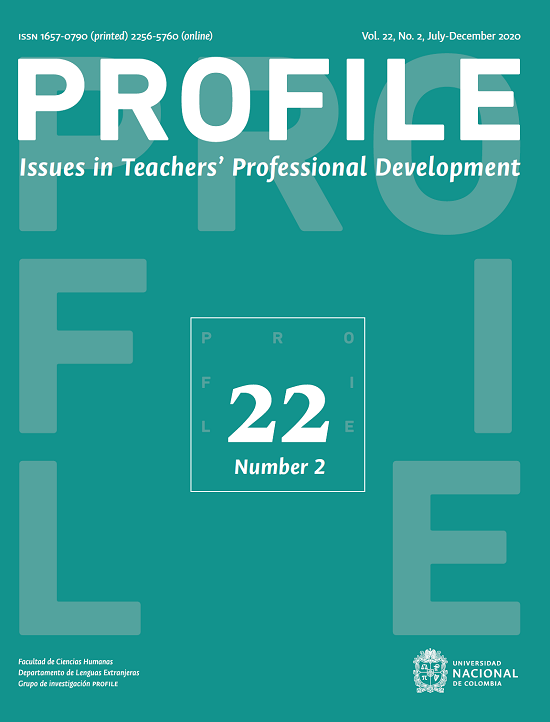
English Language Teachers’ Oral Corrective Preferences and Practices Across Proficiency Groups
Preferencias y acciones correctivas de docentes de inglés entre grupos con competencias diferentes
DOI:
https://doi.org/10.15446/profile.v22n2.82369Keywords:
beliefs, emotional reactions, foreign language learning, oral corrective feedback, proficiency level (en)aprendizaje de lenguas extranjeras, creencias, nivel de competencia, reacción emocional, retroalimentación correctiva oral (es)
Studies on oral error correction in second language acquisition have been tilted towards cognitive aspects ignoring the affective and practical dimensions. This study attempted to fill this gap by investigating the role of students’ proficiency levels in five English language teachers’ corrective behavior. Follow-up interviews were conducted with the observed teachers. The results showed that the teachers provided more corrections to less proficient learners though they preferred more correction for advanced learners and used mainly recast for both groups, avoiding explicit forms of correction. They were mainly concerned with the affective aspects of oral error correction and acted on their own value system and teaching experience. The findings carry important implications for teacher education programs and the studies in this regard.
Los estudios sobre la retroalimentación oral correctiva en la adquisición de una segunda lengua se han concentrado en los aspectos cognitivos, en detrimento de las dimensiones afectiva y práctica. Este estudio intenta llenar dicho vacío al explorar el papel que juega el nivel de competencia de los estudiantes en las prácticas correctivas de cinco docentes. Se llevaron a cabo entrevistas de seguimiento con los docentes participantes. Los resultados muestran que los profesores corrigieron más a los estudiantes menos avanzados, aunque prefirieron corregir a los más avanzados y evitar usar formas de corrección explícitas para ambos grupos. Los docentes estaban mayormente preocupados por los aspectos afectivos de la retroalimentación oral y actuaron de acuerdo con su propio sistema de valores y experiencia. Los resultados tienen importantes implicaciones para los programas de formación docente y para otros estudios similares.
References
Ammar, A., & Spada, N. (2006). One size fits all? Recasts, prompts, and L2 learning. Studies in Second Language Acquisition, 28(4), 543–574. https://doi.org/10.1017/S0272263106060268
Basturkmen, H. (2012). Review of research into the correspondence between language teachers’ stated beliefs and practices. System, 40(2), 282–295. https://doi.org/10.1016/j.system.2012.05.001
Borg, S. (2003). Teacher cognition in language teaching: A review of research on what language teachers think, know, believe, and do. Language Teaching, 36(2), 81–109. https://doi.org/10.1017/S0261444803001903
Borg, S. (2010). Language teacher research engagement. Language Teaching, 43(4), 391–429. https://doi.org/10.1017/S0261444810000170
Brown, A. V. (2009). Students’ and teachers’ perceptions of effective foreign language teaching: A comparison of ideals. The Modern Language Journal, 93(1), 46–60. https://doi.org/10.1111/j.1540-4781.2009.00827.x
Ellis, R., Loewen, S., & Erlam, R. (2006). Implicit and explicit corrective feedback and the acquisition of L2 grammar. Studies in Second Language Acquisition, 28(2), 339–368. https://doi.org/10.1017/S0272263106060141
Jean, G., & Simard, D. (2011). Grammar teaching and learning in L2: Necessary, but boring? Foreign Language Annals, 44(3), 465–492. https://doi.org/10.1111/j.1944-9720.2011.01143.x
Kaivanpanah, S., Alavi, S. M., & Sepehrinia, S. (2012). Preferences for interactional feedback: Differences between learners and teachers. The Language Learning Journal, 43(1), 74–93. https://doi.org/10.1080/09571736.2012.705571
Kamiya, N. (2016). The relationship between stated beliefs and classroom practices of oral corrective feedback. Innovation in Language Learning and Teaching, 10(3), 206–219. https://doi.org/10.1080/17501229.2014.939656
Kartchava, E., & Ammar, A. (2014). The noticeability and effectiveness of corrective feedback in relation to target type. Language Teaching Research, 18(4), 428–452. https://doi.org/10.1177/1362168813519373
Kartchava, E., Gatbonton, E., Ammar, A., & Trofimovich, P. (2018). Oral corrective feedback: Pre-service English as a second language teachers’ beliefs and practices. Language Teaching Research, 24(2), 220–249. https://doi.org/10.1177/1362168818787546
Kennedy, S. (2010). Corrective feedback for learners of varied proficiency levels: A teacher’s choices. TESL Canada Journal, 27(2), 31–50. https://doi.org/10.18806/tesl.v27i2.1054
Lee, I. (2013). Research into practice: Written corrective feedback. Language Teaching, 46(1), 108–119. https://doi.org/10.1017/S0261444812000390
Li, S. (2014). The interface between feedback type, L2 proficiency, and the nature of the linguistic target. Language Teaching Research, 18(3), 373–396. https://doi.org/10.1177/1362168813510384
Lin, Y.-H., & Hedgcock, J. (1996). Negative feedback incorporation among high-proficiency and low-proficiency Chinese-speaking learners of Spanish. Language Learning, 46(4), 567–611. https://doi.org/10.1111/j.1467-1770.1996.tb01353.x
Long, M. H. (2007). Problems in SLA. Lawrence Erlbaum.
Lyster, R. (2001). Negotiation of form, recasts, and explicit correction in relation to error types and learner repair in immersion classrooms. Language Learning, 51(s1), 265–301. https://doi.org/10.1111/j.1467-1770.2001.tb00019.x
Lyster, R. (2004). Differential effects of prompts and recasts in form-focused instruction. Studies in Second Language Acquisition, 26(3), 399–432. https://doi.org/10.1017/S0272263104263021
Lyster, R., & Ranta, L. (1997). Corrective feedback and learner uptake: Negotiation of form in communicative classrooms. Studies in Second Language Acquisition, 19(1), 37–66. https://doi.org/10.1017/S0272263197001034
Lyster, R., Saito, K., & Sato, M. (2013). Oral corrective feedback in second language classrooms. Language Teaching, 46(1), 1–40. https://doi.org/10.1017/S0261444812000365
Mackey, A., & Philp, J. (1998). Conversational interaction and second language development: Recasts, responses, and red herrings? Modern Language Journal, 82(3), 338–356. https://doi.org/10.1111/j.1540-4781.1998.tb01211.x
Mackey, A., Polio, C., & McDonough, K. (2004). The relationship between experience, education and teachers’ use of incidental focus-on-form techniques. Language Teaching Research, 8(3), 301–327. https://doi.org/10.1191/1362168804lr147oa
Martoccio, A. (2017). How does prior explicit knowledge affect the efficacy of explicit instruction and feedback? The case of the personal a in L2 Spanish. Language Teaching Research, 22(4), 379–397. https://doi.org/10.1177/1362168816689802
Mori, R. (2011). Teacher cognition in corrective feedback in Japan. System, 39(4), 451–467. https://doi.org/10.1016/j.system.2011.10.014
Philp, J. (2003). Constraints on “noticing the gap”: Nonnative speakers’ noticing of recasts in NS–NNS interaction. Studies in Second Language Acquisition, 25(1), 99–126. https://doi.org/10.1017/S0272263103000044
Polio, C., Gass, S., & Chapin, L. (2006). Using stimulated recall to investigate native speaker perceptions in native–nonnative speaker interaction. Studies in Second Language Acquisition, 28(2), 237–267. https://doi.org/10.1017/S0272263106060116
Rahimi, M., & Zhang, L. J. (2016). The role of incidental unfocused prompts and recasts in improving English as a foreign language learners’ accuracy. Language Learning Journal, 44(2), 257–268. https://doi.org/10.1080/09571736.2013.858368
Rassaei, E. (2013). Corrective feedback, learners’ perceptions, and second language development. System, 41(2), 472–483. https://doi.org/10.1016/j.system.2013.05.002
Roothooft, H. (2014). The relationship between adult EFL teachers’ oral feedback practices and their beliefs. System, 46(1), 65–79. https://doi.org/10.1016/j.system.2014.07.012
Roothooft, H., & Breeze, R. (2016). A comparison of EFL teachers’ and students’ attitudes to oral corrective feedback. Language Awareness, 25(4), 318–335. https://doi.org/10.1080/09658416.2016.1235580
Sheen, Y. (2006). Exploring the relationship between characteristics of recasts and learner uptake. Language Teaching Research, 10(4), 361–392. https://doi.org/10.1191/1362168806lr203oa
Sheen, Y. (2008). Recasts, language anxiety, modified output, and L2 learning. Language Learning, 58(4), 835–874. https://doi.org/10.1111/j.1467-9922.2008.00480.x
Tavakoli, M., & Zarrinabadi, N. (2016). Differential effects of explicit and implicit corrective feedback on EFL learners’ willingness to communicate. Innovation in Language learning and teaching, 12(3), 247–259. https://doi.org/10.1080/17501229.2016.1195391
Trofimovich, P., Ammar, A., & Gatbonton, E. (2007). How effective are recasts? The role of attention, memory, and analytical ability. In A. Mackey (Ed.), Conversational interaction in second language acquisition (pp. 171–195). Oxford University Press.
Vásquez, C., & Harvey, J. (2010). Raising teachers’ awareness about corrective feedback through research replication. Language Teaching Research, 14(4), 421–443. https://doi.org/10.1177/1362168810375365
Yang, J. (2016). Learners’ oral corrective feedback preferences in relation to their cultural background, proficiency level and types of error. System, 61, 75–86. https://doi.org/10.1016/j.system.2016.08.004
Yoshida, R. (2008). Teachers’ choice and learners’ preference of corrective feedback types. Language Awareness, 17(1), 78–93. https://doi.org/10.2167/la429.0
Zyzik, E., & Polio, C. (2008). Incidental focus on form in university Spanish literature courses. The Modern Language Journal, 92(1), 53–70. https://doi.org/10.1111/j.1540-4781.2008.00686.x
Dimensions
PlumX
Article abstract page views
Downloads
How to Cite
License
Copyright (c) 2020 Sajjad Sepehrinia; Nahid Fallah; Soad Torfi

This work is licensed under a Creative Commons Attribution-NonCommercial-NoDerivatives 4.0 International License.
You are authorized to copy and redistribute the material in any medium or format as long as you give appropriate credit to the authors of the articles and to Profile: Issues in Teachers' Professional Development as original source of publication. The use of the material for commercial purposes is not allowed. If you remix, transform, or build upon the material, you may not distribute the modified material.
Authors retain the intellectual property of their manuscripts with the following restriction: first publication is granted to Profile: Issues in Teachers' Professional Development.