 Correo Electrónico
 DNINFOA - SIA
 Bibliotecas
 Convocatorias
 Identidad U.N.



Publicado
Perspectivas y aplicaciones reales del grafeno después de 16 años de su descubrimiento
Perspectives and real applications of graphene at 16 years after its breakthrough
Perspectivas e aplicações reais do grafeno após 16 anos de sua descoberta
DOI:
https://doi.org/10.15446/rev.colomb.quim.v50n1.90134Palabras clave:
grafeno, tratamiento de agua, materiales optoelectrónicos, almacenamiento de energía, biosensores (es)Graphene, water treatment, optoelectronic materials, energy storage, biosensors (en)
Grafeno, tratamento de água, materiais optoeletrônicos, armazenamento de energia, biossensores (pt)
A 16 años del gran descubrimiento del grafeno los focos de atención vuelven a estar en este material con el reporte de su comportamiento superconductor dependiendo del apilado de sus capas. Sin embargo, su nombre durante estos últimos años no solo se ha relacionado a la superconductividad, sino que ha sido relacionado con una diversidad muy amplia de aplicaciones, en disciplinas muy diversas, entre las que cabe mencionar: materiales opto-electrónicos, electrodos para catálisis, dispositivos para tratamiento de desechos, biosensores, entre otros. Esto ha hecho que un gran número de grupos de investigación se hayan interesado no solo en estudiar sus propiedades, sino también en investigar nuevos métodos sintéticos que puedan ser escalables a niveles industriales, sin perder sus propiedades electrónicas y mecánicas. A pesar de los numerosos estudios y los recursos invertidos en grafeno no todas las aplicaciones han llegado a ser una realidad, en esta revisión se muestran algunas de las más exitosas.
16 years after the great discovery of graphene, the focus and attention are again on this material after the report of its superconducting behavior depending on the stacking of its layers. The graphene has not only been related to superconductivity but has also been related to a wide diversity of applications, in very diverse disciplines. Among them, we can mention: Opto-electronic materials, electrodes for catalysis, devices for waste-water treatment, biosensors, batteries, and solar cells. This has caused a large number of research groups to be interested not only in the study of its properties, but also in the research of new synthetic methods that can be scaled to industrial levels, without losing its electronic and mechanical properties. Despite numerous studies and resources invested in graphene, not all applications have become a reality, some of the most successful are shown in this review.
16 anos após a grande descoberta do grafeno, o foco e as atenções voltam a ser neste material com o relato de seu comportamento supercondutor em função do empilhamento de suas camadas. No entanto, seu nome nos últimos anos não tem sido apenas relacionado à supercondutividade, mas tem sido relacionado a uma diversidade muito ampla de aplicações, em disciplinas muito diversas. Entre eles podemos citar: materiais optoeletrônicos, eletrodos para catálise, dispositivos para tratamento de águas residuais, biossensores, baterias e células solares. Isso fez com que um grande número de grupos de pesquisa se interessassem não apenas em estudar suas propriedades, mas muitas pesquisas também foram feitas na geração de métodos sintéticos que pudessem ser dimensionados para níveis industriais, sem perder suas propriedades eletrônicas e mecânicas. Apesar dos inúmeros estudos e recursos investidos em grafeno, nem todas as aplicações se tornaram realidade, algumas das mais bem-sucedidas são apresentadas nesta revisão.
Fisicoquímica e Inorgánica
Perspectivas y aplicaciones reales del grafeno después de 16 años de su descubrimiento
Perspectives and real applications of graphene at 16 years after its breakthrough
Perspectivas e aplicações reais do grafeno após 16 anos de sua descoberta
Perspectivas y aplicaciones reales del grafeno después de 16 años de su descubrimiento
Revista Colombiana de Química, vol. 50, núm. 1, pp. 51-85, 2021
Universidad Nacional de Colombia
Recepción: 27 Agosto 2020
Revisado: 03 Noviembre 2020
Aprobación: 01 Diciembre 2020
Resumen: A 16 años del gran descubrimiento del grafeno los focos de atención vuelven a estar en este material con el reporte de su comportamiento superconductor dependiendo del apilado de sus capas. Sin embargo, su nombre durante estos últimos años no solo se ha relacionado a la superconductividad, sino que ha sido relacionado con una diversidad muy amplia de aplicaciones, en disciplinas muy diversas, entre las que cabe mencionar: materiales opto-electrónicos, electrodos para catálisis, dispositivos para tratamiento de desechos, biosensores, entre otros. Esto ha hecho que un gran número de grupos de investigación se hayan interesado no solo en estudiar sus propiedades, sino también en investigar nuevos métodos sintéticos que puedan ser escalables a niveles industriales, sin perder sus propiedades electrónicas y mecánicas. A pesar de los numerosos estudios y los recursos invertidos en grafeno no todas las aplicaciones han llegado a ser una realidad, en esta revisión se muestran algunas de las más exitosas.
Palabras clave: Grafeno, tratamientos de agua, materiales optoelectrónicos, almacenamiento de energía, biosensores.
Abstract: 16 years after the great discovery of graphene, the focus and attention are again on this material after the report of its superconducting behavior depending on the stacking of its layers. The graphene has not only been related to superconductivity but has also been related to a wide diversity of applications, in very diverse disciplines. Among them, we can mention: Opto-electronic materials, electrodes for catalysis, devices for waste-water treatment, biosensors, batteries, and solar cells. This has caused a large number of research groups to be interested not only in the study of its properties, but also in the research of new synthetic methods that can be scaled to industrial levels, without losing its electronic and mechanical properties. Despite numerous studies and resources invested in graphene, not all applications have become a reality, some of the most successful are shown in this review.
Keywords: Graphene, water treatment, optoelectronic materials, energy storage, biosensors.
Resumo: 16 anos após a grande descoberta do grafeno, o foco e as atenções voltam a ser neste material com o relato de seu comportamento supercondutor em função do empilhamento de suas camadas. No entanto, seu nome nos últimos anos não tem sido apenas relacionado à supercondutividade, mas tem sido relacionado a uma diversidade muito ampla de aplicações, em disciplinas muito diversas. Entre eles podemos citar: materiais optoeletrônicos, eletrodos para catálise, dispositivos para tratamento de águas residuais, biossensores, baterias e células solares. Isso fez com que um grande número de grupos de pesquisa se interessassem não apenas em estudar suas propriedades, mas muitas pesquisas também foram feitas na geração de métodos sintéticos que pudessem ser dimensionados para níveis industriais, sem perder suas propriedades eletrônicas e mecânicas. Apesar dos inúmeros estudos e recursos investidos em grafeno, nem todas as aplicações se tornaram realidade, algumas das mais bem-sucedidas são apresentadas nesta revisão.
Palavras-chave: Grafeno, tratamento de água, materiais optoeletrônicos, armazenamento de energia, biossensores.
Introducción
En los últimos años, los materiales bidimensionales (2D) y sus heteroestructuras han surgido como componentes particularmente prometedores de dispositivos novedosos, pequeños y que ofrecen una velocidad y estabilidad mejoradas. En este contexto, el grafeno, una lámina de grosor de un solo átomo hecha exclusivamente de átomos de carbono, ha atraído un enorme interés debido a sus increíbles propiedades eléctricas y mecánicas [1]. Desde su descubrimiento experimental hace 16 años, la gama de aplicaciones fundamentales y prácticas previstas para este excelente material 2D han sido bastas [2] y se están ampliando aún más con el reciente descubrimiento de sus propiedades superconductoras que dependen solo de la forma en que se apilan sus capas [3].
Por las razones mencionadas y las promesas de negocio (entre 58,9 millones de dólares estadounidenses y 14,3 billones de dólares, según el artículo de revisión de Ai Linh Nguyen et al. [4]) que este material posee, muchos gobiernos y empresas empezaron a invertir en su investigación. El grafeno no solo es un excelente conductor eléctrico y térmico, sino que también representa el material más delgado, fuerte y rígido del mundo [5]. Su gran potencial tecnológico ya se ha demostrado en pantallas táctiles, condensadores, dispositivos espintrónicos, pilas de combustible, baterías, sensores, películas conductoras transparentes, circuitos de alta frecuencia, en la eliminación de material tóxico, electrónica molecular, almacenamiento y conversión de energía, así como electrónica flexible [6-8]. Industrias como la automotriz, tintas conductoras, entre otras, ya producen grafeno en el orden de miles de toneladas por año [9].
El grafeno presenta una movilidad de electrones ultra alta de hasta 500 000 cm.v-1.-1, como se ha documentado para láminas suspendidas a baja temperatura [10]. También posee una gran área superficial de 2630 m.g-1, un notable módulo de Young de 1,0 TPa [11] y una impresionante conductividad térmica de 5000 Wm-1.-1. El grafeno muestra notables propiedades ópticas, por ejemplo, cuando se deposita sobre un sustrato apropiado, se puede distinguir fácilmente bajo un microscopio óptico, a pesar de tener un solo átomo de espesor [12, 13]. Además, exhibe absorción óptica lineal (escala con el número de capas) [14]. De especial relevancia para aplicaciones optoelectrónicas, el grafeno muestra una absorción de fotones de un rango muy amplio de energías, además, debido a su estructura electrónica, presenta un “cuello de botella” para electrones con bajas energías (<200 meV) [15-17]. Esto dota al grafeno de portadores excitados o calientes con vidas más largas que en los metales normales, lo que facilita su extracción antes de que se relajen al nivel de Fermi [18].
Todas las propiedades de este material bidimensional se deben en gran medida a su estructura de banda prohibida de 0 eV (figura 1) que lo convierte en un semimetal o semiconductor de banda 0 (cuando no presenta dopaje), lo que le permite conducir portadores de carga sin masa, descritas por la ecuación de Dirac [19]. Puede conducir electrones y huecos con solo modular la fuerza electrostática mediante un electrodo puerta. Esta propiedad es una ventaja pero también es una de las limitaciones más grandes del grafeno, ya que si se utilizan en dispositivos eléctricos y electrónicos su relación de encendido y apagado es muy pequeña [20,21].
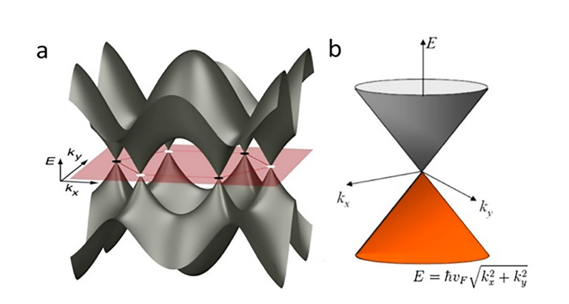
Figura 1. a) Dispersión de grafeno en banda, con seis puntos Dirac en los puntos K de la zona de Brillouin. b) La dispersión de energía lineal centrada alrededor de un único punto de Dirac. Figura adaptada de la referencia [22].
La mayoría de estas propiedades se potencian o se coartan dependiendo de los diferentes métodos de síntesis, por ejemplo, exfoliación micromecánica o química de grafito, deposición química en fase vapor (CVD, por sus siglas en inglés), exfoliación ultrasónica, descompresión de nanotubos de carbono o la reducción química, electroquímica, térmica o fotocatalítica del óxido de grafeno [23,24]. El grafeno es químicamente inerte y robusto, puede mantener su integridad estructural incluso a temperaturas altas (los defectos emergen por encima de aproximadamente 500 °C) [25] y a valores de pH tanto bajos como altos en solución acuosa [26].
En la referencia [4] se muestra un estudio comparativo del número de referencias que han obtenido las patentes y los artículos referentes al grafeno en los últimos años, en el cual se muestra cómo el interés por este material en todas las áreas parece ir en disminución. No obstante los autores de este artículo de revisión, creemos que la disminución de las citas se debe a la focalización de los artículos y patentes en aquellas aplicaciones que muestran tener resultados más promisorios. En este artículo de revisión se pretende mostrar los diferentes métodos de síntesis, las generalidades y propiedades del grafeno, su modificación química, algunas de las aplicaciones en donde más se ha avanzado en la escalación e industrialización de este material, así como las proyecciones a las áreas de mayor potencial para este material bidimensional en la actualidad.
Síntesis del grafeno
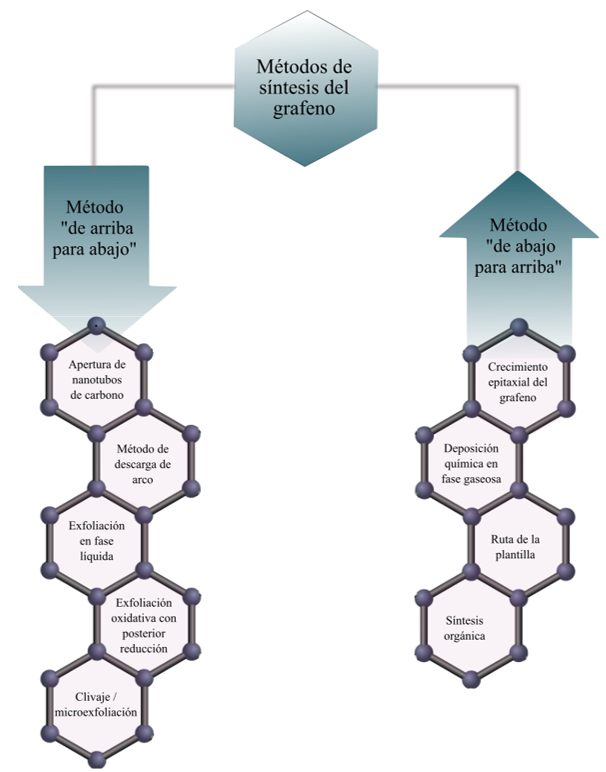
Figura 2. Esquema resumen de los diferentes métodos para la obtención de grafeno. La figura es una adaptación de la que se encuentra en la referencia [27].
Diferentes métodos de producción han sido estudiados en el grafeno, por ejemplo: deposición química en fase vapor, exfoliación micromecánica, molienda de bolas, exfoliación electroquímica, crecimiento epitaxial a partir de carburo de silicio, entre otros [27-30] (en la figura 2 se muestra un resumen de las principales metodologías). Kum et al. [31] en su revisión bibliográfica hablan de la realidad actual y de la industrialización del grafeno, incluso muestran que en los últimos años se producen miles de toneladas de grafeno anualmente. La publicación conocida como White book o libro de cocina del grafeno [32] es un compendio de la producción y el procesado del grafeno de diversos y punteros grupos europeos, todos ellos pertenecientes al proyecto europeo Graphene Flagship, que comenzó en 2013 y en el que Europa ha invertido un billón de euros [33].
El clivaje de grafito es la mejor técnica de obtención de este material, en términos de sus propiedades fisicoquímicas y del bajo costo de obtención; no obstante, no puede ser escalable y es ahí donde la obtención por CVD se vuelve más atractiva. Se considera que estas dos metodologías son las más importantes para la obtención de grafeno y por ello estas se explicarán en más detalle.
El método de microexfoliación fue el mismo que utilizaron Novoselov et al. [19] en su trabajo pionero en el aislamiento de monocapas de grafeno y su utilización como transistor, que a la postre le sirvió para ser laureado con el Premio Nobel. En este método, se vencen las fuerzas atractivas de Van der Waals entre las capas del grafito aplicando fuerzas laterales que emplean la capacidad autolubricante del grafeno; en la práctica, esto significa la utilización de cinta adhesiva para exfoliar repetidamente capas de un cristal de grafito pirolítico altamente orientado (HOPG, por sus siglas en inglés). Posteriormente, la cinta adhesiva decorada con grafeno se presiona contra un substrato objetivo y el grosor del grafeno se juzga por el contraste óptico entre el grafeno y el sustrato bajo un microscopio óptico. La absorción óptica del grafeno aumenta linealmente con el número de capas y, por ende, se puede determinar el grosor dividiendo la opacidad por 2,3%, absorbancia de una sola capa [34].
El método CVD para la obtención de grafeno produce láminas de gran área (del orden de mm2), que no se pueden alcanzar con casi ninguna de las otras técnicas mencionadas. El grafeno CVD se obtiene típicamente en superficies metálicas empleando metodologías relativamente sencillas [35]. En dicho método, se calientan superficies catalíticas como Ni, Pd o Cu, el más usado, en presencia de una mezcla de hidrógeno con metano (otros alcanos de cadena corta pueden ser también utilizados), el carbono se deposita sobre la superficie y posteriormente mediante rampas de enfriamiento, así como flujo y presión se controla el número de capas obtenidas [11]. Una variante del CVD es el llamado PVS (Physical Vapor Deposition), que consiste en evaporar en ultra-alto vacío (UHV) moléculas orgánicas (fulerenos, etileno…) para crecer grafeno en la superficie de un metal sirviéndose de sus propiedades catalíticas. Entre sus principales ventajas se encuentran: es autolimitante, es decir, una vez crecida la monocapa de grafeno, ya no crecen más capas, puesto que se necesita de las propiedades catalíticas del metal. La temperatura del sustrato que se requiere durante el crecimiento suele ser menor comparada con otros métodos. Al crecerse en UHV, la muestra es muy limpia (sin impurezas) y de una alta cristalinidad [36, 37].
La presencia del sustrato subyacente limita la aplicabilidad del grafeno en la electrónica, ya que el acoplamiento íntimo entre el metal y el grafeno altera significativamente las propiedades electrónicas del último. Por ejemplo, una fuerte interacción entre las láminas de grafeno y algunos metales como el Ni (111) puede dar como resultado una densidad de estados (DOS) alterada junto con el dopaje tipo n del grafeno, mientras que el grafeno en superficies menos interactivas como Pt (111) en gran medida preserva la forma intrínseca del cono de Dirac (figura 1), similar al grafeno independiente [35, 38]. Por lo tanto, se han desarrollado varios métodos para transferir la película de grafeno a un sustrato deseado [39]. Si bien ahora hay varios métodos confiables disponibles, aún se necesitan mejoras adicionales, ya que la electrónica y la calidad del grafeno CVD transferido es a menudo inferior a la del grafeno exfoliado.
El método más utilizado de transferencia es el “método de transferencia húmeda” (figura 3), en este el grafeno se deposita sobre el sustrato polimetilmetacrilato (PMMA) como soporte mecánico y de esta manera se minimiza la formación de arrugas en la lámina, lo que conduce a una mejor calidad del grafeno transferido [39]. El apilamiento PMMA/grafeno/Cu se coloca luego sobre una solución de grabado (generalmente persulfato de amonio o ácido clorhídrico con peróxido de hidrógeno). Después de la corrosión completa del cobre, la muestra se recoge desde abajo con un portaobjetos de vidrio y se pone en agua desionizada para eliminar todos los residuos. Finalmente, el grafeno cubierto con PMMA se extrae con el sustrato objetivo, seguido de la eliminación del PMMA por medio de acetona.
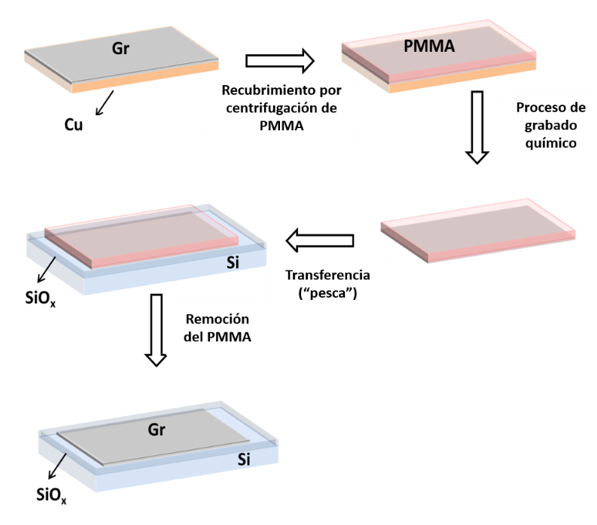
Figura 3. Diagrama esquemático de la transferencia húmeda de grafeno CVD desde láminas de Cu a sustratos de silicio utilizando PMMA como capa de soporte.
Dependiendo del método de transferencia, se obtienen diferentes propiedades ópticas, eléctricas y estructurales. Estas propiedades se discuten con mayor profundidad en el siguiente apartado.
Propiedades estructurales del grafeno
El carbono es el cuarto elemento más abundante en la tierra y la base de toda la química orgánica y organometálica. Debido a su capacidad de formar diferentes tipos de enlaces carbono-carbono, existe como diferentes alótropos, cuyas propiedades físicas y químicas dependen en gran medida de su dimensionalidad [40]. Entre estos sistemas, el grafeno, el alótropo 2D, a menudo se ha llamado la “madre” de todos los demás alótropos, ya que pueden obtenerse envolviendo, enrollando o apilando el grafeno [40, 41].
El grafeno, como se mencionó anteriormente, es una lámina plana de carbonos de un átomo de espesor dispuesta en una red de panal, como se muestra en la figura 4a. Los átomos de carbono forman una red hibridada sp2 con tres vecinos más cercanos, cada uno a una distancia de 1,42 Å, dejando un orbital p medio lleno, no hibridizado, perpendicular al plano de grafeno [42]. La terminación finita del grafeno da como resultado dos posibles geometrías de bordes, a saber, “zigzag” y “armchair”, como se muestra en la figura 4b. Los dos tipos de terminaciones muestran propiedades electrónicas bastante diferentes. Los bordes en zigzag presentan un fuerte pico de densidad de estados en la energía de Fermi, lo cual es característico de un comportamiento metálico, mientras que los bordes del “armchair” también pueden presentar un comportamiento de semiconductores. Desde el punto de vista químico, los bordes en “zigzag” son más reactivos que los “armchair” [43, 44]. La densidad de los átomos de carbono es 39 nm−2 (equivalente a 3,9·1015 átomos.cm−2).
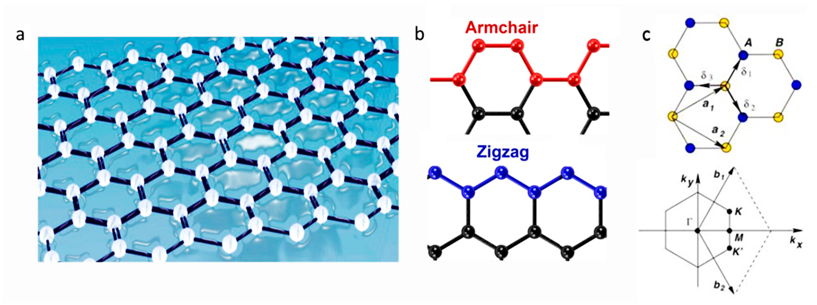
Figura 4. a) Representación esquemática de la red de panal de grafeno. b) Dos terminaciones de grafeno diferentes, “armchair” (imagen superior) y “zigzag” (imagen inferior). c) Estructura reticular real y recíproca del grafeno. La primera zona de Brillouin comprende los puntos de alta simetría Γ, M, K y K´.
Propiedades electrónicas
Como consecuencia de la estructura reticular hexagonal del grafeno (figura 4c), su primera zona de Brillouin tiene dos puntos no equivalentes, los llamados puntos Dirac, que se tocan en un solo punto (figura 1). Su nombre deriva de la estructura de banda lineal descrita por la ecuación de Dirac para Fermiones sin masa [45]. Usando el hamiltoniano [46] de unión estrecha, que considera solo la primera interacción vecina más cercana, para calcular la relación de dispersión de los electrones cerca de los dos puntos de Dirac (K, K´), se produce la siguiente dispersión de banda:

donde ai = √3a y τ es la integral de transferencia (salto de energía entre vecinos más cercanos, con un valor típico de 2,9 a 3,1 eV) [47]. La ecuación (1) cerca de los puntos de Dirac conduce a la siguiente dispersión para bajas energías:

donde el vector q es el momento relativo al punto de Dirac, ħ es la constante h de Planck dividida por 2π, y νF es la velocidad de Fermi (≈1×10⁶ ms-1). Esto hace que el grafeno sea un semiconductor de banda cero con cuasipartículas de Dirac sin masa. La estructura de bandas y los electrones Dirac confieren propiedades sobresalientes al grafeno, incluido un efecto de campo eléctrico ambipolar (p y n) [45], portadores sintonizables [11], altas movilidades de portadores [10], así como transporte de carga balístico en la escala submicrométrica [48], superconducción dependiendo del apilamiento de sus capas [3] y en apilamientos particulares generar diodos del tipo GrIM [49].
Propiedades ópticas
Debido a su brecha de banda cero, se espera que el grafeno absorba fotones de todas las frecuencias del espectro desde el ultravioleta hasta el infrarrojo, lo que lo hace interesante para la conversión de luz a electricidad. Experimentalmente, se ha detectado la absorción de fotones con energías menores de 0,2 eV [50]. La absorbancia se puede ajustar por la concentración del portador en el grafeno, mediante campos eléctricos y temperatura [51]. Debido a sus fermiones sin masa, una monocapa de grafeno, independiente, posee un valor universal de conductancia óptica [52] en el rango de frecuencia visible igual a:

Aplicando la ecuación de Fresnel en los rendimientos de película delgada:

Donde . La combinación de las dos ecuaciones anteriores proporciona una transmitancia óptica de ~97,7% de la luz incidente. Como el grafeno refleja menos del 0,1% en el rango visible, la absorción óptica de una monocapa de grafeno se obtiene al 2,3%, un valor significativo para un material que tiene solo un átomo de espesor. La absorción aumenta linealmente con el número de capas, de modo que el grosor del grafeno (número de monocapas) se puede determinar fácilmente usando un microscopio óptico [34]. Como se mencionó anteriormente, la transmisión óptica del grafeno se puede ajustar por dopaje. Esto se debe a la baja densidad de estados cerca del punto de Dirac, debido a que un cambio de nivel de Fermi provoca un cambio significativo de la densidad de carga, que a su vez modula la transmisión del material [11].
A diferencia de los semiconductores convencionales, en el grafeno la dispersión de fonones juega un papel importante debido a la falta de una brecha de banda. En consecuencia, los tiempos de vida de los portadores excitados en el grafeno son muy cortos y dependen de su calidad estructural y concentración del portador [15, 53]. Se han identificado dos procesos principales de relajación mediante mediciones resueltas en el tiempo. El más rápido, asociado con colisiones dentro de banda electrón-electrón y emisión de fonones, ocurre en el orden de cientos de femtosegundos, mientras que el más lento (cientos de picosegundos) está relacionado con la relajación electrónica entre bandas y el enfriamiento de los fonones calientes [17, 54, 55].
Funcionalización química del grafeno
La funcionalización química del grafeno ha recibido un enorme interés en la comunidad científica debido a la posibilidad de controlar sus propiedades electrónicas, así como permitir su uso en sensores químicos o electrónica molecular [56]. La unión covalente de átomos o moléculas provoca la rehibridación de átomos de carbono del sp2 plano a la hibridación sp3, tetraédrica. En principio, la unión puede ocurrir en ambas caras de la monocapa, así como en los bordes de la hoja, los últimos de los cuales suelen ser más reactivos que el plano basal. Se ha predicho que la reactividad química de los bordes dependerá de su estructura. Por ejemplo, según la teoría, los bordes en “zigzag” son más reactivos que los de “armchair” [57].
El enlace covalente de los átomos de hidrógeno al grafeno da como resultado un nuevo material llamado grafano (para una cobertura total) [58]. Se predice que el grafano tendrá una banda prohibida de aproximadamente 3,5 eV. En el primer informe experimental de grafeno hidrogenado se observó un comportamiento dieléctrico a bajas temperaturas. Los estudios experimentales sobre grafeno con una cantidad controlada de hidrógeno unido han demostrado que la movilidad disminuye proporcionalmente a la cobertura de átomos modificados en el plano de grafeno [59].
Otro derivado químico del grafeno es el llamado fluorografeno, cuya síntesis se informó por primera vez en 2010 [60]. Desde entonces, varios estudios han demostrado que el carácter eléctrico del fluorografeno varía desde semimetálico hasta aislante, dependiendo de la estequiometría. Los cálculos teóricos predicen que la fluoración parcial permite la sintonía del intervalo de banda de 0,8 a 2,9 eV, y que la resistividad puede alcanzar valores tan altos como 1012 Ω.m [60, 61]. Un estudio reciente de grafeno totalmente fluorado reportó una brecha de banda de 3,8 eV, el valor más alto hasta ahora reportado para cualquier grafeno funcionalizado [62]. La quimisorción de flúor también cambia dramáticamente las propiedades ópticas del grafeno (volviéndolo transparente) [62].
El óxido de grafeno (GO) consiste en una sola capa de óxido de grafito y generalmente se produce por oxidación de monocapas de grafeno u oxidación de grafito utilizando medios ácidos fuertes u ozono [6], seguido de dispersión y exfoliación en agua o solventes orgánicos. El GO resultante comprende regiones grafíticas intactas distribuidas aleatoriamente, intercaladas con regiones oxigenadas. Se ha identificado que los grupos funcionales oxigenados son principalmente grupos hidroxilo y epoxi en el plano basal, con cantidades más pequeñas de motivos de carboxilo, carbonilo, fenol, lactona y quinona en los bordes de la lámina [63-65].
La teoría sugiere la posibilidad de crear y ajustar la brecha de banda electrónica de GO variando el nivel de oxidación [6, 23, 66]. Sin embargo, debido a su estructura y composición mal definidas, GO es menos adecuado para aplicaciones electrónicas, ya que la densidad de los grupos oxigenados puede afectar fuertemente sus propiedades electrónicas, mecánicas y electroquímicas, y es muy difícil controlar con precisión la estequiometría específica. El GO exhibe varias propiedades intrigantes [23, 67], tales como fotoluminiscencia, dinámica óptica ultrarrápida, propiedades ópticas no lineales y actividad electrocatalítica. El GO, además, puede servir como precursor del grafeno o como base de partida para derivados de grafeno más elaborados a través de la unión covalente de grupos orgánicos a su superficie.
Aplicaciones del grafeno
Grafeno en tratamiento de aguas
Una de las principales problemáticas de la sociedad actual es la contaminación ambiental. Dentro de esta perístasis, dos de los temas más importantes es el tratamiento [68, 69] y desalinización del agua [70]. Para ambos casos se ha demostrado que el grafeno se presenta como una gran alternativa. El tratamiento de contaminantes en el agua se puede dividir en: tratamiento químico de las sustancias para la formación de una sustancia con menor toxicidad o en la absorción/adsorción o encapsulamiento del contaminante para un tratamiento posterior o disposición de este. Debido a la inmensa área superficial del grafeno [71] y su capacidad de absorción de múltiples grupos funcionales, [72] el grafeno y el óxido de grafeno tienen una proyección muy alta en la generación de membranas de filtración para el tratamiento de aguas [68, 69].
Las membranas para purificación de agua deben poseer alta selectividad y excelente permeabilidad de moléculas/iones deseados. También deben ser altamente rentables, fáciles de maniobrar y deben tener buena estabilidad química y mecánica [69]. Dentro de estos filtros de próxima generación, el GO es uno de los candidatos más llamativos. Majumder et al. [73], desarrollaron un filtro novedoso a partir de un GO viscoso que se extiende para producir una capa delgada, con una metodología similar a poner mantequilla sobre pan cuadrado, dicha propuesta genera una capa uniforme con características de adsorción bastante llamativas. La principal ventaja de esta metodología incluye la producción de filtros de manera rápida con alta efectividad, y puede filtrar las partículas mayores de 1 nm. La estructura química del óxido de grafeno en sí mismo le permite actuar como membrana debido a los defectos que se forman en sus procesos de síntesis, el tamaño del poro es de aproximadamente 0,9 nm. Las membranas de GO son químicamente inertes con numerosas sustancias, además, su costo de producción ha ido decreciendo sustancialmente [68].
Para dar mayor sensibilidad y especificidad a las superficies de grafeno, se ha demostrado la posibilidad de hacer una gran cantidad de híbridos con diferentes estructuras además de estructuras tridimensionales de GO. Estas novedosas heteroestructuras han permitido la eliminación de, por ejemplo, microorganismos y materia orgánica en general en el agua. Trabajos como el de Xue et al. [74], que mezclan rutenio con GO para eliminación de bacterias, o el de Wang et al., que utiliza magentita para eliminación de tintes orgánicos [75], son ejemplos de estas heteroestructuras. Los materiales reportados basados en heteroestructuras de nanopartículas que usan grafeno como substrato o recubrimiento que han sido desarrollados en la reducción de contaminantes orgánicos han demostrado ser eficientes y abarcar una amplia gama de contaminantes [75-79]. Varios artículos de revisión ha sido elaborados resumiendo los trabajos en esta dirección [68, 69, 77]. En este artículo de revisión se empleará un cuadro resumen que, a criterio de los autores, simplifica la búsqueda de la heteroestructura deseada (ver tabla 1).
Los diferentes iones de metales pesados existentes en los cuerpos de agua son dañinos para la vida acuática, los seres humanos y sus alrededores. Una creciente preocupación mundial en esta dirección ha generado un alto número de estudios científicos frente a este respecto. El GO se considera un adsorbente peculiar y especial para la eliminación y reducción de iones metálicos como zinc, cobre, plomo, cadmio, cobalto, etc. [68]. La adsorción de muchos iones metálicos parece ser fuerte y varía dependiendo del tipo de iones metálicos, a pesar de que la selectividad del GO sin modificar es pobre. Cuando la electronegatividad de los iones metálicos es más alta, la atracción de los iones metálicos en el negativo de la superficie GO cargada es más fuerte [69]. Una mejor adsorción de nanometales pesados en la superficie de GO se atribuye a la presencia de grupos funcionales hidroxilo y carboxilo en GO. Un resumen de la variedad de metales detectados utilizando grafeno o GO, así como las modificaciones realizadas para aumentar su selectividad, se muestran en la tabla 1.
| Adorbente | Adsorbato | Concentración adsorbida | Ref |
| Grafeno | Azul de metileno | 20-120 mg/L | [80] |
| Grafeno | Rojo catiónico X-GRL | 20-140 mg/L | [81] |
| Grafeno | Azul de metilo | 5 mg/L | [82] |
| Grafeno esponja | Azul de metileno | 0,002 mol/L | [83] |
| Grafeno esponja | Rhodamina B | 0,002 mol/L | [83] |
| Grafeno esponja | Naranja de metilo | 0,002 mol/L | [83] |
| GO | Azul de metileno | 0,33 mg/L-1,000 g/L | [84] |
| GO | Violeta de metilo | 10-50 mg/L | [85] |
| GO | Rhodamina B | 1-10 mg/L | [85] |
| GO | Naranga de acridina | 0,1 g/L | [86] |
| GO | Azul de metileno | 40-120 mg/L | [87] |
| Grafeno/Fe3O4 | Fucsina | 20-60 mg/L | [75] |
| Grafeno/Fe3O4 | Pararosanilina | 20-60 mg/L | [88] |
| Grafeno-SO3H/Fe3O4 | Salfranina T | 20-250 mg/L | [89] |
| Grafeno-SO3H/Fe3O4 | Rojo neutral | 20-250 mg/L | [89] |
| Grafeno-SO3H/Fe3O4 | Azul Victora | 20-250 mg/L | [89] |
| Grafeno/CoFe2O4 | Verde de metilo | 50-400 mg/L | [90] |
| Grafeno/arena | Rhodamina 6G | 5 mg/L | [91] |
| Grafeno quitsano | Eosin Y | 0-80 mg/L | [92] |
| Magnetita/RGO | Verde de malaquita | 0,5-4 mg/L | [93] |
| Grafeno | Acrilonitrilo | 720 mg/g | [82] |
| Grafeno | Ácido p-toluensulfónico | 1430 mg/g | [82] |
| Grafeno | Ácido 1-naftalensulfónico | 1520 mg/g | [82] |
| Grafeno | Bisfenol A | 123,92-181 mg/g | [94] |
| GNs | Fenantreno | 129,8 mg/g | [95] |
| GNs | Bifenilo | 141,2 mg/g | [95] |
| Grafeno sulfonado | Naftol | 6,4 mmol/g | [96] |
| GO | Tetraciclina | 313,48 mg/g | [97] |
| GO | Oxitetraciclina | 212,31 mg/g | [97] |
| GO | Doxiciclina | 398,41 mg/g | [97] |
| GO | Tetrabromobisfenol A | 85,41-123,25 mg/g | [98] |
| Grafeno/Fe3O4 | Anilina | 144,30-202,84 mg/g | [99] |
| Grafeno/Fe3O4 | n-cloroanilina | 35,47-43,86 mg/g | [99] |
| RGO/óxido de hierro | Naftilamina | 2,85 mmol/g | [100] |
| RGO/óxido de hierro | Naftaleno | 2,63-5,72 mmol/g | [100] |
| RGO/magentita | Ciproflaxina | 18,22 mg/g | [101] |
| RGO/magentita | Norfloxacina | 22,20 mg/g | [101] |
| GNs | As(III) | 138 mg/g | [102] |
| GO | Cd(II) | 14,9-106,3 mg/g | [103] |
| GO, GO/Fe3O4 | Co(II) | 13,0-68,2 mg/g | [103] |
| GNs, FE-GNS | Cr(IV) | 5,0-162,6 mg/g | [104] |
| GO, GO/Chitosan | Cu(II) | 46,6-120,0 mg/g | [105] |
| GO, GO/SH, GNs/SH, Ag/GNs MnO2/GNs, GNs/polipirrol | Hg(II) | 22-980 mg/g | [106] |
| GO, GO/EDTA, GO/quitosano, GNS/EDTA | Pb(II) | 22,4-479 mg/g | [107] |
| GO | Zn(II) | 30,1 mg/g | [108] |
| Grafeno | Sb(III) | 10,919 mg/g | [109] |
| Go modificado con poliamidoamina | Fe(II) | 0,5312 mmol/g | [110] |
| GO, GO/Fe3O4 | U(VI) | 299 mg/g | [111] |
| Grafeno/MnO2 | Ni(II) | 66,01 mg/g | [112] |
| Grafeno/MWCNT | Ag(II) | 46,0 mg/g | [113] |
| GO/hidróxido férrico | As(V) | 23,78 mg/g | [114] |
| RGO/magentita | As(III) | 10,20 mg/ | [115] |
Tabla 1. Resumen de sustancias que pueden ser adsorbidas por grafeno o modificaciones de grafeno para la eliminación de sustancias químicas del agua.
Para la remoción de contaminantes en el agua es necesario un mejor entendimiento de los mecanismos de los nanomateriales derivados del grafeno. La mayoría de los nanomateriales derivados del grafeno disponibles no han sido rentables en comparación con los materiales convencionales como el carbón activado y, por lo tanto, las aplicaciones futuras deberían centrarse en un rendimiento efectivo y mejorar los procesos de obtención de los nanomateriales. Sin embargo, el amplio rango de uso, así como una tasa de eliminación más alta, para la mayoría de los casos y una mejor reciclabilidad, convierten a estos materiales en elección prometedora para la purificación de aguas residuales y el reciclaje de colorantes solubles en agua.
Grafeno en materiales relacionados con la obtención y transporte de energía
Colectores de energía (celdas solares y fotodetectores)
Los requisitos necesarios para que un material transparente y conductor sea tecnológicamente llamativo son una baja resistencia Rs < 100 Ωsq-1 y una alta transparencia T ˃ 90% en el rango visible [116]. Los conductores transparentes de última generación se basan principalmente en semiconductores. Sin embargo, estos materiales se enfrentan a problemas importantes, que incluyen el precio cada vez mayor, la escasez de uno de los componentes (ITO, FTO), las dificultades en el diseño, la baja estabilidad química y la degradación de sus propiedades eléctricas [47, 116]. Por otro lado, la baja resistividad, alta transmitancia, buena estabilidad química y el bajo costo del grafeno lo convierten en una película conductora casi ideal [117]. Muchos trabajos han explorado las propiedades del grafeno como electrodo transparente [118-120], no obstante Blake et al. [121] reportaron la película de grafeno con mejores características hasta ahora, la cual alcanza un Rs = 400 Ωsq-1 y transparencia mayor al 98% con grafeno dopado n.
Uno de los dispositivos optoelectrónicos más importantes, donde el grafeno ha demostrado ser un candidato ideal, son los fotodetectores. En estos dispositivos, la energía fotónica absorbida se convierte en una señal eléctrica [122]. De forma similar a las películas conductoras descritas anteriormente, los fotodetectores se han desarrollado predominantemente utilizando materiales semiconductores. Sin embargo, la absorción óptica de los semiconductores está limitada por su banda prohibida, de modo que las energías fotónicas con valores menores a los de esta banda prohibida no puede ser detectada [47]. En contraste, al tener el grafeno una banda prohibida en forma de cono (figura 1), puede absorber fotones desde el ultravioleta al rango de terahercios [122, 123]. Otra ventaja de este material bidimensional es la alta movilidad de los portadores de carga, lo que permite que el grafeno presente fotodetección muy rápida.
Para explotar la rápida respuesta fotoeléctrica y la absorción de banda ancha del grafeno, se han explorado diferentes configuraciones de dispositivos [124-126], tales como dispositivos de metal-grafeno-metal [125], que exhiben una capacidad de respuesta (R) de »6,1 mAW-1 y una eficiencia cuántica interna (IQE) de »16%. Además, para dispositivos híbridos como puntos cuánticos/grafeno [127] se han reportado IQE de »25% y R»107 AW-1, mientras que las heteroestructuras de grafeno-semiconductores [128] arrojaron un IQE de » 10% y R » 0,13 AW-1 [47]. Ya que el grafeno es compatible con las tecnologías basadas en silicio, algunos de estos dispositivos ya han alcanzado un nivel de competitividad con las tecnologías existentes [122].
No obstante, el rendimiento de los dispositivos es limitado, debido a la corta vida útil de los portadores de carga una vez excitados (portadores calientes), dichos portadores en el grafeno se comportan como los electrones excitados en los metales. La extracción de estos portadores calientes, aunque desafiante, es altamente deseable para la implementación de grafeno en los sistemas de recolección solar. Los portadores excitados o calientes en el grafeno tienen tiempos de vida media un poco más largos que los metales, por lo que existe la posibilidad de extracción de los portadores calientes antes de que se relajen al nivel de Fermi. Estructuras novedosas como la reportada por Urcuyo et al. [129] permiten la conversión fotoeléctrica de los portadores calientes del grafeno para su uso en fotodetectores o celdas solares. Estos dispositivos con estructura Gr-TiOx-Ti (figura 5) producen un potencial de circuito abierto (Voc) de hasta 0,3 V después del dopaje. La estrategia clave implica el uso de TiOx como una capa de bloqueo de agujeros para aprovechar la diferencia de función de trabajo entre los electrodos de grafeno y Ti.
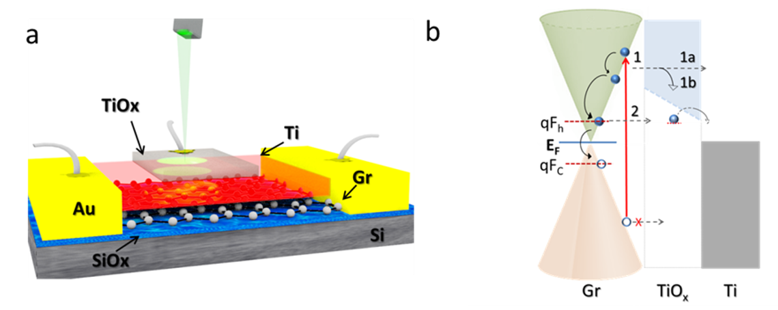
Figura 5. Diseño estructural del dispositivo utilizado para la extracción de portadores calientes de grafeno. a) Representación esquemática del dispositivo Gr-TiOx-Ti. b) Alineación electrónica de banda de la heteroestructura Gr-TiOx-Ti. Figura modificada de la referencia [129].
En el área de las celdas solares el grafeno ha sido utilizado en todas las tecnologías existentes heteroestructuras [130], poliméricas [131], sensibilizadas con tintes [132] y celdas con perovskitas [133]. En todas ellas ha tenido un papel relevante, en los siguientes párrafos se hará un resumen de los trabajos más importantes en esta área.
Las eficiencias de las diferentes tecnologías de celdas solares varían de 20 a 46%, dependiendo de la naturaleza de los materiales fotovoltaicos utilizados y de la configuración del dispositivo [130]. El Laboratorio Nacional de Energías Renovables (NREL) ha reportado eficiencias de conversión del 45,7% para celdas solares de 4 uniones metamórficas invertidas (el crecimiento de capa se da en dirección opuesta a la convención, la capa que presenta mayor desajuste cristalino crece cercana al substrato), una de las mayores eficiencias de conversión de energía (PCE). En este diseño, la celda solar consiste en una unión de galio, indio y fósforo (GaInP), una unión de arseniuro de galio (GaAs) y dos de arseniuro de indio y galio (InGaAs) [130] y es una de las celdas que mejores eficiencias presenta al ser iluminada bajo condiciones de más de 1000 soles. Es con esta tecnología de heterouniones o heteroestructuras en donde se encuentran las dos celdas con los valores de mayor eficiencia en conversión de luz solar en energía eléctrica, uno reportado por Sharp Corporation, con 44,4% [134] y el reportado por Soitec con 46% [135].
En esta área y por sus propiedades de transparencia y movilidad electrónica, anteriormente discutidas, el grafeno se ha convertido en un importante componente. El grafeno se puede utilizar como electrodo transparente, capa interfacial activa, capa de transporte de electrones, capa de transporte de agujeros o capa de separación de electrones/agujeros. Actualmente, las eficiencias superan el 10% para uniones de materiales mixtos basado en grafeno multicapa. En la tabla 2, se enumeran los diferentes dispositivos solares que han utilizado grafeno en su diseño, así como sus eficiencias.
| Dispositivo Solar | Jsc (mA/cm2) | Voc (v) | FF (%) | PCE (%) | Ref |
| PEN/ánodo de grafeno/PEDOT:PSS/MoO3/PTB7:PC71BM/Ca/Al | 14,4 | 0,72 | 58,7 | 6,1 | [137] |
| PEN/cátodo de grafeno/ZnO/PTB7:PC71BM/MoO3/Ag | 141 | 0,72 | 69,5 | 7,1 | [137] |
| grafeno/PEDOT:PSS (O2 plasma) | 6,3 | 0,49 | 44 | 1,37 | [138] |
| Ánodo de grafeno/PEDOT:PSS/P3HT:PC61BM/LiF/AL | 8,5 | 0,59 | 51 | 2,5 | [139] |
| Ánodo de grafeno/PEDOT:PSS/CuPc:C60/BCP/AG | 4,4 | 0,53 | 36 | 0,85 | [140] |
| ITO-ánodo/PEDOT:PSS/P3HT:PC61BM/LiF/Al | 9,2 | 0,58 | 57 | 3,0 | [139] |
| Grafeno-MoO3+PEDOT:PSS-ánodo/P3HT:PC61BM/LiF/Al | 4,8 | 0,59 | 43 | 1,23 | [139] |
| HCl/HNO3+grafeno dopado/MoO3+PEDOT:PSS/P3HT:PC61BM/LiF/Al | 7,0 | 0,59 | 45 | 1,9 | [139] |
| Grafeno CVD/PEDOT:PSS/CuPc:C60/BCP/Al | 4,7 | 0,48 | 52 | 1,18 | [141] |
| TCNQe-ánodo de grafeno/PEDOT:PSS/P3HT:PC61BM/Ca/Al | 8,9 | 0,57 | 48 | 2,58 | [142] |
| Cátodo de grafeno/PEDOT:PEG(PC)/ZnO/PbS(P3HT)/MoO3/Au | 24,4 | 0,5 | 34,6 | 4,6 | [143] |
| grafeno-catodo/RG-1200g/ZnO/PbS(P3HT)/MoO3/Au | 20,8 | 0,54 | 34,9 | 3,9 | [139] |
| Vidrio/grafeno/ZnO/CdS/CdTe/pasta de grafito | 22,9 | 0,43 | 42 | 4,17 | [144] |
| Cu/P3HT:PCBM/PEDOT:PSS/grafeno/PMMA | 10,4 | 0,38 | 34,5 | 1,39 | [145] |
| Ag/P3HT:PCBM/PEDOT:PSS+Au/grafeno (3 capas) | 10,3 | 0,601 | 49,48 | 3,08 | [145] |
| Si/PEDOT:PSS/AgNWs/óxido de grafeno | 28,4 | 0,601 | 78,4 | 13,3 | [146] |
| ITO/óxido de grafeno/P3HT:PCBM/LiF/Al | 10,1 | 0,64 | 50 | 3,25 | [147] |
| ITO/PEDOT:PSS/P3HT:PCBM/óxido de grafeno-Cs/Al | 9,8 | 0,62 | 50 | 3,08 | [147] |
| óxido de grafeno-Cs/Al/GO/MoO3 | 5,0 | 1,69 | 46 | 3,91 | [148] |
| óxido de grafeno-Cs/Al/grafeno óxido | 4,5 | 1,43 | 45 | 2,95 | [148] |
| ITO/PEDOT:PSS/CH3NH3PbI3−xClx/PC61BM:GDa/C60/Al | 23,4 | 0,969 | 65,4 | 14,8 | [149] |
| ITO/PEDOT:PSS/CH3NH3PbI3−xClx/PC61BM/C60/Al | 22,3 | 0,989 | 61,5 | 136 | [149] |
| FTO/Grafeno-TiO2/Al2O3/CH3NH3PbI3−xClx/spiro-OMeTADb/Au | 21,9 | 1,04 | 73 | 15,6 | [150] |
| CH3NH3PbI3/puntos cuáticos de grafeno/TiO2 | 17,0 | 0,937 | 63,5 | 10,14 | [151] |
| ITO/GO/CH3NH3PbI3−xClx/PCBM/ZnO/Al | 17,4 | 1 | 71 | 12,4 | [152] |
| ITO/RGO/CH3NH3PbI3/PC61BM/BCPc/Ag | 14,8 | 0,95 | 71,13 | 9,95 | [153] |
| CH3NH3PbI3/óxido de grafeno/spiro-MeOTAD | 20,2 | 1,04 | 73,00 | 15,1 | [154] |
| TiO2/CH3NH3PbI3 cúbico/spiro-MeOTAD | 21,6 | 1,05 | 74,00 | 17,01 | [155] |
| PET/rGO/PEDOT:PSS/P3HT:PCBM/TiO2/Al | 4,3 | 0,56 | NA | 0,78 | [156] |
| PET/GO:PEDOT:PSS/F8T2/C60/Al | 2,7 | 0,71 | 0,52 | 1,1 | [157] |
| ITO/ZnO/P3HT:PCBM/PEDOT:PSS/Au/G | 10,5 | 0,59 | 0,43 | 2,70 | [158] |
| G/Au/PEDOT:PSS/P3HT:PCBM/ZnO/Ag/PI | 10,6 | 0,597 | 0,50 | 3,17 | [145] |
| EG/PEDOT:PSS/PTB7:PC71BM/Ba/Al | 6,5 | 0,707 | 0,56 | 4,23 | [159] |
| PET/PMMA-G/MoO3/PEDOT:PSS/PCDTBT:PC70BM/Ca/Al | 8,8 | 0,83 | 0,45 | 3,30 | [160] |
| PEN/G/ZnO/PTB7:PC71BM/MoO3/Ag | 14,9 | 0,71 | 0,58 | 6,20 | [137] |
| ITO/PEDOT:PSS/P3OT:G/LiF/Al | 4,2 | 0,92 | 0,37 | 1,40 | [161] |
| ITO/PEDOT:PSS/P3HT:G/LiF/Al | 4,0 | 0,72 | 0,38 | 1,10 | [162] |
| ITO/PEDOT:PSS/P3OT:PCBM–G/LiF/Al | 4,6 | 0,67 | 0,37 | 1,14 | [163] |
| ITO/PEDOT:PSS/P3HT-f-MWCNTs-SPFG/LiF/Al | 4,7 | 0,67 | 0,32 | 1,05 | [164] |
| ITO/PEDOT:PSS/G-P3HT:C60/Al | 3,5 | 0,43 | 0,41 | 0,61 | [165] |
| ITO/PEDOT:PSS/C60-rGO:P3HT/Al | 4,4 | 0,56 | 0,49 | 1,22 | [165] |
| ITO/PEDOT:PSS/P3HT:GQDs/Al | 6,3 | 0,67 | 0,3 | 1,28 | [166] |
| ITO/PEDOT:PSS/P3HT/ANI-GQDs/Al | 3,5 | 0,61 | 0,53 | 1,14 | [167] |
| ITO/PEDOT:PSS/P3HT:PCBM:GQDs/LiF/Al | 26,4 | 0,6 | 0,33 | 5,24 | [168] |
| ITO/PEDOT:PSS/GOQDs:PTB7:PC71BM/Al | 15,2 | 0,74 | 0,68 | 7,60 | [169] |
| ITO/PEDOT:PSS/G-dopado con N:P3HT:PCBM/Al | 14,9 | 0,59 | 0,51 | 4,48 | [170] |
| ITO/PEDOT:PSS/P3HT:PTM21-GO:PCBM/LiF/Al | 8,1 | 0,59 | 0,30 | 1,43 | [171] |
| ITO/GO/PEDOT:PSS/PCDTBT:PC71BM/Al | 10,4 | 0,82 | 0,50 | 4,28 | [169] |
| ITO/PEDOT:PSS(Au@PEG–GO)/PBDTTT-CT | 16,1 | 0,75 | 0,60 | 7,26 | [172] |
| ITO/ZnO@G:EC/P3HT:PC61BM/MoO3/Ag | 7,7 | 0,63 | 0,73 | 3,90 | [173] |
| ITO/FLGs-PEDOT:PSS/PCBM/P3HT/Ca/Al | 9,4 | 0,58 | 0,55 | 3,70 | [174] |
Tabla 2. Resumen de sustancias de diferentes conformaciones que utilizan grafeno para celdas solares. Compilación tomada de las referencias [130-132, 136].
Las celdas solares a base de polímeros, por su parte, ofrecen varias ventajas, incluida la facilidad de adaptar sus propiedades físicas, su capacidad de crecer capas ultrafinas, producción rentable en gran superficie, su peso ligero, entre otros. Una de las principales desventajas, sin embargo, es la preocupación por la estabilidad ambiental de dichas celdas solares. Hasta ahora se han utilizado polímeros conjugados con tiempos de descomposición cortos bajo condiciones atmosféricas, y es en este punto donde materiales a base de carbono, y especialmente el grafeno, pueden ayudar a proporcionar estabilidad contra la temperatura, la humedad y los productos químicos, sin perder las ventajas enunciadas anteriormente.
En estos tipos de celdas el aceptor de electrones y el donador son mezclados para mejorar el contacto; el orden, así como la alineación de los componentes y sus propiedades intrínsecas son los principales responsables del incremento en la eficiencia [175]. Entre los mejores rendimientos en este tipo de celdas se encuentran ITO/PEDOT:PSS/polymer PBTTT-3:PC70BM/Ca/Al [176] con un rendimiento del 7,4% y con 6,7% la celda de ITO/MeO/organic compounds:PC70BM/Al [177]. También son ejemplos muy interesantes las celdas plásticas, como la presentada por las compañías Solarmer Energy Inc., Heliatek, Konarka y Mitsubishi Chemical, con eficiencias que llegan hasta el 9,2% (la celda de Mitsubishi Chemical). Trabajos teóricos han predicho que la eficiencia máxima que se va a obtener con estos dispositivos es del 15% [178]. A pesar de encontrarse cerca del valor predicho, todavía se debe trabajar en tres aspectos y en estos tres el grafeno resulta clave: como aditivos al componente del donador de electrones, como electrodo transparente y flexible y como material separador entre capas [131, 136].
Varios trabajos han utilizado principalmente el óxido de grafeno modificado como aditivo en sus celdas. Liu et al. [179] usaron isocianato de fenilo como modificación, lo cual hace al GO soluble en 1,2-diclorobenceno, permitiendo realizar una mezcla con la capa fotoactiva (P3HT) para una posterior deposición mediante el método de recubrimiento por centrifugación en el electrodo (ITO recubierto con PEDOT:PSS). La adición del grafeno en ese dispositivo incrementó el voltaje de circuito abierto (Voc) en aproximadamente un 100% y bajo las mejores condiciones se observó una eficiencia del 1,1%. Otras estrategias consisten en el dopaje del grafeno con heteroátomos [170] o el uso de puntos cuánticos de grafeno [180]. La incorporación de nitrógeno en rGO dentro de la celda ITO/PEDOT:PSS/N-grafeno dopado:P3HT:PCBM/Al permitió lograr una eficiencia de 4,5%. Por otro lado, el uso de puntos cuánticos como el reportado por Kim et al. [180] en la celda ITO/PEDOT:PSS/GOQDs:PTB7:PC71BM/Al presenta la mejor eficiencia (7,6%) en celdas del tipo orgánicas con grafeno como aditivo según nuestro conocimiento.
Otro de los usos del grafeno y sus derivados ha sido como electrodo transparente (TCE) para sustituir el ITO, que a pesar de ser el material más utilizado como electrodo transparente en la literatura, su precio ha ido aumentando paulatinamente debido a la escasez del material. Películas de rGO sintetizadas por recocido térmico se depositaron en tereftalato de polietileno por medio de recubrimiento por centrifugación (“spin coating”) [156]. Se obtuvieron capas de 16 nm con una transmitancia de 65% y, sorprendentemente, el dispositivo obtenido podía soportar hasta 1200 ciclos de flexión sin sacrificar su rendimiento, mientras que las celdas tradicionales que incorporan ITO normalmente se agrietan y degradan. Se mejoró significativamente el rendimiento obtenido (PCE de 3,05%), depositando una micromalla de rGO por medio de estampado láser en PET, esto se atribuyó a una mejor transparencia, 59%, y la menor resistencia de la lámina, esta PCE es comparable con dispositivos basados en ITO [181].
El principal inconveniente de estos electrodos basados en rGO es su alta densidad de defectos que limitan la eficiencia del dispositivo. También se han utilizado modificaciones del grafeno, como el que muestra Xu et al. [182] a base de grafeno sulfonado (SG) y PEDOT, compuestos preparados por polimerización in situ, mediante pasos de reducción, sulfonación con ácido sulfanílico de aril diazonio, reducción y funcionalización con dicho ácido en presencia de un catalizador (AIBN), posteriormente se adiciona el monómero EDOT en presencia de un catalizador de hierro y se lleva a cabo la polimerización. Una conductividad de 0,2 S/cm y transmisiones muy altas del orden de 80% en el rango de longitud de onda de 400-1800 nm para películas con un grosor de unos pocos nm fueron observadas. Esta conductividad es mucho más alta que la de un producto comercial PEDOT.
Aparte de grafeno y grafeno modificado también hay reportes de nanocompuestos derivados del grafeno. Como reportan Lima et al. [157], se utilizó un nanocompuesto GO/PEDOT: PSS como TCE en una celda con estructura PET/GO:PEDOT:PSS/F8T2/C60/Al, y se obtuvo un PCE de 1,10%. El dispositivo presentó buenas transmitancias que dependían del radio GO/PEDOT pero, sobre todo, era llamativo porque podía soportar hasta 1000 ciclos de doblados. Otras estrategias han sido el dopaje del grafeno [183], por ejemplo, Liu et al. [158] hicieron un dispositivo con un éster (PC61BM) y una película de grafeno CVD dopada con nanopartículas de Au y PEDOT:PSS como el electrodo superior e ITO como el electrodo inferior (figura 6), este dopaje permite un incremento de más de 400% comparado con el grafeno prístino y permite una eficiencia de 2,7%. Es importante destacar que los autores esperarían una mayor eficiencia con un grafeno de mejor calidad.
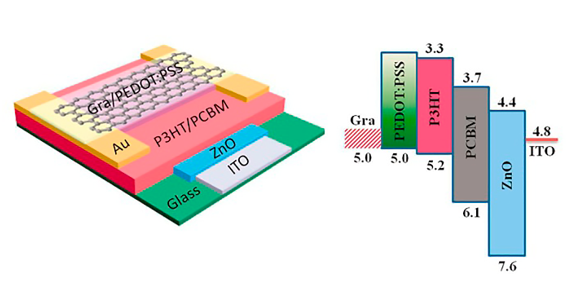
Figura 6. Representación esquemática y estructura de banda la estructura vidrio/(ITO)/ZnO/ P3HT:PCBM/Au/PEDOT:PSS/G. Figura modificada de la referencia [158].
Las celdas sensibilizadas (DSSC, por sus siglas en inglés) o que utilizan perovskitas han sido otras de las áreas que han tenido un auge muy importante en la colección de fotones para obtención de energía eléctrica. Un alto número de producciones científicas se han publicado en esta dirección desde el año 1991, cuando el grupo del profesor Graetzel propusiera esta tecnología [132, 184-186]. La figura 7 muestra una representación de lo propuesto por este grupo de investigación.
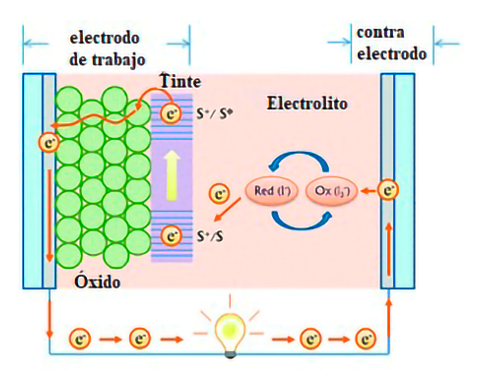
Figura 7. Representación esquemática y estructura de una celda sensibilizada modelo, así como también el flujo de electrones y la producción de trabajo eléctrico, en este caso, representado por un bombillo.
En el diagrama más estudiado se utilizan electrodos de TiO2 y como contraelectrodos se emplean electrodos de Pt. La figura de mérito que suele ser más determinante en la elección de los electrodos es la constante de transferencia de carga. Debido a la movilidad de carga del grafeno, así como estabilidad química, resulta un candidato muy interesante para su utilización como electrodo en estos sistemas [132]. Como electrolito se utiliza generalmente la mezcla yoduro/triyoduro, que es la que permite la regeneración del tinte fotosensible. Como materiales fotosensibles se encuentra una gran librería en la literatura, tintes basados en materiales polipirrílicos, porfirínicos, puntos cuánticos, nanopartículas y, de gran interés en los últimos años, perovskitas que han generado altos valores de eficiencia y reducido sus problemas en híbridos con grafeno [132].
Varias revisiones bibliográficas [132, 187-189] han resumido el uso del grafeno y sus aplicaciones en DSSC como electrodo transparente, capa semiconductora, fotosensibilizador, aditivos en electrolitos y contraelectrodo. Se han utilizado múltiples tipos de nanomateriales de carbono, incluidos fullerenos, CNT, grafeno y diamante para sus aplicaciones en DSSC como fotoánodo, contraelectrodo, colector de corriente y moléculas absorbentes de luz. Se han explorado materiales a base de grafeno como nuevos materiales de contraelectrodo en DSSC debido a sus interesantes actividades catalíticas electroquímicas, altas conductividades, altas áreas de superficie, resistencia a la corrosión, bajo peso y bajo costo de producción. En la tabla 2, se muestran los diferentes materiales a base de carbono, su uso en los diferentes tipos de celdas solares y sus eficiencias.
Grafeno en el almacenamiento de energía
El éxito de la implementación de energías renovables a nivel global depende del desarrollo de formas de almacenamiento que sean eficientes, limpias y con materiales abundantes [190]. Conforme se incrementa el uso de energías renovables en casas, transporte y aplicaciones móviles, el desarrollo de baterías con mayor capacidad de almacenamiento se vuelve indispensable [191, 192].
La tecnología existente de baterías de ion litio ha llegado prácticamente al máximo de su capacidad fisicoquímica [193]. Es por eso que se están buscando nuevas tecnologías que permitan tener mayor capacidad de almacenamiento. Sin embargo, cualquier batería de aplicación comercial tiene que cumplir con toda una serie de requerimientos, el primero es que las baterías deben ser seguras y, en caso de ruptura, no deben ser inflamables. El segundo es que deben estar hechas de materiales abundantes que puedan sostener la economía a nivel global. Las baterías deben, además, funcionar en un rango amplio de temperaturas [194, 195].
La Unión Europea ha lanzado la iniciativa Battery 2030 que contiene la hoja de ruta de investigación a largo plazo de “The Battery 2030+” [195]. Uno de los principales objetivos de esta iniciativa es el descubrimiento acelerado de interfaces y materiales. Desde el punto de vista de la investigación, no existe una preferencia clara en un tipo específico de batería, sino que se enumeran diferentes tecnologías. Entre estas, se mencionan las de iones de litio y las “poslitio”, tales como: iones de sodio, iones metálicos multivalentes, aire-metal y de flujo. En los próximos párrafos nos vamos a centrar en algunas de las tecnologías que podrían utilizan grafeno en sus componentes.
Desde su descubrimiento, el grafeno se ha destacado como un material muy prometedor para su uso en almacenamiento de energía. Algunas de sus características que lo hacen interesante para esas aplicaciones son su alta área superficial, alta conductividad eléctrica, flexibilidad y estabilidad [194]. Es por eso que en los últimos diez años se ha trabajado fuertemente tratando de incorporarlo en diferentes tecnologías de baterías. Una de las grandes interrogantes es ¿cuál va a ser la tecnología que va a venir a reemplazar la tecnología existente de baterías ion litio? Esta pregunta puede tener diferentes respuestas dependiendo de la aplicación. Sin embargo, el grafeno resulta como un material muy interesante para ser implementado en esas tecnologías. En esta sección vamos a centrarnos en tres tecnologías principales que podrían llegar a usar grafeno dentro de sus componentes: baterías ion-litio, baterías de ion-sodio y baterías ion-aluminio.
Uso de grafeno en baterías ion-litio
Las baterías de ion-litio son una tecnología que incursionó en el mercado al inicio de los noventa a cargo de la empresa Panasonic [195]. Esta tecnología de baterías ha permitido el desarrollo de todas las tecnologías de dispositivos portables con los que contamos en la actualidad. Sin embargo, desde ese momento, su capacidad no se ha incrementado apreciablemente. Las primeras versiones de las baterías de ion litio contemplaban el uso de litio metálico como ánodo y óxidos de manganeso para intercalar los iones de litio como cátodo [196]. Sin embargo, este tipo concepto de batería fue abandonado debido a problemas de seguridad en cuanto al uso de litio metálico. Además, la redeposición del litio forma dendritas que resultan en el fallo de la batería. Es por eso que en el modelo comercializado por Panasonic se utilizaba grafito como ánodo y óxidos de cobalto como cátodo [197]. A este tipo de diseño se le suele llamar silla mecedora, ya que los iones litios pasan de estar intercalados en un material o el otro sin pasar por ser litio metálico. En este diseño el grafito tiene una capacidad de almacenamiento máxima teórica de 372 mAhg-1 [198]. A pesar de que desde su comercialización el costo de este tipo de baterías ha disminuido 15 veces, su capacidad únicamente se ha duplicado [195]. Muchos creen que la capacidad de este tipo de baterías ha alcanzado su tope máximo [193]. Es por eso que se requiere buscar nuevos materiales que permitan almacenar mayores cantidades de energía sin comprometer el voltaje que pueden brindar las baterías.
El uso de grafeno en baterías ion litio se ha propuesto como una posible tecnología que podría venir a suplantar las tecnologías conocidas. El grafeno puede ser utilizado como material del cátodo en diferentes formas. Se puede tener el grafeno de pocas capas producido mediante diferentes rutas de síntesis o se puede tener materiales compuestos de mezclas físicas de grafeno con diferentes materiales que resultan en propiedades mejoradas. Dichas mezclas pueden ser de tipo físico o también pueden involucrar enlaces químicos [194].
Uno de los trabajos pioneros en el uso de grafeno puro fue realizado por Liu et al. [199], en donde se obtuvieron capacidades de 540 mAhg-1. Posteriormente, Yoo et al. [200] lograron incrementar la capacidad hasta más de 700 mAhg-1 al adicionar nanotubos de carbono y fullerenos. Pan et al. [201] encontraron que las capas desordenadas de grafeno podían incrementar su capacidad hasta 750-1054 mAhg-1. En el año 2010 el trabajo de Bharwaj mostró que al preparar grafeno a partir de la apertura de nanotubos de carbono era posible obtener baterías con capacidades de hasta 1400 mAh g-1. Sin embargo, con el tiempo esa capacidad decaía hasta 800 mAhg-1 [202].
En el área de materiales compuestos basados en grafeno se puede decir que se ha probado casi cada combinación posible. Nos vamos a enfocar en algunos ejemplos que han mostrado propiedades prometedoras. Chang y Chem [203] reportaron el uso de sulfuro de molibdeno combinado con grafeno para obtener baterías con capacidades de 1571 mAhg-1. La modificación de grafeno con óxidos de hierro también ha mostrado excelentes capacidades: 1693-1227 mAhg-1 [204]. Otros óxidos como, por ejemplo, óxidos de molibdeno han mostrado capacidades de hasta 1490 mAhg-1 [205]. En cuanto al uso de nanopartículas, algunas de las que han proporcionado mejores capacidades son las nanopartículas de silicio. Dichas partículas presentan una capacidad teórica de hasta 4200 mAh g-1 [206, 207], sin embargo, presentan el inconveniente de una expansión volumétrica de hasta 270% [208], lo cual resulta en poca ciclabilidad de la batería, inestabilidad mecánica y su cese de funcionamiento. Sin embargo, la combinación de nanopartículas de silicio con grafeno ha permitido mejorar su estabilidad con capacidades de 1500 mAhg-1 para unos 200 ciclos [209]. Mejoras en la arquitectura de los electrodos han mostrado que es posible obtener capacidades de 1600 mAhg-1 a la vez que es posible mantener hasta un 93% de la capacidad luego de 100 ciclos [210]. Sin embargo, estos avances aún se quedan cortos para aplicaciones comerciales de larga duración. Otros óxidos que se han utilizado son, por ejemplo, óxidos de estaño con capacidades de 1562 mAhg-1 y buena estabilidad en el ciclado, alcanzandolos 1300 ciclos [211].
En caso de materiales híbridos que contienen enlaces con el grafeno, se ha trabajado, por ejemplo, con nanopartículas de óxido de manganeso Mn3O4 con capacidades de aproximadamente 900 mAhg-1 [212]. El grupo de Zhou et al. [213] preparó un material composito de nanocristales de óxido de estaño con óxido de grafeno dopado con nitrógeno reducido. Ese material permitió obtener capacidades de hasta 1352 mAhg-1. Otros grupos también han logrado obtener capacidades interesantes al mezclar diferentes formas de óxido de estaño con grafeno [214-216].
Es importante mantener en mente que estas capacidades se alcanzan con baterías que contienen litio metálico como ánodo en lugar de óxidos de cobalto o fosfatos de hierro. Sin embargo, para que este tipo de baterías sean seguras y aplicables a nivel comercial se requieren mayores avances en el área de electrolitos sólidos que permitan brindar mayor estabilidad y seguridad a la batería.
Uso de grafeno en baterías ion sodio
En las baterías de ion-sodio no es posible utilizar grafito como cátodo. Se ha logrado corroborar que la intercalación de sodio en el grafito es prácticamente despreciable y lo poco que se intercala lo hace de forma irreversible [217]. El grupo de Dou [218] usó óxido de grafeno reducido para intercalar iones sodio y mostró que podía alcanzar una capacidad de almacenamiento de hasta 174,3 mAhg-1 usando una densidad de corriente de 40 mAg-1. En el año 2015, el grupo de Chang preparó grafeno de 3-5 capas mediante la exfoliación y reducción de óxido de grafito y lo utilizó para la intercalación de sodio. Estos materiales presentaron una capacidad de 220 mAhg-1 con una corriente de 30 mAg-1 [219]. El grupo de Wang realizó la modificación de grafeno con nanopartículas de óxido de estaño y obtuvieron capacidades promedio de 700 mAhg-1 en 100 ciclos con una corriente de 20 mAg-1 [220]. Xie et al. [221] prepararon compositos de sulfuro de estaño con grafeno y obtuvieron capacidades promedio de 725 mAhg-1 a 20 mAg-1 y con buenas capacidades de ciclado. Otros sulfuros como, por ejemplo, sulfuro de cobalto con grafeno también han sido utilizados y han mostrado una capacidad de 420 mAhg-1 luego de 1000 ciclos a una densidad de corriente de 1 Ag-1 [222]. La combinación de grafeno con sulfuro de molibdeno MoS2 ha mostrado capacidades de 797 mAhg-1 a una densidad de corriente de 0,2 Ag-1 [223]. El grafeno dopado con nitrógeno también ha mostrado propiedades interesantes en este tipo de baterías. Este se ha empleado, por ejemplo, a modo de aerogel, en el grupo de Zhang, y mostró una capacidad inicial de 1013,8 mAhg-1. Sin embargo, esa capacidad no se mantuvo en los otros ciclos. En el año 2017 el grupo de Huang usó grafeno dopado con nitrógeno en combinación con nanopartículas de sulfuro de estaño y obtuvieron una capacidad inicial de 1099,8 mAhg-1 y una capacidad promedio de 912,5 mAhg-1 [224].
Entre el grupo de materiales compuestos que presentan enlaces con el grafeno está el trabajo de Zhan et al. [225], en el que se realizaron la modificación de óxido de grafeno reducido con nanopartículas de sulfuro de cobalto con capacidad de 426 mAhg-1. La combinación de grafeno con fósforo de Song et al. [226] presentó una capacidad sorprendente de 2077 mAhg-1 con una retención del 95% de la capacidad luego de 60 ciclos. En un trabajo similar se realizó la modificación de óxido de grafeno reducido con puntos cuánticos de fósforo rojo y se obtuvieron capacidades de 1161 mAhg-1 con gran capacidad de ciclado y estabilidad incluso luego de 250 ciclos [227]. Estos estudios han puesto a la combinación de fósforo con grafeno a la cabeza en la investigación de baterías ion-sodio. A pesar de que se han probado muchas otras combinaciones, todas ellas se encuentran muy por debajo de los materiales compuestos con fósforo.
Aunque todas estas mediciones parecen muy prometedoras es importante mantener presente que en este tipo de celdas se utiliza como ánodo sodio metálico. Esto quiere decir que un diseño comercial de este tipo podría potencialmente tener muchos problemas de seguridad en caso de ruptura debido a la alta flamabilidad del sodio expuesto al aire. Un desarrollo comercial de esta tecnología posiblemente necesitaría contemplar el uso de materiales de intercalación en el ánodo o algún otro método que permita brindar una mayor seguridad al usuario. De momento, el uso de estas baterías se vislumbra como sustituto de las baterías ion litio en aplicaciones de bajo costo o en donde la densidad de energía no sea un factor tan importante.
Uso de grafeno en baterías ion aluminio
En la búsqueda de nuevos materiales para baterías poslitio, los metales polivalentes han empezado a adquirir importancia debido a que, al poseer estados de oxidación mayores a uno, en principio podrían almacenar mayor cantidad de carga. Entre los metales polivalentes recientemente estudiados, se destaca el calcio, el magnesio y el aluminio [228]. Canepa et al. mencionan que para el 2016 un 81% de la investigación se realizaba con magnesio, 15% con zinc, 3% con calcio y un 1% con aluminio, entre otros metales [229]. El electrolito que se utiliza actualmente en las baterías ion magnesio fue desarrollado en el Helmholzt Zentrum de Ulm y ha permitido el desarrollo de este tipo de baterías con azufre. El principal problema en el caso de las baterías basadas en magnesio es que a pesar de ser muy prometedores como tecnología poslitio, los electrolitos que se utilizan actualmente no son seguros ni amigables con el ambiente [230]. De momento, el grafeno no se prevé como un material de preferencia en las baterías ion-magnesio [231].
Cuando otros factores como accesibilidad, almacenamiento de energía, mercado, materia prima y reciclaje se toman en consideración; el aluminio es uno de los materiales más prometedores para ser utilizado en baterías [228]. Algunas de las características que hacen al aluminio interesante como vector energético son su abundancia, el aluminio es el metal más abundante en la corteza terrestre. También es reciclable, la capacidad volumétrica del aluminio es 4 veces mayor a la del litio, mientras que la capacidad específica es similar y muy importante, el aluminio es muy seguro para ser utilizado en su forma metálica, lo cual permite que sea usado directamente como ánodo sin peligros de flamabilidad [228].
La química de las baterías ion-aluminio es una que específicamente puede obtener muchos beneficios de las propiedades del grafeno. La investigación en el uso de grafeno en este tipo de baterías inició en el año 2015 [232]. Hay una serie de características que el grupo de Gao ha identificado como necesarias para que el grafeno pueda ser utilizado en baterías ion-aluminio: (i) el grafeno debe ser altamente cristalino y libre de defectos, (ii) debe contener una matriz continua que permita la conducción electrónica, (iii) debe tener una alta resistencia mecánica y un alto módulo de Young y (iv), por último, debe tener canales interconectados que permitan un alta movilidad iónica y permeabilidad del electrolito [233].
Las baterías ion-aluminio usualmente están compuestas por un ánodo de aluminio metálico, un líquido iónico formado al mezclar cloruro de aluminio con una sal de imidazol y un material grafítico de intercalación. Como se mencionó anteriormente, la primera vez que se mostró el potencial de esta configuración de batería fue en el grupo del profesor Dai [232]. Este grupo de investigación preparó una esponja de grafeno de pocas capas para ser usada como cátodo, este dispositivo mostró una capacidad de 60 mAhg-1 por más de 7500 ciclos de carga y descarga con una retención del prácticamente el 100% de la capacidad. El trabajo de Yu et al. mostró que la introducción de agujeros nanométricos creados por plasma ayuda a la permeabilidad del electrolito en la esponja de grafeno. Eso permitió obtener capacidades de 123 mAhg-1 por más de diez mil ciclos con una densidad de corriente de 5 Ag-1 y con eficiencia Coulumbica superior al 98% [234].
El trabajo de Zhang et al. mostró que, en general, una menor dimensión en el eje z del grafeno favorece la intercalación cuando se utiliza en baterías ion-aluminio. Por otro lado, las dimensiones en el plano ab presentan una dicotomía: un mayor tamaño de cristal en el plano ab favorece la estabilidad, pero desfavorece la cinética de difusión iónica, mientras que lo contrario es favorecido cuando el tamaño de cristal es pequeño [235]. El grupo de Gao demostró que el grafeno libre de defectos permite obtener gran estabilidad en el desempeño de la batería de hasta 25 000 ciclos con una capacidad de 100 mAhg-1 a 5 Ag-1 y con una retención de capacidad del 97% [236]. Gao también ha probado otros tipos de materiales basados en grafeno utilizando metodologías de alta temperatura que le ha permitido obtener polvo de grafeno bajo en defectos que ha mostrado capacidades de hasta 100 mAhg-1 a una densidad de corriente de 20 Ag-1 [237]. Otro de los materiales que también ha preparado el grupo de Gao son capas delgadas de grafeno bajas en defectos con canales verticales y horizontales que favorecen la difusión iónica. Este cátodo mostró una capacidad de 110 mAhg-1 en 250 000 ciclos de carga/descarga a una densidad de corriente de 100 Ag-1 [233]. Finalmente, el grupo de Gao ha trabajado además con esferas de aerogel de grafeno que han mostrado capacidades de 85 mAhg-1 por 8000 ciclos con una retención de capacidad del 90% a una densidad de corriente de 5Ag-1 [238]. Huang et al. [239] sintetizaron una esponja de grafeno de alta densidad y con ese grafeno fueron capaces de obtener una capacidad específica de 151 mAhg-1, que es una de las más altas reportadas. En un trabajo reciente de Xu et al. también lograron obtener una batería basada en grafeno con una capacidad específica de hasta 150 mAhg-1 y estable por 7000 ciclos [240].
Hasta la fecha, las baterías ion-aluminio basadas en grafeno y liquido iónico con cloroaluminato han mostrado algunas ventajas tales como gran seguridad, estabilidad en el ciclado y la capacidad de recarga ultrarrápida. Sin embargo, la capacidad específica sigue siendo baja en comparación con otros tipos de baterías. Es importante tener en mente que en estos tipos de baterías se da la intercalación del ión AlCl4-, lo cual representa una limitante, ya que se pierde la ventaja de usar un ion trivalente, por lo que grandes esfuerzos deben destinarse a buscar la forma de incrementar la capacidad de almacenamiento de energía.
En general, esta tecnología de baterías aún se encuentra en etapas de investigación. En la tabla 3 se muestra un resumen de algunas de las baterías metal-ion con cátodos basados en grafeno y que presentan las características más prometedoras. Las baterías ion-sodio, en general, muestran capacidades y estabilidades intermedias a excepción de las basadas en fósforo con grafeno que presentan capacidades excepcionales a pesar de que su estabilidad no es tan alta. Se puede decir que esta tecnología también se encuentra en etapas de investigación básica. Las baterías de ion litio con grafeno presentan capacidades de almacenamiento bastante altas y estabilidades intermedias. En general, las baterías de ion-litio con grafeno son las que se encuentran más cercanas a la comercialización. Por ejemplo, la empresa española GRABAT produce baterías de grafeno con polímero; sin embargo, no se cuenta con información más específica sobre las características de estas baterías [241].
| Tipo de batería | Material del cátodo | Voltaje de descarga (V) | Capacidad de almacenamiento(mAhg-1) | Densidad de corriente(mA) | Número de ciclosprobados | Referencia |
| Li-ion | Si/grafeno/carbón | 1,5 | 1600 | 100 | 100 | [210] |
| Li-ion | MoO3 grafeno | -- | 1228 | 500 | 100 | [205] |
| Li-ion | Fe2O3/óxido de grafeno reducido | 1,6 | 1227 | 100 | 50 | [204] |
| Na-ion | Fósforo/grafeno | -- | 2077 | 260 | 60 | [226] |
| Na-ion | SnS/grafeno dopado con N | 1,1 | 509,9 | 912,5 | 100 | [224] |
| Na-ion | Puntos cuánticos de fósforo con óxido de grafeno reducido | --- | 902 | 200 | 250 | [227] |
| Al-ion | Foam de grafeno | 1,8 | 60 | 4000 | 7500 | [232] |
| Al-ion | Film de grafeno | 2 | 110 | 10000 | 250000 | [233] |
| Al-ion | Grafeno en polvo | 2 | 100 | 5000 | 5000 | [237] |
Tabla 3. Comparación del rendimiento de algunas de las mejores tecnologías de baterías metal-ion que utilizan cátodos basados en grafeno.
Grafeno en biosensores
Un sensor se define como un dispositivo analítico que comprende un elemento activo que sensa y un transductor, el cual produce una señal de salida [242]. El elemento sensor es responsable de la detección selectiva del analito, mientras que el transductor convierte un evento físico o químico en una señal apropiada que puede usarse (con o sin amplificación) para determinar la concentración de analitos en una muestra de prueba [242]. Por su parte, un biosensor sigue esta misma línea de funcionamiento, con el detalle de que ahora el elemento objetivo por sensar consiste en reconocimiento de un sistema biológico como proteínas (por ejemplo, receptores celulares, enzimas, anticuerpos), oligo o polinucleótidos, microorganismos, o incluso tejidos biológicos completos (figura 8) [243].
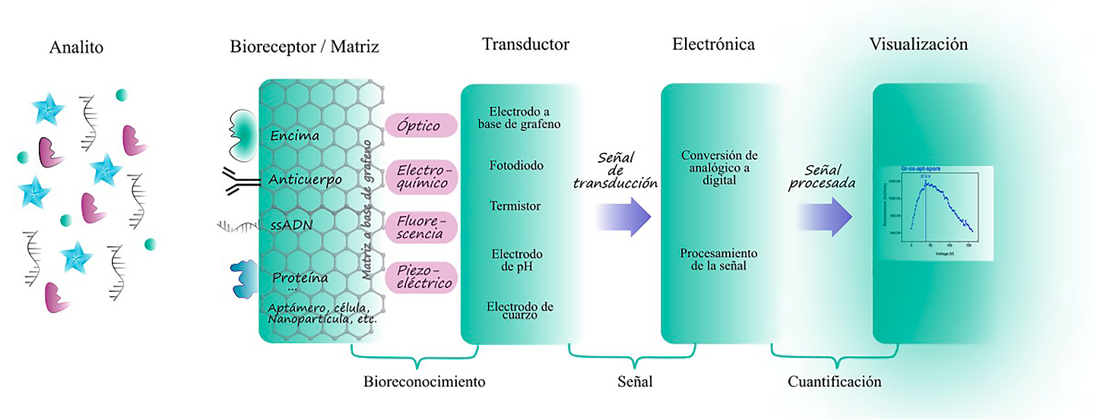
Figura 8. Ejemplo esquemático de un ensamble de biosensores, adaptación de referencia [244]. Un detector que reconoce los elementos biológicos (analito), un transductor para la conversión de la respuesta recibida en señal (eléctrica, por ejemplo), un amplificador que mejora la señal y un microprocesador para análisis electrónico.
El rendimiento de los biosensores depende de sus componentes, entre los cuales el material del substrato, matriz o biorreceptor, es decir, la capa ubicada entre la capa de reconocimiento de la biomolécula y el transductor, desempeña un papel crucial en la definición de la estabilidad, la sensibilidad y la vida útil de un biosensor [244]. La matriz o soporte sólido del biorreceptor, al igual que el biorreceptor, pueden alterar la resistencia de la biomolécula ante diferentes cambios fisicoquímicos, como pH, temperatura, composición química, entre otros [244]. Para aumentar la sensibilidad y reducir los límites de detección (LOD) incluso a nivel de moléculas individuales, se ha desarrollado una amplia gama de nanomateriales novedosos con más capacidad para inmovilizar más unidades de biorreceptores a volúmenes reducidos e incluso para actuar como un elemento de transducción. Entre dichos nanomateriales se encuentra el grafeno y sus derivados.
Todas las propiedades del grafeno que se han enumerado a lo largo del trabajo hacen de este un material atractivo en la sección de biosensores, sensores ultrasensibles y biosensores flexibles con lectura óptica [245] que pueden beneficiar el desempeño de los sensores prexistentes. La superficie del grafeno prístino usualmente interactúa con otras moléculas vía adsorción física [246] y su gran área superficial permite mejorar la carga de las biomoléculas deseadas, mientras que la excelente conductividad y la pequeña banda prohibida pueden ser beneficiosas para conducir electrones entre las biomoléculas y la superficie del electrodo [247]. Por otro lado, la capacidad de modular las propiedades fisicoquímicas del grafeno mediante funcionalizaciones específicas ha llevado a aplicaciones exitosas en sensores y superficies inteligentes [246, 248]. El grafeno funcionalizado, en particular, parece ser excepcionalmente prometedor para aplicaciones de sensores químicos y biológicos [249].
Biosensores electroquímicos a base de grafeno
Los biosensores electroquímicos son dispositivos analíticos fundamentados en un elemento de reconocimiento biológico incorporado o en contacto cercano con un transductor electroquímico [250]. Estos sensores exhiben una selectividad inherente y la especificidad del receptor biológico, combinados con la alta sensibilidad y el límite de detección bajo de los métodos de detección electroanalíticos. Se pueden miniaturizar y usar con instrumentos portátiles, producidos en masa a un costo relativamente bajo y proporcionar una respuesta analítica simple [249]. Los sensores electroquímicos utilizan mediciones de potenciometría, amperometría, voltamperometría, coulometría o capacitancia [251].
Los biosensores electroquímicos a base de grafeno exhiben altos niveles de selectividad y sensitividad hacia especies electroactivas, respuesta rápida y precisa, se pueden diseñar de forma portátil, tienen bajo costo en comparación con otros biosensores existentes [249] y, además, presentan relativa facilidad de calibración [242]. Se ha utilizado el “grafeno electroquímico” para la detección de gran variedad de biomoléculas como neurotransmisores, catecolamina (como DA, dopamina) [252-256], biosensores de drogas [257]–[259], NADH, de ADN, inmunosensores, hemoglobina, mioglobina, detección de glucosa, H2O2, proteínas, biomarcadores cancerígenos, detección de patógenos, entre otras funciones. Como se acaba de mencionar, este tipo de biosensores tiene una amplia gama de capacidades de detección. En este artículo, se discutirán sobresalientes investigaciones realizadas a lo largo del tiempo, desde los orígenes de los biosensores hasta las más recientes investigaciones de biosensores electroquímicos a base de grafeno, tales como métodos rápidos de detección (describiendo un poco su fabricación), biosensores impresos, serigrafiados, en enzimas, inmunosensores, biomarcadores y fármacos anticancerígenos, detección de la seguridad alimentaria y hasta biosensores portátiles y desechables. Esto, con el propósito de recalcar el gran aporte que traen los dispositivos a base de grafeno, y con el afán de que continúe el crecimiento y mejora del área de investigación.
Sensores a base de grafeno se han empleado para detectar glucosa oxidasa (GOD), una molécula de gran valor para la detección de diabetes. Entre los primeros dispositivos reportados, se encuentra el realizado por Leland Clark et al. [260], quienes inmovilizaron la enzima glucosa oxidasa (GOD) en una membrana semipermeable que se encontraba en la superficie de un electrodo de platino (Pt) [261, 262]. Yoon et al. [263] en 2020 utilizaron la técnica de grafeno poroso inducido por láser (LIG, por sus siglas en inglés, laser induced graphene), que permite inmovilizar proteínas (como enzimas, anticuerpos y receptores); en particular, el estudio se enfocó en esta misma enzima mencionada anteriormente, pero en un compuesto de quitosina-glucosa oxidasa (GOD). Este método simple de modificación de la superficie utiliza ácido acético para incrementar la razón de enlaces carbono-carbono, que resulta en aumento de la conductividad debido al decrecimiento de la resistencia de la capa, reduciendo el inconveniente de que los dispositivos LIG usualmente poseen insuficientes propiedades eléctricas inherentes causadas por la baja conductividad de la superficie. Una vez obtenida esta modificación, realizaron una electrodeposición de PtNPs en el LIG estable, sin agregaciones, con una distribución uniforme de las nanopartículas. Dichas superficies se utilizan para la inmovilización del complejo de quitosano-glucosa oxidasa (GOD) que funciona como un biosensor de glucosa en el sudor. En el estudio se probó la variación del nivel de glucosa en la sangre antes y después de las comidas usando la respuesta amperométrica del sensor. Este electrodo LIG/PtNPs exhibe un límite de detección ultra bajo, inferior a 300 nM y un rango lineal dinámico de hasta 2,1 mM.
En el 2013 Määttänen, Anni et al. [264] elaboraron el primer trabajo de biosensor de glucosa usando un electrodo impreso desechable de carbono, por medio de impresión por inyección de tinta. Esta tecnología en la actualidad juega un papel trascendental en los sensores de glucosa debido a sus propiedades, tales como ser desechables, de bajo costo, alta sensibilidad, estabilidad y selectividad, amigable con el ambiente y de tamaño portátil, además de poder dar el resultado del análisis en tiempo real [265].
Al-Sagur et al. [266] realizaron en el 2019 un biosensor amperométrico serigrafiado de nanoláminas de grafeno-hierro ftalocianinas. Este complejo de hierro fue incorporado en un hidrogel conductor (CH, por siglas en inglés, Conducting Hydrogel) para detectar glucosa. El dispositivo completo (GPL-FePc (PAA)-VS-PANI/GPL-FePc-CH) se compone de un hidrogel conductor tridimensional basado en ácido poliacrílico (PAA) tridimensional con polianilina sustituida con vinilo (VS-PANI) y nanoláminas de grafeno funcionalizadas de forma no covalente (GPL) con ftalocianina de hierro (FePc). En el dispositivo, el complejo FePc se usó como mediador para transferir electrones entre la enzima inmovilizada GOD y el electrodo, mediante la oxidación de la forma reducida de la enzima GOD (FADH2). El tamaño de los poros uniformes (19 µm) de esta estructura microporosa tridimensional contribuye a poder utilizar una alta carga enzimática, mayor inmobilización y bioelectrocatálisis para la glucosa. El estudio mostró una sensibilidad de 18,11 μA mM-1 cm-2 y amplio rango lineal de 1 a 20 mM de detección de glucosa.
El colesterol ha sido otra de las moléculas para las cuales se han utilizado sistemas a base de grafeno [267]. Un aspecto fundamental del desarrollo del biosensor de colesterol es la inmovilización de la colesterol oxidasa y la colesterol esterasa en la superficie del electrodo biosensible [268]. Para dicha inmovilización el grupo de Parlak [269] utilizó el sulfonato de dodecil benceno sódico (SDBS), un sulfantante iónico que genera películas autoensambladas en electrodos y altera las cargas electrostáticas del grafeno, para dar un biosensor electroquímico que puede detectar moléculas de colesterol en un rango de 0,05-0,35 mM, con límites de detección de hasta 0,05 µM.
Se han realizado biosensores electroquímicos más complejos pero altamente sensibles para la medición del colesterol; un ejemplo es el estudio realizado por Li, Zeng y Zhao [270], en el que se oxidó el colesterol para generar peróxido de hidrógeno (H2O2), que puede desintegrarse en H2O con la catálisis sinérgica de RGO CS-Fc/Pt NPs y producir la respuesta de corriente redox de H2O2 que podría cuantificarse mediante métodos amperométricos [270] (la concentración de colesterol se puede cuantificar también al monitorear el O2, pero esto presenta bastantes retos, por lo que preferiblemente se puede monitorear la concentración de H2O2 a través de su reacción redox [271, 272]). Ampliaremos con mayor detalle el motivo del ensamble escogido y estudiado por este grupo de investigación [270], el cual consiste en un electrodo de carbono impreso serigrafiado modificado (SPCE) con óxido de grafeno reducido-quitosano-ácido de ferroceno carboxilado y nanopartículas de platino (RGO-CS-Fc/Pt NPs).
En este estudio se utilizó la hereoestructura RGO-CS-Fc para modificar la superficie de un electrodo impreso de oro mediante interacciones de enlace π-π. Dicho ensamble se utilizó de manera que la quitosina se combina en la superficie o las paredes laterales de RGO, y así facilitar la dispersión RGO en muchos solventes. De esta forma se aprovecha, por un lado, el óxido de grafeno reducido (RGO) con sus propiedades de ser un excelente material para anclar otras nanopartículas y obtener una rápida cinética electroquímica durante electrocatálisis de la reacción, (además de alta conductividad y alta área superficial), y, por otro lado, el biopolímero quitosina (CS) que posee propiedades sobresalientes de formación de películas que proporciona un buen lugar para la catálisis enzimática, la reacción electroquímica y biocompatibilidad [273-275].
El ferroceno y sus derivados (Fc), por su parte, son una clase de mediadores de electrones con excelente electroactividad redox [276], convirtiéndolos en sobresalientes mediadores en asociación con diferentes nanomateriales [277]. Por lo tanto, el Fc se usa ampliamente en la construcción de biosensores altamente sensibles como etiqueta electroquímica activa para el ensayo de biomoléculas [278, 279]. Finalmente, las nanopartículas de platino se depositaron en la superficie del electrodo por deposición potenciométrica isostática; de manera que el CHOD y la CHER se inmovilizan en la superficie de todo el dispositivo de RGO-CS-Fc/Pt NPs/SPCE para luego construir el biosensor electroquímico. Este estudio generó resultados remarcables, entre los cuales se destacan, por ejemplo, la linealidad entre la corriente de respuesta redox medida y la concentración de colesterol en el rango de 0,5 a 4,0 mg∙mL-1 y un bajo límite de detección de 5,70 μg∙mL-1. Además, el biosensor de colesterol RGO-CS-Fc/Pt NPs mostró una excelente especificidad y reproducibilidad aceptable, evidenciando un gran potencial para el diagnóstico clínico.
Una de las biomoléculas más ampliamente investigadas es la dopamina, ya que su concentración puede estar directamente relacionada con una serie de condiciones clínicas [280]. El óxido de grafeno reducido (RGO) se ha utilizado como electrocatalizador para la detección de dopamina (DA). El desafío en la detección de DA es la respuesta de voltamperometría cíclica superpuesta con el ácido ascórbico (AA) y ácido úrico (UA) [280]. Wang et al. [281] afirmaron que la selectividad de grafeno-DA es mejor que la de nanotubos de carbono de paredes múltiples (MWCNT). Además, se mostró que usando RGO la dopamina se podría medir en el rango de 5 a 200 µM en un exceso de ácido ascórbico, siendo útil para poderse implementar grafeno en aplicaciones reales [280, 281]. Otros estudios han demostrado que se puede incrementar la sensibilidad de dopamina empleando electrodos serigrafiados comerciales recubiertos con grafeno ultrasónicamente exfoliado [247, 282] depositado por “drop-coating” y estabilizado por revestimientos de tensioactivos aniónicos o catiónicos, como dodecil sulfato de sodio, bromuro de hexadeciltrimetilamonio [24, 282] polietilenimina [283] y polivinilpirrolidona [284].
La superficie plana aromática del grafeno complementa la estructura aromática de la dopamina [285]. Por ejemplo, las nanohojuelas de grafeno sobre silicio contienen un alto nivel de defectos en los bordes que mejoran la cinética de transferencia de electrones con la dopamina, lo que permite su determinación en presencia de ascorbato [286]. Recientes estudios, como el realizado por Arumugasamy, Shiva Kumar, Saravanan Govindaraju y Kyusik Yun [287] en 2020, utilizan puntos cuánticos de grafeno (GQDs, 1-5 nm) y nanotubos de carbono de paredes múltiples (MWCNTs) funcionalizados con ácido en una superficie del electrodo de carbono vítreo (GCE), empleando metodologías electroquímicas para detectar dopamina y crear un biosensor radiométrico. Los sensores electroquímicos clásicos típicamente adoptan el valor absoluto de la señal como salida, los sensores electroquímicos radiométricos poseen señales electroquímicas duales y la medición cuantitativa del objetivo se basa en la relación de estas dos señales [288]. En el estudio se obtuvieron buenos resultados de reproducibilidad, sensibilidad y selectividad con rango lineal dinámico de 0,25 a250 μM, con límites de detección de 95 nM [287].
Huang, Qitong et al. [289] utilizan la heteroestructura GQDs-MWCNTs/GCE para detectar dopamina, con la particularidad de ser el primer ejemplo aplicado para medir DA secretada por células vivas PC12 con excelente rendimiento [289], generando un rango lineal de 0,005 a 100,0 μM con límite de detección de 0,87 nM.
Según la Organización Mundial de la Salud (OMS), habrán 24 millones de nuevos casos de cáncer y 14,5 millones de muertes relacionadas con el cáncer cada año para el año 2035 [290], motivo por el cual se busca un diagnóstico temprano para mejorar la tasa de supervivencia de pacientes con cáncer [291-293]. El grafeno también ha sido empleado en investigaciones relacionadas con el cáncer, como en el caso de fármacos anticancerígenos, o biomarcadores, en donde se vislumbra como un mediador para la detección.Se ha desarrollado una gran variedad de biosensores inmunoelectroquímicos basados en grafeno para la detección de proteínas relacionadas con el cáncer. Castillo, John et al. [294] desarrollaron un biosensor electroquímico a base de grafeno, donde el electrodo de grafeno fue modificado con un conjugado de nanotubos peptídicos (PNTs) y ácido fólico (FA), incrementando la transferencia de electrones para la detección selectiva de células de cáncer cervical humano (HeLa). La interacción del ácido fólico (FA) y los receptores de folato (FRs) resultan en el bloqueo de la transferencia de electrones por la membrana celular aislante y por tanto crea una disminución concomitante de la corriente. Es así como la adición de las células HeLa y unión de FRs muestran un decrecimiento en la corriente faradaica demostrado por voltametría cíclica (CV). En este estudio se obtuvo un límite de detección de 250 células de cáncer cervical humano por mL.
Otro tipo de biodetector electroquímico fue realizado por Pan et al., quienes realizaron el primer estudio [295] de un solo biosensor sin etiqueta (“label-free”) para detectar simultáneamente dos tipos de biomarcadores de cáncer: el factor de crecimiento endotelial vascular (VEGF) y el antígeno prostático específico (PSA), en muestras de sangre humano para el diagnóstico precoz de cáncer de próstata. Este se basó en óxido de grafeno GO/ssDNA/ incorporado con nanopartículas de poli(ácido L-láctico) (PLLA) [295]. El dispositivo consistía en GO funcionalizado con ssDNA en un electrodo de oro. La presencia de VEGF permitió la inmovilización de nanopartículas de poli(ácido L-láctico) (PLLA NPs) con anticuerpo-dual-modificado que amplifican la señal electroquímica y la detección de PSA. El poseer un biodetector que permite detección múltiple es una gran ventaja y abre un interés especial para su uso comercial con aplicación médica a futuro. Los límites de detección para VEGF y PSA fueron 50 pg∙mL-1 y 1 ng∙mL-1, respectivamente, y es una plataforma que podría ser prometedora para el diagnóstico médico.
Los sensores electroquímicos a base de grafeno aseguran una detección selectiva y precisa de biomoléculas, por ejemplo, la detección sensible de ADN y miRNA, que desempeñan papeles vitales en el almacenamiento y la transmisión de información genética [296]. Bajo este contexto, se desarrolló una detección ultrasensible de miRNA basado en nanopartículas de plata (AgNPs) intercaladas con polianilina y grafeno dopado tipo n [297], en este caso se logró una detección de alta sensibilidad con un amplio rango de detección dinámica de 10 fM a 10 µM y un límite de detección tan sensible como 0,2 fM. Sin embargo, el uso de grafeno en biosensores no se limita a las aplicaciones clínicas y de diagnóstico, existen dispositivos que se encargan de la detección de la seguridad alimentaria, donde se incluyen ensayos para alérgenos, toxinas, pesticidas y patógeno. En la tabla 4 también se pueden observar algunos de las aplicaciones en este sector.
Biosensores de transistores de efecto de campo a base de grafeno (GFET)
Otro de los tipos de biosensores basados en grafeno que se han desarrollado son los que utilizan el llamado “efecto de campo” (FET, por sus siglas en inglés) para estudiar interacciones biomoleculares que son claves en las respuestas biológicas de los sistemas vivos y las enfermedades que los aquejan [298]. Los biosensores FET están adaptados para la medición de biomoléculas que interactúan con la superficie del sensor. Al igual que con otras formas de detección, la superficie de un biosensor FET se modifica para reconocer selectivamente analitos específicos [298]. El grafeno, debido a su alta sensibilidad [299, 300] y su gran área superficial, presenta un cambio significativo en la conductividad cuando moléculas bioquímicas se absorben sobre su superficie [300]. Además, presenta ventajas únicas para ser utilizado en la construcción de biosensores 2D [301-303], por ejemplo: presentar una librería más amplia de funcionalizaciones con receptores de biomoléculas y bajo ruido, en comparación con los biosensores 1D FET [304, 305]. Actualmente, existen gFETS con sensibilidad attomolar [306].
Un ejemplo exitoso es el realizado por Kim et al. [307], en el cual se desarrollan biosensores, FET, basados en óxido de grafeno reducido (r-GO) para el análisis ultrasensible y sin etiqueta de un biomarcador de cáncer de próstata, PSA (por sus siglas en inglés, prostate specific antigen). La α1-anticimotripsina, o el complejo PSA-ACT, se pueden utilizar para detectar niveles femtomolares de PSA con un rango dinámico de más de seis órdenes de magnitud. Dicho biosensor FET se produjo depositando un canal de rGO sobre una superficie de vidrio aminado y funcionalizado con el anticuerpo PSA [308]. Cuando el PSA-ACT fue capturado por los anticuerpos en el sustrato FET, se logró un cambio lineal del voltaje de puerta (ΔVg, min), donde ocurre el mínimo de conductividad. Finalmente, realizaron con éxito la detección de PSA-ACT del nivel femtomolar.
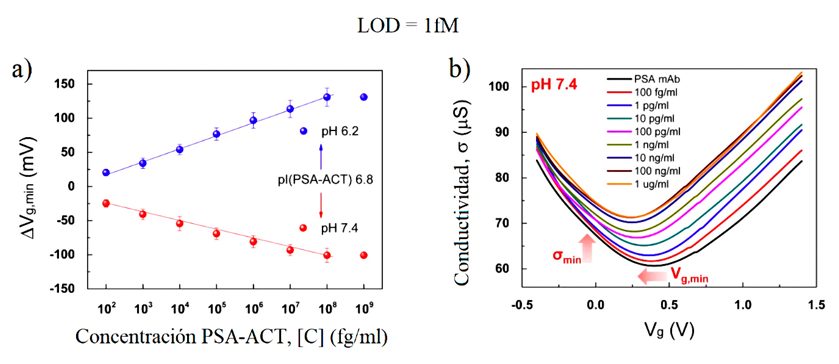
Figura 9. Transistor de efecto de campo en anticuerpo PSA en RGO/psa. Adapatación de la referencia [234].
Según el tipo de voltaje puerta aplicado, los GFET se pueden agrupar en dos clases principales: los de compuerta trasera y los de compuerta líquida o puerta desde arriba. En el caso de los GFET de compuerta líquida, los parámetros fundamentales son: el control de la funcionalización, el conocimiento del mecanismo de las reacciones de detección en la superficie y la caracterización del número de cargas que lleva cada biomolécula [300].
Picca et al. [309] han propuesto un enfoque novedoso en los biosensores FET, utilizando la funcionalización del electrolito de compuerta con una monocapa autoensamblada (SAM, por sus siglas en inglés), la cual fue oportunamente diseñada para contener el biorreceptor. Esta estrategia permite obtener límites de detección unimoleculares [310, 311]. En este trabajo específicamente, se incorporó un inmunosensor de inmunoglobulina G (IgG) autoensamblado covalentemente en el electrodo de compuerta de oro, mientras que el grafeno se usó como material del canal del transistor y en los electrodos fuente y drenaje. La presencia en la SAM de una red extendida de enlaces de hidrógeno puede actuar como amplificador de la interacción analito-receptor. Se genera un momento dipolar que determina una reorganización de la red de enlaces de hidrógeno, lo que permite detectar un número muy limitado de eventos de enlace [309].
Los dispositivos que utilizan compuertas líquidas presentan el problema de generar resistencias capacitivas debido a la separación de cargas en la frontera del electrodo. Una solución se encuentra en usar agua desionizada como electrolito, ya que el agua desionizada baja la fuerza iónica y evita los efectos de detección de Debye (efectos de carga en la frontera del electrodo) [309]. Con esta modificación, algunos sensores pueden detectar los analitos en concentraciones subfemtomolares, específicamente para el dispositivo mencionado en el párrafo anterior se encontró un LOD de aproximadamente 100 aM y se observó un amplio rango dinámico.
Los biosensores G-FET han logrado ser aplicados con éxito para la detección de bacterias y sus actividades metabólicas. Mohanty, Nihar y Vikas Berry [312] utilizaron un pequeño parche, de unos cuantos micrómetros de grafeno, capaz de detectar la unión de una sola bacteria (Bacillus cereus Gram-positiva) [313]. Pese a que este estudio conceptual demostró la impresionante capacidad del grafeno FET para la detección de bacterias, la detección se basó en la adhesión electrostática no específica de bacterias sin discriminación de especies bacterianas y la medición se realizó en atmósfera de nitrógeno [312, 313]. Huang et al. modificaron grafeno CVD con anticuerpos anti-Escherichia coli, lo que permitió detectar concentraciones de E. coli tan bajas como 10 cfu∙mL-1 [313].
En un estudio realizado por Chen et al. [314], se utilizó un nuevo derivado de grafeno, el óxido de grafeno reducido (hRGO), funcionalizado con Magainina I para producir una sonda bacteriana de amplio espectro y proporcionar interacción electrostática entre Magainina I positivamente cargada y lipopolisacáridos aniónicos de E. coli [315]. A diferencia de los nanomateriales de carbono relacionados, hRGO conserva propiedades electrónicas aún al ser funcionalizado covalentemente, al tiempo que proporciona un alto porcentaje de oxígeno disponible, necesario para una funcionalización covalente efectiva [314]. Este semiconductor tipo p (rGO) como elemento transductor en los dispositivos FET facilita la interacción entre los sensores y las bacterias gram-negativas.
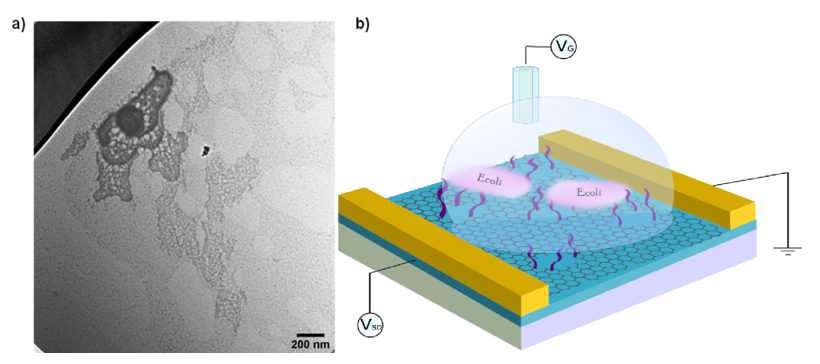
Figura 10. a) Imagen TEM del hRGO, b) Ilustración esquemática de un hRGO FET funcionalizado con AMP para la detección selectiva de células bacterianas gram-negativos y diseño representativo del biosensor a base de grafeno. Adaptado del artículo [314].
Los biosensores de glucosa a base de GFET son generalmente construidos al inmovilizar la glucosa oxidasa (GOD) en la superficie del grafeno, como el FET propuesto por Huang et al. [316], que unieron covalentemente el GOx por medio de aminas y el succinimidílico del ácido 1-pirenobutanóico; el extremo del pireno se une firmemente al grafeno a través de interacciones π-π [317]. Se logró la detección de la glucosa en concentraciones de hasta 0,1 mM al medir un cambio en la conductancia.
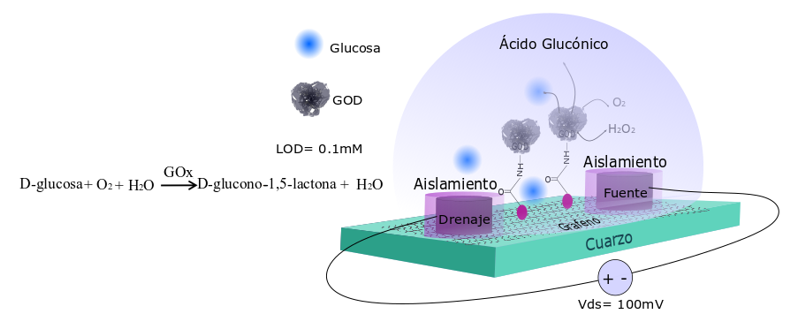
Figura 11. Diagrama esquemático del procedimiento de operación del sensor de glucosa. Se selecciona el grafeno como material de detección. Adaptado de referencia [238].
En el año 2020, el coronavirus SARS-CoV-2 del síndrome respiratorio agudo grave Covid-19 se ha convertido en un problema de salud mundial. Al 17 de noviembre de 2020, más de 5 5915 903 casos de Covid-19 fueron confirmados en todo el mundo, dando como resultado 1 342 683 de muertes [318]. Los materiales a base de grafeno han demostrado su valor en la contribución para combate con la pandemia. Los materiales basados en grafeno pueden contribuir en dispositivos de diagnóstico temprano y eficiente para la detección del SARS-CoV-2, así como para contener el brote.
Estudios recientes se han dedicado a la creación de estos sensores, entre los cuales está el biosensor reportado por Seo et al. [319], basado en FET para detectar una de las proteínas del SARS-CoV-2, cuyo anticuerpo se puede anclar a un electrodo de grafeno mediante el éster ácido 1-pirenobutírico N-hidroxisuccinimida (PBASE). En muestras clínicas se detectó con éxito el SARS-CoV-2 con un LOD en medio de cultivo y muestras clínicas de 1,6 × 101 pfu∙mL-1 y 2,42 × 10² copias∙mL-1.
El rendimiento del sensor se determinó utilizando proteínas antigénicas, virus cultivados y muestras de torunda nasofaríngea de pacientes con Covid-19 [319]. Se concluyó que el dispositivo es un método de diagnóstico inmunológico altamente sensible para Covid-19 que no requiere pretratamiento ni etiquetado de la muestra. Por lo tanto, proporciona una respuesta simple, rápida y altamente receptiva en la detección del virus SARS-CoV-2 en muestras clínicas. Esto demuestra la versatilidad y valía del grafeno.
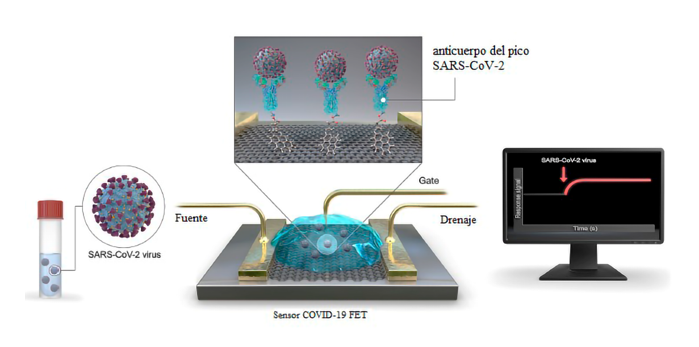
Figura 12. Diagrama esquemático del procedimiento de operación del sensor FET Covid-19. Se selecciona el grafeno como material de detección, y un anticuerpo del SARS-CoV-2 que se conjuga en la lámina de grafeno a través del ácido 1-pirenbutirico ester N-hidrosuccinimido (PBASE), que es una molécula de interfaz como conector de sonda. Adaptado de referencia [239].
Biosensores ópticos a base de grafeno
En secciones anteriores se describieron sensores basados en grafeno, en los que la respuesta del transductor era eléctrica o electroquímica. Estos dispositivos indudablemente presentan una amplia variedad de aplicaciones, sin embargo, presentar también algunos puntos débiles, que pueden ser complementados o solventadas por métodos ópticos. Los sensores de grafeno basados en transistores miden los cambios elécticos inmediatos en la superficie del grafeno, esto limita parámetros como la resolución espacial o temporal que sí pueden ser detectados por medios ópticos [320, 321]. Aunado a lo anterior, las mediciones eléctricas generalmente dañan las células vivas, lo que podría tener un impacto en los resultados de las pruebas y la custodia de los resultados.
El desarrollo de sensores ópticos basados en grafeno pueden resolver estos problemas, ya que presentan alta resolución espacial, un alto rango detección, de sensibilidad, de precisión y la detección es rápida. De esta manera, no solo se puede cuantificar los analitos, sino que también se podrá detectar cambios en la estructura superficial del grafeno y su interacción con las biomoléculas [322, 323].
Los biosensores ópticos son instrumentos de detección potentes y herramientas versátiles para fines analíticos, no solo por su baja relación señal/ruido y los bajos requisitos de volumen de reactivo, sino también por ser inmunes a las interferencias electromagnéticas y por ser capaces de detectar de manera remota. Además, pueden proporcionar detección múltiple dentro de un solo dispositivo [324, 325]. Las respuestas de los biosensores ópticos son cambios de absorbancia, fluorescencia, fosforescencia, quimioluminiscencia, reflectancia, dispersión de luz o índice de refracción, plasmón superficial en fluorescencia, fibra óptica, FRET, entre otros [325-327].
El sensor de resonancia de plasmones de superficie (SPR) es uno de los sensores ópticos más utilizados [322] por propiedades tales como ser altamente sensible (no necesita marcaje), ser capaz de responder en tiempo real y su destacada detección de analitos relacionados con el diagnóstico médico (marcadores de cáncer, marcadores de alergia, marcadores de ataque cardíaco, anticuerpos, medicamentos y hormonas) [324].
La respuesta SPR del grafeno se beneficia de las notables propiedades de este material, tales como la capacidad de aprovechar la conductividad de la superficie mediante dopaje o campo externo [328-330], poseer transparencia a la luz blanca, alta movilidad electrónica, la banda sintonizable y la baja pérdida óhmica que facilita la formación de plasmones de propagación de largo alcance [329].
Wu et al. presentaron un biosensor SPR recubriendo un película de oro con grafeno [322]. En comparación con los dispositivos biosensores SPR tradicionales, el uso de grafeno como elemento de reconocimiento biomolecular (BRE) mejoró no solo la eficiencia de adsorción de las biomoléculas, sino que también detecta el cambio en el índice de refracción cerca de la superficie del sensor, mediante el uso de un método de reflexión total atenuada (ATR) [331].
Xu et al. [332] desarrollaron un novedoso biosensor basado en rejillas de periodo largo (RPL) en fibra óptica (Long Period Fiber Grating, LPFG, por sus siglas en inglés). Funcionalizando dichas rejillas con óxido de grafeno-glucosa oxidasa (GOD) mediante entrecruzamiento químico. Estos dispositivos combinan la catálisis enzimática con la biocompatibilidad de GO.
La superficie de RPL puede inmovilizar a la GOD por los abundantes puntos de anclaje, oxígenos del GO. En la superficie modificada se crea ácido glucónico y H2O2 debido a la reacción entre GOD y la glucosa, que a su vez efectúa un cambio del espectro de transmisión de RPL debido al cambio del índice de refracción circundante (SRI, por sus siglas en inglés, de Surrounding Refractive Index). Este sensor RPL modificado por GOD-GO genera una respuesta lineal con coeficiente de 0,77 nm (mg∙mL-1) (figura 13).
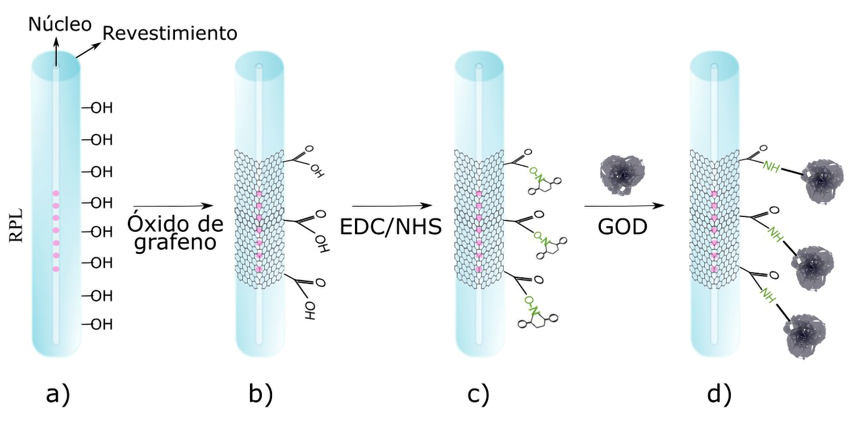
Figura 13. Ilustración esquemática del biosensor de fibra óptica basada en GO- recubriendo la superficie de RPL (a), con tratamiento de: hidroxilación (b), deposición de GO (c) y tratamiento con EDC/NHS (d) GOD-inmovilizado en RPL. Tomado de la referencia [332].
En comparación con los métodos electroquímicos, los biosensores in situ sin etiquetas basadas en fibra óptica han atraído gran atención debido a su alta sensibilidad, detección en tiempo real y efectiva resistencia electromagnética, proporcionando un nuevo método para detectar bioparámetros [332-335].
La hibridación de ADN se puede detectar utilizando técnicas ópticas como fluorescencia, quimioluminiscencia, resonancia de plasmones superficiales o interferometría [245]. Existen métodos que utilizan técnica de fluorescencia, donde el grafeno en estos casos ayuda a desactivar la señal fluorescente y atrae el uso de ensayos tipo “turn on/off” [268]. La desactivación de fluorescencia es el método de detección más común y menos complicado para sensores de ADN que emplean grafeno [336-341].
Una sola cadena de ácidos nucleícos tiene una afinidad natural con el sistema aromático de grafeno mediante el apilamiento π de sus nucleobases, en donde consecuentemente el ADNss (ADN de cadena sencilla) marcado con fluorescencia se adsorbe en la superficie del grafeno y la interacción de este con la molécula de colorante los acerca, permitiendo que ocurra una transferencia de energía, apagando efectivamente la fluorescencia del fluoróforo. Tras la hibridación del ADNss con su cadena complementaria, el ADN se desorbe del grafeno y se restaura la fluorescencia del sistema [245]. De esta manera, se pueden construir los biosensores “encendido” / “apagado”.
El óxido de grafeno también se utiliza para adsorber eficazmente el ADN y, al mismo tiempo, puede extinguir completamente los fluoróforos adsorbidos. Wu et al. [342] realizaron un estudio para mejorar la comprensión de las interacciones entre el ADN y el grafeno. En su estudio se empleó ADN de cadena sencilla de distintas extensiones (12, 18, 24 y 36 oliglonucleótidos), demostrando que la adsorción de ADN se puede ver afectada por varios factores, como el hecho de que los ADN de menor extensión se adsorben más rápido y se unen más fuertemente a la superficie del grafeno [342]. La adsorción se ve favorecida por un pH más bajo y una mayor fuerza iónica, además de permitir una desorción cercana al 100% del ADN absorbido en el grafeno [342].
Aunque los métodos de detección de fluorescencia han demostrado ser altamente sensibles, estos sensores a menudo sufren de bajo rendimiento debido a la eficiencia del etiquetado limitada, problemas de contaminación y los pasos complejos de purificación [245].
Mei, Qingsong y Zhongping Zhang [343] utilizaron el GO para diferentes grupos de analitos, pero en lugar de emplear el GO como desactivador o extintor y un fluoróforo adicional acoplado a un elemento de reconocimiento, usaron el propio GO como fluoróforo. El GO se hizo reaccionar con 1-butanamina para formar nanoláminas que emiten en el azul, y esta emisión puede eliminarse en presencia de nanopartículas de plata (AgNP) funcionalizadas con ligandos, anticuerpos y oligonucleótidos.
Tras la adición de analitos, los AgNP se disocian de las nanocapas y, por lo tanto, la fluorescencia se restablece de inmediato. Simplemente cambiando los elementos de reconocimiento en las nanopartículas de Ag, lograron la detección de glutatión, ADN y como proteína modelo: la inmunoglobulina G (IgG), en el rango de pM [245]. Sin embargo, como aspecto complementario, se debe considerar la longitud de onda de baja excitación de 350 nm, que podría causar algunos problemas en muestras biológicas reales en términos de señales de fondo altas.
El grafeno, GO y rGO son aceptados como desactivadores universales, y se han utilizado como superficies receptoras en muchas aplicaciones basadas en transferencia de energía [344]. FRET es el proceso no radiactivo más común basado en la transferencia de energía electromagnética entre el donador excitado y un receptor [345]. Este método puede convertir las interacciones biomoleculares de campo cercano en señales de campo lejano. Con la aparición de la nanotecnología, diversas nanopartículas han mejorado este método de detección [315].
Cheng et al. [346] realizaron un estudio para la detección de ATP, como una pequeña molécula biológica, con aptámeros (secuencia base: 5′-NH2-(CH2)6-ACCTGGGGGAGTATTGCGGAGGAAGGT-3′) y GO. La superficie de GO se utilizó como molécula aceptora. El aptámero selectivo de ATP, a través de sus grupos nitrogenados orgánicos, se pliega y crea una estructura de cadena globular en presencia del analito. Como resultado de eso, los grupos laterales pueden contribuir al enlace de hidrógeno, y las interacciones π en el aptámero se bloquean y liberan a los aptámeros de la superficie GO [347].
Los puntos cuánticos de grafeno (GQD), que son hojuelas de grafeno de menos de 20 nm [348], sirven como donantes en los estudios FRET debido a su buena solubilidad, facilidad de síntesis [349] y capacidades de modificación [350]. Además, los GQD muestran efectos de confinamiento cuántico como resultado de su tamaño pequeño y sintonizable, lo que permite adaptar su espectro de energía de excitación, entre 300 y 470 nm [351].
El uso de GQD como moléculas donantes en sistemas FRET permite la excitación del sistema más allá del rango de excitación del aceptor, lo que resulta en señales de luminiscencia mejoradas [347, 352]. Los GQDs presentan facilidad de funcionalización de su superficie, lo que permite integrarlos con sistemas biológicos [353] para el desarrollo de biosensores bacterianos [315].
Morales‐Narváez, Eden, Abdel‐Rahim Hassan y Arben Merkoçi [354] crearon un sensor de fase sólida para la detección de patógenos. Como aceptor de transferencia de energía para biosensores se utilizaron sondas GO y puntos cuánticos de anticuerpos (Ab-QD) para la detección de E. coli. En el trabajó se utilizaron CdSe@ZnS QDs funcionalizados con estreptavidina (núcleo-caparazón) como sonda de fotoluminiscencia. Dichos sistemas se combinaron con GO, como desactivador de fotoluminiscencia de largo alcance (ya que el GO exhibe una amplia emisión de fotoluminiscencia desde el infrarrojo cercano hasta longitudes de onda del ultravioleta [355]), y consecuentemente como agente revelador de patógenos [315].
En la investigación, la fotoluminiscencia de los microarreglos Ab-QDs fue desactivada por GO, como el aceptador FRET que se activó después de la interacción de E. coli. El sistema de detección de patógenos con GO, propuesto por este grupo de investigadores, es altamente sensible, exhibiendo un LOD de aproximadamente 5 cfu∙mL-1 para E. coli en PBS y en agua de grifo.
Debido a que nanosondas basadas en FRET presentan una limitación significativa por la baja relación señal/ruido, los investigadores Liao, Yuhui, Xiaoming Zhou y Da Xing [356] integraron QDs con GO para superar los falsos negativos y reducir la probabilidad de falsos descartes en las pruebas de rutina.
La detección de múltiples bacterias al mismo tiempo tiene una ventaja significativa en el diagnóstico médico y campos relacionados. Duan et al. [357] realizaron un estudio que admite detección simultánea de los patógenos Vibrio parahaemolyticus y Salmonella typhimurium. Este utiliza el mismo principio de transferencia de energía de resonancia de fluorescencia dual de puntos cuánticos emisores verdes (gQD) y puntos cuánticos emisores rojos (rQD) como donantes, y en nuevas nanopartículas de carbono amorfo (CNP) que actúan como aceptor.
De manera general, existen numerosas investigaciones realizadas con base en grafeno en esta área con gran diversidad de analitos, en la tabla 4 se muestras algunas de estas. Se puede observar que aún para una sola categoría de analito se tiene una pluralidad de funcionalizaciones de grafeno para la detección. El grafeno y los nanomateriales basados en grafeno son excelentes materiales para electrodos y presentan ciertas ventajas sobre los electrodos clásicos, sin embargo, todavía existen temas abiertos que requieren de oportunidades de mejora para la investigación científica.
| Analito | Sensor | Método | Composición | Límite de detección (µM) | Rango linear (µM) | Referencia, año |
| Glucosa | GOx/RGO/ β-ciclodextrina | Electroquímico | GOx inmovilizado en óxido de grafeno reducido (RGO) y compuesto β-ciclodextrina (CD) . | 12,0 | 50-3,0x10³ | [358], 2015 |
| RGO-C-PPy/ NTH | Óxido de grafeno reducido (rGO)- polipirrol carboxilado (C-PPy) nanotubos (NT) híbridos | 0,001 | - | [359], 2015 | ||
| NPs/RGO/CS/PS | Electrodo plano nanoporoso mediante “drop casting” de un nanocompuesto que consiste en rGO y quitosano sobre un sustrato de poliéster. | 5,0 | 10-750 | [360], 2016 | ||
| Gr-PE-AuNPs H | Híbrido de nanopartículas de grafeno-polietilenimina-oro | 0,32 | 1-100 | [361], 2016 | ||
| GODx/ZnS-CdS/ MWCNT/GCE | Glucosa oxidasa (GODx) usando punto cuántico ZnS / CdS (QD) modificado nanotubo de carbono de pared múltiple / electrodo de carbono vítreo | 3,0 | 10-1,0x10³ | [362], 2017 | ||
| PVP-protegido G-GOD-PFIL modificado GC | Grafeno protegido con polivinilpirrolidona / líquido iónico funcionalizado con polietilenimina / biosensor electroquímico GOD | 6000 | 14000 | [363], 2009 | ||
| LIG/PtNPs | Electrodo LIG usando tratamiento con ácido acético, el compuesto de hitosan-glucosa oxidasa (GOx) se inmovilizó con éxito en el electrodo | 0,3 | 2100 | [263], 2020 | ||
| G/PVP/PANI-modificado | Nanocompuesto de grafeno (G), polivinilpirrolidona (PVP) y polianilina (PANI) | 1,0 | 50-10000 | [364], 2014 | ||
| Pt/rGO/P3ABA | Platino / óxido de grafeno reducido / poli (ácido 3-aminobenzoico) (Pt / rGO / P3ABA) película de nanocompuesto en un electrodo de carbón serigrafiado (SPCE) | 40,5 | 250-4000 | [365], 2019 | ||
| Colesterol | (ChEt/Chox)-FC/Gr | Electroquímico | Electrodo de grafito modificado con grafeno y colesterol esterasa / colesterol oxidasa | 5,0 | 50-300 | [366], 2012 |
| AgNWs/ZnO/ITO/ GO/CS | Nanocables de plata y óxido de zinc modificados en un electrodo de óxido de indio y estaño con GO y quitosano | 0,287 | 6,5-10 x 103 | [367], 2016 | ||
| RGO/SiO2 | RGO/SiO2: sistema híbrido reducido de partículas de óxido de grafeno-sílice | 1,3 x 10³ | 2,6 x 10³-15,5 x 10³ | [368], 2015 | ||
| ChOx /GCE/CS/GR | Hojas de grafeno (G) nanocables de titanio incrustados con grafeno interconectado | 0,715 | 5-1,0 x 10³ | [369], 2015 | ||
| Dopamina | GQDs-MWCNTs | Electroquímico | Sensor electroquímico ultrasensible basado en compuestos de puntos cuánticos de grafeno / nanotubos de carbono de paredes múltiples (GQDs-MWCNTs) para detectar dopamina | 0,87 nM | 0,005-100,0 | [289], 2020 |
| TC-GQD | El nanocompuesto de punto cuántico de titania-ceria-grafeno (TC-GQD) se sintetizó por método hidrotérmico | 0,22 | 1-500 | [370], 2020 | ||
| ITO/N Gr film | Electrodos de óxido de indio y estaño (ITO), modificados con películas de N-grafeno | 0,005 | 2-240 | [371], 2018 | ||
| PEDOT/LS-Gr | Grafeno modificado con láser modificado con poli (3,4-etilen dioxitiofeno) (PEDOT) | 0,33 | 1-150 | [372], 2018 | ||
| NADH | Gr-PQQ/CTS | Electroquímico | Grafeno-pirroloquinolina quinona quitosano | 0,16 | 0,32 - 220 | [373], 2017 |
| poly(o-anisidine)/ Gr | poli (oanisidina) / grafeno | 1,3 | 0,166-1,72 | [374], 2015 | ||
| Gr-DNA-AuNps/Au Disk | Disco de oro modificado con nanopartículas de grafeno-ADN tetraedro-oro | 0,000001 x 10³ | 0,000001X10³-0,09X10³ | [375], 2015 | ||
| SPCE/RGO/PNR/AuNP | Electrodo serigrafiado modificado con óxido de grafeno reducido / rojo polineutral / nanopartícula de oro | 0,384 | 5-3170 | [376], 2020 | ||
| DNA/graphene/MB) | GCE modificada con ácido desoxirribonucleico, azul de grafeno metileno | 1,0 | 10-1500 | [377], 2013 | ||
| Au nanopartícula/ rGO nanocompuesto | Nanopartículas de oro / nanocompuestos de óxido de grafeno reducido GCE modificado | 0,00113 | 0,05-500 | [378], 2015 | ||
| ERGO–PTH/GC | Óxido de grafeno electroreducido y GCE modificado con polittionina | 0,1 | 10-3900 | [379], 2013 | ||
| Ácido ascóbico | GCE with GO-Ag-Fe3O4 | Electroquímico | Óxido de grafeno bien exfoliado acoplado con Ag o Ag-Fe3O4 | 0,074 | 0,2-60 | [380], 2020 |
| 3,4-EDOT/rGr | Electrodo de carbono vítreo modificado (3,4 etilendioxitiofeno) / óxido de grafeno reducido / dióxido de manganeso | 1,00 | 1-800 | [381], 2018 | ||
| rGO-SnO2 composite | Óxido de grafeno reducido (rGO) - compuesto de óxido de estaño (SnO2) | 38,7 | 400-1600 | [382], 2018 | ||
| GrS/Gr NR | Lámina de grafeno / nanofibra de grafeno | 0,23 | 10-360 | [383], 2015 | ||
| Epirubicina | PP/NrG/ds-DNA/PGE | Electroquímico | Electrodo de grafito de lápiz con polipirrol, grafeno reducido dopado con nitrógeno (para mejorar la conductividad eléctrica) y el esperma de salmón ds-DNA | 0,001 | 0,004-55,0 | [384], 2019 |
| Pesticida (Paraoxon) | GO | Electroquímico | Grafeno funcionalizado GO | 0,00065 | 10-1000 | [385], 2014 |
| Pesticida (Fenoxycarb) | QDs Gr | Óptico | Puntos cuánticos de grafeno, por fluorescencia | 3,15 | 6-70 | [386], 2017 |
| Micotoxina (Ochratoxin A) | GO | Óptico | Óxido de grafeno, funcionalizado por fluorescencia | 0,0187 | 2-35 | [387], 2011 |
| Alergenos (Maní) | Gra, Au NPs | Electroquímica | Grafeno, con nanopartículas de oro. | 4,1 x 10⁻¹¹ | 1x10⁻¹⁰-1x10⁻⁷ | [388], 2015 |
| Alergenos (camarón) | GO | Óptico | Óxido de grafeno, fluorescencia | 0,0042 | - | [389], 2017 |
| Patógenos (Norovirus) | Gr, AuNPs | Electroquímico | Grafeno junto con nanopartículas de oro | 0,0001 | - | [390], 2017 |
| Patógeno (S.aureus) | QDs Gr, Au NPs tipo FRET (Fluorescencia de transferencia de energía por resonancia) | Óptico | Puntos cuánticos de grafeno con nanopartículas de oro | 0,001 | - | [352], 2015 |
| ADN Virus SARS | GO-FAM d | Fluorescencia “Encendido/apagado” basado en Óxido de grafeno con aditivo de tinte FAMd | 0,1 | - | [391], 2010 | |
| Iones de metales pesadosHg2+ | (ssDNA-GO, tinte FAM (WSGO) y sonda de oligonucleótido específico de mercurio (II) marcado con colorante (MSO) | Fluorescencia “encendido/apagado” de GO con receptor de aptamero | 0,000187 | Hasta 0,623 | [392], 2011 | |
| ssDNA-GO, tinte GO | Fluorescencia “encendido/apagado” de GO con receptor de aptámero | 0,00092 | 0,001- 0,05 | [393], 2013 | ||
| (ssDNA–GO, tinte fuoresceína | Fluorescencia “encendido/apagado” de GO con receptor de aptámero | 0,0057 | Hasta 10 | [340],2011 | ||
| Aminoácido Cys | GO-ssADN, AgNP | Fluorescencia, óxido de grafeno con receptor de ADN de cadena sencilla, con aditivos de nanopartículas de plata | 0,002 | Hasta 0,001 | [394], 2011 | |
| Aminoácido Cys | GO-ssADN, AgNP | Fluorescencia, óxido de grafeno con receptor de ADN de cadena sencilla, con aditivos de nanopartículas de plata | 0,002 | Hasta 0,001 | [394], 2011 | |
| Aminoácido Cys | GO-ssADN, AgNP | Óptico | Fluorescencia, óxido de grafeno con receptor de ADN de cadena sencilla, con aditivos de nanopartículas de plata | 0,002 | Hasta 0,001 | [394], 2011 |
| Inmunoglobulina IgE | Gr-ssADN | Transistor de efecto de campo, FET | Transistor de efecto de campo con grafeno exfoliado, con receptor de aptámero | - | 0,00026- 0,16 | [395], 2011; [396], 2010 |
| PSA | rGO-APTMS, PDMS | Transistor de efecto de campo con óxido de grafeno reducido, con sensor aditivo de APTMS y PDMS | 100 pg∙mL-1 | Hasta 10 ng∙mL-1 | [307], 2013 | |
| ADN | CVD-Grafeno- AuNPs | Grafeno CVD con aditivos de sensor de Nanopartículas de oro | 1x10⁻⁵ | 0,01-0,5 | [397], 2010 | |
| rGO – AuNPs | Óxido de grafeno reducido con aditivos de sensor de Nanopartículas de oro | 0,2 | Solo se midió una concentración | [398], 2010 | ||
| H2O2 | Gr-PPy | Compuestos de nanotubos de grafeno-polipirrol (PPy) | 1x10⁻⁴ | - | [399], 2014 | |
| CTCs | GQD CACTACAGAGGTTGCGTCTGTCCCACGTTGTCATGGGGGGTTGGCCTG aptamero, con GQDs –MoS2 | Óptico | FRET GQD donador y MoS2 aceptor basado en señal encendido | 0,00119 | - | [400], 2019 |
| Trombina | Aptámero TACGGTTGGTGTGGTTGG, Ag@SiO2 NPs- GO | Señal “encendido/apagado” de receptor óxido de grafeno y donador aptamero etiquetado de Nanopartículas de plata con SiO2 | 5x10⁻⁵ | - | [401], 2016 | |
| Kanamicina | Aptamero GCGCGCCACGGGCGCGCGCGCGGCGGCTACCCCACCGCGCGCG FAM etiquetado-rGO | Señal encendido/ apagado de óxido de grefeno reducido como aceptor y FAM como donador | 1x10⁻⁶ | - | [402], 2017 |
Tabla 4. Biosensores basados en grafeno para distintos analitos.
Conclusiones
El grafeno presenta un gran potencial en el tratamiento de aguas, en su uso como almacenador de carga, biosensor o foto detector. No obstante, se necesitan establecer procedimientos que permitan su síntesis a nivel industrial con un número de defectos mucho menores a los que tienen lugar en la actualidad. Además, se requiere un mejor control de las modificaciones, sobre todo la que se usa para oxidar el grafeno, ya que el grado de oxidación, los defectos y los grupos funcionales obtenidos siguen siendo variables, lo que se traduce en poca reproducibilidad de los dispositivos.
A pesar de todos estos inconvenientes, el grafeno es uno de los materiales con mayor potencial para sustituir los electrodos en las baterías de litio y poslitio, así como los electrodos en las diferentes tecnologías de fotogeneración de corriente y como electrodo en los diferentes biosensores.
En el área del tratamiento y desalinización del agua, otro tipo de funcionalizaciones que permitan mayor selectividad deben ser estudiadas, sin embargo, el potencial de este material utilizado como soporte ya se muestra en las diferentes tecnologías enunciadas en este artículo de revisión.
Los biosensores que utilizan grafeno muestran mucho potencial para le detección de un alto número de enfermedades, además de que pueden ser utilizados en una gran variedad de tecnologías (florescencias, electroquímicas, efecto de campo, entre otras); esto significa que se podría diseñar una tecnología para cada una de las enfermedades que han sido estudiadas y mencionadas en esta revisión. Los autores de este trabajo consideramos que, a pesar de los problemas de reproducibilidad que presentan la mayoría de estos sistemas, muy pronto se encontrarán biosensores que utilicen grafeno en el mercado.
Sin importar a cuál de las aplicaciones hagamos referencia, en general el grafeno sigue presentando problemas de reproducibilidad en los diferentes dispositivos. Dicha problemática es uno de los temas de estudio más pujantes por parte de la industria y la academia, a pesar de que actualmente la producción de grafeno CVD es multimillonaria.
Referencias
[1. X. Huang, Z. Yin, S. Wu et al., “Graphene-Based Materials: Synthesis, Characterization, Properties, and Applications”, Small, vol. 7, no. 14, pp. 1876-1902, 2011. DOI: 10.1002/smll.201002009.
[2] E. V Iski, E. N. Yitamben, L. Gao, and N. P. Guisinger, “Graphene at the Atomic-Scale: Synthesis, Characterization, and Modification”, Adv. Funct. Mater., vol. 23, n.. 20, pp. 2554-2564, 2013. DOI: 10.1002/adfm.201203421
[3] Y. Cao, V. Fatemi, S. Fang et al., “Unconventional superconductivity in magic-angle graphene superlattices”, Nature, vol. 556, p. 43, Mar. 2018. [Online]. Available: https://doi.org/10.1038/nature26160.
[4] A. L. Nguyen, W. Liu, K. A. Khor, A. Nanetti & S. A. Cheong, “The golden eras of graphene science and technology: Bibliographic evidences from journal and patent publications”, J. Informetr., vol. 14, n.. 4, p. 101067, 2020. DOI: https://doi.org/10.1016/j.joi.2020.101067
[5] G. F. Brown & J. Wu, “Third generation photovoltaics”, Laser Photon. Rev., vol. 3, n.. 4, pp. 394-405, 2009. DOI: 10.1002/lpor.200810039
[6] V. Georgakilas, , M. Otyepka, A. Bourlinos et al.,“Functionalization of Graphene: Covalent and Non-Covalent Approaches, Derivatives and Applications”, Chem. Rev., vol. 112, n.. 11, pp. 6156-6214, 2012. DOI: 10.1021/cr3000412
[7] S. Huh, J. Park, K. S. Kim, B. H. Hong & S. Bin Kim, “Selective n-Type Doping of Graphene by Photo-patterned Gold Nanoparticles”, ACS Nano, vol. 5, n.. 5, pp. 3639-3644, 2011. DOI: 10.1021/nn1035203.
[8] A. Reina , X. Jia, J. Ho et al., “Large Area, Few-Layer Graphene Films on Arbitrary Substrates by Chemical Vapor Deposition”, Nano Lett., vol. 9, n.. 1, pp. 30-35, 2009. DOI: 10.1021/nl801827v
[9] W. Kong , H. Kum, S. Bae et al., “Path towards graphene commercialization from lab to market”, Nat. Nanotechnol., vol. 14, n.. 10, pp. 927-938, 2019. DOI: 10.1038/s41565-019-0555-2
[10] K. I. Bolotin, K.J. Sikes Z.Jiang et al., “Ultrahigh electron mobility in suspended graphene”, Solid State Commun., vol. 146, n.. 9-10, pp. 351-355, 2008. DOI: https://doi.org/10.1016/j.ssc.2008.02.024
[11] Y. Zhu, S. Murali, W. Cai et al., “Graphene and Graphene Oxide: Synthesis, Properties, and Applications”, Adv. Mater., vol. 22, n.. 35, pp. 3906-3924, 2010. DOI: 10.1002/adma.201001068
[12] P. Blake, E. W. Hill, A. H. Castro-Neto et al., “Making graphene visible”, Appl. Phys. Lett., vol. 91, n.. 6, 2007. DOI: https://doi.org/10.1063/1.2768624.
[13] C. Casiraghi, A. Hartschuh, E. Lidorikis, et al., “Rayleigh Imaging of Graphene and Graphene Layers”, Nano Lett., vol. 7, n.. 9, pp. 2711-2717, Sep. 2007. DOI: 10.1021/nl071168m.
[14] C. H. Lui, K. F. Mak, J. Shan & T. F. Heinz, “Ultrafast Photoluminescence from Graphene”, Phys. Rev. Lett., vol. 105, n.. 12, p. 127404, Sep. 2010. [Online]. Available: http://link.aps.org/doi/10.1103/PhysRevLett.105.127404
[15] R. Bistritzer & A. H. MacDonald, “Electronic Cooling in Graphene”, Phys. Rev. Lett., vol. 102, n.. 20, p. 206410, May 2009. [Online]. Available: http://link.aps.org/doi/10.1103/PhysRevLett.102.206410.
[16] J. C. W. Song, M. S. Rudner, C. M. Marcus & L. S. Levitov, “Hot Carrier Transport and Photocurrent Response in Graphene”, Nano Lett., vol. 11, n.. 11, pp. 4688-4692, Nov. 2011. DOI: 10.1021/nl202318u.
[17] K. J. Tielrooij , J. C. W. Song, S. A. Jensen et al., “Photoexcitation cascade and multiple hot-carrier generation in graphene”, Nat Phys, vol. 9, n.. 4, pp. 248-252, Apr. 2013. [Online]. Available: https://doi.org/10.1038/nphys2564.
[18] K. Wolfgang, Ultrashort Laser Pulses and Applications, Springer Berlin Heidelberg, 2013.
[19] K. S. Novoselov , A. K. Geim, S. V. Morozov et al., “Electric Field Effect in Atomically Thin Carbon Films”, Science, vol. 306, n.. 5696, pp. 666-669, 2004. DOI: 10.1126/science.1102896
[20] F. Xia, D. B. Farmer, Y. Lin &P. Avouris, “Graphene Field-Effect Transistors with High On/Off Current Ratio and Large Transport Band Gap at Room Temperature”, Nano Lett., vol. 10, n.. 2, pp. 715-718, Feb. 2010. DOI: 10.1021/nl9039636
[21] International, T. Roadmap, For and Semiconductors, “2012 Update Overview”, 2012. http://www.itrs.net/links/2012itrs/home2012.htm.
[22] E. Y. Andrei, G. Li & X. Du, “Electronic properties of graphene: a perspective from scanning tunneling microscopy and magnetotransport”, Reports Prog. Phys., vol. 75, n.. 5, p. 56501, 2012, [Online]. Available: http://stacks.iop.org/0034-4885/75/i=5/a=056501.
[23] D. Chen, H. Feng & J. Li, “Graphene Oxide: Preparation, Functionalization, and Electrochemical Applications”, Chem. Rev., vol. 112, n.. 11, pp. 6027-6053, 2012. DOI: 10.1021/cr300115g
[24] S. M. Notley, “Highly Concentrated Aqueous Suspensions of Graphene through Ultrasonic Exfoliation with Continuous Surfactant Addition”, Langmuir, vol. 28, n.. 40, pp. 14110-14113, 2012. DOI: 10.1021/la302750e
[25] H. Y. Nan, Z. H. Ni, J. Wang, Z. Zafar, Z. X. Shi & Y. Y. Wang, “The thermal stability of graphene in air investigated by Raman spectroscopy”, J. Raman Spectrosc., vol. 44, n.. 7, pp. 1018-1021, 2013. DOI: 10.1002/jrs.4312.
[26] Y. Ohno, K. Maehashi, Y. Yamashiro & K. Matsumoto, “Electrolyte-Gated Graphene Field-Effect Transistors for Detecting pH and Protein Adsorption”, Nano Lett., vol. 9, n.. 9, pp. 3318-3322, 2009, doi: 10.1021/nl901596m
[27] X. J. Lee, B.Y.Z Hiew, K.C. Lai et al., “Review on graphene and its derivatives: Synthesis methods and potential industrial implementation”, J. Taiwan Inst. Chem. Eng., vol. 98, pp. 163-180, 2019. DOI: https://doi.org/10.1016/j.jtice.2018.10.028
[28] S. Park & R. S. Ruoff, “Chemical methods for the production of graphenes”, Nat. Nanotechnol., vol. 4, n.. 4, pp. 217-224, 2009. DOI: 10.1038/nnano.2009.58
[29] G. Calderón, M. Cortez-Valadez, P. G. Mani-Gonzalez et al., “Green synthesis of reduced graphene oxide using ball milling”, Carbon Lett., vol. 21, p. 93, Jan. 2017. DOI: 10.5714/CL.2017.21.093.
[30] N. Mishra, J. Boeckl, N. Motta & F. Iacopi, “Graphene growth on silicon carbide: A review”, Phys. status solidi, vol. 213, n.. 9, pp. 2277-2289, Sep. 2016. DOI: 10.1002/pssa.201600091.
[31] W. Kong, H. Kum, S.H. Bae et al., “Path towards graphene commercialization from lab to market”, Nat. Nanotechnol., vol. 14, n.. 10, pp. 927-938, 2019. DOI: 10.1038/s41565-019-0555-2
[32] C. Backes, A. Abdelkader. C. Alonso et al.,“Production and processing of graphene and related materials”, 2D Mater., vol. 7, n.. 2, p. 22001, 2020. DOI: 10.1088/2053-1583/ab1e0a
[33] Y. Hernandez, , V. Nicolosi, M. Lotya et al.,“High-yield production of graphene by liquid-phase exfoliation of graphite”, Nat. Nanotechnol., vol. 3, n.. 9, pp. 563-568, 2008. DOI: 10.1038/nnano.2008.215
[34] R. R. Nair, P. Blake, A. N. Grigorenko et al.,“Fine Structure Constant Defines Visual Transparency of Graphene”, Sci., vol. 320, n.. 5881, p. 1308, Jun. 2008. [Online]. Available: http://www.sciencemag.org/content/320/5881/1308.abstract.
[35] X. Li, W. Cai, J. An et al., “Large-Area Synthesis of High-Quality and Uniform Graphene Films on Copper Foils”, Science, vol. 324, n.. 5932, pp. 1312-1314, Jun. 2009. [Online]. Available: http://science.sciencemag.org/content/324/5932/1312.abstract.
[36] A. T N’Diaye J. Coraux, M. Engler et al., “Growth of graphene on Ir(111)”, New J. Phys., vol. 11, n.. 2, p. 023006, Feb. 2009. DOI: 10.1088/1367-2630/11/2/023006
[37] J. Azpeitia, G. Otero-Irurueta, I. Palacio et al.,“High-quality PVD graphene growth by fullerene decomposition on Cu foils”, Carbon N. Y., vol. 119, pp. 535-543, 2017. DOI: https://doi.org/10.1016/j.carbon.2017.04.067
[38] C. N. R. Rao & A. K. Sood, Graphene: Synthesis, Properties, and Phenomena, Weinheim: Wiley, 2013.
[39] D. L. Mafra, T. Ming & J. Kong, “Facile graphene transfer directly to target substrates with a reusable metal catalyst”, Nanoscale, vol. 7, n.. 36, pp. 14807-14812, 2015. DOI: 10.1039/C5NR03892H.
[40] A. H. Castro Neto, F. Guinea, N. M. R. Peres, K. S. Novoselov & A. K. Geim, “The electronic properties of graphene”, Rev. Mod. Phys., vol. 81, n.. 1, pp. 109-162, Jan. 2009. [Online]. Available: http://link.aps.org/doi/10.1103/RevModPhys.81.109.
[41] S. Dutta & S. K. Pati, “Novel properties of graphene nanoribbons: a review”, J. Mater. Chem., vol. 20, n.. 38, pp. 8207-8223, 2010, doi: 10.1039/C0JM00261E.
[42] J. H. Warner, F. Schaffel, M. Rummeli & A. Bachmatiuk, Graphene: Fundamentals and emergent applications. Elsevier Science, 2012.
[43] S. K. Pati, T. Enoki & C. N. R. Rao, Graphene and Its Fascinating Attributes. World Scientific, 2011.
[44] K. Wakabayashi, “Electronic transport properties of nanographite ribbon junctions”, Phys. Rev. B, vol. 64, n.. 12, p. 125428, Sep. 2001. [Online]. Available: http://link.aps.org/doi/10.1103/PhysRevB.64.125428.
[45] A. K. Geim & K. S. Novoselov, “The rise of graphene”, Nat Mater, vol. 6, n.. 3, pp. 183-191, Mar. 2007. [Online]. Available: https://doi.org/10.1038/nmat1849.
[46] P. R. Wallace, “The Band Theory of Graphite”, Phys. Rev., vol. 71, n.. 9, pp. 622-634, May 1947. [Online]. Available: http://link.aps.org/doi/10.1103/PhysRev.71.622.
[47] F. Bonaccorso, Z. Sun, T. Hasan & A. C. Ferrari, “Graphene photonics and optoelectronics”, Nat Phot., vol. 4, n.. 9, pp. 611-622, Sep. 2010. [Online]. Available: https://doi.org/10.1038/nphoton.2010.186.
[48] X. Du, I. Skachko, A. Barker & E. Y. Andrei, “Approaching ballistic transport in suspended graphene”, Nat Nano, vol. 3, n.. 8, pp. 491-495, Aug. 2008. [Online]. Available: https://doi.org/10.1038/nnano.2008.199.
[49] R. Urcuyo, D. L. Duong, H. Y. Jeong, M. Burghard & K. Kern, “High Performance Graphene–Oxide-Metal Diode through Bias-Induced Barrier Height Modulation”, Adv. Electron. Mater., p. online version, Jul. 2016. DOI: 10.1002/aelm.201600223
[50] H. Choi, F. Borondics, D. A. Siegel et al., “Broadband electromagnetic response and ultrafast dynamics of few-layer epitaxial graphene”, Appl. Phys. Lett., vol. 94, n.. 17, 2009. DOI: https://doi.org/10.1063/1.3122348
[51] W. Xu, H. M. Dong, L. L. Li, J. Q. Yao, P. Vasilopoulos & F. M. Peeters, “Optoelectronic properties of graphene in the presence of optical phonon scattering”, Phys. Rev. B, vol. 82, n.. 12, p. 125304, Sep. 2010. [Online]. Available: http://link.aps.org/doi/10.1103/PhysRevB.82.125304.
[52] A. B. Kuzmenko, E. van Heumen, F. Carbone & D. van der Marel, “Universal Optical Conductance of Graphite”, Phys. Rev. Lett., vol. 100, n.. 11, p. 117401, Mar. 2008. [Online]. Available: http://link.aps.org/doi/10.1103/PhysRevLett.100.117401.
[53] B. H. N. & V. H. Nguyen, “Advances in graphene-based optoelectronics, plasmonics and photonics”, Adv. Nat. Sci. Nanosci. Nanotechnol, vol. 7, n.. 1, p. 13002, 2016. [Online]. Available: http://stacks.iop.org/2043-6262/7/i=1/a=013002.
[54] T. Kampfrath, L. Perfetti, F. Schapper, C. Frischkorn & M. Wolf, “Strongly Coupled Optical Phonons in the Ultrafast Dynamics of the Electronic Energy and Current Relaxation in Graphite”, Phys. Rev. Lett., vol. 95, n.. 18, p. 187403, Oct. 2005. [Online]. Available: http://link.aps.org/doi/10.1103/PhysRevLett.95.187403.
[55] M. Lazzeri, S. Piscanec, F. Mauri, A. C. Ferrari & J. Robertson, “Electron Transport and Hot Phonons in Carbon Nanotubes”, Phys. Rev. Lett., vol. 95, n.. 23, p. 236802, Nov. 2005. [Online]. Available: http://link.aps.org/doi/10.1103/PhysRevLett.95.236802.
[56] S. Cotrone, M. Ambrico, H. Toss et al., “Phospholipid film in electrolyte-gated organic field-effect transistors”, Org. Electron., vol. 13, n.. 4, pp. 638-644, 2012. DOI: https://doi.org/10.1016/j.orgel.2012.01.002
[57] H. Terrones, R. Lv, M. Terrones & M. S. Dresselhaus, “The role of defects and doping in 2D graphene sheets and 1D nanoribbons”, Reports Prog. Phys., vol. 75, n.. 6, p. 62501, 2012. [Online]. Available: http://stacks.iop.org/0034-4885/75/i=6/a=062501.
[58] D. C. Elias, R. R. Nair, T. M. G. Mohiuddin et al., “Control of Graphene’s Properties by Reversible Hydrogenation: Evidence for Graphane”, Science, vol. 323, n.. 5914, pp. 610-613, 2009. DOI: 10.1126/science.1167130
[59] M. Jaiswal, C. H. Yi Xuan Lim, Q. Bao, C. T. Toh, K. P. Loh & B. Özyilmaz, “Controlled Hydrogenation of Graphene Sheets and Nanoribbons”, ACS Nano, vol. 5, n.. 2, pp. 888-896, 2011, DOI: 10.1021/nn102034y
[60] R. R. Nair, W. Ren, R. Jalil et al., “Fluorographene: A Two-Dimensional Counterpart of Teflon”, Small, vol. 6, n.. 24, pp. 2877-2884, 2010. DOI: 10.1002/smll.201001555
[61] E. Unger, M. Liebau, G.S. Duesberg et al., “Fluorination of carbon nanotubes with xenon difluoride”, Chem. Phys. Lett., vol. 399, n.. 1-3, pp. 280-283, 2004. DOI: https://doi.org/10.1016/j.cplett.2004.10.021
[62] K.-J. Jeon, Z. Lee, E. Pollak et al., “Fluorographene: A Wide Bandgap Semiconductor with Ultraviolet Luminescence”, ACS Nano, vol. 5, n.. 2, pp. 1042-1046, 2011. DOI: 10.1021/nn1025274
[63] X. Li , G. Zhang, X. Bai et al., “Highly conducting graphene sheets and Langmuir-Blodgett films”, Nat Nano, vol. 3, n.. 9, pp. 538-542, Sep. 2008. [Online]. Available: https://doi.org/10.1038/nnano.2008.210.
[64] F. Kim, L. J. Cote & J. Huang, “Graphene Oxide: Surface Activity and Two-Dimensional Assembly”, Adv. Mater., vol. 22, n.. 17, pp. 1954-1958, 2010. DOI: 10.1002/adma.200903932
[65] G. Eda & M. Chhowalla, “Chemically Derived Graphene Oxide: Towards Large-Area Thin-Film Electronics and Optoelectronics”, Adv. Mater., vol. 22, n.. 22, pp. 2392-2415, 2010. DOI: 10.1002/adma.200903689.
[66] M. Quintana, E. Vazquez & M. Prato, “Organic Functionalization of Graphene in Dispersions”, Acc. Chem. Res., vol. 46, n.. 1, pp. 138-148, 2013. DOI: 10.1021/ar300138e
[67] K. P. Loh, Q. Bao, G. Eda & M. Chhowalla, “Graphene oxide as a chemically tunable platform for optical applications”, Nat Chem, vol. 2, n.. 12, pp. 1015-1024, Dec. 2010. [Online]. Available: https://doi.org/10.1038/nchem.907.
[68] I. Ali, A.A. Basheer, X.Y.Mbianda et al., “Graphene based adsorbents for remediation of noxious pollutants from wastewater”, Environ. Int., vol. 127, pp. 160-180, 2019. DOI: https://doi.org/10.1016/j.envint.2019.03.029.
[69] L. G. P. Jayakaran, G. S. Nirmala, “Qualitative and Quantitative Analysis of Graphene-Based Adsorbents in Wastewater Treatment”, Int. J. Chem. Eng., vol. 17, p. 9872502, 2019.
[70] A. Boretti, S. Al-Zubaidy, M. Vaclavikova, M. Al-Abri, S. Castelletto & S. Mikhalovsky, “Outlook for graphene-based desalination membranes”, npj Clean Water, vol. 1, n.. 1, p. 5, 2018. DOI: 10.1038/s41545-018-0004-z.
[71] M. D. Stoller, S. Park, Y. Zhu, J. An & R. S. Ruoff, “Graphene-Based Ultracapacitors”, Nano Lett., vol. 8, n.. 10, pp. 3498-3502, Oct. 2008. DOI: 10.1021/nl802558y.
[72] L. Kong, A. Enders, T. S. Rahman & P. A. Dowben, “Molecular adsorption on graphene”, J. Phys. Condens. Matter, vol. 26, n.. 44, p. 443001, Nov. 2014. DOI: 10.1088/0953-8984/26/44/443001.
[73] A. Akbari, P. Sheath, S.T. Martin et al., “Large-area graphene-based nanofiltration membranes by shear alignment of discotic nematic liquid crystals of graphene oxide”, Nat. Commun., vol. 7, n.. 1, p. 10891, 2016. DOI: 10.1038/ncomms10891
[74] B. Xue , M. Qin, J. Wu et al., “Electroresponsive Supramolecular Graphene Oxide Hydrogels for Active Bacteria Adsorption and Removal”, ACS Appl. Mater. Interfaces, vol. 8, n.. 24, pp. 15120-15127, Jun. 2016. DOI: 10.1021/acsami.6b04338
[75] C. Wang, C. Feng, Y. Gao, X. Ma, Q. Wu & Z. Wang, “Preparation of a graphene-based magnetic nanocomposite for the removal of an organic dye from aqueous solution”, Chem. Eng. J., vol. 173, n.. 1, pp. 92-97, 2011. DOI: https://doi.org/10.1016/j.cej.2011.07.041
[76] H. Sun, S. Liu, G. Zhou, H. M. Ang, M. O. Tadé & S. Wang, “Reduced Graphene Oxide for Catalytic Oxidation of Aqueous Organic Pollutants”, ACS Appl. Mater. Interfaces, vol. 4, n.. 10, pp. 5466-5471, Oct. 2012. DOI: 10.1021/am301372d
[77] K. Lü, G. Zhao & X. Wang, “A brief review of graphene-based material synthesis and its application in environmental pollution management”, Chinese Sci. Bull., vol. 57, n.. 11, pp. 1223-1234, 2012. DOI: 10.1007/s11434-012-4986-5
[78] K. C. Kemp, H.Seema, M. Saleh et al. “Environmental applications using graphene composites: water remediation and gas adsorption”, Nanoscale, vol. 5, n.. 8, pp. 3149-3171, Nov. 2013. DOI: 10.1039/c3nr33708a
[79] J.-H. Deng, X.-R. Zhang, G.-M. Zeng, J.-L. Gong, Q.-Y. Niu & J. Liang, “Simultaneous removal of Cd(II) and ionic dyes from aqueous solution using magnetic graphene oxide nanocomposite as an adsorbent”, Chem. Eng. J., vol. 226, pp. 189-200, 2013. DOI: https://doi.org/10.1016/j.cej.2013.04.045
[80] T. Liu, ; Y. Li, Q. Du et al., “Adsorption of methylene blue from aqueous solution by graphene”, Colloids Surfaces B Biointerfaces, vol. 90, pp. 197-203, 2012. DOI: https://doi.org/10.1016/j.colsurfb.2011.10.019.
[81] Y. Li, X. Xia & Y. Shen, “A high-gain-based global finite-time nonlinear observer”, in 2011 9th IEEE International Conference on Control and Automation (ICCA), 2011, pp. 483-488. DOI: 10.1109/ICCA.2011.6137934
[82] T. Wu, X. Cai, S. Tan, H. Li, J. Liu & W. Yang, “Adsorption characteristics of acrylonitrile, p-toluenesulfonic acid, 1-naphthalenesulfonic acid and methyl blue on graphene in aqueous solutions”, Chem. Eng. J., vol. 173, n.. 1, pp. 144-149, 2011. DOI: https://doi.org/10.1016/j.cej.2011.07.050
[83] J. Zhao, W. Ren & H.-M. Cheng, “Graphene sponge for efficient and repeatable adsorption and desorption of water contaminations”, J. Mater. Chem., vol. 22, n.. 38, pp. 20197-20202, 2012. DOI: 10.1039/C2JM34128J
[84] S. Chowdhury & R. Balasubramanian, “Recent advances in the use of graphene-family nanoadsorbents for removal of toxic pollutants from wastewater”, Adv. Colloid Interface Sci., vol. 204, pp. 35-56, 2014. DOI: https://doi.org/10.1016/j.cis.2013.12.005
[85] G. K. Ramesha, A. Vijaya Kumara, H. B. Muralidhara & S. Sampath, “Graphene and graphene oxide as effective adsorbents toward anionic and cationic dyes”, J. Colloid Interface Sci., vol. 361, n.. 1, pp. 270-277, 2011. DOI: https://doi.org/10.1016/j.jcis.2011.05.050.
[86] L. Sun, H. Yu & B. Fugetsu, “Graphene oxide adsorption enhanced by in situ reduction with sodium hydrosulfite to remove acridine orange from aqueous solution”, J. Hazard. Mater., vol. 203-204, pp. 101-110, 2012. DOI: https://doi.org/10.1016/j.jhazmat.2011.11.097
[87] Y. Li, Q. Du, T. Liu et al., “Comparative study of methylene blue dye adsorption onto activated carbon, graphene oxide, and carbon nanotubes”, Chem. Eng. Res. Des., vol. 91, n.. 2, pp. 361-368, 2013. DOI: https://doi.org/10.1016/j.cherd.2012.07.007.
[88] Q. Wu, C. Feng, C. Wang & Z. Wang, “A facile one-pot solvothermal method to produce superparamagnetic graphene–Fe3O4 nanocomposite and its application in the removal of dye from aqueous solution”, Colloids Surfaces B Biointerfaces, vol. 101, pp. 210-214, 2013. DOI: https://doi.org/10.1016/j.colsurfb.2012.05.036
[89] S. Wang, J. Wei, S. Lv, Z. Guo & F. Jiang, “Removal of Organic Dyes in Environmental Water onto Magnetic-Sulfonic Graphene Nanocomposite”, CLEAN – Soil, Air, Water, vol. 41, n.. 10, pp. 992-1001, Oct. 2013. DOI: 10.1002/clen.201200460.
[90] A. A. Farghali, M. Bahgat, W. M. A. El Rouby & M. H. Khedr, “Preparation, decoration and characterization of graphene sheets for methyl green adsorption”, J. Alloys Compd., vol. 555, pp. 193-200, 2013. DOI: https://doi.org/10.1016/j.jallcom.2012.11.190
[91] S. Sen Gupta, T. S. Sreeprasad, S. M. Maliyekkal, S. K. Das & T. Pradeep, “Graphene from sugar and its application in water purification”, ACS Appl. Mater. Interfaces, vol. 4, n.. 8, pp. 4156-4163, Aug. 2012. DOI: 10.1021/am300889u.
[92] Y. Chen, L. Chen, H. Bai & L. Li, “Graphene oxide–chitosan composite hydrogels as broad-spectrum adsorbents for water purification”, J. Mater. Chem. A, vol. 1, n.. 6, pp. 1992-2001, 2013. DOI: 10.1039/C2TA00406B
[93] H. Sun, L. Cao & L. Lu, “Magnetite/reduced graphene oxide nanocomposites: One step solvothermal synthesis and use as a novel platform for removal of dye pollutants”, Nano Res., vol. 4, n.. 6, pp. 550-562, 2011. DOI: 10.1007/s12274-011-0111-3
[94] J. Xu, L. Wang & Y. Zhu, “Decontamination of Bisphenol A from Aqueous Solution by Graphene Adsorption”, Langmuir, vol. 28, n.. 22, pp. 8418-8425, Jun. 2012. DOI: 10.1021/la301476p
[95] O. G. Apul, Q. Wang, Y. Zhou & T. Karanfil, “Adsorption of aromatic organic contaminants by graphene nanosheets: Comparison with carbon nanotubes and activated carbon”, Water Res., vol. 47, n.. 4, pp. 1648-1654, 2013. DOI: https://doi.org/10.1016/j.watres.2012.12.031
[96] G. Zhao, J. Li & X. Wang, “Kinetic and thermodynamic study of 1-naphthol adsorption from aqueous solution to sulfonated graphene nanosheets”, Chem. Eng. J., vol. 173, n.. 1, pp. 185-190, 2011. DOI: https://doi.org/10.1016/j.cej.2011.07.072
[97] S. Pavagadhi, A. L. L. Tang, M. Sathishkumar, K. P. Loh & R. Balasubramanian, “Removal of microcystin-LR and microcystin-RR by graphene oxide: Adsorption and kinetic experiments”, Water Res., vol. 47, n.. 13, pp. 4621-4629, 2013. DOI: https://doi.org/10.1016/j.watres.2013.04.033.
[98] G. Zhao, L. Jiang, Y. He et al., “Sulfonated Graphene for Persistent Aromatic Pollutant Management”, Adv. Mater., vol. 23, n.. 34, pp. 3959-3963, Sep. 2011. DOI: 10.1002/adma.201101007
[99] Y.-P. Chang, C.-L. Ren, J.-C. Qu & X.-G. Chen, “Preparation and characterization of Fe3O4/graphene nanocomposite and investigation of its adsorption performance for aniline and p-chloroaniline”, Appl. Surf. Sci., vol. 261, pp. 504-509, 2012. DOI: https://doi.org/10.1016/j.apsusc.2012.08.045.
[100] X. Yang, J. Li, T. Wen, X. Ren, Y. Huang & X. Wang, “Adsorption of naphthalene and its derivatives on magnetic graphene composites and the mechanism investigation”, Colloids Surfaces A Physicochem. Eng. Asp., vol. 422, pp. 118-125, 2013. DOI: https://doi.org/10.1016/j.colsurfa.2012.11.063
[101] Y. Tang, H. Guo, L. Xiao, S. Yu, N. Gao & Y. Wang, “Synthesis of reduced graphene oxide/magnetite composites and investigation of their adsorption performance of fluoroquinolone antibiotics”, Colloids Surfaces A Physicochem. Eng. Asp., vol. 424, pp. 74-80, 2013. DOI: https://doi.org/10.1016/j.colsurfa.2013.02.030
[102] A. Mishra and R. Sundara, “Functionalized graphene sheets for arsenic removal and desalination of sea water”, Desalination, vol. 282, pp. 39-45, Nov. 2011. DOI: 10.1016/j.desal.2011.01.038
[103] G. Zhao, J. Li, X. Ren, C. Chen & X. Wang, “Few-Layered Graphene Oxide Nanosheets as Superior Sorbents for Heavy Metal Ion Pollution Management”, Environ. Sci. Technol., vol. 45, n.. 24, pp. 10454-10462, Dec. 2011. DOI: 10.1021/es203439v
[104] H. Jabeen, V. Chandra, S. Jung, J. W. Lee, K. S. Kim & S. Bin Kim, “Enhanced Cr(vi) removal using iron nanoparticle decorated graphene”, Nanoscale, vol. 3, n.. 9, pp. 3583-3585, 2011. DOI: 10.1039/C1NR10549C
[105] N. Zhang, H. Qiu, Y. Si, W. Wang & J. Gao, “Fabrication of highly porous biodegradable monoliths strengthened by graphene oxide and their adsorption of metal ions”, Carbon N. Y., vol. 49, n.. 3, pp. 827-837, 2011. DOI: https://doi.org/10.1016/j.carbon.2010.10.024
[106] W. Gao, M. Majumder, L. Alemany et al., “Engineered Graphite Oxide Materials for Application in Water Purification”, ACS Appl. Mater. Interfaces, vol. 3, n.. 6, pp. 1821-1826, Jun. 2011. DOI: 10.1021/am200300u
[107] C. J. Madadrang, H. Yun Kim, G. Gao et al., “Adsorption Behavior of EDTA-Graphene Oxide for Pb (II) Removal”, ACS Appl. Mater. Interfaces, vol. 4, n.. 3, pp. 1186-1193, Mar. 2012. DOI: 10.1021/am201645g
[108] Y.-C. Lee & J.-W. Yang, “Self-assembled flower-like TiO2 on exfoliated graphite oxide for heavy metal removal”, J. Ind. Eng. Chem., vol. 18, n.. 3, pp. 1178-1185, 2012. DOI: https://doi.org/10.1016/j.jiec.2012.01.005
[109] Y. Leng, W. Guo, S. Su, C. Yi & L. Xing, “Removal of antimony(III) from aqueous solution by graphene as an adsorbent”, Chem. Eng. J., vol. 211–212, pp. 406-411, 2012. DOI: https://doi.org/10.1016/j.cej.2012.09.078
[110] Y. Yuan, G. Zhang, Y. Li, G. Zhang, F. Zhang & X. Fan, “Poly(amidoamine) modified graphene oxide as an efficient adsorbent for heavy metal ions”, Polym. Chem., vol. 4, n.. 6, pp. 2164-2167, 2013. DOI: 10.1039/C3PY21128B.
[111] Z. Li, F. Chen, L. Yuan et al., “Uranium(VI) adsorption on graphene oxide nanosheets from aqueous solutions”, Chem. Eng. J., vol. 210, pp. 539-546, 2012. DOI: https://doi.org/10.1016/j.cej.2012.09.030
[112] Y. Ren, N. Yan, Q. Wen et al., “Graphene/δ-MnO2 composite as adsorbent for the removal of nickel ions from wastewater”, Chem. Eng. J., vol. 175, pp. 1-7, 2011. DOI: https://doi.org/10.1016/j.cej.2010.08.010
[113] Z. Sui, Q. Meng, X. Zhang, R. Ma & B. Cao, “Green synthesis of carbon nanotube–graphene hybrid aerogels and their use as versatile agents for water purification”, J. Mater. Chem., vol. 22, n.. 18, pp. 8767-8771, 2012. DOI: 10.1039/C2JM00055E
[114] K. Zhang, V. Dwivedi, C. Chi & J. Wu, “Graphene oxide/ferric hydroxide composites for efficient arsenate removal from drinking water”, J. Hazard. Mater., vol. 182, n.. 1, pp. 162-168, 2010. DOI: https://doi.org/10.1016/j.jhazmat.2010.06.010
[115] V. Chandra, J. Park, Y. Chun, J. W. Lee, I.-C. Hwang & K. S. Kim, “Water-Dispersible Magnetite-Reduced Graphene Oxide Composites for Arsenic Removal”, ACS Nano, vol. 4, n.. 7, pp. 3979-3986, Jul. 2010. DOI: 10.1021/nn1008897
[116] J. H. Warner, F. Schaffel, M. H. Rummeli & A. Bachmatiuk, Graphene: Fundamentals and Emergent Applications. Oxford: Elsevier Science & Technology Books, 2013.
[117] V. C. Tung, L. Chen, M. Allen et al., “Low-Temperature Solution Processing of Graphene−Carbon Nanotube Hybrid Materials for High-Performance Transparent Conductors”, Nano Lett., vol. 9, n.. 5, pp. 1949-1955, May 2009. DOI: 10.1021/nl9001525
[118] K. S. Kim, Y. Zhao, H. Jang et al., “Large-scale pattern growth of graphene films for stretchable transparent electrodes”, Nature, vol. 457, n.. 7230, pp. 706-710, Feb. 2009. [Online]. Available: https://doi.org/10.1038/nature07719
[119] S. Bae, H. Kim, Y. Lee et al., “Roll-to-roll production of 30-inch graphene films for transparent electrodes”, Nat Nano, vol. 5, n.. 8, pp. 574-578, Aug. 2010. [Online]. Available: https://doi.org/10.1038/nnano.2010.132
[120] X. Wang, L. Zhi, N. Tsao, Ž. Tomović, J. Li & K. Müllen, “Transparent Carbon Films as Electrodes in Organic Solar Cells”, Angew. Chemie Int. Ed., vol. 47, n.. 16, pp. 2990-2992, Apr. 2008. DOI: 10.1002/anie.200704909.
[121] P. Blake, P. Brimicombe, R. Nair et al., “Graphene-Based Liquid Crystal Device”, Nano Lett., vol. 8, n.. 6, pp. 1704-1708, Jun. 2008. DOI: 10.1021/nl080649i
[122] F. H. L. Koppens, T. Mueller, P. Avouris, A. C. Ferrari, M. S. Vitiello & M. Polini, “Photodetectors based on graphene, other two-dimensional materials and hybrid systems”, Nat Nano, vol. 9, n.. 10, pp. 780-793, Oct. 2014. Available: https://doi.org/10.1038/nnano.2014.215.
[123] J. M. Dawlaty, S. Shivaraman, J. Strait et al., “Measurement of the optical absorption spectra of epitaxial graphene from terahertz to visible”, Appl. Phys. Lett., vol. 93, n.. 13, 2008. DOI: https://doi.org/10.1063/1.2990753
[124] F. Xia, T. Mueller, Y. Lin, A. Valdes-Garcia & P. Avouris, “Ultrafast graphene photodetector”, Nat Nano, vol. 4, n.. 12, pp. 839-843, Dec. 2009. [Online]. Available: https://doi.org/10.1038/nnano.2009.292
[125] T. Mueller, F. Xia & P. Avouris, “Graphene photodetectors for high-speed optical communications”, Nat Phot., vol. 4, n.. 5, pp. 297-301, May 2010. [Online]. Available: https://doi.org/10.1038/nphoton.2010.40
[126] C.-H. Liu, Y.-C. Chang, T. B. Norris & Z. Zhong, “Graphene photodetectors with ultra-broadband and high responsivity at room temperature”, Nat Nano, vol. 9, n.. 4, pp. 273-278, Apr. 2014, [Online]. Available: https://doi.org/10.1038/nnano.2014.31.
[127] G. Konstantatos, M. Badioli, L. Gaudreau et al., “Hybrid graphene-quantum dot phototransistors with ultrahigh gain”, Nat Nano, vol. 7, n.. 6, pp. 363-368, Jun. 2012. [Online]. Available: https://doi.org/10.1038/nnano.2012.60
[128] M. Amirmazlaghani, F. Raissi, O. Habibpour, J. Vukusic & J. Stake, “Graphene-Si Schottky IR Detector”, IEEE Journal of Quantum Electronics, vol. 49, n.. 7. pp. 589-594, 2013. DOI: 10.1109/JQE.2013.2261472
[129] R. Urcuyo, D. L. Duong, P. Sailer, M. Burghard & K. Kern, “Hot Carrier Extraction from Multilayer Graphene”, Nano Lett., vol. 16, n.. 11, pp. 6761-6766, Nov. 2016. DOI: 10.1021/acs.nanolett.6b02354
[130] E. Singh & H. S. Nalwa, “Graphene-Based Bulk-Heterojunction Solar Cells: A Review”, J. Nanosci. Nanotechnol., vol. 15, pp. 6237-6278, Jul. 2015. DOI: 10.1166/jnn.2015.11654
[131] A. Iwan & A. Chuchmała, “Perspectives of applied graphene: Polymer solar cells”, Prog. Polym. Sci., vol. 37, n.. 12, pp. 1805-1828, 2012. DOI: https://doi.org/10.1016/j.progpolymsci.2012.08.001
[132] E. Singh & H. S. Nalwa, “Graphene-Based Dye-Sensitized Solar Cells: A Review”, Sci. Adv. Mater., vol. 9, pp. 1863-1912, Jul. 2015. DOI: 10.1166/sam.2015.2438
[133] A. Agresti, S. Pescetelli, B. Taheri et al., “Graphene–Perovskite Solar Cells Exceed 18 % Efficiency: A Stability Study”, ChemSusChem, vol. 9, n.. 18, pp. 2609-2619, Sep. 2016. DOI: 10.1002/cssc.201600942.
[134] T. Takamoto, H. Washio & H. Juso, “Application of InGaP/GaAs/InGaAs triple junction solar cells to space use and concentrator photovoltaic”, in 2014 IEEE 40th Photovoltaic Specialist Conference (PVSC), 2014, pp. 1-5. DOI: 10.1109/PVSC.2014.6924936
[135] F. Dimroth, “New world record for solar cell efficiency at 46%”, Fraunhofer Institute for Solar Energy Systems ISE, 2014. https://www.ise.fraunhofer.de/content/dam/ise/en/documents/press-releases/2014/2614_ISE_PI_e_World_record_46_percent.pdf.
[136] A. Díez-Pascual, J. Luceño Sánchez, R. Peña Capilla & P. García Díaz, “Recent Developments in Graphene/Polymer Nanocomposites for Application in Polymer Solar Cells”, Polymers (Basel)., vol. 10, n.. 2, p. 217, Feb. 2018. DOI: 10.3390/polym10020217.
[137] H. Park, S. Chang, X. Zhou, J. Kong, T. Palacios & S. Gradečak, “Flexible Graphene Electrode-Based Organic Photovoltaics with Record-High Efficiency”, Nano Lett., vol. 14, n.. 9, pp. 5148-5154, Sep. 2014. DOI: 10.1021/nl501981f
[138] H. Park, J. A. Rowehl, K. K. Kim, V. Bulovic & J. Kong, “Doped graphene electrodes for organic solar cells”, Nanotechnology, vol. 21, n.. 50, p. 505204, Dec. 2010. DOI: 10.1088/0957-4484/21/50/505204
[139] Y. Wang, S. W. Tong, X. F. Xu, B. Özyilmaz & K. P. Loh, “Interface Engineering of Layer-by-Layer Stacked Graphene Anodes for High-Performance Organic Solar Cells”, Adv. Mater., vol. 23, n.. 13, pp. 1514-1518, Apr. 2011. DOI: 10.1002/adma.201003673.
[140] H. Park, P. R. Brown, V. Bulović & J. Kong, “Graphene As Transparent Conducting Electrodes in Organic Photovoltaics: Studies in Graphene Morphology, Hole Transporting Layers, and Counter Electrodes”, Nano Lett., vol. 12, n.. 1, pp. 133-140, Jan. 2012. DOI: 10.1021/nl2029859
[141] L. Gomez De Arco, Y. Zhang, C. W. Schlenker, K. Ryu, M. E. Thompson & C. Zhou, “Continuous, Highly Flexible, and Transparent Graphene Films by Chemical Vapor Deposition for Organic Photovoltaics”, ACS Nano, vol. 4, n.. 5, pp. 2865-2873, May 2010. DOI: 10.1021/nn901587x
[142] C.-L. Hsu, C.-T. Lin, J.-H. Huang, C.-W. Chu, K.-H. Wei & L.-J. Li, “Layer-by-Layer Graphene/TCNQ Stacked Films as Conducting Anodes for Organic Solar Cells”, ACS Nano, vol. 6, n.. 6, pp. 5031-5039, Jun. 2012. DOI: 10.1021/nn301721q
[143] H. Park, S. Chang, J. Jean et al., “Graphene Cathode-Based ZnO Nanowire Hybrid Solar Cells”, Nano Lett., vol. 13, n.. 1, pp. 233-239, Jan. 2013. DOI: 10.1021/nl303920b
[144] H. Bi, F. Huang, J. Liang, X. Xie & M. Jiang, “Transparent Conductive Graphene Films Synthesized by Ambient Pressure Chemical Vapor Deposition Used as the Front Electrode of CdTe Solar Cells”, Adv. Mater., vol. 23, n.. 28, pp. 3202-3206, Jul. 2011. DOI: 10.1002/adma.201100645
[145] Z. Liu, J. Li & F. Yan, “Package-Free Flexible Organic Solar Cells with Graphene top Electrodes”, Adv. Mater., vol. 25, n.. 31, pp. 4296-4301, Aug. 2013. DOI: 10.1002/adma.201205337
[146] Q. Xu, T. Song, W. Cui et al., “Solution-Processed Highly Conductive PEDOT:PSS/AgNW/GO Transparent Film for Efficient Organic-Si Hybrid Solar Cells”, ACS Appl. Mater. Interfaces, vol. 7, n.. 5, pp. 3272-3279, Feb. 2015. DOI: 10.1021/am508006q
[147] J. Liu, Y. Xue, Y. Gao, D. Yu, M. Durstock & L. Dai, “Hole and Electron Extraction Layers Based on Graphene Oxide Derivatives for High-Performance Bulk Heterojunction Solar Cells”, Adv. Mater., vol. 24, n.. 17, pp. 2228-2233, May 2012. DOI: 10.1002/adma.201104945
[148] Y. Chen, W.-C. Lin, J. Liu & L. Dai, “Graphene Oxide-Based Carbon Interconnecting Layer for Polymer Tandem Solar Cells”, Nano Lett., vol. 14, n.. 3, pp. 1467-1471. Mar. 2014. DOI: 10.1021/nl4046284
[149] C. Kuang, G. Tang, T. Jiu et al., “Highly Efficient Electron Transport Obtained by Doping PCBM with Graphdiyne in Planar-Heterojunction Perovskite Solar Cells”, Nano Lett., vol. 15, n.. 4, pp. 2756-2762, Apr. 2015. DOI: 10.1021/acs.nanolett.5b00787
[150] J. T.-W. Wang, J. Ball, E. Barea et al., “Low-Temperature Processed Electron Collection Layers of Graphene/TiO2 Nanocomposites in Thin Film Perovskite Solar Cells”, Nano Lett., vol. 14, n.. 2, pp. 724-730, Feb. 2014. DOI: 10.1021/nl403997a
[151] Z. Zhu, J. Ma, Z. Wang et al., “Efficiency Enhancement of Perovskite Solar Cells through Fast Electron Extraction: The Role of Graphene Quantum Dots”, J. Am. Chem. Soc., vol. 136, n.. 10, pp. 3760-3763, Mar. 2014. DOI: 10.1021/ja4132246
[152] Z. Wu, S. Bai, J. Xiang et al., “Efficient planar heterojunction perovskite solar cells employing graphene oxide as hole conductor”, Nanoscale, vol. 6, n.. 18, pp. 10505-10510, 2014. DOI: 10.1039/C4NR03181D
[153] J.-S. Yeo, R. Kang, S. Lee et al., “Highly efficient and stable planar perovskite solar cells with reduced graphene oxide nanosheets as electrode interlayer”, Nano Energy, vol. 12, pp. 96-104, 2015. DOI: https://doi.org/10.1016/j.nanoen.2014.12.022
[154] W. Li, H. Dong, X. Guo et al., “Graphene oxide as dual functional interface modifier for improving wettability and retarding recombination in hybrid perovskite solar cells”, J. Mater. Chem. A, vol. 2, n.. 47, pp. 20105-20111, 2014. DOI: 10.1039/C4TA05196C
[155] J.-H. Im, I.-H. Jang, N. Pellet, M. Grätzel & N.-G. Park, “Growth of CH3NH3PbI3 cuboids with controlled size for high-efficiency perovskite solar cells”, Nat. Nanotechnol., vol. 9, n.. 11, pp. 927-932, 2014. DOI: 10.1038/nnano.2014.181
[156] Z. Yin. S. Sun, T. Salim et al., “Organic Photovoltaic Devices Using Highly Flexible Reduced Graphene Oxide Films as Transparent Electrodes”, ACS Nano, vol. 4, n.. 9, pp. 5263-5268, Sep. 2010. DOI: 10.1021/nn1015874.
[157] L. F. Lima, C. F. Matos, L. C. Gonzales et al., “Water based, solution-processable, transparent and flexible graphene oxide composite as electrodes in organic solar cell application”, J. Phys. D. Appl. Phys., vol. 49, n.. 10, p. 105106, Mar. 2016. DOI: 10.1088/0022-3727/49/10/105106
[158] Z. Liu, J. Li, Z.-H. Sun, G. Tai, S.-P. Lau & F. Yan, “The Application of Highly Doped Single-Layer Graphene as the Top Electrodes of Semitransparent Organic Solar Cells”, ACS Nano, vol. 6, no. 1, pp. 810-818, Jan. 2012. DOI: 10.1021/nn204675r
[159] A. G. Ricciardulli, S. Yang, X. Feng & P. W. M. Blom, “Solution-Processable High-Quality Graphene for Organic Solar Cells”, ACS Appl. Mater. Interfaces, vol. 9, n.. 30, pp. 25412-25417, Aug. 2017. DOI: 10.1021/acsami.7b09702
[160] C. J. An. S. J. Kim, H. O. Choi et al., “Ultraclean transfer of CVD-grown graphene and its application to flexible organic photovoltaic cells”, J. Mater. Chem. A, vol. 2, n.. 48, pp. 20474-20480, 2014. DOI: 10.1039/C4TA03432E
[161] Z. Liu , Q. Liu, Y. Huang et al., “Organic Photovoltaic Devices Based on a Novel Acceptor Material: Graphene”, Adv. Mater., vol. 20, n.. 20, pp. 3924-3930, Oct. 2008. DOI: 10.1002/adma.200800366
[162] Q. Liu, Z. Liu, L. Yuan et al., “Polymer Photovoltaic Cells Based on Solution-Processable Graphene and P3HT”, Adv. Funct. Mater., vol. 19, n.. 6, pp. 894-904, Mar. 2009. DOI: 10.1002/adfm.200800954
[163] H. Wang, D. He, Y. Wang, Z. Liu, H. Wu & J. Wang, “Organic photovoltaic devices based on graphene as an electron-acceptor material and P3OT as a donor material”, Phys. status solidi, vol. 208, n.. 10, pp. 2339-2343, Oct. 2011. DOI: 10.1002/pssa.201084174
[164] Z. Liu, D. He, Y. Wang, H. Wu, J. Wang & H. Wang, “Improving photovoltaic properties by incorporating both SPFGraphene and functionalized multiwalled carbon nanotubes”, Sol. Energy Mater. Sol. Cells, vol. 94, n.. 12, pp. 2148-2153, 2010. DOI: https://doi.org/10.1016/j.solmat.2010.07.001
[165] D. Yu, Y. Yang, M. Durstock, J.-B. Baek & L. Dai, “Soluble P3HT-Grafted Graphene for Efficient Bilayer-Heterojunction Photovoltaic Devices,” ACS Nano, vol. 4, n.. 10, pp. 5633-5640, Oct. 2010. DOI: 10.1021/nn101671t
[166] Y. Li, Y. Zhao, G. Shi et al., “An Electrochemical Avenue to Green-Luminescent Graphene Quantum Dots as Potential Electron-Acceptors for Photovoltaics”, Adv. Mater., vol. 23, n.. 6, pp. 776-780, Feb. 2011. DOI: 10.1002/adma.201003819
[167] V. Gupta, N. Chaudhary, R. Srivastava, G. D. Sharma, R. Bhardwaj & S. Chand, “Luminscent Graphene Quantum Dots for Organic Photovoltaic Devices”, J. Am. Chem. Soc., vol. 133, n.. 26, pp. 9960-9963, Jul. 2011. DOI: 10.1021/ja2036749
[168] F. Li, L. Kou, W. Chen, C. Wu & T. Guo, “Enhancing the short-circuit current and power conversion efficiency of polymer solar cells with graphene quantum dots derived from double-walled carbon nanotubes”, NPG Asia Mater., vol. 5, n.. 8, pp. e60-e60, 2013. DOI: 10.1038/am.2013.38
[169] S. Rafique, S. M. Abdullah, M. M. Shahid, M. O. Ansari & K. Sulaiman, “Significantly improved photovoltaic performance in polymer bulk heterojunction solar cells with graphene oxide /PEDOT:PSS double decked hole transport layer”, Sci. Rep., vol. 7, n.. 1, p. 39555, 2017. DOI: 10.1038/srep39555
[170] G. H. Jun, S. H. Jin, B. Lee et al., “Enhanced conduction and charge-selectivity by N-doped graphene flakes in the active layer of bulk-heterojunction organic solar cells”, Energy Environ. Sci., vol. 6, n.. 10, pp. 3000-3006, 2013. DOI: 10.1039/C3EE40963E
[171] R.-H. Lee, J.-L. Huang & C.-H. Chi, “Conjugated polymer-functionalized graphite oxide sheets thin films for enhanced photovoltaic properties of polymer solar cells”, J. Polym. Sci. Part B Polym. Phys., vol. 51, n.. 2, pp. 137.148, Jan. 2013. DOI: 10.1002/polb.23180
[172] M.-K. Chuang & F.-C. Chen, “Synergistic Plasmonic Effects of Metal Nanoparticle–Decorated PEGylated Graphene Oxides in Polymer Solar Cells”, ACS Appl. Mater. Interfaces, vol. 7, n.. 13, pp. 7397-7405, Apr. 2015. DOI: 10.1021/acsami.5b01161
[173] A. Hu, Q. Wang, L. Chen et al., “In Situ Formation of ZnO in Graphene: A Facile Way To Produce a Smooth and Highly Conductive Electron Transport Layer for Polymer Solar Cells”, ACS Appl. Mater. Interfaces, vol. 7, n.. 29, pp. 16078-16085, Jul. 2015. DOI: 10.1021/acsami.5b04555
[174] D. D. Nguyenm, N. H. Tai, Y. L. Chueh et al., “Synthesis of ethanol-soluble few-layer graphene nanosheets for flexible and transparent conducting composite films”, Nanotechnology, vol. 22, n.. 29, p. 295606, 2011. DOI: 10.1088/0957-4484/22/29/295606
[175] J.-T. Chen & C.-S. Hsu, “Conjugated polymer nanostructures for organic solar cell applications”, Polym. Chem., vol. 2, n.. 12, pp. 2707-2722, 2011. DOI: 10.1039/C1PY00275A
[176] H.-Y. Chen, J. Hou, S. Zhan et al., “Polymer solar cells with enhanced open-circuit voltage and efficiency”, Nat. Photonics, vol. 3, n.. 11, pp. 649-653, 2009. DOI: 10.1038/nphoton.2009.192
[177] Y. Sun, G. C. Welch, W. L. Leong, C. J. Takacs, G. C. Bazan & A. J. Heeger, “Solution-processed small-molecule solar cells with 6.7% efficiency”, Nat. Mater., vol. 11, n.. 1, pp. 44-48, 2012. DOI: 10.1038/nmat3160.
[178] G. Dennler. M. C. Sharber, T. Ameri et al., “Design Rules for Donors in Bulk-Heterojunction Tandem Solar Cells Towards 15% Energy-Conversion Efficiency”, Adv. Mater., vol. 20, n... 3, pp. 579-583, Feb. 2008. DOI: 10.1002/adma.200702337
[179] Q. Liu, Z. Liu. X. Zhang et al., “Organic photovoltaic cells based on an acceptor of soluble graphene”, Appl. Phys. Lett., vol. 92, n.. 22, p. 223303, Jun. 2008. DOI: 10.1063/1.2938865
[180] J. K. Kim, M. J. Park, S. J. Kim et al., “Balancing Light Absorptivity and Carrier Conductivity of Graphene Quantum Dots for High-Efficiency Bulk Heterojunction Solar Cells”, ACS Nano, vol. 7, n.. 8, pp. 7207-7212, Aug. 2013. DOI: 10.1021/nn402606v
[181] D. Konios, C. Petridis, G. Kakavelakis et al., “Reduced Graphene Oxide Micromesh Electrodes for Large Area, Flexible, Organic Photovoltaic Devices”, Adv. Funct. Mater., vol. 25, n.. 15, pp. 2213-2221, Apr. 2015. DOI: 10.1002/adfm.201404046
[182] Y. Xu, Y. Wang, J. Liang et al., “A hybrid material of graphene and poly (3,4-ethyldioxythiophene) with high conductivity, flexibility, and transparency”, Nano Res., vol. 2, n.. 4, pp. 343-348, 2009. DOI: 10.1007/s12274-009-9032-9
[183] L. La Notte, G. V. Bianco, A. L. Palma, A. Di Carlo, G. Bruno & A. Reale, “Sprayed organic photovoltaic cells and mini-modules based on chemical vapor deposited graphene as transparent conductive electrode”, Carbon N. Y., vol. 129, pp. 878-883, Apr. 2018. DOI: 10.1016/J.CARBON.2017.08.001
[184] R. Wang, M. Muhammad, Y. Duan, Z.-K. Wang, J. Xue & Y. Yang, “A Review of Perovskites Solar Cell Stability”, Adv. Funct. Mater., p. 1808843, Feb. 2019. DOI: 10.1002/adfm.201808843
[185] A. K. Jena, A. Kulkarni & T. Miyasaka, “Halide Perovskite Photovoltaics: Background, Status, and Future Prospects”, Chem. Rev., vol. 119, n.. 5, pp. 3036-3103, Mar. 2019. DOI: 10.1021/acs.chemrev.8b00539
[186] Q. Tai, K.-C. Tang & F. Yan, “Recent progress of inorganic perovskite solar cells”, Energy Environ. Sci., vol. 12, n.. 8, pp. 2375-2405, 2019. DOI: 10.1039/C9EE01479A
[187] R. Wang, M. Muhammad, Y. Duan, Z.-K. Wang, J. Xue & Y. Yang, “A Review of Perovskites Solar Cell Stability”, Adv. Funct. Mater., p. 1808843, Feb. 2019. DOI: 10.1002/adfm.201808843.
[188] A. K. Jena, A. Kulkarni & T. Miyasaka, “Halide Perovskite Photovoltaics: Background, Status, and Future Prospects”, Chem. Rev., vol. 119, n.. 5, pp. 3036-3103, Mar. 2019. DOI: 10.1021/acs.chemrev.8b00539
[189] Q. Tai, K.-C. Tang & F. Yan, “Recent progress of inorganic perovskite solar cells”, Energy Environ. Sci., vol. 12, n.. 8, pp. 2375-2405, 2019. DOI: 10.1039/C9EE01479A
[190] S. K. Das, “Graphene: A Cathode Material of Choice for Aluminum-Ion Batteries”, Angew. Chemie - Int. Ed., vol. 57, n.. 51, pp. 16606-16617, 2018. DOI: 10.1002/anie.201802595
[191] B. Dunn, H. Kamath & J. M. Tarascon, “Electrical energy storage for the grid: A battery of choices”, Science, vol. 334, n.. 6058, pp. 928-935, 2011. DOI: 10.1126/science.1212741
[192] C. Pillot, “The Rechargeable Battery Market and Main Trends 2012-2025”, 2015. https://rechargebatteries.org/wp-content/uploads/2020/01/avicenne-energy_pillot-2017.pdf
[193] J. Janek & W. G. Zeier, “A solid future for battery development”, Nat. Energy, vol. 1, n.. 9, pp. 1-4, 2016. DOI: 10.1038/nenergy.2016.141
[194] M. R. Al Hassan, A. Sen, T. Zaman & M. S. Mostari, “Emergence of graphene as a promising anode material for rechargeable batteries: a review”, Mater. Today Chem., vol. 11, pp. 225-243, 2019. DOI: 10.1016/j.mtchem.2018.11.006.
[195] K. Edström, “BATTERY 2030+. Inventing the sustainable batteries of the future. Research needs and future actions”, p. 83, 2020. https://ec.europa.eu/digital-single-market/en/news/inventing-sustainable-batteries-future
[196] T. Ohzuku & R. J. Brodd, “An overview of positive-electrode materials for advanced lithium-ion batteries”, J. Power Sources, vol. 174, n.. 2, pp. 449-456, 2007. DOI: https://doi.org/10.1016/j.jpowsour.2007.06.154
[197] Y. S. Jung, A. S. Cavanagh, A. C. Dillon, M. D. Groner, S. M. George & S.-H. Lee, “Enhanced Stability of LiCoO [sub 2] Cathodes in Lithium-Ion Batteries Using Surface Modification by Atomic Layer Deposition”, J. Electrochem. Soc., vol. 157, n.. 1, p. A75, 2010. DOI: 10.1149/1.3258274
[198] M. Liang & L. Zhi, “Graphene-based electrode materials for rechargeable lithium batteries”, J. Mater. Chem., vol. 19, n.. 33, pp. 5871-5878, 2009, doi: 10.1039/b901551e
[199] Y. Liu, J. S. Xue, T. Zheng & J. R. Dahn, “Mechanism of lithium insertion in hard carbons prepared by pyrolysis of epoxy resins”, Carbon N. Y., vol. 34, n.. 2, pp. 193-200, 1996. DOI: 10.1016/0008-6223(96)00177-7.
[200] E. Yoo, J. Kim, E. Hosono, H. Zhou & T. Kudo, “Large Reversible Li Storage of Graphene Nanosheet Families for Use in”, Nano, pp. 13-18, 2008. DOI: 10.1021/nl800957b
[201] D. Pan, S. Wang, B. Zhao et al., “Li storage properties of disordered graphene nanosheets”, Chem. Mater., vol. 21, n.. 14, pp. 3136-3142, 2009. DOI: 10.1021/cm900395k
[202] T. Bhardwaj, A. Antic, B. Pavan, V. Barone & B. D. Fahlman, “Enhanced electrochemical lithium storage by graphene nanoribbons”, J. Am. Chem. Soc., vol. 132, n.. 36, pp. 12556&12558, 2010. DOI: 10.1021/ja106162f.
[203] C. Kun & C. Weixian, “L -Cysteine-Assisted Synthesis of Layered MoS2/Graphene Composites with Excellent Electrochemical Performances for Lithium Ion Batteries”, ACS Nano, vol. 5, n.. 6, pp. 4720-4728, 2011.
[204] X. Zhu, Y. Zhu, S. Murali, M. D. Stoller & R. S. Ruoff, “Nanostructured Reduced Graphene Oxide/Fe2O3 Composite As a High-Performance Anode Material for Lithium Ion Batteries”, ACS Nano, vol. 5, n.. 4, pp. 3333-3338, 2011.
[205] S. H. Choi & Y. C. Kang, “Crumpled graphene-molybdenum oxide composite powders: Preparation and application in lithium-ion batteries”, ChemSusChem, vol. 7, n.. 2, pp. 523-528, 2014. DOI: 10.1002/cssc.201300838
[206] C. K. Chan, H. Peng, G. Liu et al., “High-performance lithium battery anodes using silicon nanowires”, Nat. Nanotechnol., vol. 3, n.. 1, pp. 31-35, 2007-. DOI: 10.1038/nnano.2007.411
[207] N. Kim, C. Oh, J. Kim et al., “High-Performance Li-Ion Battery Anodes Based on Silicon-Graphene Self-Assemblies”, J. Electrochem. Soc., vol. 164, n.. 1, pp. A6075-A6083, 2017. DOI: 10.1149/2.0101701jes
[208] S. D. Beattie, D. Larcher, M. Morcrette, B. Simon & J.-M. Tarascon, “Si Electrodes for Li-Ion Batteries—A New Way to Look at an Old Problem”, J. Electrochem. Soc., vol. 155, n.. 2, p. A158, 2008. DOI: 10.1149/1.2817828
[209] J. K. Lee, K. B. Smith, C. M. Hayner & H. H. Kung, “Silicon nanoparticles-graphene paper composites for Li ion battery anodes”, Chem. Commun., vol. 46, n.. 12, pp. 2025-2027, 2010. DOI: 10.1039/b919738a
[210] L. Shi, C. Pang, S. Chen et al., “Vertical Graphene Growth on SiO Microparticles for Stable Lithium Ion Battery Anodes”, Nano Lett., vol. 17, n.. 6, pp. 3681-3687, 2017. DOI: 10.1021/acs.nanolett.7b00906.
[211] Y. Zhao, C. Wei, S. Sun, L. P. Wang & Z. J. Xu, “Reserving Interior Void Space for Volume Change Accommodation: An Example of Cable-Like MWNTs@SnO2@C Composite for Superior Lithium and Sodium Storage”, Adv. Sci., vol. 2, n.. 6, 2015, doi: 10.1002/advs.201500097
[212] H. Wang, L. Cui, Y. Yang et al., “Mn3O4-graphene hybrid as a high-capacity anode material for lithium ion batteries”, J. Am. Chem. Soc., vol. 132, n.. 40, pp. 13978-13980, 2010. DOI: 10.1021/ja105296a
[213] X. Zhou, L. J. Wan & Y. G. Guo, “Binding SnO2 nanocrystals in nitrogen-doped graphene sheets as anode materials for lithium-ion batteries”, Adv. Mater., vol. 25, n.. 15, pp. 2152-2157, 2013. DOI: 10.1002/adma.201300071
[214] L. Zhang et al., “Phosphorus Enhanced Intermolecular Interactions of SnO2 and Graphene as an Ultrastable Lithium Battery Anode”, Small, vol. 13, n.. 20, pp. 25-29, 2017. DOI: 10.1002/smll.201603973
[215] S. Wang, L. Cui, Y. Yang et al., “In Situ Synthesis of Tungsten-Doped SnO2 and Graphene Nanocomposites for High-Performance Anode Materials of Lithium-Ion Batteries”, ACS Appl. Mater. Interfaces, vol. 9, n.. 20, pp. 17163-17171, 2017. DOI: 10.1021/acsami.7b03705
[216] C. Zhu, Z. Chen, S. Zhu et al., “Construction of SnO 2 Graphene Composite with Half-Supported Cluster Structure as Anode toward Superior Lithium Storage Properties”, Sci. Rep., vol. 7, n.. 1, pp. 1-10, 2017. DOI: 10.1038/s41598-017-03603-1
[217] W. Luo, F. Shen, C. Bommier, H. Zhu, X. Ji & L. Hu, “Na-Ion Battery Anodes: Materials and Electrochemistry”, Acc. Chem. Res., vol. 49, n.. 2, pp. 231-240, 2016. DOI: 10.1021/acs.accounts.5b00482
[218] Y. X. Wang, S. L. Chou, H. K. Liu & S. X. Dou, “Reduced graphene oxide with superior cycling stability and rate capability for sodium storage”, Carbon N. Y., vol. 57, pp. 202-208, 2013. DOI: 10.1016/j.carbon.2013.01.064
[219] X. F. Luo, C. Chang, Y. Peng et al., “Graphene nanosheets, carbon nanotubes, graphite, and activated carbon as anode materials for sodium-ion batteries”, J. Mater. Chem. A, vol. 3, n.. 19, pp. 10320-10326, 2015. DOI: 10.1039/c5ta00727e
[220] D. Su, H. J. Ahn & G. Wang, “SnO2@graphene nanocomposites as anode materials for Na-ion batteries with superior electrochemical performance”, Chem. Commun., vol. 49, n.. 30, pp. 3131-3133, 2013. DOI: 10.1039/c3cc40448j
[221] X. Xie, D. Su, S. Chen, J. Zhang, S. Dou & G. Wang, “SnS2 nanoplatelet@graphene nanocomposites as high-capacity anode materials for sodium-ion batteries”, Chem. - An Asian J., vol. 9, n.. 6, pp. 1611-1617, 2014. DOI: 10.1002/asia.201400018
[222] S. Peng, X. Han, L. Li et al., “Unique Cobalt Sulfide/Reduced Graphene Oxide Composite as an Anode for Sodium-Ion Batteries with Superior Rate Capability and Long Cycling Stability”, Small, vol. 12, n.. 10, pp. 1359-1368, 2016. DOI: 10.1002/smll.201502788
[223] S. H. Choi, Y. N. Ko, J. K. Lee & Y. C. Kang, “3D MoS2-graphene microspheres consisting of multiple nanospheres with superior sodium ion storage properties”, Adv. Funct. Mater., vol. 25, n.. 12, pp. 1780-1788, 2015. DOI: 10.1002/adfm.201402428
[224] X. Xiong, C. Yang, G. Wang et al., “Sus nanoparticles electrostatically anchored on three-dimensional N-doped graphene as an active and durable anode for sodium-ion batteries”, Energy Environ. Sci., vol. 10, n.. 8, pp. 1757-1763, 2017. DOI: 10.1039/c7ee01628j
[225] G. Zhan, Z. Lin, B. Xu et al., “Cobalt sulfide-reduced graphene oxide nanohybrid as high performance sodium ion battery anode”, J. Mater. Sci. Mater. Electron., vol. 28, n.. 18, pp. 13710-13715, 2017. DOI: 10.1007/s10854-017-7215-9
[226] J. Song, Z. Yu, M. Gordin et al., “Chemically bonded phosphorus/graphene hybrid as a high performance anode for sodium-ion batteries”, Nano Lett., vol. 14, n.. 11, pp. 6329-6335, 2014. DOI: 10.1021/nl502759z
[227] G. Zeng, X. Hu, B. Zhou, J. Chen, C. Cao & Z. Wen, “Engineering graphene with red phosphorus quantum dots for superior hybrid anodes of sodium-ion batteries”, Nanoscale, vol. 9, n.. 38, pp. 14722-14729, 2017. DOI: 10.1039/c7nr05470j
[228] T. Leisegang, M. Meutzner, M. Zschornak et al., “The aluminum-ion battery: A sustainable and seminal concept?”, Front. Chem., vol. 7, n.. APR, pp. 1-21, 2019. DOI: 10.3389/fchem.2019.00268
[229] P. Canepa, G. G.Autum, D. Hannah et al., “Odyssey of Multivalent Cathode Materials: Open Questions and Future Challenges”, Chem. Rev., vol. 117, n.. 5, pp. 4287-4341, 2017. DOI: 10.1021/acs.chemrev.6b00614.
[230] X. Gao, A. Mariani, S. Jeong et al., “Prototype rechargeable magnesium batteries using ionic liquid electrolytes”, J. Power Sources, vol. 423, n.. March, pp. 52-59, 2019. DOI: 10.1016/j.jpowsour.2019.03.049
[231] M. Fichtner, Battery, n.. 23. The Royal Society of Chemistry, 2020.
[232] M. C. Lin, M. Gong, B. Lu et al., “An ultrafast rechargeable aluminium-ion battery”, Nature, vol. 520, n.. 7547, pp. 325-328, 2015. DOI: 10.1038/nature14340
[233] H. Chen, S. Wang, J. Xi et al., “Ultrafast all-climate aluminum-graphene battery with quarter-million cycle life”, Sci. Adv., vol. 3, n.. 12, 2017, doi: 10.1126/sciadv.aao7233
[234] X. Yu, B. Wang, D. Gong, Z. Xu &B. Lu, “Graphene Nanoribbons on Highly Porous 3D Graphene for High-Capacity and Ultrastable Al-Ion Batteries”, Adv. Mater., vol. 29, n.. 4, 2017. DOI: 10.1002/adma.201604118
[235] L. Zhang, L. Chen, H. Luo, X. Zhou & Z. Liu, “Large-Sized Few-Layer Graphene Enables an Ultrafast and Long-Life Aluminum-Ion Battery”, Adv. Energy Mater., vol. 7, n.. 15, pp. 1-7, 2017. DOI: 10.1002/aenm.201700034
[236] H. Chen, F. Guo, Y. Liu et al., “A Defect-Free Principle for Advanced Graphene Cathode of Aluminum-Ion Battery”, Adv. Mater., vol. 29, n.. 12, 2017. DOI: 10.1002/adma.201605958
[237] H. Chen, C. Chen, Y. Liu et al., “High-Quality Graphene Microflower Design for High-Performance Li–S and Al-Ion Batteries”, Adv. Energy Mater., vol. 7, n.. 17, pp. 1-9, 2017. DOI: 10.1002/aenm.201700051
[238] X. Zhao, W. Yao, W. Gao, H. Chen & C. Gao, “Wet-Spun Superelastic Graphene Aerogel Millispheres with Group Effect”, Adv. Mater., vol. 29, n.. 35, pp. 1-9, 2017. DOI: 10.1002/adma.20170142
[239] X. Huang, Y. Liu, H. Zhang, J. Zhang, O. Noonan & C. Yu, “Free-standing monolithic nanoporous graphene foam as a high performance aluminum-ion battery cathode”, J. Mater. Chem. A, vol. 5, n.. 36, pp. 19416-19421, 2017. DOI: 10.1039/c7ta04477a
[240] H. Xu, H. Chen, H. Lai et al, “Capacitive charge storage enables an ultrahigh cathode capacity in aluminum-graphene battery”, J. Energy Chem., vol. 45, pp. 40-44, 2020. DOI: 10.1016/j.jechem.2019.09.025
[241] G. Graphenano, “GRABAT”, 2020. https://www.grabat.es/
[242] K. Balasubramanian & M. Burghard, “Biosensors based on carbon nanotubes”, Anal. Bioanal. Chem., vol. 385, n.. 3, pp. 452-468, 2006.
[243] M. Ferrari, BioMEMS and Biomedical Nanotechnology: Volume IV: Biomolecular Sensing, Processing and Analysis, vol. 4. Springer Science & Business Media, 2007.
[244] S. K. Arya & S. Saha, “JE Ramirez vick, V. Gupta, S. Bhansali, SP Singh”, Anal. Chim. Acta, vol. 737, p. 1, 2012.
[245] F. D’Souza & K. M. Kadish, Handbook of carbon nano materials, vol. 3. World Scientific, 2012.
[246] N. Al-Aqtash and I. Vasiliev, “Ab Initio Study of Boron- and Nitrogen-Doped Graphene and Carbon Nanotubes Functionalized with Carboxyl Groups”, J. Phys. Chem. C, vol. 115, n.. 38, pp. 18500-18510, Sep. 2011. DOI: 10.1021/jp206196k.
[247] Z. Altintas, Biosensors and nanotechnology: applications in health care diagnostics. John Wiley & Sons, 2017.
[248] H. B. Akkerman, P. W. M. Blom, D. M. De Leeuw & B. De Boer, “Towards molecular electronics with large-area molecular junctions”, Nature, vol. 441, n.. 7089, pp. 69-72, 2006.
[249] A. Tiwari, H. K. Patra & A. P. F. Turner, Advanced Bioelectronic Materials. John Wiley & Sons, 2015.
[250] P. Yáñez‐Sedeño, R. Villalonga & J. M. Pingarrón, “Electroanalytical methods based on hybrid nanomaterials”, Encycl. Anal. Chem. Appl. Theory Instrum., pp. 1-22, 2006.
[251] W. Goepel, T. A. Jones, M. Kleitz, I. Lundström & T. Seiyama, Sensors, chemical and biochemical sensors, vol. 2. John Wiley & Sons, 2008.
[252] N. S. Anuar, W. J. Basirun, M. Shalauddin & S. Akhter, “A dopamine electrochemical sensor based on a platinum–silver graphene nanocomposite modified electrode”, RSC Adv., vol. 10, n.. 29, pp. 17336-17344, 2020.
[253] R. Cheng, C. Ge, L. Qi et al., “Label-Free Graphene Oxide Förster Resonance Energy Transfer Sensors for Selective Detection of Dopamine in Human Serums and Cells”, J. Phys. Chem. C, vol. 122, n.. 25, pp. 13314-13321, 2018. DOI: 10.1021/acs.jpcc.7b09256
[254] A. Pandikumar, G.T.S. How, T.P. See et al., “Graphene and its nanocomposite material based electrochemical sensor platform for dopamine”, Rsc Adv., vol. 4, n.. 108, pp. 63296-63323, 2014.
[255] M. Z. H. Khan, “Graphene oxide modified electrodes for dopamine sensing”, J. Nanomater., vol. 2017, 2017.
[256] Y. Shao, J. Wang, H. Wu, J. Liu, I. A. Aksay & Y. Lin, “Graphene Based Electrochemical Sensors and Biosensors: A Review”, Electroanalysis, vol. 22, n.. 10, pp. 1027-1036, 2010. DOI: 10.1002/elan.200900571
[257] L. Qian, A. R. Thiruppathi, R. Elmahdy, J. van der Zalm & A. Chen, “Graphene-Oxide-Based Electrochemical Sensors for the Sensitive Detection of Pharmaceutical Drug Naproxen”, Sensors, vol. 20, n.. 5, p. 1252, 2020.
[258] R. Karthik, M. Govindasamy, S. Cheng et al., “A facile graphene oxide based sensor for electrochemical detection of prostate anti-cancer (anti-testosterone) drug flutamide in biological samples”, RSC Adv., vol. 7, n.. 41, pp. 25702-25709, 2017.
[259] M. Venu, S. Venkateswarlu, Y. Radi et al., “Highly sensitive electrochemical sensor for anticancer drug by a zirconia nanoparticle-decorated reduced graphene oxide nanocomposite”, ACS omega, vol. 3, n.. 11, pp. 14597-14605, 2018.
[260] A. Tiwari, Innovative graphene technologies: evaluation and applications, vol. 2. Smithers Rapra, 2013.
[261] L. C. Clark Jr & C. Lyons, “Electrode systems for continuous monitoring in cardiovascular surgery”, Ann. N. Y. Acad. Sci., vol. 102, n.. 1, pp. 29-45, 1962.
[262] S. J. Updike & G. P. Hicks, “The enzyme electrode,” Nature, vol. 214, n.. 5092, pp. 986-988, 1967.
[263] H. Yoon, J. Nah, H. Kim et al., “A chemically modified laser-induced porous graphene based flexible and ultrasensitive electrochemical biosensor for sweat glucose detection”, Sensors Actuators B Chem., vol. 311, p. 127866, 2020.
[264] A. Määttänen, U. Vanamo, P. Ihalainemn et al., “A low-cost paper-based inkjet-printed platform for electrochemical analyses”, Sensors Actuators B Chem., vol. 177, pp. 153-162, 2013.
[265] M. J., D. D. & A. R. R., “Review—Current Trends in Disposable Graphene-Based Printed Electrode for Electrochemical Biosensors”, J. Electrochem. Soc., vol. 167, n.. 6, p. 67523, 2020. DOI: 10.1149/1945-7111/ab818b
[266] H. Al-Sagur, E. N. Kaya, M. Durmuş, T. V Basova & A. Hassan, “Amperometric glucose biosensing performance of a novel graphene nanoplatelets-iron phthalocyanine incorporated conducting hydrogel”, Biosens. Bioelectron., vol. 139, p. 111323, 2019.
[267] S. Kumar, S. Bukkitgar, S. Singh et al., “Electrochemical sensors and biosensors based on graphene functionalized with metal oxide nanostructures for healthcare applications”, ChemistrySelect, vol. 4, n.. 18, pp. 5322-5337, 2019.
[268] B. Palys, Handbook of Graphene, Volume 6: Biosensors and Advanced Sensors. John Wiley & Sons, 2019.
[269] O. Parlak, A. Tiwari, A. P. F. Turner & A. Tiwari, “Template-directed hierarchical self-assembly of graphene based hybrid structure for electrochemical biosensing”, Biosens. Bioelectron., vol. 49, pp. 53-62, 2013.
[270] G. Li, J. Zeng, L. Zhao et al., “Amperometric cholesterol biosensor based on reduction graphene oxide-chitosan-ferrocene/platinum nanoparticles modified screen-printed electrode”, J. Nanoparticle Res., vol. 21, n.. 7, p. 162, 2019. DOI: 10.1007/s11051-019-4602-6
[271] R. Ahmad, N. Tripathy, S. H. Kim, A. Umar, A. Al-Hajry & Y.-B. Hahn, “High performance cholesterol sensor based on ZnO nanotubes grown on Si/Ag electrodes”, Electrochem. commun., vol. 38, pp. 4-7, 2014.
[272] Z. Zhao, W. Lei, X. Zhang, B. Wang & H. Jiang, “ZnO-based amperometric enzyme biosensors”, Sensors, vol. 10, n.. 2, pp. 1216-1231, 2010.
[273] C. Li, Z. Wu, H. Yang, L. Deng, and X. Chen, “Reduced graphene oxide-cyclodextrin-chitosan electrochemical sensor: Effective and simultaneous determination of o-and p-nitrophenols”, Sensors Actuators B Chem., vol. 251, pp. 446-454, 2017.
[274] J. Zou, X.-Q. Chen, G.-Q. Zhao, X.-Y. Jiang, F.-P. Jiao & J.-G. Yu, “A novel electrochemical chiral interface based on the synergistic effect of polysaccharides for the recognition of tyrosine enantiomers”, Talanta, vol. 195, pp. 628-637, 2019.
[275] J. Zou M. Jia, L. Guan et al., “Highly sensitive detection of bisphenol A in real water samples based on in-situ assembled graphene nanoplatelets and gold nanoparticles composite”, Microchem. J., vol. 145, pp. 693-702, 2019.
[276] J.-D. Qiu, J. Huang, and R.-P. Liang, “Nanocomposite film based on graphene oxide for high performance flexible glucose biosensor”, Sensors Actuators B Chem., vol. 160, n.. 1, pp. 287-294, 2011.
[277] N. A. Karthick, R. Thangappan, M. Arivanandhan, A. Gnanamani & R. Jayavel, “A facile synthesis of ferrocene functionalized graphene oxide nanocomposite for electrochemical sensing of lead”, J. Inorg. Organomet. Polym. Mater., vol. 28, n.. 3, pp. 1021-1028, 2018.
[278] Z. Bai, G. Li, J. Liang et al., “Non-enzymatic electrochemical biosensor based on Pt NPs/RGO-CS-Fc nano-hybrids for the detection of hydrogen peroxide in living cells”, Biosens. Bioelectron., vol. 82, pp. 185-194, 2016.
[279] L. Fan, Q. Zhang, K. Wang, F. Li & L. Niu, “Ferrocene functionalized graphene: preparation, characterization and efficient electron transfer toward sensors of H 2 O 2”, J. Mater. Chem., vol. 22, n.. 13, pp. 6165-6170, 2012.
[280] D. A. C. Brownson and C. E. Banks, “The handbook of graphene electrochemistry,” 2014.
[281] Y. Wang, Y. Li, L. Tang, J. Lu & J. Li, “Application of graphene-modified electrode for selective detection of dopamine”, Electrochem. commun., vol. 11, n.. 4, pp. 889-892, 2009.
[282] N. J. Walch, F. Davis, N. Langford, J. L. Holmes, S. D. Collyer & S. P. J. Higson, “Enhancement of Electrode Performance by a Simple Casting Method Using Sonochemically Exfoliated Graphene”, Anal. Chem., vol. 87, n.. 18, pp. 9273-9279, Sep. 2015. DOI: 10.1021/acs.analchem.5b01829
[283] A. Y. W. Sham & S. M. Notley, “Layer-by-layer assembly of thin films containing exfoliated pristine graphene nanosheets and polyethyleneimine”, Langmuir, vol. 30, n.. 9, pp. 2410-2418, 2014.
[284] A. B. Bourlinos, V. Georgakilas, R. Zboril, T. A. Steriotis, A. K. Stubos & C. Trapalis, “Aqueous-phase exfoliation of graphite in the presence of polyvinylpyrrolidone for the production of water-soluble graphenes”, Solid State Commun., vol. 149, n.. 47-48, pp. 2172-2176, 2009.
[285] Y. Fang & E. Wang, “Electrochemical biosensors on platforms of graphene”, Chem. Commun., vol. 49, n.. 83, pp. 9526-9539, 2013.
[286] N. G. Shang, P. Papakonstantinou, M. McMullan et al.,“Catalyst‐free efficient growth, orientation and biosensing properties of multilayer graphene nanoflake films with sharp edge planes”, Adv. Funct. Mater., vol. 18, n.. 21, pp. 3506-3514, 2008.
[287] S. K. Arumugasamy, S. Govindaraju & K. Yun, “Electrochemical sensor for detecting dopamine using graphene quantum dots incorporated with multiwall carbon nanotubes”, Appl. Surf. Sci., vol. 508, p. 145294, 2020. DOI: https://doi.org/10.1016/j.apsusc.2020.145294
[288] T. Yang, R.Yub, Y. Yan et al., “A review of ratiometric electrochemical sensors: From design schemes to future prospects”, Sensors Actuators B Chem., vol. 274, pp. 501-516, 2018. DOI: https://doi.org/10.1016/j.snb.2018.07.138
[289] Q. Huang, X. Lin, L. Tong & Q.-X. Tong, “Graphene Quantum Dots/Multiwalled Carbon Nanotubes Composite-Based Electrochemical Sensor for Detecting Dopamine Release from Living Cells”, ACS Sustain. Chem. Eng., vol. 8, n.. 3, pp. 1644-1650, Jan. 2020. DOI: 10.1021/acssuschemeng.9b06623
[290] R. L. Siegel, K. D. Miller & A. Jemal, “Cancer statistics, 2019”, CA. Cancer J. Clin., vol. 69, n.. 1, pp. 7-34, 2019.
[291] H.-W. Liu, L. Chen, C. Xu et al., “Recent progresses in small-molecule enzymatic fluorescent probes for cancer imaging”, Chem. Soc. Rev., vol. 47, n.. 18, pp. 7140-7180, 2018.
[292] F. Ye, Y. Zhao, R. El-Sayed, M. Muhammed & M. Hassan, “Advances in nanotechnology for cancer biomarkers”, Nano Today, vol. 18, pp. 103-123, 2018.
[293] M. Perfézou, A. Turner & A. Merkoçi, “Cancer detection using nanoparticle-based sensors”, Chem. Soc. Rev., vol. 41, n.. 7, pp. 2606-2622, 2012.
[294] J. J. Castillo, W. E. Svendsen, N. Rozlosnik, P. Escobar, F. Martínez, and J. Castillo-León, “Detection of cancer cells using a peptide nanotube–folic acid modified graphene electrode”, Analyst, vol. 138, n.. 4, pp. 1026-1031, 2013.
[295] L.-H. Pan, S.-H. Kuo, T.-Y. Lin, C.-W. Lin, P.-Y. Fang & H.-W. Yang, “An electrochemical biosensor to simultaneously detect VEGF and PSA for early prostate cancer diagnosis based on graphene oxide/ssDNA/PLLA nanoparticles”, Biosens. Bioelectron., vol. 89, pp. 598-605, 2017.
[296] Y. Bai, T. Xu & X. Zhang, “Graphene-Based Biosensors for Detection of Biomarkers”, Micromachines, vol. 11, n.. 1, p. 60, 2020.
[297] R. Salahandish, A. Ghaffarinejad, E. Omidinia et al., “Label-free ultrasensitive detection of breast cancer miRNA-21 biomarker employing electrochemical nano-genosensor based on sandwiched AgNPs in PANI and N-doped graphene”, Biosens. Bioelectron., vol. 120, pp. 129-136, 2018.
[298] C. Karunakaran, K. Bhargava &R. Benjamin, Biosensors and bioelectronics. Elsevier, 2015.
[299] F. Schwierz, “Graphene transistors,” Nat. Nanotechnol., vol. 5, n.. 7, pp. 487-96, Jul. 2010. DOI: 10.1038/nnano.2010.89
[300] X. Zhang, Q. Jing, S. Ao et al., “Ultrasensitive Field-Effect Biosensors Enabled by the Unique Electronic Properties of Graphene”, Small, vol. 16, no. 15, p. 1902820, Oct. 2019. DOI: 10.1002/smll.201902820.
[301] B. Sharma & J.-S. Kim, “MEMS based highly sensitive dual FET gas sensor using graphene decorated Pd-Ag alloy nanoparticles for H 2 detection”, Sci. Rep., vol. 8, n.. 1, pp. 1-9, 2018.
[302] J. Tu, Y. Gan,T. Liang et al., “Graphene FET array biosensor based on ssDNA aptamer for ultrasensitive Hg2+ detection in environmental pollutants”, Front. Chem., vol. 6, p. 333, 2018.
[303] R. Ray, J. Basu, W. A. Gazi, N. Samanta, K. Bhattacharyya & C. RoyChaudhuri, “Label-free biomolecule detection in physiological solutions with enhanced sensitivity using graphene nanogrids FET biosensor”, IEEE Trans. Nanobioscience, vol. 17, n.. 4, pp. 433-442, 2018.
[304] S. Farid, X. Meshik, M. Choi et al., “Detection of Interferon gamma using graphene and aptamer based FET-like electrochemical biosensor”, Biosens. Bioelectron., vol. 71, pp. 294-299, 2015.
[305] S. Mukherjee, X. Meshik, M. Choi et al.,“A graphene and aptamer based liquid gated FET-like electrochemical biosensor to detect adenosine triphosphate”, IEEE Trans. Nanobioscience, vol. 14, n.. 8, pp. 967-972, 2015.
[306] R. Campos, J. Borme, J.R. Guerreiro et al., “Attomolar Label-Free Detection of DNA Hybridization with Electrolyte-Gated Graphene Field-Effect Transistors”, ACS Sensors, vol. 4, n.. 2, pp. 286-293, Feb. 2019. DOI: 10.1021/acssensors.8b00344
[307] D.-J. Kim, I. Y. Sohn, J.-H. Jung, O. J. Yoon, N.-E. Lee & J.-S. Park, “Reduced graphene oxide field-effect transistor for label-free femtomolar protein detection”, Biosens.Bioelectron., vol. 41, pp. 621-626, 2013.
[308] L. Xu, Y. Wen, S. Pandit et al., “Graphene-based biosensors for the detection of prostate cancer protein biomarkers: a review”, BMC Chem., vol. 13, n.. 1, p. 112, 2019. DOI: 10.1186/s13065-019-0611-x
[309] R. A. Picca, D. Blasi, E. MacChia et al., “A label-free immunosensor based on a graphene water-gated field-effect transistor”, in 2019 IEEE 8th International Workshop on Advances in Sensors and Interfaces (IWASI), 2019, pp. 136-138.
[310] K. Manoli, M. M. Patrikoussakis, M. Magliulo et al., “Pulsed voltage driven organic field-effect transistors for high stability transient current measurements”, Org.Electron., vol. 15, n.. 10, pp. 2372-2380, 2014.
[311] E. Macchia, A. Tiwari, K. Manoli et al., “Label-free and selective single-molecule bioelectronic sensing with a millimeter-wide self-assembled monolayer of anti-immunoglobulins”, Chem. Mater., vol. 31, n.. 17, pp. 6476-6483, 2019.
[312] N. Mohanty & V. Berry, “Graphene-based single-bacterium resolution biodevice and DNA transistor: interfacing graphene derivatives with nanoscale and microscale biocomponents”, Nano Lett., vol. 8, n.. 12, pp. 4469-4476, 2008.
[313] Y. Huang, X. Dong, Y. Liu, L.-J. Li & P. Chen, “Graphene-based biosensors for detection of bacteria and their metabolic activities”, J. Mater. Chem., vol. 21, n.. 33, pp. 12358-12362, 2011.
[314] Y. Chen, Z. P. Michael, G. P. Kotchey, Y. Zhao &A. Star, “Electronic detection of bacteria using holey reduced graphene oxide”, ACS Appl. Mater. Interfaces, vol. 6, n.. 6, pp. 3805-3810, 2014.
[315] A. Sharma, N. Sharma, A. Kumari, H.-J. Lee, T. Kim & K. M. Tripathi, “Nano-carbon based sensors for bacterial detection and discrimination in clinical diagnosis: A junction between material science and biology”, Appl. Mater. Today, vol. 18, p. 100467, 2020. DOI: https://doi.org/10.1016/j.apmt.2019.100467
[316] Y. Huang, X. Dong, Y. Shi, C. M. Li, L.-J. Li & P. Chen, “Nanoelectronic biosensors based on CVD grown graphene”, Nanoscale, vol. 2, n.. 8, pp. 1485-1488, 2010. DOI: 10.1039/C0NR00142B
[317] S. Szunerits & R. Boukherroub, “Graphene-based biosensors”, Interface Focus, vol. 8, n.. 3, p. 20160132, 2018.
[318] WHO, “WHO. Coronavirus Disease 2019 (Covid-19): Situation Report − 105”, WHO. Coronavirus Disease 2019 (Covid-19): Situation Report − 105, 2020.
[319] G. Seo, G. Lee, M. J. Kim et al., “Rapid Detection of COVID-19 Causative Virus (SARS-CoV-2) in Human Nasopharyngeal Swab Specimens Using Field-Effect Transistor-Based Biosensor”, ACS Nano, vol. 14, n.. 4, pp. 5135-5142, Apr. 2020. DOI: 10.1021/acsnano.0c02823
[320] F. Xing, Z.-B. Liu, Z.-C. Deng et al., “Sensitive real-time monitoring of refractive indexes using a novel graphene-based optical sensor”, Sci. Rep., vol. 2, p. 908, 2012.
[321] Z. Li, W. Zhang & F. Xing, “Graphene optical biosensors”, Int. J. Mol. Sci., vol. 20, n.. 10, p. 2461, 2019.
[322] L. Wu, H. S. Chu, W. S. Koh & E. P. Li, “Highly sensitive graphene biosensors based on surface plasmon resonance”, Opt. Express, vol. 18, n.. 14, pp. 14395-14400, 2010. DOI: 10.1364/OE.18.014395
[323] E. Morales‐Narváez & A. Merkoçi, “Graphene oxide as an optical biosensing platform”, Adv. Mater., vol. 24, n.. 25, pp. 3298-3308, 2012.
[324] C. I. L. Justino, T. A. Rocha-Santos & A. C. Duarte, “Review of analytical figures of merit of sensors and biosensors in clinical applications”, TrAC Trends Anal. Chem., vol. 29, n.. 10, pp. 1172-1183, 2010.
[325] X. Fan, I. M. White, S. I. Shopova, H. Zhu, J. D. Suter & Y. Sun, “Sensitive optical biosensors for unlabeled targets: A review”, Anal. Chim. Acta, vol. 620, n.. 1-2, pp. 8-26, 2008.
[326] V. Passaro, F. Dell’Olio, B. Casamassima & F. De Leonardis, “Guided-wave optical biosensors”, Sensors, vol. 7, n.. 4, pp. 508-536, 2007.
[327] S. Li, J. Singh, H. Li & I. A. Banerjee, Biosensor nanomaterials. John Wiley & Sons, 2011.
[328] A. Farmani, M. Miri & M. H. Sheikhi, “Tunable resonant Goos–Hänchen and Imbert–Fedorov shifts in total reflection of terahertz beams from graphene plasmonic metasurfaces”, J. Opt. Soc. Am. B, vol. 34, n.. 6, pp. 1097-1106, 2017. DOI: 10.1364/JOSAB.34.001097.
[329] A. Farmani, M. Soroosh, M. H. Mozaffari &T. Daghooghi, “Chapter 25 - Optical nanosensors for cancer and virus detections”, in Micro and Nano Technologies, B. Han, V. K. Tomer, T. A. Nguyen, A. Farmani & P. B. T.-N. for S. C. Kumar Singh, Eds. Elsevier, 2020, pp. 419-432.
[330] A. Farmani, M. Miri & M. H. Sheikhi, “Analytical modeling of highly tunable giant lateral shift in total reflection of light beams from a graphene containing structure”, Opt. Commun., vol. 391, pp. 68-76, 2017. DOI: https://doi.org/10.1016/j.optcom.2017.01.018
[331] B. Song, D. Li, W. Qi, M. Elstner, C. Fan & H. Fang, “Graphene on Au (111): a highly conductive material with excellent adsorption properties for high‐resolution bio/nanodetection and identification”, ChemPhysChem, vol. 11, n.. 3, pp. 585-589, 2010.
[332] B. Xu, J. Huang, L. Ding & J. Cai, “Graphene oxide-functionalized long period fiber grating for ultrafast label-free glucose biosensor”, Mater. Sci. Eng. C, vol. 107, p. 110329, 2020.
[333] C. Caucheteur, T. Guo & J. Albert, “Review of plasmonic fiber optic biochemical sensors: improving the limit of detection”, Anal. Bioanal. Chem., vol. 407, n.. 14, pp. 3883-3897, 2015.
[334] M. E. Bosch, A. J. R. Sánchez, F. S. Rojas & C. B. Ojeda, “Recent development in optical fiber biosensors”, Sensors, vol. 7, n.. 6, pp. 797-859, 2007.
[335] K. L. Brogan & D. R. Walt, “Optical fiber-based sensors: application to chemical biology”, Curr. Opin. Chem. Biol., vol. 9, n.. 5, pp. 494-500, 2005.
[336] W. Zhu, Z. Zhao, Z. Li, J. Jiang, G. Shen & R. Yu, “A ligation-triggered highly sensitive fluorescent assay of adenosine triphosphate based on graphene oxide”, Analyst, vol. 137, n.. 23, pp. 5506-5509, 2012.
[337] W. Zhu, Z. Zhao, Z. Li, J. Jiang, G. Shen & R. Yu, “A graphene oxide platform for the assay of DNA 3′-phosphatases and their inhibitors based on hairpin primer and polymerase elongation”, J. Mater. Chem. B, vol. 1, n.. 3, pp. 361-367, 2013.
[338] X.-J. Xing, X.-G. Liu, Q.-Y. Luo, H.-W. Tang & D.-W. Pang, “Graphene oxide based fluorescent aptasensor for adenosine deaminase detection using adenosine as the substrate”, Biosens. Bioelectron., vol. 37, n.. 1, pp. 61-67, 2012.
[339] C. Lu, J. Li, J. Liu, H. Yang, X. Chen & G. Chen, “Increasing the sensitivity and single‐base mismatch selectivity of the molecular beacon using graphene oxide as the ‘nanoquencher’”, Chem. Eur. J., vol. 16, n.. 16, pp. 4889-4894, 2010.
[340] M. Zhang, B.-C. Yin, W. Tan & B.-C. Ye, “A versatile graphene-based fluorescence ‘on/off’ switch for multiplex detection of various targets”, Biosens. Bioelectron., vol. 26, n.. 7, pp. 3260-3265, 2011.
[341] M. Luo, X. Chen, G. Zhou et al., “Chemiluminescence biosensors for DNA detection using graphene oxide and a horseradish peroxidase-mimicking DNAzyme”, Chem. Commun., vol. 48, no. 8, pp. 1126-1128, 2012.
[342] M. Wu, R. Kempaiah, P.-J. J. Huang, V. Maheshwari & J. Liu, “Adsorption and Desorption of DNA on Graphene Oxide Studied by Fluorescently Labeled Oligonucleotides”, Langmuir, vol. 27, n.. 6, pp. 2731-2738, Mar. 2011. DOI: 10.1021/la1037926
[343] Q. Mei & Z. Zhang, “Photoluminescent graphene oxide ink to print sensors onto microporous membranes for versatile visualization bioassays”, Angew. Chemie Int. Ed., vol. 51, n.. 23, pp. 5602-5606, 2012.
[344] J. Lee, J. Kim, S. Kim & D.-H. Min, “Biosensors based on graphene oxide and its biomedical application”, Adv. Drug Deliv. Rev., vol. 105, pp. 275-287, 2016.
[345] E. M. Obeng, E. C. Dullah, M. K. Danquah, C. Budiman & C. M. Ongkudon, “FRET spectroscopy—towards effective biomolecular probing”, Anal. methods, vol. 8, n.. 27, pp. 5323-5337, 2016.
[346] X. Cheng, Y. Cen, G. Xu et al., “Aptamer based fluorometric determination of ATP by exploiting the FRET between carbon dots and graphene oxide”, Microchim. Acta, vol. 185, n.. 2, p. 144, 2018.
[347] Z. S. Pehlivan, M. Torabfam, H. Kurt, C. Ow-Yang, N. Hildebrandt & M. Yüce, “Aptamer and nanomaterial based FRET biosensors: a review on recent advances (2014-2019)”, Microchim. Acta, vol. 186, n.. 8, p. 563, 2019.
[348] L. Kong, Y. Li, C. Ma, B. Liu & L. Tan, “Sensitive immunoassay of von Willebrand factor based on fluorescence resonance energy transfer between graphene quantum dots and Ag@ Au nanoparticles”, Colloids Surfaces B Biointerfaces, vol. 165, pp. 286-292, 2018.
[349] X. Gao, B. Zhang, Q. Zhang, Y. Tang, X. Liu & J. Li, “The influence of combination mode on the structure and properties of graphene quantum dot-porphyrin composites”, Colloids Surfaces B Biointerfaces, vol. 172, pp. 207-212, 2018.
[350] Y. He, X. Wen, B. Zhang & Z. Fan, “Novel aptasensor for the ultrasensitive detection of kanamycin based on grapheneoxide quantum-dot-linked single-stranded DNA-binding protein”, Sensors Actuators B Chem., vol. 265, pp. 20-26, 2018.
[351] J. Shen, Y. Zhu, X. Yang & C. Li, “Graphene quantum dots: emergent nanolights for bioimaging, sensors, catalysis and photovoltaic devices”, Chem. Commun., vol. 48, n.. 31, pp. 3686-3699, 2012.
[352] J. Shi, C. Chan, Y. Pang et al., “A fluorescence resonance energy transfer (FRET) biosensor based on graphene quantum dots (GQDs) and gold nanoparticles (AuNPs) for the detection of mecA gene sequence of Staphylococcus aureus”, Biosens. Bioelectron., vol. 67, pp. 595-600, 2015.
[353] A. Bhati, S. R. Anand, Gunture, A. K. Garg, P. Khare & S. K. Sonkar, “Sunlight-Induced Photocatalytic Degradation of Pollutant Dye by Highly Fluorescent Red-Emitting Mg-N-Embedded Carbon Dots”, ACS Sustain. Chem. Eng., vol. 6, n.. 7, pp. 9246-9256, Jul. 2018. DOI: 10.1021/acssuschemeng.8b01559
[354] E. Morales‐Narváez, A. Hassan & A. Merkoçi, “Graphene Oxide as a Pathogen‐Revealing Agent: Sensing with a Digital‐Like Response”, Angew. Chemie Int. Ed., vol. 52, n.. 51, pp. 13779-13783, 2013.
[355] R. Cheng, C. Ge, L. Qi et al., “Label-Free Graphene Oxide Förster Resonance Energy Transfer Sensors for Selective Detection of Dopamine in Human Serums and Cells”, J. Phys. Chem. C, vol. 122, n.. 25, pp. 13314-13321, 2017.
[356] Y. Liao, X. Zhou & D. Xing, “Quantum dots and graphene oxide fluorescent switch based multivariate testing strategy for reliable detection of Listeria monocytogenes”, ACS Appl. Mater. Interfaces, vol. 6, n.. 13, pp. 9988-9996, 2014.
[357] N. Duan, S. Wu, S. Dai, T. Miao, J. Chen & Z. Wang, “Simultaneous detection of pathogenic bacteria using an aptamer based biosensor and dual fluorescence resonance energy transfer from quantum dots to carbon nanoparticles”, Microchim. Acta, vol. 182, n.. 5-6, pp. 917-923, 2015.
[358] S. Palanisamy, R. Devasenathipathy, S.‐M. Chen et al., “Direct Electrochemistry of Glucose Oxidase at Reduced Graphene Oxide and β‐Cyclodextrin Composite Modified Electrode and Application for Glucose Biosensing”, Electroanalysis, vol. 27, n.. 10, pp. 2412-2420, 2015.
[359] J. W. Park, C. Lee & J. Jang, “High-performance field-effect transistor-type glucose biosensor based on nanohybrids of carboxylated polypyrrole nanotube wrapped graphene sheet transducer”, Sensors Actuators B Chem., vol. 208, pp. 532-537, 2015.
[360] A. Rabti, W. Argoubi & N. Raouafi, “Enzymatic sensing of glucose in artificial saliva using a flat electrode consisting of a nanocomposite prepared from reduced graphene oxide, chitosan, nafion and glucose oxidase”, Microchim. Acta, vol. 183, n.. 3, pp. 1227-1233, 2016.
[361] P. Rafighi, M. Tavahodi & B. Haghighi, “Fabrication of a third-generation glucose biosensor using graphene-polyethyleneimine-gold nanoparticles hybrid”, Sensors Actuators B Chem., vol. 232, pp. 454-461, 2016.
[362] Ö. Sağlam & Y. Dilgin, “Fabrication of Photoelectrochemical Glucose Biosensor in Flow Injection Analysis System Using ZnS/CdS‐Carbon Nanotube Nanocomposite Electrode”, Electroanalysis, vol. 29, n.. 5, pp. 1368-1376, 2017.
[363] C. Shan, H. Yang, J. Song, D. Han, A. Ivaska & L. Niu, “Direct electrochemistry of glucose oxidase and biosensing for glucose based on graphene”, Anal. Chem., vol. 81, n.. 6, pp. 2378-2382, 2009.
[364] N. Ruecha, R. Rangkupan, N. Rodthongkum & O. Chailapakul, “Novel paper-based cholesterol biosensor using graphene/polyvinylpyrrolidone/polyaniline nanocomposite”, Biosens. Bioelectron., vol. 52, pp. 13-19, 2014.
[365] S. Phetsang, J. Jakmunee, P. Mungkornasawakul, R. Laocharoensuk & K. Ounnunkad, “Sensitive amperometric biosensors for detection of glucose and cholesterol using a platinum/reduced graphene oxide/poly(3-aminobenzoic acid) film-modified screen-printed carbon electrode”, Bioelectrochemistry, vol. 127, pp. 125-135, 2019. DOI: https://doi.org/10.1016/j.bioelechem.2019.01.008
[366] R. Manjunatha, G. S. Suresh, J. S. Melo, S. F. D’Souza & T. V. Venkatesha, “An amperometric bienzymatic cholesterol biosensor based on functionalized graphene modified electrode and its electrocatalytic activity towards total cholesterol determination”, Talanta, vol. 99, pp. 302-309, 2012.
[367] Q. Wu, Y. Hou, M. Zhang et al., “Amperometric cholesterol biosensor based on zinc oxide films on a silver nanowire–graphene oxide modified electrode”, Anal. methods, vol. 8, n.. 8, pp. 1806-1812, 2016.
[368] S. Abraham, S. Srivastava, V. Kumar et al.,“Enhanced electrochemical biosensing efficiency of silica particles supported on partially reduced graphene oxide for sensitive detection of cholesterol”, J. Electroanal. Chem., vol. 757, pp. 65-72, 2015.
[369] Z. Li, C. Xie, J. Wang, A. Meng & F. Zhang, “Direct electrochemistry of cholesterol oxidase immobilized on chitosan–graphene and cholesterol sensing”, Sensors Actuators B Chem., vol. 208, pp. 505-511, 2015.
[370] N. Ahmadi, M. Bagherzadeh, and A. Nemati, “Comparison between electrochemical and photoelectrochemical detection of dopamine based on titania-ceria-graphene quantum dots nanocomposite”, Biosens. Bioelectron., vol. 151, p. 111977, 2020. DOI: https://doi.org/10.1016/j.bios.2019.111977
[371] B. J. Matsoso, B. K. Mutuma, C. Billing et al., “The effect of N-configurations on selective detection of dopamine in the presence of uric and ascorbic acids using surfactant-free N-graphene modified ITO electrodes”, Electrochim. Acta, vol. 286, pp. 29-38, 2018.
[372] G. Xu, Z. A. Jarjes, V. Desprez, P. A. Kilmartin & J. Travas-Sejdic, “Sensitive, selective, disposable electrochemical dopamine sensor based on PEDOT-modified laser scribed graphene”, Biosens. Bioelectron., vol. 107, pp. 184-191, 2018.
[373] S. Han, T. Du, H. Jiang, and X. Wang, “Synergistic effect of pyrroloquinoline quinone and graphene nano-interface for facile fabrication of sensitive NADH biosensor”, Biosens. Bioelectron., vol. 89, pp. 422-429, 2017.
[374] D. Sangamithirai, V. Narayanan, B. Muthuraaman & A. Stephen, “Investigations on the performance of poly (o-anisidine)/graphene nanocomposites for the electrochemical detection of NADH”, Mater. Sci. Eng. C, vol. 55, pp. 579-591, 2015.
[375] Z. Li, W. Su, S. Liu & X. Ding, “An electrochemical biosensor based on DNA tetrahedron/graphene composite film for highly sensitive detection of NADH”, Biosens. Bioelectron., vol. 69, pp. 287-293, 2015.
[376] M. Bilgi Kamaç, E. Kıymaz Onat & M. Yılmaz, “A new disposable amperometric NADH sensor based on screen-printed electrode modified with reduced graphene oxide/polyneutral red/gold nanoparticle”, Int. J. Environ. Anal. Chem., vol. 100, n.. 4, pp. 419-431, Mar. 2020. DOI: 10.1080/03067319.2019.1703965.
[377] G. M. M. Ferreira, F. M. de Oliveira, F.R.F Leite et al., “DNA and graphene as a new efficient platform for entrapment of methylene blue (MB): Studies of the electrocatalytic oxidation of β-nicotinamide adenine dinucleotide”, Electrochim. Acta, vol. 111, pp. 543-551, 2013.
[378] M. Govindhan, M. Amiri & A. Chen, “Au nanoparticle/graphene nanocomposite as a platform for the sensitive detection of NADH in human urine”, Biosens. Bioelectron., vol. 66, pp. 474-480, 2015.
[379] Z. Li, Y. Huang, L. Chen et al., “Amperometric biosensor for NADH and ethanol based on electroreduced graphene oxide–polythionine nanocomposite film”, Sensors Actuators B Chem., vol. 181, pp. 280-287, 2013.
[380] S. A. Hashemi, S. M. Mousavi, S. Bahrani, S. Ramakrishna, A. Babapoor & W.-H. Chiang, “Coupled graphene oxide with hybrid metallic nanoparticles as potential electrochemical biosensors for precise detection of ascorbic acid within blood”, Anal. Chim. Acta, vol. 1107, pp. 183-192, 2020, doi: https://doi.org/10.1016/j.aca.2020.02.018
[381] N. Tukimin, J. Abdullah & Y. Sulaiman, “Electrodeposition of poly (3, 4-ethylenedioxythiophene)/reduced graphene oxide/manganese dioxide for simultaneous detection of uric acid, dopamine and ascorbic acid”, J. Electroanal. Chem., vol. 820, pp. 74-81, 2018.
[382] R. Sha & S. Badhulika, “Facile green synthesis of reduced graphene oxide/tin oxide composite for highly selective and ultra-sensitive detection of ascorbic acid”, J. Electroanal. Chem., vol. 816, pp. 30-37, 2018.
[383] J. Lavanya & N. Gomathi, “High-sensitivity ascorbic acid sensor using graphene sheet/graphene nanoribbon hybrid material as an enhanced electrochemical sensing platform”, Talanta, vol. 144, pp. 655-661, 2015.
[384] A. Khodadadi, E. Faghih-Mirzaei, H. Karimi-Maleh, A. Abbaspourrad, S. Agarwal & V. K. Gupta, “A new epirubicin biosensor based on amplifying DNA interactions with polypyrrole and nitrogen-doped reduced graphene: experimental and docking theoretical investigations”, Sensors actuators b Chem., vol. 284, pp. 568-574, 2019.
[385] H. Zhang, Z. Li, A. Snyder, J. Xie & L. A. Stanciu, “Functionalized graphene oxide for the fabrication of paraoxon biosensors”, Anal. Chim. Acta, vol. 827, pp. 86-94, 2014.
[386] E. Caballero-Diaz, S. Benitez-Martinez & M. Valcarcel, “Rapid and simple nanosensor by combination of graphene quantum dots and enzymatic inhibition mechanisms”, Sensors Actuators B Chem., vol. 240, pp. 90-99, 2017.
[387] L. Sheng, J. Ren, Y. Miao, J. Wang & E. Wang, “PVP-coated graphene oxide for selective determination of ochratoxin A via quenching fluorescence of free aptamer”, Biosens.Bioelectron., vol. 26, n.. 8, pp. 3494-3499, 2011.
[388] X. Sun, M. Jia, L. Guan et al., “Multilayer graphene–gold nanocomposite modified stem-loop DNA biosensor for peanut allergen-Ara h1 detection”, Food Chem., vol. 172, pp. 335-342, 2015.
[389] Y. Zhang, Q. Wu, X. Wei, J. Zhang & S. Mo, “DNA aptamer for use in a fluorescent assay for the shrimp allergen tropomyosin”, Microchim. Acta, vol. 184, n.. 2, pp. 633-639, 2017.
[390] A. Pandey, Y. Gurbuz, V. Ozguz, J. H. Niazi & A. Qureshi, “Graphene-interfaced electrical biosensor for label-free and sensitive detection of foodborne pathogenic E. coli O157: H7”, Biosens. Bioelectron., vol. 91, pp. 225-231, 2017.
[391] H. Jang, Y. Kim, H. Kwon, W. Yeo, D. Kim & D. Min, “A graphene‐based platform for the assay of duplex‐DNA unwinding by helicase”, Angew. Chemie Int. Ed., vol. 49, n.. 33, pp. 5703-5707, 2010.
[392] X. Liu, L. Miao, X. Jiang, Y. Ma, Q. Fan &W. Huang, “Highly Sensitive Fluorometric Hg2+ Biosensor with a Mercury (II)‐Speci? c Oligonucleotide (MSO) Probe and Water‐Soluble Graphene Oxide (WSGO),” Chinese J. Chem., vol. 29, n.. 5, pp. 1031-1035, 2011.
[393] M. Li, X. Zhou, W. Ding, S. Guo & N. Wu, “Fluorescent aptamer-functionalized graphene oxide biosensor for label-free detection of mercury (II),” Biosens. Bioelectron., vol. 41, pp. 889-893, 2013.
[394] Y. Lin, Y. Tao, F. Pu, J. Ren & X. Qu, “Combination of Graphene Oxide and Thiol‐Activated DNA Metallization for Sensitive Fluorescence Turn‐On Detection of Cysteine and Their Use for Logic Gate Operations”, Adv. Funct. Mater., vol. 21, n.. 23, pp. 4565-4572, 2011.
[395] Y. Ohno, K. Maehashi, K. Inoue & K. Matsumoto, “Label-free aptamer-based immunoglobulin sensors using graphene field-effect transistors”, Jpn. J. Appl. Phys., vol. 50, n.. 7R, p. 70120, 2011.
[396] Y. Ohno, K. Maehashi & K. Matsumoto, “Label-free biosensors based on aptamer-modified graphene field-effect transistors”, J. Am. Chem. Soc., vol. 132, n.. 51, pp. 18012-18013, 2010.
[397] X. Dong, Y. Shi, W. Huang, P. Chen & L. Li, “Electrical detection of DNA hybridization with single‐base specificity using transistors based on CVD‐grown graphene sheets”, Adv. Mater., vol. 22, n.. 14, pp. 1649-1653, 2010.
[398] X. Dong, W. Huang & P. Chen, “In situ synthesis of reduced graphene oxide and gold nanocomposites for nanoelectronics and biosensing”, Nanoscale Res Lett, vol. 6, n.. 1, p. 60, 2011.
[399] G. A. Álvarez-Romero, G. Alarcon-Angeles & A. Merkoçi, “Graphene: insights of its application in electrochemical biosensors for environmental monitoring”, Biosens.Nanotechnol., pp. 111-140, 2014.
[400] F. Cui, J. Ji, J. Sun et al., “A novel magnetic fluorescent biosensor based on graphene quantum dots for rapid, efficient, and sensitive separation and detection of circulating tumor cells”, Anal.Bioanal. Chem., vol. 411, n.. 5, pp. 985-995, 2019.
[401] N. Sui, L. Wang, F. Xie et al., “Ultrasensitive aptamer-based thrombin assay based on metal enhanced fluorescence resonance energy transfer”, Microchim. Acta, vol. 183, n.. 5, pp. 1563-1570, 2016.
[402] N.-R. Ha, I.-P. Jung, I.-J. La, H.-S. Jung & M.-Y. Yoon, “Ultra-sensitive detection of kanamycin for food safety using a reduced graphene oxide-based fluorescent aptasensor”, Sci. Rep., vol. 7, n.. 1, pp. 1-10, 2017.
Notas de autor
roberto.urcuyo@ucr.ac.cr
Recibido: 27 de agosto de 2020; Revisión solicitada: 3 de noviembre de 2020; Aceptado: 1 de diciembre de 2020
Resumen
A 16 años del gran descubrimiento del grafeno los focos de atención vuelven a estar en este material con el reporte de su comportamiento superconductor dependiendo del apilado de sus capas. Sin embargo, su nombre durante estos últimos años no solo se ha relacionado a la superconductividad, sino que ha sido relacionado con una diversidad muy amplia de aplicaciones, en disciplinas muy diversas, entre las que cabe mencionar: materiales opto-electrónicos, electrodos para catálisis, dispositivos para tratamiento de desechos, biosensores, entre otros. Esto ha hecho que un gran número de grupos de investigación se hayan interesado no solo en estudiar sus propiedades, sino también en investigar nuevos métodos sintéticos que puedan ser escalables a niveles industriales, sin perder sus propiedades electrónicas y mecánicas. A pesar de los numerosos estudios y los recursos invertidos en grafeno no todas las aplicaciones han llegado a ser una realidad, en esta revisión se muestran algunas de las más exitosas.
Palabras clave
Grafeno, tratamientos de agua, materiales optoelectrónicos, almacenamiento de energía, biosensores.Abstract
16 years after the great discovery of graphene, the focus and attention are again on this material after the report of its superconducting behavior depending on the stacking of its layers. The graphene has not only been related to superconductivity but has also been related to a wide diversity of applications, in very diverse disciplines. Among them, we can mention: Opto-electronic materials, electrodes for catalysis, devices for waste-water treatment, biosensors, batteries, and solar cells. This has caused a large number of research groups to be interested not only in the study of its properties, but also in the research of new synthetic methods that can be scaled to industrial levels, without losing its electronic and mechanical properties. Despite numerous studies and resources invested in graphene, not all applications have become a reality, some of the most successful are shown in this review.
Keywords
Graphene, water treatment, optoelectronic materials, energy storage, biosensors.Resumo
16 anos após a grande descoberta do grafeno, o foco e as atenções voltam a ser neste material com o relato de seu comportamento supercondutor em função do empilhamento de suas camadas. No entanto, seu nome nos últimos anos não tem sido apenas relacionado à supercondutividade, mas tem sido relacionado a uma diversidade muito ampla de aplicações, em disciplinas muito diversas. Entre eles podemos citar: materiais optoeletrônicos, eletrodos para catálise, dispositivos para tratamento de águas residuais, biossensores, baterias e células solares. Isso fez com que um grande número de grupos de pesquisa se interessassem não apenas em estudar suas propriedades, mas muitas pesquisas também foram feitas na geração de métodos sintéticos que pudessem ser dimensionados para níveis industriais, sem perder suas propriedades eletrônicas e mecânicas. Apesar dos inúmeros estudos e recursos investidos em grafeno, nem todas as aplicações se tornaram realidade, algumas das mais bem-sucedidas são apresentadas nesta revisão.
Palavras-chave
Grafeno, tratamento de água, materiais optoeletrônicos, armazenamento de energia, biossensores.Introducción
En los últimos años, los materiales bidimensionales (2D) y sus heteroestructuras han surgido como componentes particularmente prometedores de dispositivos novedosos, pequeños y que ofrecen una velocidad y estabilidad mejoradas. En este contexto, el grafeno, una lámina de grosor de un solo átomo hecha exclusivamente de átomos de carbono, ha atraído un enorme interés debido a sus increíbles propiedades eléctricas y mecánicas [1]. Desde su descubrimiento experimental hace 16 años, la gama de aplicaciones fundamentales y prácticas previstas para este excelente material 2D han sido bastas [2] y se están ampliando aún más con el reciente descubrimiento de sus propiedades superconductoras que dependen solo de la forma en que se apilan sus capas [3].
Por las razones mencionadas y las promesas de negocio (entre 58,9 millones de dólares estadounidenses y 14,3 billones de dólares, según el artículo de revisión de Ai Linh Nguyen et al. [4]) que este material posee, muchos gobiernos y empresas empezaron a invertir en su investigación. El grafeno no solo es un excelente conductor eléctrico y térmico, sino que también representa el material más delgado, fuerte y rígido del mundo [5]. Su gran potencial tecnológico ya se ha demostrado en pantallas táctiles, condensadores, dispositivos espintrónicos, pilas de combustible, baterías, sensores, películas conductoras transparentes, circuitos de alta frecuencia, en la eliminación de material tóxico, electrónica molecular, almacenamiento y conversión de energía, así como electrónica flexible [6-8]. Industrias como la automotriz, tintas conductoras, entre otras, ya producen grafeno en el orden de miles de toneladas por año [9].
El grafeno presenta una movilidad de electrones ultra alta de hasta 500 000 cm.v-1.-1, como se ha documentado para láminas suspendidas a baja temperatura [10]. También posee una gran área superficial de 2630 m.g-1, un notable módulo de Young de 1,0 TPa [11] y una impresionante conductividad térmica de 5000 Wm-1.-1. El grafeno muestra notables propiedades ópticas, por ejemplo, cuando se deposita sobre un sustrato apropiado, se puede distinguir fácilmente bajo un microscopio óptico, a pesar de tener un solo átomo de espesor [12, 13]. Además, exhibe absorción óptica lineal (escala con el número de capas) [14]. De especial relevancia para aplicaciones optoelectrónicas, el grafeno muestra una absorción de fotones de un rango muy amplio de energías, además, debido a su estructura electrónica, presenta un “cuello de botella” para electrones con bajas energías (<200 meV) [15-17]. Esto dota al grafeno de portadores excitados o calientes con vidas más largas que en los metales normales, lo que facilita su extracción antes de que se relajen al nivel de Fermi [18].
Todas las propiedades de este material bidimensional se deben en gran medida a su estructura de banda prohibida de 0 eV (figura 1) que lo convierte en un semimetal o semiconductor de banda 0 (cuando no presenta dopaje), lo que le permite conducir portadores de carga sin masa, descritas por la ecuación de Dirac [19]. Puede conducir electrones y huecos con solo modular la fuerza electrostática mediante un electrodo puerta. Esta propiedad es una ventaja pero también es una de las limitaciones más grandes del grafeno, ya que si se utilizan en dispositivos eléctricos y electrónicos su relación de encendido y apagado es muy pequeña [20,21].

La mayoría de estas propiedades se potencian o se coartan dependiendo de los diferentes métodos de síntesis, por ejemplo, exfoliación micromecánica o química de grafito, deposición química en fase vapor (CVD, por sus siglas en inglés), exfoliación ultrasónica, descompresión de nanotubos de carbono o la reducción química, electroquímica, térmica o fotocatalítica del óxido de grafeno [23,24]. El grafeno es químicamente inerte y robusto, puede mantener su integridad estructural incluso a temperaturas altas (los defectos emergen por encima de aproximadamente 500 °C) [25] y a valores de pH tanto bajos como altos en solución acuosa [26].
En la referencia [4] se muestra un estudio comparativo del número de referencias que han obtenido las patentes y los artículos referentes al grafeno en los últimos años, en el cual se muestra cómo el interés por este material en todas las áreas parece ir en disminución. No obstante los autores de este artículo de revisión, creemos que la disminución de las citas se debe a la focalización de los artículos y patentes en aquellas aplicaciones que muestran tener resultados más promisorios. En este artículo de revisión se pretende mostrar los diferentes métodos de síntesis, las generalidades y propiedades del grafeno, su modificación química, algunas de las aplicaciones en donde más se ha avanzado en la escalación e industrialización de este material, así como las proyecciones a las áreas de mayor potencial para este material bidimensional en la actualidad.
Síntesis del grafeno

Diferentes métodos de producción han sido estudiados en el grafeno, por ejemplo: deposición química en fase vapor, exfoliación micromecánica, molienda de bolas, exfoliación electroquímica, crecimiento epitaxial a partir de carburo de silicio, entre otros [27-30] (en la figura 2 se muestra un resumen de las principales metodologías). Kum et al. [31] en su revisión bibliográfica hablan de la realidad actual y de la industrialización del grafeno, incluso muestran que en los últimos años se producen miles de toneladas de grafeno anualmente. La publicación conocida como White book o libro de cocina del grafeno [32] es un compendio de la producción y el procesado del grafeno de diversos y punteros grupos europeos, todos ellos pertenecientes al proyecto europeo Graphene Flagship, que comenzó en 2013 y en el que Europa ha invertido un billón de euros [33].
El clivaje de grafito es la mejor técnica de obtención de este material, en términos de sus propiedades fisicoquímicas y del bajo costo de obtención; no obstante, no puede ser escalable y es ahí donde la obtención por CVD se vuelve más atractiva. Se considera que estas dos metodologías son las más importantes para la obtención de grafeno y por ello estas se explicarán en más detalle.
El método de microexfoliación fue el mismo que utilizaron Novoselov et al. [19] en su trabajo pionero en el aislamiento de monocapas de grafeno y su utilización como transistor, que a la postre le sirvió para ser laureado con el Premio Nobel. En este método, se vencen las fuerzas atractivas de Van der Waals entre las capas del grafito aplicando fuerzas laterales que emplean la capacidad autolubricante del grafeno; en la práctica, esto significa la utilización de cinta adhesiva para exfoliar repetidamente capas de un cristal de grafito pirolítico altamente orientado (HOPG, por sus siglas en inglés). Posteriormente, la cinta adhesiva decorada con grafeno se presiona contra un substrato objetivo y el grosor del grafeno se juzga por el contraste óptico entre el grafeno y el sustrato bajo un microscopio óptico. La absorción óptica del grafeno aumenta linealmente con el número de capas y, por ende, se puede determinar el grosor dividiendo la opacidad por 2,3%, absorbancia de una sola capa [34].
El método CVD para la obtención de grafeno produce láminas de gran área (del orden de mm2), que no se pueden alcanzar con casi ninguna de las otras técnicas mencionadas. El grafeno CVD se obtiene típicamente en superficies metálicas empleando metodologías relativamente sencillas [35]. En dicho método, se calientan superficies catalíticas como Ni, Pd o Cu, el más usado, en presencia de una mezcla de hidrógeno con metano (otros alcanos de cadena corta pueden ser también utilizados), el carbono se deposita sobre la superficie y posteriormente mediante rampas de enfriamiento, así como flujo y presión se controla el número de capas obtenidas [11]. Una variante del CVD es el llamado PVS (Physical Vapor Deposition), que consiste en evaporar en ultra-alto vacío (UHV) moléculas orgánicas (fulerenos, etileno…) para crecer grafeno en la superficie de un metal sirviéndose de sus propiedades catalíticas. Entre sus principales ventajas se encuentran: es autolimitante, es decir, una vez crecida la monocapa de grafeno, ya no crecen más capas, puesto que se necesita de las propiedades catalíticas del metal. La temperatura del sustrato que se requiere durante el crecimiento suele ser menor comparada con otros métodos. Al crecerse en UHV, la muestra es muy limpia (sin impurezas) y de una alta cristalinidad [36, 37].
La presencia del sustrato subyacente limita la aplicabilidad del grafeno en la electrónica, ya que el acoplamiento íntimo entre el metal y el grafeno altera significativamente las propiedades electrónicas del último. Por ejemplo, una fuerte interacción entre las láminas de grafeno y algunos metales como el Ni (111) puede dar como resultado una densidad de estados (DOS) alterada junto con el dopaje tipo n del grafeno, mientras que el grafeno en superficies menos interactivas como Pt (111) en gran medida preserva la forma intrínseca del cono de Dirac (figura 1), similar al grafeno independiente [35, 38]. Por lo tanto, se han desarrollado varios métodos para transferir la película de grafeno a un sustrato deseado [39]. Si bien ahora hay varios métodos confiables disponibles, aún se necesitan mejoras adicionales, ya que la electrónica y la calidad del grafeno CVD transferido es a menudo inferior a la del grafeno exfoliado.
El método más utilizado de transferencia es el “método de transferencia húmeda” (figura 3), en este el grafeno se deposita sobre el sustrato polimetilmetacrilato (PMMA) como soporte mecánico y de esta manera se minimiza la formación de arrugas en la lámina, lo que conduce a una mejor calidad del grafeno transferido [39]. El apilamiento PMMA/grafeno/Cu se coloca luego sobre una solución de grabado (generalmente persulfato de amonio o ácido clorhídrico con peróxido de hidrógeno). Después de la corrosión completa del cobre, la muestra se recoge desde abajo con un portaobjetos de vidrio y se pone en agua desionizada para eliminar todos los residuos. Finalmente, el grafeno cubierto con PMMA se extrae con el sustrato objetivo, seguido de la eliminación del PMMA por medio de acetona.

Dependiendo del método de transferencia, se obtienen diferentes propiedades ópticas, eléctricas y estructurales. Estas propiedades se discuten con mayor profundidad en el siguiente apartado.
Propiedades estructurales del grafeno
El carbono es el cuarto elemento más abundante en la tierra y la base de toda la química orgánica y organometálica. Debido a su capacidad de formar diferentes tipos de enlaces carbono-carbono, existe como diferentes alótropos, cuyas propiedades físicas y químicas dependen en gran medida de su dimensionalidad [40]. Entre estos sistemas, el grafeno, el alótropo 2D, a menudo se ha llamado la “madre” de todos los demás alótropos, ya que pueden obtenerse envolviendo, enrollando o apilando el grafeno [40, 41].
El grafeno, como se mencionó anteriormente, es una lámina plana de carbonos de un átomo de espesor dispuesta en una red de panal, como se muestra en la figura 4a. Los átomos de carbono forman una red hibridada sp2 con tres vecinos más cercanos, cada uno a una distancia de 1,42 Å, dejando un orbital p medio lleno, no hibridizado, perpendicular al plano de grafeno [42]. La terminación finita del grafeno da como resultado dos posibles geometrías de bordes, a saber, “zigzag” y “armchair”, como se muestra en la figura 4b. Los dos tipos de terminaciones muestran propiedades electrónicas bastante diferentes. Los bordes en zigzag presentan un fuerte pico de densidad de estados en la energía de Fermi, lo cual es característico de un comportamiento metálico, mientras que los bordes del “armchair” también pueden presentar un comportamiento de semiconductores. Desde el punto de vista químico, los bordes en “zigzag” son más reactivos que los “armchair” [43, 44]. La densidad de los átomos de carbono es 39 nm−2 (equivalente a 3,9·1015 átomos.cm−2).

Propiedades electrónicas
Como consecuencia de la estructura reticular hexagonal del grafeno (figura 4c), su primera zona de Brillouin tiene dos puntos no equivalentes, los llamados puntos Dirac, que se tocan en un solo punto (figura 1). Su nombre deriva de la estructura de banda lineal descrita por la ecuación de Dirac para Fermiones sin masa [45]. Usando el hamiltoniano [46] de unión estrecha, que considera solo la primera interacción vecina más cercana, para calcular la relación de dispersión de los electrones cerca de los dos puntos de Dirac (K, K´), se produce la siguiente dispersión de banda:

donde ai = √3a y τ es la integral de transferencia (salto de energía entre vecinos más cercanos, con un valor típico de 2,9 a 3,1 eV) [47]. La ecuación (1) cerca de los puntos de Dirac conduce a la siguiente dispersión para bajas energías:

donde el vector q es el momento relativo al punto de Dirac, ħ es la constante h de Planck dividida por 2π, y νF es la velocidad de Fermi (≈1×10⁶ ms-1). Esto hace que el grafeno sea un semiconductor de banda cero con cuasipartículas de Dirac sin masa. La estructura de bandas y los electrones Dirac confieren propiedades sobresalientes al grafeno, incluido un efecto de campo eléctrico ambipolar (p y n) [45], portadores sintonizables [11], altas movilidades de portadores [10], así como transporte de carga balístico en la escala submicrométrica [48], superconducción dependiendo del apilamiento de sus capas [3] y en apilamientos particulares generar diodos del tipo GrIM [49].
Propiedades ópticas
Debido a su brecha de banda cero, se espera que el grafeno absorba fotones de todas las frecuencias del espectro desde el ultravioleta hasta el infrarrojo, lo que lo hace interesante para la conversión de luz a electricidad. Experimentalmente, se ha detectado la absorción de fotones con energías menores de 0,2 eV [50]. La absorbancia se puede ajustar por la concentración del portador en el grafeno, mediante campos eléctricos y temperatura [51]. Debido a sus fermiones sin masa, una monocapa de grafeno, independiente, posee un valor universal de conductancia óptica [52] en el rango de frecuencia visible igual a:

Aplicando la ecuación de Fresnel en los rendimientos de película delgada:

Donde . La combinación de las dos ecuaciones anteriores proporciona una transmitancia óptica de ~97,7% de la luz incidente. Como el grafeno refleja menos del 0,1% en el rango visible, la absorción óptica de una monocapa de grafeno se obtiene al 2,3%, un valor significativo para un material que tiene solo un átomo de espesor. La absorción aumenta linealmente con el número de capas, de modo que el grosor del grafeno (número de monocapas) se puede determinar fácilmente usando un microscopio óptico [34]. Como se mencionó anteriormente, la transmisión óptica del grafeno se puede ajustar por dopaje. Esto se debe a la baja densidad de estados cerca del punto de Dirac, debido a que un cambio de nivel de Fermi provoca un cambio significativo de la densidad de carga, que a su vez modula la transmisión del material [11].
A diferencia de los semiconductores convencionales, en el grafeno la dispersión de fonones juega un papel importante debido a la falta de una brecha de banda. En consecuencia, los tiempos de vida de los portadores excitados en el grafeno son muy cortos y dependen de su calidad estructural y concentración del portador [15, 53]. Se han identificado dos procesos principales de relajación mediante mediciones resueltas en el tiempo. El más rápido, asociado con colisiones dentro de banda electrón-electrón y emisión de fonones, ocurre en el orden de cientos de femtosegundos, mientras que el más lento (cientos de picosegundos) está relacionado con la relajación electrónica entre bandas y el enfriamiento de los fonones calientes [17, 54, 55].
Funcionalización química del grafeno
La funcionalización química del grafeno ha recibido un enorme interés en la comunidad científica debido a la posibilidad de controlar sus propiedades electrónicas, así como permitir su uso en sensores químicos o electrónica molecular [56]. La unión covalente de átomos o moléculas provoca la rehibridación de átomos de carbono del sp2 plano a la hibridación sp3, tetraédrica. En principio, la unión puede ocurrir en ambas caras de la monocapa, así como en los bordes de la hoja, los últimos de los cuales suelen ser más reactivos que el plano basal. Se ha predicho que la reactividad química de los bordes dependerá de su estructura. Por ejemplo, según la teoría, los bordes en “zigzag” son más reactivos que los de “armchair” [57].
El enlace covalente de los átomos de hidrógeno al grafeno da como resultado un nuevo material llamado grafano (para una cobertura total) [58]. Se predice que el grafano tendrá una banda prohibida de aproximadamente 3,5 eV. En el primer informe experimental de grafeno hidrogenado se observó un comportamiento dieléctrico a bajas temperaturas. Los estudios experimentales sobre grafeno con una cantidad controlada de hidrógeno unido han demostrado que la movilidad disminuye proporcionalmente a la cobertura de átomos modificados en el plano de grafeno [59].
Otro derivado químico del grafeno es el llamado fluorografeno, cuya síntesis se informó por primera vez en 2010 [60]. Desde entonces, varios estudios han demostrado que el carácter eléctrico del fluorografeno varía desde semimetálico hasta aislante, dependiendo de la estequiometría. Los cálculos teóricos predicen que la fluoración parcial permite la sintonía del intervalo de banda de 0,8 a 2,9 eV, y que la resistividad puede alcanzar valores tan altos como 1012 Ω.m [60, 61]. Un estudio reciente de grafeno totalmente fluorado reportó una brecha de banda de 3,8 eV, el valor más alto hasta ahora reportado para cualquier grafeno funcionalizado [62]. La quimisorción de flúor también cambia dramáticamente las propiedades ópticas del grafeno (volviéndolo transparente) [62].
El óxido de grafeno (GO) consiste en una sola capa de óxido de grafito y generalmente se produce por oxidación de monocapas de grafeno u oxidación de grafito utilizando medios ácidos fuertes u ozono [6], seguido de dispersión y exfoliación en agua o solventes orgánicos. El GO resultante comprende regiones grafíticas intactas distribuidas aleatoriamente, intercaladas con regiones oxigenadas. Se ha identificado que los grupos funcionales oxigenados son principalmente grupos hidroxilo y epoxi en el plano basal, con cantidades más pequeñas de motivos de carboxilo, carbonilo, fenol, lactona y quinona en los bordes de la lámina [63-65].
La teoría sugiere la posibilidad de crear y ajustar la brecha de banda electrónica de GO variando el nivel de oxidación [6, 23, 66]. Sin embargo, debido a su estructura y composición mal definidas, GO es menos adecuado para aplicaciones electrónicas, ya que la densidad de los grupos oxigenados puede afectar fuertemente sus propiedades electrónicas, mecánicas y electroquímicas, y es muy difícil controlar con precisión la estequiometría específica. El GO exhibe varias propiedades intrigantes [23, 67], tales como fotoluminiscencia, dinámica óptica ultrarrápida, propiedades ópticas no lineales y actividad electrocatalítica. El GO, además, puede servir como precursor del grafeno o como base de partida para derivados de grafeno más elaborados a través de la unión covalente de grupos orgánicos a su superficie.
Aplicaciones del grafeno
Grafeno en tratamiento de aguas
Una de las principales problemáticas de la sociedad actual es la contaminación ambiental. Dentro de esta perístasis, dos de los temas más importantes es el tratamiento [68, 69] y desalinización del agua [70]. Para ambos casos se ha demostrado que el grafeno se presenta como una gran alternativa. El tratamiento de contaminantes en el agua se puede dividir en: tratamiento químico de las sustancias para la formación de una sustancia con menor toxicidad o en la absorción/adsorción o encapsulamiento del contaminante para un tratamiento posterior o disposición de este. Debido a la inmensa área superficial del grafeno [71] y su capacidad de absorción de múltiples grupos funcionales, [72] el grafeno y el óxido de grafeno tienen una proyección muy alta en la generación de membranas de filtración para el tratamiento de aguas [68, 69].
Las membranas para purificación de agua deben poseer alta selectividad y excelente permeabilidad de moléculas/iones deseados. También deben ser altamente rentables, fáciles de maniobrar y deben tener buena estabilidad química y mecánica [69]. Dentro de estos filtros de próxima generación, el GO es uno de los candidatos más llamativos. Majumder et al. [73], desarrollaron un filtro novedoso a partir de un GO viscoso que se extiende para producir una capa delgada, con una metodología similar a poner mantequilla sobre pan cuadrado, dicha propuesta genera una capa uniforme con características de adsorción bastante llamativas. La principal ventaja de esta metodología incluye la producción de filtros de manera rápida con alta efectividad, y puede filtrar las partículas mayores de 1 nm. La estructura química del óxido de grafeno en sí mismo le permite actuar como membrana debido a los defectos que se forman en sus procesos de síntesis, el tamaño del poro es de aproximadamente 0,9 nm. Las membranas de GO son químicamente inertes con numerosas sustancias, además, su costo de producción ha ido decreciendo sustancialmente [68].
Para dar mayor sensibilidad y especificidad a las superficies de grafeno, se ha demostrado la posibilidad de hacer una gran cantidad de híbridos con diferentes estructuras además de estructuras tridimensionales de GO. Estas novedosas heteroestructuras han permitido la eliminación de, por ejemplo, microorganismos y materia orgánica en general en el agua. Trabajos como el de Xue et al. [74], que mezclan rutenio con GO para eliminación de bacterias, o el de Wang et al., que utiliza magentita para eliminación de tintes orgánicos [75], son ejemplos de estas heteroestructuras. Los materiales reportados basados en heteroestructuras de nanopartículas que usan grafeno como substrato o recubrimiento que han sido desarrollados en la reducción de contaminantes orgánicos han demostrado ser eficientes y abarcar una amplia gama de contaminantes [75-79]. Varios artículos de revisión ha sido elaborados resumiendo los trabajos en esta dirección [68, 69, 77]. En este artículo de revisión se empleará un cuadro resumen que, a criterio de los autores, simplifica la búsqueda de la heteroestructura deseada (ver tabla 1).
Los diferentes iones de metales pesados existentes en los cuerpos de agua son dañinos para la vida acuática, los seres humanos y sus alrededores. Una creciente preocupación mundial en esta dirección ha generado un alto número de estudios científicos frente a este respecto. El GO se considera un adsorbente peculiar y especial para la eliminación y reducción de iones metálicos como zinc, cobre, plomo, cadmio, cobalto, etc. [68]. La adsorción de muchos iones metálicos parece ser fuerte y varía dependiendo del tipo de iones metálicos, a pesar de que la selectividad del GO sin modificar es pobre. Cuando la electronegatividad de los iones metálicos es más alta, la atracción de los iones metálicos en el negativo de la superficie GO cargada es más fuerte [69]. Una mejor adsorción de nanometales pesados en la superficie de GO se atribuye a la presencia de grupos funcionales hidroxilo y carboxilo en GO. Un resumen de la variedad de metales detectados utilizando grafeno o GO, así como las modificaciones realizadas para aumentar su selectividad, se muestran en la tabla 1.
Adorbente
Adsorbato
Concentración adsorbida
Ref
Grafeno
Azul de metileno
20-120 mg/L
[80]
Grafeno
Rojo catiónico X-GRL
20-140 mg/L
[81]
Grafeno
Azul de metilo
5 mg/L
[82]
Grafeno esponja
Azul de metileno
0,002 mol/L
[83]
Grafeno esponja
Rhodamina B
0,002 mol/L
[83]
Grafeno esponja
Naranja de metilo
0,002 mol/L
[83]
GO
Azul de metileno
0,33 mg/L-1,000 g/L
[84]
GO
Violeta de metilo
10-50 mg/L
[85]
GO
Rhodamina B
1-10 mg/L
[85]
GO
Naranga de acridina
0,1 g/L
[86]
GO
Azul de metileno
40-120 mg/L
[87]
Grafeno/Fe3O4
Fucsina
20-60 mg/L
[75]
Grafeno/Fe3O4
Pararosanilina
20-60 mg/L
[88]
Grafeno-SO3H/Fe3O4
Salfranina T
20-250 mg/L
[89]
Grafeno-SO3H/Fe3O4
Rojo neutral
20-250 mg/L
[89]
Grafeno-SO3H/Fe3O4
Azul Victora
20-250 mg/L
[89]
Grafeno/CoFe2O4
Verde de metilo
50-400 mg/L
[90]
Grafeno/arena
Rhodamina 6G
5 mg/L
[91]
Grafeno quitsano
Eosin Y
0-80 mg/L
[92]
Magnetita/RGO
Verde de malaquita
0,5-4 mg/L
[93]
Grafeno
Acrilonitrilo
720 mg/g
[82]
Grafeno
Ácido p-toluensulfónico
1430 mg/g
[82]
Grafeno
Ácido 1-naftalensulfónico
1520 mg/g
[82]
Grafeno
Bisfenol A
123,92-181 mg/g
[94]
GNs
Fenantreno
129,8 mg/g
[95]
GNs
Bifenilo
141,2 mg/g
[95]
Grafeno sulfonado
Naftol
6,4 mmol/g
[96]
GO
Tetraciclina
313,48 mg/g
[97]
GO
Oxitetraciclina
212,31 mg/g
[97]
GO
Doxiciclina
398,41 mg/g
[97]
GO
Tetrabromobisfenol A
85,41-123,25 mg/g
[98]
Grafeno/Fe3O4
Anilina
144,30-202,84 mg/g
[99]
Grafeno/Fe3O4
n-cloroanilina
35,47-43,86 mg/g
[99]
RGO/óxido de hierro
Naftilamina
2,85 mmol/g
[100]
RGO/óxido de hierro
Naftaleno
2,63-5,72 mmol/g
[100]
RGO/magentita
Ciproflaxina
18,22 mg/g
[101]
RGO/magentita
Norfloxacina
22,20 mg/g
[101]
GNs
As(III)
138 mg/g
[102]
GO
Cd(II)
14,9-106,3 mg/g
[103]
GO, GO/Fe3O4
Co(II)
13,0-68,2 mg/g
[103]
GNs, FE-GNS
Cr(IV)
5,0-162,6 mg/g
[104]
GO, GO/Chitosan
Cu(II)
46,6-120,0 mg/g
[105]
GO, GO/SH, GNs/SH, Ag/GNs MnO2/GNs, GNs/polipirrol
Hg(II)
22-980 mg/g
[106]
GO, GO/EDTA, GO/quitosano, GNS/EDTA
Pb(II)
22,4-479 mg/g
[107]
GO
Zn(II)
30,1 mg/g
[108]
Grafeno
Sb(III)
10,919 mg/g
[109]
Go modificado con poliamidoamina
Fe(II)
0,5312 mmol/g
[110]
GO, GO/Fe3O4
U(VI)
299 mg/g
[111]
Grafeno/MnO2
Ni(II)
66,01 mg/g
[112]
Grafeno/MWCNT
Ag(II)
46,0 mg/g
[113]
GO/hidróxido férrico
As(V)
23,78 mg/g
[114]
RGO/magentita
As(III)
10,20 mg/
[115]
Para la remoción de contaminantes en el agua es necesario un mejor entendimiento de los mecanismos de los nanomateriales derivados del grafeno. La mayoría de los nanomateriales derivados del grafeno disponibles no han sido rentables en comparación con los materiales convencionales como el carbón activado y, por lo tanto, las aplicaciones futuras deberían centrarse en un rendimiento efectivo y mejorar los procesos de obtención de los nanomateriales. Sin embargo, el amplio rango de uso, así como una tasa de eliminación más alta, para la mayoría de los casos y una mejor reciclabilidad, convierten a estos materiales en elección prometedora para la purificación de aguas residuales y el reciclaje de colorantes solubles en agua.
Grafeno en materiales relacionados con la obtención y transporte de energía
Colectores de energía (celdas solares y fotodetectores)
Los requisitos necesarios para que un material transparente y conductor sea tecnológicamente llamativo son una baja resistencia Rs < 100 Ωsq-1 y una alta transparencia T ˃ 90% en el rango visible [116]. Los conductores transparentes de última generación se basan principalmente en semiconductores. Sin embargo, estos materiales se enfrentan a problemas importantes, que incluyen el precio cada vez mayor, la escasez de uno de los componentes (ITO, FTO), las dificultades en el diseño, la baja estabilidad química y la degradación de sus propiedades eléctricas [47, 116]. Por otro lado, la baja resistividad, alta transmitancia, buena estabilidad química y el bajo costo del grafeno lo convierten en una película conductora casi ideal [117]. Muchos trabajos han explorado las propiedades del grafeno como electrodo transparente [118-120], no obstante Blake et al. [121] reportaron la película de grafeno con mejores características hasta ahora, la cual alcanza un Rs = 400 Ωsq-1 y transparencia mayor al 98% con grafeno dopado n.
Uno de los dispositivos optoelectrónicos más importantes, donde el grafeno ha demostrado ser un candidato ideal, son los fotodetectores. En estos dispositivos, la energía fotónica absorbida se convierte en una señal eléctrica [122]. De forma similar a las películas conductoras descritas anteriormente, los fotodetectores se han desarrollado predominantemente utilizando materiales semiconductores. Sin embargo, la absorción óptica de los semiconductores está limitada por su banda prohibida, de modo que las energías fotónicas con valores menores a los de esta banda prohibida no puede ser detectada [47]. En contraste, al tener el grafeno una banda prohibida en forma de cono (figura 1), puede absorber fotones desde el ultravioleta al rango de terahercios [122, 123]. Otra ventaja de este material bidimensional es la alta movilidad de los portadores de carga, lo que permite que el grafeno presente fotodetección muy rápida.
Para explotar la rápida respuesta fotoeléctrica y la absorción de banda ancha del grafeno, se han explorado diferentes configuraciones de dispositivos [124-126], tales como dispositivos de metal-grafeno-metal [125], que exhiben una capacidad de respuesta (R) de »6,1 mAW-1 y una eficiencia cuántica interna (IQE) de »16%. Además, para dispositivos híbridos como puntos cuánticos/grafeno [127] se han reportado IQE de »25% y R»107 AW-1, mientras que las heteroestructuras de grafeno-semiconductores [128] arrojaron un IQE de » 10% y R » 0,13 AW-1 [47]. Ya que el grafeno es compatible con las tecnologías basadas en silicio, algunos de estos dispositivos ya han alcanzado un nivel de competitividad con las tecnologías existentes [122].
No obstante, el rendimiento de los dispositivos es limitado, debido a la corta vida útil de los portadores de carga una vez excitados (portadores calientes), dichos portadores en el grafeno se comportan como los electrones excitados en los metales. La extracción de estos portadores calientes, aunque desafiante, es altamente deseable para la implementación de grafeno en los sistemas de recolección solar. Los portadores excitados o calientes en el grafeno tienen tiempos de vida media un poco más largos que los metales, por lo que existe la posibilidad de extracción de los portadores calientes antes de que se relajen al nivel de Fermi. Estructuras novedosas como la reportada por Urcuyo et al. [129] permiten la conversión fotoeléctrica de los portadores calientes del grafeno para su uso en fotodetectores o celdas solares. Estos dispositivos con estructura Gr-TiOx-Ti (figura 5) producen un potencial de circuito abierto (Voc) de hasta 0,3 V después del dopaje. La estrategia clave implica el uso de TiOx como una capa de bloqueo de agujeros para aprovechar la diferencia de función de trabajo entre los electrodos de grafeno y Ti.
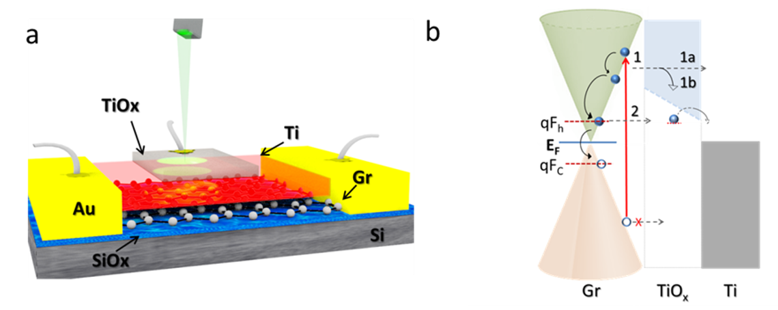
En el área de las celdas solares el grafeno ha sido utilizado en todas las tecnologías existentes heteroestructuras [130], poliméricas [131], sensibilizadas con tintes [132] y celdas con perovskitas [133]. En todas ellas ha tenido un papel relevante, en los siguientes párrafos se hará un resumen de los trabajos más importantes en esta área.
Las eficiencias de las diferentes tecnologías de celdas solares varían de 20 a 46%, dependiendo de la naturaleza de los materiales fotovoltaicos utilizados y de la configuración del dispositivo [130]. El Laboratorio Nacional de Energías Renovables (NREL) ha reportado eficiencias de conversión del 45,7% para celdas solares de 4 uniones metamórficas invertidas (el crecimiento de capa se da en dirección opuesta a la convención, la capa que presenta mayor desajuste cristalino crece cercana al substrato), una de las mayores eficiencias de conversión de energía (PCE). En este diseño, la celda solar consiste en una unión de galio, indio y fósforo (GaInP), una unión de arseniuro de galio (GaAs) y dos de arseniuro de indio y galio (InGaAs) [130] y es una de las celdas que mejores eficiencias presenta al ser iluminada bajo condiciones de más de 1000 soles. Es con esta tecnología de heterouniones o heteroestructuras en donde se encuentran las dos celdas con los valores de mayor eficiencia en conversión de luz solar en energía eléctrica, uno reportado por Sharp Corporation, con 44,4% [134] y el reportado por Soitec con 46% [135].
En esta área y por sus propiedades de transparencia y movilidad electrónica, anteriormente discutidas, el grafeno se ha convertido en un importante componente. El grafeno se puede utilizar como electrodo transparente, capa interfacial activa, capa de transporte de electrones, capa de transporte de agujeros o capa de separación de electrones/agujeros. Actualmente, las eficiencias superan el 10% para uniones de materiales mixtos basado en grafeno multicapa. En la tabla 2, se enumeran los diferentes dispositivos solares que han utilizado grafeno en su diseño, así como sus eficiencias.
Dispositivo Solar
Jsc (mA/cm2)
Voc (v)
FF (%)
PCE (%)
Ref
PEN/ánodo de grafeno/PEDOT:PSS/MoO3/PTB7:PC71BM/Ca/Al
14,4
0,72
58,7
6,1
[137]
PEN/cátodo de grafeno/ZnO/PTB7:PC71BM/MoO3/Ag
141
0,72
69,5
7,1
[137]
grafeno/PEDOT:PSS (O
2
plasma)
6,3
0,49
44
1,37
[138]
Ánodo de grafeno/PEDOT:PSS/P3HT:PC61BM/LiF/AL
8,5
0,59
51
2,5
[139]
Ánodo de grafeno/PEDOT:PSS/CuPc:C60/BCP/AG
4,4
0,53
36
0,85
[140]
ITO-ánodo/PEDOT:PSS/P3HT:PC61BM/LiF/Al
9,2
0,58
57
3,0
[139]
Grafeno-MoO3
+PEDOT:PSS-ánodo/P3HT:PC61BM/LiF/Al
4,8
0,59
43
1,23
[139]
HCl/HNO3+grafeno dopado/MoO3+PEDOT:PSS/P3HT:PC61BM/LiF/Al
7,0
0,59
45
1,9
[139]
Grafeno CVD/PEDOT:PSS/CuPc:C60/BCP/Al
4,7
0,48
52
1,18
[141]
TCNQe-ánodo de grafeno/PEDOT:PSS/P3HT:PC61BM/Ca/Al
8,9
0,57
48
2,58
[142]
Cátodo de grafeno/PEDOT:PEG(PC)/ZnO/PbS(P3HT)/MoO3/Au
24,4
0,5
34,6
4,6
[143]
grafeno-catodo/RG-1200g/ZnO/PbS(P3HT)/MoO3/Au
20,8
0,54
34,9
3,9
[139]
Vidrio/grafeno/ZnO/CdS/CdTe/pasta de grafito
22,9
0,43
42
4,17
[144]
Cu/P3HT:PCBM/PEDOT:PSS/grafeno/PMMA
10,4
0,38
34,5
1,39
[145]
Ag/P3HT:PCBM/PEDOT:PSS+Au/grafeno (3 capas)
10,3
0,601
49,48
3,08
[145]
Si/PEDOT:PSS/AgNWs/óxido de grafeno
28,4
0,601
78,4
13,3
[146]
ITO/óxido de grafeno/P3HT:PCBM/LiF/Al
10,1
0,64
50
3,25
[147]
ITO/PEDOT:PSS/P3HT:PCBM/óxido de grafeno-Cs/Al
9,8
0,62
50
3,08
[147]
óxido de grafeno-Cs/Al/GO/MoO3
5,0
1,69
46
3,91
[148]
óxido de grafeno-Cs/Al/grafeno óxido
4,5
1,43
45
2,95
[148]
ITO/PEDOT:PSS/CH3NH3PbI3−xClx/PC61BM:GDa/C60/Al
23,4
0,969
65,4
14,8
[149]
ITO/PEDOT:PSS/CH3NH3PbI3−xClx/PC61BM/C60/Al
22,3
0,989
61,5
136
[149]
FTO/Grafeno-TiO2/Al2O3/CH3NH3PbI3−xClx/spiro-OMeTADb/Au
21,9
1,04
73
15,6
[150]
CH3NH3PbI3/puntos cuáticos de grafeno/TiO2
17,0
0,937
63,5
10,14
[151]
ITO/GO/CH3NH3PbI3−xClx/PCBM/ZnO/Al
17,4
1
71
12,4
[152]
ITO/RGO/CH3NH3PbI3/PC61BM/BCPc/Ag
14,8
0,95
71,13
9,95
[153]
CH3NH3PbI3/óxido de grafeno/spiro-MeOTAD
20,2
1,04
73,00
15,1
[154]
TiO2/CH3NH3PbI3 cúbico/spiro-MeOTAD
21,6
1,05
74,00
17,01
[155]
PET/rGO/PEDOT:PSS/P3HT:PCBM/TiO2/Al
4,3
0,56
NA
0,78
[156]
PET/GO:PEDOT:PSS/F8T2/C60/Al
2,7
0,71
0,52
1,1
[157]
ITO/ZnO/P3HT:PCBM/PEDOT:PSS/Au/G
10,5
0,59
0,43
2,70
[158]
G/Au/PEDOT:PSS/P3HT:PCBM/ZnO/Ag/PI
10,6
0,597
0,50
3,17
[145]
EG/PEDOT:PSS/PTB7:PC71BM/Ba/Al
6,5
0,707
0,56
4,23
[159]
PET/PMMA-G/MoO3/PEDOT:PSS/PCDTBT:PC70BM/Ca/Al
8,8
0,83
0,45
3,30
[160]
PEN/G/ZnO/PTB7:PC71BM/MoO3/Ag
14,9
0,71
0,58
6,20
[137]
ITO/PEDOT:PSS/P3OT:G/LiF/Al
4,2
0,92
0,37
1,40
[161]
ITO/PEDOT:PSS/P3HT:G/LiF/Al
4,0
0,72
0,38
1,10
[162]
ITO/PEDOT:PSS/P3OT:PCBM–G/LiF/Al
4,6
0,67
0,37
1,14
[163]
ITO/PEDOT:PSS/P3HT-f-MWCNTs-SPFG/LiF/Al
4,7
0,67
0,32
1,05
[164]
ITO/PEDOT:PSS/G-P3HT:C60/Al
3,5
0,43
0,41
0,61
[165]
ITO/PEDOT:PSS/C60-rGO:P3HT/Al
4,4
0,56
0,49
1,22
[165]
ITO/PEDOT:PSS/P3HT:GQDs/Al
6,3
0,67
0,3
1,28
[166]
ITO/PEDOT:PSS/P3HT/ANI-GQDs/Al
3,5
0,61
0,53
1,14
[167]
ITO/PEDOT:PSS/P3HT:PCBM:GQDs/LiF/Al
26,4
0,6
0,33
5,24
[168]
ITO/PEDOT:PSS/GOQDs:PTB7:PC71BM/Al
15,2
0,74
0,68
7,60
[169]
ITO/PEDOT:PSS/G-dopado con N:P3HT:PCBM/Al
14,9
0,59
0,51
4,48
[170]
ITO/PEDOT:PSS/P3HT:PTM21-GO:PCBM/LiF/Al
8,1
0,59
0,30
1,43
[171]
ITO/GO/PEDOT:PSS/PCDTBT:PC71BM/Al
10,4
0,82
0,50
4,28
[169]
ITO/PEDOT:PSS(Au@PEG–GO)/PBDTTT-CT
16,1
0,75
0,60
7,26
[172]
ITO/ZnO@G:EC/P3HT:PC61BM/MoO3/Ag
7,7
0,63
0,73
3,90
[173]
ITO/FLGs-PEDOT:PSS/PCBM/P3HT/Ca/Al
9,4
0,58
0,55
3,70
[174]
Las celdas solares a base de polímeros, por su parte, ofrecen varias ventajas, incluida la facilidad de adaptar sus propiedades físicas, su capacidad de crecer capas ultrafinas, producción rentable en gran superficie, su peso ligero, entre otros. Una de las principales desventajas, sin embargo, es la preocupación por la estabilidad ambiental de dichas celdas solares. Hasta ahora se han utilizado polímeros conjugados con tiempos de descomposición cortos bajo condiciones atmosféricas, y es en este punto donde materiales a base de carbono, y especialmente el grafeno, pueden ayudar a proporcionar estabilidad contra la temperatura, la humedad y los productos químicos, sin perder las ventajas enunciadas anteriormente.
En estos tipos de celdas el aceptor de electrones y el donador son mezclados para mejorar el contacto; el orden, así como la alineación de los componentes y sus propiedades intrínsecas son los principales responsables del incremento en la eficiencia [175]. Entre los mejores rendimientos en este tipo de celdas se encuentran ITO/PEDOT:PSS/polymer PBTTT-3:PC70BM/Ca/Al [176] con un rendimiento del 7,4% y con 6,7% la celda de ITO/MeO/organic compounds:PC70BM/Al [177]. También son ejemplos muy interesantes las celdas plásticas, como la presentada por las compañías Solarmer Energy Inc., Heliatek, Konarka y Mitsubishi Chemical, con eficiencias que llegan hasta el 9,2% (la celda de Mitsubishi Chemical). Trabajos teóricos han predicho que la eficiencia máxima que se va a obtener con estos dispositivos es del 15% [178]. A pesar de encontrarse cerca del valor predicho, todavía se debe trabajar en tres aspectos y en estos tres el grafeno resulta clave: como aditivos al componente del donador de electrones, como electrodo transparente y flexible y como material separador entre capas [131, 136].
Varios trabajos han utilizado principalmente el óxido de grafeno modificado como aditivo en sus celdas. Liu et al. [179] usaron isocianato de fenilo como modificación, lo cual hace al GO soluble en 1,2-diclorobenceno, permitiendo realizar una mezcla con la capa fotoactiva (P3HT) para una posterior deposición mediante el método de recubrimiento por centrifugación en el electrodo (ITO recubierto con PEDOT:PSS). La adición del grafeno en ese dispositivo incrementó el voltaje de circuito abierto (Voc) en aproximadamente un 100% y bajo las mejores condiciones se observó una eficiencia del 1,1%. Otras estrategias consisten en el dopaje del grafeno con heteroátomos [170] o el uso de puntos cuánticos de grafeno [180]. La incorporación de nitrógeno en rGO dentro de la celda ITO/PEDOT:PSS/N-grafeno dopado:P3HT:PCBM/Al permitió lograr una eficiencia de 4,5%. Por otro lado, el uso de puntos cuánticos como el reportado por Kim et al. [180] en la celda ITO/PEDOT:PSS/GOQDs:PTB7:PC71BM/Al presenta la mejor eficiencia (7,6%) en celdas del tipo orgánicas con grafeno como aditivo según nuestro conocimiento.
Otro de los usos del grafeno y sus derivados ha sido como electrodo transparente (TCE) para sustituir el ITO, que a pesar de ser el material más utilizado como electrodo transparente en la literatura, su precio ha ido aumentando paulatinamente debido a la escasez del material. Películas de rGO sintetizadas por recocido térmico se depositaron en tereftalato de polietileno por medio de recubrimiento por centrifugación (“spin coating”) [156]. Se obtuvieron capas de 16 nm con una transmitancia de 65% y, sorprendentemente, el dispositivo obtenido podía soportar hasta 1200 ciclos de flexión sin sacrificar su rendimiento, mientras que las celdas tradicionales que incorporan ITO normalmente se agrietan y degradan. Se mejoró significativamente el rendimiento obtenido (PCE de 3,05%), depositando una micromalla de rGO por medio de estampado láser en PET, esto se atribuyó a una mejor transparencia, 59%, y la menor resistencia de la lámina, esta PCE es comparable con dispositivos basados en ITO [181].
El principal inconveniente de estos electrodos basados en rGO es su alta densidad de defectos que limitan la eficiencia del dispositivo. También se han utilizado modificaciones del grafeno, como el que muestra Xu et al. [182] a base de grafeno sulfonado (SG) y PEDOT, compuestos preparados por polimerización in situ, mediante pasos de reducción, sulfonación con ácido sulfanílico de aril diazonio, reducción y funcionalización con dicho ácido en presencia de un catalizador (AIBN), posteriormente se adiciona el monómero EDOT en presencia de un catalizador de hierro y se lleva a cabo la polimerización. Una conductividad de 0,2 S/cm y transmisiones muy altas del orden de 80% en el rango de longitud de onda de 400-1800 nm para películas con un grosor de unos pocos nm fueron observadas. Esta conductividad es mucho más alta que la de un producto comercial PEDOT.
Aparte de grafeno y grafeno modificado también hay reportes de nanocompuestos derivados del grafeno. Como reportan Lima et al. [157], se utilizó un nanocompuesto GO/PEDOT: PSS como TCE en una celda con estructura PET/GO:PEDOT:PSS/F8T2/C60/Al, y se obtuvo un PCE de 1,10%. El dispositivo presentó buenas transmitancias que dependían del radio GO/PEDOT pero, sobre todo, era llamativo porque podía soportar hasta 1000 ciclos de doblados. Otras estrategias han sido el dopaje del grafeno [183], por ejemplo, Liu et al. [158] hicieron un dispositivo con un éster (PC61BM) y una película de grafeno CVD dopada con nanopartículas de Au y PEDOT:PSS como el electrodo superior e ITO como el electrodo inferior (figura 6), este dopaje permite un incremento de más de 400% comparado con el grafeno prístino y permite una eficiencia de 2,7%. Es importante destacar que los autores esperarían una mayor eficiencia con un grafeno de mejor calidad.
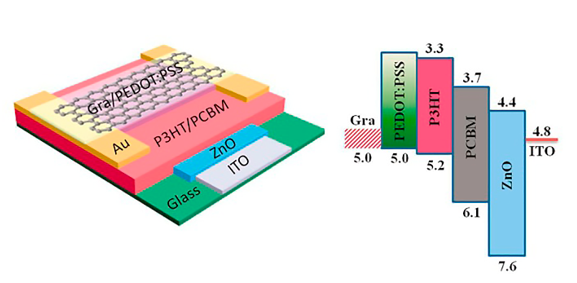
Las celdas sensibilizadas (DSSC, por sus siglas en inglés) o que utilizan perovskitas han sido otras de las áreas que han tenido un auge muy importante en la colección de fotones para obtención de energía eléctrica. Un alto número de producciones científicas se han publicado en esta dirección desde el año 1991, cuando el grupo del profesor Graetzel propusiera esta tecnología [132, 184-186]. La figura 7 muestra una representación de lo propuesto por este grupo de investigación.
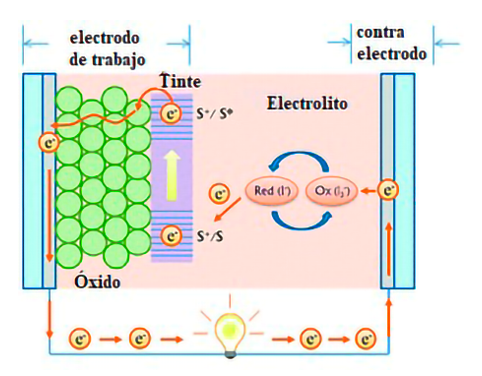
En el diagrama más estudiado se utilizan electrodos de TiO2 y como contraelectrodos se emplean electrodos de Pt. La figura de mérito que suele ser más determinante en la elección de los electrodos es la constante de transferencia de carga. Debido a la movilidad de carga del grafeno, así como estabilidad química, resulta un candidato muy interesante para su utilización como electrodo en estos sistemas [132]. Como electrolito se utiliza generalmente la mezcla yoduro/triyoduro, que es la que permite la regeneración del tinte fotosensible. Como materiales fotosensibles se encuentra una gran librería en la literatura, tintes basados en materiales polipirrílicos, porfirínicos, puntos cuánticos, nanopartículas y, de gran interés en los últimos años, perovskitas que han generado altos valores de eficiencia y reducido sus problemas en híbridos con grafeno [132].
Varias revisiones bibliográficas [132, 187-189] han resumido el uso del grafeno y sus aplicaciones en DSSC como electrodo transparente, capa semiconductora, fotosensibilizador, aditivos en electrolitos y contraelectrodo. Se han utilizado múltiples tipos de nanomateriales de carbono, incluidos fullerenos, CNT, grafeno y diamante para sus aplicaciones en DSSC como fotoánodo, contraelectrodo, colector de corriente y moléculas absorbentes de luz. Se han explorado materiales a base de grafeno como nuevos materiales de contraelectrodo en DSSC debido a sus interesantes actividades catalíticas electroquímicas, altas conductividades, altas áreas de superficie, resistencia a la corrosión, bajo peso y bajo costo de producción. En la tabla 2, se muestran los diferentes materiales a base de carbono, su uso en los diferentes tipos de celdas solares y sus eficiencias.
Grafeno en el almacenamiento de energía
El éxito de la implementación de energías renovables a nivel global depende del desarrollo de formas de almacenamiento que sean eficientes, limpias y con materiales abundantes [190]. Conforme se incrementa el uso de energías renovables en casas, transporte y aplicaciones móviles, el desarrollo de baterías con mayor capacidad de almacenamiento se vuelve indispensable [191, 192].
La tecnología existente de baterías de ion litio ha llegado prácticamente al máximo de su capacidad fisicoquímica [193]. Es por eso que se están buscando nuevas tecnologías que permitan tener mayor capacidad de almacenamiento. Sin embargo, cualquier batería de aplicación comercial tiene que cumplir con toda una serie de requerimientos, el primero es que las baterías deben ser seguras y, en caso de ruptura, no deben ser inflamables. El segundo es que deben estar hechas de materiales abundantes que puedan sostener la economía a nivel global. Las baterías deben, además, funcionar en un rango amplio de temperaturas [194, 195].
La Unión Europea ha lanzado la iniciativa Battery 2030 que contiene la hoja de ruta de investigación a largo plazo de “The Battery 2030+” [195]. Uno de los principales objetivos de esta iniciativa es el descubrimiento acelerado de interfaces y materiales. Desde el punto de vista de la investigación, no existe una preferencia clara en un tipo específico de batería, sino que se enumeran diferentes tecnologías. Entre estas, se mencionan las de iones de litio y las “poslitio”, tales como: iones de sodio, iones metálicos multivalentes, aire-metal y de flujo. En los próximos párrafos nos vamos a centrar en algunas de las tecnologías que podrían utilizan grafeno en sus componentes.
Desde su descubrimiento, el grafeno se ha destacado como un material muy prometedor para su uso en almacenamiento de energía. Algunas de sus características que lo hacen interesante para esas aplicaciones son su alta área superficial, alta conductividad eléctrica, flexibilidad y estabilidad [194]. Es por eso que en los últimos diez años se ha trabajado fuertemente tratando de incorporarlo en diferentes tecnologías de baterías. Una de las grandes interrogantes es ¿cuál va a ser la tecnología que va a venir a reemplazar la tecnología existente de baterías ion litio? Esta pregunta puede tener diferentes respuestas dependiendo de la aplicación. Sin embargo, el grafeno resulta como un material muy interesante para ser implementado en esas tecnologías. En esta sección vamos a centrarnos en tres tecnologías principales que podrían llegar a usar grafeno dentro de sus componentes: baterías ion-litio, baterías de ion-sodio y baterías ion-aluminio.
Uso de grafeno en baterías ion-litio
Las baterías de ion-litio son una tecnología que incursionó en el mercado al inicio de los noventa a cargo de la empresa Panasonic [195]. Esta tecnología de baterías ha permitido el desarrollo de todas las tecnologías de dispositivos portables con los que contamos en la actualidad. Sin embargo, desde ese momento, su capacidad no se ha incrementado apreciablemente. Las primeras versiones de las baterías de ion litio contemplaban el uso de litio metálico como ánodo y óxidos de manganeso para intercalar los iones de litio como cátodo [196]. Sin embargo, este tipo concepto de batería fue abandonado debido a problemas de seguridad en cuanto al uso de litio metálico. Además, la redeposición del litio forma dendritas que resultan en el fallo de la batería. Es por eso que en el modelo comercializado por Panasonic se utilizaba grafito como ánodo y óxidos de cobalto como cátodo [197]. A este tipo de diseño se le suele llamar silla mecedora, ya que los iones litios pasan de estar intercalados en un material o el otro sin pasar por ser litio metálico. En este diseño el grafito tiene una capacidad de almacenamiento máxima teórica de 372 mAhg-1 [198]. A pesar de que desde su comercialización el costo de este tipo de baterías ha disminuido 15 veces, su capacidad únicamente se ha duplicado [195]. Muchos creen que la capacidad de este tipo de baterías ha alcanzado su tope máximo [193]. Es por eso que se requiere buscar nuevos materiales que permitan almacenar mayores cantidades de energía sin comprometer el voltaje que pueden brindar las baterías.
El uso de grafeno en baterías ion litio se ha propuesto como una posible tecnología que podría venir a suplantar las tecnologías conocidas. El grafeno puede ser utilizado como material del cátodo en diferentes formas. Se puede tener el grafeno de pocas capas producido mediante diferentes rutas de síntesis o se puede tener materiales compuestos de mezclas físicas de grafeno con diferentes materiales que resultan en propiedades mejoradas. Dichas mezclas pueden ser de tipo físico o también pueden involucrar enlaces químicos [194].
Uno de los trabajos pioneros en el uso de grafeno puro fue realizado por Liu et al. [199], en donde se obtuvieron capacidades de 540 mAhg-1. Posteriormente, Yoo et al. [200] lograron incrementar la capacidad hasta más de 700 mAhg-1 al adicionar nanotubos de carbono y fullerenos. Pan et al. [201] encontraron que las capas desordenadas de grafeno podían incrementar su capacidad hasta 750-1054 mAhg-1. En el año 2010 el trabajo de Bharwaj mostró que al preparar grafeno a partir de la apertura de nanotubos de carbono era posible obtener baterías con capacidades de hasta 1400 mAh g-1. Sin embargo, con el tiempo esa capacidad decaía hasta 800 mAhg-1 [202].
En el área de materiales compuestos basados en grafeno se puede decir que se ha probado casi cada combinación posible. Nos vamos a enfocar en algunos ejemplos que han mostrado propiedades prometedoras. Chang y Chem [203] reportaron el uso de sulfuro de molibdeno combinado con grafeno para obtener baterías con capacidades de 1571 mAhg-1. La modificación de grafeno con óxidos de hierro también ha mostrado excelentes capacidades: 1693-1227 mAhg-1 [204]. Otros óxidos como, por ejemplo, óxidos de molibdeno han mostrado capacidades de hasta 1490 mAhg-1 [205]. En cuanto al uso de nanopartículas, algunas de las que han proporcionado mejores capacidades son las nanopartículas de silicio. Dichas partículas presentan una capacidad teórica de hasta 4200 mAh g-1 [206, 207], sin embargo, presentan el inconveniente de una expansión volumétrica de hasta 270% [208], lo cual resulta en poca ciclabilidad de la batería, inestabilidad mecánica y su cese de funcionamiento. Sin embargo, la combinación de nanopartículas de silicio con grafeno ha permitido mejorar su estabilidad con capacidades de 1500 mAhg-1 para unos 200 ciclos [209]. Mejoras en la arquitectura de los electrodos han mostrado que es posible obtener capacidades de 1600 mAhg-1 a la vez que es posible mantener hasta un 93% de la capacidad luego de 100 ciclos [210]. Sin embargo, estos avances aún se quedan cortos para aplicaciones comerciales de larga duración. Otros óxidos que se han utilizado son, por ejemplo, óxidos de estaño con capacidades de 1562 mAhg-1 y buena estabilidad en el ciclado, alcanzandolos 1300 ciclos [211].
En caso de materiales híbridos que contienen enlaces con el grafeno, se ha trabajado, por ejemplo, con nanopartículas de óxido de manganeso Mn3O4 con capacidades de aproximadamente 900 mAhg-1 [212]. El grupo de Zhou et al. [213] preparó un material composito de nanocristales de óxido de estaño con óxido de grafeno dopado con nitrógeno reducido. Ese material permitió obtener capacidades de hasta 1352 mAhg-1. Otros grupos también han logrado obtener capacidades interesantes al mezclar diferentes formas de óxido de estaño con grafeno [214-216].
Es importante mantener en mente que estas capacidades se alcanzan con baterías que contienen litio metálico como ánodo en lugar de óxidos de cobalto o fosfatos de hierro. Sin embargo, para que este tipo de baterías sean seguras y aplicables a nivel comercial se requieren mayores avances en el área de electrolitos sólidos que permitan brindar mayor estabilidad y seguridad a la batería.
Uso de grafeno en baterías ion sodio
En las baterías de ion-sodio no es posible utilizar grafito como cátodo. Se ha logrado corroborar que la intercalación de sodio en el grafito es prácticamente despreciable y lo poco que se intercala lo hace de forma irreversible [217]. El grupo de Dou [218] usó óxido de grafeno reducido para intercalar iones sodio y mostró que podía alcanzar una capacidad de almacenamiento de hasta 174,3 mAhg-1 usando una densidad de corriente de 40 mAg-1. En el año 2015, el grupo de Chang preparó grafeno de 3-5 capas mediante la exfoliación y reducción de óxido de grafito y lo utilizó para la intercalación de sodio. Estos materiales presentaron una capacidad de 220 mAhg-1 con una corriente de 30 mAg-1 [219]. El grupo de Wang realizó la modificación de grafeno con nanopartículas de óxido de estaño y obtuvieron capacidades promedio de 700 mAhg-1 en 100 ciclos con una corriente de 20 mAg-1 [220]. Xie et al. [221] prepararon compositos de sulfuro de estaño con grafeno y obtuvieron capacidades promedio de 725 mAhg-1 a 20 mAg-1 y con buenas capacidades de ciclado. Otros sulfuros como, por ejemplo, sulfuro de cobalto con grafeno también han sido utilizados y han mostrado una capacidad de 420 mAhg-1 luego de 1000 ciclos a una densidad de corriente de 1 Ag-1 [222]. La combinación de grafeno con sulfuro de molibdeno MoS2 ha mostrado capacidades de 797 mAhg-1 a una densidad de corriente de 0,2 Ag-1 [223]. El grafeno dopado con nitrógeno también ha mostrado propiedades interesantes en este tipo de baterías. Este se ha empleado, por ejemplo, a modo de aerogel, en el grupo de Zhang, y mostró una capacidad inicial de 1013,8 mAhg-1. Sin embargo, esa capacidad no se mantuvo en los otros ciclos. En el año 2017 el grupo de Huang usó grafeno dopado con nitrógeno en combinación con nanopartículas de sulfuro de estaño y obtuvieron una capacidad inicial de 1099,8 mAhg-1 y una capacidad promedio de 912,5 mAhg-1 [224].
Entre el grupo de materiales compuestos que presentan enlaces con el grafeno está el trabajo de Zhan et al. [225], en el que se realizaron la modificación de óxido de grafeno reducido con nanopartículas de sulfuro de cobalto con capacidad de 426 mAhg-1. La combinación de grafeno con fósforo de Song et al. [226] presentó una capacidad sorprendente de 2077 mAhg-1 con una retención del 95% de la capacidad luego de 60 ciclos. En un trabajo similar se realizó la modificación de óxido de grafeno reducido con puntos cuánticos de fósforo rojo y se obtuvieron capacidades de 1161 mAhg-1 con gran capacidad de ciclado y estabilidad incluso luego de 250 ciclos [227]. Estos estudios han puesto a la combinación de fósforo con grafeno a la cabeza en la investigación de baterías ion-sodio. A pesar de que se han probado muchas otras combinaciones, todas ellas se encuentran muy por debajo de los materiales compuestos con fósforo.
Aunque todas estas mediciones parecen muy prometedoras es importante mantener presente que en este tipo de celdas se utiliza como ánodo sodio metálico. Esto quiere decir que un diseño comercial de este tipo podría potencialmente tener muchos problemas de seguridad en caso de ruptura debido a la alta flamabilidad del sodio expuesto al aire. Un desarrollo comercial de esta tecnología posiblemente necesitaría contemplar el uso de materiales de intercalación en el ánodo o algún otro método que permita brindar una mayor seguridad al usuario. De momento, el uso de estas baterías se vislumbra como sustituto de las baterías ion litio en aplicaciones de bajo costo o en donde la densidad de energía no sea un factor tan importante.
Uso de grafeno en baterías ion aluminio
En la búsqueda de nuevos materiales para baterías poslitio, los metales polivalentes han empezado a adquirir importancia debido a que, al poseer estados de oxidación mayores a uno, en principio podrían almacenar mayor cantidad de carga. Entre los metales polivalentes recientemente estudiados, se destaca el calcio, el magnesio y el aluminio [228]. Canepa et al. mencionan que para el 2016 un 81% de la investigación se realizaba con magnesio, 15% con zinc, 3% con calcio y un 1% con aluminio, entre otros metales [229]. El electrolito que se utiliza actualmente en las baterías ion magnesio fue desarrollado en el Helmholzt Zentrum de Ulm y ha permitido el desarrollo de este tipo de baterías con azufre. El principal problema en el caso de las baterías basadas en magnesio es que a pesar de ser muy prometedores como tecnología poslitio, los electrolitos que se utilizan actualmente no son seguros ni amigables con el ambiente [230]. De momento, el grafeno no se prevé como un material de preferencia en las baterías ion-magnesio [231].
Cuando otros factores como accesibilidad, almacenamiento de energía, mercado, materia prima y reciclaje se toman en consideración; el aluminio es uno de los materiales más prometedores para ser utilizado en baterías [228]. Algunas de las características que hacen al aluminio interesante como vector energético son su abundancia, el aluminio es el metal más abundante en la corteza terrestre. También es reciclable, la capacidad volumétrica del aluminio es 4 veces mayor a la del litio, mientras que la capacidad específica es similar y muy importante, el aluminio es muy seguro para ser utilizado en su forma metálica, lo cual permite que sea usado directamente como ánodo sin peligros de flamabilidad [228].
La química de las baterías ion-aluminio es una que específicamente puede obtener muchos beneficios de las propiedades del grafeno. La investigación en el uso de grafeno en este tipo de baterías inició en el año 2015 [232]. Hay una serie de características que el grupo de Gao ha identificado como necesarias para que el grafeno pueda ser utilizado en baterías ion-aluminio: (i) el grafeno debe ser altamente cristalino y libre de defectos, (ii) debe contener una matriz continua que permita la conducción electrónica, (iii) debe tener una alta resistencia mecánica y un alto módulo de Young y (iv), por último, debe tener canales interconectados que permitan un alta movilidad iónica y permeabilidad del electrolito [233].
Las baterías ion-aluminio usualmente están compuestas por un ánodo de aluminio metálico, un líquido iónico formado al mezclar cloruro de aluminio con una sal de imidazol y un material grafítico de intercalación. Como se mencionó anteriormente, la primera vez que se mostró el potencial de esta configuración de batería fue en el grupo del profesor Dai [232]. Este grupo de investigación preparó una esponja de grafeno de pocas capas para ser usada como cátodo, este dispositivo mostró una capacidad de 60 mAhg-1 por más de 7500 ciclos de carga y descarga con una retención del prácticamente el 100% de la capacidad. El trabajo de Yu et al. mostró que la introducción de agujeros nanométricos creados por plasma ayuda a la permeabilidad del electrolito en la esponja de grafeno. Eso permitió obtener capacidades de 123 mAhg-1 por más de diez mil ciclos con una densidad de corriente de 5 Ag-1 y con eficiencia Coulumbica superior al 98% [234].
El trabajo de Zhang et al. mostró que, en general, una menor dimensión en el eje z del grafeno favorece la intercalación cuando se utiliza en baterías ion-aluminio. Por otro lado, las dimensiones en el plano ab presentan una dicotomía: un mayor tamaño de cristal en el plano ab favorece la estabilidad, pero desfavorece la cinética de difusión iónica, mientras que lo contrario es favorecido cuando el tamaño de cristal es pequeño [235]. El grupo de Gao demostró que el grafeno libre de defectos permite obtener gran estabilidad en el desempeño de la batería de hasta 25 000 ciclos con una capacidad de 100 mAhg-1 a 5 Ag-1 y con una retención de capacidad del 97% [236]. Gao también ha probado otros tipos de materiales basados en grafeno utilizando metodologías de alta temperatura que le ha permitido obtener polvo de grafeno bajo en defectos que ha mostrado capacidades de hasta 100 mAhg-1 a una densidad de corriente de 20 Ag-1 [237]. Otro de los materiales que también ha preparado el grupo de Gao son capas delgadas de grafeno bajas en defectos con canales verticales y horizontales que favorecen la difusión iónica. Este cátodo mostró una capacidad de 110 mAhg-1 en 250 000 ciclos de carga/descarga a una densidad de corriente de 100 Ag-1 [233]. Finalmente, el grupo de Gao ha trabajado además con esferas de aerogel de grafeno que han mostrado capacidades de 85 mAhg-1 por 8000 ciclos con una retención de capacidad del 90% a una densidad de corriente de 5Ag-1 [238]. Huang et al. [239] sintetizaron una esponja de grafeno de alta densidad y con ese grafeno fueron capaces de obtener una capacidad específica de 151 mAhg-1, que es una de las más altas reportadas. En un trabajo reciente de Xu et al. también lograron obtener una batería basada en grafeno con una capacidad específica de hasta 150 mAhg-1 y estable por 7000 ciclos [240].
Hasta la fecha, las baterías ion-aluminio basadas en grafeno y liquido iónico con cloroaluminato han mostrado algunas ventajas tales como gran seguridad, estabilidad en el ciclado y la capacidad de recarga ultrarrápida. Sin embargo, la capacidad específica sigue siendo baja en comparación con otros tipos de baterías. Es importante tener en mente que en estos tipos de baterías se da la intercalación del ión AlCl4 -, lo cual representa una limitante, ya que se pierde la ventaja de usar un ion trivalente, por lo que grandes esfuerzos deben destinarse a buscar la forma de incrementar la capacidad de almacenamiento de energía.
En general, esta tecnología de baterías aún se encuentra en etapas de investigación. En la tabla 3 se muestra un resumen de algunas de las baterías metal-ion con cátodos basados en grafeno y que presentan las características más prometedoras. Las baterías ion-sodio, en general, muestran capacidades y estabilidades intermedias a excepción de las basadas en fósforo con grafeno que presentan capacidades excepcionales a pesar de que su estabilidad no es tan alta. Se puede decir que esta tecnología también se encuentra en etapas de investigación básica. Las baterías de ion litio con grafeno presentan capacidades de almacenamiento bastante altas y estabilidades intermedias. En general, las baterías de ion-litio con grafeno son las que se encuentran más cercanas a la comercialización. Por ejemplo, la empresa española GRABAT produce baterías de grafeno con polímero; sin embargo, no se cuenta con información más específica sobre las características de estas baterías [241].
Tipo de batería
Material del cátodo
Voltaje de descarga (V)
Capacidad de almacenamiento
(mAhg-1)
Densidad de corriente
(mA)
Número de ciclos
probados
Referencia
Li-ion
Si/grafeno/carbón
1,5
1600
100
100
[210]
Li-ion
MoO3 grafeno
--
1228
500
100
[205]
Li-ion
Fe2O3/óxido de grafeno reducido
1,6
1227
100
50
[204]
Na-ion
Fósforo/grafeno
--
2077
260
60
[226]
Na-ion
SnS/grafeno dopado con N
1,1
509,9
912,5
100
[224]
Na-ion
Puntos cuánticos de fósforo con óxido de grafeno reducido
---
902
200
250
[227]
Al-ion
Foam de grafeno
1,8
60
4000
7500
[232]
Al-ion
Film de grafeno
2
110
10000
250000
[233]
Al-ion
Grafeno en polvo
2
100
5000
5000
[237]
Grafeno en biosensores
Un sensor se define como un dispositivo analítico que comprende un elemento activo que sensa y un transductor, el cual produce una señal de salida [242]. El elemento sensor es responsable de la detección selectiva del analito, mientras que el transductor convierte un evento físico o químico en una señal apropiada que puede usarse (con o sin amplificación) para determinar la concentración de analitos en una muestra de prueba [242]. Por su parte, un biosensor sigue esta misma línea de funcionamiento, con el detalle de que ahora el elemento objetivo por sensar consiste en reconocimiento de un sistema biológico como proteínas (por ejemplo, receptores celulares, enzimas, anticuerpos), oligo o polinucleótidos, microorganismos, o incluso tejidos biológicos completos (figura 8) [243].
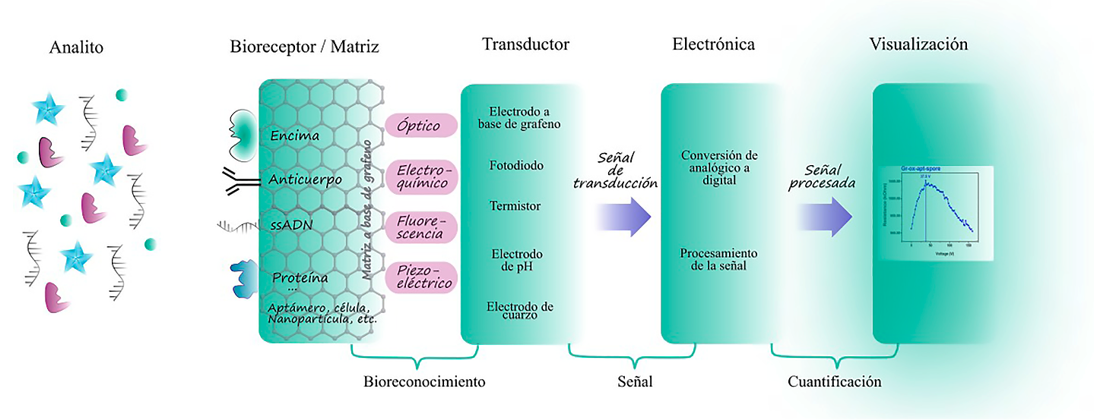
El rendimiento de los biosensores depende de sus componentes, entre los cuales el material del substrato, matriz o biorreceptor, es decir, la capa ubicada entre la capa de reconocimiento de la biomolécula y el transductor, desempeña un papel crucial en la definición de la estabilidad, la sensibilidad y la vida útil de un biosensor [244]. La matriz o soporte sólido del biorreceptor, al igual que el biorreceptor, pueden alterar la resistencia de la biomolécula ante diferentes cambios fisicoquímicos, como pH, temperatura, composición química, entre otros [244]. Para aumentar la sensibilidad y reducir los límites de detección (LOD) incluso a nivel de moléculas individuales, se ha desarrollado una amplia gama de nanomateriales novedosos con más capacidad para inmovilizar más unidades de biorreceptores a volúmenes reducidos e incluso para actuar como un elemento de transducción. Entre dichos nanomateriales se encuentra el grafeno y sus derivados.
Todas las propiedades del grafeno que se han enumerado a lo largo del trabajo hacen de este un material atractivo en la sección de biosensores, sensores ultrasensibles y biosensores flexibles con lectura óptica [245] que pueden beneficiar el desempeño de los sensores prexistentes. La superficie del grafeno prístino usualmente interactúa con otras moléculas vía adsorción física [246] y su gran área superficial permite mejorar la carga de las biomoléculas deseadas, mientras que la excelente conductividad y la pequeña banda prohibida pueden ser beneficiosas para conducir electrones entre las biomoléculas y la superficie del electrodo [247]. Por otro lado, la capacidad de modular las propiedades fisicoquímicas del grafeno mediante funcionalizaciones específicas ha llevado a aplicaciones exitosas en sensores y superficies inteligentes [246, 248]. El grafeno funcionalizado, en particular, parece ser excepcionalmente prometedor para aplicaciones de sensores químicos y biológicos [249].
Biosensores electroquímicos a base de grafeno
Los biosensores electroquímicos son dispositivos analíticos fundamentados en un elemento de reconocimiento biológico incorporado o en contacto cercano con un transductor electroquímico [250]. Estos sensores exhiben una selectividad inherente y la especificidad del receptor biológico, combinados con la alta sensibilidad y el límite de detección bajo de los métodos de detección electroanalíticos. Se pueden miniaturizar y usar con instrumentos portátiles, producidos en masa a un costo relativamente bajo y proporcionar una respuesta analítica simple [249]. Los sensores electroquímicos utilizan mediciones de potenciometría, amperometría, voltamperometría, coulometría o capacitancia [251].
Los biosensores electroquímicos a base de grafeno exhiben altos niveles de selectividad y sensitividad hacia especies electroactivas, respuesta rápida y precisa, se pueden diseñar de forma portátil, tienen bajo costo en comparación con otros biosensores existentes [249] y, además, presentan relativa facilidad de calibración [242]. Se ha utilizado el “grafeno electroquímico” para la detección de gran variedad de biomoléculas como neurotransmisores, catecolamina (como DA, dopamina) [252-256], biosensores de drogas [257]–[259], NADH, de ADN, inmunosensores, hemoglobina, mioglobina, detección de glucosa, H2O2, proteínas, biomarcadores cancerígenos, detección de patógenos, entre otras funciones. Como se acaba de mencionar, este tipo de biosensores tiene una amplia gama de capacidades de detección. En este artículo, se discutirán sobresalientes investigaciones realizadas a lo largo del tiempo, desde los orígenes de los biosensores hasta las más recientes investigaciones de biosensores electroquímicos a base de grafeno, tales como métodos rápidos de detección (describiendo un poco su fabricación), biosensores impresos, serigrafiados, en enzimas, inmunosensores, biomarcadores y fármacos anticancerígenos, detección de la seguridad alimentaria y hasta biosensores portátiles y desechables. Esto, con el propósito de recalcar el gran aporte que traen los dispositivos a base de grafeno, y con el afán de que continúe el crecimiento y mejora del área de investigación.
Sensores a base de grafeno se han empleado para detectar glucosa oxidasa (GOD), una molécula de gran valor para la detección de diabetes. Entre los primeros dispositivos reportados, se encuentra el realizado por Leland Clark et al. [260], quienes inmovilizaron la enzima glucosa oxidasa (GOD) en una membrana semipermeable que se encontraba en la superficie de un electrodo de platino (Pt) [261, 262]. Yoon et al. [263] en 2020 utilizaron la técnica de grafeno poroso inducido por láser (LIG, por sus siglas en inglés, laser induced graphene), que permite inmovilizar proteínas (como enzimas, anticuerpos y receptores); en particular, el estudio se enfocó en esta misma enzima mencionada anteriormente, pero en un compuesto de quitosina-glucosa oxidasa (GOD). Este método simple de modificación de la superficie utiliza ácido acético para incrementar la razón de enlaces carbono-carbono, que resulta en aumento de la conductividad debido al decrecimiento de la resistencia de la capa, reduciendo el inconveniente de que los dispositivos LIG usualmente poseen insuficientes propiedades eléctricas inherentes causadas por la baja conductividad de la superficie. Una vez obtenida esta modificación, realizaron una electrodeposición de PtNPs en el LIG estable, sin agregaciones, con una distribución uniforme de las nanopartículas. Dichas superficies se utilizan para la inmovilización del complejo de quitosano-glucosa oxidasa (GOD) que funciona como un biosensor de glucosa en el sudor. En el estudio se probó la variación del nivel de glucosa en la sangre antes y después de las comidas usando la respuesta amperométrica del sensor. Este electrodo LIG/PtNPs exhibe un límite de detección ultra bajo, inferior a 300 nM y un rango lineal dinámico de hasta 2,1 mM.
En el 2013 Määttänen, Anni et al. [264] elaboraron el primer trabajo de biosensor de glucosa usando un electrodo impreso desechable de carbono, por medio de impresión por inyección de tinta. Esta tecnología en la actualidad juega un papel trascendental en los sensores de glucosa debido a sus propiedades, tales como ser desechables, de bajo costo, alta sensibilidad, estabilidad y selectividad, amigable con el ambiente y de tamaño portátil, además de poder dar el resultado del análisis en tiempo real [265].
Al-Sagur et al. [266] realizaron en el 2019 un biosensor amperométrico serigrafiado de nanoláminas de grafeno-hierro ftalocianinas. Este complejo de hierro fue incorporado en un hidrogel conductor (CH, por siglas en inglés, Conducting Hydrogel) para detectar glucosa. El dispositivo completo (GPL-FePc (PAA)-VS-PANI/GPL-FePc-CH) se compone de un hidrogel conductor tridimensional basado en ácido poliacrílico (PAA) tridimensional con polianilina sustituida con vinilo (VS-PANI) y nanoláminas de grafeno funcionalizadas de forma no covalente (GPL) con ftalocianina de hierro (FePc). En el dispositivo, el complejo FePc se usó como mediador para transferir electrones entre la enzima inmovilizada GOD y el electrodo, mediante la oxidación de la forma reducida de la enzima GOD (FADH2). El tamaño de los poros uniformes (19 µm) de esta estructura microporosa tridimensional contribuye a poder utilizar una alta carga enzimática, mayor inmobilización y bioelectrocatálisis para la glucosa. El estudio mostró una sensibilidad de 18,11 μA mM-1 cm-2 y amplio rango lineal de 1 a 20 mM de detección de glucosa.
El colesterol ha sido otra de las moléculas para las cuales se han utilizado sistemas a base de grafeno [267]. Un aspecto fundamental del desarrollo del biosensor de colesterol es la inmovilización de la colesterol oxidasa y la colesterol esterasa en la superficie del electrodo biosensible [268]. Para dicha inmovilización el grupo de Parlak [269] utilizó el sulfonato de dodecil benceno sódico (SDBS), un sulfantante iónico que genera películas autoensambladas en electrodos y altera las cargas electrostáticas del grafeno, para dar un biosensor electroquímico que puede detectar moléculas de colesterol en un rango de 0,05-0,35 mM, con límites de detección de hasta 0,05 µM.
Se han realizado biosensores electroquímicos más complejos pero altamente sensibles para la medición del colesterol; un ejemplo es el estudio realizado por Li, Zeng y Zhao [270], en el que se oxidó el colesterol para generar peróxido de hidrógeno (H2O2), que puede desintegrarse en H2O con la catálisis sinérgica de RGO CS-Fc/Pt NPs y producir la respuesta de corriente redox de H2O2 que podría cuantificarse mediante métodos amperométricos [270] (la concentración de colesterol se puede cuantificar también al monitorear el O2, pero esto presenta bastantes retos, por lo que preferiblemente se puede monitorear la concentración de H2O2 a través de su reacción redox [271, 272]). Ampliaremos con mayor detalle el motivo del ensamble escogido y estudiado por este grupo de investigación [270], el cual consiste en un electrodo de carbono impreso serigrafiado modificado (SPCE) con óxido de grafeno reducido-quitosano-ácido de ferroceno carboxilado y nanopartículas de platino (RGO-CS-Fc/Pt NPs).
En este estudio se utilizó la hereoestructura RGO-CS-Fc para modificar la superficie de un electrodo impreso de oro mediante interacciones de enlace π-π. Dicho ensamble se utilizó de manera que la quitosina se combina en la superficie o las paredes laterales de RGO, y así facilitar la dispersión RGO en muchos solventes. De esta forma se aprovecha, por un lado, el óxido de grafeno reducido (RGO) con sus propiedades de ser un excelente material para anclar otras nanopartículas y obtener una rápida cinética electroquímica durante electrocatálisis de la reacción, (además de alta conductividad y alta área superficial), y, por otro lado, el biopolímero quitosina (CS) que posee propiedades sobresalientes de formación de películas que proporciona un buen lugar para la catálisis enzimática, la reacción electroquímica y biocompatibilidad [273-275].
El ferroceno y sus derivados (Fc), por su parte, son una clase de mediadores de electrones con excelente electroactividad redox [276], convirtiéndolos en sobresalientes mediadores en asociación con diferentes nanomateriales [277]. Por lo tanto, el Fc se usa ampliamente en la construcción de biosensores altamente sensibles como etiqueta electroquímica activa para el ensayo de biomoléculas [278, 279]. Finalmente, las nanopartículas de platino se depositaron en la superficie del electrodo por deposición potenciométrica isostática; de manera que el CHOD y la CHER se inmovilizan en la superficie de todo el dispositivo de RGO-CS-Fc/Pt NPs/SPCE para luego construir el biosensor electroquímico. Este estudio generó resultados remarcables, entre los cuales se destacan, por ejemplo, la linealidad entre la corriente de respuesta redox medida y la concentración de colesterol en el rango de 0,5 a 4,0 mg∙mL-1 y un bajo límite de detección de 5,70 μg∙mL-1. Además, el biosensor de colesterol RGO-CS-Fc/Pt NPs mostró una excelente especificidad y reproducibilidad aceptable, evidenciando un gran potencial para el diagnóstico clínico.
Una de las biomoléculas más ampliamente investigadas es la dopamina, ya que su concentración puede estar directamente relacionada con una serie de condiciones clínicas [280]. El óxido de grafeno reducido (RGO) se ha utilizado como electrocatalizador para la detección de dopamina (DA). El desafío en la detección de DA es la respuesta de voltamperometría cíclica superpuesta con el ácido ascórbico (AA) y ácido úrico (UA) [280]. Wang et al. [281] afirmaron que la selectividad de grafeno-DA es mejor que la de nanotubos de carbono de paredes múltiples (MWCNT). Además, se mostró que usando RGO la dopamina se podría medir en el rango de 5 a 200 µM en un exceso de ácido ascórbico, siendo útil para poderse implementar grafeno en aplicaciones reales [280, 281]. Otros estudios han demostrado que se puede incrementar la sensibilidad de dopamina empleando electrodos serigrafiados comerciales recubiertos con grafeno ultrasónicamente exfoliado [247, 282] depositado por “drop-coating” y estabilizado por revestimientos de tensioactivos aniónicos o catiónicos, como dodecil sulfato de sodio, bromuro de hexadeciltrimetilamonio [24, 282] polietilenimina [283] y polivinilpirrolidona [284].
La superficie plana aromática del grafeno complementa la estructura aromática de la dopamina [285]. Por ejemplo, las nanohojuelas de grafeno sobre silicio contienen un alto nivel de defectos en los bordes que mejoran la cinética de transferencia de electrones con la dopamina, lo que permite su determinación en presencia de ascorbato [286]. Recientes estudios, como el realizado por Arumugasamy, Shiva Kumar, Saravanan Govindaraju y Kyusik Yun [287] en 2020, utilizan puntos cuánticos de grafeno (GQDs, 1-5 nm) y nanotubos de carbono de paredes múltiples (MWCNTs) funcionalizados con ácido en una superficie del electrodo de carbono vítreo (GCE), empleando metodologías electroquímicas para detectar dopamina y crear un biosensor radiométrico. Los sensores electroquímicos clásicos típicamente adoptan el valor absoluto de la señal como salida, los sensores electroquímicos radiométricos poseen señales electroquímicas duales y la medición cuantitativa del objetivo se basa en la relación de estas dos señales [288]. En el estudio se obtuvieron buenos resultados de reproducibilidad, sensibilidad y selectividad con rango lineal dinámico de 0,25 a250 μM, con límites de detección de 95 nM [287].
Huang, Qitong et al. [289] utilizan la heteroestructura GQDs-MWCNTs/GCE para detectar dopamina, con la particularidad de ser el primer ejemplo aplicado para medir DA secretada por células vivas PC12 con excelente rendimiento [289], generando un rango lineal de 0,005 a 100,0 μM con límite de detección de 0,87 nM.
Según la Organización Mundial de la Salud (OMS), habrán 24 millones de nuevos casos de cáncer y 14,5 millones de muertes relacionadas con el cáncer cada año para el año 2035 [290], motivo por el cual se busca un diagnóstico temprano para mejorar la tasa de supervivencia de pacientes con cáncer [291-293]. El grafeno también ha sido empleado en investigaciones relacionadas con el cáncer, como en el caso de fármacos anticancerígenos, o biomarcadores, en donde se vislumbra como un mediador para la detección.Se ha desarrollado una gran variedad de biosensores inmunoelectroquímicos basados en grafeno para la detección de proteínas relacionadas con el cáncer. Castillo, John et al. [294] desarrollaron un biosensor electroquímico a base de grafeno, donde el electrodo de grafeno fue modificado con un conjugado de nanotubos peptídicos (PNTs) y ácido fólico (FA), incrementando la transferencia de electrones para la detección selectiva de células de cáncer cervical humano (HeLa). La interacción del ácido fólico (FA) y los receptores de folato (FRs) resultan en el bloqueo de la transferencia de electrones por la membrana celular aislante y por tanto crea una disminución concomitante de la corriente. Es así como la adición de las células HeLa y unión de FRs muestran un decrecimiento en la corriente faradaica demostrado por voltametría cíclica (CV). En este estudio se obtuvo un límite de detección de 250 células de cáncer cervical humano por mL.
Otro tipo de biodetector electroquímico fue realizado por Pan et al., quienes realizaron el primer estudio [295] de un solo biosensor sin etiqueta (“label-free”) para detectar simultáneamente dos tipos de biomarcadores de cáncer: el factor de crecimiento endotelial vascular (VEGF) y el antígeno prostático específico (PSA), en muestras de sangre humano para el diagnóstico precoz de cáncer de próstata. Este se basó en óxido de grafeno GO/ssDNA/ incorporado con nanopartículas de poli(ácido L-láctico) (PLLA) [295]. El dispositivo consistía en GO funcionalizado con ssDNA en un electrodo de oro. La presencia de VEGF permitió la inmovilización de nanopartículas de poli(ácido L-láctico) (PLLA NPs) con anticuerpo-dual-modificado que amplifican la señal electroquímica y la detección de PSA. El poseer un biodetector que permite detección múltiple es una gran ventaja y abre un interés especial para su uso comercial con aplicación médica a futuro. Los límites de detección para VEGF y PSA fueron 50 pg∙mL-1 y 1 ng∙mL-1, respectivamente, y es una plataforma que podría ser prometedora para el diagnóstico médico.
Los sensores electroquímicos a base de grafeno aseguran una detección selectiva y precisa de biomoléculas, por ejemplo, la detección sensible de ADN y miRNA, que desempeñan papeles vitales en el almacenamiento y la transmisión de información genética [296]. Bajo este contexto, se desarrolló una detección ultrasensible de miRNA basado en nanopartículas de plata (AgNPs) intercaladas con polianilina y grafeno dopado tipo n [297], en este caso se logró una detección de alta sensibilidad con un amplio rango de detección dinámica de 10 fM a 10 µM y un límite de detección tan sensible como 0,2 fM. Sin embargo, el uso de grafeno en biosensores no se limita a las aplicaciones clínicas y de diagnóstico, existen dispositivos que se encargan de la detección de la seguridad alimentaria, donde se incluyen ensayos para alérgenos, toxinas, pesticidas y patógeno. En la tabla 4 también se pueden observar algunos de las aplicaciones en este sector.
Biosensores de transistores de efecto de campo a base de grafeno (GFET)
Otro de los tipos de biosensores basados en grafeno que se han desarrollado son los que utilizan el llamado “efecto de campo” (FET, por sus siglas en inglés) para estudiar interacciones biomoleculares que son claves en las respuestas biológicas de los sistemas vivos y las enfermedades que los aquejan [298]. Los biosensores FET están adaptados para la medición de biomoléculas que interactúan con la superficie del sensor. Al igual que con otras formas de detección, la superficie de un biosensor FET se modifica para reconocer selectivamente analitos específicos [298]. El grafeno, debido a su alta sensibilidad [299, 300] y su gran área superficial, presenta un cambio significativo en la conductividad cuando moléculas bioquímicas se absorben sobre su superficie [300]. Además, presenta ventajas únicas para ser utilizado en la construcción de biosensores 2D [301-303], por ejemplo: presentar una librería más amplia de funcionalizaciones con receptores de biomoléculas y bajo ruido, en comparación con los biosensores 1D FET [304, 305]. Actualmente, existen gFETS con sensibilidad attomolar [306].
Un ejemplo exitoso es el realizado por Kim et al. [307], en el cual se desarrollan biosensores, FET, basados en óxido de grafeno reducido (r-GO) para el análisis ultrasensible y sin etiqueta de un biomarcador de cáncer de próstata, PSA (por sus siglas en inglés, prostate specific antigen). La α1-anticimotripsina, o el complejo PSA-ACT, se pueden utilizar para detectar niveles femtomolares de PSA con un rango dinámico de más de seis órdenes de magnitud. Dicho biosensor FET se produjo depositando un canal de rGO sobre una superficie de vidrio aminado y funcionalizado con el anticuerpo PSA [308]. Cuando el PSA-ACT fue capturado por los anticuerpos en el sustrato FET, se logró un cambio lineal del voltaje de puerta (ΔVg, min), donde ocurre el mínimo de conductividad. Finalmente, realizaron con éxito la detección de PSA-ACT del nivel femtomolar.
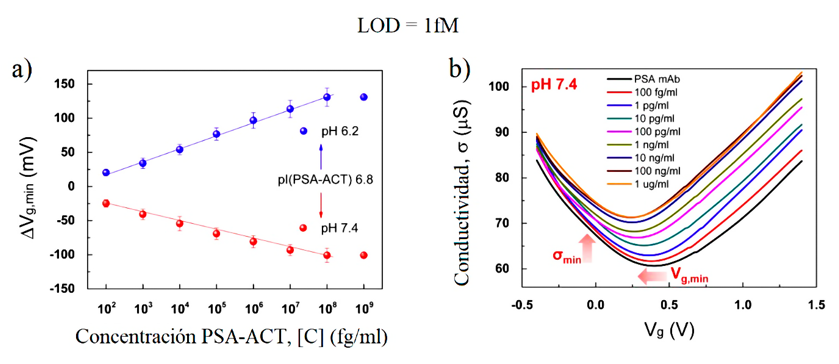
Según el tipo de voltaje puerta aplicado, los GFET se pueden agrupar en dos clases principales: los de compuerta trasera y los de compuerta líquida o puerta desde arriba. En el caso de los GFET de compuerta líquida, los parámetros fundamentales son: el control de la funcionalización, el conocimiento del mecanismo de las reacciones de detección en la superficie y la caracterización del número de cargas que lleva cada biomolécula [300].
Picca et al. [309] han propuesto un enfoque novedoso en los biosensores FET, utilizando la funcionalización del electrolito de compuerta con una monocapa autoensamblada (SAM, por sus siglas en inglés), la cual fue oportunamente diseñada para contener el biorreceptor. Esta estrategia permite obtener límites de detección unimoleculares [310, 311]. En este trabajo específicamente, se incorporó un inmunosensor de inmunoglobulina G (IgG) autoensamblado covalentemente en el electrodo de compuerta de oro, mientras que el grafeno se usó como material del canal del transistor y en los electrodos fuente y drenaje. La presencia en la SAM de una red extendida de enlaces de hidrógeno puede actuar como amplificador de la interacción analito-receptor. Se genera un momento dipolar que determina una reorganización de la red de enlaces de hidrógeno, lo que permite detectar un número muy limitado de eventos de enlace [309].
Los dispositivos que utilizan compuertas líquidas presentan el problema de generar resistencias capacitivas debido a la separación de cargas en la frontera del electrodo. Una solución se encuentra en usar agua desionizada como electrolito, ya que el agua desionizada baja la fuerza iónica y evita los efectos de detección de Debye (efectos de carga en la frontera del electrodo) [309]. Con esta modificación, algunos sensores pueden detectar los analitos en concentraciones subfemtomolares, específicamente para el dispositivo mencionado en el párrafo anterior se encontró un LOD de aproximadamente 100 aM y se observó un amplio rango dinámico.
Los biosensores G-FET han logrado ser aplicados con éxito para la detección de bacterias y sus actividades metabólicas. Mohanty, Nihar y Vikas Berry [312] utilizaron un pequeño parche, de unos cuantos micrómetros de grafeno, capaz de detectar la unión de una sola bacteria (Bacillus cereus Gram-positiva) [313]. Pese a que este estudio conceptual demostró la impresionante capacidad del grafeno FET para la detección de bacterias, la detección se basó en la adhesión electrostática no específica de bacterias sin discriminación de especies bacterianas y la medición se realizó en atmósfera de nitrógeno [312, 313]. Huang et al. modificaron grafeno CVD con anticuerpos anti-Escherichia coli, lo que permitió detectar concentraciones de E. coli tan bajas como 10 cfu∙mL-1 [313].
En un estudio realizado por Chen et al. [314], se utilizó un nuevo derivado de grafeno, el óxido de grafeno reducido (hRGO), funcionalizado con Magainina I para producir una sonda bacteriana de amplio espectro y proporcionar interacción electrostática entre Magainina I positivamente cargada y lipopolisacáridos aniónicos de E. coli [315]. A diferencia de los nanomateriales de carbono relacionados, hRGO conserva propiedades electrónicas aún al ser funcionalizado covalentemente, al tiempo que proporciona un alto porcentaje de oxígeno disponible, necesario para una funcionalización covalente efectiva [314]. Este semiconductor tipo p (rGO) como elemento transductor en los dispositivos FET facilita la interacción entre los sensores y las bacterias gram-negativas.
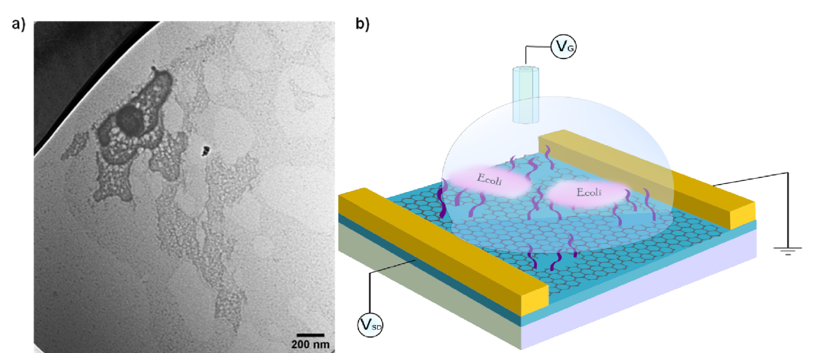
Los biosensores de glucosa a base de GFET son generalmente construidos al inmovilizar la glucosa oxidasa (GOD) en la superficie del grafeno, como el FET propuesto por Huang et al. [316], que unieron covalentemente el GOx por medio de aminas y el succinimidílico del ácido 1-pirenobutanóico; el extremo del pireno se une firmemente al grafeno a través de interacciones π-π [317]. Se logró la detección de la glucosa en concentraciones de hasta 0,1 mM al medir un cambio en la conductancia.
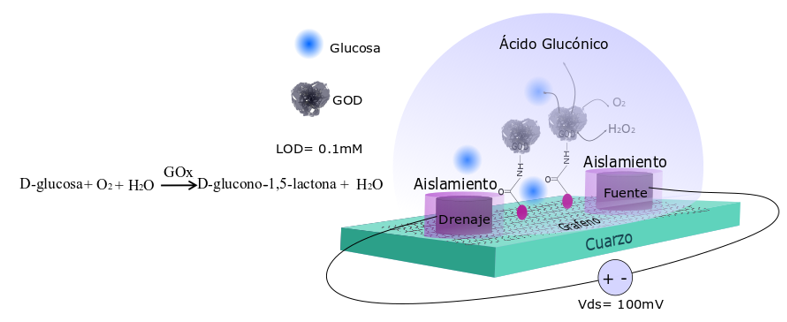
En el año 2020, el coronavirus SARS-CoV-2 del síndrome respiratorio agudo grave Covid-19 se ha convertido en un problema de salud mundial. Al 17 de noviembre de 2020, más de 5 5915 903 casos de Covid-19 fueron confirmados en todo el mundo, dando como resultado 1 342 683 de muertes [318]. Los materiales a base de grafeno han demostrado su valor en la contribución para combate con la pandemia. Los materiales basados en grafeno pueden contribuir en dispositivos de diagnóstico temprano y eficiente para la detección del SARS-CoV-2, así como para contener el brote.
Estudios recientes se han dedicado a la creación de estos sensores, entre los cuales está el biosensor reportado por Seo et al. [319], basado en FET para detectar una de las proteínas del SARS-CoV-2, cuyo anticuerpo se puede anclar a un electrodo de grafeno mediante el éster ácido 1-pirenobutírico N-hidroxisuccinimida (PBASE). En muestras clínicas se detectó con éxito el SARS-CoV-2 con un LOD en medio de cultivo y muestras clínicas de 1,6 × 101 pfu∙mL-1 y 2,42 × 10² copias∙mL-1.
El rendimiento del sensor se determinó utilizando proteínas antigénicas, virus cultivados y muestras de torunda nasofaríngea de pacientes con Covid-19 [319]. Se concluyó que el dispositivo es un método de diagnóstico inmunológico altamente sensible para Covid-19 que no requiere pretratamiento ni etiquetado de la muestra. Por lo tanto, proporciona una respuesta simple, rápida y altamente receptiva en la detección del virus SARS-CoV-2 en muestras clínicas. Esto demuestra la versatilidad y valía del grafeno.
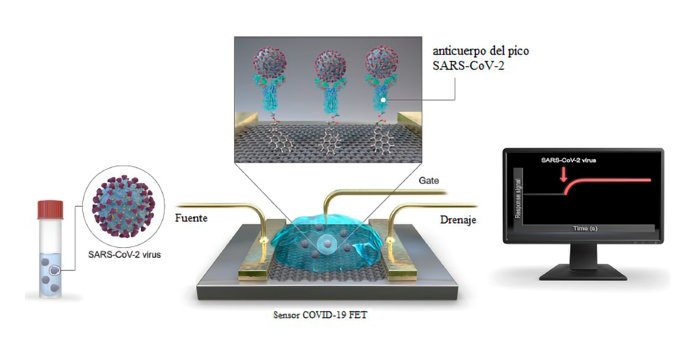
Biosensores ópticos a base de grafeno
En secciones anteriores se describieron sensores basados en grafeno, en los que la respuesta del transductor era eléctrica o electroquímica. Estos dispositivos indudablemente presentan una amplia variedad de aplicaciones, sin embargo, presentar también algunos puntos débiles, que pueden ser complementados o solventadas por métodos ópticos. Los sensores de grafeno basados en transistores miden los cambios elécticos inmediatos en la superficie del grafeno, esto limita parámetros como la resolución espacial o temporal que sí pueden ser detectados por medios ópticos [320, 321]. Aunado a lo anterior, las mediciones eléctricas generalmente dañan las células vivas, lo que podría tener un impacto en los resultados de las pruebas y la custodia de los resultados.
El desarrollo de sensores ópticos basados en grafeno pueden resolver estos problemas, ya que presentan alta resolución espacial, un alto rango detección, de sensibilidad, de precisión y la detección es rápida. De esta manera, no solo se puede cuantificar los analitos, sino que también se podrá detectar cambios en la estructura superficial del grafeno y su interacción con las biomoléculas [322, 323].
Los biosensores ópticos son instrumentos de detección potentes y herramientas versátiles para fines analíticos, no solo por su baja relación señal/ruido y los bajos requisitos de volumen de reactivo, sino también por ser inmunes a las interferencias electromagnéticas y por ser capaces de detectar de manera remota. Además, pueden proporcionar detección múltiple dentro de un solo dispositivo [324, 325]. Las respuestas de los biosensores ópticos son cambios de absorbancia, fluorescencia, fosforescencia, quimioluminiscencia, reflectancia, dispersión de luz o índice de refracción, plasmón superficial en fluorescencia, fibra óptica, FRET, entre otros [325-327].
El sensor de resonancia de plasmones de superficie (SPR) es uno de los sensores ópticos más utilizados [322] por propiedades tales como ser altamente sensible (no necesita marcaje), ser capaz de responder en tiempo real y su destacada detección de analitos relacionados con el diagnóstico médico (marcadores de cáncer, marcadores de alergia, marcadores de ataque cardíaco, anticuerpos, medicamentos y hormonas) [324].
La respuesta SPR del grafeno se beneficia de las notables propiedades de este material, tales como la capacidad de aprovechar la conductividad de la superficie mediante dopaje o campo externo [328-330], poseer transparencia a la luz blanca, alta movilidad electrónica, la banda sintonizable y la baja pérdida óhmica que facilita la formación de plasmones de propagación de largo alcance [329].
Wu et al. presentaron un biosensor SPR recubriendo un película de oro con grafeno [322]. En comparación con los dispositivos biosensores SPR tradicionales, el uso de grafeno como elemento de reconocimiento biomolecular (BRE) mejoró no solo la eficiencia de adsorción de las biomoléculas, sino que también detecta el cambio en el índice de refracción cerca de la superficie del sensor, mediante el uso de un método de reflexión total atenuada (ATR) [331].
Xu et al. [332] desarrollaron un novedoso biosensor basado en rejillas de periodo largo (RPL) en fibra óptica (Long Period Fiber Grating, LPFG, por sus siglas en inglés). Funcionalizando dichas rejillas con óxido de grafeno-glucosa oxidasa (GOD) mediante entrecruzamiento químico. Estos dispositivos combinan la catálisis enzimática con la biocompatibilidad de GO.
La superficie de RPL puede inmovilizar a la GOD por los abundantes puntos de anclaje, oxígenos del GO. En la superficie modificada se crea ácido glucónico y H2O2 debido a la reacción entre GOD y la glucosa, que a su vez efectúa un cambio del espectro de transmisión de RPL debido al cambio del índice de refracción circundante (SRI, por sus siglas en inglés, de Surrounding Refractive Index). Este sensor RPL modificado por GOD-GO genera una respuesta lineal con coeficiente de 0,77 nm (mg∙mL-1) (figura 13).
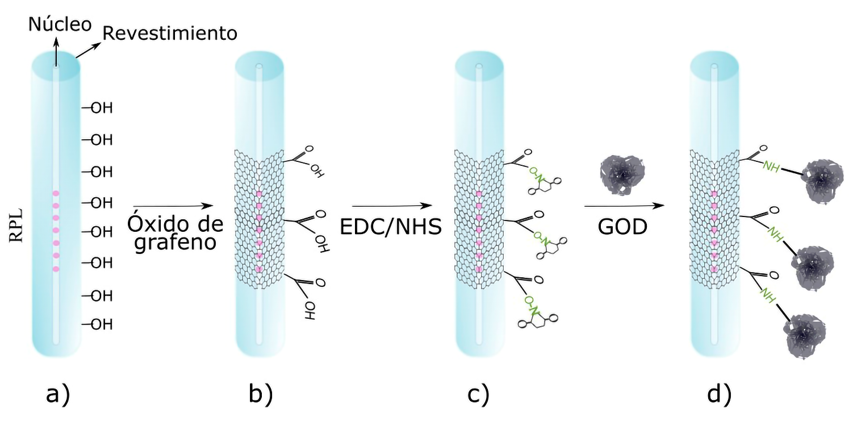
En comparación con los métodos electroquímicos, los biosensores in situ sin etiquetas basadas en fibra óptica han atraído gran atención debido a su alta sensibilidad, detección en tiempo real y efectiva resistencia electromagnética, proporcionando un nuevo método para detectar bioparámetros [332-335].
La hibridación de ADN se puede detectar utilizando técnicas ópticas como fluorescencia, quimioluminiscencia, resonancia de plasmones superficiales o interferometría [245]. Existen métodos que utilizan técnica de fluorescencia, donde el grafeno en estos casos ayuda a desactivar la señal fluorescente y atrae el uso de ensayos tipo “turn on/off” [268]. La desactivación de fluorescencia es el método de detección más común y menos complicado para sensores de ADN que emplean grafeno [336-341].
Una sola cadena de ácidos nucleícos tiene una afinidad natural con el sistema aromático de grafeno mediante el apilamiento π de sus nucleobases, en donde consecuentemente el ADNss (ADN de cadena sencilla) marcado con fluorescencia se adsorbe en la superficie del grafeno y la interacción de este con la molécula de colorante los acerca, permitiendo que ocurra una transferencia de energía, apagando efectivamente la fluorescencia del fluoróforo. Tras la hibridación del ADNss con su cadena complementaria, el ADN se desorbe del grafeno y se restaura la fluorescencia del sistema [245]. De esta manera, se pueden construir los biosensores “encendido” / “apagado”.
El óxido de grafeno también se utiliza para adsorber eficazmente el ADN y, al mismo tiempo, puede extinguir completamente los fluoróforos adsorbidos. Wu et al. [342] realizaron un estudio para mejorar la comprensión de las interacciones entre el ADN y el grafeno. En su estudio se empleó ADN de cadena sencilla de distintas extensiones (12, 18, 24 y 36 oliglonucleótidos), demostrando que la adsorción de ADN se puede ver afectada por varios factores, como el hecho de que los ADN de menor extensión se adsorben más rápido y se unen más fuertemente a la superficie del grafeno [342]. La adsorción se ve favorecida por un pH más bajo y una mayor fuerza iónica, además de permitir una desorción cercana al 100% del ADN absorbido en el grafeno [342].
Aunque los métodos de detección de fluorescencia han demostrado ser altamente sensibles, estos sensores a menudo sufren de bajo rendimiento debido a la eficiencia del etiquetado limitada, problemas de contaminación y los pasos complejos de purificación [245].
Mei, Qingsong y Zhongping Zhang [343] utilizaron el GO para diferentes grupos de analitos, pero en lugar de emplear el GO como desactivador o extintor y un fluoróforo adicional acoplado a un elemento de reconocimiento, usaron el propio GO como fluoróforo. El GO se hizo reaccionar con 1-butanamina para formar nanoláminas que emiten en el azul, y esta emisión puede eliminarse en presencia de nanopartículas de plata (AgNP) funcionalizadas con ligandos, anticuerpos y oligonucleótidos.
Tras la adición de analitos, los AgNP se disocian de las nanocapas y, por lo tanto, la fluorescencia se restablece de inmediato. Simplemente cambiando los elementos de reconocimiento en las nanopartículas de Ag, lograron la detección de glutatión, ADN y como proteína modelo: la inmunoglobulina G (IgG), en el rango de pM [245]. Sin embargo, como aspecto complementario, se debe considerar la longitud de onda de baja excitación de 350 nm, que podría causar algunos problemas en muestras biológicas reales en términos de señales de fondo altas.
El grafeno, GO y rGO son aceptados como desactivadores universales, y se han utilizado como superficies receptoras en muchas aplicaciones basadas en transferencia de energía [344]. FRET es el proceso no radiactivo más común basado en la transferencia de energía electromagnética entre el donador excitado y un receptor [345]. Este método puede convertir las interacciones biomoleculares de campo cercano en señales de campo lejano. Con la aparición de la nanotecnología, diversas nanopartículas han mejorado este método de detección [315].
Cheng et al. [346] realizaron un estudio para la detección de ATP, como una pequeña molécula biológica, con aptámeros (secuencia base: 5′-NH2-(CH2)6-ACCTGGGGGAGTATTGCGGAGGAAGGT-3′) y GO. La superficie de GO se utilizó como molécula aceptora. El aptámero selectivo de ATP, a través de sus grupos nitrogenados orgánicos, se pliega y crea una estructura de cadena globular en presencia del analito. Como resultado de eso, los grupos laterales pueden contribuir al enlace de hidrógeno, y las interacciones π en el aptámero se bloquean y liberan a los aptámeros de la superficie GO [347].
Los puntos cuánticos de grafeno (GQD), que son hojuelas de grafeno de menos de 20 nm [348], sirven como donantes en los estudios FRET debido a su buena solubilidad, facilidad de síntesis [349] y capacidades de modificación [350]. Además, los GQD muestran efectos de confinamiento cuántico como resultado de su tamaño pequeño y sintonizable, lo que permite adaptar su espectro de energía de excitación, entre 300 y 470 nm [351].
El uso de GQD como moléculas donantes en sistemas FRET permite la excitación del sistema más allá del rango de excitación del aceptor, lo que resulta en señales de luminiscencia mejoradas [347, 352]. Los GQDs presentan facilidad de funcionalización de su superficie, lo que permite integrarlos con sistemas biológicos [353] para el desarrollo de biosensores bacterianos [315].
Morales‐Narváez, Eden, Abdel‐Rahim Hassan y Arben Merkoçi [354] crearon un sensor de fase sólida para la detección de patógenos. Como aceptor de transferencia de energía para biosensores se utilizaron sondas GO y puntos cuánticos de anticuerpos (Ab-QD) para la detección de E. coli. En el trabajó se utilizaron CdSe@ZnS QDs funcionalizados con estreptavidina (núcleo-caparazón) como sonda de fotoluminiscencia. Dichos sistemas se combinaron con GO, como desactivador de fotoluminiscencia de largo alcance (ya que el GO exhibe una amplia emisión de fotoluminiscencia desde el infrarrojo cercano hasta longitudes de onda del ultravioleta [355]), y consecuentemente como agente revelador de patógenos [315].
En la investigación, la fotoluminiscencia de los microarreglos Ab-QDs fue desactivada por GO, como el aceptador FRET que se activó después de la interacción de E. coli. El sistema de detección de patógenos con GO, propuesto por este grupo de investigadores, es altamente sensible, exhibiendo un LOD de aproximadamente 5 cfu∙mL-1 para E. coli en PBS y en agua de grifo.
Debido a que nanosondas basadas en FRET presentan una limitación significativa por la baja relación señal/ruido, los investigadores Liao, Yuhui, Xiaoming Zhou y Da Xing [356] integraron QDs con GO para superar los falsos negativos y reducir la probabilidad de falsos descartes en las pruebas de rutina.
La detección de múltiples bacterias al mismo tiempo tiene una ventaja significativa en el diagnóstico médico y campos relacionados. Duan et al. [357] realizaron un estudio que admite detección simultánea de los patógenos Vibrio parahaemolyticus y Salmonella typhimurium. Este utiliza el mismo principio de transferencia de energía de resonancia de fluorescencia dual de puntos cuánticos emisores verdes (gQD) y puntos cuánticos emisores rojos (rQD) como donantes, y en nuevas nanopartículas de carbono amorfo (CNP) que actúan como aceptor.
De manera general, existen numerosas investigaciones realizadas con base en grafeno en esta área con gran diversidad de analitos, en la tabla 4 se muestras algunas de estas. Se puede observar que aún para una sola categoría de analito se tiene una pluralidad de funcionalizaciones de grafeno para la detección. El grafeno y los nanomateriales basados en grafeno son excelentes materiales para electrodos y presentan ciertas ventajas sobre los electrodos clásicos, sin embargo, todavía existen temas abiertos que requieren de oportunidades de mejora para la investigación científica.
Analito
Sensor
Método
Composición
Límite de detección (µM)
Rango linear (µM)
Referencia, año
Glucosa
GOx/RGO/ β-ciclodextrina
Electroquímico
GOx inmovilizado en óxido de grafeno reducido (RGO) y compuesto β-ciclodextrina (CD) .
12,0
50-3,0x10³
[358], 2015
RGO-C-PPy/ NTH
Óxido de grafeno reducido (rGO)- polipirrol carboxilado (C-PPy) nanotubos (NT) híbridos
0,001
-
[359], 2015
NPs/RGO/CS/PS
Electrodo plano nanoporoso mediante “drop casting” de un nanocompuesto que consiste en rGO y quitosano sobre un sustrato de poliéster.
5,0
10-750
[360], 2016
Gr-PE-AuNPs H
Híbrido de nanopartículas de grafeno-polietilenimina-oro
0,32
1-100
[361], 2016
GODx/ZnS-CdS/ MWCNT/GCE
Glucosa oxidasa (GODx) usando punto cuántico ZnS / CdS (QD) modificado nanotubo de carbono de pared múltiple / electrodo de carbono vítreo
3,0
10-1,0x10³
[362], 2017
PVP-protegido G-GOD-PFIL modificado GC
Grafeno protegido con polivinilpirrolidona / líquido iónico funcionalizado con polietilenimina / biosensor electroquímico GOD
6000
14000
[363], 2009
LIG/PtNPs
Electrodo LIG usando tratamiento con ácido acético, el compuesto de hitosan-glucosa oxidasa (GOx) se inmovilizó con éxito en el electrodo
0,3
2100
[263], 2020
G/PVP/PANI-modificado
Nanocompuesto de grafeno (G), polivinilpirrolidona (PVP) y polianilina (PANI)
1,0
50-10000
[364], 2014
Pt/rGO/P3ABA
Platino / óxido de grafeno reducido / poli (ácido 3-aminobenzoico) (Pt / rGO / P3ABA) película de nanocompuesto en un electrodo de carbón serigrafiado (SPCE)
40,5
250-4000
[365], 2019
Colesterol
(ChEt/Chox)-FC/Gr
Electroquímico
Electrodo de grafito modificado con grafeno y colesterol esterasa / colesterol oxidasa
5,0
50-300
[366], 2012
AgNWs/ZnO/ITO/ GO/CS
Nanocables de plata y óxido de zinc modificados en un electrodo de óxido de indio y estaño con GO y quitosano
0,287
6,5-10 x 103
[367], 2016
RGO/SiO2
RGO/SiO2: sistema híbrido reducido de partículas de óxido de grafeno-sílice
1,3 x 10³
2,6 x 10³-15,5 x 10³
[368], 2015
ChOx /GCE/CS/GR
Hojas de grafeno (G) nanocables de titanio incrustados con grafeno interconectado
0,715
5-1,0 x 10³
[369], 2015
Dopamina
GQDs-MWCNTs
Electroquímico
Sensor electroquímico ultrasensible basado en compuestos de puntos cuánticos de grafeno / nanotubos de carbono de paredes múltiples (GQDs-MWCNTs) para detectar dopamina
0,87 nM
0,005-100,0
[289], 2020
TC-GQD
El nanocompuesto de punto cuántico de titania-ceria-grafeno (TC-GQD) se sintetizó por método hidrotérmico
0,22
1-500
[370], 2020
ITO/N Gr film
Electrodos de óxido de indio y estaño (ITO), modificados con películas de N-grafeno
0,005
2-240
[371], 2018
PEDOT/LS-Gr
Grafeno modificado con láser modificado con poli (3,4-etilen dioxitiofeno) (PEDOT)
0,33
1-150
[372], 2018
NADH
Gr-PQQ/CTS
Electroquímico
Grafeno-pirroloquinolina quinona quitosano
0,16
0,32 - 220
[373], 2017
poly(o-anisidine)/ Gr
poli (oanisidina) / grafeno
1,3
0,166-1,72
[374], 2015
Gr-DNA-AuNps/Au Disk
Disco de oro modificado con nanopartículas de grafeno-ADN tetraedro-oro
0,000001 x 10³
0,000001X10³-0,09X10³
[375], 2015
SPCE/RGO/PNR/AuNP
Electrodo serigrafiado modificado con óxido de grafeno reducido / rojo polineutral / nanopartícula de oro
0,384
5-3170
[376], 2020
DNA/graphene/MB)
GCE modificada con ácido desoxirribonucleico, azul de grafeno metileno
1,0
10-1500
[377], 2013
Au nanopartícula/ rGO nanocompuesto
Nanopartículas de oro / nanocompuestos de óxido de grafeno reducido GCE modificado
0,00113
0,05-500
[378], 2015
ERGO–PTH/GC
Óxido de grafeno electroreducido y GCE modificado con polittionina
0,1
10-3900
[379], 2013
Ácido ascóbico
GCE with GO-Ag-Fe3O4
Electroquímico
Óxido de grafeno bien exfoliado acoplado con Ag o Ag-Fe3O4
0,074
0,2-60
[380], 2020
3,4-EDOT/rGr
Electrodo de carbono vítreo modificado (3,4 etilendioxitiofeno) / óxido de grafeno reducido / dióxido de manganeso
1,00
1-800
[381], 2018
rGO-SnO2 composite
Óxido de grafeno reducido (rGO) - compuesto de óxido de estaño (SnO2)
38,7
400-1600
[382], 2018
GrS/Gr NR
Lámina de grafeno / nanofibra de grafeno
0,23
10-360
[383], 2015
Epirubicina
PP/NrG/ds-DNA/PGE
Electroquímico
Electrodo de grafito de lápiz con polipirrol, grafeno reducido dopado con nitrógeno (para mejorar la conductividad eléctrica) y el esperma de salmón ds-DNA
0,001
0,004-55,0
[384], 2019
Pesticida (Paraoxon)
GO
Electroquímico
Grafeno funcionalizado GO
0,00065
10-1000
[385], 2014
Pesticida (Fenoxycarb)
QDs Gr
Óptico
Puntos cuánticos de grafeno, por fluorescencia
3,15
6-70
[386], 2017
Micotoxina (Ochratoxin A)
GO
Óptico
Óxido de grafeno, funcionalizado por fluorescencia
0,0187
2-35
[387], 2011
Alergenos (Maní)
Gra, Au NPs
Electroquímica
Grafeno, con nanopartículas de oro.
4,1 x 10⁻¹¹
1x10⁻¹⁰-1x10⁻⁷
[388], 2015
Alergenos (camarón)
GO
Óptico
Óxido de grafeno, fluorescencia
0,0042
-
[389], 2017
Patógenos (Norovirus)
Gr, AuNPs
Electroquímico
Grafeno junto con nanopartículas de oro
0,0001
-
[390], 2017
Patógeno (S.aureus)
QDs Gr, Au NPs tipo FRET (Fluorescencia de transferencia de energía por resonancia)
Óptico
Puntos cuánticos de grafeno con nanopartículas de oro
0,001
-
[352], 2015
ADN Virus SARS
GO-FAM d
Fluorescencia “Encendido/apagado” basado en Óxido de grafeno con aditivo de tinte FAMd
0,1
-
[391], 2010
Iones de metales pesados
Hg2+
(ssDNA-GO, tinte FAM (WSGO) y sonda de oligonucleótido específico de mercurio (II) marcado con colorante (MSO)
Fluorescencia “encendido/apagado” de GO con receptor de aptamero
0,000187
Hasta 0,623
[392], 2011
ssDNA-GO, tinte GO
Fluorescencia “encendido/apagado” de GO con receptor de aptámero
0,00092
0,001- 0,05
[393], 2013
(ssDNA–GO, tinte fuoresceína
Fluorescencia “encendido/apagado” de GO con receptor de aptámero
0,0057
Hasta 10
[340],2011
Aminoácido Cys
GO-ssADN, AgNP
Fluorescencia, óxido de grafeno con receptor de ADN de cadena sencilla, con aditivos de nanopartículas de plata
0,002
Hasta 0,001
[394], 2011
Aminoácido Cys
GO-ssADN, AgNP
Fluorescencia, óxido de grafeno con receptor de ADN de cadena sencilla, con aditivos de nanopartículas de plata
0,002
Hasta 0,001
[394], 2011
Aminoácido Cys
GO-ssADN, AgNP
Óptico
Fluorescencia, óxido de grafeno con receptor de ADN de cadena sencilla, con aditivos de nanopartículas de plata
0,002
Hasta 0,001
[394], 2011
Inmunoglobulina IgE
Gr-ssADN
Transistor de efecto de campo, FET
Transistor de efecto de campo con grafeno exfoliado, con receptor de aptámero
-
0,00026- 0,16
[395], 2011; [396], 2010
PSA
rGO-APTMS, PDMS
Transistor de efecto de campo con óxido de grafeno reducido, con sensor aditivo de APTMS y PDMS
100 pg∙mL-1
Hasta 10 ng∙mL-1
[307], 2013
ADN
CVD-Grafeno- AuNPs
Grafeno CVD con aditivos de sensor de Nanopartículas de oro
1x10⁻⁵
0,01-0,5
[397], 2010
rGO – AuNPs
Óxido de grafeno reducido con aditivos de sensor de Nanopartículas de oro
0,2
Solo se midió una concentración
[398], 2010
H2O2
Gr-PPy
Compuestos de nanotubos de grafeno-polipirrol (PPy)
1x10⁻⁴
-
[399], 2014
CTCs
GQD CACTACAGAGGTTGCGTCTGTCCCACGTTGTCATGGGGGGTTGGCCTG aptamero, con GQDs –MoS2
Óptico
FRET GQD donador y MoS2 aceptor basado en señal encendido
0,00119
-
[400], 2019
Trombina
Aptámero TACGGTTGGTGTGGTTGG, Ag@SiO2 NPs- GO
Señal “encendido/apagado” de receptor óxido de grafeno y donador aptamero etiquetado de Nanopartículas de plata con SiO2
5x10⁻⁵
-
[401], 2016
Kanamicina
Aptamero GCGCGCCACGGGCGCGCGCGCGGCGGCTACCCCACCGCGCGCG FAM etiquetado-rGO
Señal encendido/ apagado de óxido de grefeno reducido como aceptor y FAM como donador
1x10⁻⁶
-
[402], 2017
Conclusiones
El grafeno presenta un gran potencial en el tratamiento de aguas, en su uso como almacenador de carga, biosensor o foto detector. No obstante, se necesitan establecer procedimientos que permitan su síntesis a nivel industrial con un número de defectos mucho menores a los que tienen lugar en la actualidad. Además, se requiere un mejor control de las modificaciones, sobre todo la que se usa para oxidar el grafeno, ya que el grado de oxidación, los defectos y los grupos funcionales obtenidos siguen siendo variables, lo que se traduce en poca reproducibilidad de los dispositivos.
A pesar de todos estos inconvenientes, el grafeno es uno de los materiales con mayor potencial para sustituir los electrodos en las baterías de litio y poslitio, así como los electrodos en las diferentes tecnologías de fotogeneración de corriente y como electrodo en los diferentes biosensores.
En el área del tratamiento y desalinización del agua, otro tipo de funcionalizaciones que permitan mayor selectividad deben ser estudiadas, sin embargo, el potencial de este material utilizado como soporte ya se muestra en las diferentes tecnologías enunciadas en este artículo de revisión.
Los biosensores que utilizan grafeno muestran mucho potencial para le detección de un alto número de enfermedades, además de que pueden ser utilizados en una gran variedad de tecnologías (florescencias, electroquímicas, efecto de campo, entre otras); esto significa que se podría diseñar una tecnología para cada una de las enfermedades que han sido estudiadas y mencionadas en esta revisión. Los autores de este trabajo consideramos que, a pesar de los problemas de reproducibilidad que presentan la mayoría de estos sistemas, muy pronto se encontrarán biosensores que utilicen grafeno en el mercado.
Sin importar a cuál de las aplicaciones hagamos referencia, en general el grafeno sigue presentando problemas de reproducibilidad en los diferentes dispositivos. Dicha problemática es uno de los temas de estudio más pujantes por parte de la industria y la academia, a pesar de que actualmente la producción de grafeno CVD es multimillonaria.
Referencias
Referencias
https://doi.org/10.1002/smll.201002009.
https://doi.org/10.1002/adfm.201203421
https://doi.org/10.1038/nature26160.
https://doi.org/10.1016/j.joi.2020.101067
https://doi.org/10.1002/lpor.200810039
https://doi.org/10.1021/cr3000412
https://doi.org/10.1021/nn1035203.
https://doi.org/10.1021/nl801827v
https://doi.org/10.1038/s41565-019-0555-2
https://doi.org/10.1016/j.ssc.2008.02.024
https://doi.org/10.1002/adma.201001068
https://doi.org/10.1063/1.2768624.
https://doi.org/10.1021/nl071168m.
https://doi.org/10.1103/PhysRevLett.105.127404
https://doi.org/10.1103/PhysRevLett.102.206410.
https://doi.org/10.1021/nl202318u.
https://doi.org/10.1038/nphys2564.
K. Wolfgang, Ultrashort Laser Pulses and Applications, Springer Berlin Heidelberg, 2013.
https://doi.org/10.1126/science.1102896
https://doi.org/10.1021/nl9039636
International, T. Roadmap, For and Semiconductors, “2012 Update Overview”, 2012. http://www.itrs.net/links/2012itrs/home2012.htm.
E. Y. Andrei, G. Li & X. Du, “Electronic properties of graphene: a perspective from scanning tunneling microscopy and magnetotransport”, Reports Prog. Phys., vol. 75, n.o 5, p. 56501, 2012, [Online]. Available: http://stacks.iop.org/0034-4885/75/i=5/a=056501.
https://doi.org/10.1021/cr300115g
https://doi.org/10.1021/la302750e
https://doi.org/10.1002/jrs.4312.
https://doi.org/10.1021/nl901596m
https://doi.org/10.1016/j.jtice.2018.10.028
https://doi.org/10.1038/nnano.2009.58
https://doi.org/10.5714/CL.2017.21.093.
https://doi.org/10.1002/pssa.201600091.
https://doi.org/10.1038/s41565-019-0555-2
https://doi.org/10.1088/2053-1583/ab1e0a
https://doi.org/10.1038/nnano.2008.215
R. R. Nair, P. Blake, A. N. Grigorenko et al.,“Fine Structure Constant Defines Visual Transparency of Graphene”, Sci., vol. 320, n.o 5881, p. 1308, Jun. 2008. [Online]. Available: http://www.sciencemag.org/content/320/5881/1308.abstract.
X. Li, W. Cai, J. An et al., “Large-Area Synthesis of High-Quality and Uniform Graphene Films on Copper Foils”, Science, vol. 324, n.o 5932, pp. 1312-1314, Jun. 2009. [Online]. Available: http://science.sciencemag.org/content/324/5932/1312.abstract.
https://doi.org/10.1088/1367-2630/11/2/023006
https://doi.org/10.1016/j.carbon.2017.04.067
C. N. R. Rao & A. K. Sood, Graphene: Synthesis, Properties, and Phenomena, Weinheim: Wiley, 2013.
https://doi.org/10.1039/C5NR03892H.
https://doi.org/10.1103/RevModPhys.81.109.
https://doi.org/10.1039/C0JM00261E.
J. H. Warner, F. Schaffel, M. Rummeli & A. Bachmatiuk, Graphene: Fundamentals and emergent applications. Elsevier Science, 2012.
S. K. Pati, T. Enoki & C. N. R. Rao, Graphene and Its Fascinating Attributes. World Scientific, 2011.
https://doi.org/10.1103/PhysRevB.64.125428.
https://doi.org/10.1038/nmat1849.
https://doi.org/10.1103/PhysRev.71.622.
https://doi.org/10.1038/nphoton.2010.186.
https://doi.org/10.1038/nnano.2008.199.
https://doi.org/10.1002/aelm.201600223
https://doi.org/10.1063/1.3122348
https://doi.org/10.1103/PhysRevB.82.125304.
https://doi.org/10.1103/PhysRevLett.100.117401.
B. H. N. & V. H. Nguyen, “Advances in graphene-based optoelectronics, plasmonics and photonics”, Adv. Nat. Sci. Nanosci. Nanotechnol, vol. 7, n.o 1, p. 13002, 2016. [Online]. Available: http://stacks.iop.org/2043-6262/7/i=1/a=013002.
https://doi.org/10.1103/PhysRevLett.95.187403.
https://doi.org/10.1103/PhysRevLett.95.236802.
https://doi.org/10.1016/j.orgel.2012.01.002
H. Terrones, R. Lv, M. Terrones & M. S. Dresselhaus, “The role of defects and doping in 2D graphene sheets and 1D nanoribbons”, Reports Prog. Phys., vol. 75, n.o 6, p. 62501, 2012. [Online]. Available: http://stacks.iop.org/0034-4885/75/i=6/a=062501.
https://doi.org/10.1126/science.1167130
https://doi.org/10.1021/nn102034y
https://doi.org/10.1002/smll.201001555
https://doi.org/10.1016/j.cplett.2004.10.021
https://doi.org/10.1021/nn1025274
https://doi.org/10.1038/nnano.2008.210.
https://doi.org/10.1002/adma.200903932
https://doi.org/10.1002/adma.200903689.
https://doi.org/10.1021/ar300138e
https://doi.org/10.1038/nchem.907.
https://doi.org/10.1016/j.envint.2019.03.029.
L. G. P. Jayakaran, G. S. Nirmala, “Qualitative and Quantitative Analysis of Graphene-Based Adsorbents in Wastewater Treatment”, Int. J. Chem. Eng., vol. 17, p. 9872502, 2019.
https://doi.org/10.1038/s41545-018-0004-z.
https://doi.org/10.1021/nl802558y.
https://doi.org/10.1088/0953-8984/26/44/443001.
https://doi.org/10.1038/ncomms10891
https://doi.org/10.1021/acsami.6b04338
https://doi.org/10.1016/j.cej.2011.07.041
https://doi.org/10.1021/am301372d
https://doi.org/10.1007/s11434-012-4986-5
https://doi.org/10.1039/c3nr33708a
https://doi.org/10.1016/j.cej.2013.04.045
https://doi.org/10.1016/j.colsurfb.2011.10.019.
https://doi.org/10.1109/ICCA.2011.6137934
https://doi.org/10.1016/j.cej.2011.07.050
https://doi.org/10.1039/C2JM34128J
https://doi.org/10.1016/j.cis.2013.12.005
https://doi.org/10.1016/j.jcis.2011.05.050.
https://doi.org/10.1016/j.jhazmat.2011.11.097
https://doi.org/10.1016/j.cherd.2012.07.007.
https://doi.org/10.1016/j.colsurfb.2012.05.036
https://doi.org/10.1002/clen.201200460.
https://doi.org/10.1016/j.jallcom.2012.11.190
https://doi.org/10.1021/am300889u.
https://doi.org/10.1039/C2TA00406B
https://doi.org/10.1007/s12274-011-0111-3
https://doi.org/10.1021/la301476p
https://doi.org/10.1016/j.watres.2012.12.031
https://doi.org/10.1016/j.cej.2011.07.072
https://doi.org/10.1016/j.watres.2013.04.033.
https://doi.org/10.1002/adma.201101007
https://doi.org/10.1016/j.apsusc.2012.08.045.
https://doi.org/10.1016/j.colsurfa.2012.11.063
https://doi.org/10.1016/j.colsurfa.2013.02.030
https://doi.org/10.1016/j.desal.2011.01.038
https://doi.org/10.1021/es203439v
https://doi.org/10.1039/C1NR10549C
https://doi.org/10.1016/j.carbon.2010.10.024
https://doi.org/10.1021/am200300u
https://doi.org/10.1021/am201645g
https://doi.org/10.1016/j.jiec.2012.01.005
https://doi.org/10.1016/j.cej.2012.09.078
https://doi.org/10.1039/C3PY21128B.
https://doi.org/10.1016/j.cej.2012.09.030
https://doi.org/10.1016/j.cej.2010.08.010
https://doi.org/10.1039/C2JM00055E
https://doi.org/10.1016/j.jhazmat.2010.06.010
https://doi.org/10.1021/nn1008897
J. H. Warner, F. Schaffel, M. H. Rummeli & A. Bachmatiuk, Graphene: Fundamentals and Emergent Applications. Oxford: Elsevier Science & Technology Books, 2013.
https://doi.org/10.1021/nl9001525
https://doi.org/10.1038/nature07719
https://doi.org/10.1038/nnano.2010.132
https://doi.org/10.1002/anie.200704909.
https://doi.org/10.1021/nl080649i
https://doi.org/10.1038/nnano.2014.215.
https://doi.org/10.1063/1.2990753
https://doi.org/10.1038/nnano.2009.292
https://doi.org/10.1038/nphoton.2010.40
https://doi.org/10.1038/nnano.2014.31.
https://doi.org/10.1038/nnano.2012.60
https://doi.org/10.1109/JQE.2013.2261472
https://doi.org/10.1021/acs.nanolett.6b02354
https://doi.org/10.1166/jnn.2015.11654
https://doi.org/10.1016/j.progpolymsci.2012.08.001
https://doi.org/10.1166/sam.2015.2438
https://doi.org/10.1002/cssc.201600942.
https://doi.org/10.1109/PVSC.2014.6924936
F. Dimroth, “New world record for solar cell efficiency at 46%”, Fraunhofer Institute for Solar Energy Systems ISE, 2014. https://www.ise.fraunhofer.de/content/dam/ise/en/documents/press-releases/2014/2614_ISE_PI_e_World_record_46_percent.pdf.
https://doi.org/10.3390/polym10020217.
https://doi.org/10.1021/nl501981f
https://doi.org/10.1088/0957-4484/21/50/505204
https://doi.org/10.1002/adma.201003673.
https://doi.org/10.1021/nl2029859
https://doi.org/10.1021/nn901587x
https://doi.org/10.1021/nn301721q
https://doi.org/10.1021/nl303920b
https://doi.org/10.1002/adma.201100645
https://doi.org/10.1002/adma.201205337
https://doi.org/10.1021/am508006q
https://doi.org/10.1002/adma.201104945
https://doi.org/10.1021/nl4046284
https://doi.org/10.1021/acs.nanolett.5b00787
https://doi.org/10.1021/nl403997a
https://doi.org/10.1021/ja4132246
https://doi.org/10.1039/C4NR03181D
https://doi.org/10.1016/j.nanoen.2014.12.022
https://doi.org/10.1039/C4TA05196C
https://doi.org/10.1038/nnano.2014.181
https://doi.org/10.1021/nn1015874.
https://doi.org/10.1088/0022-3727/49/10/105106
https://doi.org/10.1021/nn204675r
https://doi.org/10.1021/acsami.7b09702
https://doi.org/10.1039/C4TA03432E
https://doi.org/10.1002/adma.200800366
https://doi.org/10.1002/adfm.200800954
https://doi.org/10.1002/pssa.201084174
https://doi.org/10.1016/j.solmat.2010.07.001
https://doi.org/10.1021/nn101671t
https://doi.org/10.1002/adma.201003819
https://doi.org/10.1021/ja2036749
https://doi.org/10.1038/am.2013.38
https://doi.org/10.1038/srep39555
https://doi.org/10.1039/C3EE40963E
https://doi.org/10.1002/polb.23180
https://doi.org/10.1021/acsami.5b01161
https://doi.org/10.1021/acsami.5b04555
https://doi.org/10.1088/0957-4484/22/29/295606
https://doi.org/10.1039/C1PY00275A
https://doi.org/10.1038/nphoton.2009.192
https://doi.org/10.1038/nmat3160.
https://doi.org/10.1002/adma.200702337
https://doi.org/10.1063/1.2938865
https://doi.org/10.1021/nn402606v
https://doi.org/10.1002/adfm.201404046
https://doi.org/10.1007/s12274-009-9032-9
https://doi.org/10.1016/J.CARBON.2017.08.001
https://doi.org/10.1002/adfm.201808843
https://doi.org/10.1021/acs.chemrev.8b00539
https://doi.org/10.1039/C9EE01479A
https://doi.org/10.1002/adfm.201808843.
https://doi.org/10.1021/acs.chemrev.8b00539
https://doi.org/10.1039/C9EE01479A
https://doi.org/10.1002/anie.201802595
https://doi.org/10.1126/science.1212741
C. Pillot, “The Rechargeable Battery Market and Main Trends 2012-2025”, 2015. https://rechargebatteries.org/wp-content/uploads/2020/01/avicenne-energy_pillot-2017.pdf
https://doi.org/10.1038/nenergy.2016.141
https://doi.org/10.1016/j.mtchem.2018.11.006.
K. Edström, “BATTERY 2030+. Inventing the sustainable batteries of the future. Research needs and future actions”, p. 83, 2020. https://ec.europa.eu/digital-single-market/en/news/inventing-sustainable-batteries-future
https://doi.org/10.1016/j.jpowsour.2007.06.154
https://doi.org/10.1149/1.3258274
https://doi.org/10.1039/b901551e
https://doi.org/10.1016/0008-6223(96)00177-7.
https://doi.org/10.1021/nl800957b
https://doi.org/10.1021/cm900395k
https://doi.org/10.1021/ja106162f.
C. Kun & C. Weixian, “L -Cysteine-Assisted Synthesis of Layered MoS2/Graphene Composites with Excellent Electrochemical Performances for Lithium Ion Batteries”, ACS Nano, vol. 5, n.o 6, pp. 4720-4728, 2011.
X. Zhu, Y. Zhu, S. Murali, M. D. Stoller & R. S. Ruoff, “Nanostructured Reduced Graphene Oxide/Fe2O3 Composite As a High-Performance Anode Material for Lithium Ion Batteries”, ACS Nano, vol. 5, n.o 4, pp. 3333-3338, 2011.
https://doi.org/10.1002/cssc.201300838
https://doi.org/10.1038/nnano.2007.411
https://doi.org/10.1149/2.0101701jes
https://doi.org/10.1149/1.2817828
https://doi.org/10.1039/b919738a
https://doi.org/10.1021/acs.nanolett.7b00906.
https://doi.org/10.1002/advs.201500097
https://doi.org/10.1021/ja105296a
https://doi.org/10.1002/adma.201300071
https://doi.org/10.1002/smll.201603973
https://doi.org/10.1021/acsami.7b03705
https://doi.org/10.1038/s41598-017-03603-1
https://doi.org/10.1021/acs.accounts.5b00482
https://doi.org/10.1016/j.carbon.2013.01.064
https://doi.org/10.1039/c5ta00727e
https://doi.org/10.1039/c3cc40448j
https://doi.org/10.1002/asia.201400018
https://doi.org/10.1002/smll.201502788
https://doi.org/10.1002/adfm.201402428
https://doi.org/10.1039/c7ee01628j
https://doi.org/10.1007/s10854-017-7215-9
https://doi.org/10.1021/nl502759z
https://doi.org/10.1039/c7nr05470j
https://doi.org/10.3389/fchem.2019.00268
https://doi.org/10.1021/acs.chemrev.6b00614.
https://doi.org/10.1016/j.jpowsour.2019.03.049
M. Fichtner, Battery, n.o 23. The Royal Society of Chemistry, 2020.
https://doi.org/10.1038/nature14340
https://doi.org/10.1126/sciadv.aao7233
https://doi.org/10.1002/adma.201604118
https://doi.org/10.1002/aenm.201700034
https://doi.org/10.1002/adma.201605958
https://doi.org/10.1002/aenm.201700051
https://doi.org/10.1002/adma.20170142
https://doi.org/10.1039/c7ta04477a
https://doi.org/10.1016/j.jechem.2019.09.025
G. Graphenano, “GRABAT”, 2020. https://www.grabat.es/
K. Balasubramanian & M. Burghard, “Biosensors based on carbon nanotubes”, Anal. Bioanal. Chem., vol. 385, n.o 3, pp. 452-468, 2006.
M. Ferrari, BioMEMS and Biomedical Nanotechnology: Volume IV: Biomolecular Sensing, Processing and Analysis, vol. 4. Springer Science & Business Media, 2007.
S. K. Arya & S. Saha, “JE Ramirez vick, V. Gupta, S. Bhansali, SP Singh”, Anal. Chim. Acta, vol. 737, p. 1, 2012.
F. D’Souza & K. M. Kadish, Handbook of carbon nano materials, vol. 3. World Scientific, 2012.
https://doi.org/10.1021/jp206196k.
Z. Altintas, Biosensors and nanotechnology: applications in health care diagnostics. John Wiley & Sons, 2017.
H. B. Akkerman, P. W. M. Blom, D. M. De Leeuw & B. De Boer, “Towards molecular electronics with large-area molecular junctions”, Nature, vol. 441, n.o 7089, pp. 69-72, 2006.
A. Tiwari, H. K. Patra & A. P. F. Turner, Advanced Bioelectronic Materials. John Wiley & Sons, 2015.
P. Yáñez‐Sedeño, R. Villalonga & J. M. Pingarrón, “Electroanalytical methods based on hybrid nanomaterials”, Encycl. Anal. Chem. Appl. Theory Instrum., pp. 1-22, 2006.
W. Goepel, T. A. Jones, M. Kleitz, I. Lundström & T. Seiyama, Sensors, chemical and biochemical sensors, vol. 2. John Wiley & Sons, 2008.
N. S. Anuar, W. J. Basirun, M. Shalauddin & S. Akhter, “A dopamine electrochemical sensor based on a platinum–silver graphene nanocomposite modified electrode”, RSC Adv., vol. 10, n.o 29, pp. 17336-17344, 2020.
https://doi.org/10.1021/acs.jpcc.7b09256
A. Pandikumar, G.T.S. How, T.P. See et al., “Graphene and its nanocomposite material based electrochemical sensor platform for dopamine”, Rsc Adv., vol. 4, n.o 108, pp. 63296-63323, 2014.
M. Z. H. Khan, “Graphene oxide modified electrodes for dopamine sensing”, J. Nanomater., vol. 2017, 2017.
https://doi.org/10.1002/elan.200900571
L. Qian, A. R. Thiruppathi, R. Elmahdy, J. van der Zalm & A. Chen, “Graphene-Oxide-Based Electrochemical Sensors for the Sensitive Detection of Pharmaceutical Drug Naproxen”, Sensors, vol. 20, n.o 5, p. 1252, 2020.
R. Karthik, M. Govindasamy, S. Cheng et al., “A facile graphene oxide based sensor for electrochemical detection of prostate anti-cancer (anti-testosterone) drug flutamide in biological samples”, RSC Adv., vol. 7, n.o 41, pp. 25702-25709, 2017.
M. Venu, S. Venkateswarlu, Y. Radi et al., “Highly sensitive electrochemical sensor for anticancer drug by a zirconia nanoparticle-decorated reduced graphene oxide nanocomposite”, ACS omega, vol. 3, n.o 11, pp. 14597-14605, 2018.
A. Tiwari, Innovative graphene technologies: evaluation and applications, vol. 2. Smithers Rapra, 2013.
L. C. Clark Jr & C. Lyons, “Electrode systems for continuous monitoring in cardiovascular surgery”, Ann. N. Y. Acad. Sci., vol. 102, n.o 1, pp. 29-45, 1962.
S. J. Updike & G. P. Hicks, “The enzyme electrode,” Nature, vol. 214, n.o 5092, pp. 986-988, 1967.
H. Yoon, J. Nah, H. Kim et al., “A chemically modified laser-induced porous graphene based flexible and ultrasensitive electrochemical biosensor for sweat glucose detection”, Sensors Actuators B Chem., vol. 311, p. 127866, 2020.
A. Määttänen, U. Vanamo, P. Ihalainemn et al., “A low-cost paper-based inkjet-printed platform for electrochemical analyses”, Sensors Actuators B Chem., vol. 177, pp. 153-162, 2013.
https://doi.org/10.1149/1945-7111/ab818b
H. Al-Sagur, E. N. Kaya, M. Durmuş, T. V Basova & A. Hassan, “Amperometric glucose biosensing performance of a novel graphene nanoplatelets-iron phthalocyanine incorporated conducting hydrogel”, Biosens. Bioelectron., vol. 139, p. 111323, 2019.
S. Kumar, S. Bukkitgar, S. Singh et al., “Electrochemical sensors and biosensors based on graphene functionalized with metal oxide nanostructures for healthcare applications”, ChemistrySelect, vol. 4, n.o 18, pp. 5322-5337, 2019.
B. Palys, Handbook of Graphene, Volume 6: Biosensors and Advanced Sensors. John Wiley & Sons, 2019.
O. Parlak, A. Tiwari, A. P. F. Turner & A. Tiwari, “Template-directed hierarchical self-assembly of graphene based hybrid structure for electrochemical biosensing”, Biosens. Bioelectron., vol. 49, pp. 53-62, 2013.
https://doi.org/10.1007/s11051-019-4602-6
R. Ahmad, N. Tripathy, S. H. Kim, A. Umar, A. Al-Hajry & Y.-B. Hahn, “High performance cholesterol sensor based on ZnO nanotubes grown on Si/Ag electrodes”, Electrochem. commun., vol. 38, pp. 4-7, 2014.
Z. Zhao, W. Lei, X. Zhang, B. Wang & H. Jiang, “ZnO-based amperometric enzyme biosensors”, Sensors, vol. 10, n.o 2, pp. 1216-1231, 2010.
C. Li, Z. Wu, H. Yang, L. Deng, and X. Chen, “Reduced graphene oxide-cyclodextrin-chitosan electrochemical sensor: Effective and simultaneous determination of o-and p-nitrophenols”, Sensors Actuators B Chem., vol. 251, pp. 446-454, 2017.
J. Zou, X.-Q. Chen, G.-Q. Zhao, X.-Y. Jiang, F.-P. Jiao & J.-G. Yu, “A novel electrochemical chiral interface based on the synergistic effect of polysaccharides for the recognition of tyrosine enantiomers”, Talanta, vol. 195, pp. 628-637, 2019.
J. Zou M. Jia, L. Guan et al., “Highly sensitive detection of bisphenol A in real water samples based on in-situ assembled graphene nanoplatelets and gold nanoparticles composite”, Microchem. J., vol. 145, pp. 693-702, 2019.
J.-D. Qiu, J. Huang, and R.-P. Liang, “Nanocomposite film based on graphene oxide for high performance flexible glucose biosensor”, Sensors Actuators B Chem., vol. 160, n.o 1, pp. 287-294, 2011.
N. A. Karthick, R. Thangappan, M. Arivanandhan, A. Gnanamani & R. Jayavel, “A facile synthesis of ferrocene functionalized graphene oxide nanocomposite for electrochemical sensing of lead”, J. Inorg. Organomet. Polym. Mater., vol. 28, n.o 3, pp. 1021-1028, 2018.
Z. Bai, G. Li, J. Liang et al., “Non-enzymatic electrochemical biosensor based on Pt NPs/RGO-CS-Fc nano-hybrids for the detection of hydrogen peroxide in living cells”, Biosens. Bioelectron., vol. 82, pp. 185-194, 2016.
L. Fan, Q. Zhang, K. Wang, F. Li & L. Niu, “Ferrocene functionalized graphene: preparation, characterization and efficient electron transfer toward sensors of H 2 O 2”, J. Mater. Chem., vol. 22, n.o 13, pp. 6165-6170, 2012.
D. A. C. Brownson and C. E. Banks, “The handbook of graphene electrochemistry,” 2014.
Y. Wang, Y. Li, L. Tang, J. Lu & J. Li, “Application of graphene-modified electrode for selective detection of dopamine”, Electrochem. commun., vol. 11, n.o 4, pp. 889-892, 2009.
https://doi.org/10.1021/acs.analchem.5b01829
A. Y. W. Sham & S. M. Notley, “Layer-by-layer assembly of thin films containing exfoliated pristine graphene nanosheets and polyethyleneimine”, Langmuir, vol. 30, n.o 9, pp. 2410-2418, 2014.
A. B. Bourlinos, V. Georgakilas, R. Zboril, T. A. Steriotis, A. K. Stubos & C. Trapalis, “Aqueous-phase exfoliation of graphite in the presence of polyvinylpyrrolidone for the production of water-soluble graphenes”, Solid State Commun., vol. 149, n.o 47-48, pp. 2172-2176, 2009.
Y. Fang & E. Wang, “Electrochemical biosensors on platforms of graphene”, Chem. Commun., vol. 49, n.o 83, pp. 9526-9539, 2013.
N. G. Shang, P. Papakonstantinou, M. McMullan et al.,“Catalyst-free efficient growth, orientation and biosensing properties of multilayer graphene nanoflake films with sharp edge planes”, Adv. Funct. Mater., vol. 18, n.o 21, pp. 3506-3514, 2008.
https://doi.org/10.1016/j.apsusc.2020.145294
https://doi.org/10.1016/j.snb.2018.07.138
https://doi.org/10.1021/acssuschemeng.9b06623
R. L. Siegel, K. D. Miller & A. Jemal, “Cancer statistics, 2019”, CA. Cancer J. Clin., vol. 69, n.o 1, pp. 7-34, 2019.
H.-W. Liu, L. Chen, C. Xu et al., “Recent progresses in small-molecule enzymatic fluorescent probes for cancer imaging”, Chem. Soc. Rev., vol. 47, n.o 18, pp. 7140-7180, 2018.
F. Ye, Y. Zhao, R. El-Sayed, M. Muhammed & M. Hassan, “Advances in nanotechnology for cancer biomarkers”, Nano Today, vol. 18, pp. 103-123, 2018.
M. Perfézou, A. Turner & A. Merkoçi, “Cancer detection using nanoparticle-based sensors”, Chem. Soc. Rev., vol. 41, n.o 7, pp. 2606-2622, 2012.
J. J. Castillo, W. E. Svendsen, N. Rozlosnik, P. Escobar, F. Martínez, and J. Castillo-León, “Detection of cancer cells using a peptide nanotube–folic acid modified graphene electrode”, Analyst, vol. 138, n.o 4, pp. 1026-1031, 2013.
L.-H. Pan, S.-H. Kuo, T.-Y. Lin, C.-W. Lin, P.-Y. Fang & H.-W. Yang, “An electrochemical biosensor to simultaneously detect VEGF and PSA for early prostate cancer diagnosis based on graphene oxide/ssDNA/PLLA nanoparticles”, Biosens. Bioelectron., vol. 89, pp. 598-605, 2017.
Y. Bai, T. Xu & X. Zhang, “Graphene-Based Biosensors for Detection of Biomarkers”, Micromachines, vol. 11, n.o 1, p. 60, 2020.
R. Salahandish, A. Ghaffarinejad, E. Omidinia et al., “Label-free ultrasensitive detection of breast cancer miRNA-21 biomarker employing electrochemical nano-genosensor based on sandwiched AgNPs in PANI and N-doped graphene”, Biosens. Bioelectron., vol. 120, pp. 129-136, 2018.
C. Karunakaran, K. Bhargava &R. Benjamin, Biosensors and bioelectronics. Elsevier, 2015.
https://doi.org/10.1038/nnano.2010.89
https://doi.org/10.1002/smll.201902820.
B. Sharma & J.-S. Kim, “MEMS based highly sensitive dual FET gas sensor using graphene decorated Pd-Ag alloy nanoparticles for H 2 detection”, Sci. Rep., vol. 8, n.o 1, pp. 1-9, 2018.
J. Tu, Y. Gan,T. Liang et al., “Graphene FET array biosensor based on ssDNA aptamer for ultrasensitive Hg2+ detection in environmental pollutants”, Front. Chem., vol. 6, p. 333, 2018.
R. Ray, J. Basu, W. A. Gazi, N. Samanta, K. Bhattacharyya & C. RoyChaudhuri, “Label-free biomolecule detection in physiological solutions with enhanced sensitivity using graphene nanogrids FET biosensor”, IEEE Trans. Nanobioscience, vol. 17, n.o 4, pp. 433-442, 2018.
S. Farid, X. Meshik, M. Choi et al., “Detection of Interferon gamma using graphene and aptamer based FET-like electrochemical biosensor”, Biosens. Bioelectron., vol. 71, pp. 294-299, 2015.
S. Mukherjee, X. Meshik, M. Choi et al.,“A graphene and aptamer based liquid gated FET-like electrochemical biosensor to detect adenosine triphosphate”, IEEE Trans. Nanobioscience, vol. 14, n.o 8, pp. 967-972, 2015.
https://doi.org/10.1021/acssensors.8b00344
D.-J. Kim, I. Y. Sohn, J.-H. Jung, O. J. Yoon, N.-E. Lee & J.-S. Park, “Reduced graphene oxide field-effect transistor for label-free femtomolar protein detection”, Biosens. Bioelectron., vol. 41, pp. 621-626, 2013.
https://doi.org/10.1186/s13065-019-0611-x
R. A. Picca, D. Blasi, E. MacChia et al., “A label-free immunosensor based on a graphene water-gated field-effect transistor”, in 2019 IEEE 8th International Workshop on Advances in Sensors and Interfaces (IWASI), 2019, pp. 136-138.
K. Manoli, M. M. Patrikoussakis, M. Magliulo et al., “Pulsed voltage driven organic field-effect transistors for high stability transient current measurements”, Org. Electron., vol. 15, n.o 10, pp. 2372-2380, 2014.
E. Macchia, A. Tiwari, K. Manoli et al., “Label-free and selective single-molecule bioelectronic sensing with a millimeter-wide self-assembled monolayer of anti-immunoglobulins”, Chem. Mater., vol. 31, n.o 17, pp. 6476-6483, 2019.
N. Mohanty & V. Berry, “Graphene-based single-bacterium resolution biodevice and DNA transistor: interfacing graphene derivatives with nanoscale and microscale biocomponents”, Nano Lett., vol. 8, n.o 12, pp. 4469-4476, 2008.
Y. Huang, X. Dong, Y. Liu, L.-J. Li & P. Chen, “Graphene-based biosensors for detection of bacteria and their metabolic activities”, J. Mater. Chem., vol. 21, n.o 33, pp. 12358-12362, 2011.
Y. Chen, Z. P. Michael, G. P. Kotchey, Y. Zhao &A. Star, “Electronic detection of bacteria using holey reduced graphene oxide”, ACS Appl. Mater. Interfaces, vol. 6, n.o 6, pp. 3805-3810, 2014.
https://doi.org/10.1016/j.apmt.2019.100467
https://doi.org/10.1039/C0NR00142B
S. Szunerits & R. Boukherroub, “Graphene-based biosensors”, Interface Focus, vol. 8, n.o 3, p. 20160132, 2018.
WHO, “WHO. Coronavirus Disease 2019 (Covid-19): Situation Report − 105”, WHO. Coronavirus Disease 2019 (Covid-19): Situation Report − 105, 2020.
https://doi.org/10.1021/acsnano.0c02823
F. Xing, Z.-B. Liu, Z.-C. Deng et al., “Sensitive real-time monitoring of refractive indexes using a novel graphene-based optical sensor”, Sci. Rep., vol. 2, p. 908, 2012.
Z. Li, W. Zhang & F. Xing, “Graphene optical biosensors”, Int. J. Mol. Sci., vol. 20, n.o 10, p. 2461, 2019.
https://doi.org/10.1364/OE.18.014395
E. Morales-Narváez & A. Merkoçi, “Graphene oxide as an optical biosensing platform”, Adv. Mater., vol. 24, n.o 25, pp. 3298-3308, 2012.
C. I. L. Justino, T. A. Rocha-Santos & A. C. Duarte, “Review of analytical figures of merit of sensors and biosensors in clinical applications”, TrAC Trends Anal. Chem., vol. 29, n.o 10, pp. 1172-1183, 2010.
X. Fan, I. M. White, S. I. Shopova, H. Zhu, J. D. Suter & Y. Sun, “Sensitive optical biosensors for unlabeled targets: A review”, Anal. Chim. Acta, vol. 620, n.o 1-2, pp. 8-26, 2008.
V. Passaro, F. Dell’Olio, B. Casamassima & F. De Leonardis, “Guided-wave optical biosensors”, Sensors, vol. 7, n.o 4, pp. 508-536, 2007.
S. Li, J. Singh, H. Li & I. A. Banerjee, Biosensor nanomaterials. John Wiley & Sons, 2011.
https://doi.org/10.1364/JOSAB.34.001097.
A. Farmani, M. Soroosh, M. H. Mozaffari &T. Daghooghi, “Chapter 25 - Optical nanosensors for cancer and virus detections”, in Micro and Nano Technologies, B. Han, V. K. Tomer, T. A. Nguyen, A. Farmani & P. B. T.-N. for S. C. Kumar Singh, Eds. Elsevier, 2020, pp. 419-432.
https://doi.org/10.1016/j.optcom.2017.01.018
B. Song, D. Li, W. Qi, M. Elstner, C. Fan & H. Fang, “Graphene on Au (111): a highly conductive material with excellent adsorption properties for high-resolution bio/nanodetection and identification”, ChemPhysChem, vol. 11, n.o 3, pp. 585-589, 2010.
B. Xu, J. Huang, L. Ding & J. Cai, “Graphene oxide-functionalized long period fiber grating for ultrafast label-free glucose biosensor”, Mater. Sci. Eng. C, vol. 107, p. 110329, 2020.
C. Caucheteur, T. Guo & J. Albert, “Review of plasmonic fiber optic biochemical sensors: improving the limit of detection”, Anal. Bioanal. Chem., vol. 407, n.o 14, pp. 3883-3897, 2015.
M. E. Bosch, A. J. R. Sánchez, F. S. Rojas & C. B. Ojeda, “Recent development in optical fiber biosensors”, Sensors, vol. 7, n.o 6, pp. 797-859, 2007.
K. L. Brogan & D. R. Walt, “Optical fiber-based sensors: application to chemical biology”, Curr. Opin. Chem. Biol., vol. 9, n.o 5, pp. 494-500, 2005.
W. Zhu, Z. Zhao, Z. Li, J. Jiang, G. Shen & R. Yu, “A ligation-triggered highly sensitive fluorescent assay of adenosine triphosphate based on graphene oxide”, Analyst, vol. 137, n.o 23, pp. 5506-5509, 2012.
W. Zhu, Z. Zhao, Z. Li, J. Jiang, G. Shen & R. Yu, “A graphene oxide platform for the assay of DNA 3′-phosphatases and their inhibitors based on hairpin primer and polymerase elongation”, J. Mater. Chem. B, vol. 1, n.o 3, pp. 361-367, 2013.
X.-J. Xing, X.-G. Liu, Q.-Y. Luo, H.-W. Tang & D.-W. Pang, “Graphene oxide based fluorescent aptasensor for adenosine deaminase detection using adenosine as the substrate”, Biosens. Bioelectron., vol. 37, n.o 1, pp. 61-67, 2012.
C. Lu, J. Li, J. Liu, H. Yang, X. Chen & G. Chen, “Increasing the sensitivity and single-base mismatch selectivity of the molecular beacon using graphene oxide as the ‘nanoquencher’”, Chem. Eur. J., vol. 16, n.o 16, pp. 4889-4894, 2010.
M. Zhang, B.-C. Yin, W. Tan & B.-C. Ye, “A versatile graphene-based fluorescence ‘on/off’ switch for multiplex detection of various targets”, Biosens. Bioelectron., vol. 26, n.o 7, pp. 3260-3265, 2011.
M. Luo, X. Chen, G. Zhou et al., “Chemiluminescence biosensors for DNA detection using graphene oxide and a horseradish peroxidase-mimicking DNAzyme”, Chem. Commun., vol. 48, no. 8, pp. 1126-1128, 2012.
https://doi.org/10.1021/la1037926
Q. Mei & Z. Zhang, “Photoluminescent graphene oxide ink to print sensors onto microporous membranes for versatile visualization bioassays”, Angew. Chemie Int. Ed., vol. 51, n.o 23, pp. 5602-5606, 2012.
J. Lee, J. Kim, S. Kim & D.-H. Min, “Biosensors based on graphene oxide and its biomedical application”, Adv. Drug Deliv. Rev., vol. 105, pp. 275-287, 2016.
E. M. Obeng, E. C. Dullah, M. K. Danquah, C. Budiman & C. M. Ongkudon, “FRET spectroscopy—towards effective biomolecular probing”, Anal. methods, vol. 8, n.o 27, pp. 5323-5337, 2016.
X. Cheng, Y. Cen, G. Xu et al., “Aptamer based fluorometric determination of ATP by exploiting the FRET between carbon dots and graphene oxide”, Microchim. Acta, vol. 185, n.o 2, p. 144, 2018.
Z. S. Pehlivan, M. Torabfam, H. Kurt, C. Ow-Yang, N. Hildebrandt & M. Yüce, “Aptamer and nanomaterial based FRET biosensors: a review on recent advances (2014-2019)”, Microchim. Acta, vol. 186, n.o 8, p. 563, 2019.
L. Kong, Y. Li, C. Ma, B. Liu & L. Tan, “Sensitive immunoassay of von Willebrand factor based on fluorescence resonance energy transfer between graphene quantum dots and Ag@ Au nanoparticles”, Colloids Surfaces B Biointerfaces, vol. 165, pp. 286-292, 2018.
X. Gao, B. Zhang, Q. Zhang, Y. Tang, X. Liu & J. Li, “The influence of combination mode on the structure and properties of graphene quantum dot-porphyrin composites”, Colloids Surfaces B Biointerfaces, vol. 172, pp. 207-212, 2018.
Y. He, X. Wen, B. Zhang & Z. Fan, “Novel aptasensor for the ultrasensitive detection of kanamycin based on grapheneoxide quantum-dot-linked single-stranded DNA-binding protein”, Sensors Actuators B Chem., vol. 265, pp. 20-26, 2018.
J. Shen, Y. Zhu, X. Yang & C. Li, “Graphene quantum dots: emergent nanolights for bioimaging, sensors, catalysis and photovoltaic devices”, Chem. Commun., vol. 48, n.o 31, pp. 3686-3699, 2012.
J. Shi, C. Chan, Y. Pang et al., “A fluorescence resonance energy transfer (FRET) biosensor based on graphene quantum dots (GQDs) and gold nanoparticles (AuNPs) for the detection of mecA gene sequence of Staphylococcus aureus”, Biosens. Bioelectron., vol. 67, pp. 595-600, 2015.
https://doi.org/10.1021/acssuschemeng.8b01559
E. Morales-Narváez, A. Hassan & A. Merkoçi, “Graphene Oxide as a Pathogen-Revealing Agent: Sensing with a Digital-Like Response”, Angew. Chemie Int. Ed., vol. 52, n.o 51, pp. 13779-13783, 2013.
R. Cheng, C. Ge, L. Qi et al., “Label-Free Graphene Oxide Förster Resonance Energy Transfer Sensors for Selective Detection of Dopamine in Human Serums and Cells”, J. Phys. Chem. C, vol. 122, n.o 25, pp. 13314-13321, 2017.
Y. Liao, X. Zhou & D. Xing, “Quantum dots and graphene oxide fluorescent switch based multivariate testing strategy for reliable detection of Listeria monocytogenes”, ACS Appl. Mater. Interfaces, vol. 6, n.o 13, pp. 9988-9996, 2014.
N. Duan, S. Wu, S. Dai, T. Miao, J. Chen & Z. Wang, “Simultaneous detection of pathogenic bacteria using an aptamer based biosensor and dual fluorescence resonance energy transfer from quantum dots to carbon nanoparticles”, Microchim. Acta, vol. 182, n.o 5-6, pp. 917-923, 2015.
S. Palanisamy, R. Devasenathipathy, S.-M. Chen et al., “Direct Electrochemistry of Glucose Oxidase at Reduced Graphene Oxide and β-Cyclodextrin Composite Modified Electrode and Application for Glucose Biosensing”, Electroanalysis, vol. 27, n.o 10, pp. 2412-2420, 2015.
J. W. Park, C. Lee & J. Jang, “High-performance field-effect transistor-type glucose biosensor based on nanohybrids of carboxylated polypyrrole nanotube wrapped graphene sheet transducer”, Sensors Actuators B Chem., vol. 208, pp. 532-537, 2015.
A. Rabti, W. Argoubi & N. Raouafi, “Enzymatic sensing of glucose in artificial saliva using a flat electrode consisting of a nanocomposite prepared from reduced graphene oxide, chitosan, nafion and glucose oxidase”, Microchim. Acta, vol. 183, n.o 3, pp. 1227-1233, 2016.
P. Rafighi, M. Tavahodi & B. Haghighi, “Fabrication of a third-generation glucose biosensor using graphene-polyethyleneimine-gold nanoparticles hybrid”, Sensors Actuators B Chem., vol. 232, pp. 454-461, 2016.
Ö. Sağlam & Y. Dilgin, “Fabrication of Photoelectrochemical Glucose Biosensor in Flow Injection Analysis System Using ZnS/CdS-Carbon Nanotube Nanocomposite Electrode”, Electroanalysis, vol. 29, n.o 5, pp. 1368-1376, 2017.
C. Shan, H. Yang, J. Song, D. Han, A. Ivaska & L. Niu, “Direct electrochemistry of glucose oxidase and biosensing for glucose based on graphene”, Anal. Chem., vol. 81, n.o 6, pp. 2378-2382, 2009.
N. Ruecha, R. Rangkupan, N. Rodthongkum & O. Chailapakul, “Novel paper-based cholesterol biosensor using graphene/polyvinylpyrrolidone/polyaniline nanocomposite”, Biosens. Bioelectron., vol. 52, pp. 13-19, 2014.
https://doi.org/10.1016/j.bioelechem.2019.01.008
R. Manjunatha, G. S. Suresh, J. S. Melo, S. F. D’Souza & T. V. Venkatesha, “An amperometric bienzymatic cholesterol biosensor based on functionalized graphene modified electrode and its electrocatalytic activity towards total cholesterol determination”, Talanta, vol. 99, pp. 302-309, 2012.
Q. Wu, Y. Hou, M. Zhang et al., “Amperometric cholesterol biosensor based on zinc oxide films on a silver nanowire–graphene oxide modified electrode”, Anal. methods, vol. 8, n.o 8, pp. 1806-1812, 2016.
S. Abraham, S. Srivastava, V. Kumar et al.,“Enhanced electrochemical biosensing efficiency of silica particles supported on partially reduced graphene oxide for sensitive detection of cholesterol”, J. Electroanal. Chem., vol. 757, pp. 65-72, 2015.
Z. Li, C. Xie, J. Wang, A. Meng & F. Zhang, “Direct electrochemistry of cholesterol oxidase immobilized on chitosan–graphene and cholesterol sensing”, Sensors Actuators B Chem., vol. 208, pp. 505-511, 2015.
https://doi.org/10.1016/j.bios.2019.111977
B. J. Matsoso, B. K. Mutuma, C. Billing et al., “The effect of N-configurations on selective detection of dopamine in the presence of uric and ascorbic acids using surfactant-free N-graphene modified ITO electrodes”, Electrochim. Acta, vol. 286, pp. 29-38, 2018.
G. Xu, Z. A. Jarjes, V. Desprez, P. A. Kilmartin & J. Travas-Sejdic, “Sensitive, selective, disposable electrochemical dopamine sensor based on PEDOT-modified laser scribed graphene”, Biosens. Bioelectron., vol. 107, pp. 184-191, 2018.
S. Han, T. Du, H. Jiang, and X. Wang, “Synergistic effect of pyrroloquinoline quinone and graphene nano-interface for facile fabrication of sensitive NADH biosensor”, Biosens. Bioelectron., vol. 89, pp. 422-429, 2017.
D. Sangamithirai, V. Narayanan, B. Muthuraaman & A. Stephen, “Investigations on the performance of poly (o-anisidine)/graphene nanocomposites for the electrochemical detection of NADH”, Mater. Sci. Eng. C, vol. 55, pp. 579-591, 2015.
Z. Li, W. Su, S. Liu & X. Ding, “An electrochemical biosensor based on DNA tetrahedron/graphene composite film for highly sensitive detection of NADH”, Biosens. Bioelectron., vol. 69, pp. 287-293, 2015.
https://doi.org/10.1080/03067319.2019.1703965.
G. M. M. Ferreira, F. M. de Oliveira, F.R.F Leite et al., “DNA and graphene as a new efficient platform for entrapment of methylene blue (MB): Studies of the electrocatalytic oxidation of β-nicotinamide adenine dinucleotide”, Electrochim. Acta, vol. 111, pp. 543-551, 2013.
M. Govindhan, M. Amiri & A. Chen, “Au nanoparticle/graphene nanocomposite as a platform for the sensitive detection of NADH in human urine”, Biosens. Bioelectron., vol. 66, pp. 474-480, 2015.
Z. Li, Y. Huang, L. Chen et al., “Amperometric biosensor for NADH and ethanol based on electroreduced graphene oxide–polythionine nanocomposite film”, Sensors Actuators B Chem., vol. 181, pp. 280-287, 2013.
https://doi.org/10.1016/j.aca.2020.02.018
N. Tukimin, J. Abdullah & Y. Sulaiman, “Electrodeposition of poly (3, 4-ethylenedioxythiophene)/reduced graphene oxide/manganese dioxide for simultaneous detection of uric acid, dopamine and ascorbic acid”, J. Electroanal. Chem., vol. 820, pp. 74-81, 2018.
R. Sha & S. Badhulika, “Facile green synthesis of reduced graphene oxide/tin oxide composite for highly selective and ultra-sensitive detection of ascorbic acid”, J. Electroanal. Chem., vol. 816, pp. 30-37, 2018.
J. Lavanya & N. Gomathi, “High-sensitivity ascorbic acid sensor using graphene sheet/graphene nanoribbon hybrid material as an enhanced electrochemical sensing platform”, Talanta, vol. 144, pp. 655-661, 2015.
A. Khodadadi, E. Faghih-Mirzaei, H. Karimi-Maleh, A. Abbaspourrad, S. Agarwal & V. K. Gupta, “A new epirubicin biosensor based on amplifying DNA interactions with polypyrrole and nitrogen-doped reduced graphene: experimental and docking theoretical investigations”, Sensors actuators b Chem., vol. 284, pp. 568-574, 2019.
H. Zhang, Z. Li, A. Snyder, J. Xie & L. A. Stanciu, “Functionalized graphene oxide for the fabrication of paraoxon biosensors”, Anal. Chim. Acta, vol. 827, pp. 86-94, 2014.
E. Caballero-Diaz, S. Benitez-Martinez & M. Valcarcel, “Rapid and simple nanosensor by combination of graphene quantum dots and enzymatic inhibition mechanisms”, Sensors Actuators B Chem., vol. 240, pp. 90-99, 2017.
L. Sheng, J. Ren, Y. Miao, J. Wang & E. Wang, “PVP-coated graphene oxide for selective determination of ochratoxin A via quenching fluorescence of free aptamer”, Biosens. Bioelectron., vol. 26, n.o 8, pp. 3494-3499, 2011.
X. Sun, M. Jia, L. Guan et al., “Multilayer graphene–gold nanocomposite modified stem-loop DNA biosensor for peanut allergen-Ara h1 detection”, Food Chem., vol. 172, pp. 335-342, 2015.
Y. Zhang, Q. Wu, X. Wei, J. Zhang & S. Mo, “DNA aptamer for use in a fluorescent assay for the shrimp allergen tropomyosin”, Microchim. Acta, vol. 184, n.o 2, pp. 633-639, 2017.
A. Pandey, Y. Gurbuz, V. Ozguz, J. H. Niazi & A. Qureshi, “Graphene-interfaced electrical biosensor for label-free and sensitive detection of foodborne pathogenic E. coli O157: H7”, Biosens. Bioelectron., vol. 91, pp. 225-231, 2017.
H. Jang, Y. Kim, H. Kwon, W. Yeo, D. Kim & D. Min, “A graphene-based platform for the assay of duplex-DNA unwinding by helicase”, Angew. Chemie Int. Ed., vol. 49, n.o 33, pp. 5703-5707, 2010.
X. Liu, L. Miao, X. Jiang, Y. Ma, Q. Fan &W. Huang, “Highly Sensitive Fluorometric Hg2+ Biosensor with a Mercury (II)-Speci? c Oligonucleotide (MSO) Probe and Water-Soluble Graphene Oxide (WSGO),” Chinese J. Chem., vol. 29, n.o 5, pp. 1031-1035, 2011.
M. Li, X. Zhou, W. Ding, S. Guo & N. Wu, “Fluorescent aptamer-functionalized graphene oxide biosensor for label-free detection of mercury (II),” Biosens. Bioelectron., vol. 41, pp. 889-893, 2013.
Y. Lin, Y. Tao, F. Pu, J. Ren & X. Qu, “Combination of Graphene Oxide and Thiol-Activated DNA Metallization for Sensitive Fluorescence Turn-On Detection of Cysteine and Their Use for Logic Gate Operations”, Adv. Funct. Mater., vol. 21, n.o 23, pp. 4565-4572, 2011.
Y. Ohno, K. Maehashi, K. Inoue & K. Matsumoto, “Label-free aptamer-based immunoglobulin sensors using graphene field-effect transistors”, Jpn. J. Appl. Phys., vol. 50, n.o 7R, p. 70120, 2011.
Y. Ohno, K. Maehashi & K. Matsumoto, “Label-free biosensors based on aptamer-modified graphene field-effect transistors”, J. Am. Chem. Soc., vol. 132, n.o 51, pp. 18012-18013, 2010.
X. Dong, Y. Shi, W. Huang, P. Chen & L. Li, “Electrical detection of DNA hybridization with single-base specificity using transistors based on CVD-grown graphene sheets”, Adv. Mater., vol. 22, n.o 14, pp. 1649-1653, 2010.
X. Dong, W. Huang & P. Chen, “In situ synthesis of reduced graphene oxide and gold nanocomposites for nanoelectronics and biosensing”, Nanoscale Res Lett, vol. 6, n.o 1, p. 60, 2011.
G. A. Álvarez-Romero, G. Alarcon-Angeles & A. Merkoçi, “Graphene: insights of its application in electrochemical biosensors for environmental monitoring”, Biosens. Nanotechnol., pp. 111-140, 2014.
F. Cui, J. Ji, J. Sun et al., “A novel magnetic fluorescent biosensor based on graphene quantum dots for rapid, efficient, and sensitive separation and detection of circulating tumor cells”, Anal. Bioanal. Chem., vol. 411, n.o 5, pp. 985-995, 2019.
N. Sui, L. Wang, F. Xie et al., “Ultrasensitive aptamer-based thrombin assay based on metal enhanced fluorescence resonance energy transfer”, Microchim. Acta, vol. 183, n.o 5, pp. 1563-1570, 2016.
N.-R. Ha, I.-P. Jung, I.-J. La, H.-S. Jung & M.-Y. Yoon, “Ultrasensitive detection of kanamycin for food safety using a reduced graphene oxide-based fluorescent aptasensor”, Sci. Rep., vol. 7, n.o 1, pp. 1-10, 2017.
Cómo citar
IEEE
ACM
ACS
APA
ABNT
Chicago
Harvard
MLA
Turabian
Vancouver
Descargar cita
CrossRef Cited-by
1. R. Flores-Cruz, M. Arteaga-Varela, A. de J. Herrrera-Carbajal, O.A. Domínguez-Ramírez, V. Rodríguez-Lugo. (2025). Tunable n/p-type semiconductors in 1:1 alloyed graphene, silicene, and germanene monolayers: A DFT study for flexible electronics. Physica B: Condensed Matter, 715, p.417637. https://doi.org/10.1016/j.physb.2025.417637.
Dimensions
PlumX
Visitas a la página del resumen del artículo
Descargas
Licencia
Derechos de autor 2021 Revista Colombiana de Química

Esta obra está bajo una licencia internacional Creative Commons Atribución 4.0.
Los autores/as conservarán sus derechos de autor y garantizarán a la revista el derecho de primera publicación de su obra, el cuál estará simultáneamente sujeto a la Licencia de reconocimiento de Creative Commons (CC. Atribución 4.0) que permite a terceros compartir la obra siempre que se indique su autor y su primera publicación en esta revista.
Los autores/as podrán adoptar otros acuerdos de licencia no exclusiva de distribución de la versión de la obra publicada (p. ej.: depositarla en un archivo telemático institucional o publicarla en un volumen monográfico) siempre que se indique la publicación inicial en esta revista.
Se permite y recomienda a los autores/as difundir su obra a través de Internet (p. ej.: en archivos telemáticos institucionales o en su página web) antes y durante el proceso de envío, lo cual puede producir intercambios interesantes y aumentar las citas de la obra publicada. (Véase El efecto del acceso abierto).










