
Publicado
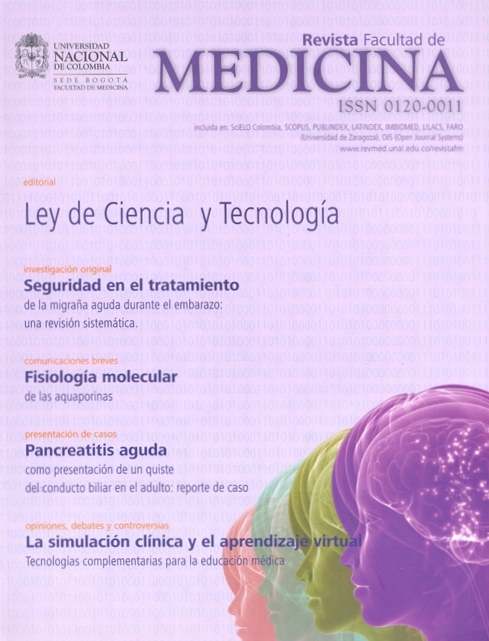
La simulación clínica y el aprendizaje virtual. Tecnologías complementarias para la educación médica
Clinical simulation and virtual learning. Complementary technologies for medical education
Palabras clave:
simulación, educación médica, aprendizaje, bibliotecas virtuales, tecnología educacional. (es)simulation, education, medical, learning, virtual libraries, educational technology. (en)
Referencias
Elliot M. Are we going in the right direction? A survey of the undergraduate medical education in Canada, Australia and the United Kingdom from a general practice perspective. Medical Teacher. 1999; 21: 53-60.
Snyman WD, Kroon J. Vertical and horizontal integration of knowledge and skills - a working model. Eur J Dental Education. 2005; 9: 26-31.
Ypinazar VA, Margolis SA. Clinical simulators: applications and implications for rural medical education. Rural and Remote Health. 2006; 6: 527 (Online). Disponible en http://rrh.deakin.edu.au.
Roberts KE, Bell RL, Duffy AJ. Evolution of surgical skills training. World J Gastroentrol. 2006;12: 3219-3224.
O'Sullivan M, Martin J, Murray E. Student's perceptions of the relative advantages and disadvantages of community-based and hospital-based teaching: a qualitative study. Medical Education. 2000; 34: 648-655.
Flanagan B, Nestel D, Joseph M. Making patient safety the focus: crisis resource management in the undergraduate curriculum. Medical Education. 2004; 38: 56-66.
Anastakis DJ, Wanzel KR, Brown MH, Mcllroy JH, Hamstra SJ, Ali J, et al. Evaluating the effectiveness of a 2-year curriculum in a surgical skills center. Am J Surg. 2003; 185:378 -385.
Gaba D. The future vision of simulation in health care. Quality SafetyHealth Care. 2004; 13(suppl 1):i2–i10.
Morgan PJ, Cleave-Hogg D. Simulation technology in training students, residents and faculty. Curr Op Anaesthes. 2005; 18: 199-203.
Pugh CM, Salud LH; Association for Surgical Education. Fear of missing a lesion: use of simulated breast models to decrease student anxiety when learning clinical breast examinations. Am J Surg. 2007; 193:766-70.
Shaefer JJ 3rd. Simulators and difficult airway management skills. Pediatric Anaesthesia. 2004; 14: 28-37.
Dutta S, Gaba D, Krummel TM. To simulate or not to simulate. What is the question? Ann Surg. 2006; 243: 301- 305.
Hammond J. Simulation in critical care and trauma education and training. Curr Op Critical Care. 2004; 10: 325- 329.
McLaughlin SA, Doezem D, Sklar DP. Human simulation in emergency medicine training: a model curriculum. Academic Emergency Medicine. 2002; 9: 1310-1318.
Sutherland LM, Middleton PF, Anthony A, Hamdorf J, Cregan P, Scott D, et al. Surgical simulation. A systematic review. Ann Surg. 2006; 243: 291-300.
Weller JM. Simulation in undergraduate medical education: bridging the gap between theory and practice. Medical Education. 2004; 38: 32-38.
Gordon JA, Wilkerson WM, Shaffer DW, Armstrong EG. "Practicing" medicine without risk: Student's and educators' responses to high-fidelity patient simulation. Academic Medicine. 2001;76: 469-482.
Gómez PI. Uso de simuladores y otras ayudas educativas en medicina. Rev Fac Med Univ Nac Colomb. 2003; 51: 227-232.
Bradley P, Posthletwaite K. Simulation in clinical learning. Med Edu 2003; 37 (Supp 1): 1-5.
Gorman PJ, Meier AH, Krummel TM. Simulation and virtual reallity in surgery. Real or unreal?. Arch Surg .1999: 134: 1203-1208.
Maran NJ, Glavin RJ. Low- to high-fidelity simulation – a continuum of medical education?. Med Edu. 2003; 37 (Suppl 1). 22-28.
Howell JN, Conatser RR, Williams RL 2nd, Burns JM, Eland DC. The virtual haptic back: a simulation for training in palpatory diagnosis. BMC Med Educ. 2008; 8: 14.
Gros sb. El ordenador invisible. Hacia la apropiación del ordenador en la enseñanza. 1ra. Ed. Barcelona: Editorial Gedisa. 2000.
McLuhan M. La galaxia Gutemberg. Barcelona: Ediciones 62, 1973.
Cabero AJ. Nuevas tecnologías, comunicación y educación. EDUTEC. Revista electrónica de tecnología educativa. 1996; 1.
Manovich L. The Language of New Media. Cambridge: the mit press. Masachusetts Institute of Technology. U.S.A., 2001.
Ezpeleta D, Martínez A, Esteruelas A, Moral JM, et al. Sistemas Multimedia en la Enseñanza. En: Aula de Innovación Educativa. N° 40-41, 1995: 19-23.
Prendes MP."Potencial educativo del multimedia", En: Blázquez, Cabero y Loscertales. Nuevas tecnologías de la información y comunicación para la educación. Sevilla: Alfar. 1994.
Gardner H. Frames of Mind: The Theory of Multiple Intelligences. 2da. Edición. Britain: Fontana Press. 1993: 466.
Skinner BF. Science and human behavior. New York: Free Press. 1953.
Marqués GP. Ventajas e inconvenientes del multimedia educativo. Universidad Autónoma de Barcelona. [en línea] Barcelona. 2000. Disponible en: http://dewey.uab.es/pmarques/ventajas.htm.
Locatis C, Vega A, Bhagwat M, Liu WL, Conde J. Virtual computer lab for distance biomedical technology education. BMC Med Educ. 2008; 8:12.
Visitas a la página del resumen del artículo
Descargas
Cómo citar
Licencia
Derechos de autor 2009 Revista de la Facultad de Medicina

Esta obra está bajo una licencia Creative Commons Reconocimiento 3.0 Unported.
-









