Correo Electrónico
 DNINFOA - SIA
 Bibliotecas
 Convocatorias
 Identidad U.N.


Publicado
Eficacia de las modalidades deportivas del programa 40X40 en escolares con sobrepeso y obesidad
Effectiveness of sports teaching methods in the 40X40 program in overweight and obesity in school children
DOI:
https://doi.org/10.15446/revfacmed.v64n3Sup.51059Palabras clave:
Promoción de la salud, Actividad física, Deportes, Adaptación fisiológica, Desarrollo infantil, Composición corporal (es)Health Promotion, Motor Activity, Sports, Physiological Adaptation, Child Development, Body Composition (en)
Introducción. En Bogotá, hay una prevalencia de sobrepeso y obesidad del 16% y del 6%, respectivamente, tanto en niños como adolescentes escolares (1). En 2013, se implementó el Programa 40X40 (P40X40) en instituciones educativas distritales (IED) con el objetivo de incrementar los niveles de actividad física de los escolares.
Objetivo. El presente estudio busca determinar el efecto del P40x40 en la composición corporal de escolares con sobrepeso y obesidad de las IED de Bogotá.
Materiales y métodos. Estudio controlado no aleatorizado en el que participaron 1003 escolares (6 a 17 años) asignados a un grupo de intervención (GI) (P40X40) (n=497) y a un grupo control (GC) (n=506). Se evaluó el efecto de dos meses de intervención del P40X40 sobre las variables porcentaje de grasa corporal (PGC), índice de masa corporal (IMC) e índice de masa corporal Zscore (IMCZscore).
Resultados. Se presentaron cambios significativos en el GI para todas las variables (p=0.00), con mayor reducción en el PGC para los deportes de tiempo y marca por diferencia de medias (DaMs) (DaMs=1.36).
Conclusiones. Al observarse cambios significativos en el GI para todas las variables (p=0.00) sin relevancia clínica, se determinó que el P40X40 requiere modificaciones en cuanto a intensidad, frecuencia y duración si su objetivo es disminuir los niveles de sobrepeso y obesidad en escolares.
Introduction: In Bogotá, there is a prevalence of overweight and obesity of 16% and 6%, respectively, in both school children and adolescents (1). In 2013, the 40X40 program (P40X40) was implemented by city educational institutions (IED, by its acronym in Spanish) in order to increase levels of physical activity in school children.
Objective: This study aims to determine the effect of P40x40 in body composition of overweight and obese school children at public schools in Bogotá.
Materials and methods: Non-randomized controlled study involving 1 003 school children (age 6 to 17) assigned to an intervention group (IG) (P40X40) (n=497) and a control group (CG) (n=506). The effect of the P40X40 intervention was assessed at two months in relation to body fat percentage (BFP), body mass index (BMI) and body mass index Zscore (BMIZscore).
Results: Significant changes in IG for all variables (p=0.00) were presented, with greater reduction in BFP for time sports and mean difference (DaMs, for its acronym in Spanish) (DaMs = 1.36).
Conclusions: After observing significant changes in the IG for all variables (p=0.00) with no clinical relevance, it was determined that the P40X40 requires changes in intensity, frequency and duration if the goal is to reduce levels of overweight and obesity in school children.
Investigación original
DOI: https://doi.org/10.15446/revfacmed.v64n3Supl.51059
Eficacia de las modalidades deportivas del programa 40X40
en escolares con sobrepeso y obesidad
Effectiveness of sports teaching methods in the 40X40 program
in overweight and obesity in school children
Recibido: 04/06/2015. Aceptado: 17/02/2016.
Diana Carolina Preciado-Martínez1 • Erica Mabel Mancera-Soto1 • Edgar Debray Hernández-Álvarez1 • Diana Marcela Zapata1 •
Beatriz Mena-Bejarano1
1 Universidad Nacional de Colombia - Sede Bogotá - Facultad de Medicina - Departamento del Movimiento Corporal Humano - Bogotá D.C. - Colombia.
Correspondencia: Diana Carolina Preciado-Martínez. Departamento del Movimiento Corporal Humano, Facultad de Medicina, Universidad Nacional de Colombia. Carrera 30 No. 45-03, edificio 471, oficina 524c. Teléfono: +57 3165000, ext.: 15169. Bogotá D.C. Colombia. Correo electrónico: dicpreciadoma@unal.edu.co.
| Resumen |
Introducción. En Bogotá, hay una prevalencia de sobrepeso y obesidad del 16% y del 6%, respectivamente, tanto en niños como adolescentes escolares (1). En 2013, se implementó el Programa 40X40 (P40X40) en instituciones educativas distritales (IED) con el objetivo de incrementar los niveles de actividad física de los escolares.
Objetivo. El presente estudio busca determinar el efecto del P40x40 en la composición corporal de escolares con sobrepeso y obesidad de las IED de Bogotá.
Materiales y métodos. Estudio controlado no aleatorizado en el que participaron 1003 escolares (6 a 17 años) asignados a un grupo de intervención (GI) (P40X40) (n=497) y a un grupo control (GC) (n=506). Se evaluó el efecto de dos meses de intervención del P40X40 sobre las variables porcentaje de grasa corporal (PGC), índice de masa corporal (IMC) e índice de masa corporal Zscore (IMCZscore).
Resultados. Se presentaron cambios significativos en el GI para todas las variables (p=0.00), con mayor reducción en el PGC para los deportes de tiempo y marca por diferencia de medias (DaMs) (DaMs=1.36).
Conclusiones. Al observarse cambios significativos en el GI para todas las variables (p=0.00) sin relevancia clínica, se determinó que el P40X40 requiere modificaciones en cuanto a intensidad, frecuencia y duración si su objetivo es disminuir los niveles de sobrepeso y obesidad en escolares.
Palabras clave: Promoción de la salud; Actividad física; Deportes; Adaptación fisiológica; Desarrollo infantil; Composición corporal (DeCS).
Preciado-Martínez DC, Mancera-Soto EM, Hernández-Álvarez ED, Zapata DM, Mena-Bejarano B. Eficacia de las modalidades deportivas del programa 40X40 en escolares con sobrepeso y obesidad. Rev. Fac. Med. 2016;64:S143-50. Spanish. doi:https://doi.org/10.15446/revfacmed.v64n3Supl.51059.
| Abstract |
Introduction: In Bogotá, there is a prevalence of overweight and obesity of 16% and 6%, respectively, in both school children and adolescents (1). In 2013, the 40X40 program (P40X40) was implemented by city educational institutions (IED, by its acronym in Spanish) in order to increase levels of physical activity in school children.
Objective: This study aims to determine the effect of P40x40 in body composition of overweight and obese school children at public schools in Bogotá.
Materials and methods: Non-randomized controlled study involving 1 003 school children (age 6 to 17) assigned to an intervention group (IG) (P40X40) (n=497) and a control group (CG) (n=506). The effect of the P40X40 intervention was assessed at two months in relation to body fat percentage (BFP), body mass index (BMI) and body mass index Zscore (BMIZscore).
Results: Significant changes in IG for all variables (p=0.00) were presented, with greater reduction in BFP for time sports and mean difference (DaMs, for its acronym in Spanish) (DaMs = 1.36).
Conclusions: After observing significant changes in the IG for all variables (p=0.00) with no clinical relevance, it was determined that the P40X40 requires changes in intensity, frequency and duration if the goal is to reduce levels of overweight and obesity in school children.
Keywords: Health Promotion; Motor Activity; Sports; Physiological Adaptation; Child Development; Body Composition (Mesh).
Preciado-Martínez DC, Mancera-Soto EM, Hernández-Álvarez ED, Zapata DM, Mena-Bejarano B. Effectiveness of sports teaching methods in the 40X40 program in overweight and obesity in school children. Rev. Fac. Med. 2016;64:S143-50. Spanish. doi:https://doi.org/10.15446/revfacmed.v64n3Supl.51059.
Introducción
La obesidad es considerada la pandemia mundial del siglo XXI (2). En 2010, la Organización Mundial de la Salud (OMS) reportó que 43 millones de niños y adolescentes sufrían de sobrepeso y obesidad en el mundo (3). En Colombia, la Encuesta Nacional de Situación Nutricional (ENSIN), señaló que el 4.3% de los niños entre los 5 y los 9 años presentaban problemas de obesidad, mientras que en adolescentes, 1 de cada 4 entre los 10 y los 17 años tenían el mismo problema (4).
La mayor problemática es que la obesidad y el sobrepeso, tanto en infantes como en adolescentes, está asociada al desarrollo de algun tipo de enfermedad crónica. Un niño obeso tiene entre un 30% y 40% más de probabilidades de desarrollar diabetes tipo II (5), hipertensión y dislipidemia y, por tanto, síndrome metabólico (6,7,8).
El sobrepeso y la obesidad, especialmente en la edad escolar, son problemas relacionados con la práctica de actividades sedentarias como ver televisión o jugar video juegos, lo que incrementa el riesgo de ser obeso entre un 2% y 4.5% (9,10). Además, la relación inversa entre la edad y el comportamiento activo de niños y adolescentes, cuyo consumo energético es dos veces mayor al de los infantes de hace 50 años (11), favorece la aparición y desarrollo de estas condiciones (4).
Diferentes análisis han demostrado que una vía útil para disminuir estas cifras son las estrategias relacionadas con el incremento de la actividad física (AF) en el contexto. Esto se debe no solo a sus beneficios sobre el desarrollo cognitivo, social y psicológico (12), sino también a sus efectos sobre la composición corporal (CC) en función del mejoramiento y mantenimiento de un peso corporal saludable (13).
A raíz de lo anterior, en Bogotá (Colombia), en 2013, se implementó el Programa 40X40 (P40X40), proyecto a través del cual se aumentó de 20 a 40 horas semanales el horario de la jornada escolar de todos los estudiantes de colegios oficiales de la ciudad. El P40X40 fue organizado alrededor de varios ejes temáticos con la intención de agrupar los centros de interés, siendo uno de estos ejes el de la AF y deportes. Este eje buscaba estimular el desarrollo de la motricidad de base, las habilidades más complejas, así como la iniciación y especialización en diferentes deportes, integrados por modalidades deportivas individuales, de conjunto, de nuevas tendencias urbanas y tradicionales. Lo anterior como una estrategia para promover, entre otros, la adquisición de hábitos y estilos de vida saludables en la población escolar.
La estructura de cada modalidad deportiva en relación con los componentes de AF se dio en términos de frecuencia (dos veces por semana) y duración (dos horas por sesión). Por otro lado, las modalidades deportivas se agruparon en cuatro categorías: arte y precisión, tiempo y marca, pelota, combate y deportes urbanos y de nuevas tendencias (DUNT). Finalmente, el propósito de esta investigación fue determinar la eficacia de la participación en las modalidades deportivas del P40X40, teniendo en cuenta su efecto en la composición corporal (CC) en escolares con sobrepeso y obesidad, a partir de los cambios en el índice de masa corporal (IMC), índice de masa corporal zscore (IMCZscore) y porcentaje de grasa corporal (PGC).
Materiales y métodos
Diseño del estudio
Se diseñó un estudio controlado, no aleatorizado, durante el periodo de julio de 2013 y agosto de 2014, con la participación voluntaria de 1 003 escolares entre los 6 y 17 años de edad, quienes fueron distribuidos en dos grupos: un grupo de intervención (GI), conformado por 497 escolares matriculados en las IED vinculadas al P40X40 y un grupo control (GC), constituido por 506 escolares de IED que no participaron en el P40X40. Se obtuvo la autorización de participación y consentimiento informado, en donde además se tuvo en cuenta a los padres de familia o representantes legales de los participantes. Esta fue una investigación con riesgo mínimo según la Resolución 8430 de 1993 del Ministerio de Salud y fue aprobada por el Comité de Ética de la Facultad de Medicina de la Universidad Nacional de Colombia.
Población de estudio
A partir de las IED vinculadas al estudio, se seleccionaron los escolares participantes para los dos grupos (intervención y control) y acudieron un total de 1 908. De ellos, 1 751 cumplieron con los criterios de inclusión propuestos y 1 003 completaron el estudio. Dentro de los criterios de inclusión se tuvo en cuenta si los escolares presentaban índices de PGC de acuerdo con los criterios de Deurenberg et al., cuyo rango de valores para niños y adolescentes con adiposidad moderadamente alta está entre 20.01% y 25% y para mujeres, entre 25.01% y 30%, mientras que el rango de valores para hombres con alta adiposidad es de >25.01% y para mujeres de >30.01% (14). Por otro lado, se tuvo en cuenta que no estuvieran recibiendo algún tipo de tratamiento médico, farmacológico o nutricional que afectara la CC durante el periodo de intervención del estudio. Finalmente, otro criterio que fue considerado es que los participantes estuvieran formalmente inscritos en una de las 26 modalidades deportivas ofertadas por el P40X40, con una participación mínima de ocho semanas.
Para el GC, además de cumplir con los dos primeros criterios, se les recomendó no participar en actividades extracurriculares de AF o ejercicio físico adicionales a las clases de educación física propuestas en las IED. De esa manera se llevó un control a través de la aplicación de encuestas periódicas a los participantes y registro de sus actividades extracurriculares.
Características de las modalidades deportivas del P40X40
Grupo intervención
El diseño metodológico de las modalidades deportivas del P40X40 cumplió con las características de los deportes de iniciación, momento en el que el niño empieza a aprender de forma específica uno o varios deportes cuya dominante es el esfuerzo físico. Además, el P40X40 contempló componentes competitivos bajo reglamentos específicos, de modo que fuera susceptible a transformarse en una actividad profesional orientada a la conformación de una reserva deportiva para el distrito (15). Cada entrenador fue autónomo en el diseño metodológico de las clases según la modalidad deportiva; asimismo, la estructuración de cada modalidad en relación con los componentes de la AF, se caracterizó por tener una frecuencia de dos veces por semana con una duración de dos horas por sesión y con un seguimiento de dos meses. A continuación se listan las dieciséis modalidades deportivas, según la categoría deportiva, practicadas por los escolares del GI (Tabla 1).
Grupo de control
El GC no tuvo ningún tipo de intervención adicional a las clases de educación física, cuyo diseño metodológico era el correspondiente al componente curricular de las IED y a la autonomía del profesor. Participando, así, en clases de educación física una vez por semana, con una duración de dos horas por sesión.
Tabla 1. Lista de las modalidades deportivas por categorías deportivas del grupo intervención.
|
Categoría deportiva |
Modalidad deportiva |
|
Arte y precisión |
Ajedrez, gimnasia, porras |
|
Tiempo y marca |
Atletismo, patinaje de carreras |
|
Pelota |
Futbol, futbol sala, futbol de salón, tenis, tenis de mesa, baloncesto |
|
Combate |
Karate, judo, taekwondo |
Fuente: Elaboración propia.
Valoración de la composición corporal
Para la toma de las variables de peso (kg) y de PGC se utilizó un bioimpedanciometro, marca TANITA®, con referencia BF-679W/BF.680W, Body Fat Monitor/Scale. Para la captura de la medición, se exigió como requisito que el escolar hubiera evacuado su vejiga previamente. La determinación de la estatura se realizó con un tallimetro (16), mientras que para el registro de la talla sentado se empleó una silla sin espaldar y se solicitó a cada escolar ubicarse en posición sedente corto, verificando la formación de un ángulo de 90° entre el tronco y las piernas. Se registró la distancia entre el vértice y la superficie horizontal donde estaba sentado el escolar (17).
Para el PGC se usó la clasificación de Lohman, empleada por Deurenberg et al., cuyos valores de referencia se indican en los siguientes rangos: desfavorable o insano con muy baja adiposidad (6%), aceptable para un límite bajo de adiposidad (7%-16%), aceptable para un límite alto de adiposidad (17%-24%) y desfavorable o insano con muy alta adiposidad (≥25%) (14).
Para el IMC se tuvo en cuenta la clasificación del estado nutricional de los estándares de la OMS que indica lo siguiente: sobrepeso, IMC de 25 kg/m2, y obesidad, IMC de 30 kg/m2 (18). El IMCZscore fue determinado a través de las formulas basadas en el método LMS, método de referencia de crecimiento, resumido en una tabla de valores L, M y S, donde L es el indicador de simetría, M es la mediana y S es el coeficiente de variación, diseñado para calcular los percentiles P50, P85, P97 y los valores Z (que van entre -3 y 3) que indican: normal: P15-P85 (z ≥-1 y ≤+1); subnutrición (tres niveles): leve <P15 y >P3 (z <-1 y ≥-2), moderada z <2 ≥-3 y grave z <-3; sobrenutrición (tres niveles): leve (sobrepeso) >P85 y <P97 (>+1 y ≤+2), obesidad >P97 (z >+2 y ≤+3) y obesidad intensa z >+3 (18,19).
Análisis estadístico
La normalidad fue asumida por el tamaño de la muestra poblacional. Para determinar la homogeneidad entre grupos se analizaron las variables de edad (en años), peso (kg), talla (cm), %GC, IMC y IMCZscore a través de la prueba estadística T Student. Luego se realizó un análisis intragrupal para ambos grupos (GI y GC), comparando las medias de los dos momentos de evaluación por medio de la misma prueba T Student, pero pareada. De esta manera, se establecieron las medias con su desviación estándar, la diferencia de medias y la significancia p<0.05. Por otra parte, una vez completado el análisis intragrupal, se llevó a cabo uno intergrupal para comparar las diferencias de medias del GI con el GC, estableciendo la razón de cambio a través del test de Levene para la comparación de diferencia de medias.
En cuanto al análisis por categoría deportiva, se compararon los dos momentos de evaluación para cada variable a través de una prueba T Student. Después se calcularon intervalos de confianza (IC) del 95% y se estableció un valor de significación p<0.05 para todas las variables. El análisis de datos se realizó con el software estadístico SPSS (versión 21, SPSS, Chicago,II).
Resultados
Un total de 1 751 escolares fueron contactados inicialmente, de estos, 1 025 cumplieron con los criterios de inclusión. De los 1025 escolares, 22 no se presentaron durante la semana de la evaluación post-intervención debido a factores climáticos y fueron excluidos del estudio. Se finalizó con una muestra de 1 003 escolares: grupode intervención (GI) (n= 497) y grupo control (GC) (n=506) (Figura 1).
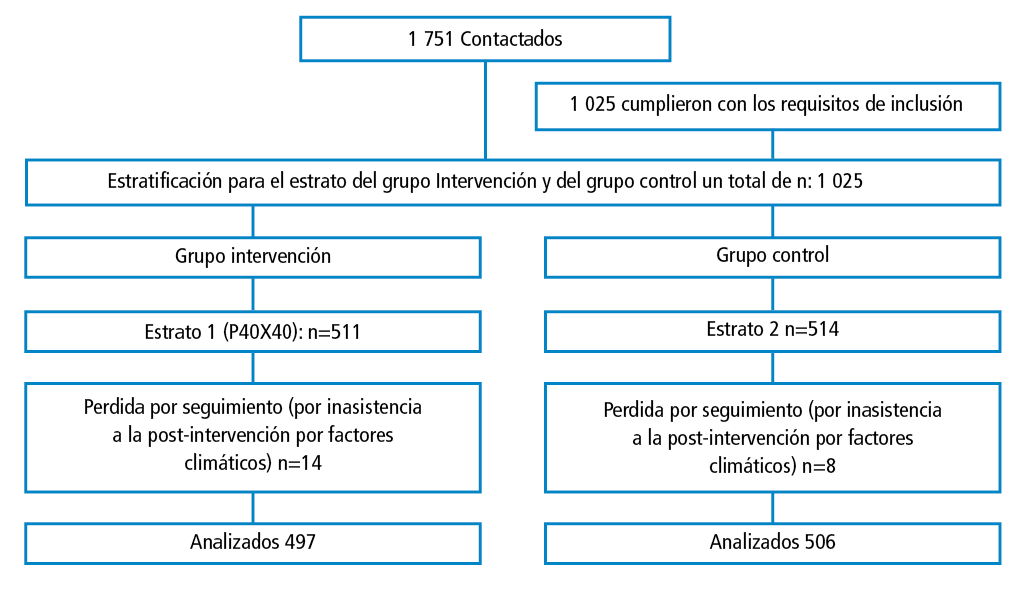
Figura 1. Seguimiento de los participantes. Diagrama de flujo: método estadístico por estratificación de muestra poblacional del actual estudio. Fuente: Elaboración propia.
Los datos de peso y talla se expresaron como medias (± desviación estándar), la cuales son recogidas en la Tabla 2. Con respecto al PGC, los escolares de ambos grupos se encontraron en un rango desfavorable: insano o muy alto (≥25%) (GI ±27.0 y GC ±28.7). En relación al IMC, se ubicaron en un estado nutricional normal (<25Kg/m2) (GI ±20.3 y GC ±22.3) y según el IMCZscore, se clasificaron en el puntaje Z de normalidad para su edad y talla (GI ± 0.002 y GC ± -0.86) (Tabla 2).
Tabla 2. Datos demográficos.
|
|
Grupo intervención (n=497) |
Grupo control (n=506) |
|
||||
|
Variables |
n |
Media (Ds) |
Er |
N |
Media (Ds) |
Er |
P |
|
Edad (años) |
497 |
12.4 (2.8) |
0.12 |
506 |
11.9 (2.2) |
0.09 |
0.001 |
|
Peso (Kg) |
497 |
45 (13.7) |
0.61 |
506 |
51.7 (12.6) |
0.56 |
0.001 |
|
Talla (Cm) |
497 |
147.8 (15.0) |
0.67 |
506 |
151 (11.1) |
0.49 |
0.0001 |
|
PGC |
497 |
27.0 (4.4) |
0.2 |
506 |
28.7 (5.5) |
0.24 |
0.0002 |
|
IMC (kg/m²) |
497 |
20.3 (4.33) |
0.19 |
506 |
22.3 (4.2) |
0.18 |
0.0002 |
|
IMCZscore |
497 |
0.002 (0.998) |
0.044 |
506 |
-0.867 (1.04) |
0.46 |
0.0002 |
Media + Desviación estándar (Ds) n=1003. Er: Error típico; Diferencias significativas (p<0.05). Fuente: Elaboración propia.
Datos análisis intragrupal
Los resultados se expresan como diferencia de medias (DaMs) con un IC del 95% y una significancia p<0.05. Según los datos, se encontró una mayor disminución en el PGC en las niñas
(DaMs=2.62) (p<0.001), en comparación con los niños (DaMs= 0.57) (p<0.001) (Tabla 3). A pesar de los cambios, el PGC continuó por encima del 25% para ambos géneros, ubicando a los escolares en un rango desfavorable o muy alto (≥25%) (Tabla 3).
Por otra parte, el IMC en las niñas tendió al aumento, pero sin significancia estadística (DaMs=-1,01) (p=0.399), mientras que en los varones disminuyó con cambios estadísticamente significativos (DaMs 0.36) (p=0.01). A pesar de lo anterior, los escolares se mantuvieron en la categoría de normopeso (<25Kg/m2) respecto al peso y talla (Tabla 3).
Los puntajes Z tendieron hacia la disminución en los escolares (DaMs=-2.06) (p=0.03), con una puntuación Z normal para las niñas (DaMs=-0.77) (p<0.05) y delgadez extrema para los niños (DaMs=-2.25) (p<0.05). Sin embargo, la media de los escolares de ambos géneros se ubicó en el punto de corte de normalidad.
Según el análisis intragrupal del GC sobre las variables de la composición corporal, el PGC tuvo un mayor aumento en las niñas (DaMs=-0.28) (p<0.05), que en niños (DaMs=-0.19) (p<0.05). Por lo que se mantuvo en un rango muy desfavorable de PGC para los dos géneros (≥25%) (Tabla 4).
De forma similar, el IMC aumentó significativamente (DaMs= -0.24) (p<0.05). Se observó un mayor crecimiento en las niñas (DaMs=-0.26) (p<0.05), a diferencia de lo ocurrido en los niños (DaMs=-0.19) (p<0.05). Con base en estos datos, fueron clasificados en la categoría de normopeso (<25Kg/m2) respecto al peso y la talla presente en los dos géneros (Tabla 4).
Los puntajes Z se mantuvieron normales (DaMs=-0.02) (p<0.05), con mayor tendencia hacia la disminución en las niñas (DaMs=-0.03) (p<0.05) en comparación con los niños (DaMs= -0.01) (p<0.05). No obstante, los escolares mantuvieron un valor Z de normalidad.
Tabla 3. Análisis intragrupal por genero de las variables de la composición corporal del grupo intervención.
|
Variable |
Género |
Pre |
Post |
IC 95% |
DaMs |
p |
||||
|
n |
Media |
Ds. |
Media |
Ds. |
< |
> |
||||
|
MG |
Niña |
32 |
25.51 |
4.23 |
22.88 |
4.76 |
1.84 |
3.40 |
2.62 |
0.001 |
|
Niño |
465 |
27.19 |
4.47 |
26.61 |
4.28 |
0.51 |
0.63 |
0.57 |
0.001 |
|
|
IMC |
Niña |
32 |
23.23 |
6.22 |
24.24 |
5.83 |
-3.43 |
1.40 |
-1.01 |
0.39 |
|
Niño |
465 |
20.18 |
4.11 |
19.81 |
4.19 |
0.30 |
0.42 |
0.36 |
0.01 |
|
|
IMC Zscore |
Niña |
32 |
0.033 |
1.15 |
0.8 |
0.22 |
-1.13 |
-0.40 |
-0.77 |
0.03 |
|
Niño |
465 |
0.000 |
0.99 |
-2.25 |
0.91 |
2.14 |
-2.37 |
-2.25 |
0.01 |
|
Media +. Desviación estándar (Ds) n=497. Diferencia de medias (DaMs). IC 95%. Momentos: Pre: pre intervención, Post: post intervención. Diferencias significativas (p<0.05). Fuente: Elaboración propia.
Análisis intergrupal
Los resultados del análisis de razón de cambio entre grupos mostró diferencias estadísticamente significativas (p<0.05) en todas las variables de la composición corporal. En este sentido, el PGC tuvo cambios significativos para los dos grupos (DaMs=0.95) (p<0.05), tendiendo a la disminución en el GI (m=-0.70) y al aumento en el GC (media= 0.25). El IMC fue diferente entre los grupos (DaMs=0.51) (p<0.05) disminuyendo en el GI (media=-0.27) y aumentando en el GC (media=0.24). Los valores Z tuvieron cambios significativos entre los grupos (DaMs=2.08) (p<0.05) y tendieron hacia la disminución en ambos grupos: GI (media=0.02) y GC (media=- 2.06).
Análisis intragrupal del efecto de las modalidades deportivas del P40X40 sobre las variables de la composición corporal
Según los resultados, la mayor participación de la población se dio en los deportes de pelota (51.7%), seguida de los de combate (28.4%), los de arte y precisión (9.9%), los de tiempo y marca (6.2%) y los DUNT (3.8%).
La categoría deportiva que tuvo mayor efecto en la disminución del PGC por DaMs fue tiempo y marca (DaMs=1.36) (p<0.05), seguida de arte y precisión (DaMs=0.95) (p<0.05). Mientras que las categorías deportivas de combate (DaMs=0.78) y de pelota (DaMs=0.63) (p<0.05) tuvieron un menor efecto. Por último, la categoría DUNT favoreció el aumento del PGC (DaMs=-0.46) (p<0.05).
La mayor disminución del IMC fue para la categoría de arte y precisión (DaMs=0.50), seguida de tiempo y marca (DaMs=0.36) y de pelota (DaMs=0.34) (p<0.05). Por otra parte, la categoría de combate obtuvo una índice menor de disminución, pero sin cambios estadísticamente significativos (DaMs=0.11) (p=0.67). Finalmente, la categoría de DUNT presentó un favorecimiento en el aumento del IMC, sin cambios estadísticamente significativos (DaMs=-0.10) (p=0.431).
En relación con el IMCZscore, las categorías que mantuvieron un valor Z más cercano a la normalidad fueron la de tiempo y marca (DaMs=1.30), seguida de la de combate (DaMs=1.88) y de arte y precisión (DaMs=1.95) (p<0.05). Mientras tanto, la de DUNT tuvo un valor Z más cercano a delgadez (DaMs=-2.33) junto a la de pelota (DaMs=-2.25) (p<0.05) (Tabla 4).
Tabla 4. Efecto del programa 40X40: análisis intragrupal de las categorías deportivas sobre las variables de la composición corporal.
|
Categoría Deportiva |
Variables |
Momentos |
n |
Media |
Ds |
DaMs |
IC 95% |
p |
|
|
< |
> |
||||||||
|
Arte y precisión |
MG |
Pre |
49 |
28.99 |
5.08 |
0.95 |
0.69 |
1.22 |
0.002 |
|
Post |
28.03 |
5.16 |
|||||||
|
IMC |
Pre |
49 |
20.02 |
4.29 |
0.50 |
0.40 |
0.61 |
0.002 |
|
|
Post |
19.52 |
4.30 |
|||||||
|
IMCZscore |
Pre |
49 |
0.09 |
1.24 |
1.95 |
1.53 |
2.37 |
0.002 |
|
|
Post |
-1.86 |
1.15 |
|||||||
|
Tiempo y marca |
MG |
Pre |
31 |
26.55 |
4.31 |
1.36 |
0.69 |
2.02 |
0.001 |
|
Post |
25.19 |
4.81 |
|||||||
|
IMC |
Pre |
31 |
22.38 |
5.65 |
0.36 |
0.21 |
0.51 |
0.002 |
|
|
Post |
22.02 |
5.59 |
|||||||
|
IMCZscore |
Pre |
31 |
0.17 |
1.06 |
1.30 |
0.75 |
1.86 |
0.001 |
|
|
Post |
-1.13 |
1.78 |
|||||||
|
Pelota |
MG |
Pre |
257 |
26.96 |
4.54 |
0.63 |
0.54 |
0.72 |
0.003 |
|
Post |
26.33 |
4.36 |
|||||||
|
IMC |
Pre |
257 |
20.29 |
4.28 |
0.34 |
0.25 |
0.43 |
0.001 |
|
|
Post |
19.95 |
4.37 |
|||||||
|
IMCZscore |
Pre |
257 |
-0.03 |
0.99 |
-2.25 |
2.09 |
2.41 |
0.002 |
|
|
Post |
-2.29 |
0.92 |
|||||||
|
Combate |
MG |
Pre |
141 |
27.41 |
3.87 |
0.78 |
0.60 |
0.96 |
0.003 |
|
Post |
26.63 |
3.97 |
|||||||
|
IMC |
Pre |
141 |
20.09 |
4.17 |
0.11 |
-0.65 |
0.65 |
0.67 |
|
|
Post |
19.97 |
4.40 |
|||||||
|
IMCZscore |
Pre |
141 |
0.05 |
0.92 |
-1.88 |
1.63 |
2.14 |
0.003 |
|
|
Post |
-1.83 |
1.27 |
|||||||
|
DUNT |
MG |
Pre |
19 |
22.28 |
2.68 |
-0.46 |
-0.62 |
-0.3 |
0.002 |
|
Post |
22.74 |
2.65 |
|||||||
|
IMC |
Pre |
19 |
21.37 |
3.21 |
-0.10 |
-0.36 |
0.16 |
0.43 |
|
|
Post |
21.47 |
3.03 |
|||||||
|
IMCZscore |
Pre |
19 |
-0.29 |
0.85 |
-2.33 |
1.88 |
2.78 |
0.001 |
|
|
|
-2.63 |
0.38 |
|||||||
*Media +. Desviación estándar (Ds) n=497. Diferencia de medias (DaMs). IC 95%. Momentos: Pre: pre intervención, Post: post intervención. Diferencias significativas (p<0.05). Fuente: Elaboración propia.
Discusión
El sobrepeso y la obesidad en niños y adolescentes son factores que preceden la aparición de enfermedades crónicas no transmisibles en edades tempranas y cuya manifestación clínica puede perdurar hasta la adultez. Por lo tanto, el ejercicio se vuelve un componente importante dentro de los programas de pérdida de peso con beneficios en el metabolismo energético (20). En Colombia, se busca la promoción de comportamientos activos y saludables a partir de la práctica regular de AF. En consecuencia, el P40x40 se convierte en una estrategia que busca promover la realización de los deportes de iniciación durante la jornada escolar. En este sentido, se siguió el ejemplo de países como Irlanda, Finlandia, Chipre, Alemania y Portugal, en donde se incluyeron asignaturas deportivas en los currículos escolares que perfilan las habilidades deportivas del escolar y fortalecen los comportamientos activos y saludables (21).
Las modificaciones favorables que produce el ejercicio físico, por ejemplo, la disminución del PGC, se han ido relacionando con los hallazgos presentes en este estudio (22,23). Según los resultados, el P40X40 generó una disminución estadísticamente significativa en el PGC en los escolares después de dos meses de intervención (p<0.05). Sin embargo, estas modificaciones carecen de significancia clínica debido a que la media presente en los escolares participantes se mantuvo en un rango muy alto de PGC en ambos grupos (por encima del 25%).
Este resultado no alcanza a relacionarse con lo expuesto por Hernández, quien argumenta que la efectividad de un programa de ejercicio físico para la reducción de peso debe tener un efecto mayor al 1% (23). Esto se debe a que la intensidad del ejercicio y el efecto en los umbrales de esfuerzo físico alcanzado por los escolares durante las sesiones de entrenamiento no son planificados ni controlados al interior del programa P40X40. Por lo tanto, es posible que sí sean insuficientes para activar los procesos endocrinos y metabólicos que favorecen la obtención de energía a partir de la metabolización de los ácidos grasos (22).
Además, la duración y frecuencia que maneja el programa no es suficiente para modificar el gasto energético y potencializar los procesos de crecimiento óseo y muscular que garanticen tanto la obtención de energía a partir de las grasas, como el incremento del metabolismo lipídico durante el reposo y la actividad (22-25). En ese orden de ideas, se puede asumir que los resultados obtenidos pueden deberse a la limitación del periodo de intervención del estudio: intensidad, duración, frecuencia y volumen propias de las modalidades deportivas del P40X40, por lo que se carece de una planificación estructurada acorde a los principios de la adaptación biológica, sugiriendo una reestructuración de acuerdo a la especificidad de cada deporte y a las condiciones de salud de los escolares, de manera que logren tener efecto no solo sobre el aprendizaje del deporte, sino también a nivel clínico. Así se proporcionarán mejoras en la salud de los escolares y, en este caso, de quienes presentan sobrepeso y obesidad.
Por otra parte, este estudio utilizó el IMC como variable/resultado que permite determinar el efecto de las modalidades deportivas del P40X40, dado que, como indicador, facilita la clasificación del sobrepeso y obesidad (19). Sin embargo, los resultados deben ser contrastados con otros indicadores de adiposidad o métodos indirectos que verifiquen los cambios en la composición corporal (22,23). Por lo tanto, el IMC fue significativamente diferente en ambos grupos (p<0.05) y careció de importancia clínica gracias a que los escolares de ambos grupos permanecieron en la categoría de normopeso (<25Kg/m2) con una DaMs de 0.51, cuyo efecto debe ser entre 0.6 y 1 para estimar que el programa ha sido efectivo (23). Tales hallazgos se correlacionan con el meta-análisis de Guerra, quien afirma que, a pesar de los beneficios de las intervenciones de AF en la escuela, bien carecen o no producen ningún efecto significativo sobre el IMC (26).
La ventaja de utilizar el IMCZscore consiste en que este permite comparar cualquier cambio sobre la variable, a través de las diferentes edades y diferencia de género (27). De esta forma, es una variable capaz de indicar la efectividad de una intervención sobre las variables antropométricas en grupos de niños y jóvenes (27). Este estudio empleó las puntuaciones Z para medir el efecto del P40X40 en escolares con sobrepeso y obesidad; los resultados obtenidos indicaron una disminución significativa en los participantes del GI en los niños, quienes pasaron de un valor Z de normalidad (z=0,0) (z ≥-1 y ≤+1) a uno de delgadez moderada (z=-2,06) (z <2 ≥-3).
Resultados similares fueron publicados por Lazaar et al., quienes demostraron una mayor disminución en el IMCZscore en la comparación del grupo de hombres con el de mujeres (p<0.001) (28). Mientras tanto, Pérez et al. (29) en su estudio sobre efectividad de una intervención escolar en obesidad, reportaron disminuciones mínimas pero con significancia estadística, pues los participantes del estudio, después de dos meses de intervención, pasaron de un valor Z inicial de 1.14 a uno de 1.02 (p=0.017), manteniéndose en un valor Z de normalidad.
Los hallazgos de este estudio permiten establecer que no hay una relación directa entre el PGC y el IMC, siendo clara la subestimación del segundo sobre el primero. Otros estudios reportaron cambios significativos (p<0.05 a p<0.001) en las variables antropométricas en periodos de intervención de dos a seis meses. Encontrándose, así, disminuciones en el IMC o en el IMCZscore relacionadas con el PGC, pero no en las tres variables, incluso cuando se compararon con otras variables como la circunferencia de cintura (28,29). De acuerdo a lo anterior, se asume que aunque los escolares de este estudio tienen un alto contenido de grasa corporal, no tienen un IMC adecuado respecto a su edad y estatura.
Impacto de las modalidades deportivas sobre la composición corporal
Actualmente existe controversia respecto al impacto que tienen estas estrategias en la composición corporal, específicamente en los indicadores de PGC e IMCZscore. Según Vella et al. (30), en su análisis de regresión lineal, no hay asociación significativa entre la participación en deportes de iniciación y la relación peso/talla (t=1.40, p=0.163). Sin embargo, este estudio reportó disminuciones significativas en las variables PGC, IMC e IMCZscore en los escolares participantes (p<0.05). Estos resultados pueden ser más contundentes si se continúa con una práctica regular de dos años, tal como lo argumentan Johnston et al., asegurando la significancia clínica (24).
Por otra parte, los efectos de las intervenciones de AF en la edad escolar, que incluyen deportes de iniciación como estrategias que puedan afectar de forma favorable los índices de la composición corporal, no han sido claramente definidos (30). Lavelle et al. señalan la necesidad de establecer el tipo ideal de estrategias que incluyan análisis de efectividad clínica y en donde se garanticen cambios significativos de la composición corporal en este tipo de población (31). En ese sentido, este estudio muestra la viabilidad de los posibles cambios en las variables antropométricas en escolares con sobrepeso y obesidad gracias a la realización de un deporte de iniciación, cuya estructura se basa en frecuencia, duración y la experiencia de instructores con formación metodológica y técnica de cada modalidad deportiva.
Se puede asumir que la estrategia del P40X40 del Instituto Distrital de Recreación y Deporte (IDRD) se asocia con cambios aceptables en la composición corporal de los escolares con sobrepeso y obesidad, más específicamente en la variable de PGC. Sin embargo, los efectos a nivel clínico no son de gran impacto como para describir este programa como una estrategia efectiva que logre beneficios reales sobre la composición corporal de los escolares en condiciones especiales de salud, como lo son el sobrepeso y la obesidad.
Así, la modificación metodológica en términos de frecuencia, duración, intensidad y volumen es necesaria, sugiriendo que las jornadas de práctica deportiva pasen de dos veces a un mínimo de tres veces por semana, e inclusive a cuatro. A la vez, se debe tratar de conservar la misma duración (dos horas), planificando y cuantificando la intensidad tanto del ejercicio, como del gasto energético, acorde a las necesidades de los escolares y la especificidad del deporte.
Si se realizan estos cambios, se alcanzarán umbrales de intensidad entre el 75% y el 85% del consumo máximo de oxigeno (VO2max), con duraciones aproximadas de 60 a 90 minutos y con la aplicación de la metodología del entrenamiento de la resistencia adecuada para su edad. De esta forma, en deportes de iniciación es necesario alcanzar esfuerzos moderados con una frecuencia de cuatro veces por semana y duraciones aproximadas a los 120 minutos. Además, su práctica debe ser por lo menos de dos años continuos (22,26,30).
Por otra parte, la planificación de las modalidades deportivas debe tener contenidos técnicos y pedagógicos que brinden un soporte más estable, así como incluir procesos de evaluación y seguimiento de los escolares por categoría deportiva, en los que se tengan en cuenta diferentes aspectos de la salud, entre ellos, las variables de la composición corporal.
Para concluir, a pesar de las limitaciones del actual estudio, se puede evidenciar que las estrategias de AF en el contexto escolar benefician la composición corporal en niños y adolescentes con condiciones especiales de salud. No obstante, se recomienda que futuras investigaciones traten de evaluar los efectos de los deportes de iniciación, teniendo en cuenta la planificación de cada uno sobre las variables de la composición corporal en niños y adolescentes, sin dejar de lado las características de género, crecimiento y metabolismo energético, con el fin de implementar estrategias efectivas que garanticen alcanzar una buena salud y una buena calidad de vida que se preserve hasta la edad adulta.
Conflicto de intereses
Ninguno declarado por los autores.
Financiación
Beca de investigación en el área de actividad física y deportes 2013 de la Secretaría de Cultura, Recreación y Deporte de Bogotá.
Agradecimientos
A la Secretaria de Cultura Recreación y Deporte, a los colegios y escolares participantes en el P40X40 y al IDRD por el apoyo en el desarrollo de la investigación.
Referencias
1. ICBF, Profamilia, Instituto Nacional de Salud, Instituto Colombiano de Bienestar Familiar, Ministerio de Proteccion Social. Encuesta Nacional De La Situacion Nutricional En Colombia 2010. Bogotá, D.C.; 2010 [cited 2016 Oct 18]. Available from: https://goo.gl/lLbg0E.
2. Arian T. La Obesidad Infantil: una epidemia mundial. Faros. 2009 [cited 2014 May 3]:1-3. Available from: https://goo.gl/5xAkjg.
3. World Health Organization. Population-based prevention strategies for childhood obesity. Geneva: World Health Organization; 2009 [cited 2014 Apr 12]. Available from: https://goo.gl/aEjSnx.
4. Instituto Colombiano de Bienestar Familiar. Encuesta Nacional de la Situacion Nutricional en Colombia. Bogotá, D.C: ICBF; 2010 [Cited 2013 Apr 2]. Available from: https://goo.gl/7x8YjQ.
5. Janssen I, LeBlanc AG. Systematic review of the health benefits of physical activity and fitness in school-aged children and youth. Int J Behav Nutr Phys Act. 2010;7:40-55. http://doi.org/bqr2.
6. Braet C, Tanghe A, Decaluwé V, Moens E, Rosseel Y. Inpatient treatment for children with obesity: weight loss, psychological well-being, and eating behavior. J Pediatr Psychol. 2004;29(7):519-29. http://doi.org/bkhxfb.
7. Barrera M, Pinilla A, Caicedo L, Castillo Y, Lozano Y, Rodríguez K. Food and nutritional risk factors in adults suffering from diabetes mellitus. Rev Fac Med. 2012 [cited 2013 Apr 4];60(1):28-40. Available from: https://goo.gl/qgId54.
8. World Health Organization. Obesidad y sobrepeso. Geneve: Wolrd Health Organization; 2011 [Cited 2013 Apr 15]. Available from:
https://goo.gl/rLkXEf.
9. Donnelly JE, Blair SN, Jakicic JM, Manore MM, Rankin JW, Smith BK. American College of Sports Medicine Position Stand. Appropriate physical activity intervention strategies for weight loss and prevention of weight regain for adults. Med Sci Sports Exerc. 2009;41(2):459-71. http://doi.org/c36htn.
10. Administration for Children and Families, Child Care Bureau. Promoting Physical Activity and Health Nutrition in Afterschool Settings: Strategies for program leaders and Policy Markers. Washington: U.S. Department of Heatlh and Human Service; 2006 [cited 2014 Feb 14]. Available from: https://goo.gl/HNfW3P.
11. Ramirez S, Monterrey P, Galvis M. Niños activos: adultos saludables. Bogotá D.C: Universidad del Rosario, Facultad de C. Naturales y Matemeticas; 2012 [cited 2014 Jul 25]. Available from: https://goo.gl/OF6rce.
12. Singh A, Uijtdewilligen L, Twisk JW, van Mechelen W, Chinapaw MJ. Physical activity and performance at school: a systematic review of the literature including a methodological quality assessment. Arch Pediatr Adolesc Med. 2012;166(1):49-55. http://doi.org/fzqhdg.
13. Centers for Disease Control and Prevention. School health guidelines to promote healthy eating and physical activity. Washington: Morbidity and Mortality weekly Report; 2011 [cited 2014 Mar 10]; 60:1-76. Available from: https://goo.gl/A0va6C.
14. Deurenberg P, Pieters JJ, Hautvast JG. The assessment of the body fat percentage by skinfold thickness measurements in childhood and young adolescence. Br J Nutr. 1990;63(2):293-303. http://doi.org/bcxjd6.
15. Alcaldía mayor de Bogotá D.C. Informe de control preventivo sobre jornada única escolar. Bogotá D.C: Veeduría Distrital; 2013 [cited 2014 Feb 10]. Available from: https://goo.gl/nr2SGF.
16. A health professional’s guide to using growth charts. Paediatr Child Health. 2004 [cited 2014 May 4];9(3):174-6. Available from: https://goo.gl/iLNLIv.
17. Malina R. Antropometria. PubliCE Standard. 1995 [cited 2013 May 17] Disponible en: https://goo.gl/ZA3FcS.
18. Department of Nutrition, World Health Organization, Memberd of the WHO Multicentre Growth Study Group. WHO Child Growth Standard based on length/height, weigth, and age. Acta Paediatric. 2006 [cited 2013 May 4];450:76-85. Available from: https://goo.gl/uk3yWG.
19. Martinez C, Pedrón C. Valoración del estado nutricional. In: Manual práctico de nutrición en Pediatría. Madrid: Comité de Nutrición de la AEP; 2007.
20. Aranzález L, Mockus I, Ramírez D, Mancera E, García O. The effect of aerobic exercise on serum adiponectin and leptin levels in postmenopausal females. Rev Fac Med. 2011 [cited 2014 May 3];59(2):95-102. Available from: https://goo.gl/I9yvve.
21. European Commission/EACEA/Eurydice. Physical Education and Sport at School in Europe Eurydice Report. Luxembourg: Publications Office of the European Union; 2013 [cited 2014 Apr 5]. Available from:
https://goo.gl/qTKGLY.
22. Amstrong N. Pediatric Exercise Physiology. Advances in Sport and Exercise Science Series. Philadelphia: Elsevier; 2007.
23. Hernandez ED, Valero MV, Mancera EM. Efficacy of the prescription of physical activity in the obese child population. Rev. Salud Pública. 2015;17(1):120-131. http://doi.org/bqr6.
24. Johnston CA, Tyler C, Fullerton G, McFarlin BK, Poston WS, Haddock CK, et al. Effects of a school-based weight maintenance program for Mexican-American children: results at 2 years. Obesity (Silver Spring). 2010;18(3):542-7. http://doi.org/frsjth.
25. Dokken B, Tsao T. The Physiology of Body Weight Regulation: Are We Too Efficient for Our Own Good?. Diabetes Spectr. 2007;20:166-170. http://doi.org/cwfcs4.
26. Guerra P, Nobre M, da Silveira J, de Aguiar J. The effect of school-based physical activity interventions on body mass index: a meta-analysis of randomized trials. Clinics (Sao Paulo). 2013;68(9):1263-73. http://doi.org/bqr7.
27. National Institute For Health and Care Excellence. Managing overweigth and obesity among children and young people:lifestyle weight manament services. NICE public health guidance. 2013 [cited 2015 Feb 12];47:1-117. Available from: https://goo.gl/ZAxkwq.
28. Lazaar N, Aucouturier J, Ratel S, Rance M, Meyer M, Duché P. Effect of physical activity intervention on body composition in young children: influence of body mass index status and gender. Acta Paediatr. 2007;96(9):1315-20. http://doi.org/ftv4sp.
29. Perez D, Diaz JJ, Alvarez F, Suarez I, Suarez E, Riano I. Effectiveness of a school-based program to prevent obesity. An Pediatr (Barc). 2015;83:19-25. http://doi.org/f2vr37.
30. Vella SA, Cliff DP, Okely AD, Scully ML, Morley BC. Associations between sports participation, adiposity and obesity-related health behaviors in Australian adolescents. Int J Behav Nutr Phys Act. 2013;10:113-19. http://doi.org/bqr8.
31. Lavelle HV, Mackay DF, Pell JP. Systematic review and meta-analysis of school-based interventions to reduce body mass index. J Public Health (Oxf). 2012;34:360-9. http://doi.org/fxsptt.
Referencias
ICBF, Profamilia, Instituto Nacional de Salud, Instituto Colombiano de Bienestar Familiar, Ministerio de Proteccion Social. Encuesta Nacional De La Situacion Nutricional En Colombia 2010. Bogotá, D.C.; 2010 [cited 2016 Oct 18]. Available from: https://goo.gl/lLbg0E.
Arian T. La Obesidad Infantil: una epidemia mundial. Faros. 2009 [cited 2014 May 3]:1-3. Available from: https://goo.gl/5xAkjg.
World Health Organization. Population-based prevention strategies for childhood obesity. Geneva: World Health Organization; 2009 [cited 2014 Apr 12]. Available from: https://goo.gl/aEjSnx.
Instituto Colombiano de Bienestar Familiar. Encuesta Nacional de la Situacion Nutricional en Colombia. Bogotá, D.C: ICBF; 2010 [Cited 2013 Apr 2]. Available from: https://goo.gl/7x8YjQ.
Janssen I, LeBlanc AG. Systematic review of the health benefits of physical activity and fitness in school-aged children and youth. Int J Behav Nutr Phys Act. 2010;7:40-55. http://doi.org/bqr2.
Braet C, Tanghe A, Decaluwé V, Moens E, Rosseel Y. Inpatient treatment for children with obesity: weight loss, psychological well-being, and eating behavior. J Pediatr Psychol. 2004;29(7):519-29. http://doi.org/bkhxfb.
Barrera M, Pinilla A, Caicedo L, Castillo Y, Lozano Y, Rodríguez K. Food and nutritional risk factors in adults suffering from diabetes mellitus. Rev Fac Med. 2012 [cited 2013 Apr 4];60(1):28-40. Available from: https://goo.gl/qgId54.
World Health Organization. Obesidad y sobrepeso. Geneve: Wolrd Health Organization; 2011 [Cited 2013 Apr 15]. Available from: https://goo.gl/rLkXEf.
Donnelly JE, Blair SN, Jakicic JM, Manore MM, Rankin JW, Smith BK. American College of Sports Medicine Position Stand. Appropriate physical activity intervention strategies for weight loss and prevention of weight regain for adults. Med Sci Sports Exerc. 2009;41(2):459-71. http://doi.org/c36htn.
Administration for Children and Families, Child Care Bureau. Promoting Physical Activity and Health Nutrition in Afterschool Settings: Strategies for program leaders and Policy Markers. Washington: U.S. Department of Heatlh and Human Service; 2006 [cited 2014 Feb 14]. Available from: https://goo.gl/HNfW3P.
Ramirez S, Monterrey P, Galvis M. Niños activos: adultos saludables. Bogotá D.C: Universidad del Rosario, Facultad de C. Naturales y Matemeticas; 2012 [cited 2014 Jul 25]. Available from: https://goo.gl/OF6rce.
Singh A, Uijtdewilligen L, Twisk JW, van Mechelen W, Chinapaw MJ. Physical activity and performance at school: a systematic review of the literature including a methodological quality assessment. Arch Pediatr Adolesc Med. 2012;166(1):49-55. http://doi.org/fzqhdg.
Centers for Disease Control and Prevention. School health guidelines to promote healthy eating and physical activity. Washington: Morbidity and Mortality weekly Report; 2011 [cited 2014 Mar 10]; 60:1-76. Available from: https://goo.gl/A0va6C.
Deurenberg P, Pieters JJ, Hautvast JG. The assessment of the body fat percentage by skinfold thickness measurements in childhood and young adolescence. Br J Nutr. 1990;63(2):293-303. http://doi.org/bcxjd6.
Alcaldía mayor de Bogotá D.C. Informe de control preventivo sobre jornada única escolar. Bogotá D.C: Veeduría Distrital; 2013 [cited 2014 Feb 10]. Available from: https://goo.gl/nr2SGF.
A health professional’s guide to using growth charts. Paediatr Child Health. 2004 [cited 2014 May 4];9(3):174-6. Available from: https://goo.gl/iLNLIv.
Malina R. Antropometria. PubliCE Standard. 1995 [cited 2013 May 17] Disponible en: https://goo.gl/ZA3FcS.
Department of Nutrition, World Health Organization, Memberd of the WHO Multicentre Growth Study Group. WHO Child Growth Standard based on length/height, weigth, and age. Acta Paediatric. 2006 [cited 2013 May 4];450:76-85. Available from: https://goo.gl/uk3yWG.
Martinez C, Pedrón C. Valoración del estado nutricional. In: Manual práctico de nutrición en Pediatría. Madrid: Comité de Nutrición de la AEP; 2007.
Aranzález L, Mockus I, Ramírez D, Mancera E, García O. The effect of aerobic exercise on serum adiponectin and leptin levels in postmenopausal females. Rev Fac Med. 2011 [cited 2014 May 3];59(2):95-102. Available from: https://goo.gl/I9yvve.
European Commission/EACEA/Eurydice. Physical Education and Sport at School in Europe Eurydice Report. Luxembourg: Publications Office of the European Union; 2013 [cited 2014 Apr 5]. Available from: https://goo.gl/qTKGLY.
Amstrong N. Pediatric Exercise Physiology. Advances in Sport and Exercise Science Series. Philadelphia: Elsevier; 2007.
Hernandez ED, Valero MV, Mancera EM. Efficacy of the prescription of physical activity in the obese child population. Rev. Salud Pública. 2015;17(1):120-131. http://doi.org/bqr6.
Johnston CA, Tyler C, Fullerton G, McFarlin BK, Poston WS, Haddock CK, et al. Effects of a school-based weight maintenance program for Mexican-American children: results at 2 years. Obesity (Silver Spring). 2010;18(3):542-7. http://doi.org/frsjth.
Dokken B, Tsao T. The Physiology of Body Weight Regulation: Are We Too Efficient for Our Own Good?. Diabetes Spectr. 2007;20:166-170. http://doi.org/cwfcs4.
Guerra P, Nobre M, da Silveira J, de Aguiar J. The effect of school-based physical activity interventions on body mass index: a meta-analysis of randomized trials. Clinics (Sao Paulo). 2013;68(9):1263-73. http://doi.org/bqr7.
National Institute For Health and Care Excellence. Managing overweigth and obesity among children and young people:lifestyle weight manament services. NICE public health guidance. 2013 [cited 2015 Feb 12];47:1- 117. Available from: https://goo.gl/ZAxkwq.
Lazaar N, Aucouturier J, Ratel S, Rance M, Meyer M, Duché P. Effect of physical activity intervention on body composition in young children: influence of body mass index status and gender. Acta Paediatr. 2007;96(9):1315-20. http://doi.org/ftv4sp.
Perez D, Diaz JJ, Alvarez F, Suarez I, Suarez E, Riano I. Effectiveness of a school-based program to prevent obesity. An Pediatr (Barc). 2015;83:19-25. http://doi.org/f2vr37.
Vella SA, Cliff DP, Okely AD, Scully ML, Morley BC. Associations between sports participation, adiposity and obesity-related health behaviors in Australian adolescents. Int J Behav Nutr Phys Act. 2013;10:113-19. http://doi.org/bqr8.
Lavelle HV, Mackay DF, Pell JP. Systematic review and meta-analysis of school-based interventions to reduce body mass index. J Public Health (Oxf). 2012;34:360-9. http://doi.org/fxsptt.
Cómo citar
APA
ACM
ACS
ABNT
Chicago
Harvard
IEEE
MLA
Turabian
Vancouver
Descargar cita
CrossRef Cited-by
1. Analí Morales-Juárez, Norma Alfaro, Yvette Fautsch-Macías, Maaike Arts, Paula Veliz, María F. Kroker-Lobos. (2025). School-Based Interventions to Prevent Overweight in Latin America: A Scoping Review and Policy Analysis. Nutrients, 17(21), p.3435. https://doi.org/10.3390/nu17213435.
2. Andrés Godoy-Cumillaf, Paola Fuentes-Merino, Armando Díaz-González, Judith Jiménez-Díaz, Vicente Martínez-Vizcaíno, Celia Álvarez-Bueno, Iván Cavero-Redondo. (2020). The Effects of Physical Activity and Diet Interventions on Body Mass Index in Latin American Children and Adolescents: A Systematic Review and Meta-Analysis. Nutrients, 12(5), p.1378. https://doi.org/10.3390/nu12051378.
3. Elkin Eduardo Roldán-Aguilar, Giancarlo Vergara-Ramos, Andrés Felipe Jaramillo-Osorno. (2022). Investigaciones realizadas en Colombia relacionadas con actividad física y obesidad 2010-2020. Revista Politécnica, 18(36), p.53. https://doi.org/10.33571/rpolitec.v18n36a5.
Dimensions
PlumX
Visitas a la página del resumen del artículo
Descargas
Licencia
Derechos de autor 2017 Revista de la Facultad de Medicina

Esta obra está bajo una licencia Creative Commons Reconocimiento 3.0 Unported.
-