Publicado
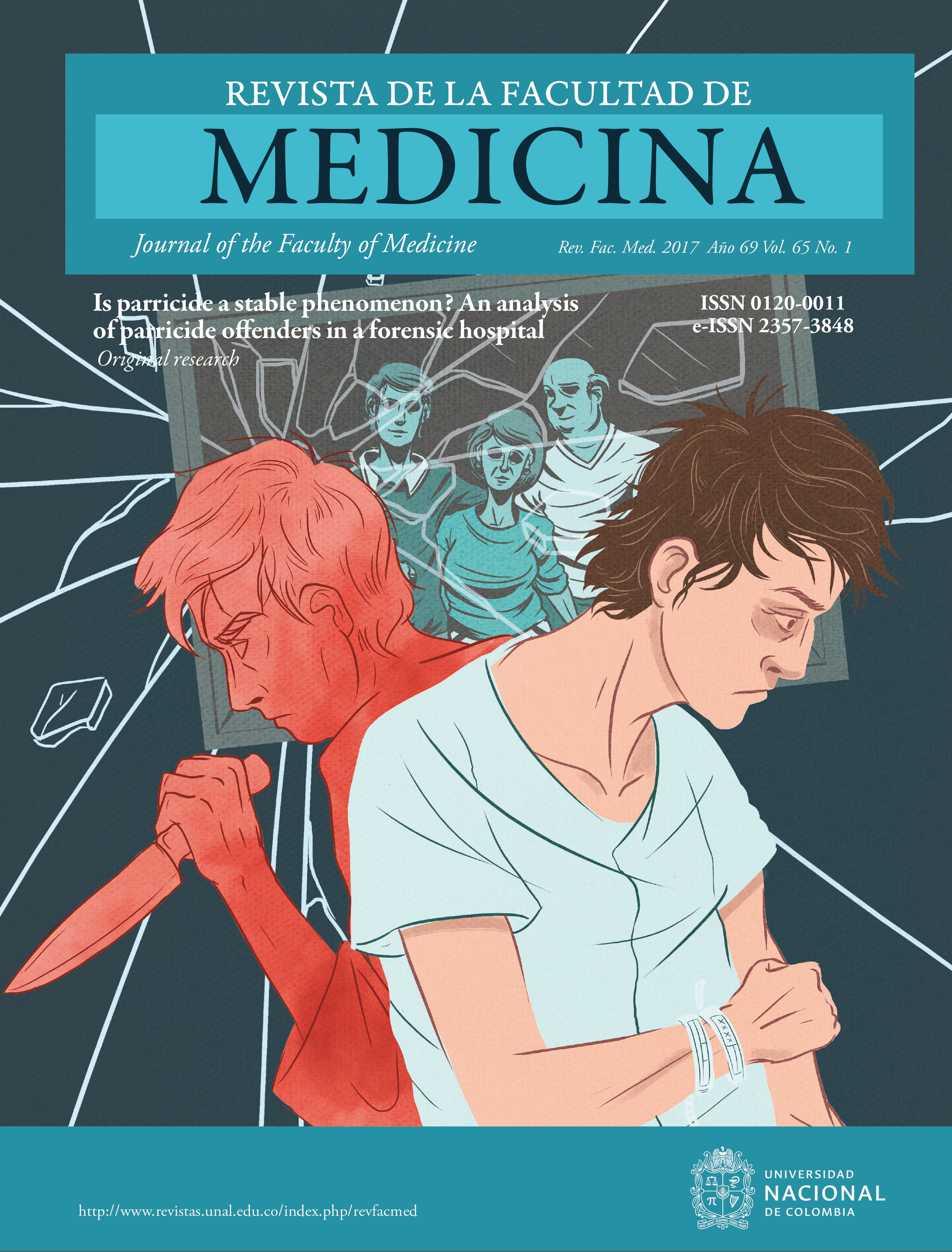
Is parricide a stable phenomenon? An analysis of parricide offenders in a forensic hospital
¿Es el parricidio un fenómeno estable? Análisis de los parricidas en un hospital forense
DOI:
https://doi.org/10.15446/revfacmed.v65n1.58829Palabras clave:
Domestic Violence, Family Violence, Forensic Psychiatry, Commitment of the Mentally Ill, Homicide (en)Violencia doméstica, Violencia familiar, Psiquiatría forense, Internación compulsoria del enfermo mental (es)
Descargas
Introduction: Previous research has shown that severe mental illness is prevalent among parricide offenders.
Objective: To investigate sociodemographic and psychiatric characteristics, killing methods and criminal background of parricide offenders admitted into a forensic inpatient mental health facility in Brazil.
Materials and methods: Sample consisting of patients charged with parricide under psychiatric care in the Forensic Psychiatric Hospital. A cross-sectional analysis of the sociodemographic variables of parricide offenders and their victims, crime characteristics and psychiatric diagnosis of perpetrators was carried out.
Results: Most parricides were young (mean age=29.2;SD=9.4) and had little or no formal schooling (mean=5.4;SD=3.9); 100% were adult males, 94.4% (n=17) were single, and 77.8%(n=14) did not have prior convictions. All offenders acted alone, predominantly against elderly victims (mean=63.3;SD=13.2), at their parent’s household (n=15; 83.3%), and only one used firearms; 55.6% (n=10) were patricides, 5.6% (n=1) step-patricides, 33.3% (n=6) matricides, and 5.6% (n=1) double parricides. After perpetrating the crime, 27.8% (n=5) attempted to escape the scene. Most perpetrators suffered schizophrenia (n=11;61.1%) or had an antisocial personality (n=3;16.7%).
Conclusions: Regarding weapon usage and the characteristics of victims and offenders, the observed pattern is consistent with previous researches, which allows concluding that the phenomenon of parricide is relatively stable and homogeneous. A forensic psychiatric evaluation of parricide offenders should be warranted given the high prevalence of mental illness among them.
Introducción. Estudios anteriores demuestran que la enfermedad mental severa es frecuente entre los parricidas.
Objetivo. Investigar las características psiquiátricas y sociodemográficas, los métodos de asesinato y los antecedentes penales de criminales acusados de parricidio remitidos a un centro de salud mental forense en Brasil.
Materiales y métodos. La muestra estuvo constituida por todos los pacientes acusados de parricidio que contaban con asistencia psiquiátrica en el Instituto Psiquiátrico Forense Dr. Maurício Cardoso. Se realizó un análisis transversal de las variables sociodemográficas de los parricidas y sus víctimas, las características del crimen y el diagnóstico psiquiátrico.
Resultados. La mayoría de parricidas eran jóvenes (29.2±9.4) con bajo nivel de educación (5.4±3.9); 100% eran varones adultos, 94.4% solteros y 77.8% no tenía antecedentes penales. Todos los delincuentes actuaron solos, en su mayoría en contra de personas mayores (63.3±13.2) y en casa de sus padres (83.3%). Solo uno utilizó arma de fuego; 10 eran patricidas y 6 matricidas, 1 asesinó a su padrastro y 1 cometió doble parricidio. Tras cometer el asesinato, 27.8% trató de escapar de la escena del crimen. La mayoría de los condenados sufrían esquizofrenia (61.1%) o personalidad antisocial (16.7%).
Conclusiones. El patrón observado en relación con las características de uso de armas, víctima y asesino es consistente con investigaciones previas, lo que permite concluir que este fenómeno es relativamente estable y homogéneo. Se debe garantizar evaluación psiquiátrica forense a quienes hayan cometido parricidio, dada la alta prevalencia de enfermedad mental en estos individuos.
Referencias
Escobar-Córdoba F. Aspectos Neurobiológicos del Homicidio. In: Folino JO, Escobar-Córdoba, F., editors. Estudios sobre Homicidios; perspectivas forense, clínica y epidemiológica. La Plata: Libreria Editora Platense; 2009. p. 153-84.
Diem C, Pizarro JM. Social Structure and Family Homicides. J Fam Viol. 2010;25(5):521-32. http://doi.org/cbc5bv.
Raymond S, Leger AS, Lachaux B. A descriptive and follow-up study of 40 parricidal patients hospitalized in a French secure unit over a 15-year period. Int J Law Psychiatry. 2015;41:43-9. http://doi.org/b4dx.
Singhal S, Dutta A. Who commits patricide? Acta psychiatr Scand. 1990;82(1):40-3. http://doi.org/b7bb43.
Bourget D, Gagné P, Labelle ME. Parricide: a comparative study of matricide versus patricide. J Am Acad Psychiatry Law. 2007;35(3):306-12.
Ogunwale A, Abayomi O. Matricide and schizophrenia in the 21(st) century: a review and illustrative cases. Afr J Psychiatry. 2012;15(1):55-7. http://doi.org/b4dz.
Ahn BH, Kim JH, Oh S, Choi SS, Ahn SH, Kim SB. Clinical features of parricide in patients with schizophrenia. Australian N Z J Psychiatry. 2012;46(7):621-9. http://doi.org/b4d2.
Fazel S, Danesh J. Serious mental disorder in 23000 prisoners: a systematic review of 62 surveys. Lancet. 2002;359(9306):545-50. http://doi.org/cn6r3m.
Weisman AM, Sharma KK. Forensic analysis and psycholegal implications of parricide and attempted parricide. J Forensic Sci. 1997;42(6):1107-13. http://doi.org/b4d5.
Heide KM, Boots DP. A comparative analysis of media reports of U.S. parricide cases with officially reported national crime data and the psychiatric and psychological literature. Int J Offender Ther Comp Criminol. 2007;51(6):646-75. http://doi.org/c2wmkj.
Millaud F, Auclair N, Meunier D. Parricide and mental illness. A study of 12 cases. Int J Law Psychiatry. 1996;19(2):173-82. http://doi.org/df5ksc.
Heide KM. Patricide and steppatricide victims and offenders: an empirical analysis of U.S. arrest data. Int J Offender Ther Comp Criminol. 2014;58(11):1261-78. http://doi.org/f6kjfq.
Heide KM. Matricide and stepmatricide victims and offenders: an empirical analysis of U.S. arrest data. Behav Sci Law. 2013;31(2):203-14. http://doi.org/f4v4wp.
Walsh JA, Krienert JL. A decade of child-initiated family violence: comparative analysis of child--parent violence and parricide examining offender, victim, and event characteristics in a national sample of reported incidents, 1995-2005. J Interpers Violence. 2009;24(9):1450-77. http://doi.org/c27b69.
Devaux C, Petit G, Perol Y, Porot M. Enquete sur le parricide en France. Ann Med Psychol. 1974;1(2):161-8.
Marleau JD, Webanck T. Parricide and violent crimes: a Canadian study. Adolescence. 1997;32(126):357-9.
Dantas S, Santos A, Dias I, Dinis-Oliveira RJ, Magalhães T. Parricide: a forensic approach. J Forensic Leg Med. 2014;22:1-6. http://doi.org/f5rk27.
Taborda JG. Criminal Justice System in Brazil: functions of a forensic psychiatrist. Int J Law Psychiatry. 2001;24(4-5):371-86. http://doi.org/fb6hcp.
Marleau JD, Millaud F, Auclair N. A comparison of parricide and attempted parricide: a study of 39 psychotic adults. Int J Law Psychiatry. 2003;26(3):269-79. http://doi.org/fdzsbw.
Shon PC, Roberts MA. Post-offence characteristics of 19th-century American parricides: An archival exploration. J. Investig. Psych. Offender Profil. 2008;5(3):147-69. http://doi.org/bhs8fn.
Telles LEB, Barros AJS. Homicídio Familiar. In: Abdalla-Filho E, Chalub M, Telles LEB, editors. Psiquiatria forense de Taborda. 3rd ed. Porto Alegre: Artmed; 2016. p. 384-99.
Teixeira EH, Meneguette J, Dalgalarrondo P. Matricídio, seguido de canibalismo e automutilação de pênis e mão em paciente esquizofrênico motivado por delírios religiosos. J Bras Psiquiatr. 2012;61(3):185-8. http://doi.org/b4ff.
Green CM. Matricide by sons. Med Sci Law. 1981;21(3):207-14.
Menezes SB. Parricides by mentally disordered offenders in Zimbabwe. Med Sci Law. 2010;50(3):126-30. http://doi.org/d696zf.
Fegadel AR, Heide KM. Double Parricide: An In-Depth Look at Two Victim Homicides Involving Parents as Victims. Behav Sci Law. 2015;33(6):723-39. http://doi.org/f78cjd.
Hillbrand M, Cipriano T. Commentary: parricides unanswered questions, methodological obstacles, and legal considerations. J Am Acad Psychiatry Law. 2007;35(3):313-6.
Heide KM, Petee TA. Parricide: an empirical analysis of 24 years of U.S. data. J Interpers Violence. 2007;22(11):1382-99. http://doi.org/ds2p4b.
Baxter H, Duggan C, Larkin E, Cordess C, Page K. Mentally disordered parricide and stranger killers admitted to high-security care. 1: A descriptive comparison. The Journal of Forensic Psychiatry. 2001;12(2):287-99. http://doi.org/bswgcv.
Heide KM, Petee TA. Weapons used by juveniles and adult offenders in U.S. parricide cases. J Interpers Violence. 2007;22(11):1400-14. http://doi.org/chmb65.
Telles LEB, Costa GM. Violência contra o idoso. In: Abdalla-Filho E, Chalub M, Telles LEB, editors. Psiquiatria forense de Taborda. 3rd ed. Porto Alegre: Artmed; 2016. p. 372-83.
Dogan KH, Demirci S, Deniz I, Erkol Z. Decapitation and dismemberment of the corpse: a matricide case. J Forensic Sci. 2010;55(2):542-5. http://doi.org/cb2gnb.
Jargin SV. Elder abuse and neglect versus parricide. Int J High Risk Behav Addict. 2013;2(3):136-8. http://doi.org/b4fg.
Heide KM, Frei A. Matricide: a critique of the literature. Trauma Violence Abuse. 2010;11(1):3-17. http://doi.org/c7kqsx.
Catanesi R, Rocca G, Candelli C, Carabellese F. Matricide by Mentally Disordered Sons: Gaining a Criminological Understanding Beyond Mental Illness--A Descriptive Study. Int J Offender Ther Comp Criminol. 2015;59(14):1550-63. http://doi.org/f72vcb.
Clark SA. Matricide: the schizophrenic crime? Med Sci Law. 1993;33(4):325-8. http://doi.org/b4fh.
Liettu A, Mikkola L, Säävälä H, Räsänen P, Joukamaa M, Hakko H. Mortality rates of males who commit parricide or other violent offense against a parent. J Am Acad Psychiatry Law. 2010;38(2):212-20.
Heide KM. Parents who get killed and the children who kill them. J Interpers Violence. 1993;8(4):531-44. http://doi.org/bq7dq4.
Schlesinger LB. Adolescent sexual matricide following repetitive mother-son incest. J Forensic Sci. 1999;44(4):746-9. http://doi.org/b4fj.
Dimensions
PlumX
Visitas a la página del resumen del artículo
Descargas
Cómo citar
Licencia
Derechos de autor 2017 Revista de la Facultad de Medicina

Esta obra está bajo una licencia Creative Commons Reconocimiento 3.0 Unported.
-