Publicado
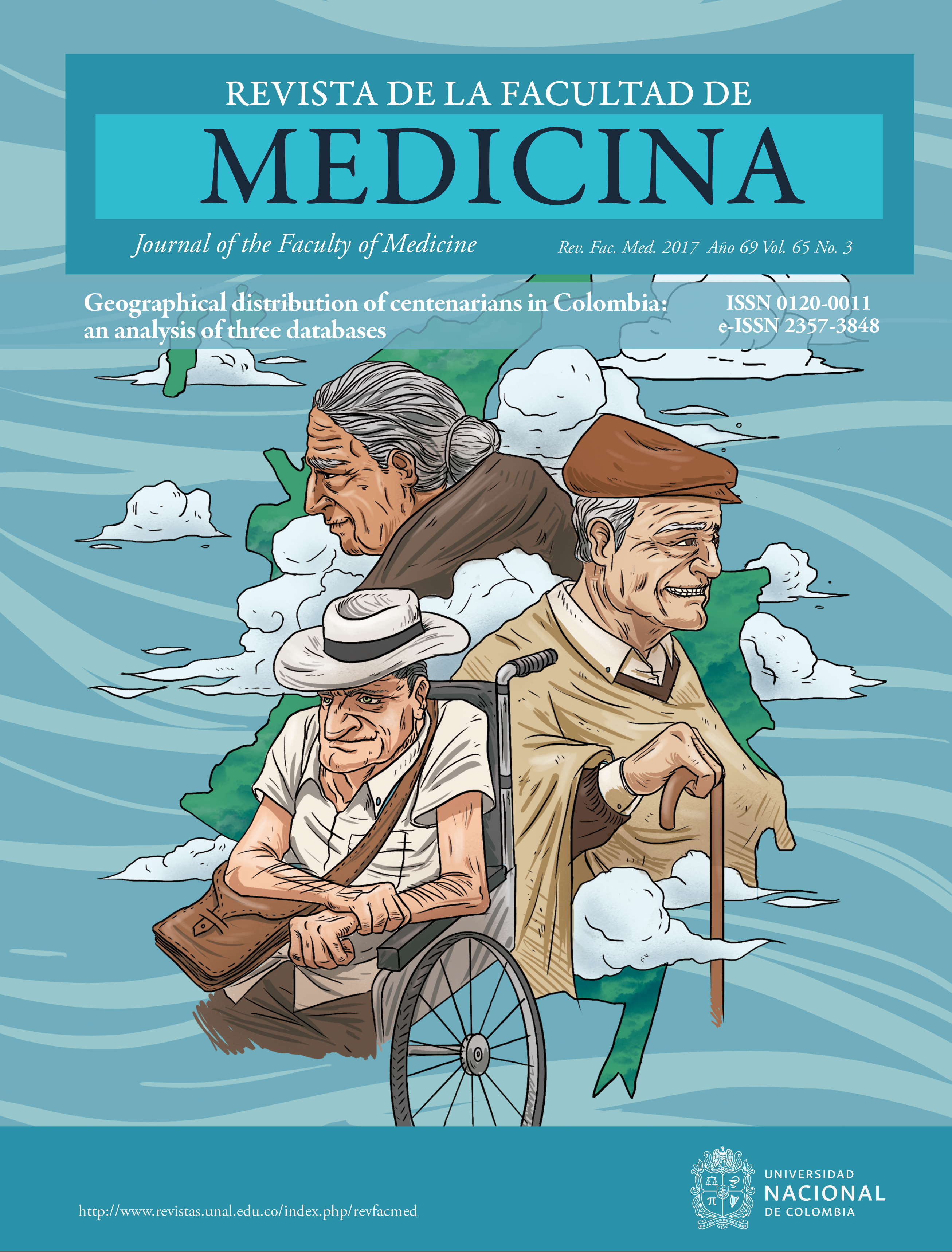
Geographical distribution of centenarians in Colombia: an analysis of three databases
Distribución geográfica de los centenarios en Colombia: un análisis de tres bases de datos
DOI:
https://doi.org/10.15446/revfacmed.v65n3.59505Palabras clave:
Age Distribution, Aged 80 and over, Demography, Gender Ratio (en)Anciano de 80 o más años, Demografía, Distribución por edad, Razón de masculinidad (es)
Descargas
Introduction: Individuals aged one hundred years or more are of interest for the study of the aging process, which has been scarcely addressed in Colombia.
Objective: To estimate the number and geographical distribution of centenarians in Colombia.
Materials and methods: Three sources of information were reviewed: the 2005 Census, the death certificates issued from 2010 to 2013, and the Individual Registries of Health Services Provision (RIPS in Spanish) of 2014.
Results: The census recorded data of 3 165 centenarians (1 972 women, 62.3%), finding the highest rates in La Guajira (2.23 x 10 000), Chocó (1.90) and Sucre (1.61). In the four-year period analyzed, 3 611 people died, with the highest proportions (for every 1 000 deaths) found in Chocó (10.4), La Guajira (9.4) and Sucre (6.5). RIPS identified 3 390 centenarians, with a higher frequency in Sucre (2.17 x 10000), Chocó (1.29) and Córdoba (1.11).
Conclusions: Although the results are consistent with the number and geographical distribution of centenarians, some errors may be found in the date of birth stated in the records, which is the basis for estimating age in the three sources. Other factors potentially involved in the results may be physical activity, family and community support, low stress and healthy diet in these regions.
Introducción. Las personas mayores de 100 años han sido poco estudiadas en Colombia, si bien son importantes para entender el envejecimiento.
Objetivo. Estimar el número y distribución geográfica de los centenarios en Colombia.
Materiales y métodos. Se revisaron tres fuentes de información: el Censo de 2005, los certificados de defunción de 2010 a 2013 y los Registros Individuales de Prestaciones de Servicios de Salud (RIPS) de 2014.
Resultados. En el censo, se identificaron 3 165 centenarios (1 972 mujeres, correspondientes al 62.3%) con las tasas más elevadas en La Guajira (2.23 x 10 000), Chocó (1.90) y Sucre (1.61). En el cuatrienio analizado fallecieron 3 611 y se hallaron sus mayores proporciones (por cada 1 000 fallecidos) en Chocó (10.4), La Guajira (9.4) y Sucre (6.5). Los RIPS identificaron 3 390 centenarios, cuyas tasas más altas se ubicaron en Sucre (2.17 x 10 000), Chocó (1.29) y Córdoba (1.11).
Conclusiones. Aunque los resultados de la investigación fueron consistentes en el número y la distribución geográfica de los individuos centenarios, pudo haber errores de registro de la fecha de nacimiento, que es la base para estimar la edad en las tres fuentes. Otra explicación de estos resultados podría involucrar la actividad física, el apoyo familiar y comunitario, el bajo nivel de estrés y la dieta saludable en estas regiones.
Referencias
Franceschi C, Monti D, Sansoni P, Cossarizza A. The immunology of exceptional individuals: the lesson of centenarians. Immunol Today. 1995;16(1):12-6. http://doi.org/bfmwd6.
Biagi E, Nylund L, Candela M, Ostan R, Bucci L, Pini E, et al. Through ageing, and beyond: gut microbiota and inflammatory status in seniors and centenarians. PLoS One. 2010;5(5):e10667. http://doi.org/drp8df.
Gentilini D, Mari D, Castaldi D, Remondini D, Ogliari G, Ostan R, et al. Role of epigenetics in human aging and longevity: genome-wide DNA methylatio5n profile in centenarians and centenarians’ offspring. Age (Dordr). 2013;35(5):1961-73. http://doi.org/f5hxgc.
Gutiérrez WA, Samudio ML, Cano CA. Caracterización de las personas centenarias atendidas en el Hospital Universitario San Ignacio de enero del 2005 a diciembre del 2012. Univ. Méd. 2015;56(3):268-74.
Rosselli D, Hernández-Galvis J. El impacto del envejecimiento sobre el sistema de salud colombiano. Salud Pública Méx. 2016;58(6):595-6. http://doi.org/b47h.
Departamento Administrativo Nacional de Estadística. Censo general 2005. Bogotá D.C.: DANE, CANDANE; 2009 [cited 2017 May 3]. Available from: http://goo.gl/24MSRm.
Departamento Administrativo Nacional de Estadística. Defunciones no fetales 2010-2013. Bogotá D.C.: DANE; 2015 [cited 2017 May 3]. Available from: http://goo.gl/O9m9r6.
Willcox DC, Willcox BJ, He Q, Wang N, Suzuki M. They really are that old: a validation study of centenarian prevalence in Okinawa. J Gerontol A Biol Sci Med Sci. 2008;63(4):338-49. http://doi.org/dwskxs.
Registraduría Nacional del Estado Civil. Historia de nuestra cédula de ciudadanía. Revista Nuestra Huella Digital. 2012 [cited 2016 Aug 9];6(69) Available from: http://goo.gl/1MUork.
Mazess RB, Forman SH. Longevity and age exaggeration in Vilcabamba, Ecuador. J Gerontol. 1979;34(1):94-8. http://doi.org/b47k.
Wang Z, Zeng Y, Jeune B, Vaupel JW. Age validation of Han Chinese centenarians. Genus. 1998;54(1-2):123-41.
Medvedev ZA. Caucasus and Altay longevity: a biological or social problem? Gerontologist. 1986;14(5 Pt 1):381-7. http://doi.org/d2qcnp.
Perls TT, Bochen K, Freeman M, Alpert L, Silver MH. Validity of reported age and centenarian prevalence in New England. Age Ageing. 1999;28(2):193-7. http://doi.org/dh9mxn.
Poulain M, Herm A, Pes G. The Blue Zones: areas of exceptional longevity around the world. Vienna Yearb Popul Res. 2014;11:87-108. http://doi.org/b47n.
Panagiotakos DB, Chrysohoou C, Siasos G, Zisimos K, Skoumas J, Pitsavos C, et al. Sociodemographic and lifestyle statistics of oldest old people (>80 years) living in Ikaria Island: the Ikaria study. Cardiol Res Pract. 2011;2011:1-7. http://doi.org/ctgnpz.
Appel LJ. Dietary patterns and longevity: expanding the blue zones. Circulation. 2008;118(3):214-5. http://doi.org/fsw4r2.
Andrade V, Mosos JD, Pacheco B, Polanía MJ, Yucumá D, Rosselli D. Venta de alcohol y tasa de enfermedad hepática alcohólica por departamentos en Colombia. Rev Colomb Gastroenterol. 2015 [cited 2017 Apr 4];30(4):407-11. Available from: http://goo.gl/sZlHZ1.
Ministerio de Salud y Protección Social. Socialización del informe final de evaluación de necesidades para la ampliación del Convenio Marco de Control del Tabaco. Bogotá D.C.: MinSalud; 2007. [Cited 2016 Oct 23]. Available from: http://goo.gl/R7EfgK.
Departamento Administrativo Nacional de Estadística. Proyecciones nacionales y departamentales de población 2005-2020. Bogotá D.C.: DANE, CANDANE; 2009.
Dimensions
PlumX
Visitas a la página del resumen del artículo
Descargas
Cómo citar
Licencia
Derechos de autor 2017 Revista de la Facultad de Medicina

Esta obra está bajo una licencia Creative Commons Reconocimiento 3.0 Unported.
-