Publicado
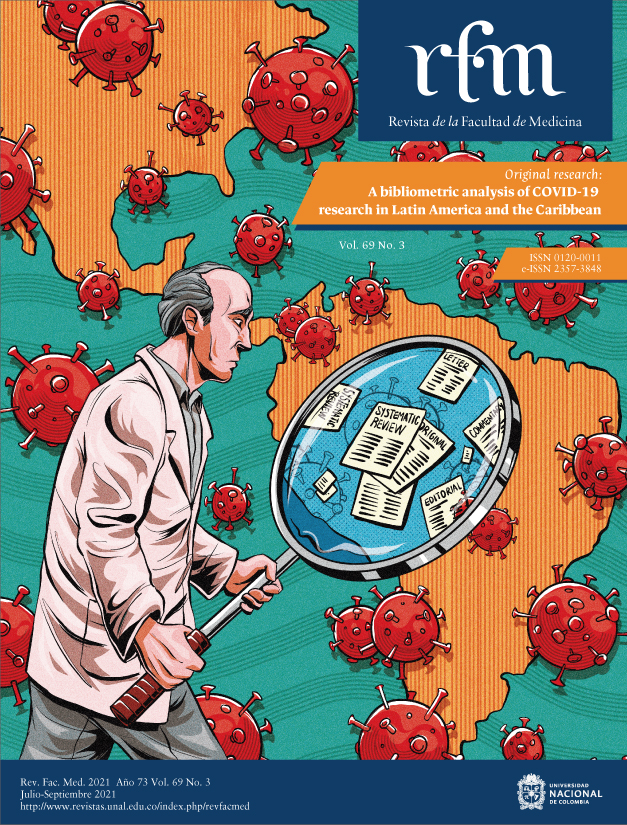
A bibliometric analysis of COVID-19 research in Latin America and the Caribbean
Un análisis bibliométrico de la investigación sobre COVID-19 en Latinoamérica y el Caribe
DOI:
https://doi.org/10.15446/revfacmed.v69n3.94520Palabras clave:
COVID-19, Biomedical Research, Bibliometrics, Latin America, Caribbean Region (en)COVID-19, Investigación biomédica, América Latina, Región del Caribe (es)
Descargas
Introduction: Latin America and the Caribbean (LAC) is one of the regions most affected by the COVID-19 pandemic. Yet, there is scarce literature addressing the research strategies developed in LAC to face COVID-19.
Objective: To quantify and assess the production of scientific publications about COVID-19 in 32 countries of LAC between January 1 and July 31, 2020.
Materials and methods: Bibliometric study. Scientific papers on COVID-19 conducted in LAC or reporting data pertaining to LAC and published between January 1 to July 31, 2020, were searched in the Scopus, PubMed, and LILACS databases. A subgroup analysis including only original research articles was performed to determine the contribution of LAC countries to research on COVID-19, and standardization measures (# of articles per million people) were applied to compare the country-specific production of this type of articles.
Results: A total of 1 291 publications were retrieved. Overall, most of them were non-original research articles (81.72%), and the countries with the highest scientific production were Brazil (43.91%) and Mexico (9.14%). However, after applying the standardization measures, Chile was the country with the highest production of original articles (0.58 per million inhabitants). Regarding original studies (n=236), cross-sectional design was the most common (25.84%). Diagnosis and treatment of the disease was the main research focus (n=354; 27.42%). However, in the subgroup analysis (n=236), epidemiology and surveillance were the most prevalent research focus (n=57; 24.15%).
Conclusions: During the study period, non-original research articles were predominant in the scientific production of the LAC region, and interventional studies were scarce among original articles, while the cross-sectional design predominated. Further research with a better quality of evidence should be performed in these countries to contribute to the making of health policies aimed at easing the burden of COVID-19 in the region and preparing for future pandemics.
Introducción. Latinoamérica y el Caribe (LAC) es una de las regiones más afectadas por la pandemia por COVID-19. Sin embargo, hay poca literatura sobre las estrategias de investigación desarrolladas en la región para confrontar esta enfermedad.
Objetivo. Cuantificar y evaluar la producción de publicaciones científicas sobre COVID-19 en 32 países de LAC entre el 1 de enero y el 31 de julio del 2020.
Materiales y métodos. Estudio bibliométrico. Se realizó una búsqueda de artículos científicos sobre COVID-19 realizados en LAC o con datos de LAC, y publicados entre enero 1 y julio 31 de 2020 en Scopus, PubMed y LILACS. Se realizó un análisis de subgrupos en el que se incluyeron solo artículos de investigación original para determinar la contribución de los países de la región a la investigación sobre COVID-19; además, se utilizaron medidas de estandarización (# artículos por millón de habitantes) para comparar la producción de este tipo de artículos por país.
Resultados. Se identificaron 1 291 artículos. La mayoría no eran investigaciones originales (81.72%), y los países con más producción fueron Brasil (43.91%) y México (9.14%). Sin embargo, luego de aplicar las medidas de estandarización, Chile fue el país con mayor producción de artículos originales (0.58 por millón de habitantes). Respecto a los artículos originales (n=236), el tipo de diseño de estudio más común fue el transversal (25.84%). El diagnóstico y tratamiento de COVID-19 fue el tema más investigado en todas las publicaciones (n=354, 27.42%), pero en el análisis de subgrupo (n=236), el enfoque de investigación más frecuente fue epidemiologia y vigilancia (n=57, 24.15%).
Conclusiones. En el periodo de estudio, los artículos no originales predominaron en la producción científica de LAC, y, entre las investigaciones originales, los estudios intervencionales escasearon, mientras que los transversales predominaron. Se requiere realizar más investigación con una mejor calidad de evidencia en los países de la región para contribuir en la formulación de políticas de salud dirigidas a aliviar la carga de la COVID-19 y para prepararse para futuras pandemias.
Referencias
Cucinotta D, Vanelli M. WHO declares COVID-19 a pandemic. Acta Biomed. 2020;91(1):157-60. https://doi.org/ggq86h.
Wold Health Organization (WHO). WHO Coronavirus (COVID-19) Dashboard. New York: Who; 2021 [cited 2021 Mar 17]. Available from: https://bit.ly/3DhSOY5.
Gianola S, Jesus TS, Bargeri S, Castellini G. Characteristics of academic publications, preprints, and registered clinical trials on the COVID-19 pandemic. PLoS One. 2020;15(10):e0240123. https://doi.org/ghgdxw.
Brainard J. Scientists are drowning in COVID-19 papers. Can new tools keep them afloat? Science. 2020 [cited 2021 Jun 14]. Available from: https://bit.ly/3gAEksC.
Viglione G. How scientific conferences will survive the coronavirus shock. Nature. 2020;582(7811):166-7. https://doi.org/gsrv.
Kun Á. Time to acceptance of 3 days for papers about COVID-19. Publications. 2020;8(2):30. https://doi.org/gg924h.
Durieux V, Gevenois PA. Bibliometric indicators: quality measurements of scientific publication. Radiology. 2010;255(2):342-51. https://doi.org/d8b2vn.
Ortiz AP, Calo WA, Suárez-Balseiro C, Maura-Sardo M, Suárez E. Bibliometric assessment of cancer research in Puerto Rico, 1903-2005. Rev Panam Salud Publica. 2009;25(4):353-61. https://doi.org/fswzv8.
Hamidah I, Sriyono S, Hudha MN. A Bibliometric Analysis of Covid-19 Research using VOSviewer. Indones J Sci Technol. 2020;5(2):209-16. https://doi.org/gmbncm.
Fan J, Gao Y, Zhao N, Dai R, Zhang H, Feng X, et al. Bibliometric analysis on COVID-19: A comparison of research between English and Chinese studies. Front Public Health. 2020;8:477. https://doi.org/gjpthh.
Reeves P, Kahn C. Latin America becomes A new epicenter of the Coronavirus pandemic. NPR. 2020 Jun 3 [cited 2021 Mar 17]. Available from: https://n.pr/38eWf3p.
Forero-Peña DA, Carrión-Nessi FS, Camejo-Ávila NA, Forero-Peña MJ. COVID-19 en Latinoamérica: una revisión sistemática de la literatura y análisis bibliométrico. Rev. salud publica. 2020;22(2):1-7. https://doi.org/gsrz.
Fiesco-Sepúlveda KY, Serrano-Bermúdez LM. Contributions of Latin American researchers in the understanding of the novel coronavirus outbreak: a literature review. PeerJ. 2020;8:e9332. https://doi.org/gk7f4z.
Gregorio-Chaviano O, Limaymanta CH, López-Mesa EK. Análisis bibliométrico de la producción científica latinoamericana sobre COVID-19. Biomedica. 2020;40(Suppl 2):104-15. https://doi.org/fmvw.
World Health Organization (WHO). Countries. New York: WHO; 2021 [cited 2021 Jun 20]. Available from: https://bit.ly/2WnMpdg.
Worldometer. Latin America and the Caribbean Population. Worldometer; 2021 [cited 2021 Feb 15]. Available from: https://bit.ly/3BggD0y.
Pérez-Ortega R. ‘We’re losing an entire generation of scientists.’COVID-19’s economic toll hits Latin America hard. Science. 2020 Aug 12 [cited 2021 Mar 17]. Available from: https://bit.ly/3gCJVi6.
Rueda A. Pese a crisis, Latinoamérica financia investigación en COVID-19. Scidev.net. 2020 Jul 13 [cited 2021 Mar 17]. Available from: https://bit.ly/3sORO8U.
Greer SL, King EJ, da Fonseca EM, Peralta-Santos A. The comparative politics of COVID-19: The need to understand government responses. Glob Public Health. 2020;15(9):1413-6. https://doi.org/ghc7p6.
Liu W, Hu G, Gu M. The probability of publishing in first-quartile journals. Scientometrics. 2016;106(3):1273-6. https://doi.org/f8ktds.
Gallegos M, Cervigni M, Consoli AJ, Caycho-Rodríguez T, Polanco FA, Martino P, et al. COVID-19 in Latin America: A bibliometric analysis of scientific publications in health. Electron J Gen Med. 2020;17(6):em261. https://doi.org/gsv2.
Wang P, Tian D. Bibliometric analysis of global scientific research on COVID-19. J Biosaf Biosecur. 2021;3(1):4-9. https://doi.org/gsv3.
Didegah F, Thelwall M. Which factors help authors produce the highest impact research? Collaboration, journal and document properties. J Informetr. 2013;7(4):861-73. https://doi.org/f5jbpm.
Rahman MM, Ghoshal UC, Ragunath K, Jenkins G, Rahman M, Edwards C, et al. Biomedical research in developing countries: Opportunities, methods, and challenges. Indian J Gastroenterol. 2020;39(3):292-302. https://doi.org/gh7294.
Guleid FH, Oyando R, Kabia E, Mumbi A, Akech S, Barasa E. A bibliometric analysis of COVID-19 research in Africa. BMJ Glob Health. 2021;6(5):e005690. https://doi.org/gmb22q.
National Academies of Sciences Engineering and Medicine, Health and Medicine Division, Board on Health Sciences Policy, Board on Global Health, Committee on Clinical Trials During the 2014-2015 Ebola Outbreak. Integrating clinical research into epidemic response: The Ebola experience. Mancher M, Cuff P, Keusch G, editors. Washington D.C.: National Academies Press; 2017. https://doi.org/gsv4.
Rabaan AA, Al-Ahmed SH, Bazzi AM, Al-Tawfiq JA. Dynamics of scientific publications on the MERS-CoV outbreaks in Saudi Arabia. J Infect Public Health. 2017;10(6):702-10. https://doi.org/gsv6.
COVID-19 is here. Now How Long Will It Last? New Haven: Yale School of Medicine; 2020 [cited 2021 Mar 17]. Available from: https://bit.ly/2WuIzPq.
Malamud C, Núñez R. El COVID-19 en América Latina: desafíos políticos, retos para los sistemas sanitarios e incertidumbre económica. Oxford: University of Oxford; 2020 [cited 2021 Mar 17]. Available from: https://bit.ly/3ktTmkW.
Coronel E, Halstead D, Fregni F. Clinical research in Latin America: obstacles and opportunities. Clin Investig. 2011;1(7):911-3. https://doi.org/cf7txr.
Sisa I, Abad A, Espinosa I, Martinez-Cornejo I, Burbano-Santos P. A decade of Ecuador´s efforts to raise its health research output: a bibliometric analysis. Glob Health Action. 2021;14(1):1855694. https://doi.org/gsv9.
Smyth AR, Rawlinson C, Jenkins G. Preprint servers: a “rush to publish” or “just in time delivery” for science? Thorax. 2020;75(7):532-3. https://doi.org/gg9242.
Mingers J, Leydesdorff L. A review of theory and practice in scientometrics. Eur J Oper Res. 2015;246(1):1-19. https://doi.org/gcpndb.
Gasparyan AY. Bibliographic databases: some critical points. J Korean Med Sci. 2013;28(6):799-800. https://doi.org/gswc.
AlRyalat SAS, Malkawi LW, Momani SM. Comparing bibliometric analysis using PubMed, Scopus, and Web of Science databases. J Vis Exp. 2019;(152):e58494. https://doi.org/ghph9g.
Dimensions
PlumX
Visitas a la página del resumen del artículo
Descargas
Cómo citar
Licencia
Derechos de autor 2021 Revista de la Facultad de Medicina

Esta obra está bajo una licencia Creative Commons Reconocimiento 3.0 Unported.
-